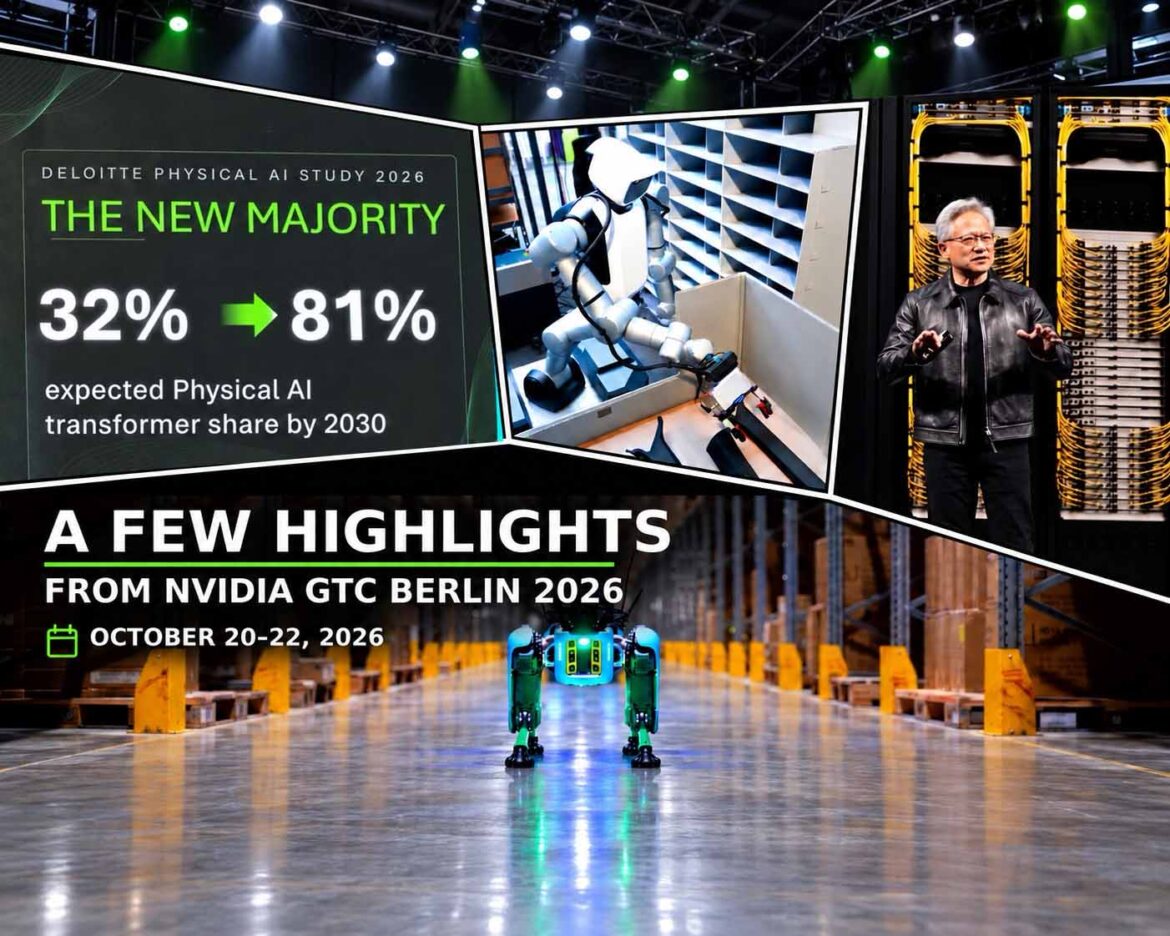
A conference shows how computing power becomes industrial infrastructure.
Collage: Study results, a humanoid robot, the keynote and an autonomous legged robot represent the path of AI from the data center into the physical world | Image: © Ulrich Buckenlei | XR Stager Online Magazine | VISORIC GmbH
Berlin-Kreuzberg in October 2026. On the morning of October 21, the queue in front of the Tempodrom stretches all the way around Askanischer Platz. Shortly after ten o’clock the hall is full, and many visitors follow the keynote of NVIDIA founder Jensen Huang on their smartphones. For three days, from October 20 to 22, NVIDIA GTC Berlin brought together developers, researchers, industry and policymakers at one of Europe’s most important AI conferences, with workshops, more than 100 sessions and an exhibition at STATION-Berlin.
Anyone who followed the three days takes away one insight above all: artificial intelligence is now planned, built and secured like a power plant or a production line. The focus was not on new graphics cards, but on questions previously known from the energy sector and factory planning. How quickly can computing capacity be built? Where do power and cooling come from? How does an autonomously acting system become safe? And how does intelligence move from the data center to the shop floor?
For management teams, plant managers, innovation teams and IT leaders, this is more than a technology trend. It shifts the question of who benefits from AI. The best model alone does not decide, but the ability to combine computing power, energy, security, data and people into a functioning system. Exactly this combination was visible at GTC Berlin in numerous announcements, partner projects and studies.
This article examines the most important developments of GTC Berlin 2026 step by step: from the economic logic of the AI factory through prefabricated data centers, energy and cooling, the security of AI agents and humanoid robots in logistics to cross-vendor robot fleets, new study data on Physical AI and the question of technological sovereignty. It also shows what an entry looks like that starts small and delivers measurable results.
- AI becomes industrial infrastructure with energy, construction and operation.
- Data centers are increasingly prefabricated in the factory.
- Security for AI agents moves into the hardware.
- Physical AI reaches logistics and production.
- The digital twin becomes the test bench for every change.
The following article shows what lies behind these developments, which figures support them and which questions companies should answer now.
Europe should produce its own AI
Jensen Huang opened his roughly two-hour keynote at the Tempodrom with a list of European companies working with NVIDIA on AI, including L’Oréal, Revolut, Spotify, Merck, Vodafone, Zara, Porsche, Nestlé and HSBC. The message behind it was clearly stated: anyone who wants to take part in the AI economy should not only consume AI, but produce it. Europe, Huang said, has good preconditions for this with its industrial base and has already started.[1]
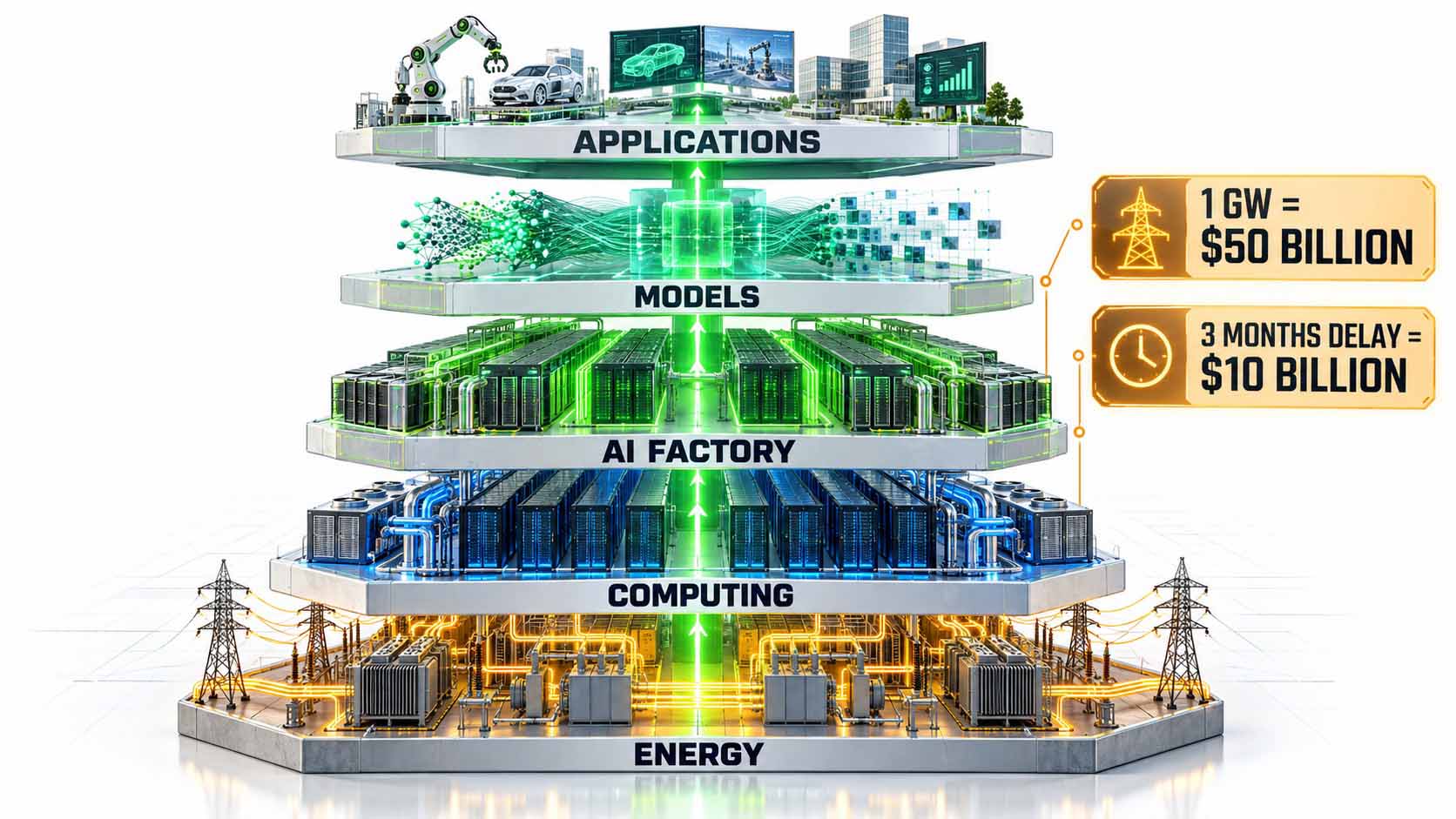
To explain this thesis, Huang described AI as a five-layer structure. At the bottom is energy. On top of it come computing systems that work together in an AI factory, a data center whose product is not storage space but generated intelligence. Models run on top of that, and applications sit at the very top. Before models emerge, Huang said, the infrastructure has to exist, just as the internet first needed networks and electrification first needed a power grid.[1]
The figures Huang cited show how serious this infrastructure question is. According to him, an AI factory with one gigawatt of capacity costs around 50 billion US dollars. A delay of three months until commissioning can mean around ten billion dollars in lost revenue. NVIDIA itself says it has invested nearly ten billion dollars in the European technology ecosystem over the past year and announced fourteen startup investments during its European tour.[2]
Anyone who wants to produce AI first needs the layers underneath.
Infographic: The five-layer model explains why energy and infrastructure determine value creation with AI long before a model is trained | Graphic: © Ulrich Buckenlei | XR Stager Online Magazine | VISORIC GmbH
The graphic shows the core of this logic. Value creation becomes visible in the top layer, in applications such as assistance systems, robots or simulations. Whether it can happen at all, however, is decided in the lower layers. Anyone dependent there remains dependent at the top. For Europe, this is a question of industrial policy, for companies a strategic one: which layers must be controlled, which can be purchased, and which data must never leave the company?
For companies, this means a new view of AI projects. A pilot with a language model is started quickly. Productive use in manufacturing, logistics or service, by contrast, requires answers to questions that previously did not appear in IT projects: available computing capacity, energy costs, data storage, security architecture and employee skills. The next chapter shows how the industry intends to answer the first of these questions.
- Huang calls on Europe to produce AI itself.
- AI consists of five layers from energy to application.
- A one-gigawatt AI factory costs around 50 billion dollars.
- Three months of delay cost around ten billion dollars in revenue.
- Productive AI requires answers on energy, data and security.
The key insight of the first chapter is therefore: AI has become an infrastructure question, and infrastructure follows the rules of construction, energy and operation.
Data centers come from the factory
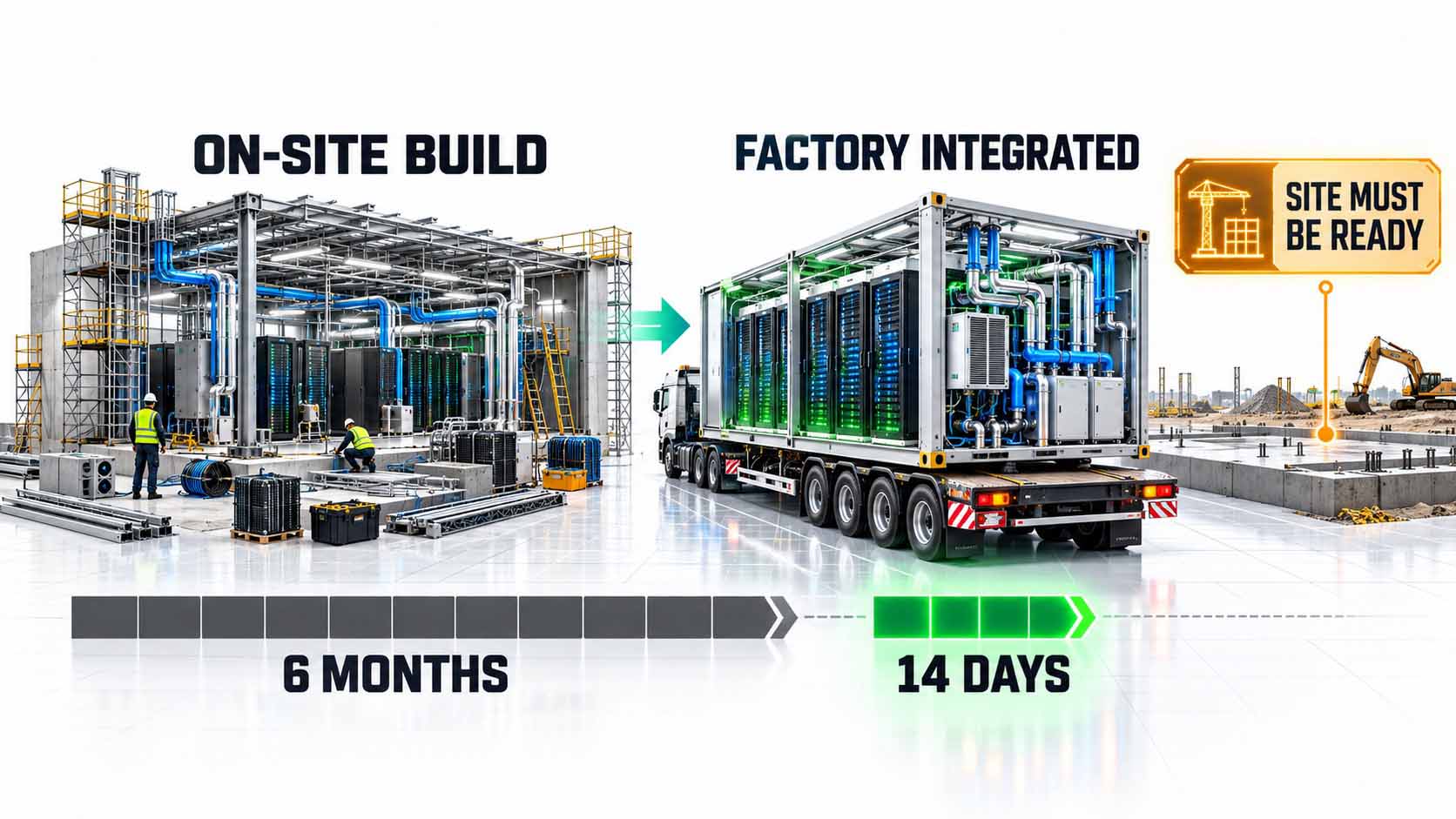
The most important hardware announcement at GTC Berlin was not a chip, but a construction method. NVIDIA introduced DSX POD, a reference design for complete AI factories based on the Vera Rubin platform, built by partners in modular containers. Cabling, power distribution, liquid cooling and functional testing are completed at the factory before delivery. On site, the containers essentially only need to be connected to power, cooling and the network.[3]
The effect is considerable. According to NVIDIA, on-site commissioning at a prepared site is reduced from around six months to about 14 days. Huang spoke of a fundamental transformation of the global supply chain for data centers. The first systems are to be delivered via partners in early 2027, including major server and infrastructure manufacturers.[3] According to Huang, the underlying Vera Rubin platform is already in full production.
The provider of modular data centers Armada showed how partners are implementing this concept. The company announced that it will manufacture standardized AI factories based on DSX POD in its own plants and, together with Johnson Controls, build 500 megawatts of distributed, sovereign computing capacity in 2027. For context, Armada cites the effort of conventional construction: a 50-megawatt data center requires around 600,000 labor hours on the construction site, while the construction industry is forecast to be short of 288,000 workers by 2027.[4]
The work moves from the construction site to the production hall.
Infographic: Pre-integrated AI factories drastically shorten commissioning, but preparing the site remains a separate and often longer task | Graphic: © Ulrich Buckenlei | XR Stager Online Magazine | VISORIC GmbH
The graphic also makes the most important limitation visible. The 14 days only apply to the connection at a prepared site. The customer still has to build the building, grid connection and cooling infrastructure, and this part often takes longer than the integration it replaces. Then there is the supply chain: NVIDIA announced agreements for a 2.5-fold increase in capacity for chip substrates, but significant parts of it are not expected to become available until 2027 and 2028.[3]
For companies, this construction method changes the planning of computing capacity. Instead of multi-year construction projects, standardized units become orderable and can be expanded step by step. This applies not only to hyperscalers, but increasingly to industrial companies, research institutions and public authorities that want to operate computing power under their own control. The next chapter shows which limit is becoming more important than space or money.
- DSX POD delivers complete AI factories in a container.
- Commissioning drops from six months to about 14 days.
- Site preparation remains the customer’s responsibility.
- Armada plans 500 megawatts for 2027 with Johnson Controls.
- Computing capacity becomes an orderable industrial product.
Prefabrication thus shifts the bottleneck: away from the construction site, towards site, grid connection and supply chain.
Power and water set the limits
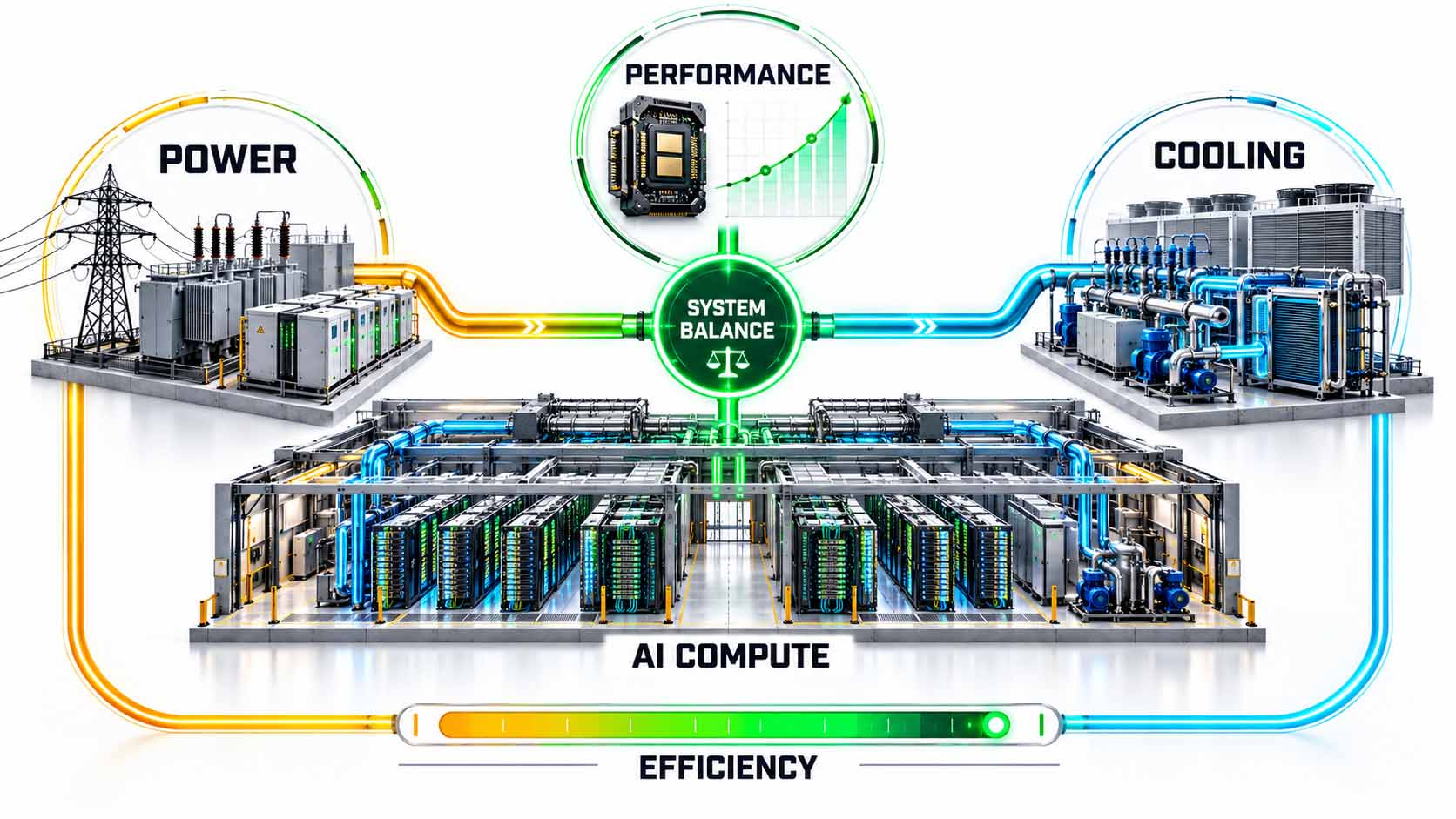
At GTC Berlin, one statement was repeated again and again in various forms: power has become the biggest bottleneck of AI infrastructure. NVIDIA puts the backlog of equipment for power grids and data centers at more than 300 billion US dollars. In the US alone, according to these figures, projects with more than 200 gigawatts of capacity are waiting for a grid connection. NVIDIA names as one cause that the power grid, buildings and computing technology have so far been planned separately from one another.[5]
The answer is a software layer that connects all three levels. With DSX MaxLPS, a data center is meant to adapt its power consumption dynamically to its workload and, according to NVIDIA, deliver the same AI performance with up to 30 percent less energy. In a test at the operator Nscale in Iceland, the inference throughput of four rack systems rose by 49 percent at an unchanged 264 kilowatts. DSX Flex, in turn, aligns consumption with the state of the power grid. In a trial with the British grid operator National Grid, the power draw of a cluster fell by 40 percent during simulated grid events while critical workloads kept running.[6]
Water is just as important. The Vera Rubin infrastructure works with closed cooling loops whose coolant may be up to 45 degrees Celsius warm. The waste heat is released via dry coolers instead of consuming water in evaporative towers. For a site with two gigawatts of capacity, NVIDIA calculates savings of around 54 million liters of water per day.[6] At high outdoor temperatures, additional cooling may still be required.
Efficiency decides where AI can be built at all.
Infographic: When the power grid, data center and cooling are controlled as one system, a bottleneck becomes a plannable factor | Graphic: © Ulrich Buckenlei | XR Stager Online Magazine | VISORIC GmbH
| Measure | Effect according to manufacturer | Test environment | Assessment |
|---|---|---|---|
| DSX MaxLPS | Up to 30 % less energy per AI output | Nscale, Iceland, 4 racks, 264 kW | +49 % inference throughput at the same power |
| DSX Flex | Up to 40 % less load during grid events | Trial with National Grid, United Kingdom | Data center as a flexible grid participant |
| Closed-loop cooling | Coolant up to 45 °C, dry coolers | Vera Rubin reference design | Around 54 million liters of water per day at 2 GW |
| All figures | Manufacturer values | Individual pilot environments | Not yet independently verified |
Overview: Measures for energy and water efficiency in AI factories, own assessment based on the cited sources | Table: © Ulrich Buckenlei | XR Stager Online Magazine | VISORIC GmbH
The graphic and the overview show a principle that extends beyond data centers. Efficiency emerges when systems that were previously planned separately are controlled together. However, the figures cited come from manufacturer statements and individual pilot environments. Whether they can be transferred to other sites, climate zones and load profiles has not yet been independently verified.
For companies, energy thus becomes a location question for AI. Anyone planning their own computing capacity should consider grid connection, waste heat use, cooling concept and water consumption from the start, ideally in a digital model in which variants can be compared before investing. The next chapter shows which security question arises with the new computing power.
- Power is the biggest bottleneck of AI infrastructure.
- Software controls the data center and grid together.
- Up to 30 percent less energy per AI output has been announced.
- Closed-loop cooling saves large amounts of water.
- All values are manufacturer figures from pilot environments.
Energy and water thus become the factors that decide where in Europe AI capacity can be built.
AI agents need a safety cage
A large part of the keynote was devoted to AI agents, systems that do not just answer questions, but independently plan, use tools and carry out tasks. Huang described an agent as the interplay of five elements: a model, a control layer that coordinates work and memory, an isolated execution environment, access to knowledge and access to tools. The most important thing, Huang said, is the security of the agent, because it accesses files, networks and systems.[1]
NVIDIA’s answer is called OpenShell. The reference architecture is built on an open-source runtime that places every agent in an isolated environment at the operating system level and gives it only minimal rights. In addition, the Sentry software monitors the agent from a separate processor, a so-called Data Processing Unit of the BlueField-4 type. Because this control runs outside the actual computing path, a faulty or compromised agent cannot directly observe or bypass it. If it leaves its permitted boundaries, it is to be stopped within milliseconds, according to the manufacturer.[7]
According to NVIDIA, OpenShell is available now and runs on Linux distributions from Canonical, SUSE and Red Hat, as well as on Windows via a container solution. The technology companies involved include Anthropic, OpenAI, Meta, CrowdStrike and SAP. In Europe, according to media reports, banks such as BBVA and Santander are evaluating its use.[8] Every time an agent starts, Huang said, its privileges are different, and that is exactly why control must adapt dynamically.
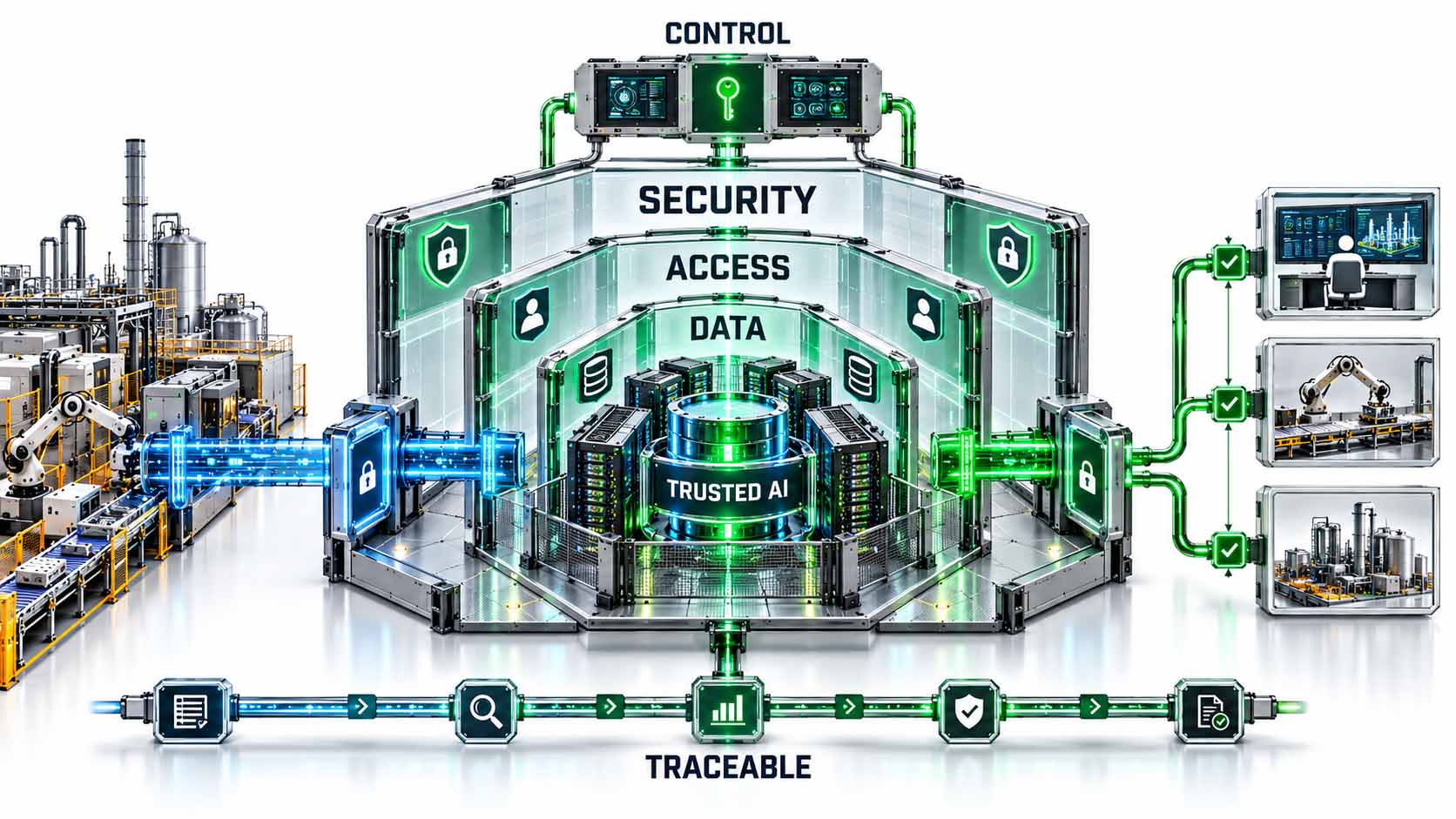
Trust emerges when control lies outside the agent.
Infographic: Minimal rights, an isolated environment and independent monitoring turn an autonomous agent into a controllable system | Graphic: © Ulrich Buckenlei | XR Stager Online Magazine | VISORIC GmbH
The graphic illustrates a principle well known from information security: a system that monitors itself is vulnerable. Only when control lies on a separate level that the agent cannot influence does reliable trust emerge. Whether security teams and regulators will accept this hardware-based control as sufficient will only become clear in practical use. The response times cited are so far manufacturer statements.
For companies, the question of agent security will become concrete in the coming months. As soon as an agent triggers orders, changes production parameters or processes customer data, clear rules are needed: which rights does it have, who approves extensions, how are actions logged and who intervenes? The next chapter shows how AI takes the step from software into the physical world of the factory.
- AI agents act independently with tools and data.
- OpenShell gives every agent only minimal rights.
- A separate processor monitors the agent independently.
- Boundary violations are to be stopped in milliseconds.
- Companies need rules for rights, logging and intervention.
Security thus moves from the rulebook into the architecture, and that is exactly where it becomes reliable for autonomous systems.
Physical AI reaches the shop floor
Physical AI refers to AI that perceives the real world through sensors, makes decisions and acts through machines. At GTC Berlin, the most concrete example was a proof of concept by Agile Robots, Audi, Dassault Systèmes and NVIDIA. In Audi’s Production Lab, mobile humanoid robots take components from material containers and place them in the correct sequence for final assembly. In Audi’s logistics, around one million such picks per day ensure that the right parts are at the line at the right time.[9]
Before the robots work in the real environment, the logistics area is recreated as a virtual twin. In it, the feasibility, cycle times, ergonomics and safety of the robot deployment are tested. Dassault Systèmes expects planning processes to be shortened from months to days. Audi emphasizes that the robots are meant to take over repetitive tasks and relieve employees. The robots from Agile Robots combine the reach and dexterity of a humanoid with the stability of a mobile base.[9]
The same pattern appeared in other projects. Siemens is integrating AI agents based on the NVIDIA Factory Operations Blueprint into its factory software to find the root causes of disruptions and coordinate processes, with estimated cost savings of 20 percent. At the electronics factory in Erlangen, the calibration time of inspection processes for circuit boards was reduced by 40 percent using synthetically generated defect images.[10] Deloitte also showed in Berlin, using the powertrain manufacturer HORSE as an example, how agents detect production bottlenecks early and propose countermeasures.
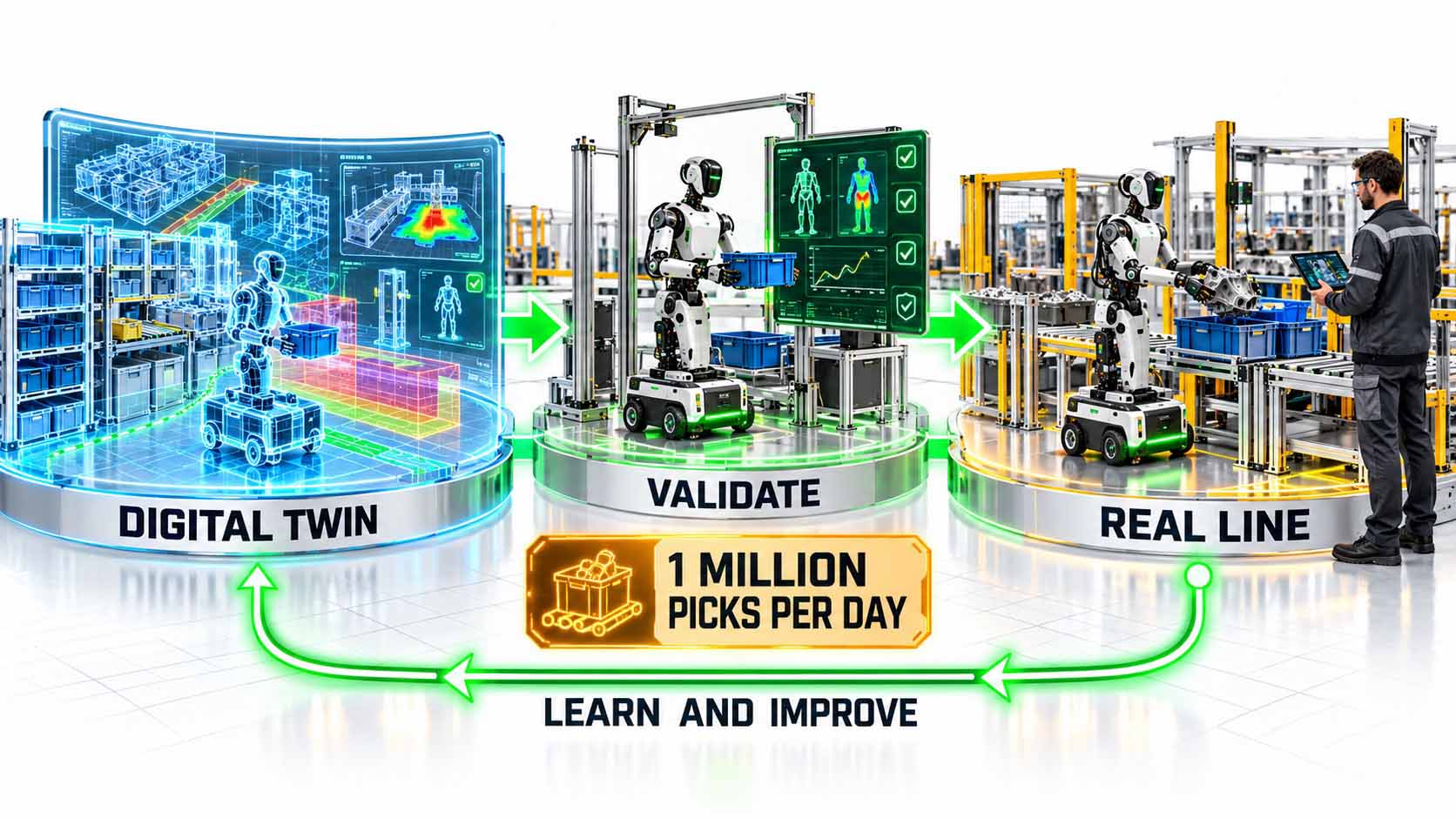
Every change is first tested in the twin.
Infographic: Physical AI follows a fixed cycle of simulation, validation and real deployment that reduces risks before a robot touches the first component | Graphic: © Ulrich Buckenlei | XR Stager Online Magazine | VISORIC GmbH
The graphic summarizes what connects all the examples. The digital twin is no longer just a visualization, but a test bench. Robots, processes and agents are tested virtually, validated and only then transferred to the real environment. Insights from operation flow back into the model. For research, NVIDIA also presented the Agile ONE SN, a 1.40-meter reference humanoid that is expected to be available in early 2027 and is designed to shorten setup time for research teams from weeks to days.
For companies, this means a realistic view of humanoid robots. Their first fields of application lie in clearly defined, recurring tasks in logistics and assembly, not in the household. What matters most for success is less the shape of the robot than the quality of the digital twin and the involvement of employees. The next chapter shows what happens when robots from different manufacturers are meant to work together.
- Physical AI combines perception, decision and action.
- Audi is testing mobile humanoids for around one million picks per day.
- The virtual twin tests feasibility, ergonomics and safety.
- Siemens expects 20 percent savings through factory agents.
- Humanoids start with clearly defined industrial tasks.
Physical AI thus reaches the shop floor not as a spectacle, but as a process that begins in the digital twin.
Robots work across manufacturer boundaries
In many warehouses and plants today, robots from different manufacturers work side by side, often with their own control systems and their own fleet management. The next stage is for them to perceive their surroundings through cameras and sensors, act with foresight and be coordinated across brand boundaries. At GTC Berlin, the Otto Group showed what this looks like in practice. Its COALA initiative coordinates mixed robot fleets and automation systems in warehouse environments.[11]
For this purpose, the Otto Group has built a platform that connects warehouse IT, robot control, fleet management and building technology. Open robot control systems and vendor-independent fleet management are meant to make it possible to simulate the behavior and interaction of different robot fleets in the digital twin. At the group’s largest fulfillment center in Haldensleben, shelving and conveyor technology are converted from point clouds into highly accurate digital representations. First image analysis applications, for example, automatically detect empty pallet stacks and independently trigger transport orders.[11]
For robots from different manufacturers to work safely side by side, shared safety concepts are also needed. Several manufacturers are integrating the NVIDIA Halos safety system into their architectures, including Agile Robots, Agility, Dexory, FORT Robotics and KION for warehouse robots. The sensor manufacturer SICK is evaluating Halos so that industrial robots can react dynamically to changing conditions outside fixed safety zones. Testing organizations such as TÜV SÜD support the certification of such systems.[12]
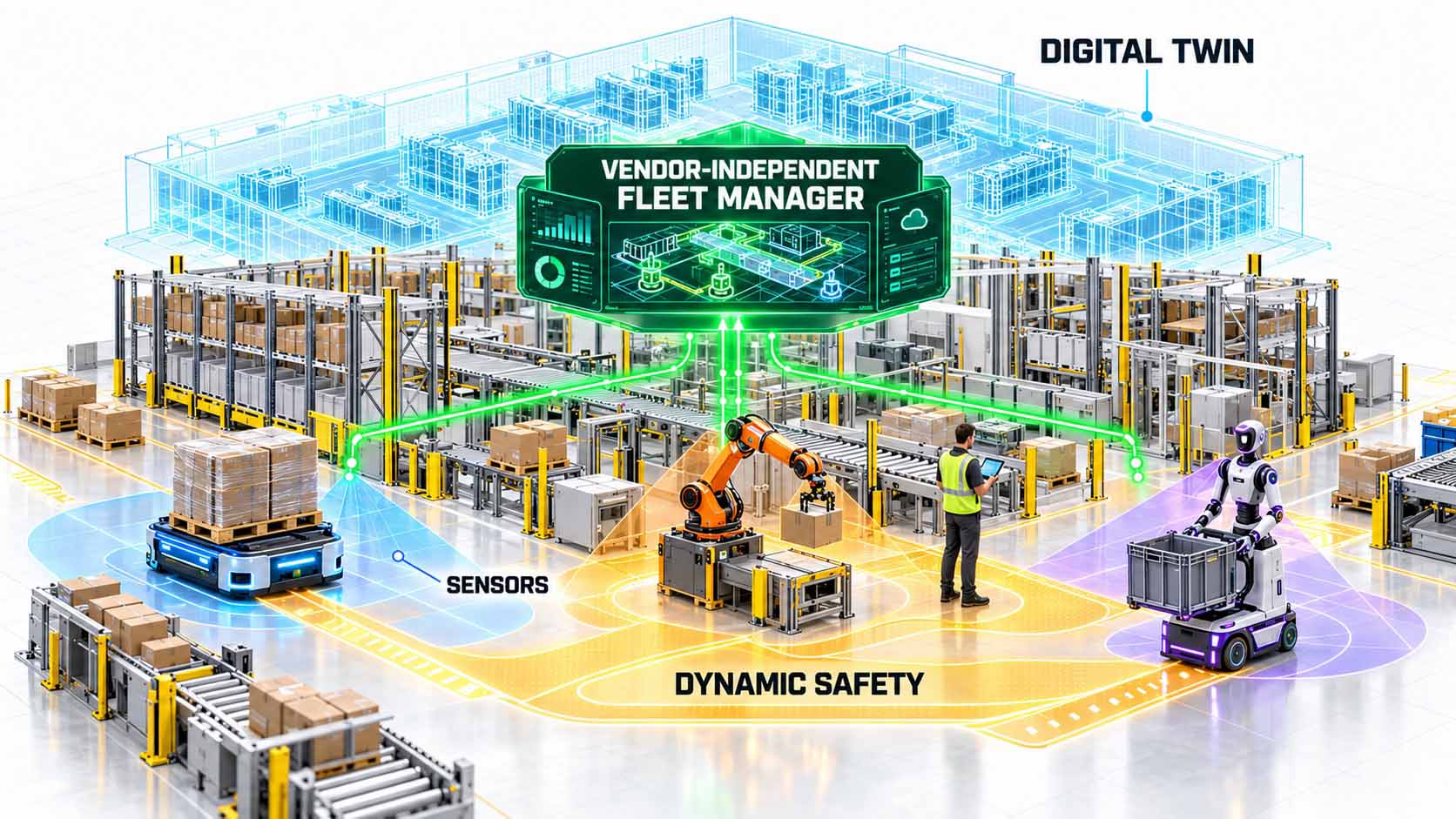
Shared perception turns individual robots into a team.
Infographic: Vendor-independent fleet management and dynamic safety zones allow robots from different brands to work together in a coordinated and safe way | Graphic: © Ulrich Buckenlei | XR Stager Online Magazine | VISORIC GmbH
The graphic shows the shift from fixed safety zones to dynamic safety. Until now, robots were often separated from people and other machines by fences or rigid areas. When every system perceives its surroundings and a higher-level management system coordinates the routes, people and machines can work together more closely. The prerequisite is a digital twin in which these processes are tested in advance, and open interfaces that do not exclude individual manufacturers.
For companies, this is an important decision aid for automation projects. Anyone procuring robots today should pay attention to open interfaces, cross-vendor fleet management and simulation-capable models. This keeps the system expandable and reduces dependence on individual suppliers. The next chapter shows, with new study data, how companies themselves assess the state of Physical AI.
- Warehouses increasingly work with robots from different manufacturers.
- The Otto Group coordinates mixed fleets with COALA.
- Haldensleben becomes a digital twin from point clouds.
- Halos brings dynamic safety to warehouse robots.
- Open interfaces protect against vendor lock-in.
The future of automation thus lies in the coordinated interplay of many systems, controlled and tested in the digital twin.
What the data reveals about Physical AI
On the last day of GTC Berlin, Deloitte presented the results of its EMEA Physical AI Study 2026 in an exclusive presentation at its Berlin headquarters. One figure was at the center: the share of companies that Deloitte classifies as Physical AI transformers, organizations that use Physical AI to transform their core processes, is expected to rise from 32 percent today to 81 percent in 2030. Deloitte called this group the new majority.[13]
The barriers were just as revealing. Asked about the three most important barriers, 38 percent of respondents named cybersecurity and operational safety risks, 35 percent high investment and implementation costs and 30 percent a lack of relevant skills. These were followed by regulatory, privacy and liability requirements at 26 percent, and insufficient data quality and system integration as well as employee acceptance at 20 percent each. Only six percent saw no significant barriers.[13] Deloitte summed up the situation this way: organizations believe in the value but fear the scaling. Physical AI exposes the security gaps that already exist today.
The study fits into a broader picture. In its State of AI in the Enterprise report 2026, Deloitte had already reported that 58 percent of the companies surveyed use Physical AI at least to a limited extent and that this share is expected to rise to 80 percent within two years. As the areas with the greatest long-term impact, respondents named intelligent security and monitoring systems, collaborative robotics and digital twins.[14]
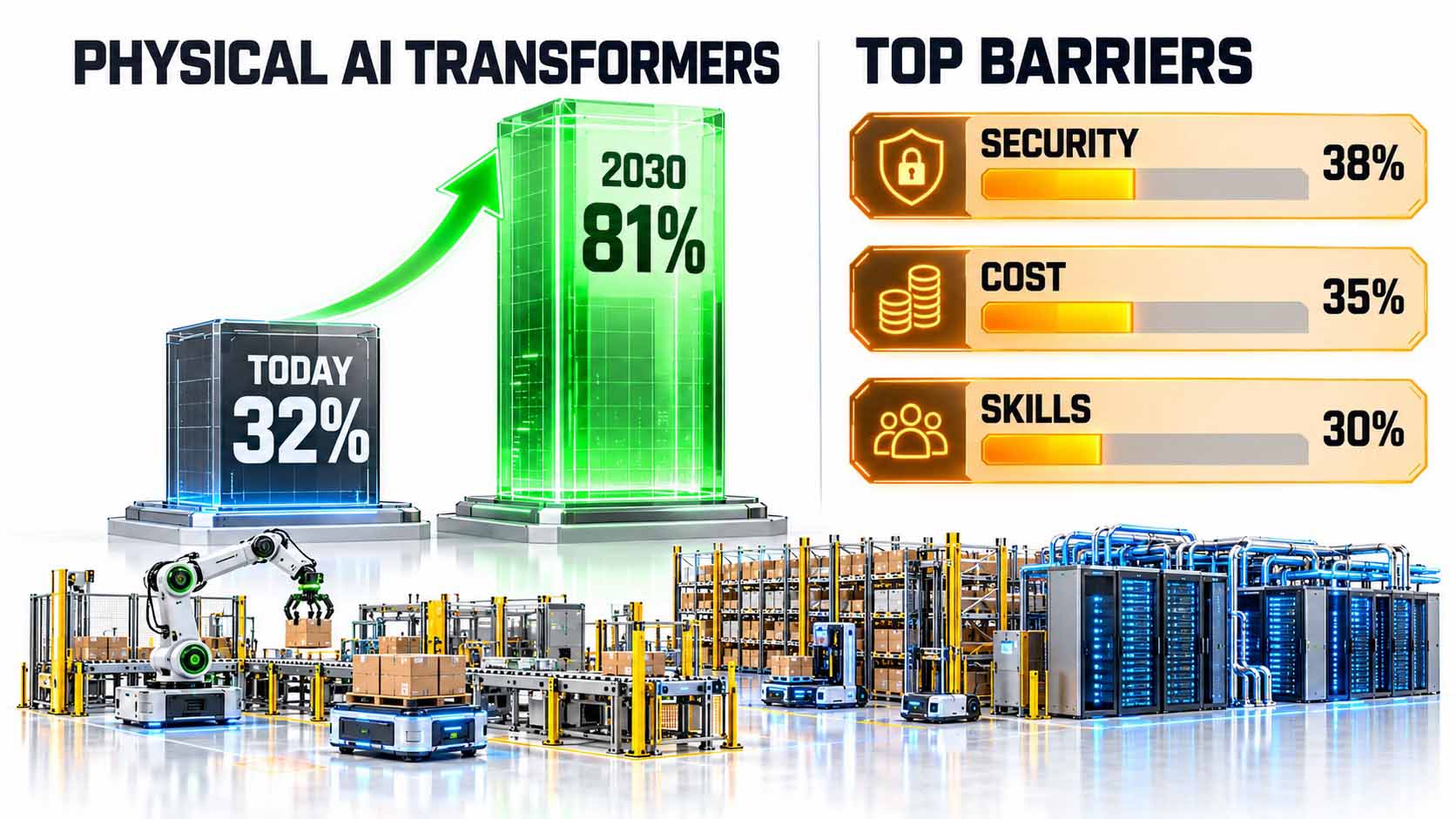
Belief in the value is greater than the readiness to scale.
Infographic: The number of Physical AI pioneers is expected to more than double by 2030, slowed mainly by security, costs and missing skills | Graphic: © Ulrich Buckenlei | XR Stager Online Magazine | VISORIC GmbH
| Barrier | Share of mentions | Type of barrier | Possible lever |
|---|---|---|---|
| Cybersecurity and operational safety | 38 % | Technical and organizational | Security architecture from the start |
| Investment and implementation costs | 35 % | Economic | Pilot with measurable value |
| Lack of relevant skills | 30 % | Human | Training in virtual work environments |
| Regulation, privacy, liability | 26 % | Legal | Early alignment with specialist departments |
| Dependency on non-European providers | 19 % | Strategic | Open models and own data storage |
Overview: Selected barriers to Physical AI according to the Deloitte EMEA Physical AI Study 2026, supplemented by an own assessment of possible levers | Table: © Ulrich Buckenlei | XR Stager Online Magazine | VISORIC GmbH
The graphic and the overview show an encouraging pattern. The three biggest barriers do not concern the technology itself, but its secure integration, its economic viability and the people who work with it. All three can be solved. The skills gap in particular can be closed in a targeted way when employees get to know new processes, robots and agents in a virtual copy of their real workplace before these go into operation.
For companies, the figures provide a clear list of priorities. Anyone who wants to introduce Physical AI should not add security as an afterthought, should start projects with a manageable, measurable use case and should plan employee qualification from the beginning. The next chapter shows what role the question of technological independence plays in this.
- Deloitte presented the EMEA Physical AI Study 2026 in Berlin.
- The share of pioneers is expected to rise from 32 to 81 percent.
- Security is the biggest barrier at 38 percent.
- Costs and skills follow at 35 and 30 percent.
- The biggest barriers can be solved organizationally.
The data thus shows: the path to Physical AI is less a question of technology than a question of security, economic viability and qualification.
Sovereignty becomes an architecture decision
The question of technological sovereignty accompanied GTC Berlin from the very beginning. On October 19, two days before the keynote, the German Federal Ministry for Economic Affairs and the Federal Ministry of Research signed a declaration of intent with NVIDIA at the federal government’s investment summit in Berlin. The goal is an initiative to develop advanced AI models for Physical AI that are meant to be accessible not only to large industry but also to small and medium-sized enterprises and research institutions.[15]
The federal government initially gave no details on possible investments. According to a media report, the project is to be supported with a three-digit million euro amount, among other things for computing capacity in Deutsche Telekom’s industrial AI cloud. Huang praised Germany’s technological potential, but at the same time criticized the slow pace of innovation in Europe. His recommendation to Germany was brief: simply get to work.[15]
Technically, sovereignty means above all control over models, data and infrastructure. In Berlin, NVIDIA expanded its family of open models for language, robotics, biology and quantum computing. Companies can post-train these models with their own data and run them on infrastructure they control themselves.[16] Partners such as Netris also showed how a GPU cluster can be rented out to many customers, with each customer separated from the others directly in the network hardware. The Deloitte study confirms that this topic matters to companies: 19 percent name dependency on non-European technology providers as a barrier to Physical AI.
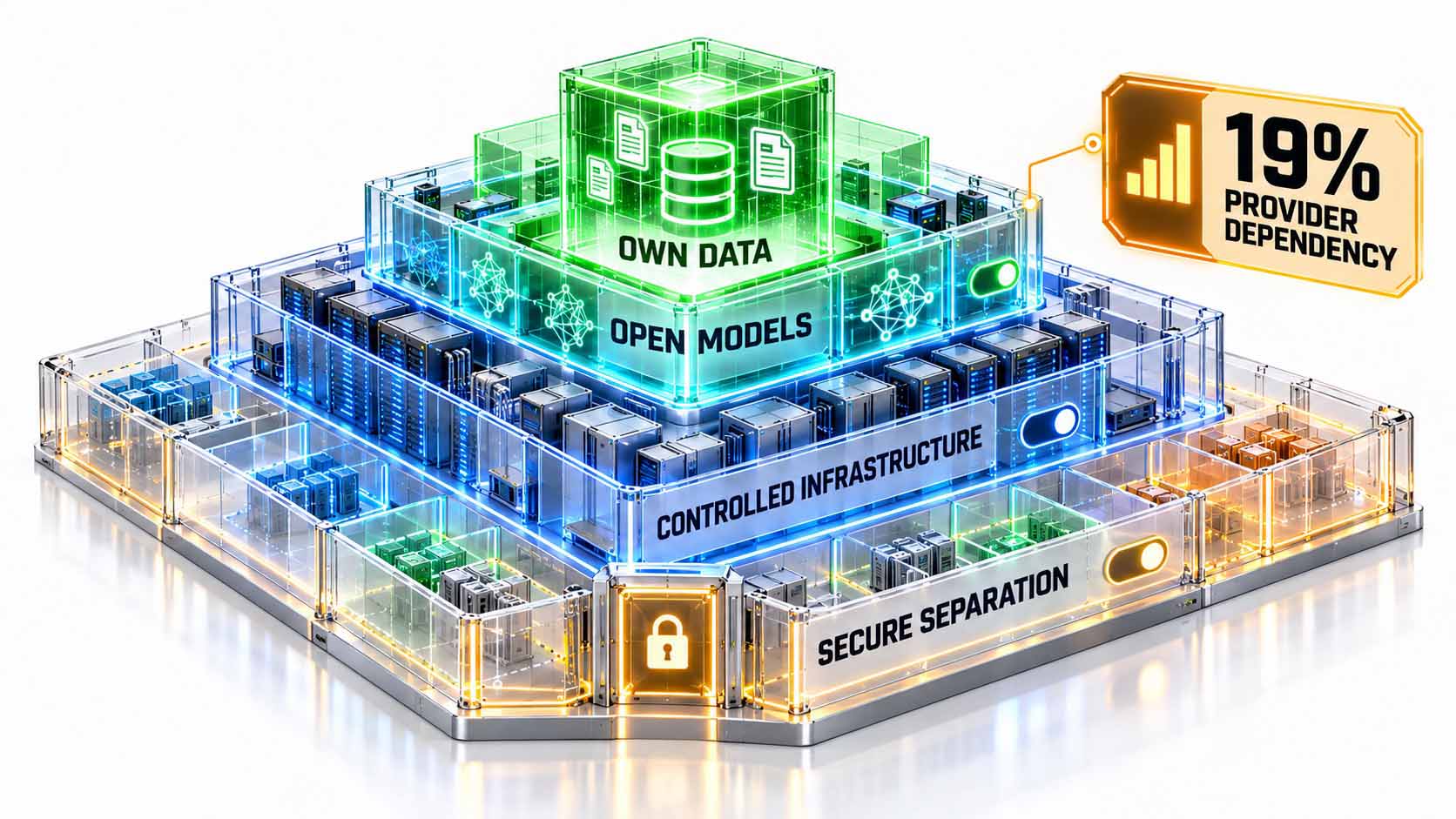
Sovereignty emerges where data, models and infrastructure come together.
Infographic: Own data forms the protected core, surrounded by open models, controlled infrastructure and secure separation, and technological sovereignty emerges through conscious control of every architectural layer | Graphic: © Ulrich Buckenlei | XR Stager Online Magazine | VISORIC GmbH
The graphic shows sovereignty as a layered model. At the core is a company’s own data, its knowledge about products, processes and customers. Around it lie open models that can be adapted to this knowledge, controlled infrastructure and secure separation in the network. Each layer can be purchased or operated in-house. A company is sovereign not when it does everything itself, but when it consciously decides which layers it controls.
For companies, sovereignty thus turns from a political buzzword into a concrete architecture decision. It concerns the choice of models, the location of data storage, contracts with cloud providers and the question of where the company’s own knowledge flows into AI systems. Those who make these decisions early can scale AI faster and with lower risk. The following chapter summarizes what the three days on site show in pictures.
- The federal government and NVIDIA agreed on an initiative for Physical AI.
- The models are meant to be accessible to SMEs as well.
- Open models can be post-trained with own data.
- 19 percent see provider dependency as a barrier.
- Sovereignty is a conscious decision for each layer.
GTC Berlin has thus shown that Europe’s AI future depends less on individual models than on smart architecture decisions.
Impressions from day one in the video
The video shows impressions from the first day of NVIDIA GTC Berlin 2026, recorded on site in Berlin-Kreuzberg. The day was dedicated to full-day workshops at STATION-Berlin, in which developers worked on topics such as AI agents, inference, accelerated networking and robotics. Around the venues, the conference’s typical green shaped the cityscape.
The strongest impression of this first day is the mix of expert audience and a spirit of new beginnings. Developers, researchers, founders and industry representatives from all over Europe used the workshops and receptions to make contacts and prepare for the announcements of the following days. Many conversations already revolved around the topics that later shaped the keynote: infrastructure, energy, security and Physical AI.
The technical context of the video is described in the previous chapters. The footage shows the atmosphere and the places where these developments were discussed, not the individual products in detail.
Video: Impressions from the first day of NVIDIA GTC Berlin 2026 | Footage, analysis, editing and video production: © Ulrich Buckenlei | XR Stager Online Magazine | VISORIC GmbH
It is remarkable how naturally topics were discussed at GTC Berlin that were still future scenarios just a few years ago. Humanoid robots in logistics, data centers from the factory and supervised AI agents are now the subject of concrete projects with timelines and partners.
For context, it should also be said: many of the systems presented will only be available from 2027, and numerous figures come from manufacturer statements or individual pilot projects. The real question of GTC Berlin is therefore addressed to companies themselves: how do the announcements turn into their own safe and measurable entry?
- The video shows impressions from the first day on site.
- Workshops at STATION-Berlin opened the conference.
- Infrastructure, energy and security shaped the conversations.
- Many systems will be available from 2027.
- Numerous figures are still manufacturer statements.
The video makes visible what the chapters describe: the technology has been announced, and the value emerges through implementation in companies.
You know your processes, we make Physical AI tangible
A successful entry into Physical AI is built on two kinds of knowledge. The company knows its processes, facilities, employees and the decisions that should become faster or safer. Implementation requires experience with digital twins, 3D data, simulation and learning environments in which people understand new systems before they work with them. Exactly this combination forms the core of the work of VISORIC GmbH.
For more than 15 years, the Munich-based expert team has been developing applications in 3D, AI and XR for companies ranging from SMEs to DAX corporations. VISORIC designs digital twins of facilities and workplaces, virtual training environments and spatial representations of complex processes. VISORIC brings the results together in the XR Stager platform, in the browser, on large displays or in XR. The skills gap in particular, which according to Deloitte holds back almost one in three companies, can be closed in a targeted way: employees get to know new robots, agents and processes in a virtual copy of their real environment.

Process knowledge and spatial preparation together create a reliable pilot.
Image: The company contributes processes, facilities and goals, the expert team contributes digital twins, simulation and virtual learning environments | © Ulrich Buckenlei | XR Stager Online Magazine | VISORIC GmbH
The entry does not have to be large. A clearly defined pilot makes sense: one workplace, one facility or one logistics area, one concrete question and one responsible role. It is defined in advance which data will be used, what will be simulated and what will be trained, and how success will be measured. Only when this pilot has demonstrated its value is it worth adding further areas, robots or agents. In this way, the digital twin grows with demonstrable value instead of complexity, and the employees grow with it.
- Selection of an area and a decision that should improve.
- Digital twin of the workplace or facility.
- Virtual learning environment, measured against the previous process.
Precisely because Physical AI is now arriving on the shop floor, now is a good time to prepare people and processes for it.
Which process in your company would benefit most from being tested in a digital twin first?
Talk to the VISORIC expert team in Munich. Together we will review your starting point, select a measurable use case and develop a pilot that shows what digital twins and virtual learning environments can achieve for your entry into Physical AI.
Contact:
Email: info@visoric.com
Phone: +49 89 21552678
Sources and References
- Caulfield, B., NVIDIA Blog. GTC Berlin 2026: Live Updates From NVIDIA CEO Jensen Huang’s Keynote, October 21, 2026. blogs.nvidia.com/blog/gtc-berlin-2026-keynote.
- Investing.com. NVIDIA at GTC Berlin 2026 Keynote: Europe’s AI buildout, transcript and summary of the keynote, October 21, 2026. investing.com/news/transcripts.
- NVIDIA Newsroom. NVIDIA Introduces DSX POD AI Factories to Accelerate Europe’s Infrastructure Deployment, press release, October 21, 2026. nvidianews.nvidia.com/news/nvidia-introduces-dsx-pod-ai-factories-to-accelerate-europes-infrastructure-deployment.
- Armada. Armada Unveils Superintelligence Factories Built Within NVIDIA DSX POD, Deployable in Months, Not Years, press release via PR Newswire, October 21, 2026. prnewswire.com.
- NVIDIA Blog. How Companies Are Using NVIDIA DSX to Break the Power Bottleneck, October 21, 2026. blogs.nvidia.com/blog/dsx-power.
- Rutherford, M., Tech Times. NVIDIA Cuts AI Factory Deployment to 14 Days With DSX POD at GTC Berlin, October 22, 2026. techtimes.com.
- NVIDIA Newsroom. NVIDIA Launches OpenShell Reference Architecture for Safe AI Agents, press release, October 21, 2026. nvidianews.nvidia.com/news/openshell-reference-architecture.
- Bauduin, S., PC Games Hardware. Nvidia GTC Berlin 2026: KI-Fabrik im Container und Agenten unter Aufsicht (German), October 21, 2026. pcgameshardware.de.
- AUDI AG. Agile Robots and Audi to transform automotive logistics with mobile humanoids, supported by Dassault Systèmes and NVIDIA, press release, October 21, 2026. audi.com/en/press-releases.
- McKenna, J., NVIDIA Blog. Europe’s Industrial Leaders Reinvent Engineering and Manufacturing With NVIDIA, October 21, 2026. blogs.nvidia.com/blog/europe-industrial-leaders-engineering-manufacturing.
- Otto Group. Otto Group Advance the Autonomous Warehouse with COALA and NVIDIA Omniverse, October 21, 2026. ottogroup.com/en/stories.
- Ciupek, M., ingenieur.de. GTC in Berlin: Deutscher Roboterhersteller steht bei Nvidia im Fokus (German), October 21, 2026. ingenieur.de.
- Deloitte. EMEA Physical AI Study 2026, presentation of the study results at Deloitte headquarters Berlin, October 22, 2026, own attendance and recording.
- Deloitte. The State of AI in the Enterprise, 2026. deloitte.com.
- ZDFheute. Deutschland und Nvidia starten KI-Offensive für die Industrie (German), October 19, 2026. zdfheute.de.
- Briski, K., NVIDIA Blog. NVIDIA Open Models Advance Europe’s Sovereign Intelligence Across Industries, October 21, 2026. blogs.nvidia.com/blog/open-models-europe-industry.
- VISORIC practical projects in the fields of digital twins, virtual learning environments, simulation and spatial computing.
- XR Stager platform for real-time 3D, digital twins and industrial spatial computing applications.
Contact Us:
Email: info@xrstager.com
Phone: +49 89 21552678
Contact Persons:
Ulrich Buckenlei (Creative Director)
Mobil +49 152 53532871
Mail: ulrich.buckenlei@xrstager.com
Nataliya Daniltseva (Projekt Manager)
Mobil + 49 176 72805705
Mail: nataliya.daniltseva@xrstager.com
Address:
VISORIC GmbH
Bayerstraße 13
D-80335 Munich