

Body-Centric Computing When Technology Becomes Wearable Material
Concept visualization: © Ulrich Buckenlei | Stretchable electronics and body-integrated computing | Illustrative representation without claim to technical completeness
For decades, computing was tied to clearly defined devices. Technology existed as an object with fixed boundaries, its own casing, and explicit modes of operation. We held it in our hands, wore it on our bodies, or placed it in front of us. This spatial and psychological separation between humans and technology is now beginning to dissolve fundamentally.
Recent advances in materials science show that electronic circuits no longer need to be rigid. Conductive metal-polymer structures can be integrated into elastic materials without losing functionality. These circuits can be stretched, bent, and deformed while following the natural movements of the human body.[1][2] Computing thus leaves the classical device paradigm and becomes part of fabrics, surfaces, and layers that already accompany us in everyday life.
The visualization shown stands as a proxy for this transformation. It does not depict a concrete product, but a new way of thinking. Computing is no longer understood as a separate object, but as an infrastructural layer that surrounds and accompanies us. The focus shifts away from displays and hardware toward proximity, presence, and bodily integration.
This development is not a speculative vision of the future. It is emerging today at the intersection of materials research, wearable technology, and human-computer interaction, marking a structural shift in how technology itself is understood.[1][2][3]
Why Rigid Devices Are Losing Their Role
For a long time, the physical form of computing was dictated by technical constraints. Circuit boards, fixed components, and closed housings defined how electronics could be built and used. These limitations shaped not only the devices themselves, but also the way people interacted with them.
Stretchable electronics challenge these foundations. When conductive paths, sensors, and circuits are embedded in elastic materials, they no longer require rigid substrates. Electronics can become thin, soft, and partially transparent. They adapt to movement instead of resisting it.[1][3]
This removes a central boundary that tied computing to device-centric concepts for decades. Technology no longer has to be attached to the body. It can become part of its movement.
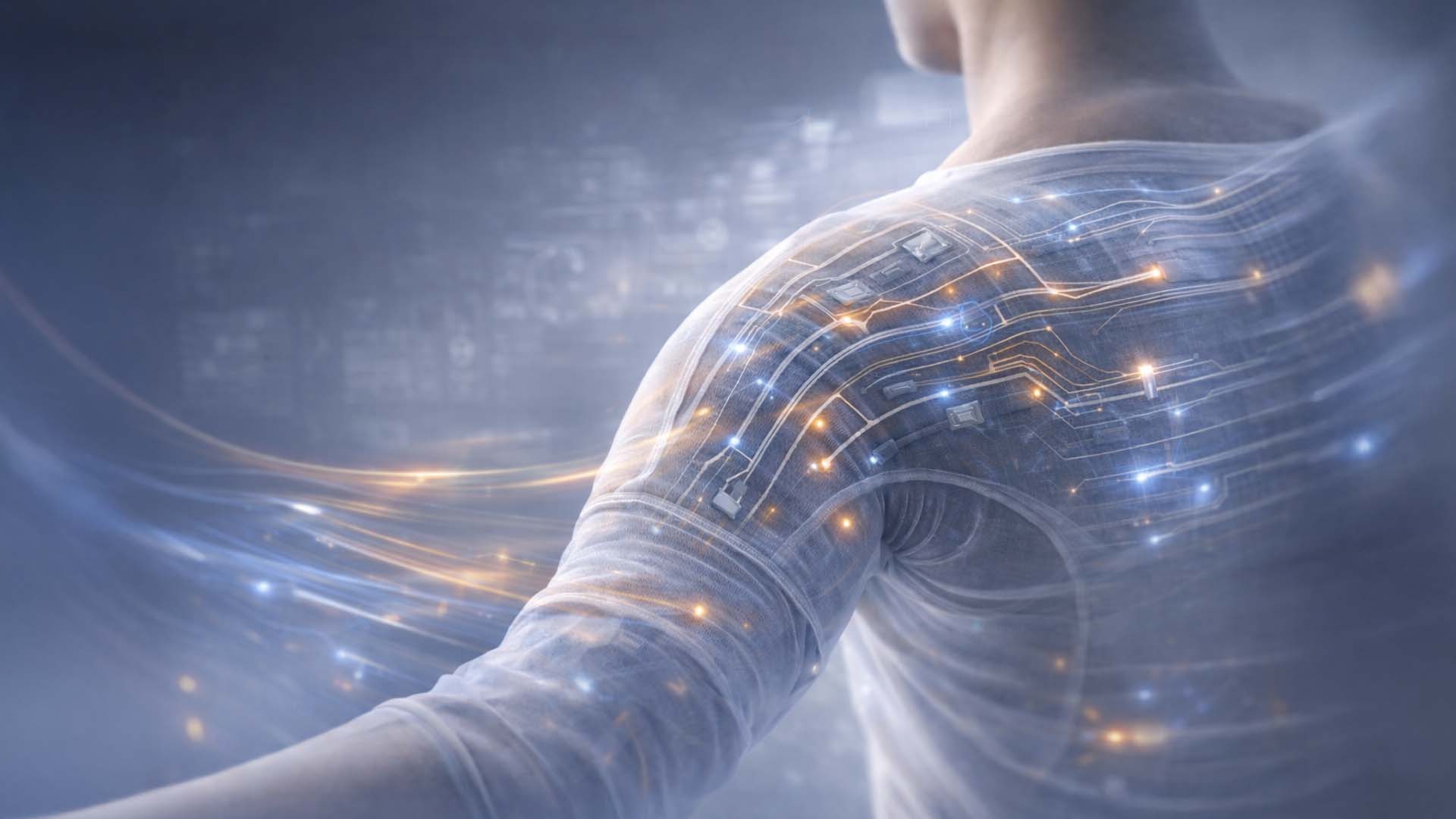
Stretchable electronics as material: electronic circuits adapt to the movement of the body
Concept visualization: © Ulrich Buckenlei | Based on current research on flexible electronics
The industrial and societal value does not arise from a single material or an isolated technological property. What matters is the interplay of elasticity, electrical conductivity, and structural stability. Only this combination enables electronics to be integrated into everyday contexts without forcing people to consciously adapt. Technology adapts to the body, not the other way around.[1] Computing thus loses its instrumental character and becomes a supportive, almost self-evident background layer of human activity.
This development marks a fundamental shift in the design of technological systems. Functionality is no longer achieved through rigid forms or clearly defined device classes, but through materials that allow movement, work with it, and even anticipate it. This creates new degrees of freedom for design, use, and acceptance of technological solutions.[3]
- Mechanical adaptation → Electronics follow movement instead of blocking it
- New formal freedom → The elimination of rigid housings and carrier structures opens new design spaces
- Proximity to the body → Technology integrates into natural movement patterns and everyday routines
This physical freedom is more than an ergonomic advantage. It forms the basis for a changed understanding of computing itself. When technology is no longer perceived as a separate object, but as part of materials, clothing, or surfaces, expectations around interaction, control, and responsibility shift as well.
The next chapter therefore focuses on what happens when electronics no longer behave like a classical device, but like a material. A development that not only enables new products, but also opens new ways of thinking about the relationship between humans, technology, and the environment.
Computing as Material, Not as Object
Once electronics become stretchable and flexible, their character fundamentally changes. They are no longer assembled into clearly delineated products, but integrated into existing materials. Fabrics, surfaces, and layers themselves become carriers of computational capability.[2][4]
This also transforms the interaction model. People no longer operate devices, but move within environments that respond to them. Computing becomes quiet, accompanying, and barely visible. It does not demand attention, but supports processes in the background.
From a systems perspective, the focus shifts from object-based interaction to infrastructural presence. Technology becomes part of the environment rather than its focal point.

Computing as material: electronics become part of textiles, surfaces, and everyday objects
Concept visualization: © Ulrich Buckenlei | Illustrative representation of material-integrated systems
This development changes not only the technical implementation of systems, but also the fundamental perception of technology itself. The less visible and less explanatory it becomes, the more naturally it integrates into everyday life. Computing no longer appears as an independent object, but as a quiet supporting structure operating in the background without demanding attention. This is a central quality: technology supports without dominating, and enables action instead of restricting it.[3]
As invisibility increases, the role of users shifts as well. Interaction becomes less of a conscious action and more of a reaction to situations, contexts, and needs. Systems learn to cooperate with their environment rather than override it. Computing thus becomes not only smarter, but also more restrained and more compatible with human routines.[3]
- Material integration → Electronics increasingly disappear into everyday life and become part of familiar surfaces
- Environmental logic → Computing accompanies processes instead of visibly controlling them
- New interaction → Contextual response replaces conscious operation of individual devices
When computing becomes a material, the boundary between product and platform begins to blur. Functionality is no longer tied to a single object, but distributed across clothing, surfaces, and environments. From this development emerges the next consequence: wearables that are no longer perceived as such, but function as a natural part of everyday life.
Wearable by Itself When Technology Disappears
Classic wearables remain recognizable as devices. Watches, wristbands, or headsets clearly mark where technology begins. Body-centric computing removes this separation. Electronics are integrated directly into clothing, gloves, masks, or medical textiles.[2][4]
The decisive shift is psychological. Technology no longer feels added on. It becomes part of what we already wear. As a result, the barrier to adoption is significantly reduced.
The real innovation lies not in new products, but in the disappearance of the device boundary.

Wearable by itself: computing integrates unobtrusively into clothing and textiles
Concept visualization: © Ulrich Buckenlei | Illustrative representation
This close connection between body and technology is a central factor for acceptance and sustainable use. Systems that operate permanently on or near the body must prove themselves not only technically, but also emotionally and cognitively. The more natural technology feels, the lower the mental barrier to its use. Trust arises less from visible functionality than from reliability, restraint, and unobtrusive behavior in everyday life.[3][4]
Technology used close to the body becomes part of personal routines. It accompanies movement, responds to situations, and integrates into individual realities of life. This proximity demands a sensitive interplay of design, materiality, and system logic. Only when technology is not perceived as a foreign object can it be accepted and used meaningfully in the long term.
- Invisible technology → Clear device boundaries increasingly dissolve
- Psychological proximity → Technology feels familiar and reduces cognitive distance
- Everyday suitability → Use occurs continuously without conscious activation
With this new form of proximity, the question inevitably arises of where computational power should be located. Not all functions must or can operate permanently on the body. The next chapter therefore examines why computing deliberately separates from the body in certain areas, and how distributed architectures emerge that rebalance proximity and distance.
Why Computing Power Does Not Have to Stay on the Body
Body-centric computing does not mean that all computational processes must take place permanently and entirely on the body. On the contrary: body-adjacent systems benefit from intelligently distributed computing. Lightweight, flexible interfaces gain functionality and everyday usability when computation-intensive tasks such as analysis, modeling, or contextual interpretation are offloaded to external systems.[5]
This decoupling of sensing, interaction, and processing opens new architectural possibilities. While data capture, feedback, and control remain anchored directly to the body, actual processing takes place where sufficient computing power, energy, and scalability are available. The result is systems that are powerful without being physically bulky.[5]
This allows interfaces to be designed as soft, thin, and unobtrusive. Glasses, contact lenses, or intelligent surfaces lose their device character and become natural interfaces between humans and the digital environment. Computing no longer appears as visible technology, but as a functional layer that adapts flexibly to situations and requirements.
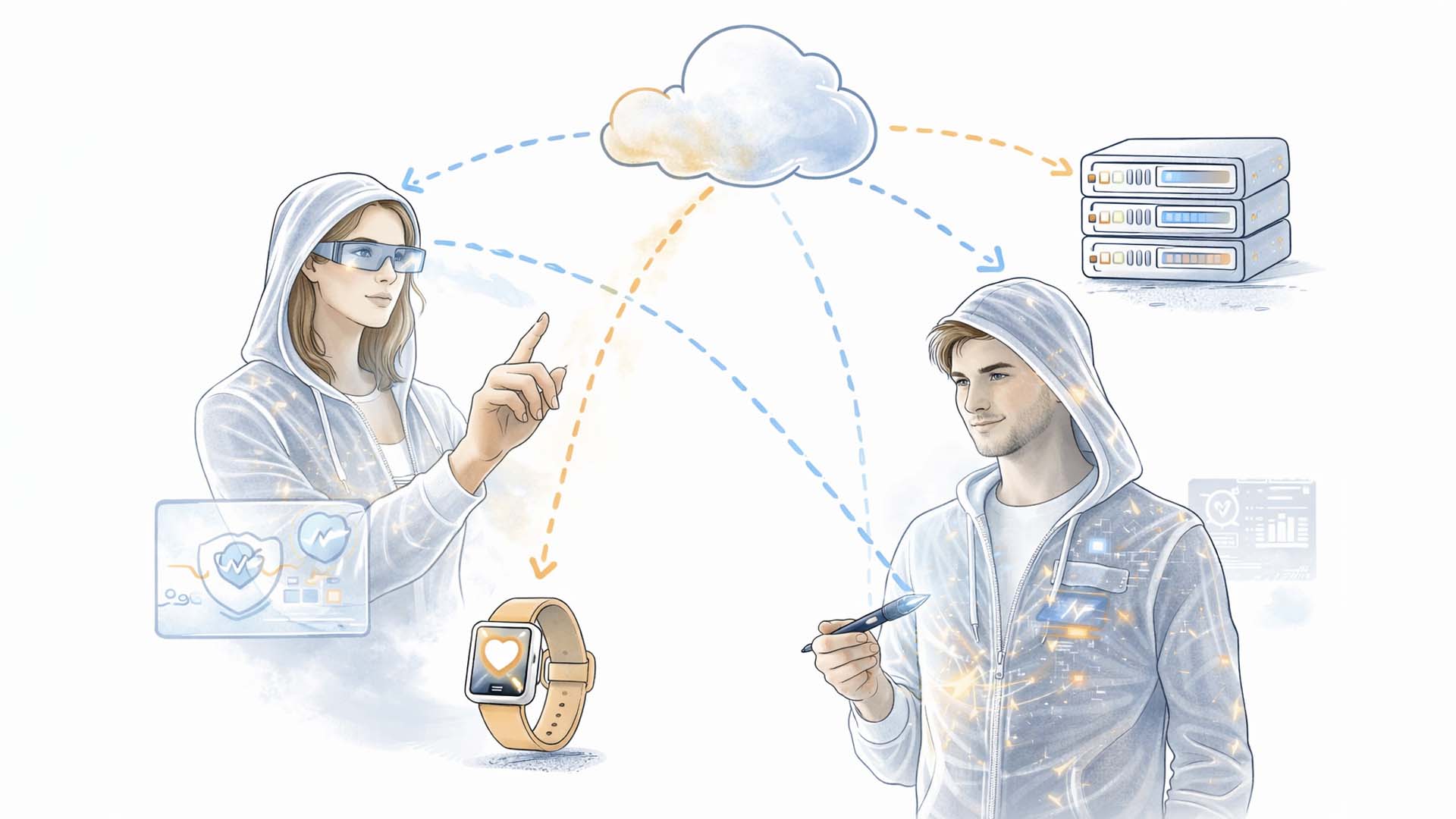
Distributed architecture: body-adjacent interfaces connected to external computing power
Concept visualization: © Ulrich Buckenlei | System representation without claim to technical completeness
This functional separation of body-adjacent interfaces and external computing power opens new degrees of freedom in the design of technological systems. When computationally intensive processes are offloaded, the complexity of components worn or used directly on the body is reduced. This results not only in lighter and more comfortable interfaces, but also in shorter development cycles, as hardware and software can evolve more independently.[5]
At the same time, this architecture accelerates innovation. New functions can be added at the external level without fully redesigning existing interfaces. Systems become more modular, adaptable, and maintainable in the long term. Computing thus evolves from a fixed device category into a flexible infrastructure that can adapt to changing requirements.
- Lightweight interfaces → Reduced hardware directly on the body
- External processing → Computing power is consolidated outside the body-adjacent system
- New form factors → Glasses, lenses, and environmental surfaces replace classical devices
Through this distributed architecture, artificial intelligence becomes a permanent companion layer. It no longer acts sporadically, but continuously in the background, analyzing contexts and supporting decisions. This role of AI as a persistent, adaptive layer is the focus of the next chapter.
AI as a Permanent Companion Rather Than an Application
In body-centric systems, the role of artificial intelligence fundamentally changes. AI is no longer consciously launched or explicitly activated. It is continuously present and operates as a permanent background layer. Sensors constantly capture information about movement, posture, environment, and bodily states. These data streams are evaluated in real time, correlated, and interpreted situationally.[6]
This creates a system that does not wait for individual inputs, but recognizes relationships. AI reacts not in isolation, but contextually. It simultaneously considers spatial, temporal, and bodily factors and dynamically adapts its behavior. Computing thus becomes less reactive and more anticipatory. The intelligence of the system lies not in individual functions, but in the continuous processing of context.[6]
Within this logic, artificial intelligence transforms from a tool into an accompanying layer. Interaction no longer arises through explicit commands or classical user interfaces, but emerges from situations. Systems respond to what is happening, not only to what is requested. This shift marks a decisive step toward a new form of interaction between humans, technology, and the environment.
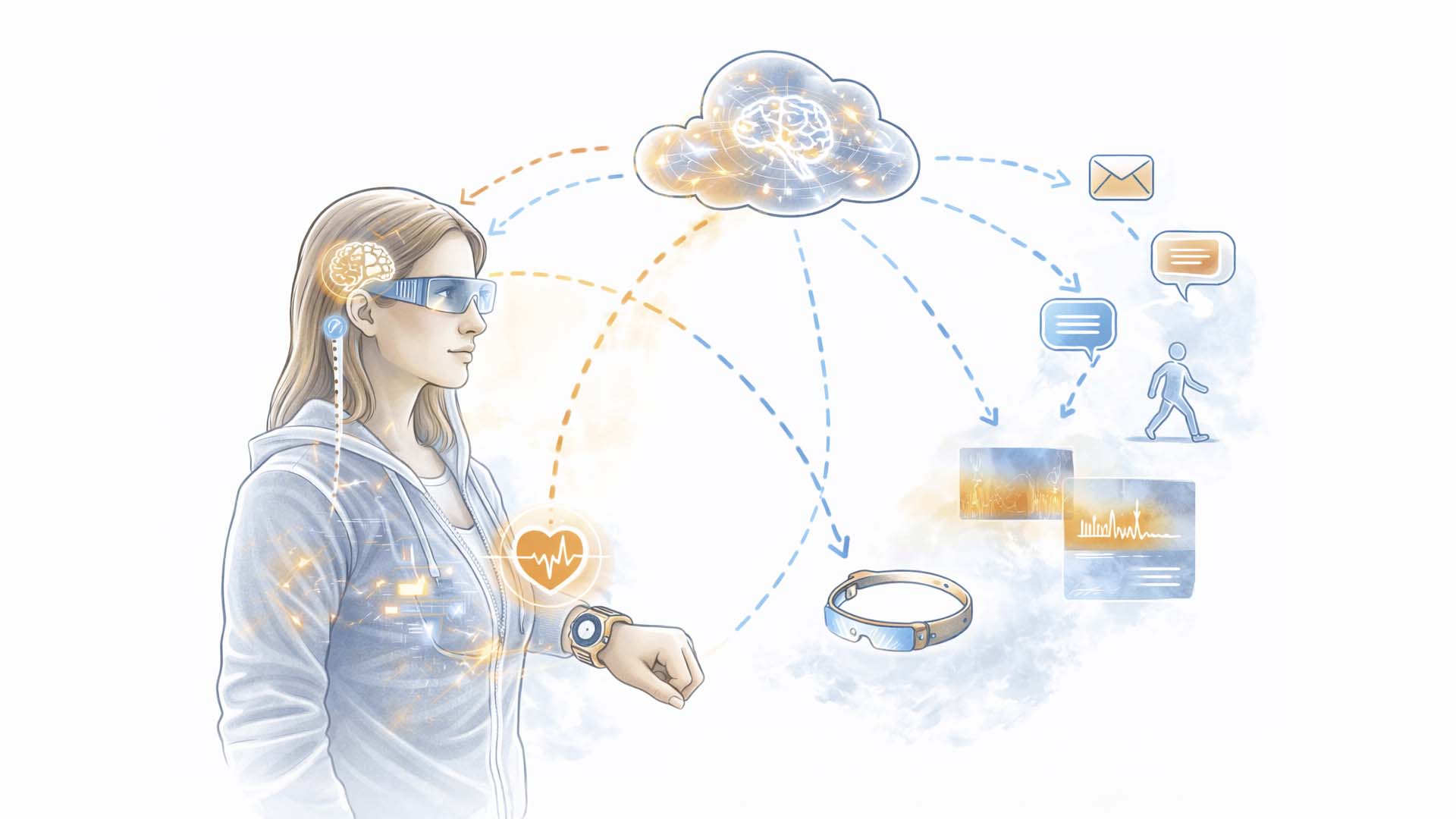
AI as a continuous layer: contextual awareness through body-adjacent sensing
Illustration | Editorial visualization
This development opens far-reaching new possibilities for design, interaction, and functionality. At the same time, responsibility grows to design these systems consciously and proactively. When artificial intelligence is permanently present and continuously evaluates context, ethical and design guidelines gain central importance. Questions of transparency, control, trust, and autonomy move into focus, as technology no longer operates occasionally, but accompanies everyday life continuously.
Design thus becomes a decisive steering instrument. It is not only about what is technically possible, but about how systems behave, how they are perceived, and which action spaces they open or restrict. Human-centered design in this context does not mean maximum automation, but a sensitive balance between support, restraint, and comprehensibility. Only in this way can continuous intelligence be accepted and responsibly deployed in the long term.
- Continuous intelligence → AI is permanently active and contextually embedded
- Context sensitivity → Behavior, environment, and situation form the basis for decisions
- Human-centeredness → Interaction supports without forcing conscious control
All of these aspects lead to a fundamental reordering of how computing is understood. Technology is no longer conceived as a tool or product, but as an integral part of human environments. This gives rise to a new paradigm that connects technical performance, design responsibility, and societal impact more closely than ever before.
From Devices We Wear to Computing That Accompanies Us
Body-centric computing marks a structural shift in how computing is understood, designed, and deployed. Technology increasingly detaches from individual products and clearly delineated devices, evolving instead into distributed systems that are deeply embedded in everyday processes. Computing is no longer used selectively, but continuously accompanies situations, workflows, and decisions.
This shift has far-reaching implications across numerous application domains. Especially in medical technology, soft robotics, and human-machine interaction, new conceptual models emerge in which the body is no longer merely a recipient of technological functions. It becomes an active part of the system itself. Context, sensing surface, and interface increasingly converge.[2][4]
As a result, the role of technological systems changes as well. They no longer respond exclusively to explicit inputs, but interpret bodily states, movements, and environments as part of their logic. Computing becomes situational, adaptive, and body-adjacent. In this integration lies the potential for new forms of support, safety, and interaction that are oriented toward humans and flexibly adapt to individual needs.
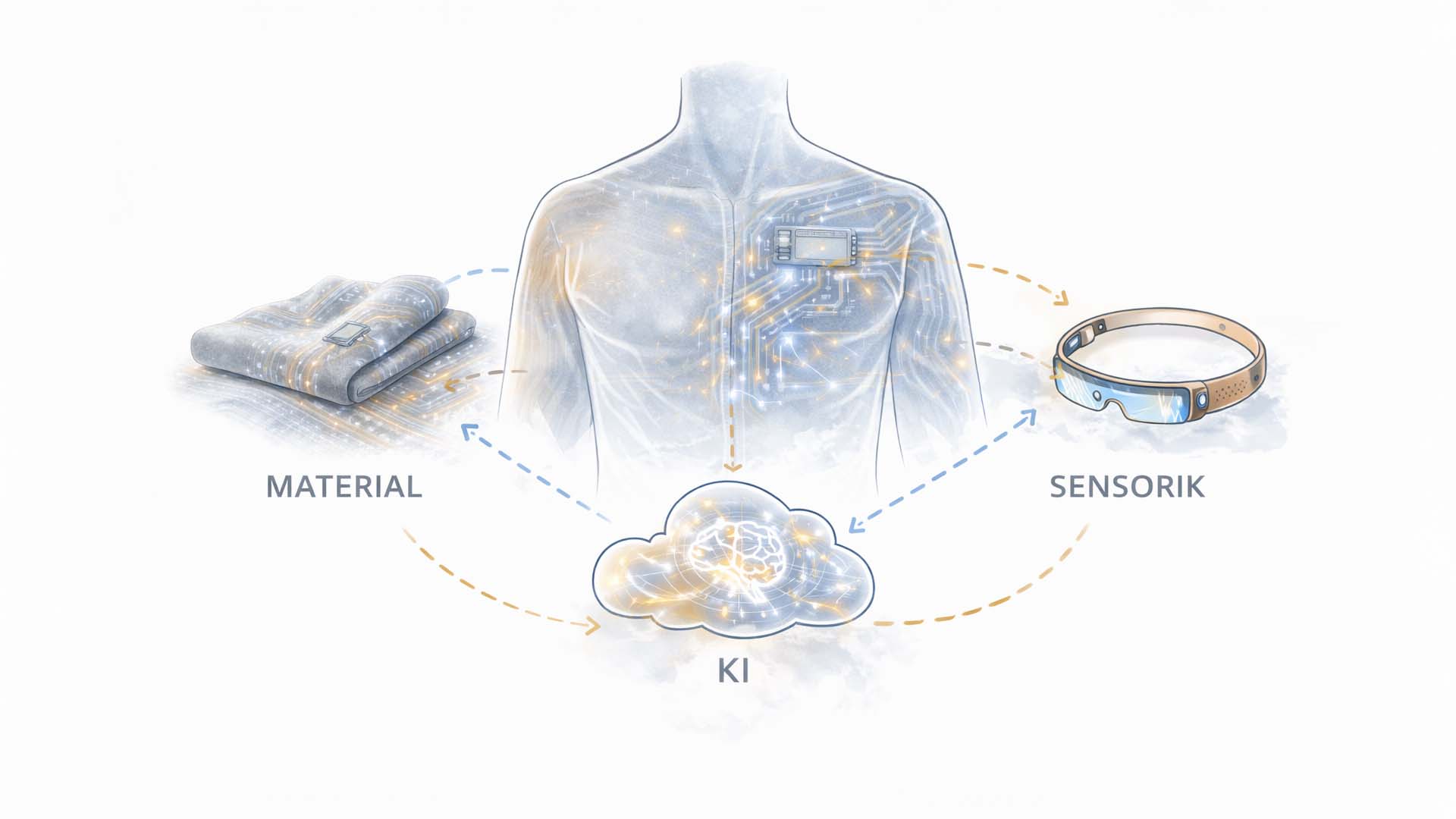
Body-centered systems: computing emerges from the interaction of material, sensing, and AI
Illustration: © Ulrich Buckenlei | Conceptual representation
This development cannot be reduced to individual products or technologies. It represents a fundamental shift in perspective on computing. Instead of isolated devices, systemic interdependencies move to the forefront. Materials, sensing, software, and artificial intelligence merge into integrated structures that can no longer be thought of separately. Computing thus becomes physically tangible while simultaneously growing more conceptually complex.
It is precisely this system perspective that opens new application spaces. It forces technological developments to be considered not only functionally, but also spatially, bodily, and socially. Application areas emerge where previous device boundaries reached their limits and new forms of interaction become necessary.
- Structural shift → Moving away from device-centric thinking toward distributed systems
- New application fields → Medicine, assistance systems, and robotics as drivers of body-adjacent technologies
- Intelligent materials → Computing becomes part of physical structures and surfaces
This systemic perspective forms the foundation for real-world applications that are already becoming visible today. It shows that body-centric computing does not remain a theoretical concept, but is gradually being translated into concrete products, infrastructures, and usage scenarios. The following examples illustrate how these principles are already manifesting in practice.
Video Body-Centric Computing in Practice
The following video illustrates exemplarily how body-integrated systems and flexible electronics can operate in everyday life. The focus is deliberately not on a single product or specific application, but on the interplay of material, movement, and context. It shows how technology integrates into everyday situations without demanding attention or restricting users’ freedom of action.
The scenes shown make tangible what can only be described abstractly in text. Movements, reactions, and transitions demonstrate how computing changes its presence. It is not consciously activated, not started, and not operated. It is continuously present, accompanies situations in the background, and supports processes without moving into the foreground. This quality defines the core of body-centric systems.
Video documentation on body-centric computing concepts
Video material provided by the author | Editorial classification by Ulrich Buckenlei
At the center of this development lies a new quality of interaction between humans and technology. Systems no longer respond exclusively to conscious inputs, but to bodily signals, movements, and situations. Technology thus becomes less in need of explanation and more deeply integrated into existing action flows. Interaction arises incidentally, without interruption and without the feeling of actively operating a technical system.
At the same time, the understanding of materiality changes. Electronics lose their distinctly technical character and approach the properties of classical materials. They become flexible, compliant, and adaptable. Computing is no longer bound to rigid forms, but follows the body, the surfaces, and the environments in which it is deployed.[1][2]
- Body-adjacent interaction → Technology responds directly to movement and posture
- Material intelligence → Electronics behave like fabric and adapt physically
- Seamless presence → Computing becomes self-evident and fades into the background
From this combination emerges a new form of technological presence. Computing is no longer perceived as a separate layer, but merges with everyday situations. Systems are present without being visible. They support without dominating. This forms the basis for long-term acceptance and for technologies that are not experienced as foreign objects, but as natural components of human environments.
Sources and References
- Chinese Academy of Sciences, NIMTE Research News: “Chinese Scientists Develop Highly Robust Stretchable Electrode for E-skin Applications”, 28 Apr 2022. Contains data on a study published in InfoMat, including durability metrics such as stable conductivity over many stretch cycles. [CAS]
- Chinese Academy of Sciences, Research Progress: “Wearable Electronic Fabric Sheds Light On Human Motion Monitor”, 07 Dec 2017. Describes a study published in Advanced Electronic Materials on textile-based stretchable sensing for motion monitoring. [CAS]
- Royal Society of Chemistry, Nanoscale Horizons Review: “Recent advances in flexible and wearable sensors for monitoring chemical factors”, 2022. Overview of wearable sensors, material systems, and healthcare applications. [RSC]
- PubMed, Su et al.: “Textile Based Flexible Capacitive Pressure Sensors”, 2022. Review of e-textiles, pressure sensing, and e-skin application areas. [PubMed]
- Jin et al., “A survey on edge computing for wearable technology”, Digital Signal Processing, 2022. Open PDF overview of edge computing, energy, latency, and security in wearable scenarios. [DSP]
- PMC, Al Saedi et al.: “Context Aware Edge Based AI Models for Wireless Sensor Networks”, 2022. Open access overview of context-aware evaluation in sensor systems. [PMC]
When Computing Becomes Part of Everyday Life
Body-centric computing shows that the future of technology lies less in new devices and more in deeper, more intelligent integration. As electronics become soft, stretchable, and increasingly invisible, computing fades into the background and becomes a natural part of everyday life.
At the intersection of materials research, human behavior, and artificial intelligence, interpretation becomes essential. This is precisely where the work of the Visoric expert team from Munich comes into play. The goal is to analyze complex technological developments clearly, contextualize them, and make them strategically usable.

The Visoric expert team: analysis, contextualization, and visual translation of complex technologies
Source: VISORIC GmbH | Munich
- Analytical classification of new computing paradigms
- Translation of complex systems into comprehensible visual models
- Strategic communication around AI and human-centered technologies
- Editorial support for technological transformation processes
Body-centric computing is not a distant future promise. It is a development already underway today. Those who understand it early lay the foundation for actively shaping the next generation of human-centered technologies.
For this reason, the next step is crucial: not merely observing, but making this development strategically tangible. Where do concrete potentials arise for MedTech, wearables, industrial safety, soft robotics, or new human-machine interfaces? Which system architectures make sense when sensing operates close to the body, computing power is distributed, and AI acts as a continuously context-aware layer? And how can this development be communicated in a way that is understood internally, conveyed credibly externally, and designed responsibly?
If you want to contextualize body-centric computing for your organization, your product, or your communication strategy, the Visoric expert team from Munich supports you in structuring relevant developments clearly, translating them into comprehensible models, and turning them into concrete courses of action. The focus is on clarity over hype and on a solid foundation for decision-making, design, and implementation.
- Use case workshop → Identify and prioritize relevant application fields
- System mapping → Model sensing, data flows, AI logic, and interfaces in a comprehensible way
- Strategy briefing → Structure opportunities, risks, and next steps for decision-makers
If you like, feel free to send us your use case or the industry where you see potential. We will respond with a well-founded initial assessment and propose meaningful next steps.
Contact Us:
Email: info@xrstager.com
Phone: +49 89 21552678
Contact Persons:
Ulrich Buckenlei (Creative Director)
Mobil +49 152 53532871
Mail: ulrich.buckenlei@xrstager.com
Nataliya Daniltseva (Projekt Manager)
Mobil + 49 176 72805705
Mail: nataliya.daniltseva@xrstager.com
Address:
VISORIC GmbH
Bayerstraße 13
D-80335 Munich