
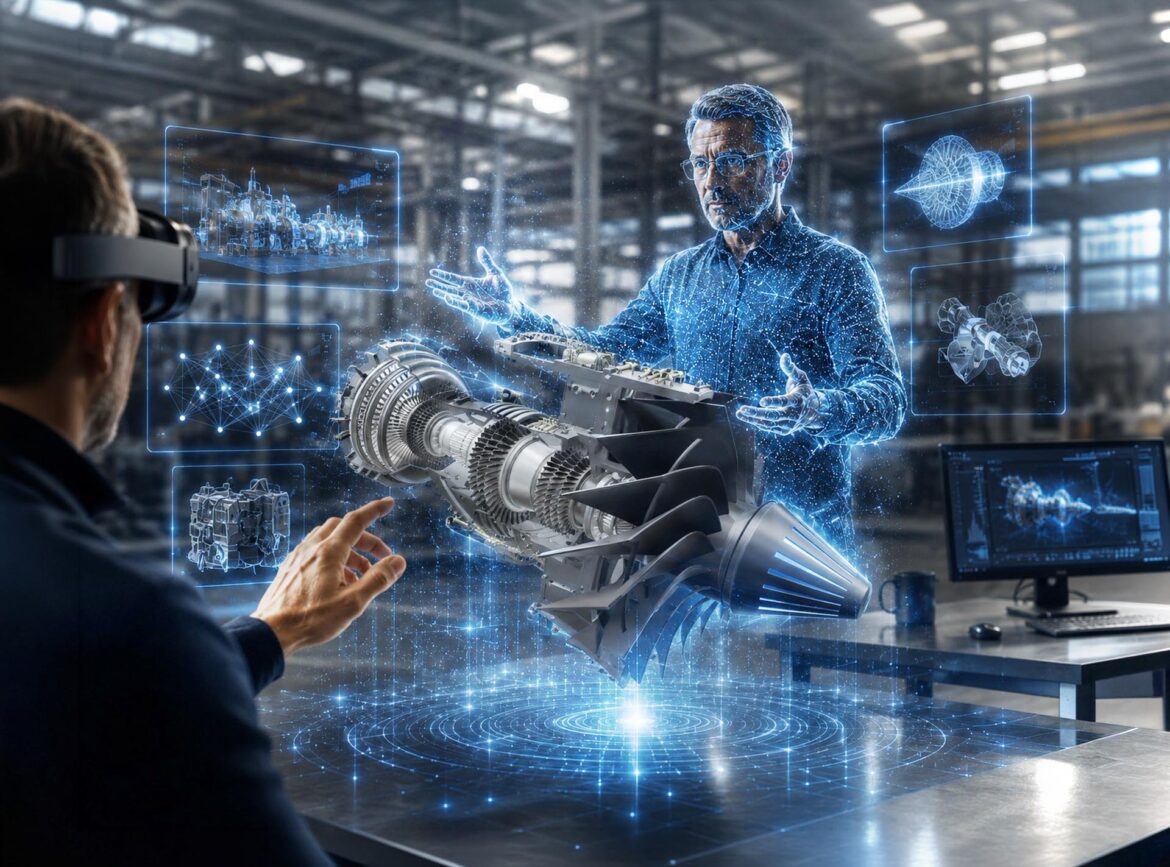
Gaussian Splatting, Volumetric Video and immersive web technologies are currently transforming industrial knowledge transfer
Visualization: Immersive industrial knowledge platform with volumetric expert visualization, photorealistic 3D models, Spatial Computing interfaces and interactive training processes | Image: © Ulrich Buckenlei | VISORIC GmbH
Industrial companies are currently facing a fundamental transformation of their knowledge, training and service processes. Technical systems are becoming more complex, development cycles are getting shorter and at the same time the need is growing to make expert knowledge available over the long term and scalable internationally. Especially in industrial environments, this increasingly creates the challenge of not only documenting complex technical content, but also communicating it in a realistic, interactive and understandable way. [1][2]
Traditional knowledge systems are increasingly reaching their limits. Documentation, videos or static 3D content are often no longer sufficient to efficiently represent real work processes, spatial relationships and practical experience. At the same time, new spatial media formats are fundamentally changing the possibilities of industrial knowledge transfer. [3]
At the same time, a new generation of immersive media formats is emerging. Gaussian Splatting, Volumetric Video, Spatial Computing and browser based platform technologies increasingly enable digital experience spaces in which real people, machines, processes and technical environments can be spatially captured, interactively displayed and flexibly used. [4]
Various industrial projects already show that such technologies are becoming relevant not only for visualization, but are also increasingly being used for training, service, knowledge preservation, product communication and international collaboration. Particularly interesting is the combination of Realtime 3D, artificial intelligence, volumetric data pipelines and immersive web technologies.
This is precisely the intersection where new industrial knowledge platforms are currently emerging, combining traditional media formats with spatial capture, interactive visualization, AI supported analysis and scalable delivery across different devices.
The next chapter therefore analyzes why traditional media formats and conventional knowledge systems are increasingly reaching their limits and why spatial technologies such as Gaussian Splatting and Volumetric Video are becoming increasingly relevant for industrial companies.
Why traditional knowledge transfer is increasingly reaching its limits
In many companies, industrial knowledge transfer is still based on classic documentation, presentations, video formats or linear E Learning systems. Although these formats enable structured information transfer, they increasingly reach their limits when complex technical processes, spatial relationships or practical experience need to be communicated. [5]
Especially in industrial environments, this creates a fundamental problem. Machines, systems and production environments are becoming more complex, while at the same time pressure is increasing to secure knowledge more quickly, onboard new employees efficiently and reliably qualify international service or training teams. Traditional media formats can often represent real work processes only to a limited extent. Knowledge remains abstract, spatial relationships are difficult to understand and essential experiential knowledge is often lost. [6]
At the same time, the requirements for modern knowledge systems are changing significantly. Companies increasingly need platforms that do not merely store content, but make it available in a realistic, interactive way across different devices. Technical knowledge should no longer only be read or viewed, but spatially understood, actively explored and applied in a practical context. [7]
The following developments show why spatial media formats are currently becoming increasingly important:
- Realism → technical processes become spatially and visually understandable
- Interaction → knowledge is not only consumed, but actively explored and applied
- Scalability → expert knowledge can be made available across locations, devices and platforms
At the same time, modern knowledge platforms are increasingly developing into intelligent data and content structures. Gaussian Splatting, Volumetric Video, Realtime 3D, artificial intelligence and immersive web technologies now enable digital experience spaces that operate much closer to real industrial situations than traditional documentation or video concepts. [8]
This is exactly where new technological platform approaches are currently emerging. In various industrial projects, it is becoming increasingly clear that modern knowledge systems are no longer merely individual 3D applications, but complex infrastructures consisting of data pipelines, browser based delivery, interactive 3D spaces and intelligent assistance systems.
The expert team of VISORIC GmbH from Munich develops scalable platform solutions for immersive training, simulation and knowledge systems together with industrial partners. Depending on project requirements, different technology and infrastructure approaches are used, including the internally developed XR Stager Industrial Metaverse and Spatial Computing platform as well as established realtime and AI technologies such as NVIDIA Omniverse, Unity and Unreal Engine.
The aim is to make industrial content such as CAD data, technical processes, digital twins, Gaussian Splatting content, Volumetric Video, Realtime 3D and artificial intelligence flexibly available for different training, service and knowledge environments, from traditional desktop workstations to mobile devices and large format displays through to Spatial Computing platforms such as Apple Vision Pro, Meta Quest or Magic Leap.
At the same time, central platform structures are becoming increasingly important. Content can be managed, analyzed and dynamically adapted via backend systems. AI agents, sensor data and intelligent assistance systems enable adaptive knowledge spaces that can flexibly adjust to different usage scenarios, service processes and training requirements. This creates knowledge, training and simulation platforms that can be used over the long term and not only document technical content, but make it spatially experienceable.
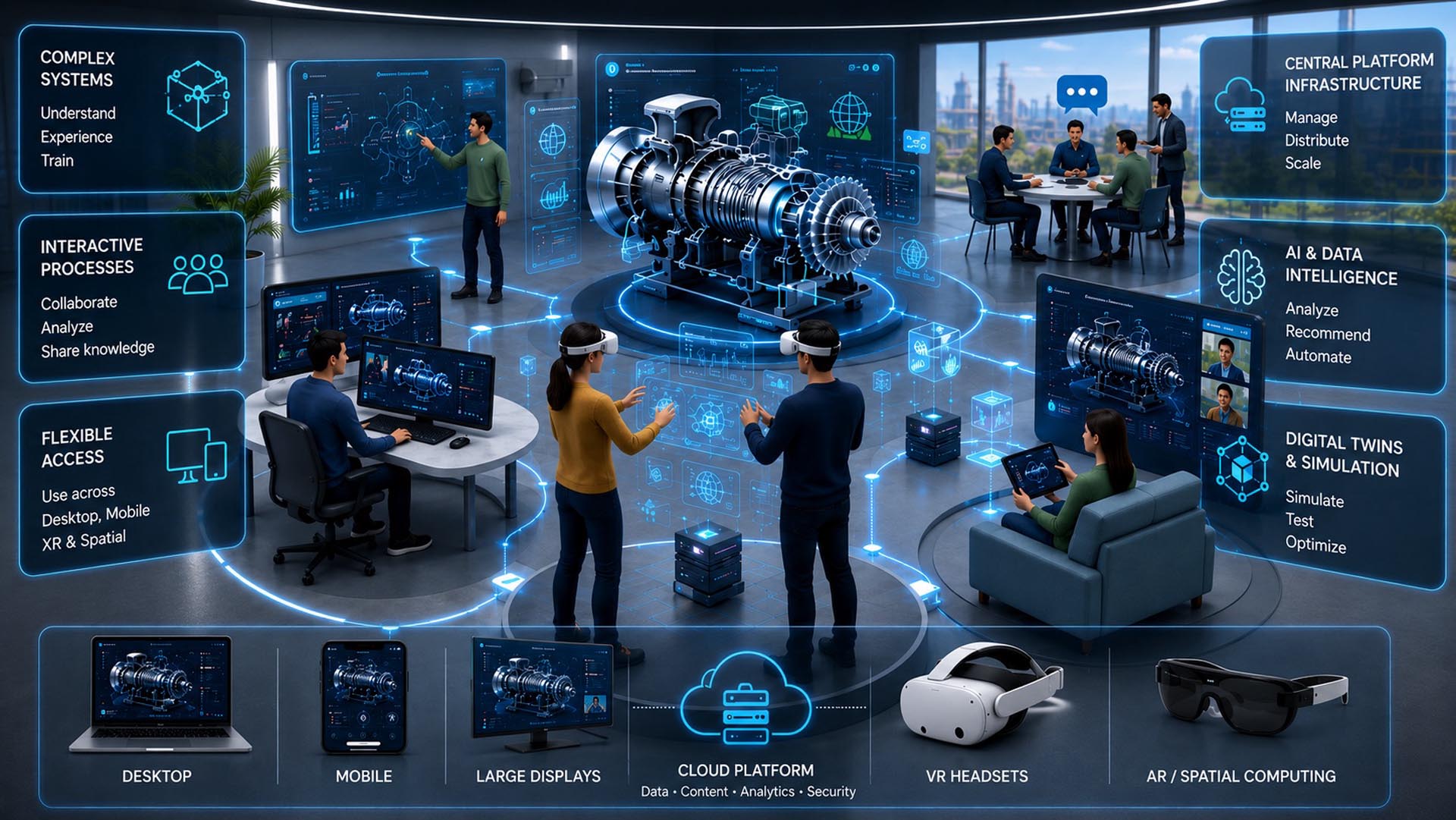
Spatial media formats connect industrial knowledge transfer, volumetric visualization and intelligent training systems
Visualization: Interactive industrial knowledge environment with Gaussian Splatting, Volumetric Video, Realtime 3D visualization, Spatial Computing and centrally managed platform structures | © VISORIC GmbH | Munich
The image shows how industrial knowledge transfer is currently changing. Instead of isolated documents, videos or presentations, connected knowledge platforms are increasingly emerging that link real processes, interactive 3D content, volumetric media and different end devices.
Particularly relevant is the ability not only to display complex technical systems, but to make them spatially understandable and actively experienceable. Users can interactively explore machines, components, process states and expert knowledge and understand technical relationships much more intuitively than in traditional training or documentation formats.
At the same time, it becomes clear that modern knowledge platforms increasingly integrate elements from realtime simulation, Spatial Computing, artificial intelligence and browser based media pipelines. This is precisely where a new form of industrial knowledge transfer is currently emerging, in which know how is not only stored, but made permanently usable, updatable and scalable.
The next chapter therefore analyzes why Gaussian Splatting and volumetric media create a new knowledge infrastructure for industrial companies and what role photorealistic 3D content could play in the future for training, service, marketing and knowledge preservation.
Gaussian Splatting and Volumetric Media as a New Knowledge Infrastructure
With the increasing digitalization of industrial processes, not only training systems and platform structures are currently evolving, but also the media formats themselves through which knowledge is captured, stored and communicated. In particular, Gaussian Splatting, Volumetric Video and spatial media formats are gaining significant importance because they make real environments, machines and expert knowledge far more realistic and immersive than traditional 3D or video technologies. [9]
A fundamental technological shift is currently emerging. While traditional media formats mostly provide only two dimensional information or simplified 3D models, modern volumetric technologies increasingly enable the spatial capture of complete scenes, processes and interactions. As a result, technical content can no longer only be viewed, but experienced from different perspectives and actively explored. [10]
This development is becoming particularly relevant for industrial companies because knowledge can now be preserved far more realistically and made available at scale. Expert processes, maintenance procedures, machine states or training situations can be captured volumetrically and used long term as interactive knowledge environments.
The following characteristics illustrate why Gaussian Splatting and volumetric media are increasingly becoming part of modern knowledge platforms:
- Photorealism → real environments and technical systems can be captured with far greater detail
- Spatiality → content can be explored interactively from different perspectives
- Scalability → volumetric content can be delivered flexibly across web browsers, XR systems and different platforms
These developments are fundamentally changing the structure of modern industrial knowledge systems. Knowledge platforms are increasingly evolving from static documentation systems into immersive experiential spaces in which spatial media, realtime data and interactive processes merge together. [11][12]
This development becomes especially interesting through modern streaming and data pipelines. Gaussian Splatting content, volumetric scenes and photorealistic 3D environments can now increasingly be delivered browser based, cross platform and in realtime. This creates entirely new possibilities for training, service, marketing, remote maintenance and industrial knowledge preservation.
The expert team at VISORIC GmbH in Munich develops scalable platform solutions together with industrial partners for immersive knowledge, training and simulation systems. Depending on project requirements, different infrastructure and realtime technologies are used, including the proprietary XR Stager Industrial Metaverse and Spatial Computing platform as well as modern volumetric rendering and streaming pipelines.
The goal is to make industrial content such as CAD data, technical processes, expert knowledge, Gaussian Splatting scenes, Volumetric Video and digital twins flexibly available for different devices and usage scenarios, ranging from traditional web browsers and mobile platforms to immersive Spatial Computing environments such as Apple Vision Pro or Meta Quest.
At the same time, centralized platform structures are becoming increasingly important. Content can be managed, analyzed and dynamically updated through backend systems. AI systems, intelligent data pipelines and adaptive media structures enable entirely new forms of immersive knowledge communication that can flexibly adapt to different industrial processes and application scenarios.
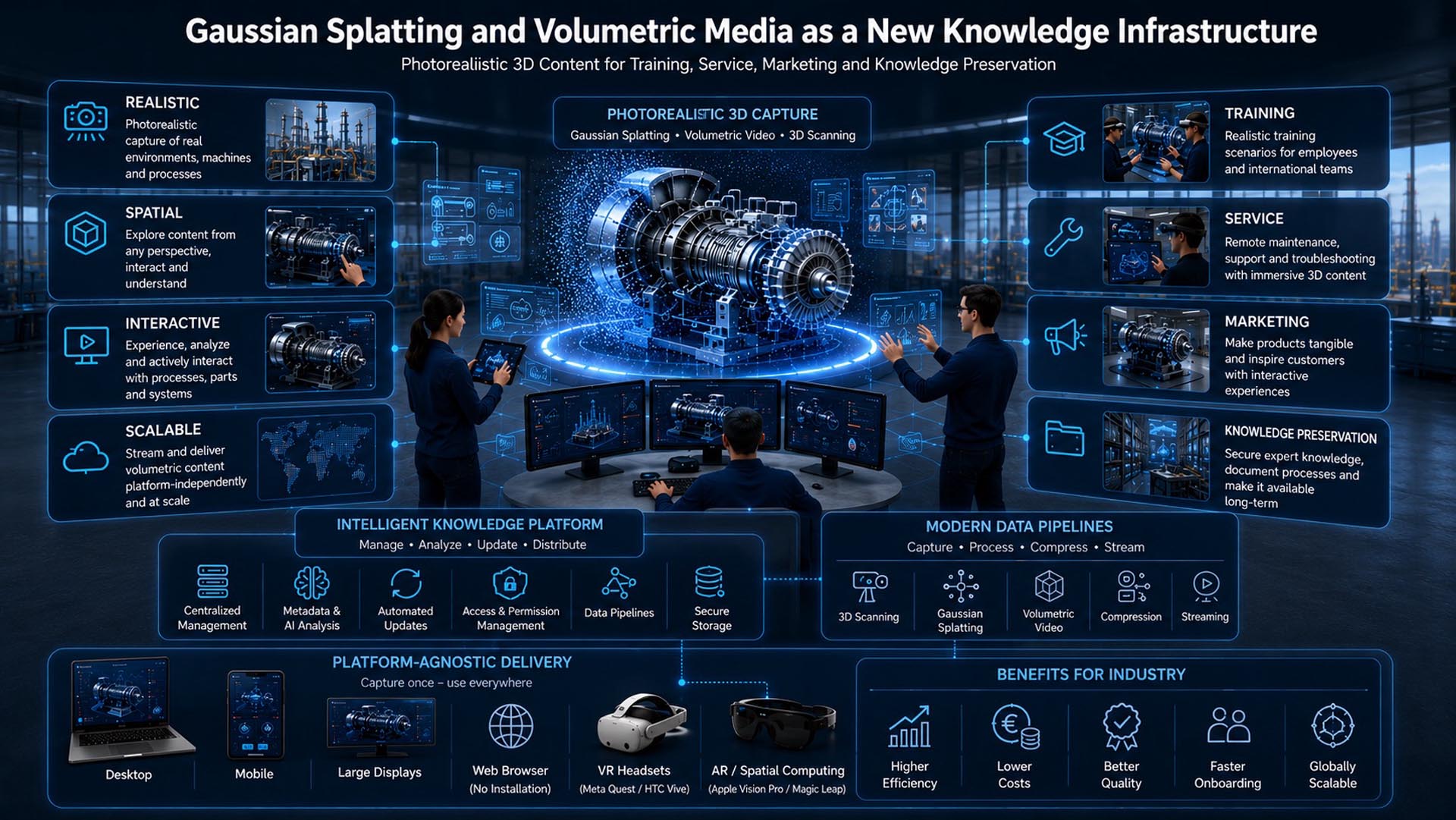
Gaussian Splatting and volumetric media combine photorealistic knowledge communication with immersive industrial platforms
Visualization: Immersive industrial knowledge environment with volumetric media formats, Gaussian Splatting, realtime 3D visualization and browser based Spatial Computing technologies | © VISORIC GmbH | Munich
The image illustrates how industrial knowledge communication is currently evolving. Instead of static documentation or isolated media formats, spatial knowledge platforms are increasingly emerging that connect real processes, photorealistic 3D content and interactive media structures.
Particularly relevant is the possibility of not only visually presenting complex technical systems, but making them realistically experienceable. Users can explore machines, processes and expert knowledge from different perspectives and understand technical relationships far more intuitively than in traditional training or documentation systems.
At the same time, it becomes clear that modern knowledge platforms increasingly integrate elements of realtime rendering, volumetric visualization, Spatial Computing and browser based streaming technologies. From this, a new generation of industrial knowledge infrastructures is currently emerging that increasingly expands or replaces traditional media formats.
The next chapter therefore analyzes how browser based Spatial Computing platforms and immersive web technologies could make industrial knowledge environments more flexible, collaborative and internationally scalable in the future.
The Spatial Web and the Industrial Metaverse
With the increasing convergence of browser based Spatial Computing platforms, Realtime 3D, artificial intelligence and immersive web technologies, a new generation of industrial knowledge spaces is currently emerging. Content is increasingly evolving from static documentation into interactive, spatial and collaborative systems that can be used flexibly across different devices and locations. [13]
Browser based platform technologies in particular are fundamentally changing the possibilities of industrial knowledge transfer. Complex machines, production environments and technical processes can now be visualized, analyzed and used interactively directly through web technologies, without the need for traditional software installations. This creates significantly more flexible and internationally scalable platform structures. [14]
At the same time, this also changes the requirements for modern industrial platforms. Companies increasingly need systems that can centrally manage content, update it in real time and flexibly provide it across desktop workstations, mobile devices, large displays and Spatial Computing platforms.
The following developments show why Spatial Web technologies and immersive platforms are currently becoming highly important:
- Browser based spatial systems → immersive content becomes flexibly and platform independently available
- Collaborative knowledge spaces → teams can analyze, train and interact together worldwide
- Realtime data integration → digital content can be dynamically connected with live data and backend systems
In the international technology context, this development is often described as the Spatial Web or Industrial Metaverse. This does not refer to isolated VR applications, but to connected platform architectures that combine Realtime 3D, digital twins, backend systems, artificial intelligence and collaborative processes. [15][16]
This development becomes particularly interesting through modern streaming and data pipelines. Photorealistic content such as Gaussian Splatting scenes, volumetric media or interactive 3D environments can now increasingly be provided directly via web browsers and streamed flexibly to different devices. This creates new possibilities for industrial training systems, service processes, product visualization and international knowledge transfer.
The expert team of VISORIC GmbH from Munich develops scalable platform solutions for immersive training, visualization and Spatial Computing systems together with industrial partners. Depending on project requirements, different realtime, web and infrastructure technologies are used, including the XR Stager Industrial Metaverse platform, browser based spatial interfaces as well as modern Realtime 3D and AI technologies.
The aim is to make industrial content such as CAD data, digital twins, volumetric media, Gaussian Splatting scenes and interactive 3D processes flexibly available across different devices, platforms and international application scenarios. Content should not only be visualized, but used over the long term as an intelligent and collaborative knowledge infrastructure.
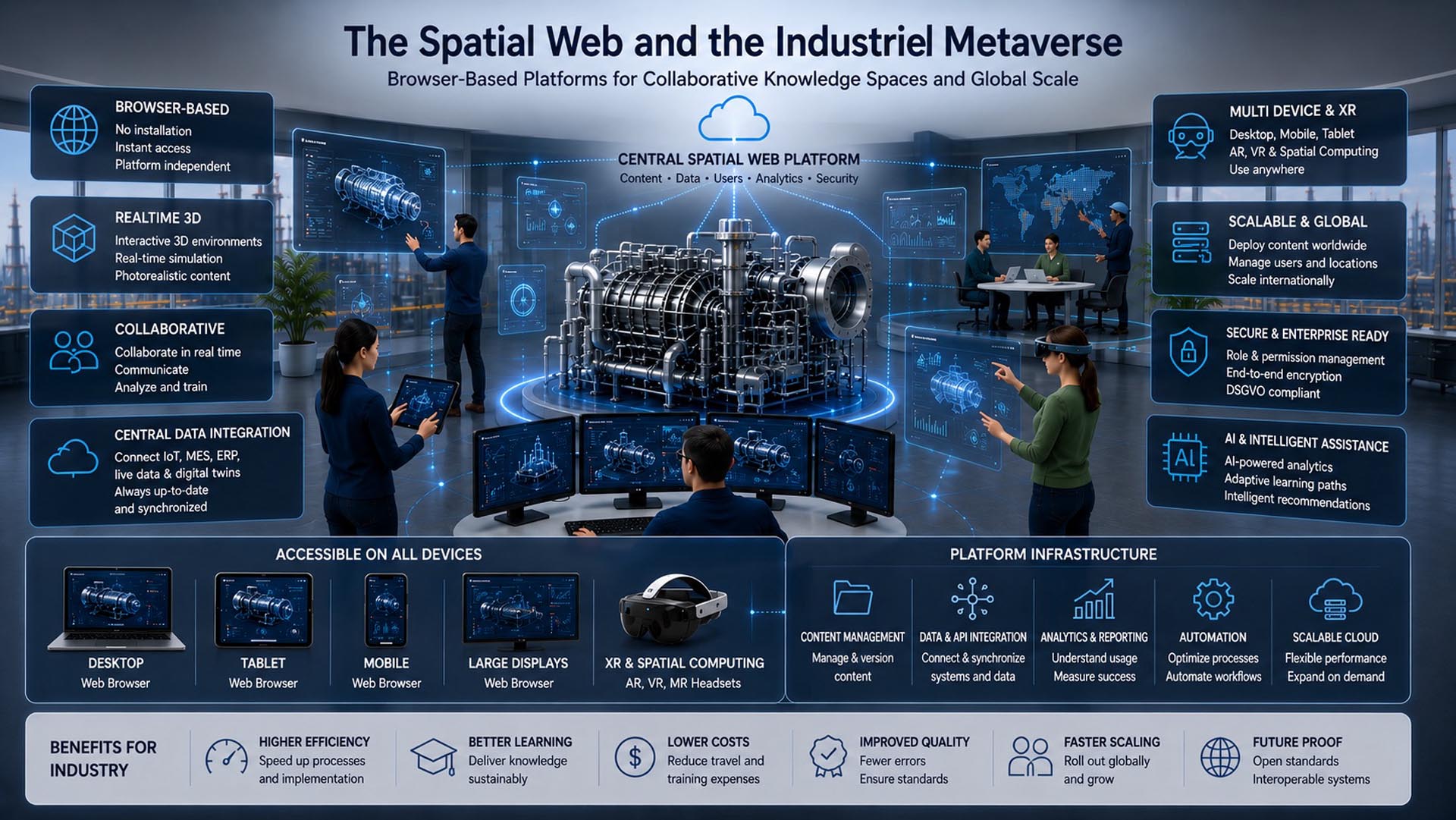
Browser based Spatial Computing platforms connect Realtime 3D, collaborative knowledge spaces and industrial training processes
Visualization: Immersive industrial platform environment with browser based spatial interfaces, Realtime 3D visualization, digital twins and collaborative training systems | © VISORIC GmbH | Munich
The image shows how industrial knowledge platforms are increasingly developing into connected Spatial Computing environments. Instead of isolated applications, immersive knowledge spaces are emerging in which technical content can be interactively visualized, jointly analyzed and flexibly used across different devices.
Particularly relevant is the ability not only to display complex industrial processes, but to make them usable as dynamic realtime environments. Teams can jointly explore machines, digital twins and technical systems, simulate processes and understand content much more intuitively than in traditional knowledge systems.
At the same time, it becomes clear that modern platform architectures increasingly combine browser based technologies, realtime streaming, collaborative interfaces and intelligent data structures. This is precisely where a new generation of industrial knowledge spaces is currently emerging, increasingly expanding or replacing traditional E Learning and documentation systems.
The next chapter therefore analyzes how intelligent data pipelines, artificial intelligence and adaptive platform structures could fundamentally change industrial knowledge transfer, training processes and immersive media platforms in the future.
Volumetric Video and Holographic Knowledge Transfer
With the increasing development of volumetric media formats, not only the visual quality of digital content is currently changing, but also the entire structure of industrial knowledge transfer. Training platforms are increasingly evolving from traditional video and documentation systems into spatial media environments in which people, processes and technical knowledge can be experienced far more realistically, interactively and immersively. [17]
Volumetric capture technologies in particular open up entirely new possibilities for industrial training, service and knowledge processes. Expert knowledge can now no longer only be stored as linear video content, but increasingly as spatially captured and interactive media structures. This creates holographic learning environments in which real people, machines and workflows can be communicated far more authentically. [18]
At the same time, this also changes the requirements for modern knowledge platforms. Companies increasingly need systems that can flexibly stream, analyze and deliver spatial media formats across different devices. Volumetric content is therefore increasingly evolving into a new form of digital knowledge infrastructure.
The following developments illustrate why volumetric media and holographic knowledge systems are currently becoming increasingly important:
- Spatial knowledge transfer → expert knowledge becomes interactively and three dimensionally experienceable
- Photorealistic presence → people, processes and machines can be represented far more realistically
- Flexible usage → content can be delivered through web browsers, mobile devices and Spatial Computing platforms
This development becomes especially interesting through modern Spatial Computing systems such as Apple Vision Pro as well as new holographic interaction concepts. Volumetric media can now increasingly be integrated directly into spatial user interfaces and combined with realtime data, digital twins and interactive 3D environments. [19][20]
This creates entirely new forms of industrial communication and knowledge transfer. In the future, experts will no longer only explain processes, but spatially demonstrate, analyze and interactively guide them. Especially in international training scenarios, service processes and complex maintenance environments, this opens up completely new possibilities for knowledge preservation and scalable training processes.
The expert team at VISORIC GmbH in Munich develops immersive platform solutions together with industrial partners for volumetric media, Spatial Computing and browser based 3D knowledge environments. Modern realtime pipelines, volumetric streaming technologies and interactive spatial interfaces are used to make industrial content flexibly available across different devices and usage scenarios.
The goal is not only to visualize technical processes, expert knowledge and industrial training content, but to make them usable long term as immersive and interactive knowledge systems. In particular, the combination of volumetric video, Gaussian Splatting, artificial intelligence and browser based spatial platforms is increasingly evolving into a new infrastructure for industrial knowledge transfer.

Volumetric media and holographic platforms combine spatial knowledge transfer with immersive training processes
Visualization: Immersive industrial learning environment with volumetric video, holographic interfaces, Spatial Computing and interactive knowledge platforms | © VISORIC GmbH | Munich
The image illustrates how industrial knowledge transfer is increasingly evolving from traditional media formats toward spatial and holographic platform structures. Instead of static videos or documentation, immersive knowledge spaces are emerging in which real people, technical processes and machines become interactively experienceable.
Particularly relevant is the possibility of making expert knowledge permanently available as a spatially captured media structure. Training content can therefore be communicated much more realistically, collaboratively analyzed and flexibly used across different devices.
At the same time, it becomes clear that modern platform architectures increasingly combine volumetric media, realtime streaming, artificial intelligence and browser based spatial interfaces. This is exactly where a new generation of immersive knowledge platforms for industrial training, service and communication processes is currently emerging.
The next chapter therefore analyzes the future role of digital twins, realtime data and intelligent platform structures for immersive training systems and industrial knowledge spaces.
Browser Streaming, Realtime Data and Scalable Immersive Platforms
With the increasing shift of immersive technologies into browser based platform environments, the technical foundations of industrial knowledge transfer are also changing. Training systems are increasingly evolving from isolated applications into flexible platform structures that can make content, data and immersive media formats globally available in realtime. [21]
Browser based Spatial Computing technologies in particular open up entirely new possibilities for industrial training, service and knowledge processes. Content no longer needs to be installed locally or tied to individual systems. Instead, open platform architectures are increasingly emerging that can flexibly deliver Realtime 3D, volumetric media, digital twins and interactive training environments directly through web browsers. [22]
At the same time, the requirements for modern data pipelines are growing significantly. Photorealistic 3D content, Gaussian Splatting scenes, Volumetric Video and complex simulation data must be processed efficiently, compressed and displayed with high performance across a wide variety of devices.
The following developments illustrate why browser based immersive platforms are currently becoming increasingly important:
- Browser streaming → immersive content can be delivered globally without local installation
- Cross platform usage → content works flexibly across desktop, mobile, XR and Spatial Computing devices
- Realtime data pipelines → volumetric media, digital twins and 3D content can be dynamically updated
This development becomes especially interesting through modern realtime engines and open platform technologies. Browser based Spatial Computing systems are increasingly evolving into intelligent infrastructures that connect immersive content, backend systems, user interactions and realtime data. [23][24]
This is precisely where new industrial knowledge environments are currently emerging, in which training, service, simulation and collaborative knowledge transfer merge together. Content can be deployed flexibly across different devices, locations and usage scenarios while remaining centrally manageable and scalable.
The expert team at VISORIC GmbH in Munich develops scalable immersive platform solutions together with industrial partners based on the XR Stager Industrial Metaverse and Spatial Computing infrastructure. The goal is to flexibly connect browser based Realtime 3D platforms, volumetric media, digital twins and intelligent data pipelines and make them usable for a wide variety of industrial applications.
In particular, open platform architectures and multi device strategies are becoming increasingly important. Content today must be made available flexibly across desktop systems, mobile devices, large displays, XR headsets and future Spatial Computing platforms. This is exactly where new immersive infrastructures for industrial knowledge transfer, service processes and global training systems are currently emerging.
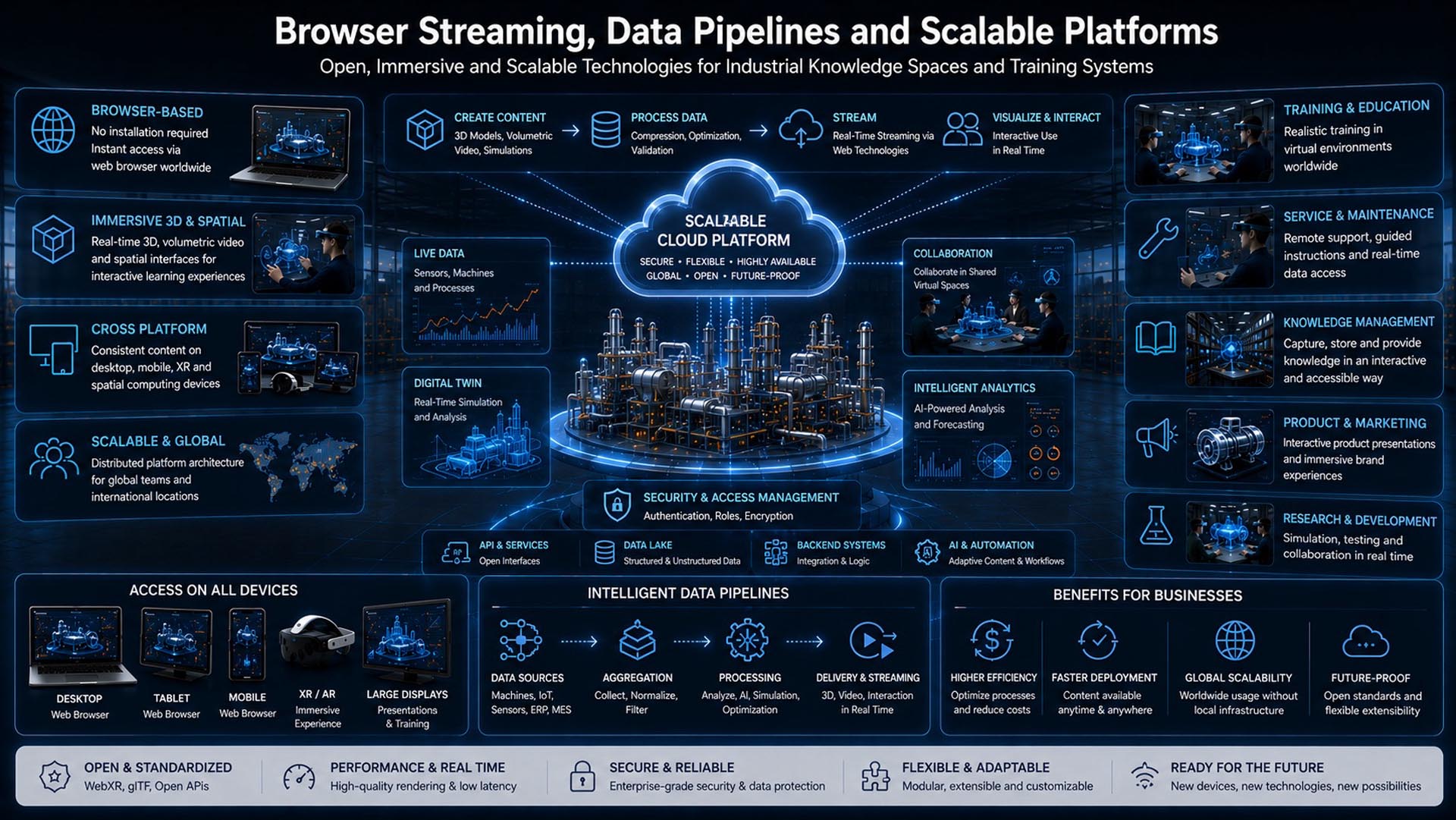
Browser based Spatial Computing platforms combine immersive media, realtime data and global knowledge environments
Visualization: Scalable immersive platform architecture with browser based streaming, volumetric media, Realtime 3D and intelligent data pipelines for industrial knowledge transfer | © VISORIC GmbH | Munich
The image illustrates how industrial platform technologies are currently evolving from isolated applications into open, connected and scalable knowledge infrastructures. Immersive content, realtime data and interactive media formats can be delivered flexibly across different devices and usage scenarios.
Particularly relevant is the possibility of making complex 3D content directly accessible through browser based platforms. Training systems, digital twins and volumetric media can therefore be distributed internationally, updated and collaboratively used much more easily.
At the same time, it becomes clear that modern immersive platforms increasingly need to integrate centralized backend systems, intelligent data pipelines and adaptive infrastructure components. This is exactly where new technological foundations for scalable industrial knowledge environments and immersive enterprise platforms are currently emerging.
The next chapter therefore analyzes how companies could strategically use immersive platform technologies in the future and what role spatial media formats could play long term for training, service, marketing and industrial knowledge preservation.
From Spatial Computing to Industrial Knowledge Preservation
With the increasing digitalization of industrial processes, not only the way knowledge is communicated is currently changing, but also how companies can preserve technical know how long term, manage it and make it internationally accessible. Immersive platform technologies and spatial media formats in particular are increasingly evolving into strategic tools for modern knowledge infrastructures. [25]
Many industrial companies are facing growing pressure to act. The experience based knowledge of long term experts, complex service processes and technical workflows are often difficult to document or transfer in a scalable way. At the same time, global teams, new technologies and shorter innovation cycles are accelerating the demand for flexible digital knowledge systems.
This is precisely where Spatial Computing, volumetric media and immersive platform technologies are becoming increasingly important. Knowledge can no longer only be documented in text form, but can now be spatially captured, interactively visualized and made available long term within digital experiential environments. [26]
The following developments illustrate why immersive knowledge platforms will become increasingly strategic in the future:
- Knowledge preservation → expert knowledge can be spatially documented and made available long term
- Immersive training environments → complex processes can be communicated interactively and close to real practice
- Global platform structures → content can be flexibly delivered across locations, devices and user groups
This development becomes especially interesting through the combination of Spatial Computing, volumetric media formats, artificial intelligence and scalable platform architectures. Training, service and knowledge systems are increasingly evolving into intelligent infrastructures that connect real processes, digital content and interactive user experiences. [27]
At the same time, entirely new forms of spatial knowledge environments are emerging in which expert knowledge is no longer only archived, but actively made experienceable. Volumetric Video, Gaussian Splatting, digital twins and browser based realtime platforms enable significantly more realistic forms of industrial knowledge transfer than traditional documentation systems.
The expert team at VISORIC GmbH in Munich develops scalable immersive platform solutions together with industrial partners based on the XR Stager Industrial Metaverse and Spatial Computing infrastructure. The goal is to flexibly connect spatial media formats, volumetric content, intelligent data pipelines and interactive knowledge environments and make them sustainably usable for industrial training, service and knowledge processes.
Open platform structures and adaptive knowledge systems are becoming increasingly important. Content today must be flexibly available across desktop systems, mobile devices, large displays and Spatial Computing platforms while also being centrally managed, analyzed and continuously developed. This is exactly where new technological foundations for industrial knowledge preservation and immersive enterprise platforms are currently emerging. [28]
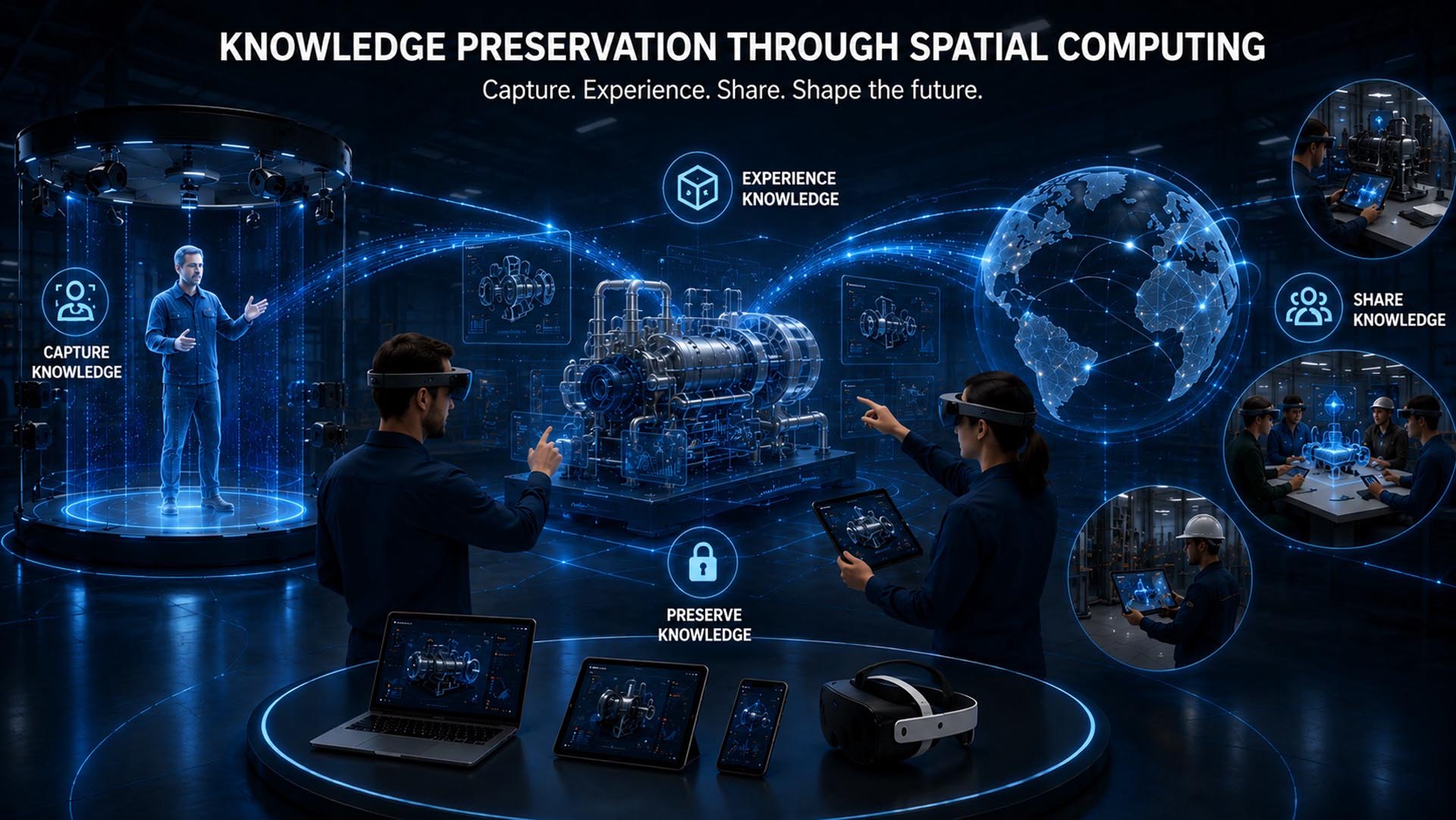
Immersive knowledge platforms combine Spatial Computing, volumetric media and industrial knowledge preservation
Visualization: Connected immersive knowledge infrastructure with volumetric media, Spatial Computing platforms, interactive training environments and globally scalable learning systems | © VISORIC GmbH | Munich
The image illustrates how industrial knowledge platforms are increasingly evolving into connected spatial infrastructures. Different devices, media formats and interactive content are interconnected through centralized platform structures.
Particularly relevant is the possibility of not only digitally storing expert knowledge, but making it interactively experienceable and sustainably scalable. Training processes, service workflows and technical content can therefore be communicated far more realistically and made internationally usable.
At the same time, it becomes clear that immersive platform technologies are increasingly becoming part of strategic enterprise infrastructures. Spatial Computing, volumetric media, digital twins and intelligent data pipelines are evolving into core components of modern industrial knowledge systems.
As a result, the focus is increasingly shifting away from isolated applications toward long term knowledge infrastructures that combine training, service, collaboration and knowledge preservation.
The next chapter therefore analyzes how immersive knowledge platforms could fundamentally transform industrial knowledge transfer long term and what role spatial media formats may play in the future for companies, expert networks and digital competence development.
How Immersive Media Could Transform Service, Training and Industrial Processes Long Term
With the increasing convergence of Spatial Computing, artificial intelligence, volumetric media formats and immersive platform technologies, not only industrial knowledge transfer is currently changing, but also the structure of modern work, service and training processes. Spatial media are increasingly evolving into strategic tools for knowledge preservation, assistance systems and digital competence development. [29]
Particularly in technology driven industrial environments, entirely new requirements for modern knowledge systems are emerging. Technical processes are becoming more complex, global teams are working in increasingly connected structures and service workflows must become significantly faster, more flexible and more efficient. At the same time, the demand is growing for platforms that do not only document knowledge, but make it interactively, spatially and sustainably scalable.
As a result, the role of immersive media formats is fundamentally changing. Gaussian Splatting, Volumetric Video, holographic interfaces and browser based Spatial Computing platforms are increasingly evolving from experimental technologies into central components of modern industrial knowledge infrastructures. [30]
The following developments illustrate why immersive knowledge platforms are gaining strategic importance long term:
- Spatial knowledge transfer → technical content becomes interactively, visually and practically experienceable
- Global accessibility → content can be flexibly delivered across different devices and locations
- Intelligent assistance systems → AI and immersive interfaces support analysis, training and service workflows
This development becomes especially interesting through the increasing convergence of different technologies. Immersive platforms are increasingly evolving into intelligent knowledge environments that combine Realtime 3D, holographic media formats, artificial intelligence, sensor data and collaborative processes. [31]
This creates entirely new industrial experiential environments in which training, service, analysis and collaboration increasingly merge together. Knowledge transfer is no longer understood merely as a static information process, but as a dynamic infrastructure that can flexibly adapt to real usage scenarios and industrial requirements.
The expert team at VISORIC GmbH in Munich develops immersive platform solutions together with industrial partners based on the XR Stager Industrial Metaverse and Spatial Computing infrastructure. The goal is to flexibly combine volumetric media, interactive knowledge environments, intelligent training systems and scalable platform architectures and make them sustainably usable for industrial service, training and knowledge processes. [32]
Open platform structures, browser based spatial interfaces and intelligent data pipelines are becoming increasingly important. Content today must be flexibly available across desktop systems, mobile devices, XR headsets and future Spatial Computing platforms. This is exactly where a new generation of immersive enterprise platforms is currently emerging that increasingly expands traditional knowledge systems and enables entirely new forms of industrial collaboration.
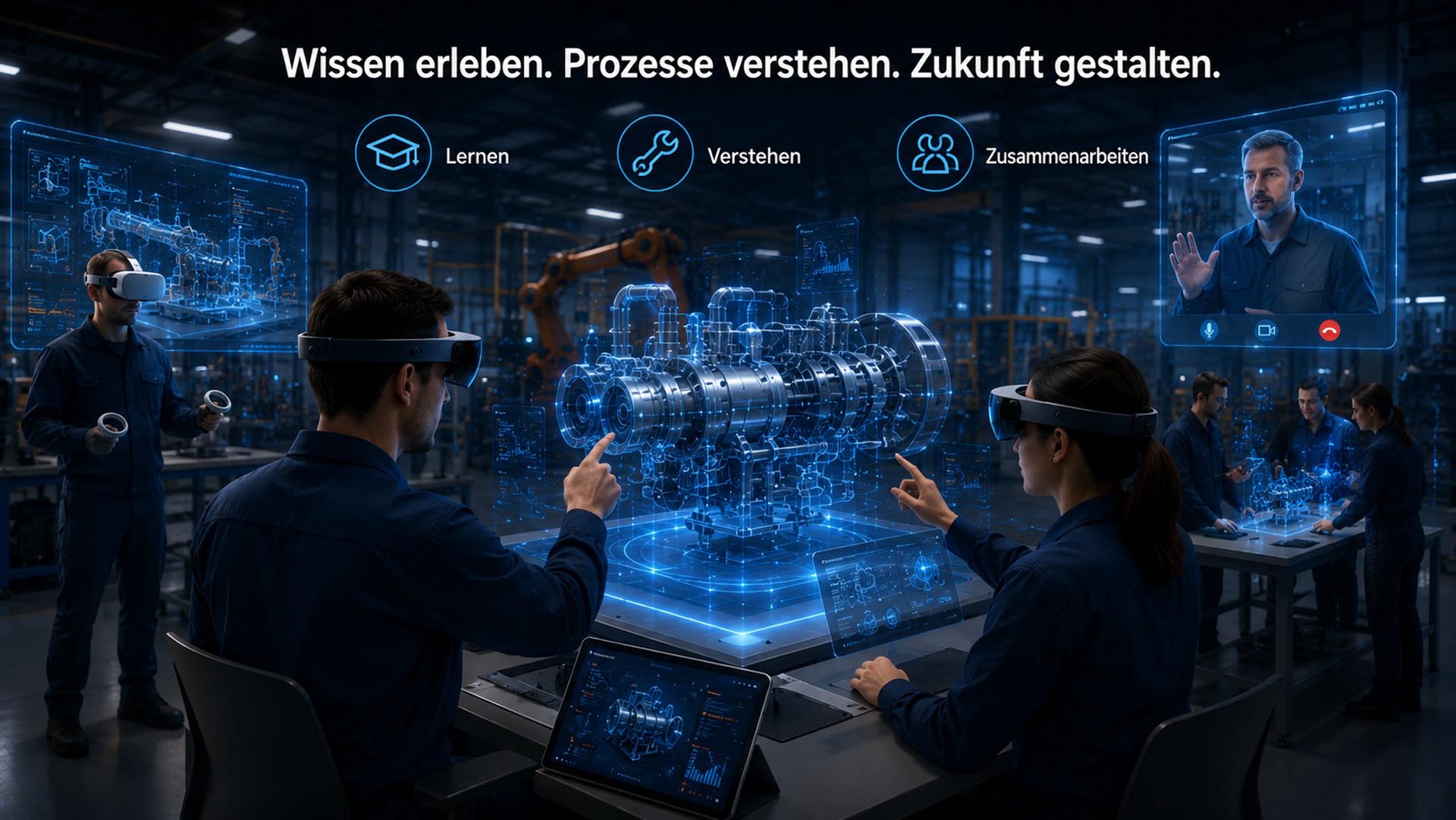
Immersive knowledge platforms combine Spatial Computing, volumetric media and intelligent industrial processes
Visualization: Intelligent industrial knowledge environment with volumetric media formats, holographic interfaces, collaborative training environments and scalable Spatial Computing infrastructure | © VISORIC GmbH | Munich
The image illustrates how industrial knowledge transfer is increasingly evolving into an intelligent spatial infrastructure. Realtime 3D, volumetric media, artificial intelligence and collaborative platform technologies are merging into immersive knowledge environments that operate much closer to real industrial processes than traditional training systems.
Particularly relevant is the possibility of not only digitally providing knowledge, but making it interactively experienceable, analyzable and sustainably scalable. Service workflows, training processes and technical assistance systems are therefore increasingly evolving into dynamic platform structures for modern industrial companies.
At the same time, it becomes clear that companies in the future will no longer only require isolated technologies, but flexible immersive infrastructures capable of intelligently connecting different media formats, data sources and usage scenarios.
This is exactly where a new generation of industrial knowledge and service platforms is currently emerging that increasingly expands traditional training and documentation systems while creating the foundation for future forms of digital collaboration.
The following section brings together and contextualizes the central developments of this article. At the same time, it analyzes the future role immersive platform technologies, volumetric media and Spatial Computing could play for industrial companies.
When Learning Becomes a Spatial Experience
The following video demonstrates how spatial media formats are currently evolving from traditional video formats into interactive knowledge environments. Instead of passive content, immersive media experiences are emerging that can be flexibly used through web browsers, Spatial Computing platforms and XR systems.
At the center is Gaussian Splatting as a new form of volumetric knowledge transfer. Users no longer view content only from a frontal perspective as in traditional videos, but can freely move through scenes, change perspectives and spatially experience real workflows. This creates a significantly stronger sense of presence, interaction and understanding.
This approach becomes particularly interesting for industrial training and service processes. In the future, expert knowledge can no longer only be documented, but spatially preserved and made interactively accessible. Maintenance procedures, repair workflows, training sessions or technical demonstrations therefore become significantly more realistic and intuitive to experience.
The presented scene highlights several developments that are becoming increasingly relevant for modern industrial knowledge platforms:
- Gaussian Splatting → real people and processes become spatially experienceable
- Volumetric Video → content can be viewed from every perspective
- Browser Streaming → immersive media becomes flexibly accessible through the web
- Spatial Computing → content dynamically adapts to real environments
- Knowledge preservation → expert knowledge can be made digitally available long term
The decisive difference lies not only in visualization, but in the entire user experience. Users no longer observe content from the outside, but move directly within the scene. Processes can be spatially understood, details analyzed more precisely and complex workflows communicated far more intuitively.
This creates entirely new possibilities for training, onboarding, technical service and industrial knowledge transfer. Content can be flexibly delivered across desktop systems, tablets, smartphones, AR devices or Spatial Computing headsets while also being centrally managed and internationally scalable.
Gaussian Splatting and volumetric media transform traditional videos into interactive spatial learning experiences
Credits: Based on insights from Andrey Volodin (Gracia AI) and Justin Ryan (@spatialinsider)
Particularly relevant is the possibility of not only storing expert knowledge as a document or video, but providing it as a spatially experienceable knowledge environment. Processes can therefore be communicated more realistically, scaled internationally and understood far more intuitively.
At the same time, it becomes clear that modern industrial knowledge platforms are increasingly converging from multiple technologies. Gaussian Splatting, volumetric media, realtime rendering, browser streaming, artificial intelligence and Spatial Computing are evolving into a new infrastructure for digital knowledge transfer.
The expert team at VISORIC GmbH in Munich develops scalable platform solutions together with industrial partners for immersive media, interactive knowledge environments and browser based Spatial Computing applications. The goal is to make complex industrial content sustainably usable, flexibly scalable and interactively experienceable.
From Spatial Media to Real Industrial Knowledge Platforms
Industrial companies are currently facing a central challenge. Technical knowledge must be communicated faster, made internationally accessible and preserved long term, while processes, systems and products are simultaneously becoming increasingly complex.
This is precisely where Gaussian Splatting, Volumetric Video, Spatial Computing and immersive web technologies are currently evolving into a new generation of industrial knowledge infrastructures. Instead of static documentation or traditional training videos, interactive spatial systems are emerging in which knowledge can be communicated far more realistically, intuitively and practically.
This becomes especially interesting for companies that want to explain complex machines, preserve expert knowledge long term, digitalize service processes or build entirely new forms of international training and onboarding structures.
The true added value does not emerge from isolated technologies, but from the intelligent combination of realtime rendering, browser based platforms, volumetric media, artificial intelligence and scalable data pipelines.
Immersive knowledge platforms combine Gaussian Splatting, Volumetric Video and Spatial Computing into scalable industrial learning and service systems
Visualization: Interactive industrial Spatial Computing platform for immersive knowledge transfer, volumetric media, Realtime 3D and browser based training systems | © VISORIC GmbH | Munich
The expert team at VISORIC GmbH in Munich develops scalable platform solutions together with industrial partners for immersive media, volumetric learning systems, digital twins and browser based Spatial Computing applications.
Depending on project requirements, customized solutions are created for:
- Training and onboarding → interactive knowledge transfer for international teams
- Service and maintenance → spatially experienceable processes and digital expert assistance
- Volumetric knowledge preservation → long term preservation of expert knowledge and process know how
- Marketing and product communication → immersive product and technology experiences
- Browser based Spatial Computing platforms → flexible usage across web, mobile and XR systems
- Scalable data and content pipelines → centralized management of immersive content and realtime processes
These are not isolated XR demonstrators, but long term usable platform architectures that can flexibly adapt to existing processes, systems and international enterprise structures.
This is currently becoming particularly relevant for companies that want to evaluate how immersive media, Spatial Computing, artificial intelligence and volumetric platform technologies can be meaningfully integrated into existing training, service or knowledge processes.
A joint workshop or strategy discussion often already provides initial insights into which technological approaches, platform architectures and infrastructure strategies could be suitable for different industrial application areas.
Contact the VISORIC Expert Team:
VISORIC GmbH
Bayerstr. 13
80335 Munich
Germany
Web: https://www.visoric.com
E Mail: info@visoric.com
Sources and References
The following sources form the scientific, technological and strategic foundation of this article. They are directly aligned with the individual chapters and thematic focus areas of the analysis.
- World Economic Forum, “Future of Jobs Report 2025”, analysis of workforce transformation, knowledge preservation and future competency requirements in industrial companies. [1]
- McKinsey & Company, “The State of AI and Industrial Transformation”, study on the role of artificial intelligence and digital platforms in industrial transformation processes. [2]
- Deloitte, “Spatial Computing and the Future of Enterprise Learning”, analysis of immersive learning systems and future industrial knowledge platforms. [3]
- IEEE, “Spatial Web Standards and Immersive Systems”, research on spatial interfaces, spatial information systems and immersive web technologies. [4]
- PwC, “The Effectiveness of Immersive Learning”, study on learning effectiveness and knowledge transfer in immersive training environments. [5]
- Fraunhofer Institute, “Future Industrial Learning Systems”, research on XR based learning systems and digital training platforms. [6]
- Harvard Business Review, “Why Traditional Training Fails in Complex Systems”, analysis of modern knowledge transfer in technology driven companies. [7]
- Learntec, “Corporate Learning Trends Report 2026”, analysis of current developments in E Learning, immersive learning systems and digital training platforms. [8]
- ResearchGate, “3D Gaussian Splatting for Real Time Radiance Field Rendering”, research on Gaussian Splatting and photorealistic realtime visualization. [9]
- NVIDIA Research, “Real Time Neural Rendering and Gaussian Splatting”, technologies for volumetric visualization and immersive media pipelines. [10]
- IEEE Access, “Volumetric Video Streaming for Immersive Applications”, study on volumetric media formats and realtime streaming. [11]
- MIT Technology Review, “The Rise of Spatial Media”, analysis of future spatial media formats and immersive knowledge transfer. [12]
- IEEE, “Spatial Web Standards”, research on spatial web structures, spatial interfaces and interoperable immersive systems. [13]
- Unity Technologies, “Realtime 3D Industry Report”, developments in Realtime 3D and industrial platform technologies. [14]
- NVIDIA Omniverse, “Industrial Metaverse and Digital Twins”, technologies for collaborative industrial realtime platforms. [15]
- Siemens, “Industrial Metaverse Research”, perspectives on industrial metaverse structures and immersive work environments. [16]
- 8i, “Volumetric Human Capture Technology”, technologies for volumetric human capture and holographic media formats. [17]
- Microsoft Mixed Reality, “Volumetric Capture for Enterprise Applications”, study on volumetric media in industrial environments. [18]
- Apple, “Spatial Video and Apple Vision Pro”, analysis of spatial media formats and Spatial Computing applications. [19]
- Meta Reality Labs, “Immersive Presence and Spatial Interaction”, research on spatial interaction and holographic interfaces. [20]
- Google Developers, “WebXR and Immersive Web Technologies”, technologies for browser based immersive platforms and spatial interfaces. [21]
- Mozilla, “The Future of the Immersive Web”, analysis of browser based XR systems and open platform architectures. [22]
- Epic Games, “Unreal Engine for Industrial Pipelines”, realtime rendering and scalable data pipelines for industrial applications. [23]
- Unity Technologies, “Cross Platform Spatial Deployment”, strategies for multi device deployment and scalable immersive platforms. [24]
- World Economic Forum, “Knowledge Retention in the Digital Era”, study on knowledge loss and digital competency strategies in companies. [25]
- McKinsey & Company, “Digital Knowledge Systems”, analysis of intelligent knowledge systems and digital enterprise infrastructures. [26]
- Accenture, “The Future of Spatial Computing in Enterprise”, perspectives on Spatial Computing and future knowledge platforms. [27]
- Visoric Research, “Spatial Knowledge Infrastructures and Industrial Learning Systems”, analysis of immersive knowledge platforms, volumetric learning environments and scalable Spatial Computing systems. [28]
- Siemens, “Human Centered Industrial Intelligence”, perspectives on human centered industrial assistance and learning systems. [29]
- Fraunhofer Institute, “Immersive Industrial Assistance Systems”, research on spatial assistance systems and collaborative training platforms. [30]
- MIT Media Lab, “Future Human Machine Interfaces”, research on holographic interfaces and future interaction concepts. [31]
- Visoric Research, “Volumetric Enterprise Learning and Spatial Media Systems”, study on volumetric knowledge transfer and immersive enterprise platforms. [32]
Contact Us:
Email: info@xrstager.com
Phone: +49 89 21552678
Contact Persons:
Ulrich Buckenlei (Creative Director)
Mobil +49 152 53532871
Mail: ulrich.buckenlei@xrstager.com
Nataliya Daniltseva (Projekt Manager)
Mobil + 49 176 72805705
Mail: nataliya.daniltseva@xrstager.com
Address:
VISORIC GmbH
Bayerstraße 13
D-80335 Munich