

Two artists, one production, one half shot for real, the other created from a prompt.
On the left, the shot is created the classic way, with a camera and tripod; on the right, the elaborate part of the same campaign, a luxury car and a private jet, is created purely from a prompt on a screen, without either ever having stood on location | Image: © Ulrich Buckenlei | XR Stager Online Magazine | VISORIC GmbH
A commercial that cost 2,000 US dollars and reached 20 million people. A boxer who never once stood in front of the camera for his own campaign film. A run of labels with 7 million individual designs that no studio could ever have drawn by hand. What connects these three productions is not their subject matter, but a shared precondition: none of them would have been economically or logistically feasible before generative AI.[1]
This very shift has now reached the leadership level of the advertising industry itself. At a panel discussion titled “Now that we have AI, why do we still need managers?”, Serviceplan CEO Florian Haller sat alongside representatives from Metaplan, the advertiser association OWM, and the magazine brand eins, and referred to a production that simply would not have existed without artificial intelligence, without naming the specific example publicly. It is exactly these kinds of examples, real, documented, and backed by hard numbers, that this article puts at its center.
- AI makes creative productions possible that used to fail due to budget or access.
- A $2,000 commercial reached 20 million people.
- One campaign was made entirely without access to its actual protagonist.
- The same technology also creates new risks around quality and authorship.
- Regulators in the US and EU now require clear labeling.
Using real cases, this article shows the three kinds of impossibility that AI actually resolves in creative production, exactly where the technology hits its limits, what new conflicts over authorship arise, and how companies can decide when using it is worthwhile and when it is not.
The Impossible Brief. When the Protagonist Simply Isn’t Available
Before generative AI, some campaign briefs were simply turned down because the basic precondition was missing: access to the person the campaign was about. One such case became the most discussed example in the entire industry in 2024.
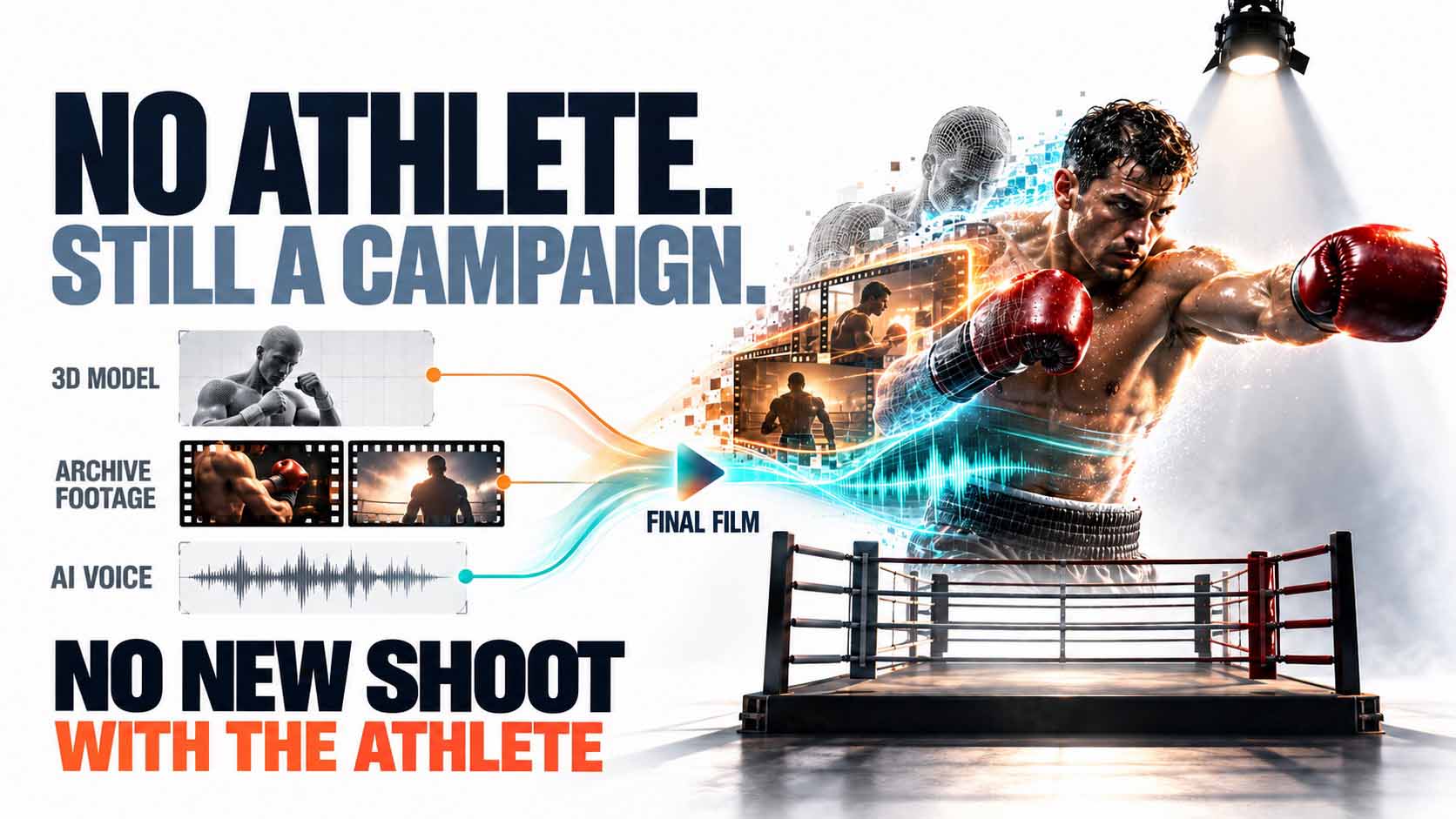
Under Armour wanted to celebrate its renewed partnership with boxing world champion Anthony Joshua, shortly before his fight against Francis Ngannou. Joshua himself, however, was fully occupied with fight preparations and unavailable for filming. The production company Tool got the job anyway, working from a strikingly sparse starting point: only a 3D model of Joshua and already-existing, licensed footage, not a single new day of shooting with the athlete himself.[2] Director Wes Walker later described it this way: Under Armour had asked for a film to be built entirely from existing assets, from a 3D model, with no access to the athlete at all.[3]
The result, “Forever Is Made Now,” combines AI video, AI photography, 3D CGI, 2D VFX, motion graphics, 35-millimeter footage, and an AI-generated voice trained on Joshua’s real tone, completed in just three to four weeks from concept to delivery.[4] A team of AI engineers, CGI artists, and traditional editors worked on it in parallel, not pure software automation, but a new, hybrid production model.
Two artists, one production, one half shot for real, the other created from a prompt.
On the left, the shot is created the classic way, with a camera and tripod; on the right, the elaborate part of the same campaign, a luxury car and a private jet, is created purely from a prompt on a screen, without either ever having stood on location | Image: © Ulrich Buckenlei | XR Stager Online Magazine | VISORIC GmbH
The Two-Thousand-Dollar Commercial
While Under Armour solved an access problem, a second example shows a completely different kind of impossibility: an advertising budget that simply would not have covered a classic production of this reach.
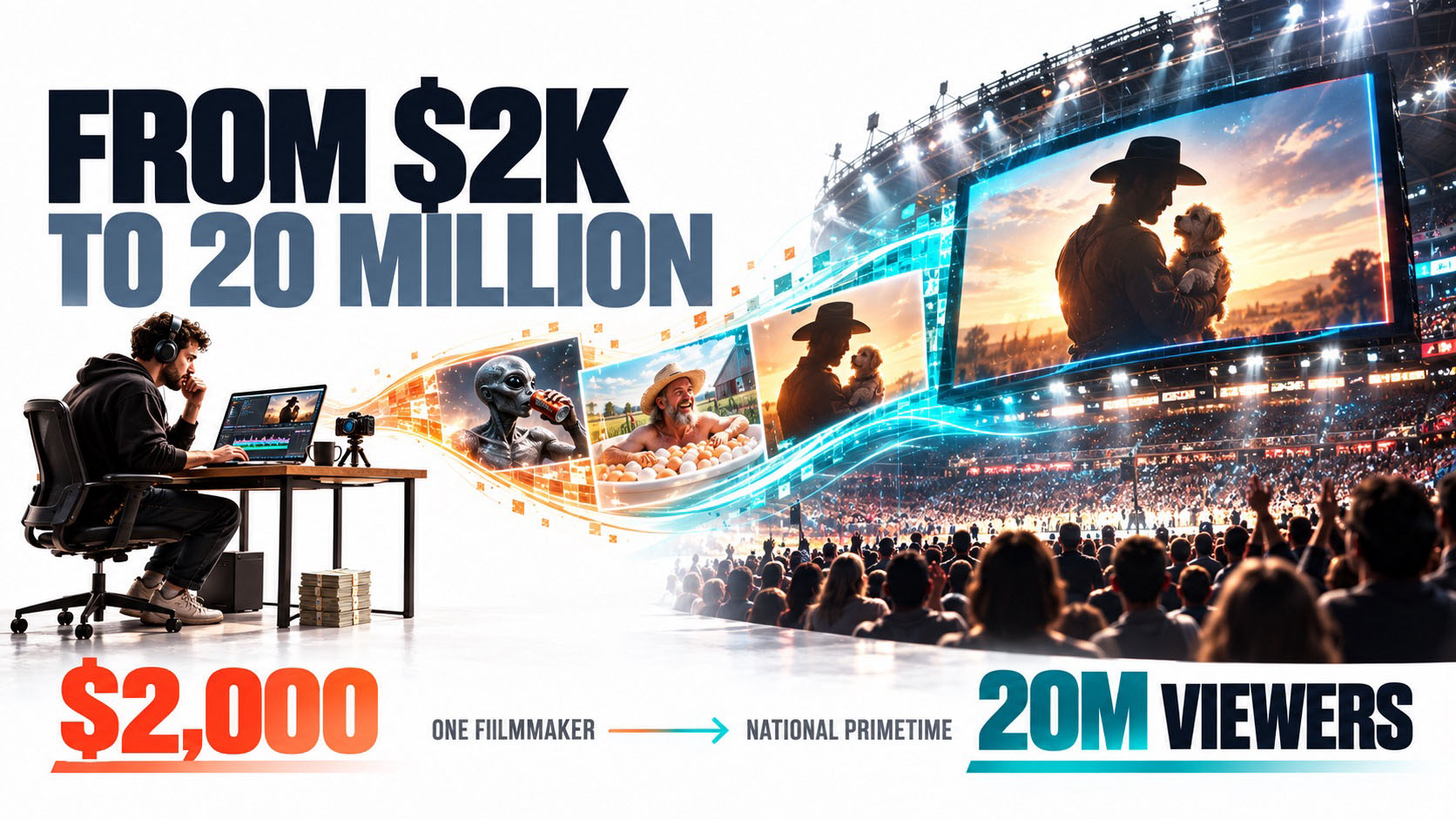
During the 2025 NBA Finals, the financial trading platform Kalshi aired a 30-second spot, a surreal mix of images featuring a farmer in an egg bath, a beer-drinking alien, and a man in a cowboy hat with a chihuahua. The entire spot was produced by a single AI filmmaker, PJ Accetturo, with a total budget of around 2,000 US dollars.[5] Despite this microbudget, the campaign reached roughly 20 million viewers and is considered one of the first AI-generated commercials to run in nationwide primetime.[6]
For comparison: a classic 30-second spot of comparable visual quality, with a film crew, studio rental, actors, and post-production, typically runs into the six or seven figures for a campaign of this scale. According to industry estimates, AI commercials save an average of 50 to 70 percent in production costs compared to classic shoots, because manual steps like editing, retouching, and effects are largely automated.[7]
A microbudget, an audience of millions.
Infographic: It illustrates the disproportion between Kalshi’s roughly $2,000 production budget and its actual reach of 20 million viewers during the NBA Finals | Graphic: © Ulrich Buckenlei | XR Stager Online Magazine | VISORIC GmbH
What stands out about this case is that no large agency, but a single filmmaker, was responsible for the entire production, a role that practically did not exist in classic advertising production.
- Kalshi’s NBA Finals spot cost roughly $2,000 to produce.
- A single filmmaker was responsible for the entire production.
- The campaign reached roughly 20 million viewers.
- Comparable classic spots cost six to seven figures.
- AI saves the industry an average of 50 to 70 percent in production costs.
Beyond missing access and missing budget, there is a third form of impossibility, one that has less to do with a single spot than with sheer volume. That is exactly what the next chapter shows.
When Scale Itself Becomes the Product
Some projects fail not because of access or budget, but simply because of the volume a single campaign demands. Two examples show how AI resolves exactly this third hurdle.
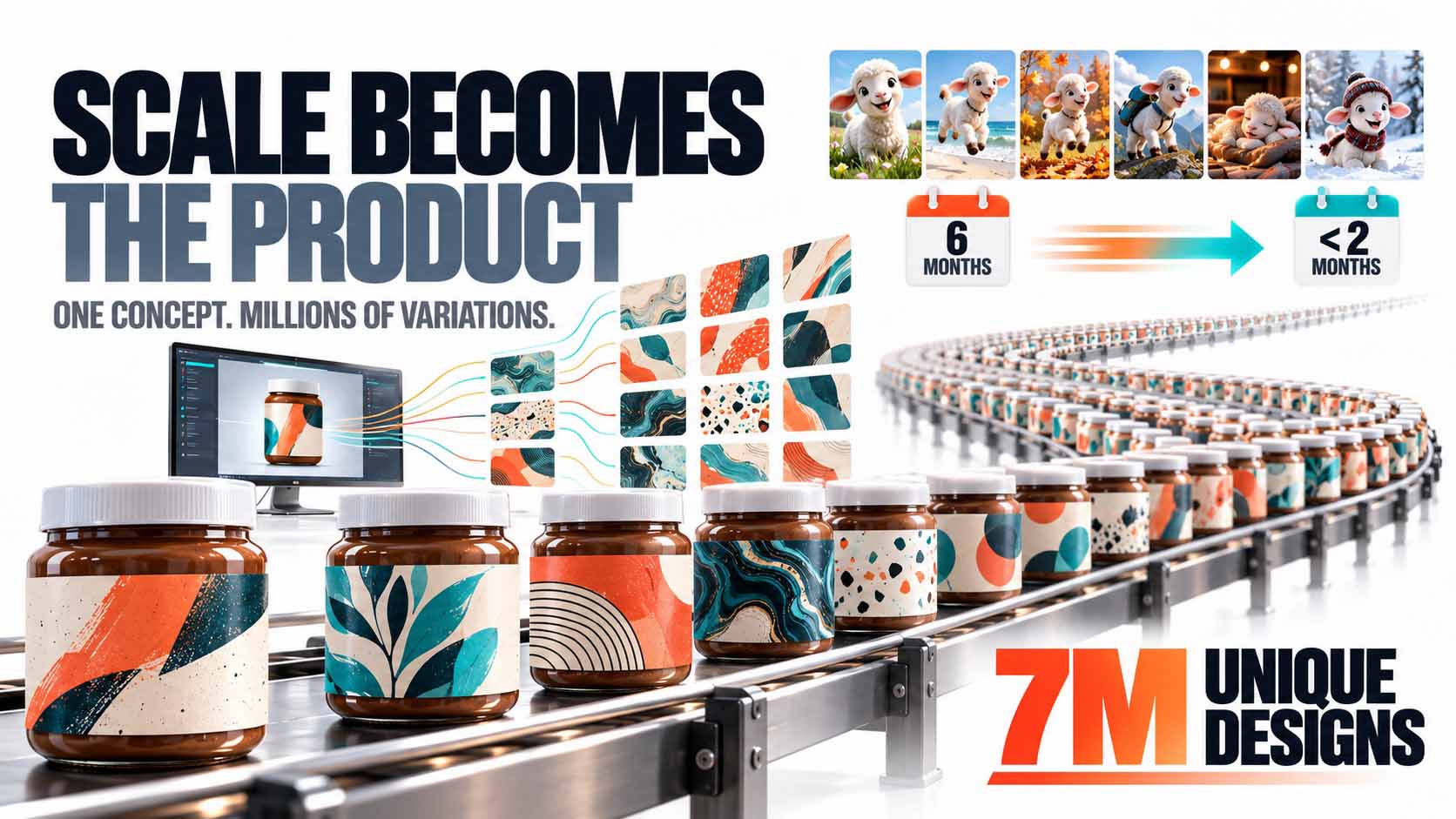
For a limited special edition, Nutella had 7 million unique label designs generated, each jar with its own individual pattern, a volume no design team in the world could ever have drawn by hand. Every single jar of the run sold out.[8] In China, meanwhile, the children’s milk brand Yili Jinlingguan produced China’s first fully AI-generated animated advertising series with “Youzi Little Sheep’s Quest for Freshness,” six episodes of three minutes each. Through a combination of AI and human direction, production time for the entire series shrank from the usual six months to under two months.[9]
Both cases point to the same underlying logic: it is not a single image or a single film that AI makes easier to produce, but an entire series, a variation, a personalized run, forms of production that previously would have been either unaffordable or simply impossible to finish in the available time.
7 million designs, one concept, no manual limit left.
Infographic: It shows how AI first makes mass personalization economically viable, as with Nutella’s 7 million unique label designs, and how it noticeably shortens production time for entire ad series, as with Yili | Graphic: © Ulrich Buckenlei | XR Stager Online Magazine | VISORIC GmbH
For brand managers, this opens up a new strategic option: large-scale personalization, once either scrapped entirely or limited to a few special editions, can now be planned as a regular campaign format.
- Nutella generated 7 million individual label designs using AI.
- Every jar of the limited edition sold out completely.
- Yili shortened a six-part animated series to under two months.
- Scale itself becomes a creative campaign format.
- Previously unaffordable personalization becomes a regular option.
Three very different examples, one shared pattern. How to pin down that pattern precisely, and what it means for the overall cost equation, is what the next chapter shows.
What These Examples Really Have in Common
Zooming out from the three individual cases, exactly three categories of impossibility emerge that AI resolves in creative production, and each has its own economic logic.
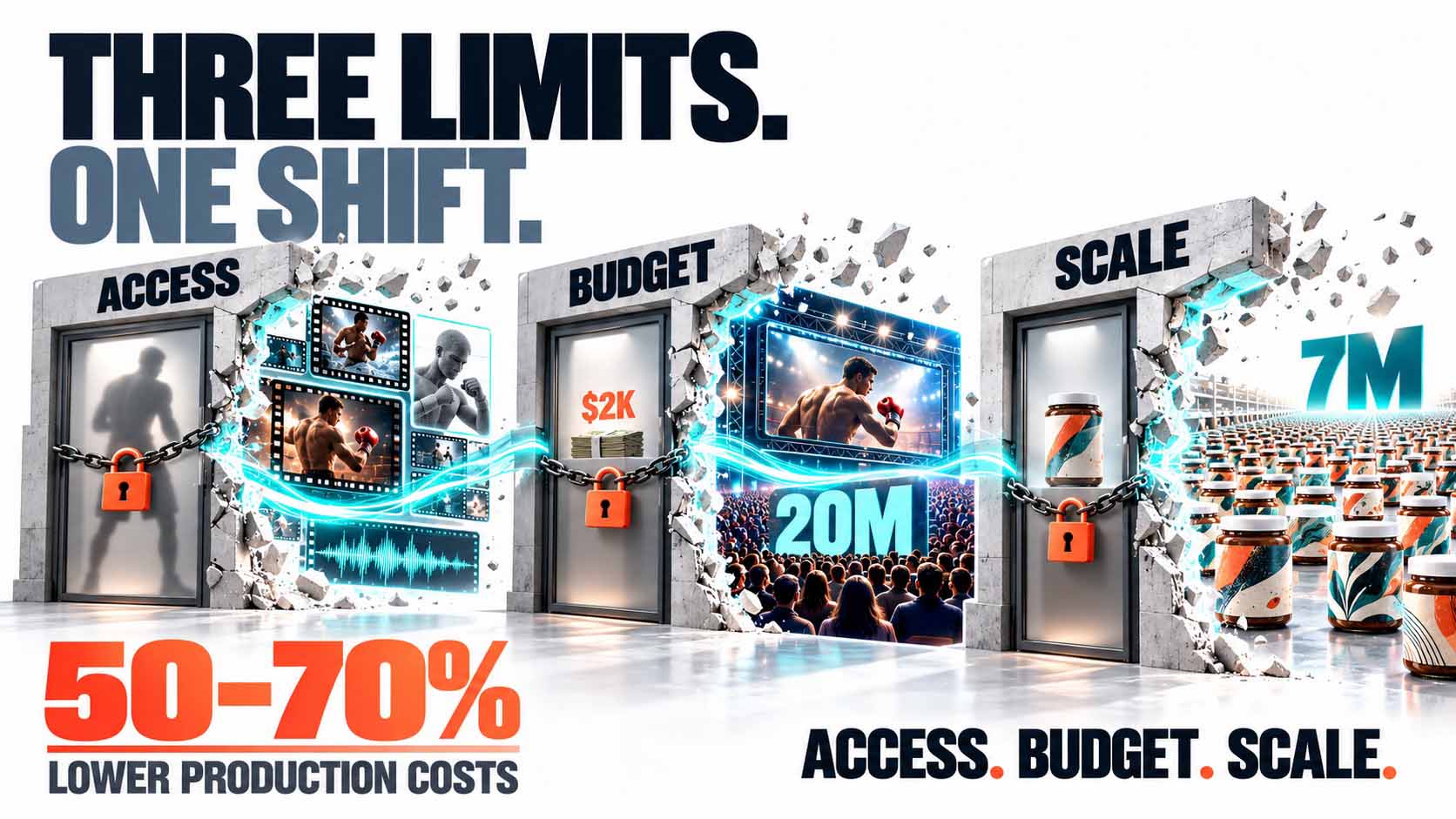
The first category is access: people, places, or moments that are simply unavailable for a classic production, as with Anthony Joshua. The second category is budget: productions that would have been possible in content terms but would have failed due to available funds, as with Kalshi. The third category is scale: volumes that no human production capacity in the world could have handled in the available time, as with Nutella and Yili.
Across all three categories, a consistent cost picture emerges. AI-assisted advertising productions save an industry-wide average of 50 to 70 percent compared to classic shoots, though the exact savings depend heavily on the chosen tool stack and the creative ambition involved.[7] What matters most here is not simply the cost reduction itself, but the fact that projects once flatly rejected are now even entering the calculation in the first place.
Three doors, one key.
Infographic: It summarizes the three categories on which creative productions most often used to fail before generative AI, lack of access, lack of budget, and lack of capacity for large-scale output | Graphic: © Ulrich Buckenlei | XR Stager Online Magazine | VISORIC GmbH
For marketing decision-makers, this three-way breakdown is exactly the practical value of this chapter: before dismissing a project as impossible, it’s worth asking which of the three hurdles is actually in the way, because for each one there is now a documented, working example.
- Three categories dissolve through AI: access, budget, scale.
- Each category has its own documented reference example.
- The average cost savings is 50 to 70 percent.
- What matters is that previously rejected projects become viable again.
- The exact savings depend heavily on the chosen tool stack.
As convincing as these three categories sound, they only tell half the story. What happens when the same technology doesn’t succeed but visibly fails is what the next chapter shows.
Where It Goes Wrong
As impressive as the previous examples are, AI production guarantees no good result. One prominent counterexample from the same year shows exactly where the technology visibly hits its limits.
At Super Bowl LX in February 2026, Svedka aired “Shake Your Bots Off,” a 30-second spot featuring the robot characters Fembot and Brobot, considered one of the first predominantly AI-generated national Super Bowl spots. Around 15 of the 66 spots at this Super Bowl contained AI elements or came from AI-focused companies.[10] The reaction to Svedka’s spot, however, was mixed to negative. Trade outlets like the Hollywood Reporter criticized inconsistent physics and “emotionally vacant” results in their roundup of the best and worst spots, characters that visibly changed between cuts, objects that didn’t obey gravity.[11]
The criticism hit exactly the point where AI production is still unreliable today: not basic feasibility, but craft consistency across the full length of a spot. The hurdle of simply getting an AI spot onto television has fallen; the hurdle of making a genuinely good one remains.

The hurdle to air has fallen, the hurdle to convince hasn’t.
Infographic: It illustrates where AI-generated commercials like Svedka’s Super Bowl entry drew criticism, for visibly inconsistent physics and characters that noticeably changed between individual cuts | Graphic: © Ulrich Buckenlei | XR Stager Online Magazine | VISORIC GmbH
For brands, this marks an important caveat to the success stories so far: a low budget or a tight timeline is no guarantee of a convincing result; craftsmanship remains the decisive factor even in AI-assisted production.
- Svedka’s 2026 Super Bowl spot was predominantly AI-generated.
- Around 15 of 66 Super Bowl spots in 2026 contained AI elements.
- Trade critics cited inconsistent physics and emotional vacancy.
- Characters visibly changed between individual cuts.
- The airing hurdle has fallen, the quality hurdle has not.
Besides craft quality, there is a second, often underestimated risk area, the question of whose work actually went into an AI spot. That is exactly what the next chapter is about.
The Question of Authorship
Beyond craft quality, AI production raises a second, legally and ethically thornier question: whose creative work actually went into a result that an AI system helped generate?
This very question also caught up with the Under Armour spot from Chapter 1. Shortly after release, creatives spoke up on Instagram and identified parts of the spot as reused, uncredited work by others. Director Gustav Johansson of the Scandinavian studio Newland stated that the spot was a remix of a complete, uncredited film production he had directed himself, featuring footage by cinematographer André Chementoff. A 2023 video by filmmaker Maik Schuster of Iconoclast Germany also turned up in the finished spot, likewise without credit.[12] Director Wes Walker publicly acknowledged that Under Armour had indeed initially tried to get direct access to Joshua, but this had been repeatedly declined, all within just three weeks from idea to delivery.[13]
The case illustrates a structural problem: AI systems are often trained on vast amounts of existing footage, with no way for clients or audiences to recognize whose specific work actually ended up in a given generated result. Johansson himself put it succinctly in the public exchange with Walker: the issue isn’t whether AI was involved, but how transparently a brand communicates whose work is actually behind it.[12]
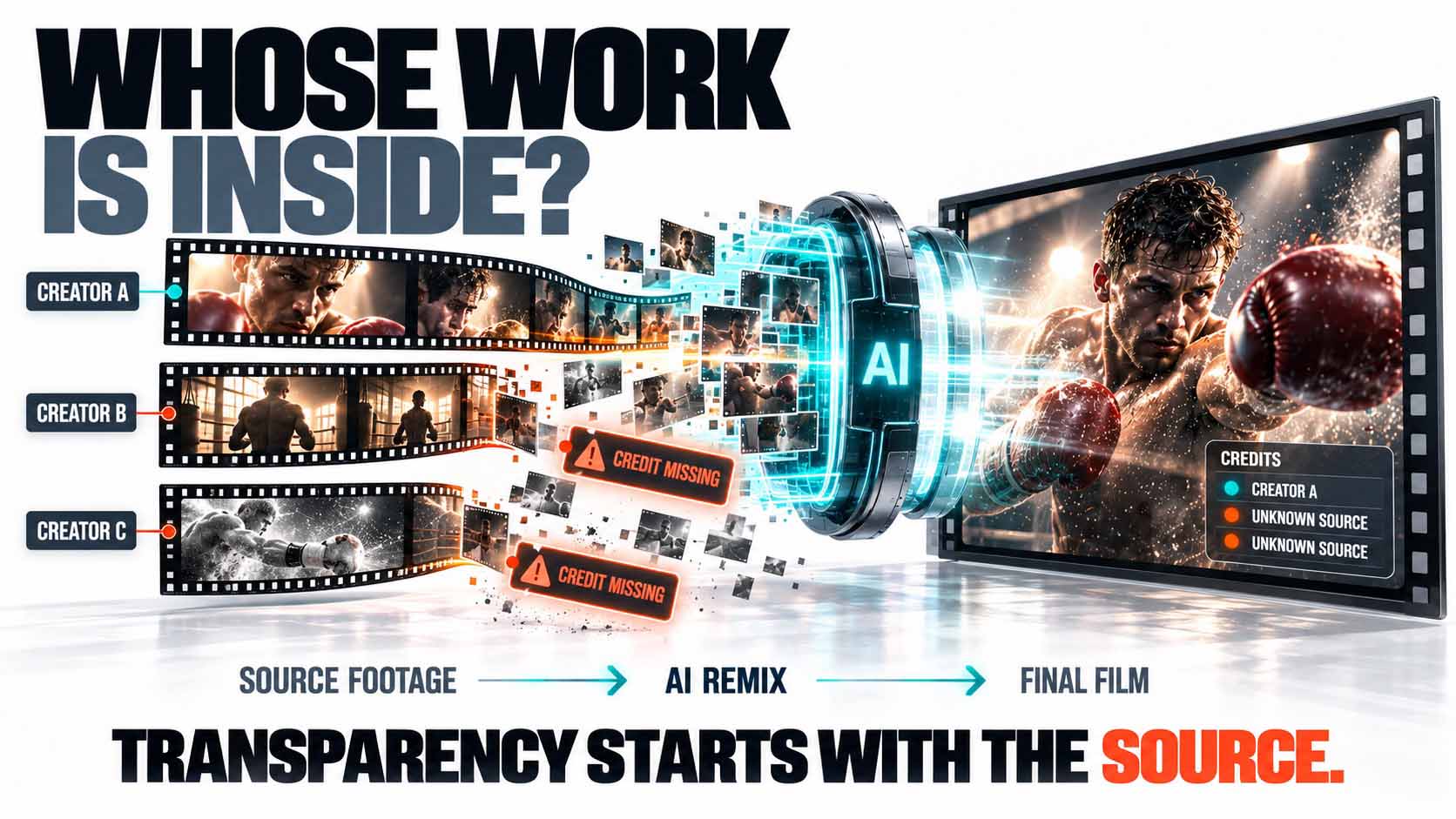
One spot, several authors, not all of them credited.
Infographic: It represents the authorship question that caught up with the Under Armour spot after the fact, when two filmmakers recognized their own uncredited material in the finished result | Graphic: © Ulrich Buckenlei | XR Stager Online Magazine | VISORIC GmbH
For companies, this means an additional duty of care that goes beyond pure technical feasibility: before any AI-assisted production, it should be established what training material the tools being used are based on, and how potential third-party rights are handled.
- The Under Armour spot drew criticism over uncredited source material.
- Two filmmakers recognized their own uncredited work in the finished spot.
- The director acknowledged the failed attempt at genuine access.
- AI training on existing material structurally blurs authorship.
- Transparency about training material becomes a new duty of care.
Quality risks and authorship questions are two sides of the same problem: a lack of transparency. How lawmakers are now responding to exactly that is what the next chapter shows.
Labeling Requirements and Audience Trust
Both the quality problems from Chapter 5 and the authorship questions from Chapter 6 ultimately come down to the same demand: audiences should know what they’re dealing with. Lawmakers are now enforcing exactly that.
Since June 9, 2026, the US state of New York has legally required advertisers to visibly disclose the use of AI-generated, synthetic performers in ads, with fines of up to $5,000 per violation.[14] Starting August 2, 2026, Article 50 of the EU AI Act requires that realistic-looking, AI-generated or AI-altered depictions of people, objects, places, or events be clearly labeled in a machine-readable way, a rule that explicitly covers advertising and corporate communications too, and that applies even to companies outside the EU as soon as their content is shown there.[15] In the US, the Federal Trade Commission additionally actively pursues unfair, misleading AI advertising under existing law, with recent fines exceeding $51,000 per individual case.[16]
These rules hit exactly the two sore points from the previous chapters: mandatory labeling makes quality shortcomings like Svedka’s more recognizable to audiences, and required transparency about the origin of material addresses precisely where the Under Armour case failed.

From August 2026, persuasive power alone won’t be enough, labeling becomes mandatory.
Infographic: It shows the regulatory framework that, starting in 2026, requires AI-generated advertising in the US and the EU to carry visible labeling for the first time | Graphic: © Ulrich Buckenlei | XR Stager Online Magazine | VISORIC GmbH
For companies, this carries a clear practical consequence: as of 2026, labeling is no longer an optional commitment to transparency, but a legal requirement in key markets with real consequences for violations.
- New York has required visible AI labeling in advertising since June 2026.
- The EU AI Act requires machine-readable labeling starting August 2026.
- The rule also applies to companies outside the EU.
- The US FTC is already imposing fines exceeding $51,000.
- In 2026, labeling shifts from a commitment to a legal obligation.
With this legal framework in view, a practical guide can now be derived for when AI production is actually worthwhile, and when the risk outweighs it. That is what the concluding chapter shows.
A Guide to When AI Production Is Actually Worth It
Zooming out from all the previous examples, a clear decision-making logic emerges for when AI-assisted creative production is the right choice, and when classic production or a hybrid approach remains preferable.
The first checkpoint is the category of impossibility from Chapter 4: is there genuinely an access, budget, or scale problem that AI can solve, or would a classic production have been feasible anyway? The second checkpoint is the core message: if the content is emotional, brand-defining material centered on a real, known person, the risk of visible quality shortcomings, as with Svedka, rises significantly, while scalable, decorative, or playful formats, as with Nutella, are considerably lower-risk.
The third checkpoint is the origin of the training material, clarified and documented before production starts, not after critics publicly pick apart the finished result. The fourth checkpoint is labeling itself, planned in from the start rather than negotiated after the fact, as described in Chapter 7. The fifth and final checkpoint is an honest expectation around time savings: three to four weeks, as with Under Armour, is achievable, but only with a well-coordinated, hybrid team of AI specialists and traditional filmmakers, not as a solo effort.
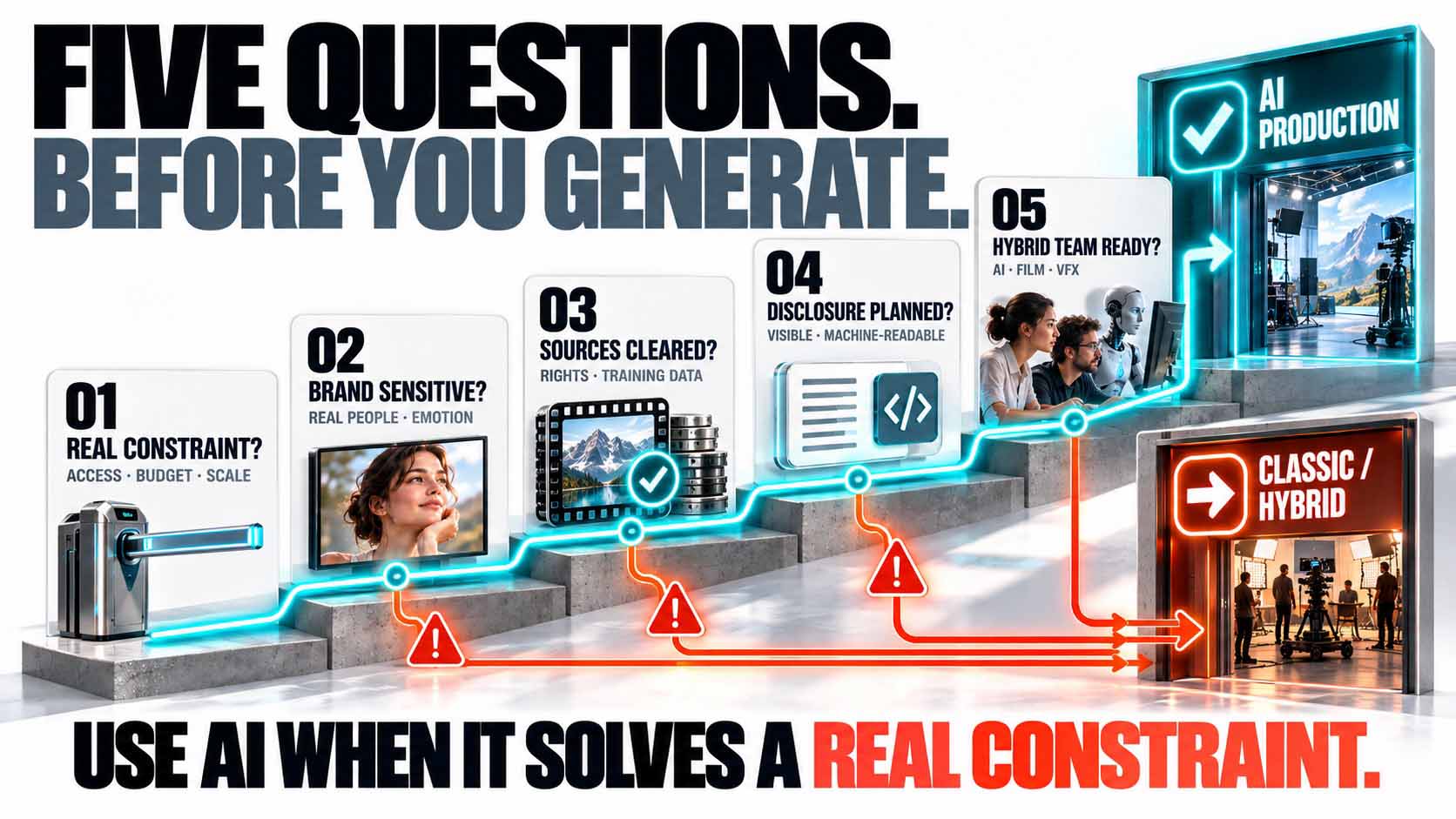
Five questions before the camera, or the rendering process, even starts.
Infographic: It summarizes the five-step decision path companies can use to check in advance whether AI-assisted production is actually worthwhile for a specific project | Graphic: © Ulrich Buckenlei | XR Stager Online Magazine | VISORIC GmbH
Companies that consistently check these five points can capture exactly the advantages from Chapters 1 through 4, without falling into the traps from Chapters 5 and 6.
- First check which category of impossibility is actually at play.
- Emotional core messages featuring real people carry higher risk.
- Clarify training material upfront, not after public criticism.
- Plan labeling in from the start, not negotiate it after the fact.
- Realistic timelines require a well-coordinated, hybrid team.
From Campaign Idea to Responsible AI Production
A convincing AI-assisted campaign doesn’t come from the right software alone, but from the thoughtful interplay of creative concept, clean sourcing, and realistic expectation management, exactly the combination that lies at the heart of VISORIC’s work.
The expert team at VISORIC GmbH in Munich combines over 15 years of experience in 3D, AI, and Spatial Computing with hands-on experience visualizing demanding brand projects, exactly the building blocks that also matter for AI-assisted campaigns, whether it’s a campaign film, a scaled product series, or a complex visual production. VISORIC helps companies capture the opportunities of AI-assisted production without falling into the traps around quality, authorship, or labeling.

15 years of experience in 3D, AI, and XR, the VISORIC expert team from Munich.
Image: © Ulrich Buckenlei | XR Stager Online Magazine | VISORIC GmbH
A well-thought-out pilot project, a single campaign, a single format, can often be realized considerably faster and with more legal certainty than many companies expect. VISORIC accompanies this path from the first concept idea through technical implementation to a legally sound, properly labeled final production.
- Creative concepting for AI-assisted campaigns and scaled productions.
- Clarifying origin, rights, and labeling requirements before production starts.
- From the first idea to a legally sound, convincing final production.
That’s exactly where the conversation should start: not with the big, company-wide vision, but with a clearly defined, quickly executable first project that shows where AI can genuinely move your creative production forward.
Which of your campaign ideas has so far only been missing access, budget, or time?
Talk to the VISORIC expert team from Munich about AI-assisted creative production, 3D visualization, and responsible implementation. Together, we’ll turn your idea into a convincing, legally sound, and properly labeled production.
Contact:
Email: info@visoric.com
Phone: +49 89 21552678
Sources and References
- Superside. 9 AI Marketing Campaigns Pushing Creative Boundaries in 2026.
- No Film School. Under Armour Launches AI Video Campaign.
- TechCrunch. ‘AI-powered’ ad ignites creator controversy on Instagram.
- Tool. Under Armour, Forever Is Made Now, official case study, toolofna.com.
- Digital Agency Network. AI Marketing Campaigns, Your 2026 Playbook.
- Superside. 9 AI Marketing Campaigns Pushing Creative Boundaries in 2026.
- That Works Media. The Best AI-Generated Commercials.
- Coupler.io Blog. AI Marketing Use Cases in 2026, Real Examples & Strategies.
- AI-CMO. AI Marketing Case Studies 2026, 15 Winning Campaign Breakdowns.
- Playcut. AI Commercial Generator, Famous Examples, Costs & How to Make One.
- The Hollywood Reporter, cited via Playcut. Super Bowl LX Best-and-Worst rating.
- Tech Times. Under Armour’s AI-Powered Commercial Draws Creative Backlash on Instagram.
- TechCrunch. ‘AI-powered’ ad ignites creator controversy on Instagram.
- Governor Kathy Hochul / billo.app. New York Synthetic Performer Law, in effect since June 9, 2026.
- Davis+Gilbert LLP. EU AI Act Guidance Expands AI Disclosure Rules for Advertisers and PR Teams.
- allaboutadvertisinglaw.com, thestacc.com. FTC enforcement against misleading AI advertising under Section 5.
- VISORIC practical projects in 3D visualization, AI production, and digital twins.
- XR Stager platform for real-time 3D, digital twins, and industrial Spatial Computing applications.
- VISORIC Praxisprojekte in den Bereichen 3D-Visualisierung, KI-Produktion und Digitale Zwillinge.
- XR Stager Plattform für Echtzeit-3D, Digitale Zwillinge und industrielle Spatial-Computing-Anwendungen.
Contact Us:
Email: info@xrstager.com
Phone: +49 89 21552678
Contact Persons:
Ulrich Buckenlei (Creative Director)
Mobil +49 152 53532871
Mail: ulrich.buckenlei@xrstager.com
Nataliya Daniltseva (Projekt Manager)
Mobil + 49 176 72805705
Mail: nataliya.daniltseva@xrstager.com
Address:
VISORIC GmbH
Bayerstraße 13
D-80335 Munich