
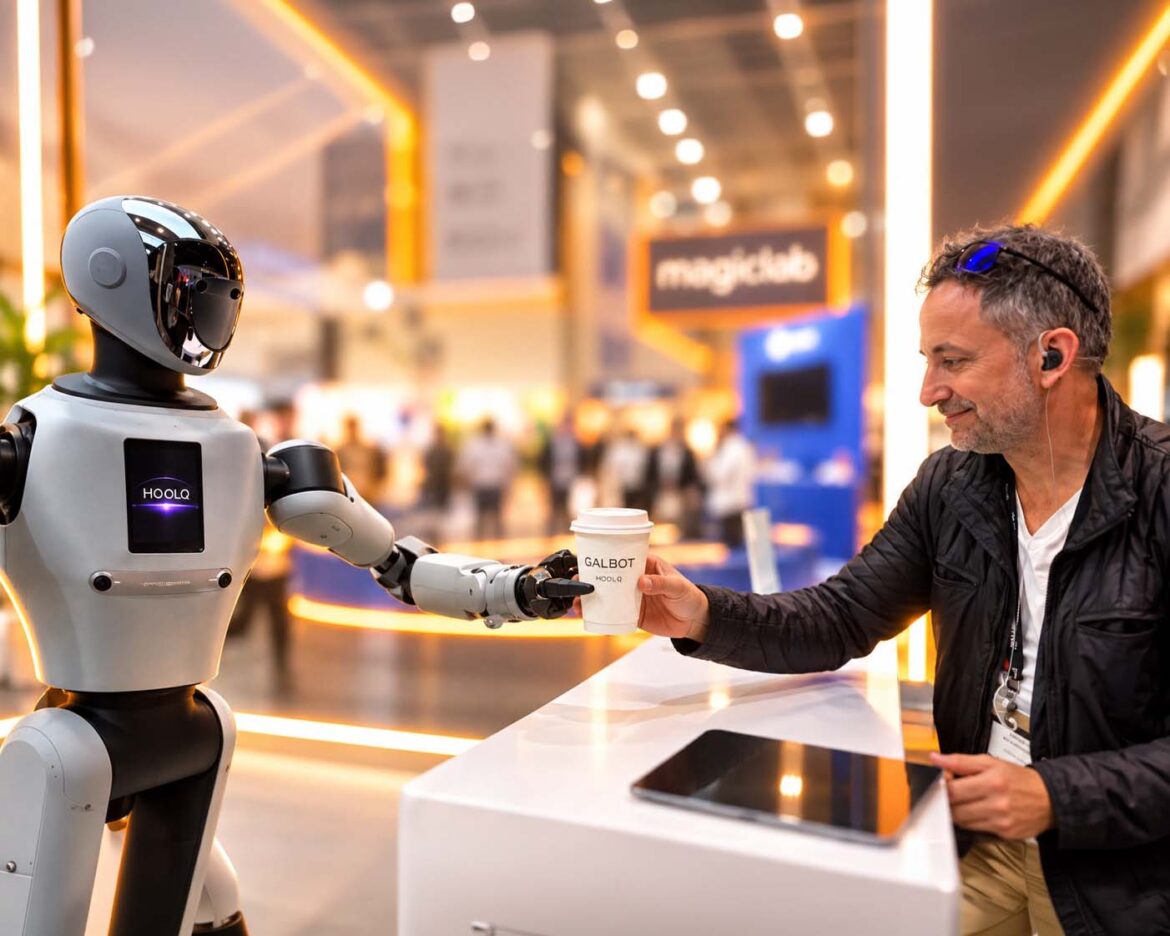
A robotic arm hands over the coffee, a humanoid assistant carries the conversation.
Photo: © Ulrich Buckenlei | XR Stager Online Magazine | VISORIC GmbH
A humanoid robot has been routinely handing coffee over the counter in Shanghai for months, in Amazon warehouses another one moves tens of thousands of boxes every day, and for 20,000 US dollars you can reserve one for your own living room this year. More than 140 companies worldwide are now working on machines with arms, legs and a torso, from billion-dollar US corporations to Chinese mass manufacturers.[1]
At the same time, independent studies show that these very systems fail in the vast majority of cases at everyday tasks outside controlled test environments, and that one market analyst after another has repeatedly revised its forecasts for unit numbers and market volume sharply upward within just a few months.[2] Humanoid robotics in 2026 genuinely moves between these two truths.
- More than 140 companies worldwide are developing humanoid robots for service and industry.
- China accounts for more than 80 percent of all global installations in 2025.
- A coffee robot in Shanghai stands in for hundreds of similar service deployments.
- The private household remains the most demanding use case, despite the first pre-orders.
- Analyst forecasts for unit numbers and market volume vary considerably.
This article sorts out what already works reliably today, what only looks convincing at first glance, which models and prices currently shape the market, and what a company needs to know if it is considering getting started in 2026.
Taking stock. More than 140 companies are building machines with arms and legs
The market for humanoid robots exploded before it matured. That makes orientation harder for companies trying to make a solid decision, but not impossible, once you distinguish between announcement and actual availability.
According to industry trackers, more than 140 companies are currently active in the humanoid robot business. Market researchers at Counterpoint Research put China’s share of all global installations in 2025 at over 80 percent, led by Unitree with around 5,500 units sold and manufacturer AgiBot with a good 5,168 units.[3] TrendForce expects a jump to over 50,000 units shipped worldwide in 2026, a rise of around 700 percent over the previous year.
One detail rarely shown in promotional videos is crucial for framing this correctly: not every robot on display is actually available for purchase. Tesla Optimus, for instance, remains a purely in-house product through mid-2026 despite all the announcements, every unit stays inside Tesla’s own factories. Boston Dynamics Atlas is in industrial pilot operation at Hyundai, with a commercial launch expected at the earliest between 2026 and 2028.[4] Anyone who can actually place an order today usually ends up with Chinese manufacturers such as Unitree, or with specialized niche providers like the German company NEURA Robotics.
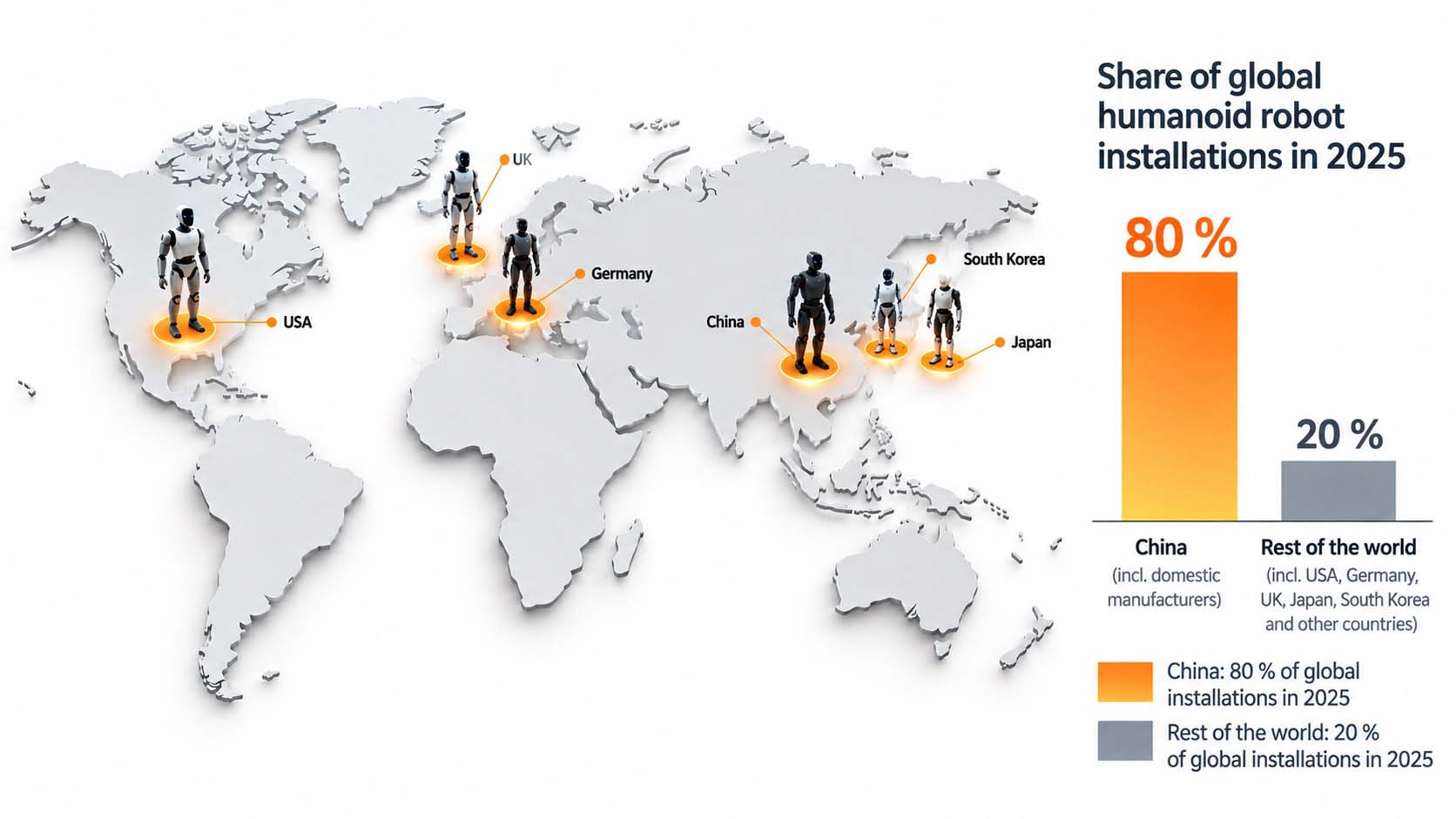
China accounts for the most units sold today, the US for the most attention.
Infographic: Locations of the leading humanoid robot manufacturers and market share by units, 2025 | Graphic: © Ulrich Buckenlei | XR Stager Online Magazine | VISORIC GmbH
That already establishes a first rule for any purchasing decision at this point: announcement, pilot operation and actual market availability are three different states that public reporting often presents as indistinguishable.
| Model | Manufacturer | Price (as of 2026) | Availability |
|---|---|---|---|
| Unitree G1 | Unitree (China) | 13,500–21,500 USD (EDU up to 74,000 USD) | Orderable, some delivery delays |
| Unitree H1 / H2 | Unitree (China) | 90,000–129,000 USD | Orderable |
| Figure 03 | Figure AI (USA) | no public price | Pilot operation (BMW) |
| Tesla Optimus | Tesla (USA) | Target price 20,000–30,000 USD | Not for sale, in-house use at Tesla only |
| Agility Digit | Agility Robotics (USA) | approx. 250,000 USD, or approx. 30 USD/hr as RaaS | Commercially deployed |
| 1X NEO | 1X Technologies (Norway/USA) | 20,000 USD, or 499 USD/month | Pre-order, deliveries from late 2026 |
| NEURA 4NE-1 Gen 3.5 | NEURA Robotics (Germany) | approx. 98,000 EUR (fleet approx. 60,000 EUR) | Deliveries from mid/late 2026 |
| Galbot G1 | Galbot (China) | no public unit price, B2B sales | Commercially deployed |
Eight models, three entirely different levels of availability.
Table: Prices and availability of selected humanoid robots, as of summer 2026 | Source: manufacturer data and independent trade media | © Ulrich Buckenlei | XR Stager Online Magazine | VISORIC GmbH
This table is the most important reference point before any research of your own: a model’s name alone says little about whether a company can actually order it or is merely reading an announcement.
- More than 140 companies are currently developing humanoid robots.
- China accounts for over 80 percent of all installations worldwide in 2025.
- Tesla Optimus is not yet available for purchase despite the announcements.
- Boston Dynamics Atlas is still in pilot operation at Hyundai.
- Unitree and NEURA Robotics already deliver systems that can genuinely be ordered.
Against this backdrop, it is worth looking at a concrete example that shows how far service robotics has already come in everyday life in China, well beyond individual trade show demonstrations.
Coffee without a barista. How China has long been testing service robotics in everyday life
What looks like a demonstration at a trade show like IFA has long been routine in major Chinese cities. That is exactly what one example shows, the example that sparked this article in the first place: at a booth in Berlin, our author ordered a cup of coffee via smartphone, two robotic arms brewed the drink behind glass, while a humanoid Galbot G1 supervised the station and interacted with customers.
The system behind it comes from Hooloo Coffee, a smart coffee brand owned by Shenzhen Haoyin Technology, which already operates such “Galaxy Capsule” robot shops at several locations in Shanghai.[5] Competitor Hi-Dolphin Robot Technology operates more than 500 automated coffee kiosk locations across China under the Cofe+ brand, by its own account, including hospitals, museums, bookstores and temples, with a capacity of up to 800 cups a day and a preparation time of around 50 seconds per cup. The company received one of the first food licenses for a robot café in China and closed a Series A funding round.[6]
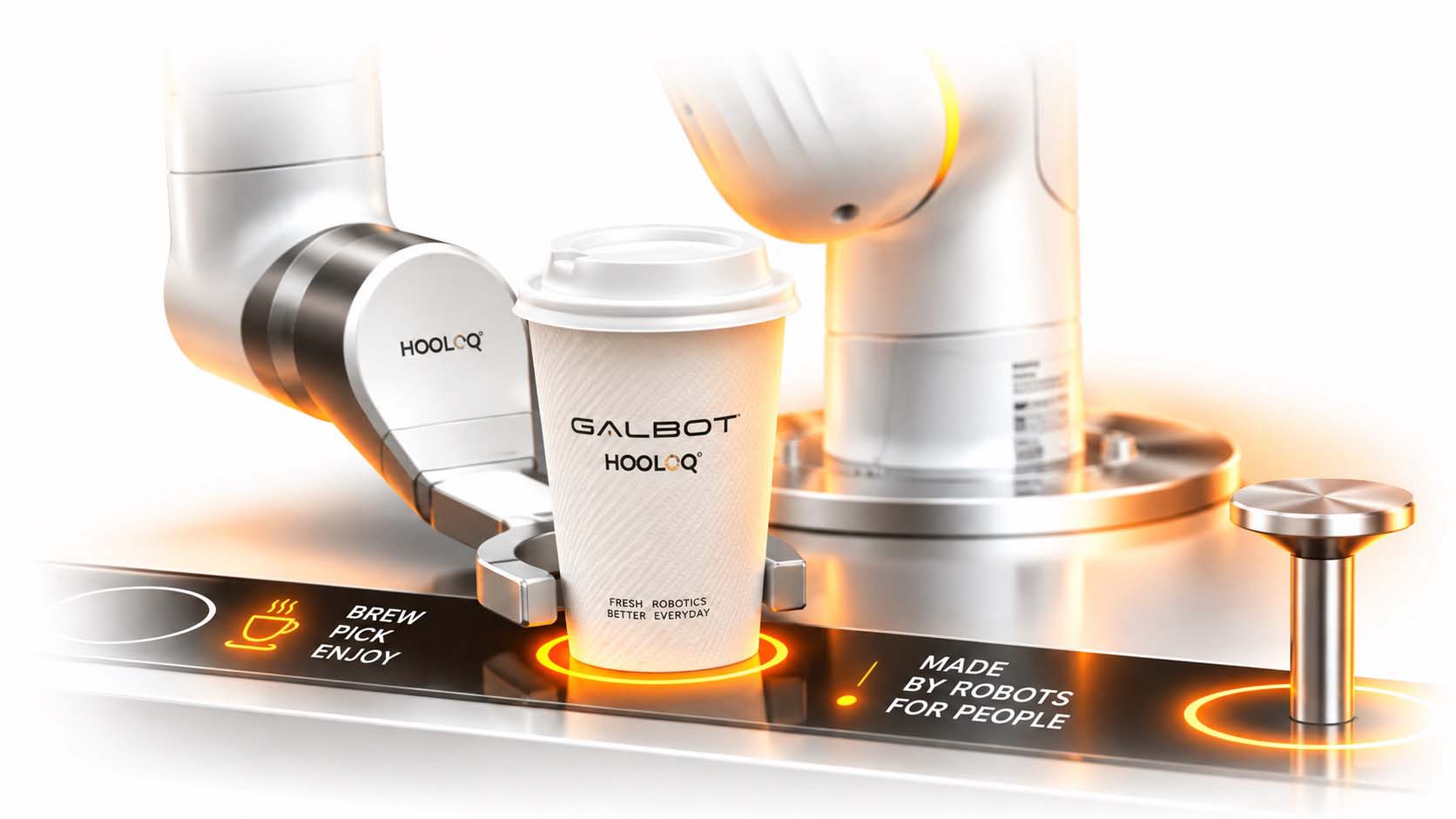
The proof is right there on the cup itself, GALBOT and HOOLOO, no made-up name.
Photo: Finished drink at the handover point of the Hooloo Coffee booth, IFA 2026, Berlin | Photo: © Ulrich Buckenlei | XR Stager Online Magazine | VISORIC GmbH
What stands out in these examples is less the technology itself than the business model behind it. It is not about making the robot as human-like as possible, but about a division of labor between mobile ordering, stationary precision automation, and a humanoid element that handles customer interaction exclusively. As the following chapters show, this exact pattern recurs in practically every working service robotics case.
- Hooloo Coffee already operates several robot cafés in Shanghai.
- Competitor Cofe+ counts more than 500 automated locations across China.
- A single Cofe+ system can handle up to 800 cups a day.
- Robotic arms handle the precision work, the humanoid handles customer contact.
- China has long been testing this model in everyday life, far beyond trade show halls.
As the next chapter shows, this division of labor also turns up outside China in entirely different industries, from hotel lobbies to airports.
From the hotel lobby to the airport. Further examples from around the world
Outside China, deployment density is lower, but the number of cases is growing noticeably, especially wherever staff shortages are already a real operational problem today, not just a theoretical one.
The American hotel industry reports staffing shortages at 87 percent of surveyed properties for 2025, according to the American Hotel & Lodging Association.[7] This is exactly where the first robot deployments come in: delivery robots for room service and housekeeping are already leased for 1,000 to 2,000 US dollars a month, while concierge-style humanoid systems cost between 25,000 and over 100,000 US dollars depending on configuration. Properties that introduce such systems report around 25 percent fewer calls to the front desk. Japan’s Henn-na Hotel remains a historical reference case, while Hilton’s concierge robot “Connie” is considered an early test case for guest-facing information robots.
Evidence in retail is now also more solid than pure marketing promises. SoftBank Robotics’ humanoid service companion Pepper was deployed in more than 1,000 Nestlé stores in Japan and is said to have contributed to a documented 15 percent sales increase for Nescafé coffee machines there.[8] In March 2026, Japan Airlines became the first airline in the world to deploy humanoid robots in live airport operations at Tokyo Haneda Airport, a clear signal that service robotics is starting to prove itself in high-traffic, public environments as well.
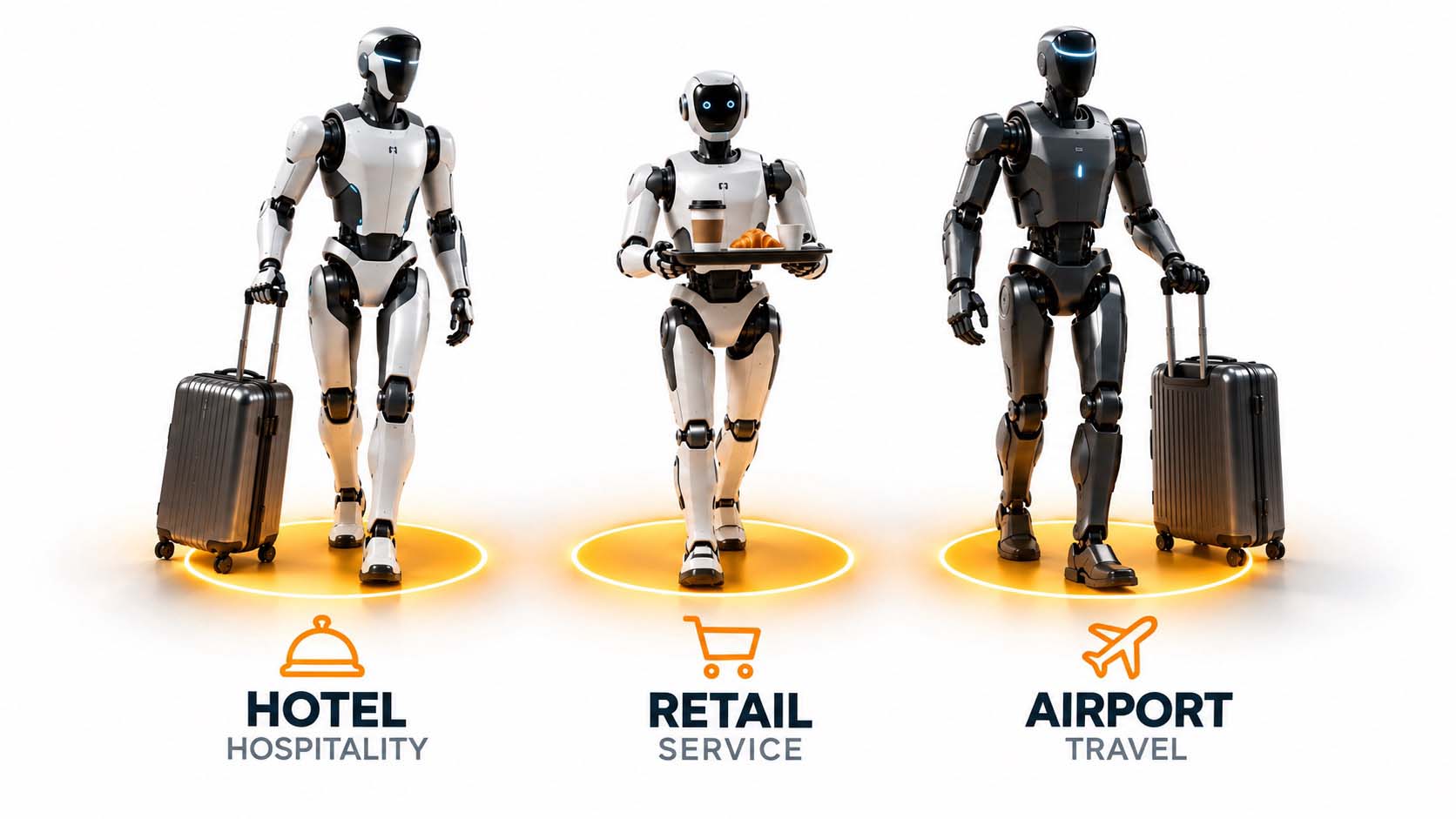
Three industries, one shared pattern, robotics wherever staff is missing.
Infographic: Service robotics examples from hospitality, retail and airport operations | Graphic: © Ulrich Buckenlei | XR Stager Online Magazine | VISORIC GmbH
These examples show that the path to humanoid service usually runs through simpler, cheaper intermediate steps, such as pure delivery robots, rather than jumping straight to a fully humanoid system.
- 87 percent of US hotels report staffing shortages in 2025.
- Robot deployment cuts measured front-desk calls by around 25 percent.
- Pepper achieved a documented 15 percent sales increase in Nestlé stores.
- Japan Airlines has deployed humanoid robots at the airport since March 2026.
- The path to a humanoid system usually runs through simpler intermediate steps.
All the examples so far have one thing in common: they take place in commercial, controlled environments. The next chapter shows what the picture looks like once a robot enters the private household.
The household. The industry’s most expensive promise
The private household is considered the most demanding use case of all, more demanding than any factory floor or trade show booth, and that is exactly where the technology still stands at the beginning.
In the fall of 2025, 1X Technologies launched the best-known attempt so far to actually bring a humanoid robot into private homes with NEO. For a purchase price of 20,000 US dollars or a monthly rental of 499 US dollars, the company promises help with folding laundry, washing dishes and tidying up, and more than 10,000 pre-orders have already come in.[9] The crucial caveat is usually in the fine print: NEO is not fully autonomous at market launch. For tasks the system cannot yet handle on its own, an “expert” employed by 1X takes over remote control via a VR headset, seeing directly into the customer’s home through the robot’s cameras. A Wall Street Journal investigation found that, with the exception of two simple hand movements, virtually every task shown in a widely watched product demonstration was actually remote-controlled.
A widely cited Stanford study, reported on by Fortune in May 2026, shows just how large the gap between demo and everyday reality really is: robots that achieved nearly 90 percent success rates in controlled simulations managed just 12 percent in real household and industrial tasks.[10] Other analyses put the failure rate for general household tasks outside strictly controlled test environments at around 88 percent.
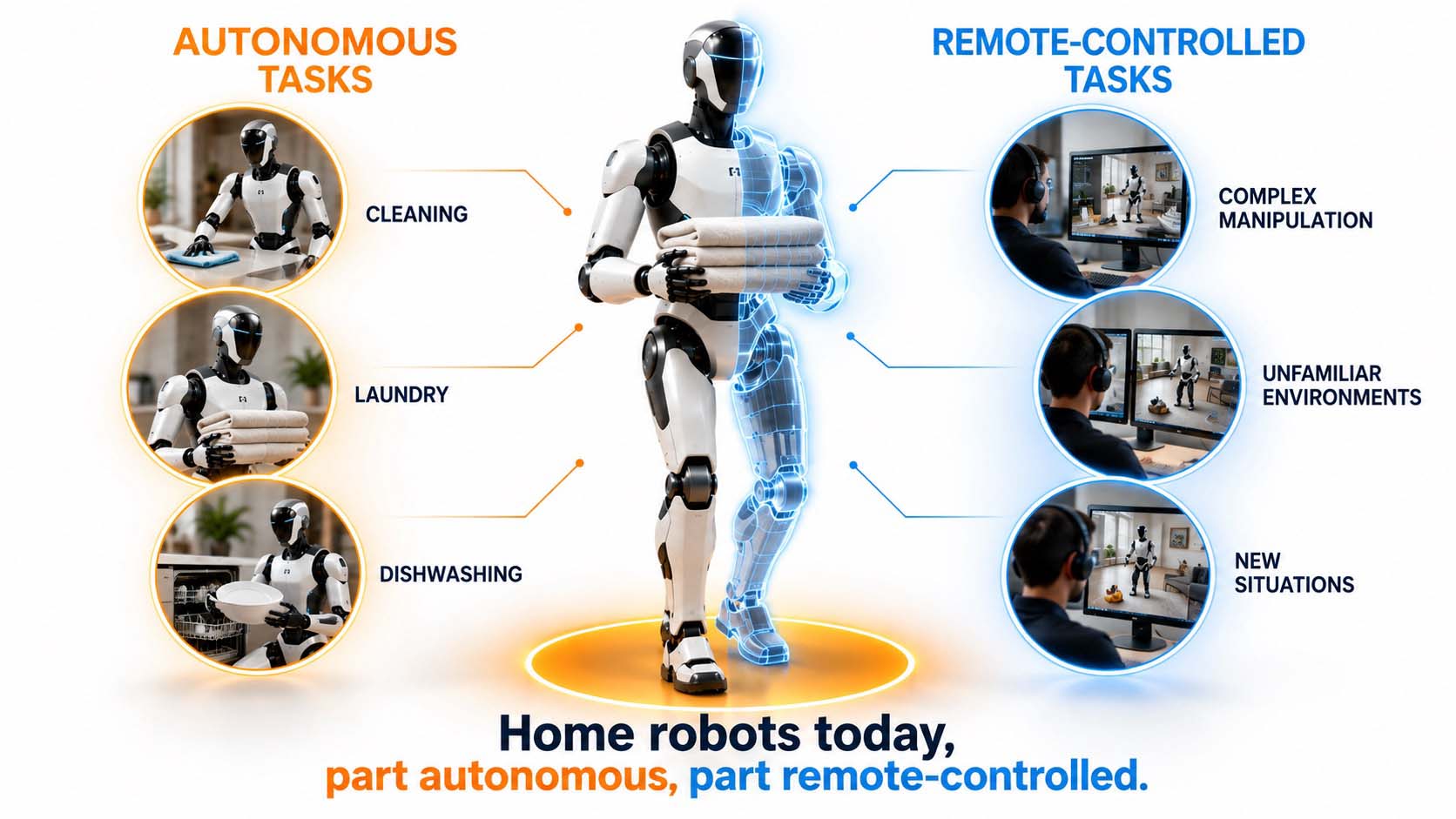
What looks like autonomy is often still remote control at market launch.
Infographic: Share of remote-controlled tasks in current household robots | Graphic: © Ulrich Buckenlei | XR Stager Online Magazine | VISORIC GmbH
For companies that believe in a swift, broad rollout to private customers, the Stanford figure is an important reality check. For trade media such as TechRadar, the case is also reason enough to openly discuss the remote-control model as a privacy issue, quite apart from its raw performance.
- 1X NEO costs 20,000 US dollars, or 499 US dollars a month.
- More than 10,000 pre-orders are already in, with delivery starting late 2026.
- Nearly every task shown in a WSJ investigation was remote-controlled.
- A 90 percent simulation success rate drops to 12 percent in the real world.
- Privacy questions around remote control remain publicly unresolved.
This gap between demo and practice leads directly to the next, more fundamental technical question: what exactly is holding back reliability today, regardless of the specific use case.
Why reliability is still the real bottleneck
It is not appearance but battery life, error rates and system integration that currently determine the practical value of a humanoid robot, far more than any marketing footage would suggest.
Conventional industrial robots from manufacturers such as FANUC, ABB or KUKA typically achieve 95 to 99 percent uptime in established production environments. Humanoid systems still fall noticeably short of that. According to an IEEE Spectrum investigation from October 2025, Agility Digit lasts around 90 minutes before a nine-minute fast charge, which is why Amazon works in 30-minute cycles in practice. Figure 03 manages roughly three to four hours of active runtime, while UBTECH Walker S2 gets two hours walking or four hours standing. No currently available model can complete a full eight-hour shift without recharging.[11]
On top of that come technical details rarely visible in product videos: standard Wi-Fi in factory halls full of metal delivers latencies of 50 to 200 milliseconds, while safety systems typically need under 10 milliseconds for a reliable emergency stop. Integration into existing operating systems also regularly takes twice as long as originally planned in practice, even for experienced industrial customers like BMW. The consequence for the economics: most warehouse deployments do not yet achieve a positive return on investment in the first two years, that typically only materializes in years three to five.[12]
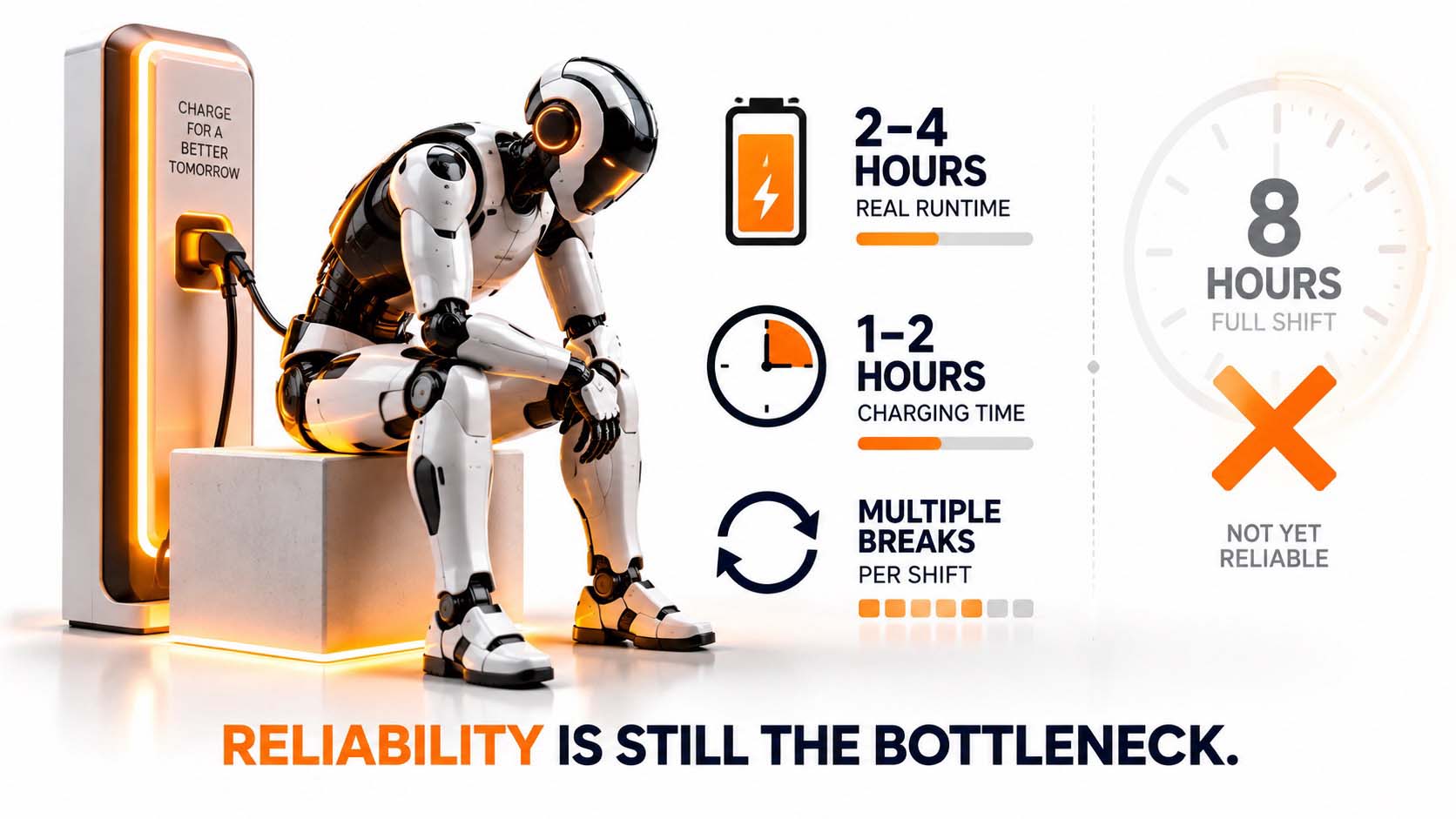
No eight-hour shift without a charging break, for any current model.
Infographic: Active operating time and charging breaks for selected humanoid robots over the course of a day | Graphic: © Ulrich Buckenlei | XR Stager Online Magazine | VISORIC GmbH
For decision-makers, this means the return on investment of a humanoid purchase cannot be derived from the purchase price alone, but depends heavily on how realistically battery life and integration effort are planned for within your own operation.
- Industrial robots reach 95 to 99 percent uptime, humanoids fall well short.
- Agility Digit lasts about 30 minutes at a stretch in practical use.
- No current model can manage a full eight-hour shift without charging.
- Wi-Fi latencies in factory halls sit well above the safety threshold.
- Positive ROI for warehouse deployments usually only arrives after year two.
These technical limits have a direct effect on the cost calculation. What a service robot actually costs, beyond the sticker price, is the subject of the next chapter.
What a service robot really costs
The purchase price is only part of the calculation, often not even the biggest part. Anyone looking to acquire a humanoid robot today chooses between three fundamentally different models.
First, buying a development platform for 13,500 to around 90,000 US dollars, as with Unitree. Second, buying a commercially proven specialized system for 150,000 to 250,000 US dollars, as with Agility Digit. Third, the Robots-as-a-Service model, where monthly rates run between about 1,000 US dollars (Figure 03) and 8,500 US dollars (Digit), usually below the fully loaded hourly cost of over 30 US dollars for human warehouse labor.[13] For Germany and Europe, the NEURA 4NE-1 from Metzingen provides a concrete domestic benchmark: 98,000 euros for a single system, around 60,000 euros for fleet purchases, with deliveries of Generation 3.5 announced from mid-2026.[14]
| Procurement model | Typical costs | Best fit for |
|---|---|---|
| Buy a development platform (e.g. Unitree G1) | 13,500 to approx. 90,000 USD | Research, education, in-house skill building |
| Buy a commercial specialized system (e.g. Agility Digit) | approx. 150,000 to 250,000 USD | Large logistics and manufacturing operations |
| Robots-as-a-Service (RaaS) | approx. 1,000 to 8,500 USD/month | Companies avoiding heavy capital commitment |
| European industrial system (NEURA 4NE-1) | approx. 98,000 EUR (single unit), approx. 60,000 EUR (fleet) | Industry and service operations with GDPR requirements |
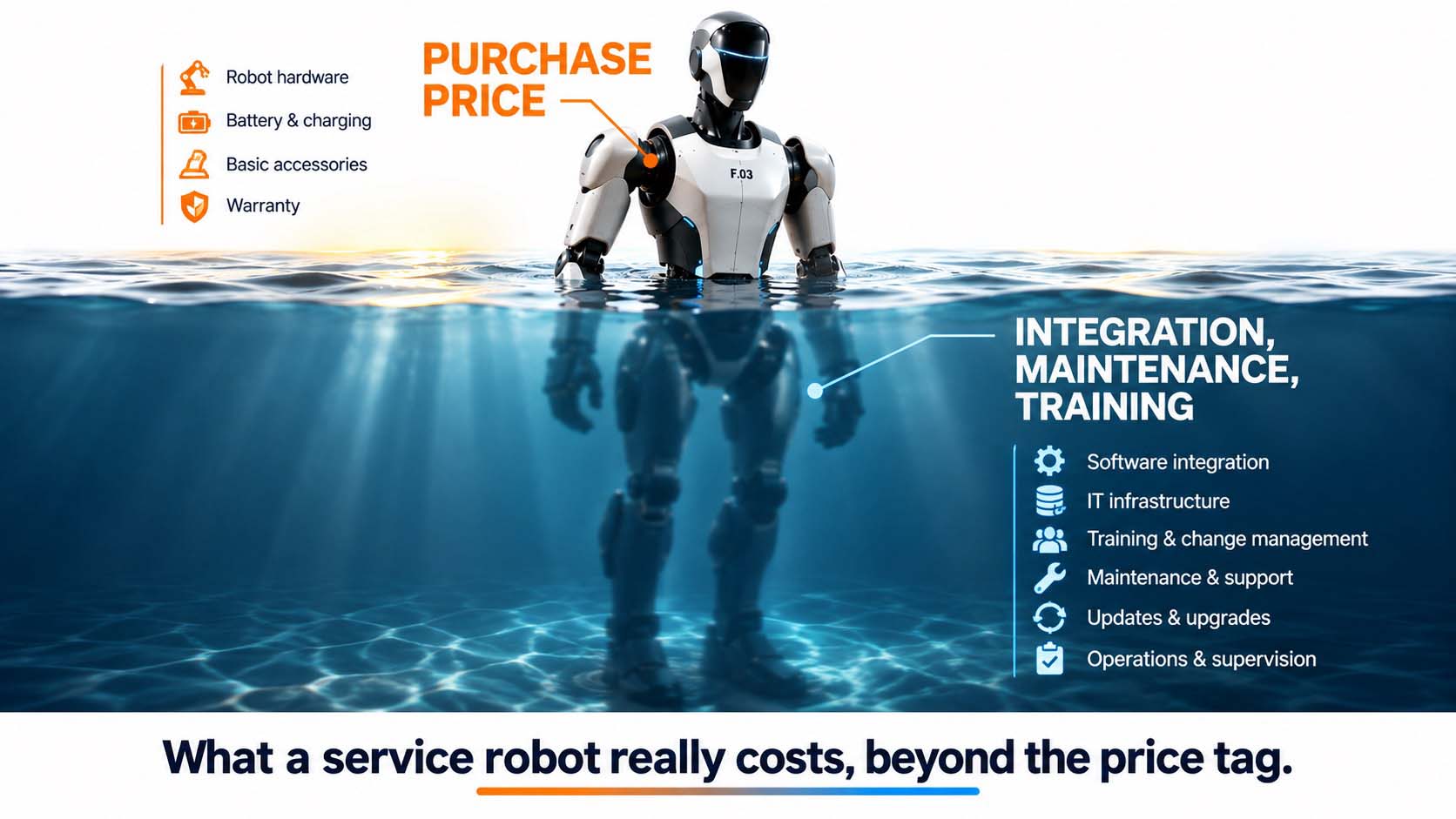
The list price is rarely the whole bill.
Table: Procurement models and typical costs for humanoid robots, as of summer 2026 | Source: manufacturer data and independent trade media | © Ulrich Buckenlei | XR Stager Online Magazine | VISORIC GmbH
It is important for the calculation that the purchase or rental price rarely reflects the full operating cost. Integration into existing IT systems, staff training, maintenance, and a human fallback process for outages more often determine the economic success of a project in practice than the machine’s plain list price.
- Development platforms cost 13,500 to around 90,000 US dollars.
- Commercial specialized systems like Digit cost 150,000 to 250,000 US dollars.
- Robots-as-a-Service usually runs below human warehouse labor costs.
- NEURA 4NE-1 offers a concrete European price benchmark.
- Integration, maintenance and training often exceed the purchase price.
This cost reality immediately raises the next question: how quickly will this calculation change as prices fall and unit numbers grow, and what do the forecasts actually say about that.
The forecasts. Between market breakthrough and expectation management
The range of credible forecasts is enormous, even among established analyst houses, and that range alone says a great deal about how mature the industry really is.
Morgan Stanley has raised its estimate for China’s market twice within just a few months, from an original 14,000 up to 50,000 expected shipments for 2026 alone, forecasting 446,000 units per year by 2030 and a market volume of 15 billion US dollars for China.[15] In the long term, the bank’s scenario for 2050 envisions more than a billion humanoid robots worldwide, around 90 percent of them for industrial and commercial purposes, with only around 80 million units actually standing in private households. Goldman Sachs is considerably more cautious, forecasting a global addressable market of 38 billion US dollars by 2035 and more than 250,000 shipments in 2030, predominantly for industrial applications.[16]
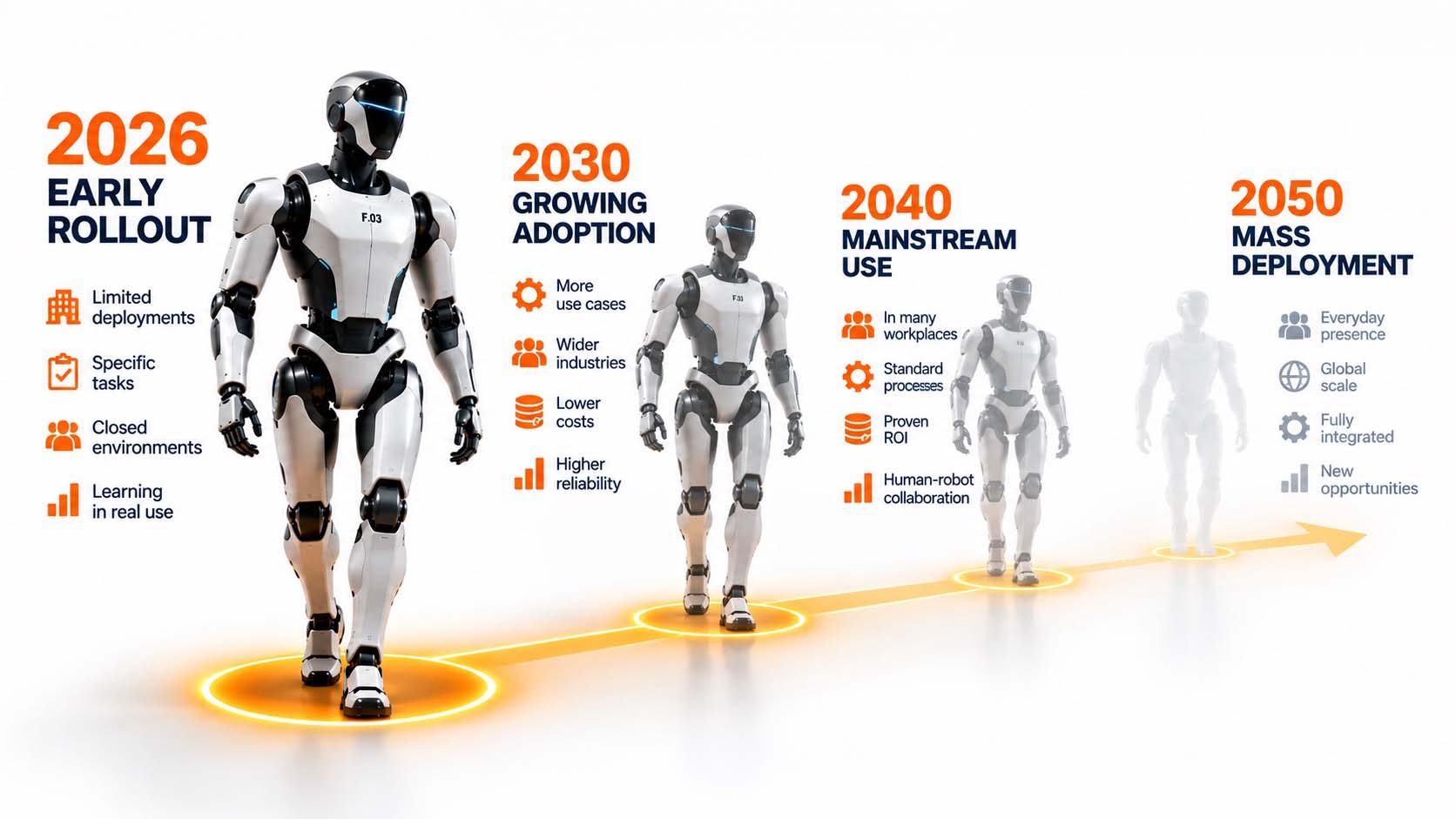
Almost every forecast agrees on one point, the household comes last.
Infographic: Expected maturity of humanoid robotics by use case and year, 2026 to 2050 | Graphic: © Ulrich Buckenlei | XR Stager Online Magazine | VISORIC GmbH
This discrepancy is no coincidence, it reflects different assumptions about the speed and sequence of market development. Yet virtually all the institutes cited agree on one point: broad availability for private households still lies much further in the future than industrial and commercial deployment.
- Morgan Stanley raises its China forecast twice within 2026 alone.
- 446,000 units per year are expected for China by 2030.
- Goldman Sachs sees a global market of 38 billion US dollars by 2035.
- Around 90 percent of all long-term expected robots serve industry and commerce.
- The private household remains the last use case in practically every forecast.
This forecast landscape allows for a pragmatic roadmap for anyone getting started themselves. The final chapter shows what that can look like in concrete terms.
A getting-started guide. What actually matters in 2026
Anyone starting now should begin small, controlled and with clear metrics, not with a broad vision of a fully humanoid workforce.
Successful projects at companies like Amazon, GXO or BMW began with a tightly defined, recurring task, such as box transport or material feeding, not with a wish for the most versatile robot possible. Industry experts also recommend at least a 30-day trial run under your own operating conditions before signing any delivery contract. Even a controlled, eight-hour factory trial with the HMND 01 Alpha model at Siemens showed a success rate of a good 90 percent, meaning a residual error rate of around 10 percent even under optimal conditions.[17]
For industrial and collaborative scenarios, the relevant standards are ISO 10218 and ISO/TS 15066; for personal service and care robots, ISO 13482 or the emerging UL 3300 standard applies. A documented risk analysis under ISO 12100 is now considered the minimum standard, regardless of which model is deployed.[18] Equally important is a realistic calculation of total costs, as described in Chapter 6, along with honest communication about where remote-controlled elements exist, as seen in Chapter 4 with the 1X Neo example.
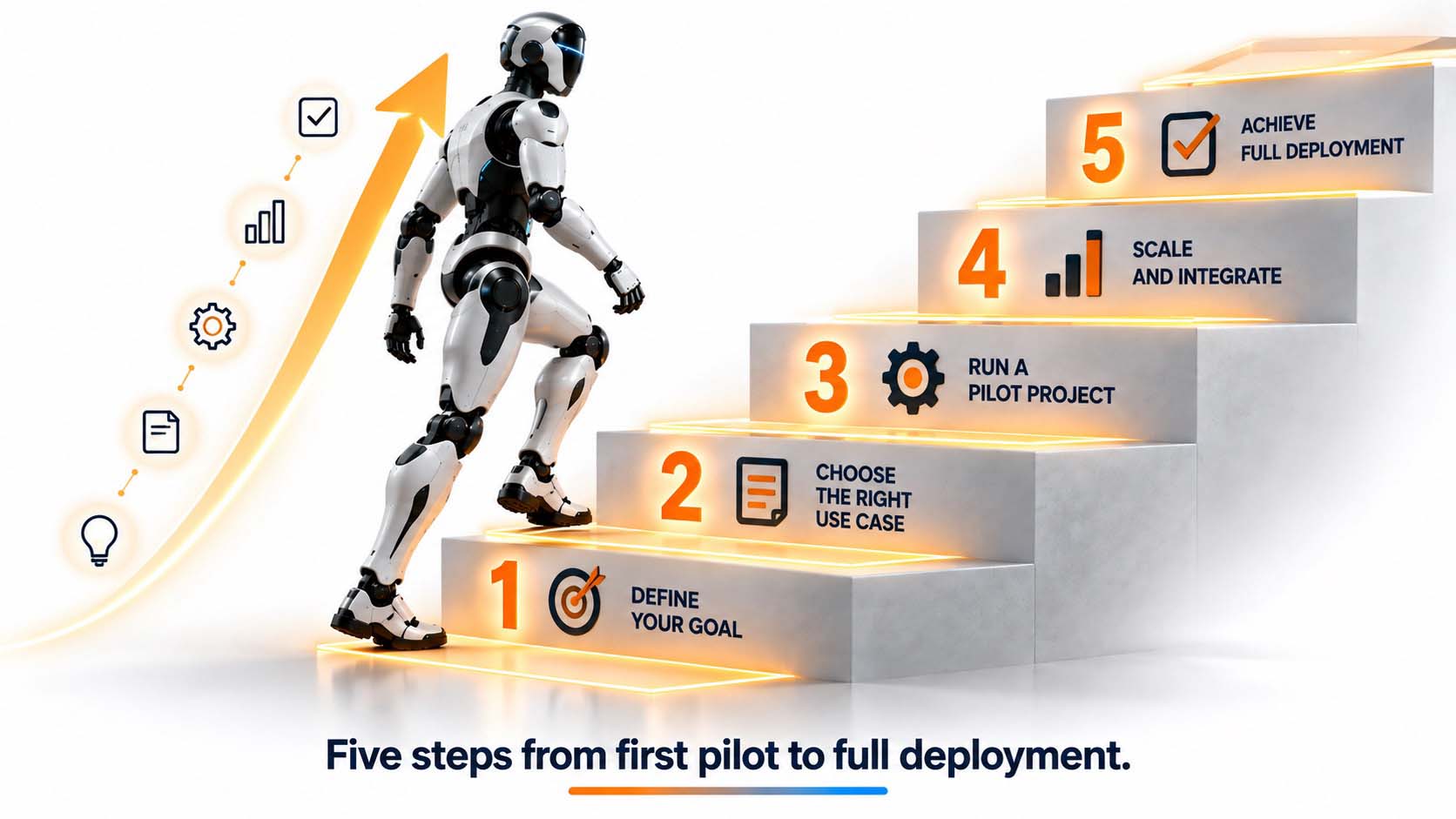
Five steps separate a successful pilot from an expensive disappointment.
Infographic: Five-step getting-started guide for humanoid service robotics in the enterprise | Graphic: © Ulrich Buckenlei | XR Stager Online Magazine | VISORIC GmbH
Companies with clearly structured, repetitive processes in logistics, manufacturing, or simple hospitality and retail service can already launch solid pilot projects today with models like Unitree G1, Agility Digit, or NEURA 4NE-1. For the general private household or unstructured public environments, however, 2026 remains a year to watch, not a year to buy.
- Successful projects start with one tightly defined, single task.
- A trial run of at least 30 days should precede every purchase contract.
- ISO 10218, ISO/TS 15066 and ISO 13482 are the relevant safety standards.
- Even controlled factory trials show a residual error rate of around 10 percent.
- 2026 is a year to get started for structured operations, a year to watch for the household.
The very moment that sparked this entire article, a simple coffee, ordered by smartphone and served by a humanoid assistant, shows in the following video just how close this division of labor already is to a working everyday reality.
When a robot brings the coffee and the technology becomes invisible
The preceding chapters have shown which models are genuinely available today, where service robotics already works in everyday life, why the household remains the biggest challenge, and what a company needs to know to get started itself. How convincing this principle already is in practice is most vividly seen in the experience that formed the starting point for this article.
Embedded here is the video of the Galbot G1 coffee stand from Hooloo Coffee, filmed at IFA 2026 in Berlin. The order was placed by smartphone, brewed by two robotic arms, while the humanoid Galbot G1 supervised the station and held a brief conversation, until the finished coffee was handed over the counter.[19]
Video: Galbot G1 × Hooloo Coffee, coffee ordering and preparation in live operation | Product & demo: Galbot G1 × Hooloo Coffee, filmed and analyzed by Ulrich Buckenlei, IFA 2026, Berlin | © Ulrich Buckenlei | XR Stager Online Magazine | VISORIC GmbH
The video makes visible what the previous chapters worked out technically and economically: the technology fades into the background exactly when task, environment and expectation are precisely matched, not a surprise, but the result of a clear division of labor between precision automation and humanoid customer service.
- The video shows the real coffee order at the Hooloo Coffee stand at IFA 2026.
- Two robotic arms handle the actual preparation.
- The humanoid Galbot G1 handles supervision and customer contact.
- The technology disappears exactly when the task is clearly bounded.
- This principle can be transferred to many other service scenarios.
This example makes tangible where humanoid service robotics has already gotten to in well-defined applications, from trade show demonstration to a working everyday tool.
From market assessment to your own robotics decision
A solid decision for or against humanoid robotics does not come from a single trade show experience, but from the thoughtful interplay of realistic market assessment, clean cost calculation, and a clearly scoped pilot application, exactly the combination at the core of VISORIC’s work.
The expert team at VISORIC GmbH in Munich combines over 15 years of experience in 3D, AI and spatial computing with practical experience visualizing industrial digitalization projects, exactly the building blocks that also matter when assessing humanoid service robotics, whether it’s about an initial feasibility assessment, an investment decision, or visualizing a possible deployment scenario.[20] VISORIC helps companies cleanly separate ambition from reality in a humanoid acquisition, before capital gets tied up.

15 years of experience in 3D, AI and XR, the VISORIC expert team from Munich.
Photo: © Ulrich Buckenlei | XR Stager Online Magazine | VISORIC GmbH
A well-thought-out pilot project, a single use case, a single process station, can often be realized much faster and more cost-effectively than many companies expect. VISORIC accompanies this path from the first market assessment through visualizing possible deployment scenarios to a ready-to-use decision brief for management.[21]
- Market assessment and feasibility studies for humanoid service robotics.
- 3D visualization of possible deployment scenarios ahead of the investment decision.
- From the first pilot idea to a solid decision brief.
That is exactly where a conversation should start: not with the big, company-wide vision, but with a clearly scoped, quickly achievable first step that shows whether and where humanoid robotics can already be put to sensible use today.
Want to find out whether and where humanoid service robotics is already worthwhile for your company today?
Talk to the VISORIC expert team in Munich about market assessment, feasibility, and visualizing possible deployment scenarios. Together, we’ll turn your requirements into a solid, realistic decision basis, not another marketing brochure.
Contact:
Email: info@visoric.com
Phone: +49 89 21552678
Sources and references
- RoboZaps. 38 Best Humanoid Robots in 2026 (Evidence-Ranked). blog.robozaps.com.
- TrendForce via theresarobotforthat.com. Humanoid Robot Companies 2026: Specs, Prices, Deployments.
- Counterpoint Research / Rest of World via theresarobotforthat.com. Humanoid Robot Companies 2026.
- optimusk.blog. Tesla Optimus vs Unitree G1, 1X NEO & Digit: 2026 Comparison.
- Lifehacker Japan. Galbot Hooloo Coffee test report, IFA 2026 / Shanghai.
- South China Morning Post; GlobeNewswire, Shanghai Hi-Dolphin Robot Technology Series A announcement.
- RoboZaps. Humanoid Robots in Hospitality [2026]. blog.robozaps.com.
- RoboZaps. Humanoid Robots in Retail [2026]. blog.robozaps.com.
- Engadget. 1X Neo is a $20,000 home robot that will learn chores via teleoperation.
- Fortune / Stanford University study, May 2026, via theresarobotforthat.com Deployment Mistakes Report.
- IEEE Spectrum, October 2025, via blog.robozaps.com Humanoid Robotics Challenges [2026].
- awesomerobots.xyz. Enterprise Humanoid Robots Guide 2026, ROI, TCO & Deployment Analysis.
- AI Business. Unitree vs Tesla Optimus vs Figure: What a Humanoid Robot Actually Costs in 2026.
- humanoidmagazin.de and skill-sprinters.de, NEURA 4NE-1 pricing and delivery information, 2026.
- CNBC / Morgan Stanley. Morgan Stanley doubles China humanoid robot shipment forecast, June 2026.
- Goldman Sachs Research. The global market for humanoid robots could reach 38 billion by 2035.
- theresarobotforthat.com. Humanoid Robot Deployment: Real Operating Hours, 7 Mistakes.
- robotomated.com. Robot Safety Standards in 2026: What Buyers Must Know Before Deploying.
- Own footage and analysis: Ulrich Buckenlei, IFA 2026, Berlin, Galbot G1 × Hooloo Coffee.
- VISORIC practical projects in 3D visualization, digital twins and spatial computing.
- XR Stager platform for real-time 3D, digital twins and industrial spatial computing applications.
Contact Us:
Email: info@xrstager.com
Phone: +49 89 21552678
Contact Persons:
Ulrich Buckenlei (Creative Director)
Mobil +49 152 53532871
Mail: ulrich.buckenlei@xrstager.com
Nataliya Daniltseva (Projekt Manager)
Mobil + 49 176 72805705
Mail: nataliya.daniltseva@xrstager.com
Address:
VISORIC GmbH
Bayerstraße 13
D-80335 Munich