
Smartphones instead of specialized scanners, game engines instead of in-house development, small teams instead of new departments. Why the business case for the digital twin is fundamentally changing right now.
Visualization: Existing engineering data often already forms the largest part of a digital twin | Image: © Ulrich Buckenlei | XR Stager Online Magazin | VISORIC GmbH
One of the world’s most innovative car manufacturers trains its driver assistance system in a video game. At the same time, many mid-sized companies are postponing their first digital twin because they consider it too expensive, too complex or too time-consuming. These two things no longer fit together. The tools that large corporations use today to simulate, plan and test have long been within reach of smaller companies as well.
A digital twin is a digital replica of something real, such as a product, a machine, a pipe in the ground or an entire factory. It can be used to work, test and learn before decisions in the real world become expensive. Almost every industrial company considers this technology relevant. And yet, in many organizations, it remains limited to presentations and declarations of intent.
The reason rarely lies in the technology itself. More often, it is experience from a time when digital twins really did require large budgets, expensive specialized equipment, dedicated development departments and long project durations. This experience still shapes many investment decisions today, even though the conditions have changed fundamentally in recent years.
This article examines the five most common concerns one by one, based on current studies and real projects: the question of data, devices, tools, time and team. It also shows where the limits lie and why every successful project begins not with technology, but with a clear question.
- Almost every industrial company considers the digital twin relevant.
- Many projects fail because of outdated experience.
- The tools of large corporations are now within reach of mid-sized companies.
- Five typical concerns are examined using studies and projects.
- It starts with the question, not the technology.
The following article describes the gap between interest and implementation, answers the questions of data, devices, tools, time and team, shows why the goal must come before the technology, and outlines a pragmatic and cost-conscious way to get started.
An Expensive Gap Between Interest and Implementation
Interest in the digital twin is hardly in question anymore. In a McKinsey survey of 75 industrial executives, 86 percent stated that a digital twin is relevant for their company. 44 percent had already implemented one, and a further 15 percent were planning to do so.[1] The digital twin has therefore arrived in the strategy papers of industry.
A closer look, however, shows how far ambition and everyday reality still diverge. According to the Manufacturing IT/OT Trend Report 2025, just under 41 percent of the companies surveyed are still in the pilot phase, while only 20 percent report full integration.[2] Many projects remain stuck at the trial stage, even though the technology is available.
A survey by the German digital association Bitkom shows why. 57 percent of the industrial companies surveyed see missing data as the central problem in using digital twins, and 48 percent cite inadequate technical prerequisites.[3] It is striking that both reasons describe assessments. Whether the data is actually missing or simply not recognized as such remains open in such answers.
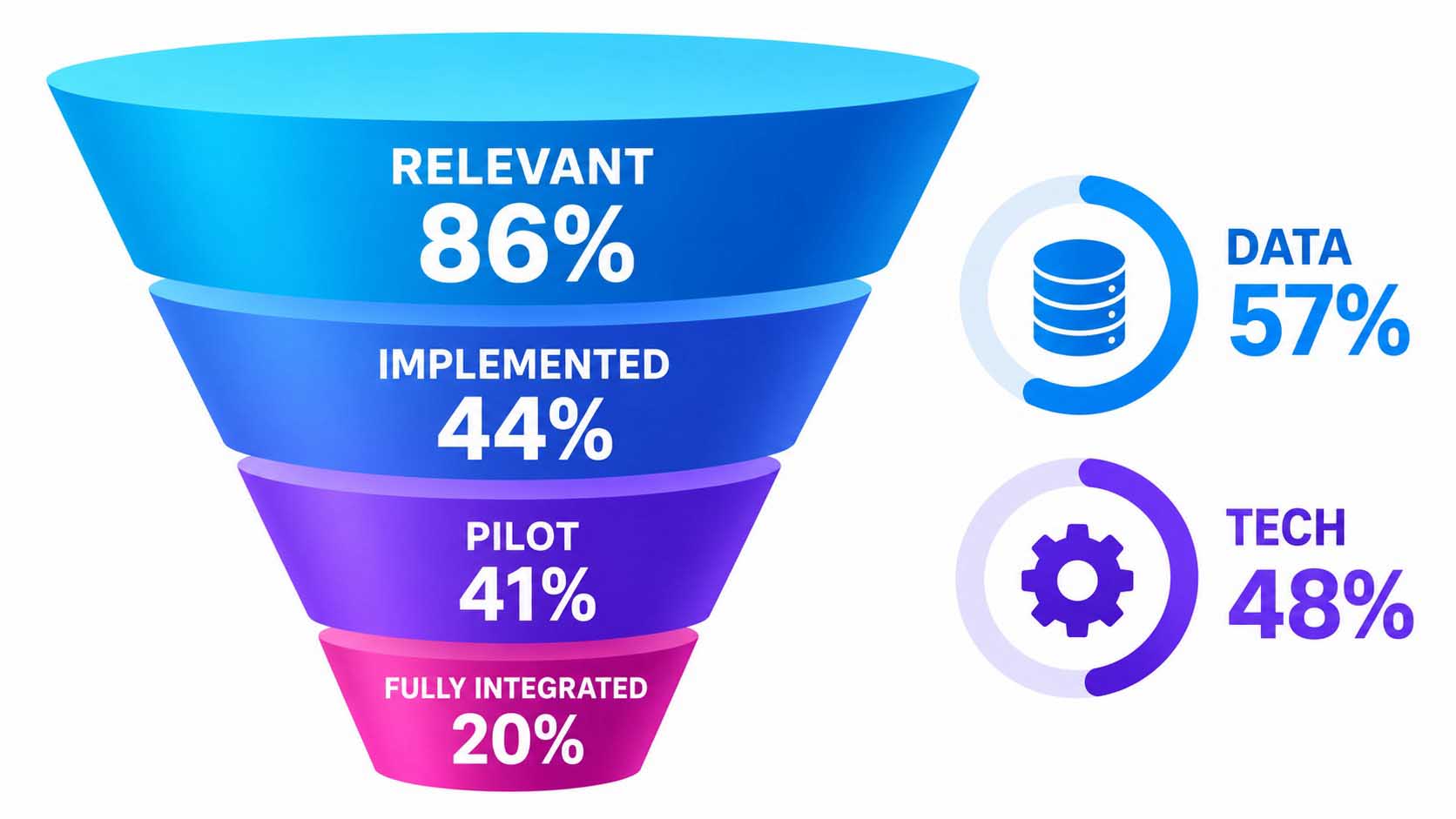
There is a wide gap between interest and implementation.
Infographic: Almost everyone considers the digital twin relevant, but only a fraction use it in everyday operations | Graphic: © Ulrich Buckenlei | XR Stager Online Magazin | VISORIC GmbH
For companies, this gap is expensive. Investments in workshops and pilot projects deliver no lasting benefit if they never move into operations. At the same time, competitors who already simulate before they build gain an advantage. The good news: if the biggest hurdles are based on assessments, they can be overcome with knowledge and a clear approach, without first having to release large budgets.
The most common concern relates to data. Whether companies really start from scratch is shown in the next chapter.
- 86 percent of executives surveyed consider the twin relevant.
- 44 percent have already implemented a digital twin.
- Just under 41 percent are still in the pilot phase.
- Only 20 percent report full integration.
- Missing data is considered the most common obstacle.
The figures show a clear pattern: the will is there, but the path into everyday operations is missing. This is exactly where the following chapters come in.
The Data Question. The Most Important Building Block Is Often Already in the Archive
The sentence “We don’t have the data” comes up in almost every first conversation about a digital twin. It describes the feeling of having to start completely from scratch. On closer inspection, however, this feeling rarely applies to technical companies.
Anyone who develops products works with CAD data, meaning computer-aided design models. These already contain a large part of what a digital twin needs: the exact geometry of every component, dimensions and tolerances, material specifications, the structure of the assemblies, bills of materials and often also axes of motion. Added to this are photos from marketing and documentation, manuals from service, training videos and machine data from operations. The US National Institute of Standards and Technology has examined the economics of digital twins in a dedicated report and describes them as computer models of physical objects and processes whose benefits arise across the entire life cycle.[4]
Where no current CAD data exists, for example for older halls and existing installations, the missing building blocks can now be captured with reasonable effort. At the real-world lab of the ARENA2036 research campus, various methods for digitizing existing facilities were compared. Manual modeling achieved the highest accuracy there with 93.4 percent according to the mAP metric, but was very time-consuming. A method called Gaussian Splatting, which computes a photorealistic 3D scene from a simple video scan, achieved a value of 91.2 percent within a few minutes.[5]
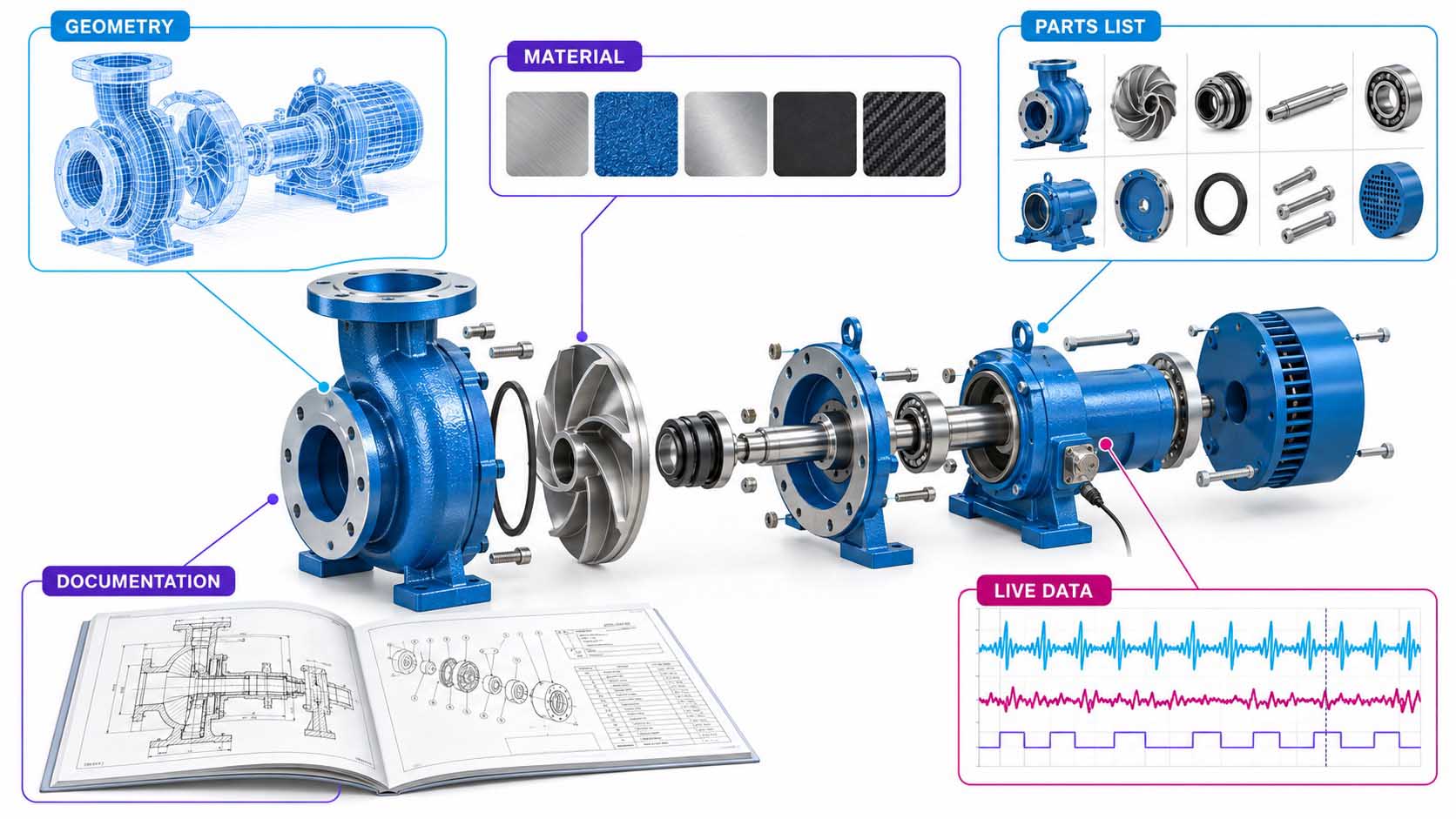
The CAD model already contains the shell of the digital twin.
Infographic: Engineering data contains geometry, material, assemblies, bill of materials and motion, and thus the foundation of every twin | Graphic: © Ulrich Buckenlei | XR Stager Online Magazin | VISORIC GmbH
The real problem is therefore usually not the absence of data, but its distribution. CAD models are designed, used for production and then archived. Years later, sales commissions new product images, service redraws exploded views, and training produces new videos, even though the necessary information already exists in the engineering model. Companies thus pay several times for content they already own. Researchers at Chalmers University of Technology have also shown that realistic virtual models significantly reduce typical problems such as missing scale and misunderstood communication, particularly when planning in existing factories.[6]
Anyone who reviews their existing data therefore often finds that a large part of the journey has already been completed. Where gaps remain, the question arises as to how much effort it takes to capture them, and that is exactly what the next chapter is about.
- Technical companies almost always own CAD data.
- Engineering models contain geometry, material and assemblies.
- Photos, manuals and machine data complete the picture.
- Existing facilities can be captured via video scan in minutes.
- The problem is usually distribution, not absence.
The data question is therefore answered in most cases. The building blocks are there, they are just spread across different departments and archives.
The Device Question. When the Smartphone Replaces the Specialized Scanner
Where data is missing, it has to be captured. Many people think of expensive terrestrial laser scanners on tripods, specialized software and trained surveying teams. This picture is accurate for tasks where every millimeter counts. For a large share of applications, however, it is outdated.
Current pro-class smartphones have a built-in LiDAR sensor, a small laser sensor that measures distances, and combine it with the camera. A study published in the ISPRS Archives in 2026 compared five iPhone apps for 3D scanning in controlled tests, including PIX4Dcatch. The result: smartphone LiDAR can achieve centimeter-level accuracy, although performance varies considerably depending on the app.[7] A study by the University of New Brunswick determined an absolute accuracy of about three centimeters horizontally and about seven millimeters vertically with an iPhone 13 Pro.[8]
What this looks like in practice is shown by the Danish construction company Nordkysten, which repairs and replaces power and utility lines in cities. The company digs and backfills around 1,500 excavation pits per year on average and documents them with mobile devices. According to the provider, no special training is required for successful captures, and the data is automatically uploaded to the cloud and processed there into 3D models that can be shared with customers.[9] The Swiss company Multinet also relies on this approach, explicitly because its on-site teams are not trained surveyors and have to work with minimal instruction.[10]
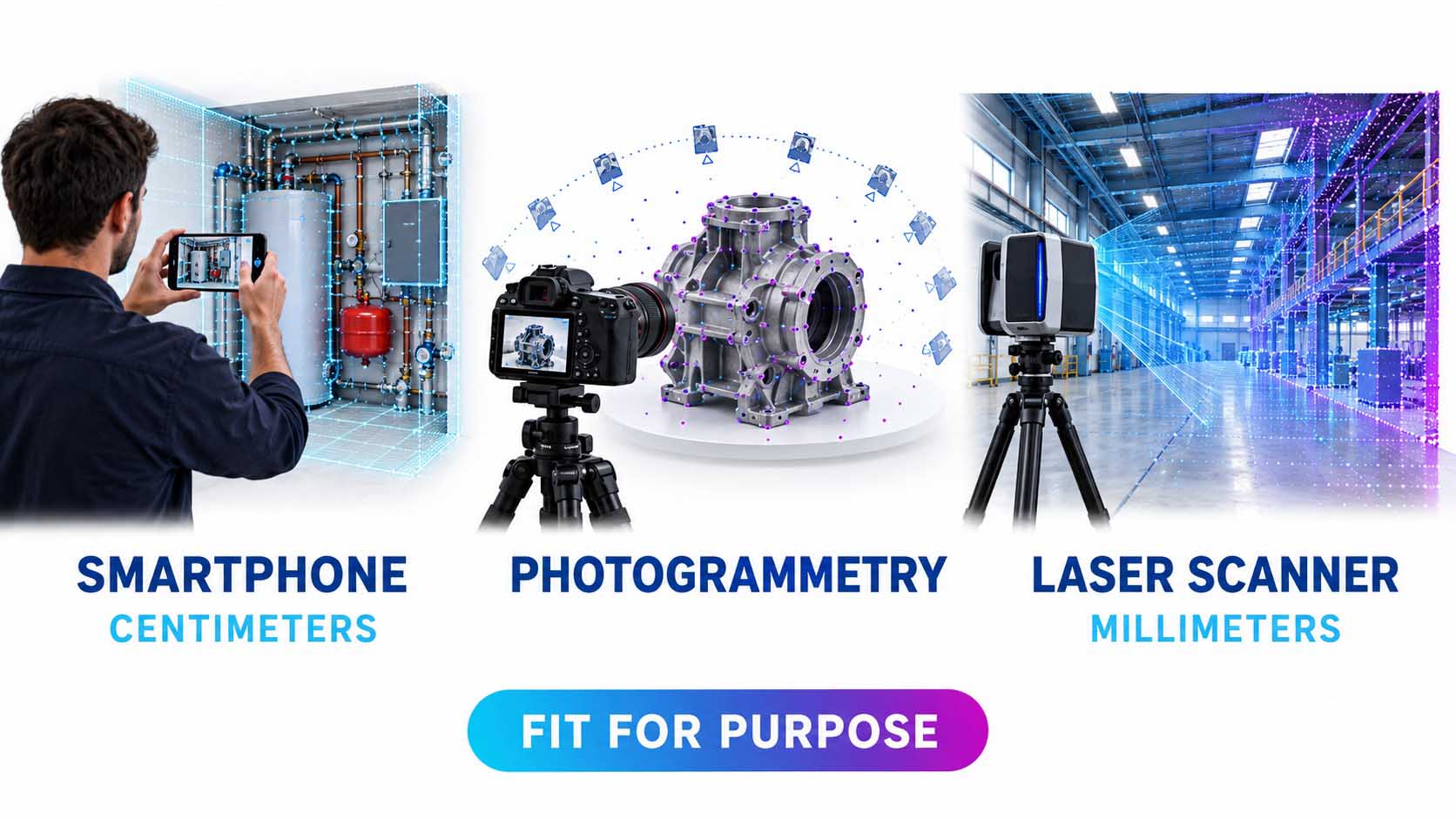
Not every task needs millimeters.
Infographic: The required accuracy determines the appropriate capture method and thus the costs | Graphic: © Ulrich Buckenlei | XR Stager Online Magazin | VISORIC GmbH
For companies, this shifts the decisive question. It is no longer what a scanner costs, but how accurate the result needs to be for the respective purpose. For documentation, planning, coordination and later locating pipes and cables, the centimeter range is often sufficient. Where millimeters matter, for example for fits or binding surveys, laser scanners and classic surveying remain the reference. Those who combine both worlds use expensive technology specifically where it is really needed and save everywhere else.
Once the data has been captured, the next question arises: what brings it to life, makes it interactive and simulatable? The answer comes from an industry that many in manufacturing underestimate.
- Pro smartphones have built-in laser sensors for 3D scans.
- Studies confirm accuracies in the centimeter range.
- Quality depends heavily on the app used.
- On-site teams need only a short briefing.
- For millimeter work, laser scanners remain the reference.
The device question is therefore answered for many tasks. Often, a smartphone and the employee who is on site anyway are all it takes.
The Tool Question. What Industry Is Learning from Video Games
Viewed soberly, a digital twin is an interactive 3D world in which objects move, light and physics are calculated and people can intervene in real time. This is exactly what game engines, the software foundation of modern video games, deliver. Nevertheless, many companies still assume that game engines are toys and unsuitable for serious industrial applications. Those who think this way often plan an expensive in-house development where a proven tool is already available.
Practice shows how widespread these tools already are. According to Epic Games, hundreds of car manufacturers, suppliers and dealers use Unreal Engine, from the first design concept to factory planning.[11] Mercedes-Benz has introduced an infotainment system in the new CLA that is based on the Unity game engine.[12] And the Daimler subsidiary Protics used Unreal Engine to develop a platform for collaborative design reviews that has been described as a multiplayer online game for engineers.[13]
The most striking example was presented by Tesla at its AI Day back in 2021. The company trains its driver assistance system in a photorealistic simulation that it itself describes as a video game with Autopilot as the player. Real drives by the fleet are recreated as game worlds, and in these worlds rare and dangerous situations such as night, rain or pedestrians suddenly appearing can be played through as often as needed and without risk.[14]
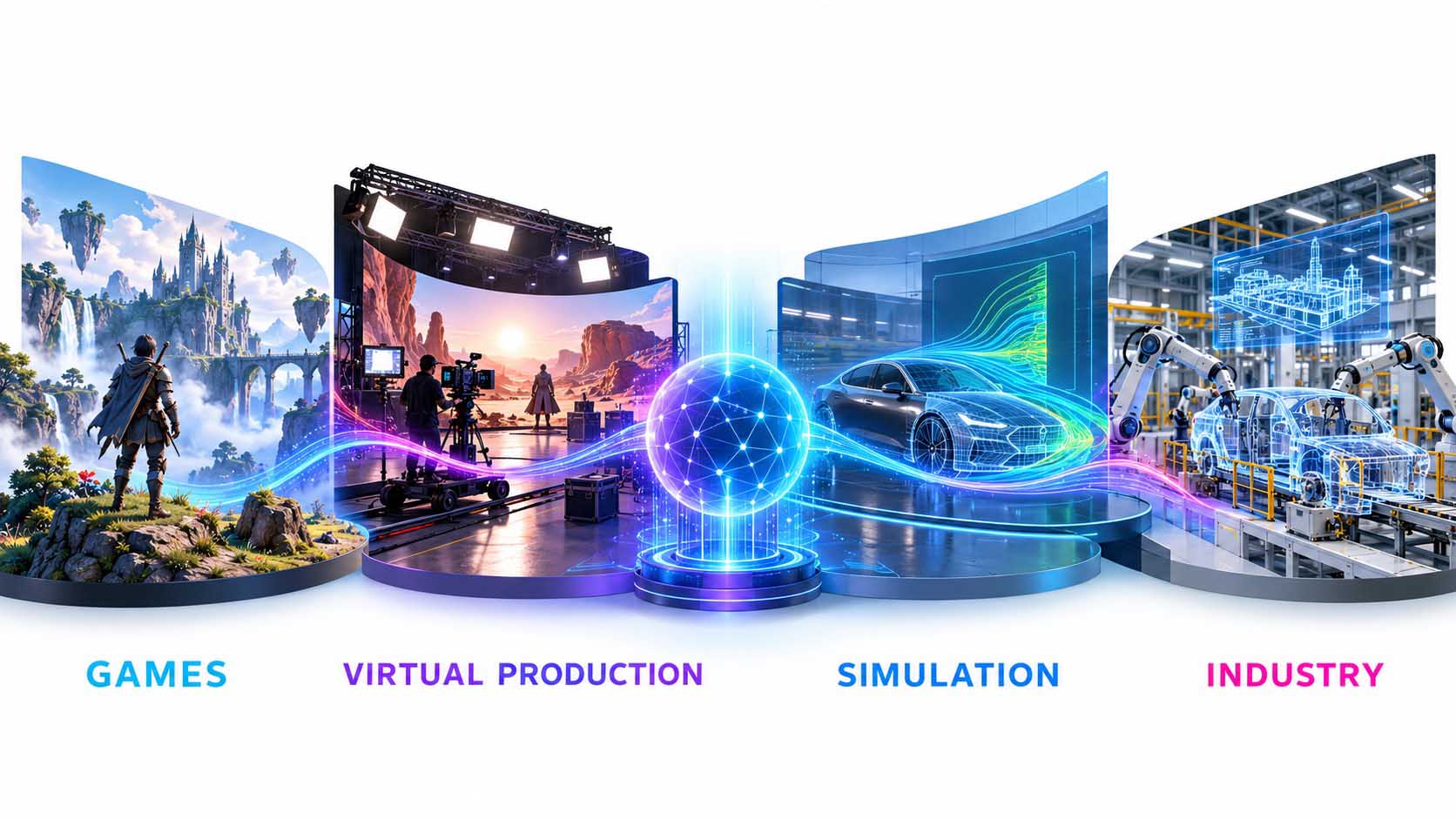
What was developed for games now simulates factories and vehicles.
Infographic: Game engines have moved from entertainment into industrial simulation and are long established there | Graphic: © Ulrich Buckenlei | XR Stager Online Magazin | VISORIC GmbH
The economic advantage of simulation can be summed up in one sentence: a video of the real world only shows what happened. A simulation shows what could happen. For companies, this means testing variants before they are built, training employees on installations that do not yet exist and presenting products that are still in planning. Standardization also shows that this technology is maturing: the Khronos Group, the consortium behind widely used 3D formats, presented an extension in 2026 that allows photorealistic 3D reconstructions to be stored in an open exchange format.[15] Open standards protect companies from dependence on individual vendors.
That leaves the question of how long it takes to build such interactive applications. Here, too, more has changed in a short time than many realize, as the next chapter shows.
- Game engines calculate 3D worlds, light and physics in real time.
- Hundreds of car manufacturers use Unreal Engine.
- Mercedes builds the infotainment of the new CLA with Unity.
- Tesla trains its driver assistance system in a game world.
- Open standards protect against vendor lock-in.
The tool question is therefore answered. Game engines are not toys, but the most powerful tools for interactive simulation available today.
The Time Question. Prototypes in Days Instead of Months
Even those who have data and tools often fear the time required. Common experience says that it takes months before a first prototype is ready to show to management, customers or investors. However, this experience dates from a time before generative artificial intelligence.
A controlled experiment by Microsoft Research, GitHub and MIT provided early, reliable figures on this. Developers were asked to program a web server as quickly as possible. The group with an AI assistant was 55.8 percent faster than the comparison group without one.[16] In its own study, McKinsey concluded that new code is written with generative AI in nearly half the time.[17] And a study by Harvard Business School with the Boston Consulting Group showed that consultants with AI support completed more tasks, worked around 25 percent faster and delivered significantly better results.[18]
The technology has developed considerably since then. In September 2026, software developer Dilum Sanjaya showed how OpenAI’s AI model GPT-6 Astra created an interactive visualization of a V8 engine with crank drive, valve train and speed control. According to him, the model needed 25 minutes for this.[19] On the same day, developer Ashe Magalhaes published the Human Atlas, an interactive anatomy atlas with 2,234 individually selectable structures from 15 body systems. The anatomical geometry comes from the existing reference model BodyParts3D, and the AI turned it into a usable application.[20]
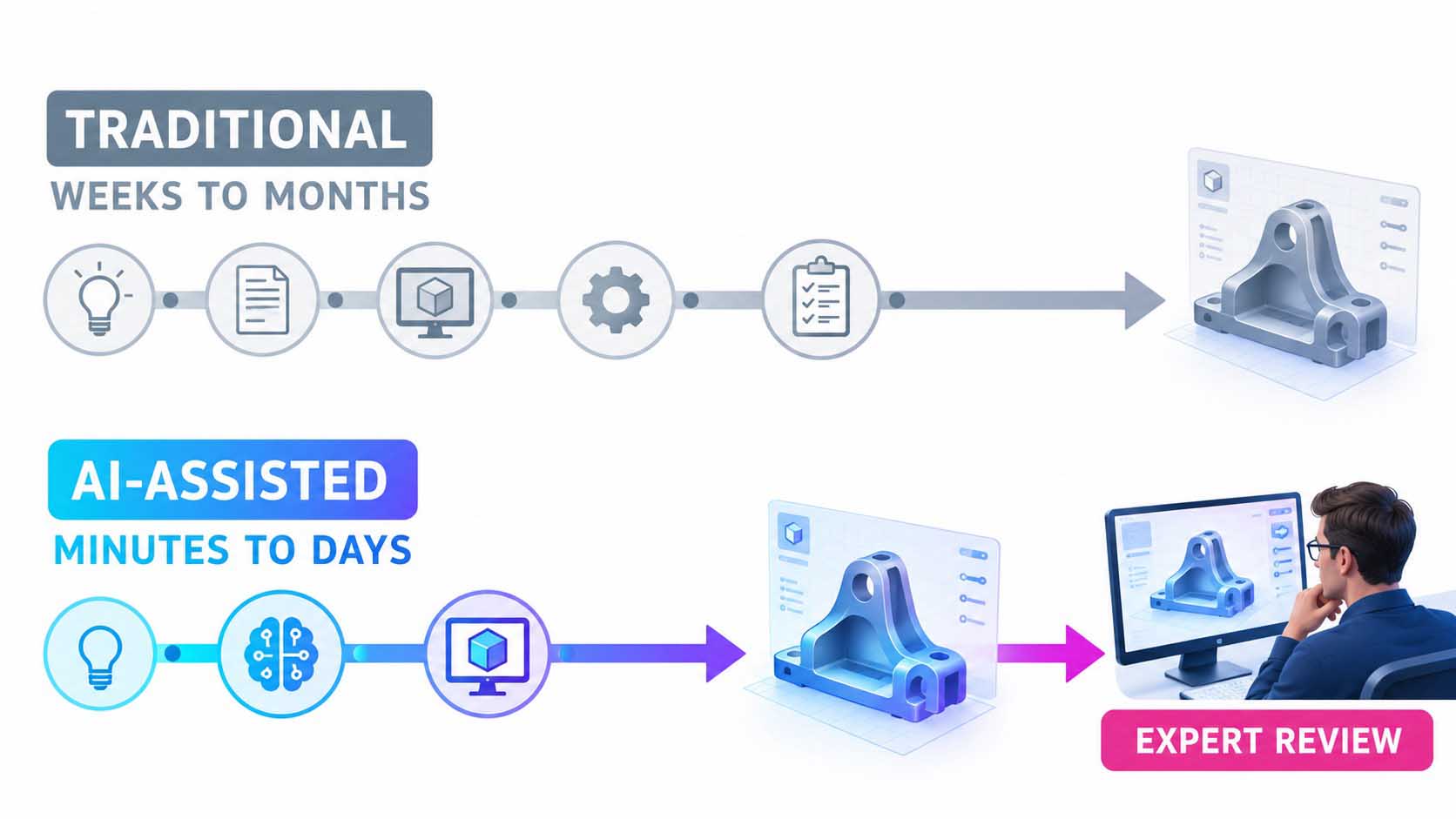
Faster to the prototype, but not without review.
Infographic: Artificial intelligence drastically shortens the path to the first prototype, while expert review remains a separate, indispensable step | Graphic: © Ulrich Buckenlei | XR Stager Online Magazin | VISORIC GmbH
For companies, this changes the logic of investment decisions. If a first presentable prototype can be created in days instead of months, the risk of an early start drops considerably. Ideas can be shown, discussed and discarded before large budgets are committed. At the same time, an important caveat applies: the examples shown are early demonstrations. Experts must check whether geometry, function and quality are correct, especially for safety-relevant applications.
This shifts the human role from execution to steering and review. Who takes on this role and how large the team needs to be is answered in the next chapter.
- With an AI assistant, developers completed a task 55.8 percent faster.
- According to McKinsey, new code takes nearly half the time.
- An interactive V8 engine was created in 25 minutes.
- An anatomy atlas with 2,234 structures was published the same day.
- Expert review remains indispensable.
The time question therefore needs to be reassessed. Presentable results can now be created in days instead of months, provided experts review them carefully.
The Team Question. Why Small Teams Are Often Better
The last concern is often the most persistent. Even if data, tools and time are no longer a problem, there remains the worry of having to set up a dedicated department for such a project. Large corporations have entire innovation divisions, while mid-sized companies have neither the staff nor the budget for this.
Research, however, does not suggest that size automatically leads to better results. A study by Lingfei Wu, Dashun Wang and James Evans published in Nature in 2019 analyzed more than 65 million papers, patents and software products from the years 1954 to 2014. Smaller teams tended to produce new, disruptive ideas, while larger teams primarily developed existing approaches further.[21] Dashun Wang summarized the result by saying that large teams attract more attention, but small teams systematically create more that is new.[22]
This pattern is also gaining ground in industrial practice. McKinsey describes how a large manufacturer built its digital twin with a cross-functional product team of manufacturing engineers, operations managers, data specialists and IT architects. The team connected the data sources, first tested a minimum viable product and built a scalable solution on that basis.[1] What mattered was not the size of the team, but its composition.
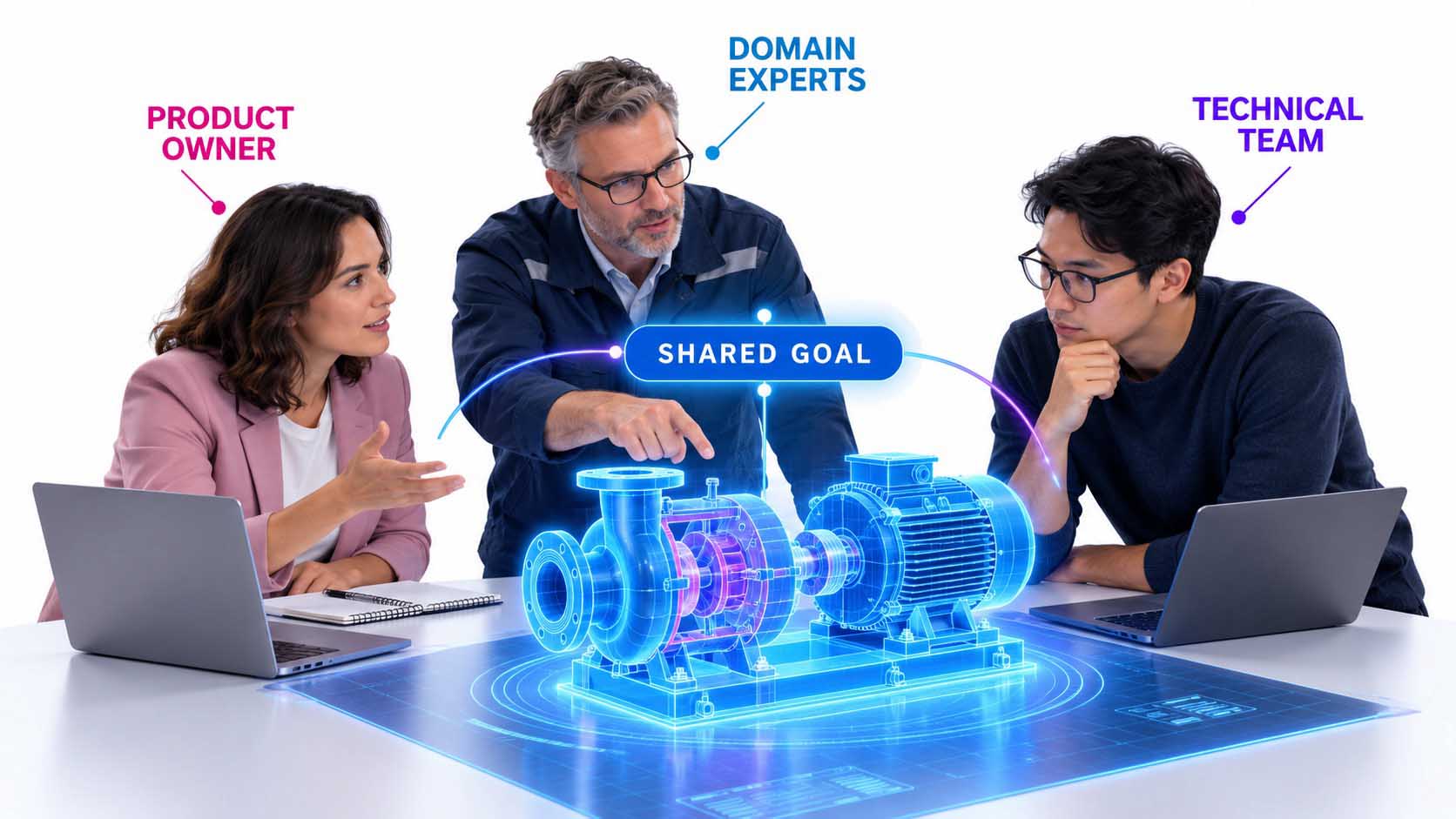
Three roles replace an entire department.
Infographic: A small team of goal ownership, domain expertise and technical implementation is enough to start a digital twin | Graphic: © Ulrich Buckenlei | XR Stager Online Magazin | VISORIC GmbH
A simple formula can be derived from this. It takes one person in the company who knows the goal, sets priorities and inspires others for the topic, often referred to as the product owner. It takes the specialist department that understands its own product and processes best. And it takes a small specialist team that masters the technology and handles implementation. This team does not have to be built in-house. For mid-sized companies in particular, it is often more economical to staff the technical implementation externally and keep the knowledge about goal and product within the company.
With the team question, all five concerns have been examined. But one building block is still missing, and it determines whether a digital twin ultimately creates real value.
- A Nature study analyzed more than 65 million works.
- Small teams are more likely to produce new ideas.
- Successful twins emerge from mixed product teams.
- Product owner, specialist department and specialist team form the core.
- Technical implementation can be handled externally.
The team question is therefore answered. Companies do not need a large team, but the right one.
The Goal First, Then the Technology
The term digital twin is now used for very different things, from a simple 3D model to a fully networked simulation of a factory. At an expert panel at INTERGEO 2026 in Munich, a fitting thought came up: the term means everything and nothing, and the decisive question is not whether you have a digital twin, but which question it is supposed to answer.[23]
An example from the same discussion showed how important this distinction is. A city presented its digital twin and wanted to use it to simulate flooding. This did not work, because although the model looked good, it contained neither semantics nor reliable measurements. It was a beautiful picture, not a tool for the actual question.[23] The example stands for a widespread pattern: technology is procured first, and only afterwards is it considered what it should be used for.
McKinsey therefore recommends a different starting point. The first step in building a digital twin is to get stakeholders to agree on a shared, clear vision.[24] This vision determines which data is needed, which accuracy is sufficient and which technology fits best.
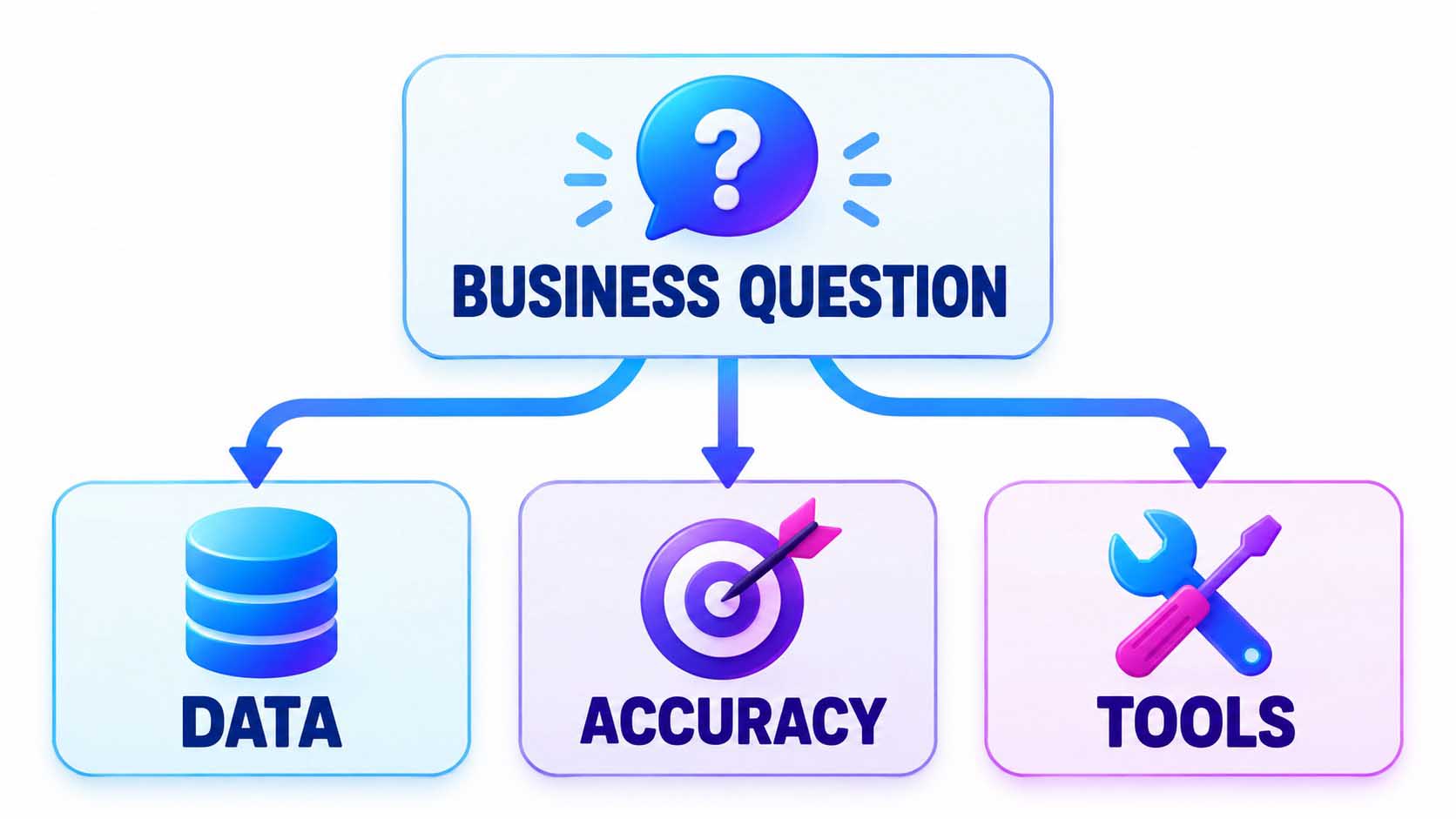
The question determines data, accuracy and technology.
Infographic: A digital twin creates value when it is planned from a clear question and not from the available technology | Graphic: © Ulrich Buckenlei | XR Stager Online Magazin | VISORIC GmbH
For companies, this sequence is the most effective protection against bad investments. A twin for training service staff needs different data than one for the layout planning of a hall, and a twin for sales and marketing needs different data than one for predictive maintenance. Those who clarify the question first avoid expensive captures that nobody uses, and at the same time recognize how many of the required building blocks are already available.
That leaves the question of how a clear goal becomes a concrete first step without immediately turning into a major project. That is the subject of the final chapter.
- The term digital twin is used in very different ways.
- A model without a clear question remains a pretty picture.
- McKinsey recommends starting with a shared vision.
- The question determines data, accuracy and technology.
- The right sequence protects against bad investments.
The starting point is therefore not the question of technology, but the question of the goal. Those who answer it first invest more purposefully.
Start Small, Grow Measurably
A digital twin does not have to begin as a major project. On the contrary: the most successful initiatives often start with a narrowly defined task whose benefit can be measured quickly. McKinsey also describes this path for many industrial companies, which first test a minimum viable product and only then expand it into a scalable solution.[1]
The potential economic leverage is considerable. According to McKinsey, the use of digital twins in large capital projects can reduce costs and schedules by up to 30 percent by changing processes in planning, manufacturing, logistics and construction.[25] In the Manufacturing IT/OT Trend Report 2025, 65 percent of companies already using digital twins stated that they had reduced downtime and operating costs.[2]
A three-step approach has proven effective for getting started. First, the goal is clarified, meaning the concrete question the twin is meant to answer. Then the existing data is reviewed, from CAD models to photos and operating data, and missing building blocks are captured in a targeted way. In the third step, a first prototype is created and tested in a real coordination meeting. What is measured is whether decisions are made faster, whether errors become apparent earlier and how high the actual effort is.
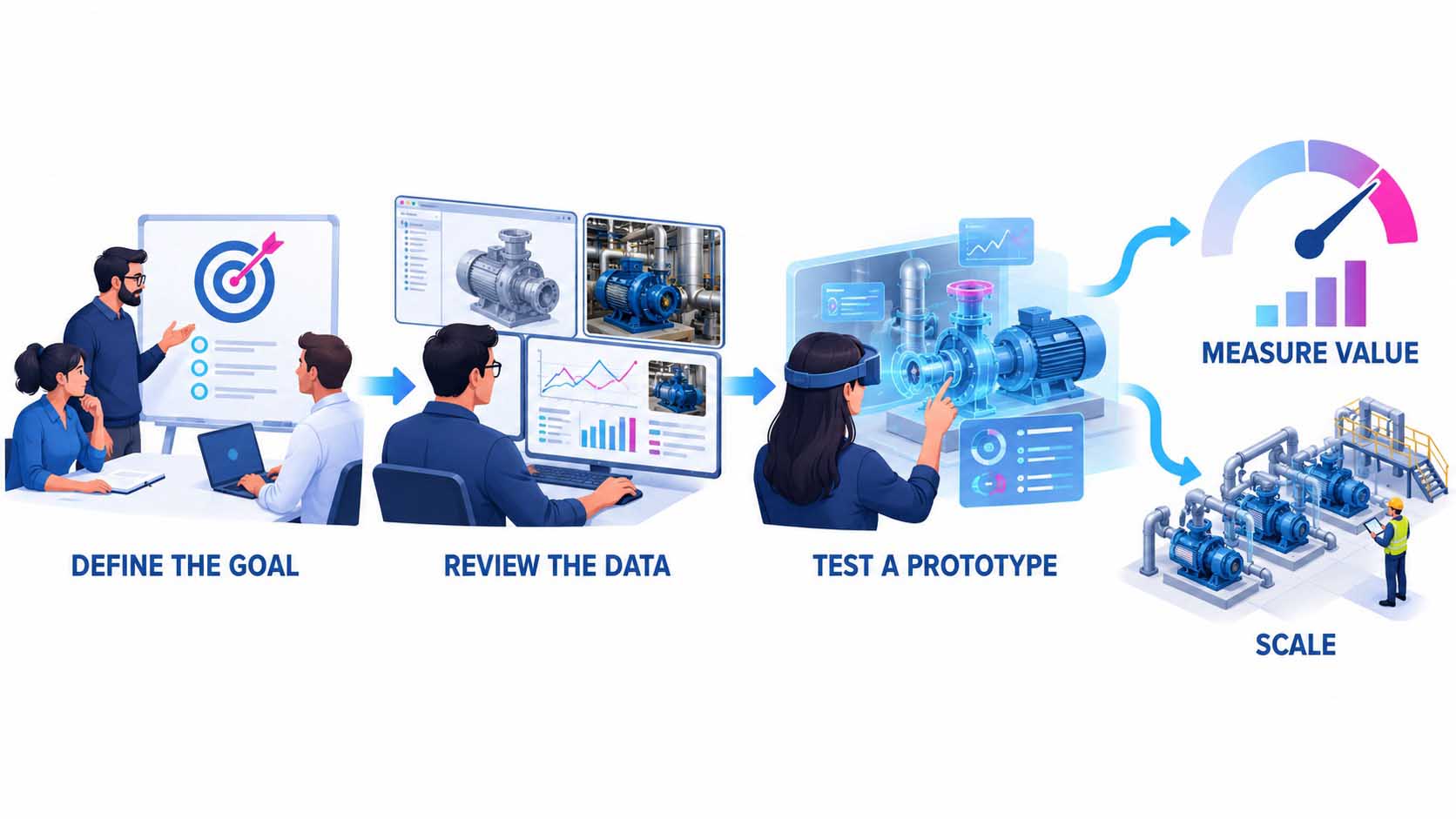
Three steps lead to the first measurable result.
Infographic: A limited pilot with a clear goal creates a solid basis for every further investment | Graphic: © Ulrich Buckenlei | XR Stager Online Magazin | VISORIC GmbH
This approach combines all the findings of the previous chapters. The data is usually available, missing building blocks can be captured with off-the-shelf technology, game engines provide the interactive foundation, artificial intelligence shortens the path to the prototype, and a small team of goal ownership, domain expertise and technical implementation is enough to get started. For mid-sized companies, this means that getting started is now a manageable investment with a clearly measurable result.
The following video shows how these ideas were brought together in a talk for an expert audience.
- Successful twins begin with a limited task.
- McKinsey cites up to 30 percent savings on capital projects.
- 65 percent of users report lower costs.
- Getting started follows three steps: goal, data, prototype.
- A measurable pilot creates the basis for investment.
In the end, success is determined not by the size of the budget, but by the clarity of the goal and the courage to take the first step.
From a Blank Sheet to a Digital Twin in a Talk
The questions in this article were at the center of a talk at the TuWAs Network Days 2026 at the TUM Entrepreneurship Research Institute in Garching near Munich. Under the title “From a Blank Sheet to a Digital Twin”, Ulrich Buckenlei presented five common myths about the digital twin to an expert audience from industry and research and showed how companies can refute them with existing resources.
The image of the blank sheet ran through the entire talk. Many companies believe they have to start completely from scratch. With each myth refuted, the sheet filled up with another building block, from CAD data to the smartphone, the game engine and AI-assisted prototyping to the small team. At the very top, at the end, stood the most important word: the goal.
The video summarizes the talk with the examples shown: the documentation of underground utility lines with smartphones and augmented reality, the training of Tesla’s driver assistance system in a game world as presented at AI Day 2021, and interactive 3D prototypes created with artificial intelligence in a very short time.
Video: From a Blank Sheet to a Digital Twin, talk at the TuWAs Network Days 2026, TUM Campus Garching | Example videos: PIX4D, Tesla AI Day 2021, Dilum Sanjaya and Ashe Magalhaes with OpenAI GPT-6 Astra | Talk, analysis, voiceover and video editing: © Ulrich Buckenlei | XR Stager Online Magazin | VISORIC GmbH
It is remarkable how little of what was shown is still a vision of the future. The smartphones are off-the-shelf, the game engines established, the AI models freely accessible. What many companies lack is less the technology than a clear starting point and the experience to bring the existing building blocks together.
The assessment also includes this: the AI examples shown are early demonstrations whose results must be reviewed by experts before productive use. And the accuracy of smartphone scans is sufficient for many, but not all, tasks.
- The talk took place at the TuWAs Network Days 2026.
- Five myths were refuted one after another.
- Utility documentation via smartphone and AR is shown.
- Tesla trains its driver assistance system in a game world.
- AI creates interactive 3D prototypes in a very short time.
The video makes visible what the chapters describe: the path to a digital twin is shorter and more affordable than many think.
You Bring the Project Knowledge, We Bring the Expertise
A successful digital twin is created from two kinds of knowledge. The company knows its product, its processes and the goal to be achieved. Implementation requires experience in preparing CAD data, capturing spaces and installations, in game engines, artificial intelligence and extended reality. This very combination is at the core of VISORIC GmbH’s work.
For more than 15 years, the Munich-based expert team has been developing applications in 3D, AI and XR for companies ranging from mid-sized businesses to DAX corporations. VISORIC prepares existing data for interactive display, captures missing building blocks and brings everything together in the XR Stager platform, in the browser, on large displays or in XR. That getting started does not have to be big is shown by our own projects: for a DAX corporation, an initiative started with a budget of well under EUR 100,000, and a car manufacturer now saves around EUR 2 million every year by generating product images itself with a game engine.

Project knowledge and expertise together create the digital twin.
Image: The company contributes the goal and domain knowledge, the expert team the implementation, and the result remains anchored in the company | © Ulrich Buckenlei | XR Stager Online Magazin | VISORIC GmbH
Getting started begins with a conversation about the goal. Together, we clarify which question the digital twin should answer, which data already exists and what a first prototype could look like that can be tested within a short time.
- Preparation of existing CAD data for interactive display.
- Capture of missing building blocks with the right accuracy.
- Implementation in the browser, on displays and in XR.
Precisely because smartphones, game engines and artificial intelligence have made getting started so much easier, now is a good time to bring the first building blocks together.
Which question should your digital twin answer?
Talk to the VISORIC expert team in Munich. Together, we clarify your goal, review your existing data and develop a first prototype that shows what your digital twin can achieve.
Contact:
Email: info@visoric.com
Phone: +49 89 21552678
Sources and References
- McKinsey & Company. Digital twins and the factory of the future. Survey of 75 industrial executives, 2024. mckinsey.com.
- Manufacturing IT/OT Trend Report 2025. Summary in Process Excellence Network, 2025. processexcellencenetwork.com.
- Bitkom e. V. Lack of IT infrastructure and data slows the use of digital twins. Press release, Bitkom Research, 2026. bitkom.org.
- Thomas, D. Economics of Digital Twins. Costs, Benefits, and Economic Decision Making. NIST Advanced Manufacturing Series 100-61, 2024. nvlpubs.nist.gov.
- ARENA2036. Brownfield and GenAI, the future of the existing factory, technology comparison at the real-world lab. arena2036.de.
- Chalmers University of Technology. Virtual Engineering Using Realistic Virtual Models in Brownfield Factory Layout Planning, 2021. research.chalmers.se.
- Abdelghany, A. A. et al. Evaluating iPhone-Based 3D Scanning Applications for Heritage Documentation. Controlled Experiments and Future Directions. ISPRS Archives, XLIX-M-1-2026, 2026. doi.org/10.5194/isprs-archives-XLIX-M-1-2026-1-2026.
- Apple iPhone 13 Pro LiDAR Accuracy Assessment for Engineering Applications. University of New Brunswick, conferences.lib.unb.ca.
- Pix4D. Streamlining Utility Network Maintenance, customer story Entreprenørfirmaet Nordkysten A/S. pix4d.com.
- Pix4D. Multinet digitized telecommunications with PIX4D, customer story. pix4d.com.
- Epic Games. Unreal Engine for the automotive industry. unrealengine.com.
- Unity Technologies. Unity-based MBUX system in the new Mercedes-Benz CLA. unity.com.
- Engineering.com. Report on Daimler Protics’ design review platform based on Unreal Engine. engineering.com.
- Tesla. AI Day, presentation on Autopilot simulation, August 19, 2021. youtube.com/tesla.
- Khronos Group. Khronos Announces glTF Gaussian Splatting Extension. khronos.org, February 3, 2026.
- Peng, S., Kalliamvakou, E., Cihon, P., Demirer, M. The Impact of AI on Developer Productivity. Evidence from GitHub Copilot. arXiv:2302.06590, 2023.
- McKinsey & Company. Unleashing developer productivity with generative AI, 2023. mckinsey.com.
- Dell’Acqua, F. et al. Navigating the Jagged Technological Frontier. Field Experimental Evidence of the Effects of AI on Knowledge Worker Productivity and Quality. Harvard Business School Working Paper 24-013, 2023.
- Sanjaya, D. Interactive V8 engine visualization with OpenAI GPT-6 Astra. Post on X and LinkedIn, September 5, 2026.
- Magalhaes, A. (ashebytes). Human Atlas, interactive 3D anatomy atlas based on BodyParts3D, open source. September 5, 2026.
- Wu, L., Wang, D., Evans, J. A. Large teams develop and small teams disrupt science and technology. Nature 566, 378-382, 2019. doi.org/10.1038/s41586-019-0941-9.
- Kellogg Insight. Small vs. large research teams. Northwestern University, 2019. insight.kellogg.northwestern.edu.
- Expert panel on Gaussian Splatting and digital twins, INTERGEO 2026, Munich. Own notes and analysis, Ulrich Buckenlei.
- McKinsey & Company. Digital twins. The foundation of the enterprise metaverse, 2022. mckinsey.com.
- McKinsey & Company. Capital Excellence, Digital and innovation. mckinsey.com.
- VISORIC practical projects in the fields of digital twins, real-time 3D and spatial computing.
- XR Stager platform for real-time 3D, digital twins and industrial spatial computing applications.
Contact Us:
Email: info@xrstager.com
Phone: +49 89 21552678
Contact Persons:
Ulrich Buckenlei (Creative Director)
Mobil +49 152 53532871
Mail: ulrich.buckenlei@xrstager.com
Nataliya Daniltseva (Projekt Manager)
Mobil + 49 176 72805705
Mail: nataliya.daniltseva@xrstager.com
Address:
VISORIC GmbH
Bayerstraße 13
D-80335 Munich