
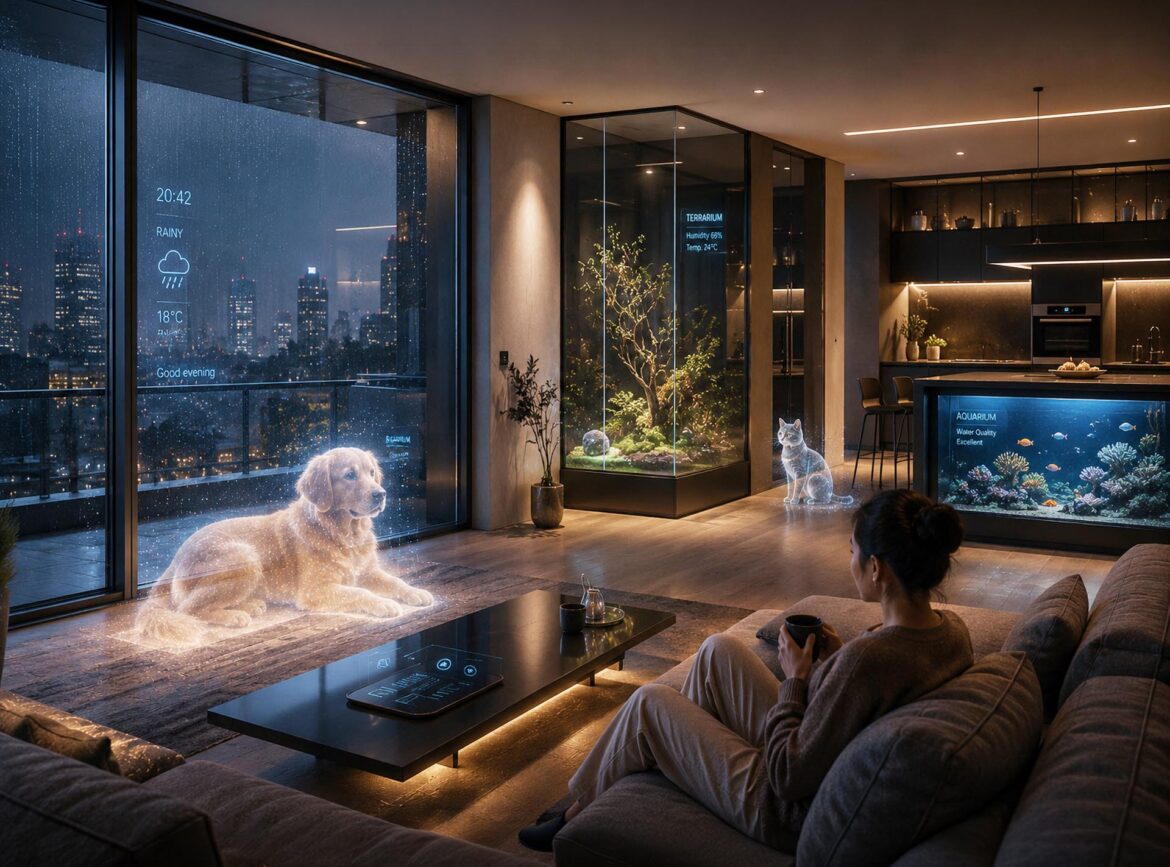
The concept image illustrates a possible future of transparent displays, where digital pets, aquariums, and terrariums are seamlessly integrated into living spaces.
Visualization: Transparent displays, digital pets, intelligent aquariums, adaptive terrariums, and AI powered real time 3D content within a connected living environment | Image: © Ulrich Buckenlei | VISORIC GmbH
Transparent displays could fundamentally change the way digital content is experienced in homes, hotels, showrooms, and intelligent buildings over the coming years. Glass surfaces would no longer remain passive architectural elements but evolve into active media surfaces where digital content appears directly within the real environment. This is where the concept of intelligent Living Displays begins.[1]
What still appears to be a futuristic vision today is becoming increasingly realistic through transparent OLED displays, MicroLED technologies, artificial intelligence, and real time 3D. Particularly exciting is not only the display technology itself, but also the question of how digital content can be integrated into our daily lives in a more natural, emotional, and spatial way in the future.[2]
The cover image of this article visualizes exactly this possible development. A modern living space is no longer dominated by traditional screens. Instead, a digital dog, a virtual cat, an intelligent aquarium, and an adaptive terrarium appear directly within transparent glass surfaces. As a result, digital content is no longer viewed in isolation but begins to merge with architecture, lighting, furniture, and atmosphere.
Especially in private living environments, this development could enable entirely new forms of digital experiences. People could enjoy virtual pets without the responsibilities of real animal ownership. Aquariums could appear as digital ecosystems. Terrariums could simulate different habitats. At the same time, such content could adapt to the time of day, mood, usage scenario, or personal preferences.[3]
This fundamentally changes the role of the display. It is no longer merely a surface for images, videos, or information. It becomes part of the space itself. Companies in the fields of display technology, smart homes, spatial computing, and immersive media are already exploring how transparent media surfaces can be connected with artificial intelligence, real time graphics, and interactive systems in the future.[4]
The real question is therefore no longer just what a screen can display. Increasingly, it is about how digital content becomes part of our surroundings. This is precisely where the unique impact of transparent Living Displays begins.
- Transparent displays integrate digital content directly into real environments
- AI systems can intelligently control virtual animals and environments
- Real time 3D makes digital content more spatial and lifelike
- Living spaces could evolve into personalized media environments
- Glass surfaces are becoming intelligent interfaces of everyday life
Particularly exciting is the point where digital content is no longer simply displayed, but appears as living real time models with behavior, routines, and interaction.
Digital Pets as Real Time 3D Models
One of the most emotional applications of transparent Living Displays could be digital pets. Unlike traditional animations or simple screen based content, these animals would not simply be played back but calculated as real time 3D models. This allows them to react, move, change posture, and respond to users or environmental situations.[5]
A digital dog could rest quietly in the living room, respond to movement, or adapt to specific times of day. A virtual cat could display different moods, prefer familiar locations, or develop its own personality through recurring routines. The key difference is that such systems no longer feel like videos but rather like digital beings with spatial presence.
This creates a new form of emotional media engagement. Digital pets could provide companionship, entertainment, and atmosphere without replacing real animal ownership. Particularly in urban apartments, hotels, care environments, or public spaces, such systems could create new forms of experiences positioned between design objects, media installations, and interactive companions.[6]
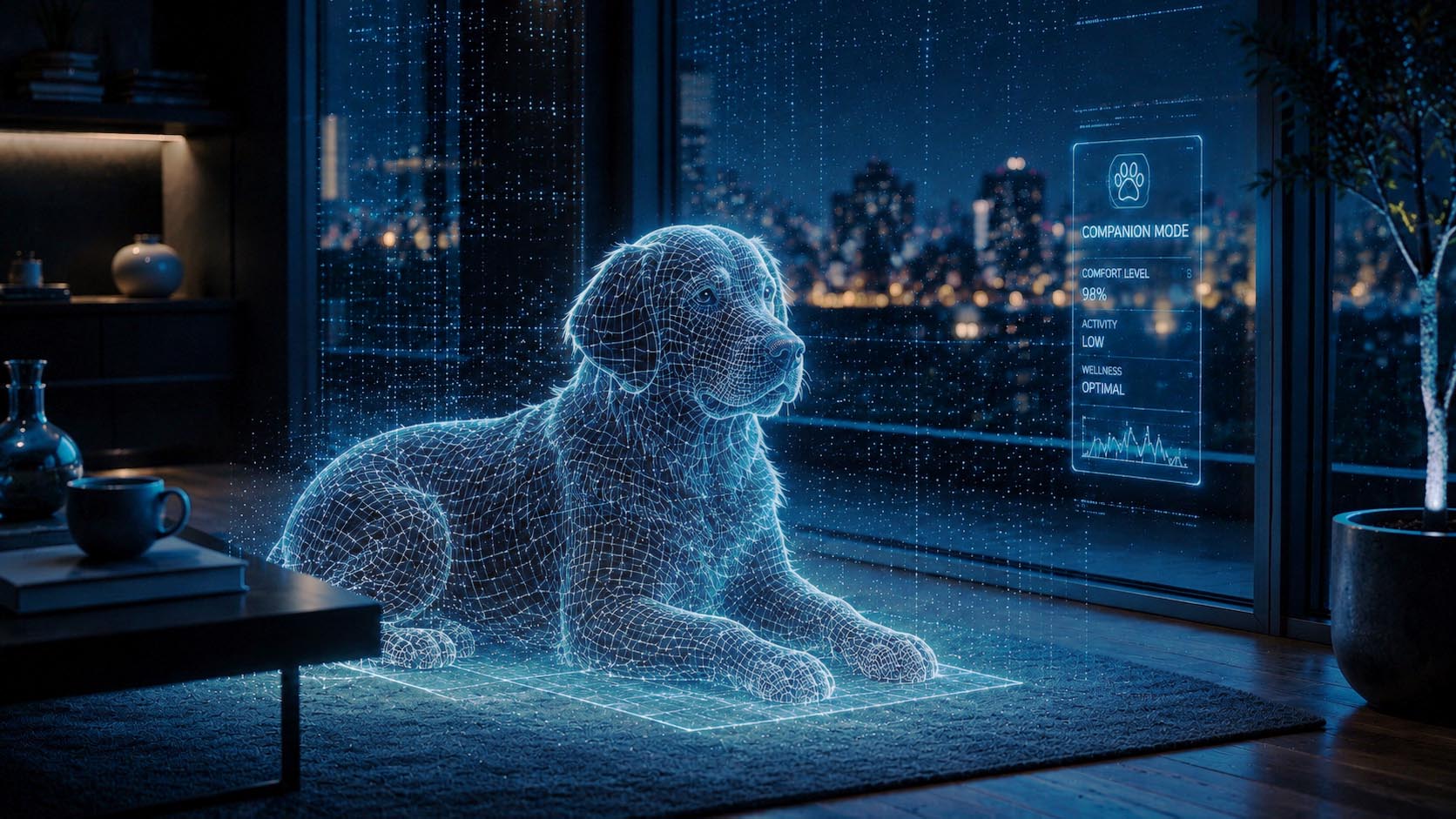
The concept image shows a digital dog as a visible wireframe model, illustrating how a virtual pet could be constructed as a real time 3D object within a physical space.
Visualization: Digital Companion Dog as an AI controlled real time 3D model with wireframe structure, transparent display appearance, and adaptive behavioral logic | Image: © Ulrich Buckenlei | VISORIC GmbH
Especially interesting is the combination of real time rendering, generative AI, and digital character models. Modern systems can increasingly generate movements, reactions, and dialogue dynamically. This means future digital pets may not only appear visually convincing but also respond contextually and adapt to users over time.[7]
This also creates new opportunities for architecture, interior design, and smart home applications. Digital animals may no longer appear as conventional gadgets but as integral elements of spatial design. They can create atmosphere, emotionally enrich spaces, or deliberately act as calming, energizing, or playful elements.
Real time 3D, AI driven behavior models, and transparent display surfaces are therefore evolving into an entirely new media format for living environments. Specialized teams working in spatial computing, real time visualization, and interactive media are increasingly focused on how such digital content can be implemented in a believable, high quality, and practical manner.[8]
- Digital pets are created as interactive real time 3D models
- AI can dynamically control behavior, reactions, and routines
- Transparent displays make virtual animals spatially visible
- Living spaces gain emotional and customizable media layers
- Digital companions could become a new component of intelligent spaces
Yet digital animals require more than attractive 3D models. The underlying technical infrastructure that reliably connects media servers, AI systems, real time rendering, and transparent displays becomes equally important.
The Technical Infrastructure Behind Intelligent Living Displays
Behind digital pets, intelligent aquariums, and adaptive terrariums lies far more than a simple display surface. In order for virtual content to appear believable, synchronized, and continuously interactive, numerous technologies must work together in real time. This is where the true system architecture of future Living Displays emerges.[9]
At the core of such systems are powerful media servers that connect real time graphics, simulations, sensor data, and artificial intelligence. They coordinate all content, manage digital characters, and ensure that every display operates in sync. At the same time, modern real time platforms enable the calculation of complex 3D worlds, physical simulations, and dynamic behavioral models.[10]
The objective is no longer to view digital content as isolated applications, but as interconnected components of an intelligent living environment. A virtual pet can react to the same data as a digital aquarium or an adaptive terrarium. Weather information, time of day, user interactions, and environmental conditions all contribute to a shared real time logic system.
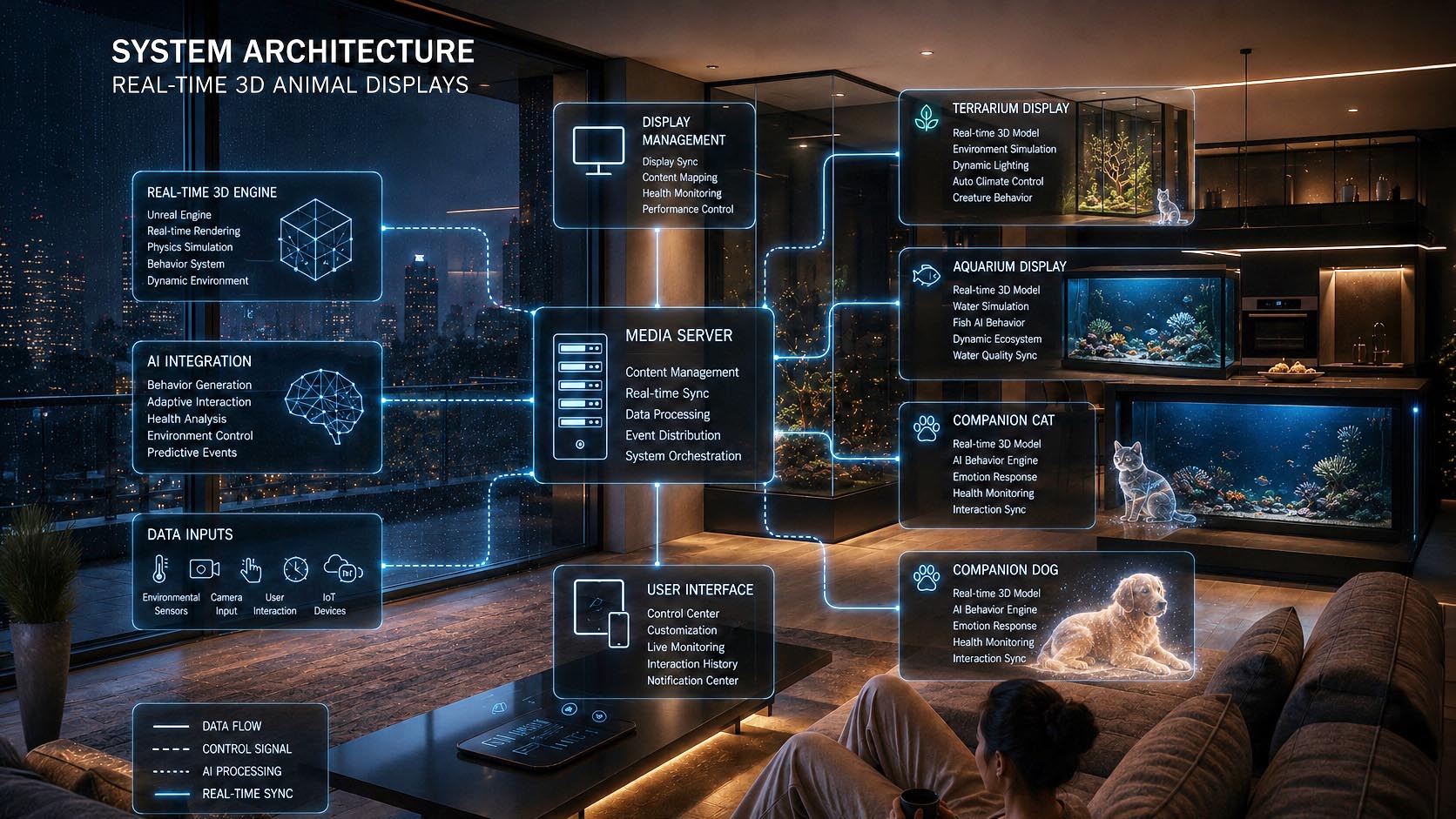
The system architecture illustrates the interaction between media servers, real time 3D platforms, AI systems, and transparent displays within an intelligent living environment.
Visualization: System architecture for digital pets, intelligent aquariums, adaptive terrariums, and AI controlled real time 3D content | Image: © Ulrich Buckenlei | VISORIC GmbH
The concept image in this chapter visualizes one possible architecture for such systems. Media servers coordinate all data streams, while real time 3D engines calculate virtual worlds. Artificial intelligence controls behavioral models, interactions, and personalization. Transparent displays serve as the visible interface between the digital and physical worlds.
This development becomes particularly interesting through the increasing convergence of Digital Twins, real time simulations, and intelligent media environments. Technologies from virtual production, immersive installations, and industrial visualization are finding their way into private living spaces for the first time.[11]
At the same time, new demands arise regarding synchronization, performance, and scalability. Multiple displays, different content types, and adaptive AI systems must communicate continuously. This is why modern media servers and real time platforms play a central role in the next generation of intelligent living spaces.[12]
- Media servers coordinate all content and data streams
- AI systems control behavior, personalization, and interactions
- Real time 3D platforms calculate dynamic virtual worlds
- Digital Twins enable intelligent environmental logic
- Transparent displays become the visible user interface
Yet even the best technical infrastructure is only the foundation. It is adaptive AI systems that create digital characters capable of evolving over time and responding intelligently to their surroundings.
When Digital Companions Develop Their Own Daily Rhythm
The next stage in the evolution of intelligent Living Displays begins when digital characters no longer perform predefined animations but develop their own behavior. Artificial intelligence already enables virtual agents to adapt to situations, users, and environments. This creates digital companions that feel significantly more natural than traditional computer simulations.[13]
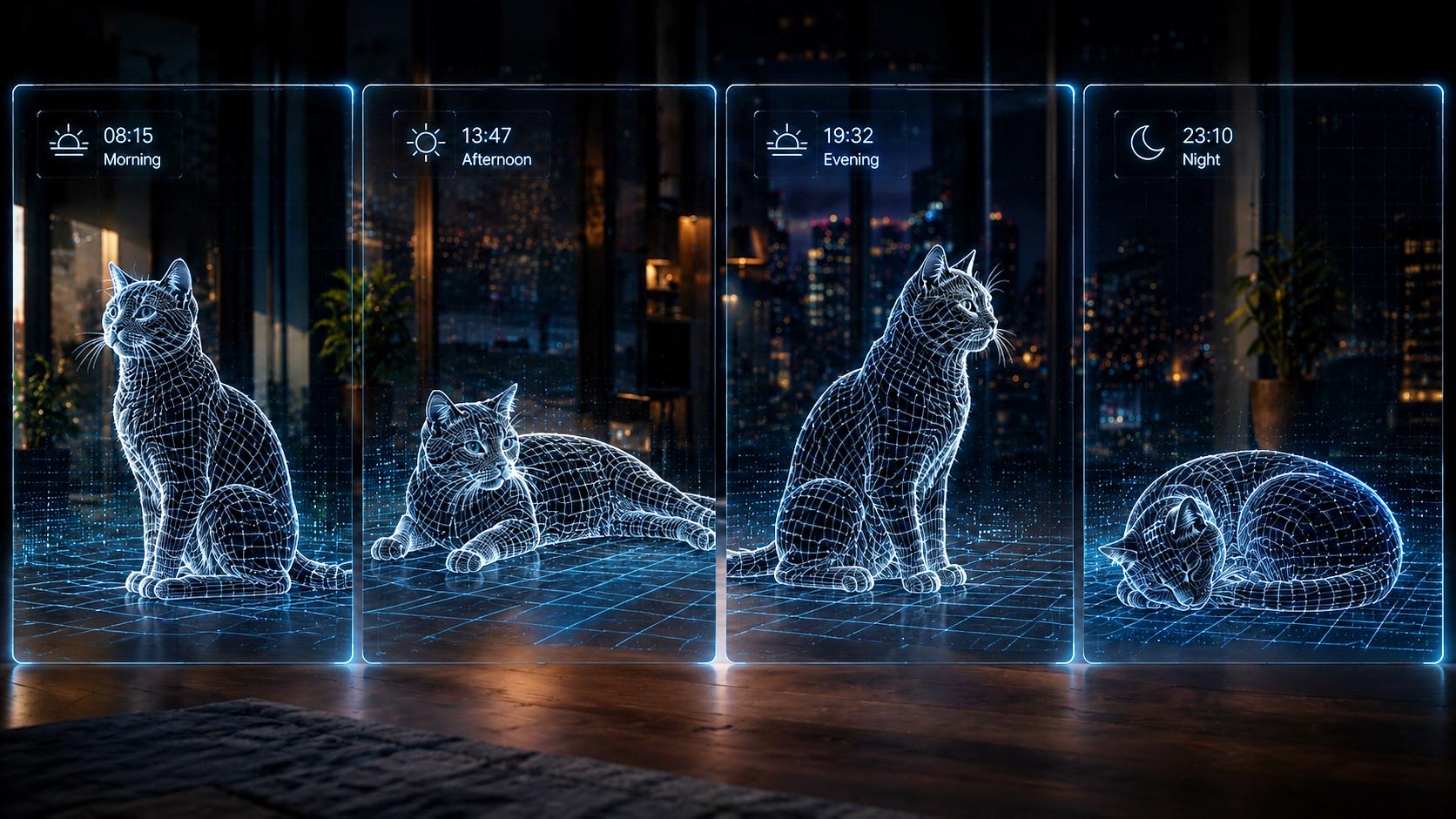
A digital cat, for example, could be active in the morning, seek out different favorite locations during the day, and retreat to quieter areas in the evening. Such behavioral patterns no longer need to be fully programmed in advance. Modern AI systems can dynamically generate, adjust, and continuously refine behavioral models.[14]
Particularly exciting is the combination of real time data and learning systems. Time of day, lighting conditions, user interactions, and habits can all influence the behavior of a digital companion over the long term. This creates the impression of an individual personality.
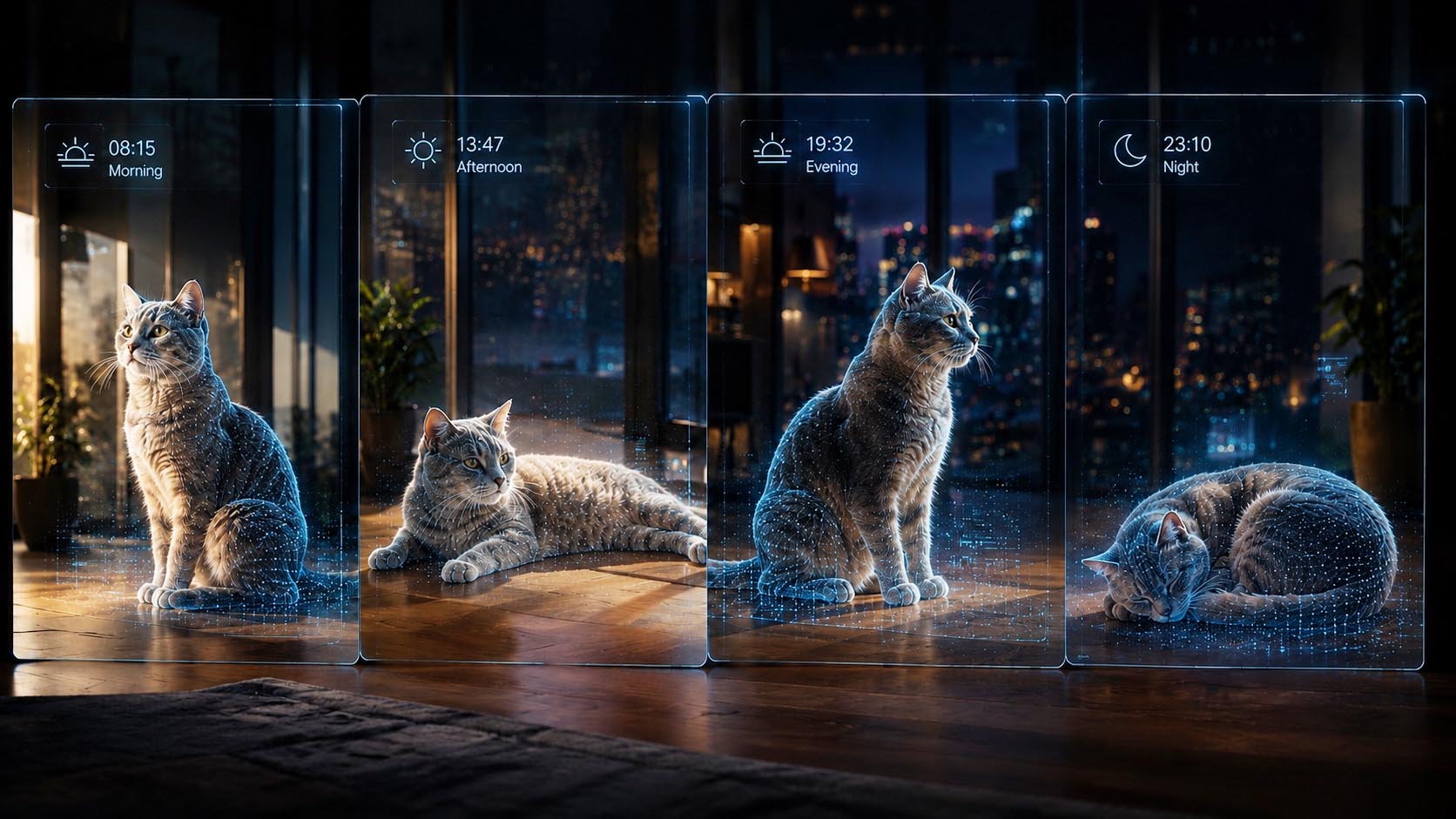
The visualization shows a digital cat whose behavior could dynamically adapt to the time of day, environment, and user interactions.
Visualization: AI Companion Cat with adaptive behavioral logic, daily rhythms, emotional states, and real time interaction | Image: © Ulrich Buckenlei | VISORIC GmbH
The image in this chapter illustrates four different phases of a digital companion’s daily cycle. Active in the morning, attentive during the day, calm in the evening, and sleeping at night. What appears simple at first glance actually requires complex systems involving artificial intelligence, real time logic, and behavioral simulation behind the scenes.
Research fields such as Reinforcement Learning, multimodal AI models, and Human Centered AI are already heavily focused on these challenges. The goal is to develop digital systems that not only react but also learn over time, recognize preferences, and interact meaningfully with people.[15]
This opens new possibilities, especially in the field of digital companions. Virtual pets could adapt to individual routines, develop preferred behaviors, or respond to recurring situations. As a result, interactions become more personal and emotionally convincing.
In the long term, such systems could extend far beyond entertainment. They could function as digital assistants, learning companions, emotional interfaces, or intelligent environmental characters. The boundaries between display content, digital character, and artificial intelligence are becoming increasingly blurred.[16]
- Digital characters develop individual behavioral patterns
- AI enables adaptive daily schedules and routines
- User interactions influence long term development
- Emotional interfaces create new forms of digital companionship
- Virtual pets become increasingly customizable
However, digital companions are only one part of intelligent living environments. The development becomes truly fascinating where entire ecosystems such as terrariums and aquariums are controlled, simulated, and personalized through AI.
Digital Terrariums as Adaptive Habitats
Transparent displays do not only create new possibilities for digital pets. The concept becomes especially fascinating when complete habitats are simulated. In the future, a terrarium may no longer consist solely of glass, plants, and lighting, but instead appear as a dynamic digital environment that adapts to time of day, climate, mood, or user preferences.[17]
Unlike traditional animations, modern real time platforms generate complete digital ecosystems. Plants grow, lighting changes, animals move through different areas, and entire environments react to external influences. This creates living worlds that continuously evolve and never appear exactly the same twice.[18]
Particularly interesting is the combination of artificial life, procedural generation, and real time 3D. Digital habitats no longer need to be created entirely by hand. Modern systems can automatically generate vegetation, terrain formations, lighting conditions, and behavioral patterns while dynamically adapting them over time. This results in unique ecosystems capable of long term evolution.[19]
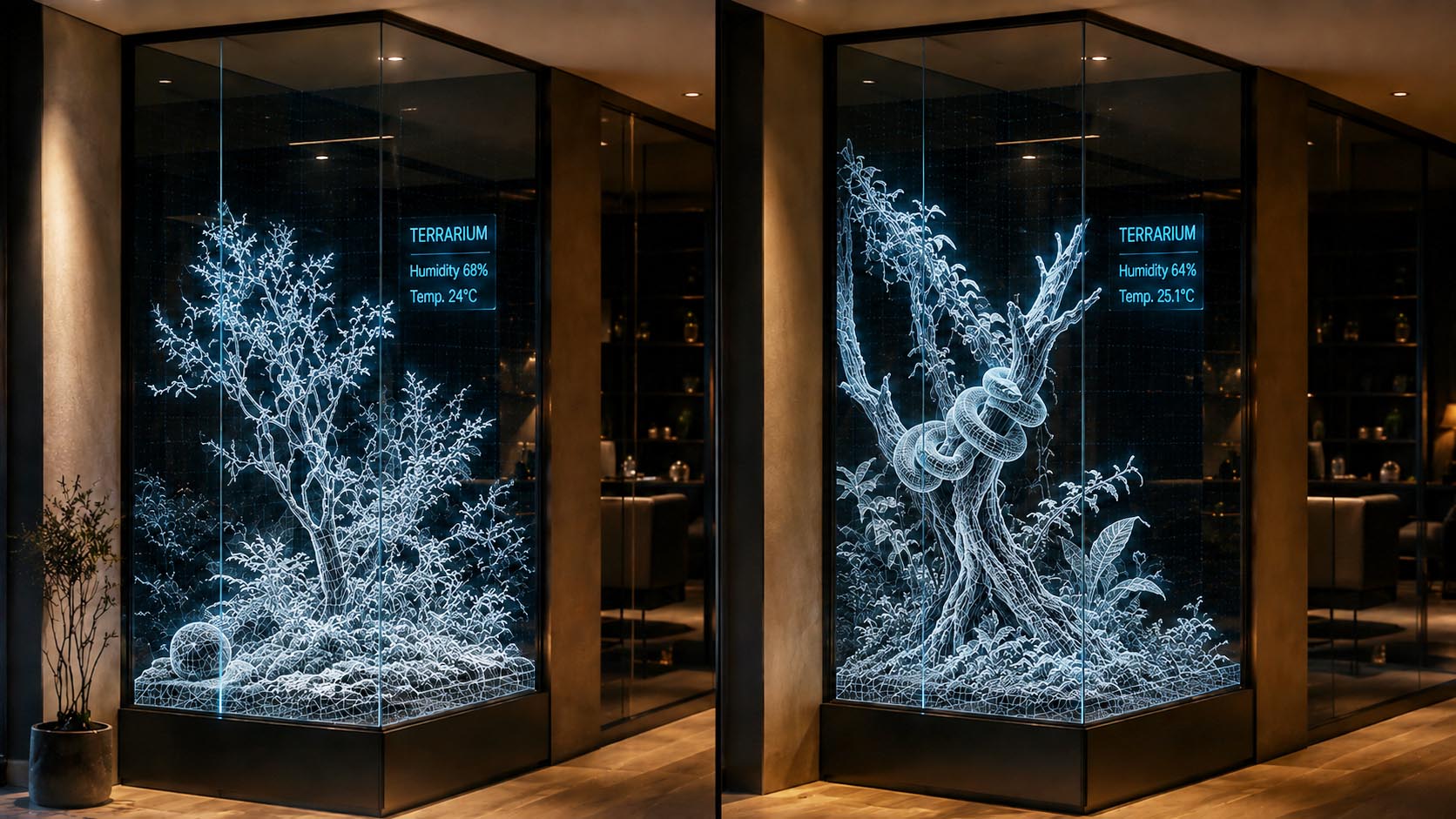
Digital terrariums could one day represent living ecosystems that dynamically adapt to users, time of day, and environmental conditions.
Visualization: Adaptive digital terrariums featuring real time vegetation, simulated habitats, intelligent behavioral patterns, and dynamic environmental logic | Image: © Ulrich Buckenlei | VISORIC GmbH
The image in this chapter presents two different digital terrarium worlds. While one side creates a tropical environment with dense vegetation, the other simulates a completely different animal and plant ecosystem. Both habitats are based on the same technological foundations, yet produce entirely distinct visual and ecological identities.
When combined with artificial intelligence, this creates new opportunities for personalized living spaces. Users could define their own habitats, select animal species, or automatically adapt environments to seasons and personal preferences. The terrarium becomes a living digital installation rather than a static decoration.[20]
New opportunities also emerge for entertainment, education, and experience design. Digital ecosystems could explain natural phenomena, simulate habitats, or visualize long term environmental changes. As a result, real and virtual worlds increasingly merge.
What is particularly interesting is the question of how such worlds are created. Behind every plant, every animal, and every movement lies a complex digital model. This technological foundation becomes visible in the next chapter.
- Digital terrariums simulate complete habitats
- Vegetation and environments are procedurally generated in real time
- AI can dynamically influence ecological systems
- Every user could design unique living worlds
- Digital ecosystems continuously evolve over time
To understand how these worlds are created, it is worth looking behind the visible surface. Before a digital terrarium appears alive, it first exists as a complex three dimensional model.
How Transparent Displays Make Digital Worlds Visible
Digital pets, virtual aquariums, and adaptive terrariums appear almost magical at first glance. In reality, however, their visualization is based on a combination of modern display technology, real time graphics, and optical integration. This is where the true innovation of transparent displays begins.[21]
Unlike traditional screens, transparent displays do not completely block the surrounding environment. Instead, they allow light to pass through while simultaneously displaying digital content. This creates the impression that virtual objects exist directly within the physical space. The real environment remains visible while digital content appears to exist freely within the architecture.[22]
OLED and future MicroLED technologies are particularly driving this development forward. Both approaches aim to display high resolution images on transparent surfaces without completely sacrificing transparency. As a result, windows, room dividers, and furniture surfaces can become active media surfaces while maintaining their original function and appearance.[23]
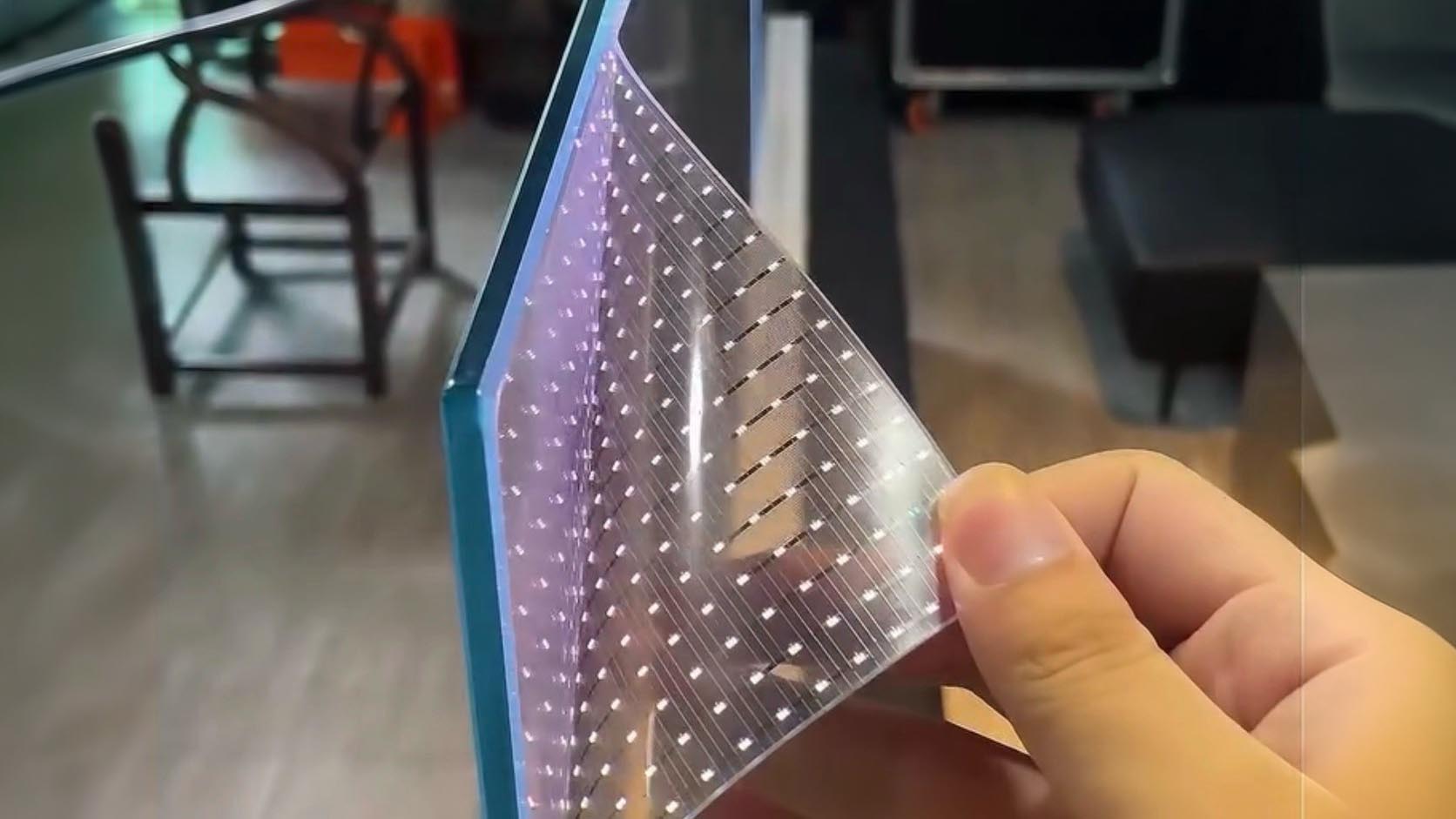
The visualization illustrates the technical structure of modern transparent displays and demonstrates how digital content can appear to exist freely within a physical space.
Visualization: Transparent OLED and MicroLED technologies featuring optical layers, light transmission, and real time rendering of digital content | Image: © Ulrich Buckenlei | VISORIC GmbH
The image in this chapter schematically presents the technological layers of modern transparent displays. Light transmitting materials, active pixel structures, and transparent carrier elements work together to make digital content visible without completely obscuring the surrounding environment.
This creates an entirely new relationship between architecture and digital media. Glass surfaces evolve from passive building elements into active information surfaces. Content appears exactly where it is needed without requiring additional monitors or traditional screens within the space.
For intelligent living environments, this opens numerous possibilities. Digital pets can appear to live freely within a room. Aquariums emerge directly within furniture or room dividers. Terrariums evolve into interactive ecosystems. At the same time, the architecture itself remains visible and fully functional.
It is precisely this combination of transparency, real time graphics, and artificial intelligence that makes transparent displays one of the most exciting technology fields of the coming years. They form the foundation for a new generation of digital living spaces where real and virtual content increasingly merge.[24]
- Transparent displays combine visibility and media presentation
- OLED and MicroLED enable entirely new spatial concepts
- Digital content appears to exist freely within physical space
- Architecture and media surfaces merge together
- Transparent displays form the foundation of future Living Displays
Yet the true strength of intelligent living spaces is not created by display technology alone. The most exciting developments emerge where artificial intelligence, sensors, and real time data begin to individually control and personalize digital worlds.
How Intelligent Aquariums Are Controlled by AI
Digital aquariums represent one of the most exciting application areas for transparent Living Displays. Unlike traditional screen based animations, these systems create complete underwater worlds that are calculated, simulated, and continuously adapted in real time. Fish, plants, lighting conditions, and water movements respond not only to predefined sequences but increasingly to data, user interactions, and intelligent control systems.[25]
At the center of such systems is the combination of real time 3D, artificial intelligence, sensors, and physical simulation. Modern platforms already enable the creation of complex underwater environments featuring dynamic lighting, realistic movement patterns, and intelligent behavioral models. This transforms the experience from a decorative effect into a living digital ecosystem.[26]
This development becomes especially interesting through the integration of real environmental data. Time of day, room lighting, weather information, and individual user preferences can influence the aquarium’s appearance. The digital system therefore evolves from a static animation into an intelligent real time environment.
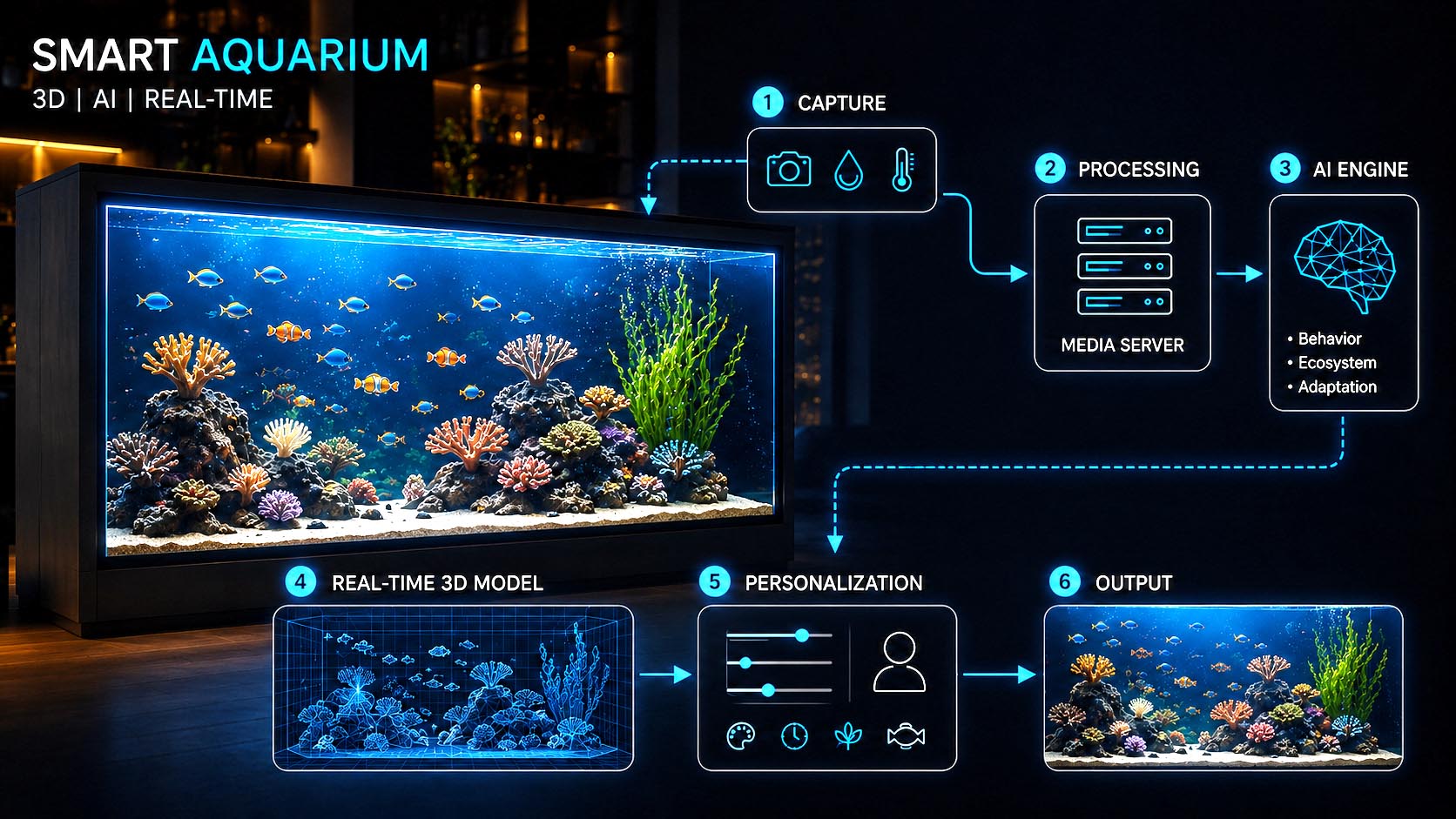
The infographic illustrates the interaction between AI, real time 3D, personalization, sensors, and media control within an intelligent Living Aquarium.
Visualization: Smart Aquarium architecture featuring real time data, AI control, sensors, simulation, personalization, and transparent display systems | Image: © Ulrich Buckenlei | VISORIC GmbH
The image in this chapter illustrates the technical architecture behind an intelligent aquarium. Data sources provide information about both the environment and the user. An AI engine analyzes this information and generates individualized behavioral patterns. Real time 3D systems calculate the virtual underwater world, while media servers deliver the content to transparent displays.
The combination of real time visualization and intelligent control opens entirely new possibilities. Schools of fish can change their behavior. Lighting conditions respond to the time of day. Plants evolve dynamically over time. This creates a system that does not merely display content but continuously reacts to its surroundings.[27]
New opportunities also emerge for smart home applications. Digital aquariums could visualize information, create moods, or integrate seamlessly into existing interior concepts. As a result, the technology increasingly becomes a combination of artwork, information system, and interactive experience space.
- AI analyzes environmental data and user interactions
- Real time 3D creates dynamic underwater worlds
- Sensors enable adaptive behavioral models
- Digital aquariums react to real world situations
- Living Displays evolve into intelligent media objects
The technical foundation is now established. The most exciting developments, however, occur when every aquarium is individually tailored to its user, creating truly unique digital habitats.
Personalized Living Aquariums for Intelligent Living Spaces
While traditional aquariums remain identical for every observer, future Living Aquariums could be tailored specifically to individual users. Artificial intelligence analyzes preferences, usage patterns, and interactions to generate personalized underwater worlds that continuously evolve over time.[29]
One user may prefer tropical reef environments with colorful schools of fish. Others may desire calm deep sea settings with minimal movement and subdued lighting conditions. Modern recommendation systems and adaptive AI models could automatically recognize such preferences and adjust the digital environment accordingly.[30]
This fundamentally changes the role of digital content. The aquarium is no longer viewed as a static visualization but evolves into an individual experience space. Every user experiences a different environment even though the same technological platform is being used.

Personalized Living Aquariums could create unique underwater worlds that adapt to user behavior, preferences, and everyday situations.
Visualization: Adaptive Living Aquarium with personalized fish environments, intelligent behavioral models, real time rendering, and AI driven user adaptation | Image: © Ulrich Buckenlei | VISORIC GmbH
The image in this chapter shows a photorealistic digital aquarium seamlessly integrated into a modern living space. The underwater world does not appear as screen content but rather as a natural part of the environment. It is precisely this combination of architecture, design, and digital experience that makes Living Displays so compelling.
Particularly when combined with personalization, new opportunities emerge for homes, hotels, lounges, and premium experience environments. Content can automatically adapt to different target audiences, creating individualized atmospheres without requiring changes to the physical environment.[31]
From an economic perspective, new opportunities also arise. Digital services are increasingly evolving from standardized applications into highly personalized experiences. Living Displays could follow the same path and adapt to individual people, families, or specific usage scenarios.
The long term perspective is especially interesting. The better systems understand their users, the more individualized the displayed content becomes. Living Displays therefore evolve from simple display surfaces into intelligent media environments that actively respond to people and provide contextual digital content.[32]
- Every user receives a unique digital underwater world
- AI analyzes preferences and usage patterns
- Personalization creates unique experience environments
- Digital content automatically adapts to situations
- Living Displays evolve into intelligent media environments
The future of transparent displays does not end with aquariums, terrariums, or digital pets. The most interesting developments emerge when Living Displays become a permanent component of intelligent living spaces and digital content fully merges with everyday life.
The Emotional Future of Intelligent Living Displays
Many of the technologies surrounding transparent displays, digital pets, and intelligent media environments still appear futuristic today. At the same time, current developments already show that artificial intelligence is increasingly beginning to make digital content more emotional, personal, and closer to everyday life. The real transformation does not lie solely in the technology itself. It fundamentally changes how people interact with digital systems and how digital content is perceived.[33]
Digital companions could develop individual routines in the future, respond to situations, and build familiar behavioral patterns over time. Living Aquariums could create calming atmospheres. Digital terrariums could dynamically adapt to the seasons. As a result, transparent displays would no longer be perceived as technical devices, but as a natural part of the living space.
What is particularly interesting is the emotional quality of such systems. People demonstrably respond to social behavior patterns, natural movements, and familiar routines. Digital content thereby develops a new form of presence. It is no longer merely viewed, but increasingly experienced.[34]
At the same time, new forms of intelligent interfaces are emerging. Information is increasingly disappearing from traditional applications and appearing directly within the spatial context. A digital companion could provide guidance. An aquarium could visualize moods. Transparent displays could integrate information without appearing like traditional screens.
The visualization shows a digital companion as part of a future living environment where emotional interaction, real time 3D, and artificial intelligence merge.
Visualization: Emotional AI Companion with real time behavior, natural interaction, transparent display technology, and intelligent living space context | Image: © Ulrich Buckenlei | VISORIC GmbH
The image in this chapter shows a digital dog within a premium living environment. The technology deliberately fades into the background. The focus is on the relationship between human, space, and digital content. Many researchers consider exactly this development to be one of the most important shifts in future human technology interaction.
Especially in the fields of Ambient Intelligence, Social Robotics, and Human Centered AI, new approaches are currently emerging to make digital systems more understandable, emotional, and intuitive. Living Displays could therefore become far more than pure entertainment media. They evolve into intelligent companions that respond to situations and meaningfully integrate digital content into everyday life.[35]
New economic potential is also emerging. Digital services are increasingly evolving from standardized applications into personalized experiences. Transparent displays, real time 3D, and artificial intelligence could bring this development directly into our living spaces in the future.
- Digital companions develop emotional behavioral patterns
- Living Displays integrate digital content more naturally into everyday life
- AI creates personalized and adaptive user experiences
- Information appears directly within the spatial context
- Transparent displays evolve into emotional interfaces
The future of intelligent Living Displays therefore does not end with individual products or applications. It describes a development in which digital content increasingly becomes part of our environment and integrates seamlessly into architecture, everyday life, and human perception.
When Digital Content Becomes Part of the Living Space
Transparent displays are a clear example of how profoundly the relationship between architecture, media, and artificial intelligence could change. Digital pets appear as real time 3D models within the room. Intelligent aquariums respond to their surroundings. Adaptive terrariums evolve into living ecosystems. Glass surfaces thereby become active media platforms that seamlessly integrate digital content into real living spaces.
The following video visually summarizes this development. It shows how transparent displays, real time 3D, and artificial intelligence can enable new forms of digital living spaces. Traditional screen surfaces evolve into interactive Living Displays that connect architecture, digital content, and personal experiences.
Visualization: Transparent displays, digital pets, intelligent aquariums, real time 3D systems, and AI powered Living Displays | Source material discovered through social media and online platforms | Analysis, storyline, and technological classification: © Ulrich Buckenlei | VISORIC GmbH
The real innovation does not lie in an individual display or in the graphic quality of a digital animal. What matters is the combination of real time graphics, artificial intelligence, personalization, and transparent architecture. This is exactly where new forms of digital living spaces emerge, in which real and virtual content increasingly merge.
For living, hospitality, smart home systems, entertainment, and experience design, this opens up new possibilities. Rooms could respond individually to people, integrate digital companions, and dynamically adapt content to different situations. Architecture increasingly evolves into an intelligent platform for digital experiences.
The Munich based VISORIC expert team views this development particularly in connection with real time 3D, Spatial Computing, Digital Twins, and intelligent media platforms. What becomes especially interesting is the question of how digital content can be meaningfully integrated into real environments over the long term without compromising the actual quality of living.
- Transparent displays integrate digital content directly into the living space
- AI creates personalized and adaptive media experiences
- Real time 3D makes digital content spatially experienceable
- Living Displays connect architecture, design, and technology
- Digital companions evolve into intelligent spatial interfaces
The future of transparent displays is therefore still at the beginning of its development. Yet it is already becoming clear how artificial intelligence, real time 3D, and new display technologies could fundamentally change our idea of living spaces.
From Living Displays to Intelligent Living Space Platforms
The development of transparent displays shows how profoundly the relationship between architecture, artificial intelligence, and real time 3D could change in the coming years. Digital pets, intelligent aquariums, adaptive terrariums, and personalized media environments are only the first examples of a much larger development. New digital living space platforms are emerging that no longer limit content to traditional screens, but integrate it directly into the architecture.
This becomes particularly exciting where digital content does not merely entertain, but creates real added value. Transparent displays can explain products, visualize information, stage brand worlds, or create individual user experiences. Hotels can create personalized experience spaces. Showrooms can present products emotionally. Premium residential projects can integrate digital content as a fixed component of modern interior architecture. At the same time, new opportunities are emerging for smart home systems, hospitality concepts, experience design, and intelligent living environments.
At exactly this intersection, the Munich based VISORIC expert team develops individual concepts, prototypes, and platform solutions for transparent displays, real time 3D applications, Digital Twins, AI powered companion systems, and intelligent media environments. The focus is not on isolated individual installations, but on scalable solutions that can be used over the long term, are technically robust, and are economically meaningful.

The VISORIC expert team develops concepts for transparent displays, digital companions, intelligent media environments, and real time 3D platforms for the next generation of connected living spaces.
Visualization: Future oriented platform architecture for Living Displays, artificial intelligence, real time 3D applications, Digital Twins, and intelligent media environments | © VISORIC GmbH | Munich
From digital pets and intelligent aquariums to fully personalized living environments, new digital product categories are currently emerging. Companies, architecture partners, interior designers, manufacturers, real estate developers, and technology providers are increasingly exploring how transparent displays can be meaningfully integrated into future living and experience spaces.
VISORIC supports companies from the initial concept phase through technical architecture to the implementation of functional prototypes and market ready solutions. This includes real time 3D visualization, AI integration, media server architectures, Digital Twin platforms, interactive user experiences, and the development of individual Living Display systems.
The living spaces of the future will therefore not only become more intelligent. They will become more interactive, more personal, and more emotional. This is exactly where the most exciting fields of innovation are emerging for the next generation of digital living space technologies.
Are you planning a Living Display, a transparent display product, a digital companion, or an intelligent real time 3D application?
Talk to the Munich based VISORIC expert team about concept development, feasibility analyses, prototyping, and technical implementation.
Contact us:
Email: info@visoric.com
Phone: +49 89 21552678
Address: Bayerstr. 13, 80335 Munich
Sources and References
- LG Electronics, LG SIGNATURE OLED T, Transparent OLED TV, product and technology information.
- Samsung Display, Transparent MICRO LED, technology presentation on transparent MicroLED displays.
- SID Display Week, technical papers on transparent OLED, MicroLED, and future display architectures.
- MIT Media Lab, Ambient Intelligence and Human Computer Interaction Research.
- NVIDIA ACE, Generative AI for autonomous digital characters and interactive avatars.
- Unreal Engine, real time 3D rendering, animation, simulation, and interactive character worlds.
- ACM Digital Library, research on Digital Companions, Virtual Agents, and Human AI Interaction.
- IEEE Xplore, studies on emotional AI, virtual companions, and adaptive interface systems.
- NVIDIA Omniverse, platform for real time 3D, simulation, and Digital Twins.
- Disguise, Real Time Production and media server workflows for synchronized media environments.
- 7thSense, media server and show control systems for immersive installations.
- Dataton WATCHOUT, multi display control and synchronized media architecture.
- Google DeepMind, research on Reinforcement Learning, adaptive agents, and learning systems.
- OpenAI Research, foundations of generative AI systems, interaction, and multimodal models.
- MIT Media Lab, research on social robots, companion interfaces, and emotional technology.
- Stanford HAI, Human Centered Artificial Intelligence and user centered AI systems.
- Unity SpeedTree, procedural vegetation and real time plant models for 3D environments.
- Unreal Engine Procedural Content Generation Framework, procedural scenes and environments.
- Artificial Life Journal, research on digital ecosystems, behavior, and artificial life.
- Nature Ecology and Evolution, scientific foundations of ecosystem modeling and environmental behavior.
- LG Display, Transparent OLED Signage and transparent display technology.
- Samsung Display, Transparent MicroLED and next generation emissive display surfaces.
- IEEE, research on MicroLED scaling, transparent electrodes, and display integration.
- SID Symposium Digest of Technical Papers, technical publications on OLED, MicroLED, and transparent displays.
- NVIDIA Omniverse, physically based simulation, Digital Twins, and real time visualization.
- Unreal Engine, real time rendering, fluid simulation, particles, and interactive 3D systems.
- ACM SIGGRAPH, research on realistic underwater worlds, simulation, and visual effects.
- IEEE Sensors Journal, sensors, environmental data, and intelligent real time systems.
- ACM Transactions on Computer Human Interaction, research on personalization and adaptive interfaces.
- Google Research, user modeling, recommendation systems, and context aware AI systems.
- MIT Personal Robots Group, user centered interaction with intelligent digital systems.
- Harvard Business Review, personalization, digital services, and data based customer experiences.
- MIT Media Lab, Social Robotics, Ambient Intelligence, and emotional human technology interaction.
- Stanford Human Computer Interaction Group, interactive systems, spatial interfaces, and experience design.
- IEEE Transactions on Affective Computing, emotional AI and adaptive digital systems.
Contact Us:
Email: info@xrstager.com
Phone: +49 89 21552678
Contact Persons:
Ulrich Buckenlei (Creative Director)
Mobil +49 152 53532871
Mail: ulrich.buckenlei@xrstager.com
Nataliya Daniltseva (Projekt Manager)
Mobil + 49 176 72805705
Mail: nataliya.daniltseva@xrstager.com
Address:
VISORIC GmbH
Bayerstraße 13
D-80335 Munich