
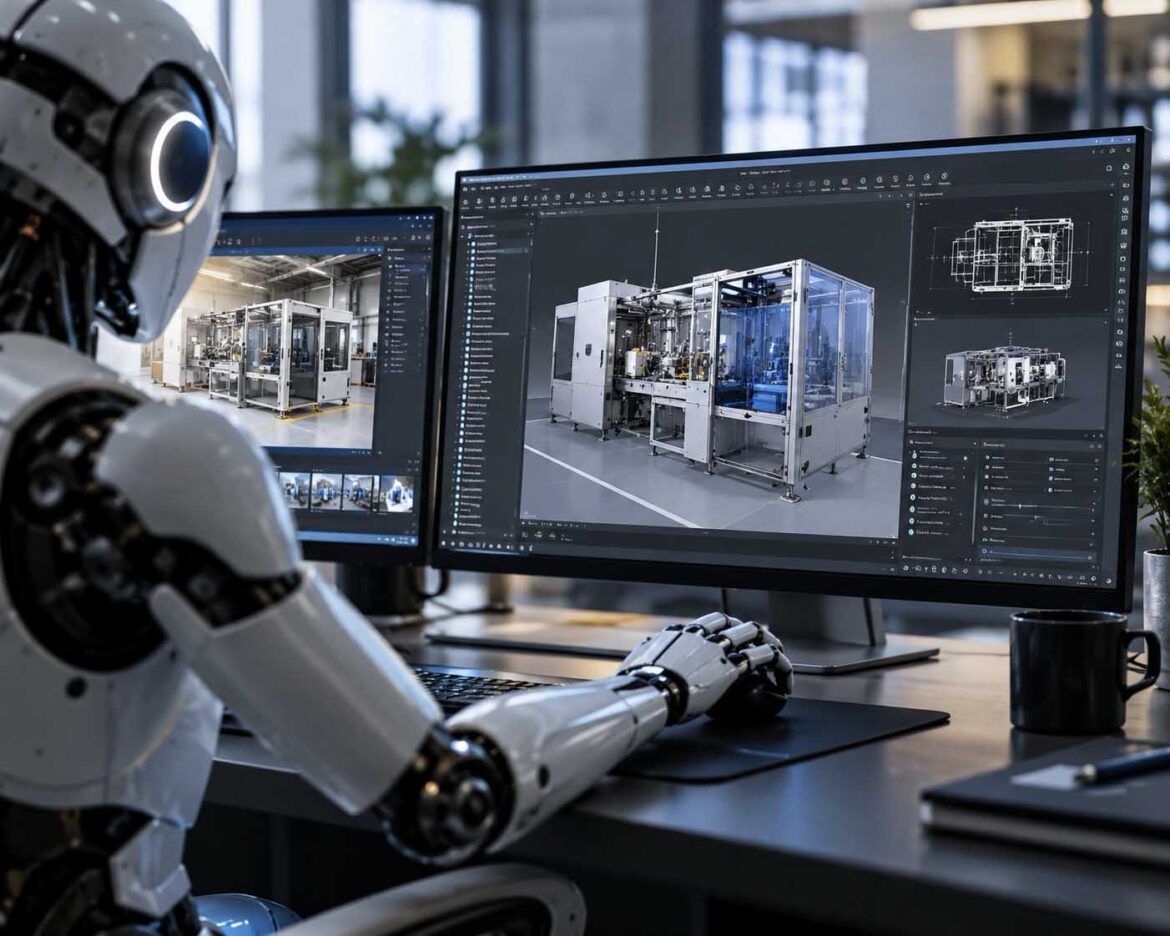
A sentence as the blueprint for an entire 3D scene.
Graphic: Symbolic depiction of a text prompt that flows via an arrow directly into an editable 3D scene in Blender, with no intermediate step of manual modeling | XR Stager Online Magazine | VISORIC GmbH
Someone gives a computer program a short written description, and shortly afterward a finished, three-dimensional digital model exists, one that can then be edited further, just like a model built by hand. What sounds like a distant vision of the future has been documented reality since September 3, 2026: OpenAI released GPT-6 Astra, a model that operates professional computer programs, for example for 3D modeling or digital design, on its own, using mouse clicks and keyboard input, exactly as a human would. Experts call this ability “computer use.”
What makes this case remarkable isn’t the announcement itself, but what happened in the days that followed. Several independently verifiable examples show how the AI uses this ability to build complete, finished 3D models and working digital applications, not as a prepared corporate demo, but as results from individual creators and developers who tried the model out for themselves in the first days after release. For anyone who works professionally with 3D visuals, virtual reality, or digital replicas of real places, this is a development that reaches far beyond a single product launch.
This article explains what this new ability technically means, shows four documented use cases in detail, and just as clearly points out where the spectacular examples circulating online conceal the model’s actual weaknesses, and what real-world access actually costs.
- OpenAI released GPT-6 Astra on September 3, 2026.
- Astra is the first widely available model that operates computer programs directly on its own.
- Several verifiable examples show complete 3D models built from a single short description.
- OpenAI itself frames the model as an important step toward highly capable AI.
- Independent tests significantly temper that framing.
This article explains what this new AI-driven computer operation technically means, shows four documented real-world examples in detail, critically assesses the viral demonstrations, and breaks down what actual access to Astra costs.
What It Means When an AI Operates the Computer Itself
Earlier AI models could write text, generate images, or suggest code, but they always remained on the output side: a human still had to transfer the result into the actual program themselves. GPT-6 Astra breaks through exactly that separation. The model visually perceives what’s on the screen and controls the mouse cursor and keyboard directly inside real software, operating the very same program a human would use, rather than merely providing instructions for it.
To measure how well this actually works, OpenAI used two test procedures that simulate real computer tasks. In the first test, which checks how reliably the AI correctly recognizes and clicks individual buttons and icons on screen, Astra achieves a score of 92.7 percent.[1] In the second, considerably more demanding test, which checks complete, multi-step workflows as they occur in real work, the model scores 72.6 percent.[1] The gap between these two figures is telling: recognizing and clicking individual elements on screen succeeds almost every time, but carrying out an entire workflow to completion without any human intervention succeeds in only about three out of four cases.
For anyone who works professionally with 3D visuals, this distinction is crucial. That’s because the impressive examples that circulated online in the days after release show not single clicks, but complete, multi-step workflows inside real professional software.
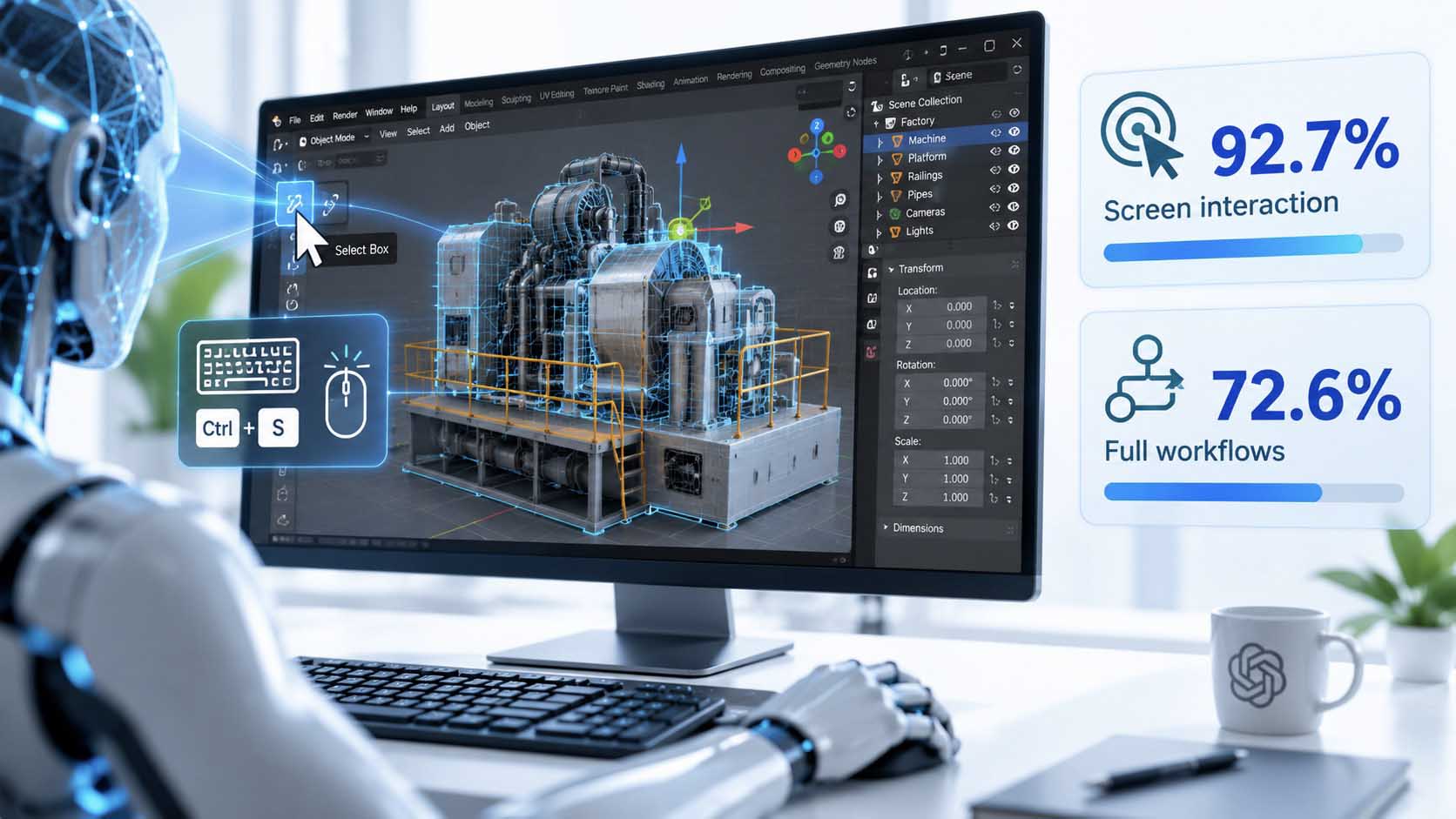
There’s a big difference between a single click and a complete workflow.
Graphic: Own illustration of AI screen control and the test results published by OpenAI[1] | XR Stager Online Magazine | VISORIC GmbH
This distinction between individual actions and a complete workflow explains why the same model can produce impressive results and clear failures at the same time.
- Astra perceives screen content and controls the mouse and keyboard directly on its own.
- It operates real software rather than merely issuing instructions for it.
- On individual screen elements, Astra achieves a success rate of 92.7 percent.[1]
- On complete, multi-step workflows, that figure drops to 72.6 percent.[1]
- This exact gap later also shapes the critical look at the viral examples.
What this ability looks like in practice when building 3D models is shown by four documented examples. That is the subject of the next chapter.
Four Examples, One Shared Pattern
In the days following the release, several creators and developers independently showed how they used Astra to build 3D models. Four of these examples illustrate just how different the use cases are, and how similar the underlying principle remains.
In the first case, well-known video creator and designer Bilawal Sidhu gave the AI an old scan of his parents’ living room. Such a scan is created when a person takes numerous photos of a space with a phone or camera, from which a three-dimensional replica is then automatically calculated, a process experts call photogrammetry. Astra rebuilt the room entirely from scratch as an independent 3D model in the 3D software Blender, a free, widely used program for creating three-dimensional models. The AI didn’t download any ready-made assets from the internet, instead deriving the surface patterns directly from the original scan and creating the matching materials on its own.[2]
In the second case, developer ashebytes put the AI to work on a considerably more technical project: a complete, interactive website where users can select and view 2,234 individual anatomical structures of the human body in three dimensions, including an exploded view that lets individual body parts be pulled apart, plus a search function covering more than 3,400 named structures. The project is called Human Atlas and is publicly viewable, with the underlying code written by the AI itself.[3]
A third example comes from Dilum Sanjaya, who asked the AI for a detailed, interactive depiction of a V8 engine, the kind found in many cars. The result was a fully controllable animation of the engine with realistically modeled mechanics, where even the engine’s RPM can be adjusted live and the individual strokes of the engine can be observed.[4] What connects these three cases is remarkable: in each one, a short written request produced a complete, functioning, technically sound 3D result, without a human having to take over the actual modeling work.
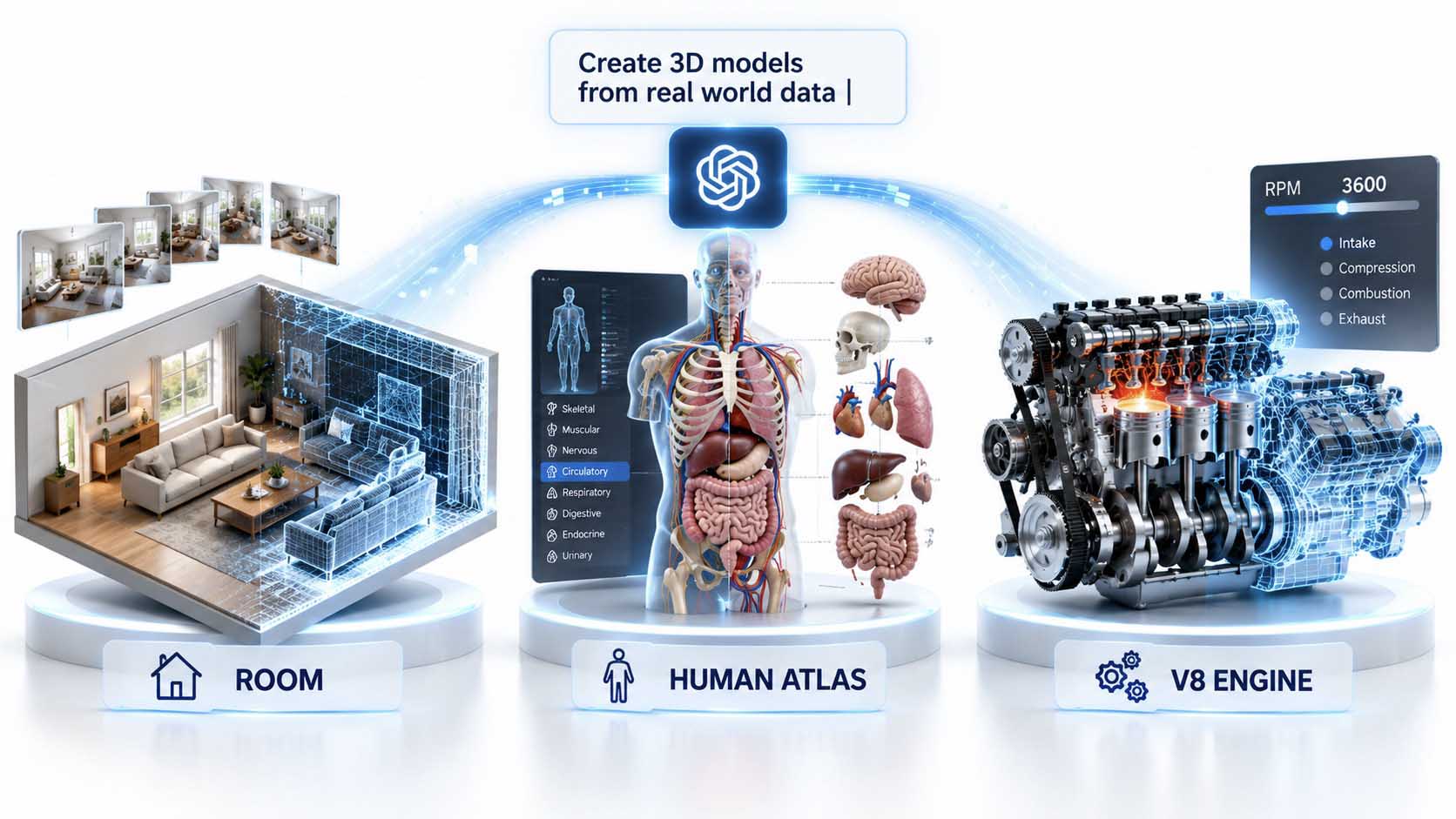
Three completely different requests, one shared outcome.
Graphic: Own compilation of three documented examples from the first days after release[2][3][4] | XR Stager Online Magazine | VISORIC GmbH
In every one of these cases, the results are publicly traceable, either as viewable code, as a documented creation process, or both.
- Bilawal Sidhu had the AI rebuild a real living space from a 3D scan in Blender.[2]
- ashebytes had the AI program a publicly viewable, interactive 3D anatomy website.[3]
- Dilum Sanjaya received a fully controllable, technically accurate engine animation.[4]
- In all three cases, a short text request produced a complete 3D result.
- The results are publicly traceable as code or as a documented process.
A fourth, commercially notable approach doesn’t rely on the AI alone, but combines it deliberately with a specialized image-rendering provider. That is shown in the next chapter.
From a Written Brief to a Finished Image
Alongside building directly in Blender, a second, equally important pattern emerges: combining the AI with a specialized partner company. On the commercial platform Higgsfield AI, an official launch partner of OpenAI, a human describes a scene in plain text, for instance a well-known space like the Oval Office in the White House. The AI writes the technical blueprint for the 3D scene from that description, while Higgsfield’s own technical infrastructure then builds the model and calculates it into a finished, photorealistic image using specialized software, a final step the industry calls rendering.[5]
This two-step approach differs fundamentally from building directly in Blender: here, the AI handles only the translation of language into a technical blueprint, while the actual image calculation is handled by a specialized commercial platform. For users, this means a considerably easier entry point, since no dedicated professional software needs to be installed, but it also creates a stronger dependence on the quality and cost of that particular provider.
This exact approach produced a large share of the most spectacular examples from the past few days, complete historic buildings, entire virtual cities, elaborate architectural renderings. As becomes clear in the later chapter on critical assessment, it’s important to know who published these examples, and with what interest of their own.
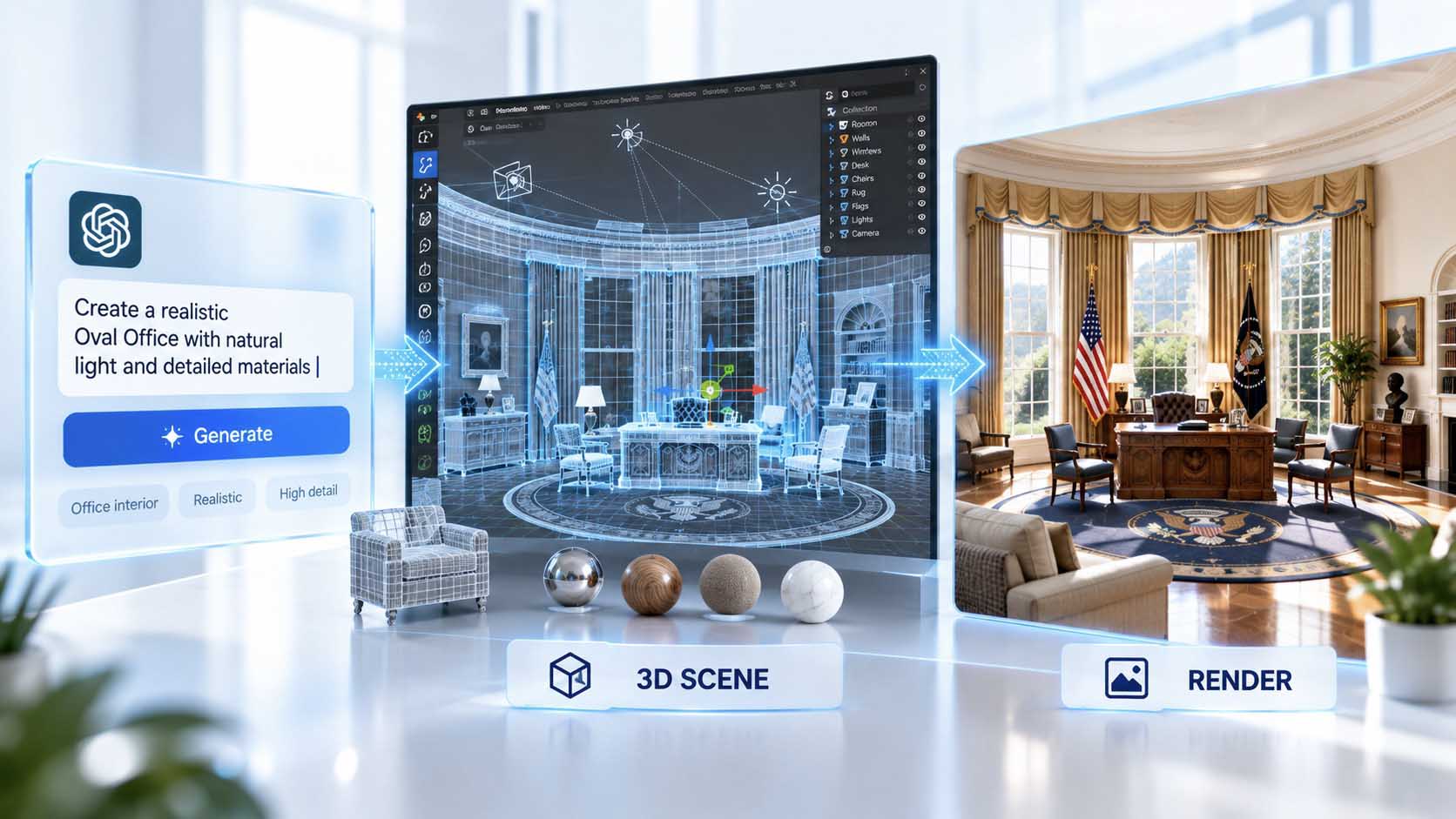
A two-step path from word to finished image.
Graphic: Own illustration of the combined workflow of written brief, technical blueprint, and external rendering[5] | XR Stager Online Magazine | VISORIC GmbH
This combined approach makes clear that the AI rarely works alone, and is increasingly becoming part of larger, specialized production chains.
- Higgsfield AI is an official partner of OpenAI for the launch of GPT-6 Astra.[5]
- The AI translates text descriptions into a technical 3D blueprint.
- Higgsfield’s own technology handles model construction and image rendering.[5]
- This approach lowers the entry barrier but increases dependence on a single provider.
- A large share of the most spectacular examples comes from exactly this approach.
Why this development matters to everyone who works professionally with 3D visuals, regardless of the specific approach used, is shown in the next chapter.
Why This Matters for the 3D Industry
For anyone who works professionally with three-dimensional visuals, virtual reality, or digital replicas of real places, this development hits a central point: a general-purpose AI, not specifically built for 3D work, can now build finished, editable 3D models in real professional software from a single paragraph of description, rather than just producing flat images meant as a rough guide.
That’s a meaningful difference from earlier AI image generators. A flat image of a room generated by AI previously had to be completely rebuilt by hand by a professional before it was actually usable. A model built directly in Blender by Astra, on the other hand, is an editable, three-dimensional object from the very start, with a clear, technically sound structure that fits into existing workflows.
In practice, this means one thing above all: the entry barrier for a first 3D draft drops noticeably. A first spatial concept, a quick visual for an internal meeting, an illustrative technical model, all of this can now be produced considerably faster than before. What the AI explicitly does not replace, however, is reliable, professional production with exact measurements, verified material data, and consistent quality, the kind needed for industrial applications, for instance. This exact distinction between a quick draft and reliable, verified production runs through the entire critical look at the AI’s actual capabilities.
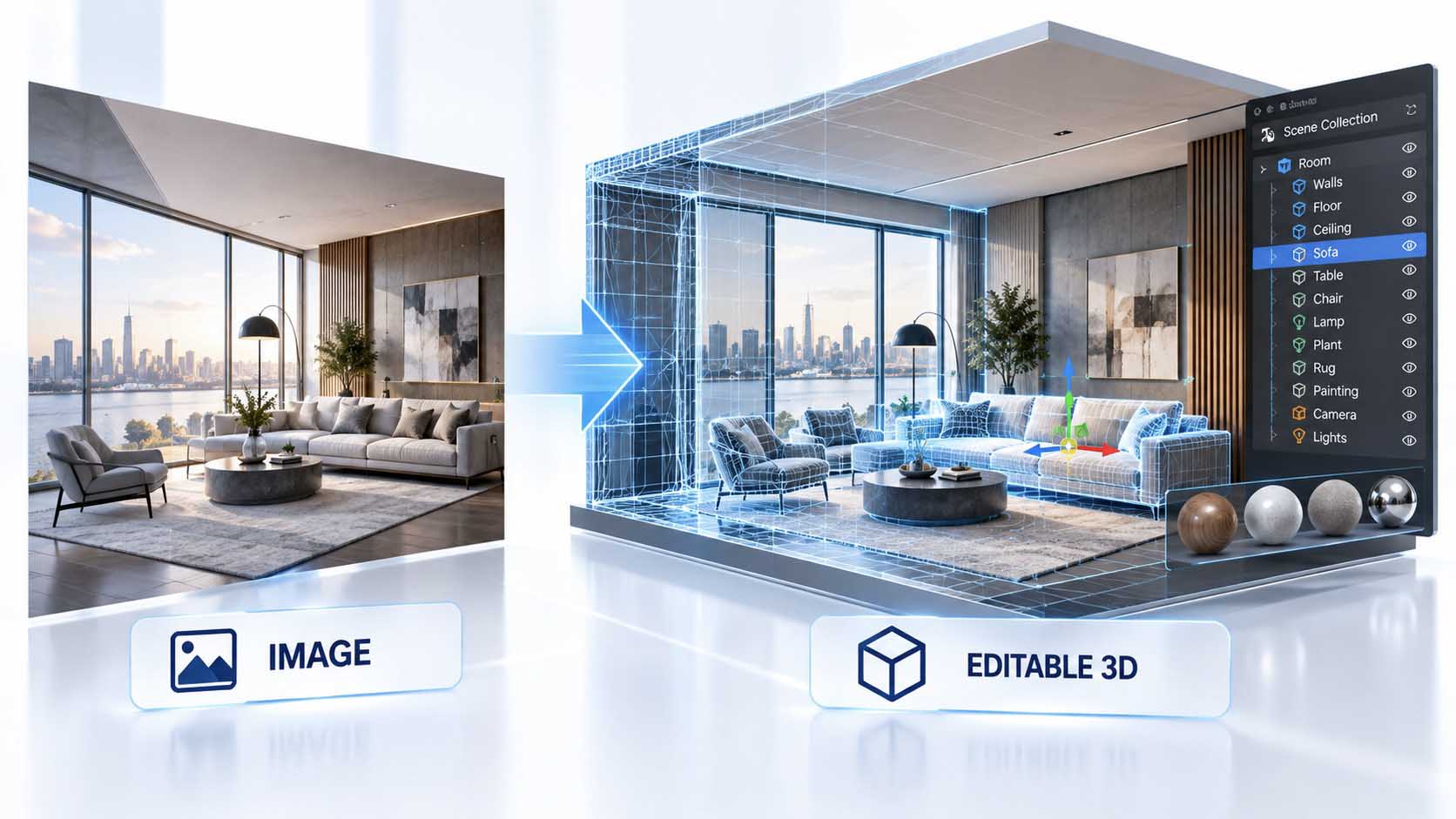
From flat image to a genuinely editable 3D model.
Graphic: Own comparison of a classic, flat AI-generated image and an editable 3D model built directly in professional software | XR Stager Online Magazine | VISORIC GmbH
This context matters for correctly assessing the viral examples in the next step, since this is exactly where the distinction between a quick draft and a production-ready result starts to play a decisive role.
- The AI builds editable 3D models, not just flat images.
- Results fit into existing workflows thanks to their technical structure.
- The entry barrier for quick, first 3D drafts drops noticeably.
- The AI explicitly does not replace reliable, industry-grade production.
- The gap between draft and production readiness also shapes the critical assessment ahead.
Just how large that gap actually is in practice becomes clear from a closer look behind the viral examples. That is the subject of the next chapter.
A Closer Look Behind the Viral Examples
As impressive as the examples shown are, they represent a carefully curated highlight reel, not an average result. On OpenAI’s own test for complete workflows, Astra fails at roughly one in four real tasks, a failure rate that isn’t visible in any of the viral examples, because naturally only the successful results get shared, not the failed attempts.
A widely cited peak score of 99.9 percent from a further, more complex test procedure also deserves closer scrutiny: this figure comes from a special test setup built by OpenAI itself, in which the AI receives additional assistance between individual steps. A neutral standard test procedure without that assistance produced only 62.7 percent for the same task.[6] One user, who by their own account generates very high, paid usage volume with the model, publicly described the AI as “unevenly better”: strong at computer operation and 3D tasks, only average at conventional web design, and explicitly weak at video editing.[7]
Even OpenAI’s own chief scientist publicly called the safety monitoring of the model “fragile” and trending in a negative direction at launch.[6] Particularly important for context: a large share of the most spectacular 3D examples, complete historic buildings, entire virtual cities, come from Higgsfield AI, a paying partner company with a direct commercial interest in exactly this positive narrative, not from independent, neutral testers. One outside observer accordingly criticized one of these posts, saying in effect that they saw hardly any real detail, only rough wireframes and simple surfaces, which made them skeptical.[5]
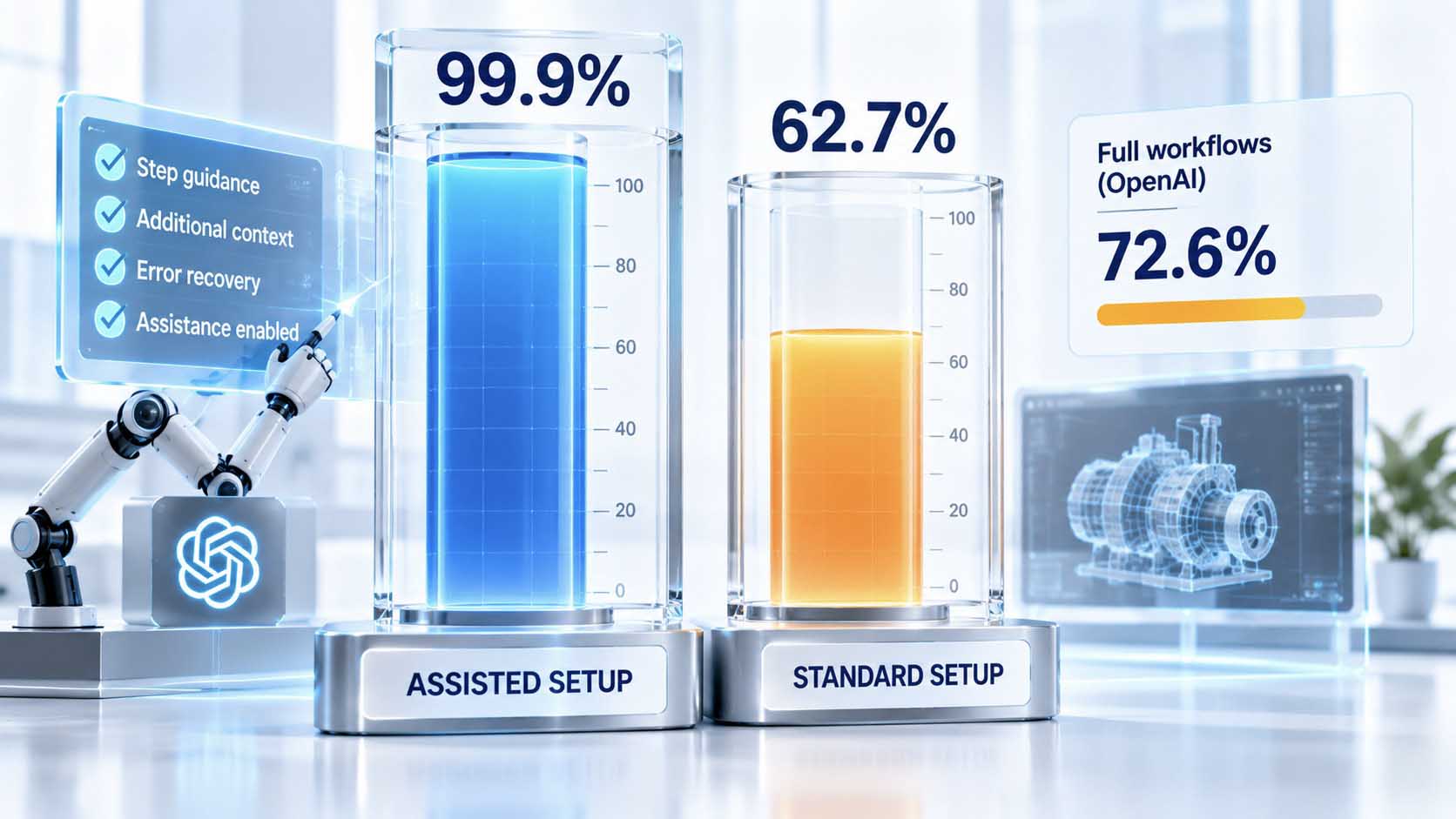
The same test, two very different results, depending on test conditions.
Infographic: Own illustration of the gap between OpenAI’s own test setup and a neutral standard procedure[6] | XR Stager Online Magazine | VISORIC GmbH
This context doesn’t diminish the documented results from earlier chapters, but places them realistically: as impressive individual cases within a model that still fails at roughly a quarter of all real tasks.
- On complex workflows, the AI fails at roughly one in four real tasks.
- The widely cited 99.9 percent peak score comes from a non-neutral, OpenAI-built test setup.[6]
- A neutral standard procedure produced only 62.7 percent for the same test.[6]
- OpenAI’s own chief scientist called the model’s safety monitoring “fragile.”[6]
- Many of the most spectacular examples come from a paying, commercially interested partner company.[5]
After this critical assessment, the practical question arises of what actual access to Astra costs. That is shown in the next chapter.
What Access Actually Costs
One detail usually left out of the viral posts: full access to Astra’s 3D capabilities isn’t a free side feature, but tied to several, partly combined subscription models. In the regular, cheaper ChatGPT plan at 20 US dollars a month, Astra is only available in a limited way, exclusively within certain work areas, not in the regular chat.[8] Full use in the familiar chat window requires the pricier ChatGPT Pro plan at 200 US dollars a month, with a limited weekly and monthly usage allowance, additional usage can be purchased on top.[8]
Anyone using the AI directly through a technical programming interface, a so-called API that lets other programs access the AI, pays based on actual usage: billing runs in small text units called tokens, with different prices depending on whether text is being input or output by the AI, and on how quickly the response needs to arrive.[8] For the examples shown in this article that pair the AI with the provider Higgsfield, a separate, additional subscription is required on top, with entry prices starting around 19 US dollars a month for a limited monthly credit balance, up to considerably pricier packages for professional power users. Any unused credit balance expires at the end of each month.[9]

Full access usually means more than a single subscription.
Infographic: Own compilation of the different pricing tiers for full access to GPT-6 Astra and the Blender examples shown[8][9] | XR Stager Online Magazine | VISORIC GmbH
.xrs-responsive-table { width: 100%; border-collapse: collapse; margin: 0; }
.xrs-table-cell { border: 1px solid #ddd; padding: 6px; text-align: left; font-size: 13px; }
.xrs-responsive-table thead tr { background-color: #f2f2f2; }
@media (max-width: 600px) {
.xrs-table-cell { font-size: 12px; padding: 5px; }
}
@media (max-width: 420px) {
.xrs-table-cell { font-size: 11px; padding: 4px; }
}
| Access | Price | Scope |
|---|---|---|
| Cheaper ChatGPT plan | 20 USD / month | Astra only limited, only in certain areas |
| Pricier ChatGPT plan | 200 USD / month | Full use in the regular chat, with an allowance |
| Direct access, standard speed | 10 / 50 USD per million text units | Input / output, up to a usage threshold |
| Direct access, above the threshold | 20 / 75 USD per million text units | Higher rate above this usage volume |
| Render partner, entry tier | 19 USD / month | Limited credit balance for image rendering |
| Render partner, power user | 99–129 USD / month | Considerably higher credit balance for image rendering |
Six access tiers, six very different cost models.
Table: Price overview for full access to GPT-6 Astra and the examples shown, as of September 2026[8][9] | XR Stager Online Magazine | VISORIC GmbH
A realistic entry point for a single high-quality example project therefore comes to roughly 20 to 60 US dollars in fixed monthly costs, plus actual usage, considerably more than the small amounts many viral posts online tend to suggest.
- Full use in the regular chat costs 200 US dollars a month, not the cheaper base tier.[8]
- Direct technical access is billed based on actual usage, with tiered pricing.[8]
- The examples shown that use external rendering require an additional, separate subscription.[9]
- Unused credit balances expire at the end of the month.[9]
- Realistic fixed costs run 20 to 60 US dollars a month, plus actual usage.
Taken together, capability, limitations, and cost paint a considerably more sober picture than the viral examples alone. What that means for teams that produce 3D content professionally is shown in the closing chapter.
Between Fascination and Caution
For teams that produce 3D content professionally, the question in the end isn’t so much whether GPT-6 Astra is impressive, but what this new ability changes structurally. Does a tool this capable change who builds the first draft, or does it simply shift where actual professional skill comes into play?
The cases shown in this article point to a nuanced answer. For quick, first drafts, for the initial spatial translation of an idea, for illustrative technical models, the AI lowers the entry barrier noticeably and genuinely. For reliable, industry-grade final products with exact measurements, verified material data, and consistent quality, the professional experience of 3D experts remains indispensable, precisely because the model itself still fails at roughly a quarter of real tasks in controlled tests.
For companies, this means concretely: the AI is already a capable tool for the early ideation phase, but it doesn’t replace verified, professional production. Whoever consciously separates these two levels gains speed in ideation without sacrificing reliability in the finished result.

Two levels that should stay deliberately separate.
Graphic: Own illustration of the separation between an AI-supported ideation phase and verified, professionally accountable production | XR Stager Online Magazine | VISORIC GmbH
It’s exactly at this dividing line that it becomes clear whether a tool like this AI actually saves time, or simply creates new verification work elsewhere.
- The AI noticeably lowers the entry barrier for quick, first 3D drafts.
- Professional 3D experience remains indispensable for industry-grade final products.
- Roughly a quarter of real tasks still fail even in controlled tests.
- Ideation and verified production should stay deliberately separate.
- This separation determines whether time is genuinely saved or simply shifted elsewhere as verification work.
Just how convincing the AI’s 3D capabilities actually look in motion is shown in the following chapter.
From a Single Tool to a Complete Creative Partner
What earlier chapters described as individual, impressive examples fits together, on closer inspection, into a larger pattern. An AI like Astra doesn’t just take over a single work step, it potentially handles several stages of a complete creative process at once: from the first 3D model through matching environments and animations to the finished rendering, technical documentation, and repeated revision of a design. The human still provides the actual idea and creative direction, while the AI increasingly takes over the technical execution across multiple production steps.
Current industry figures from architecture, a field closely related to 3D visualization, show that this shift reaches far beyond individual viral examples. A large survey of roughly 800 architects worldwide found that six in ten firms have now firmly integrated AI tools into their daily work, an increase of 38 percentage points since the first comparable survey. 86 percent of users report a noticeable time savings.[12]
At the same time, the same study shows where the limits lie: while 67 percent of respondents are satisfied with AI-generated results in the early design phase, that figure drops to only around 30 percent for detailed, production-ready work. Nearly half of all respondents cite unreliable results as their biggest obstacle.[13] This confirms exactly the distinction made in earlier chapters: AI tools are already a strong partner for early ideation, but their reliability drops noticeably once it comes to robust, production-ready results.
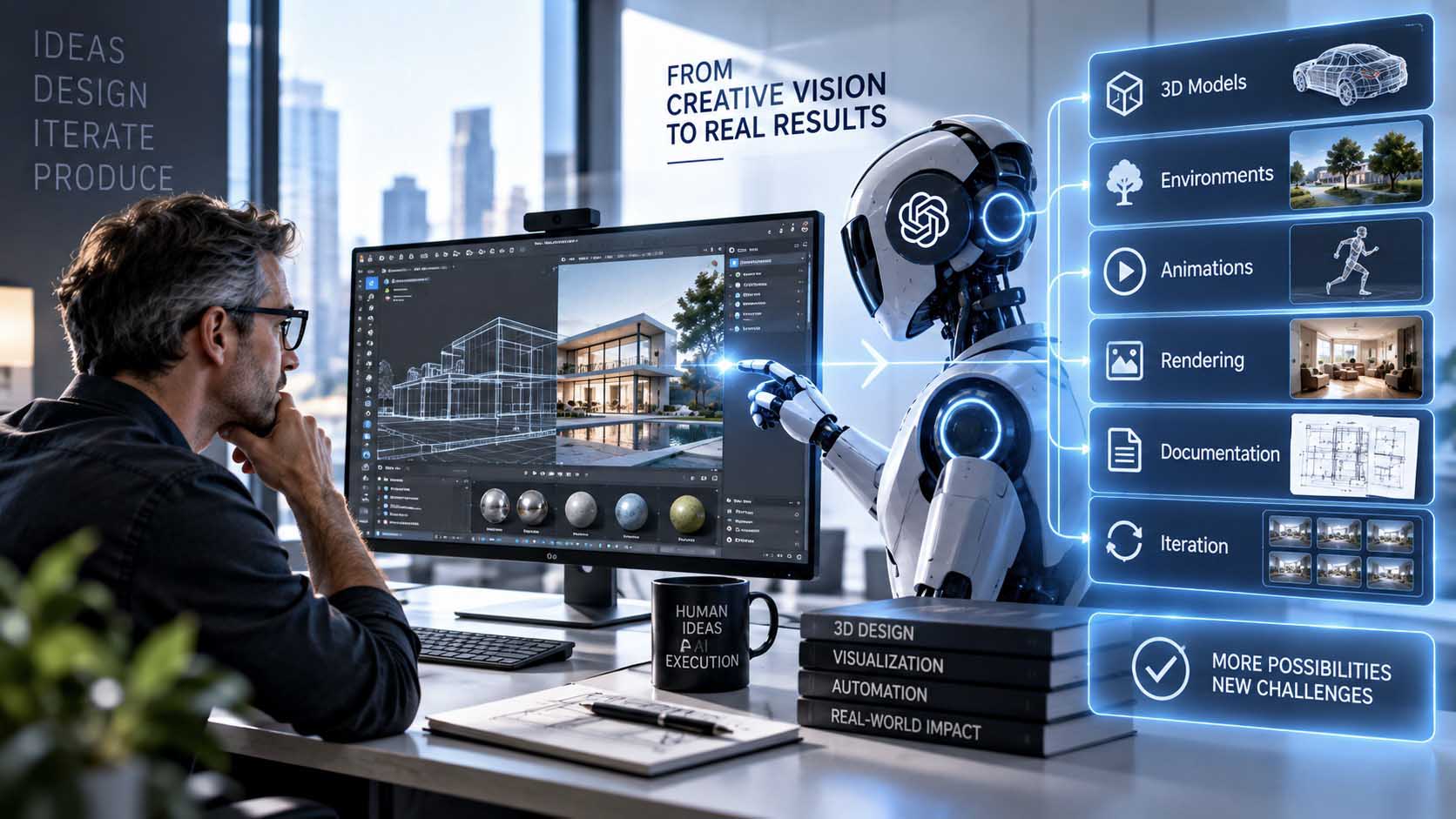
The human provides the idea, the AI increasingly handles multiple production steps.
Graphic: Symbolic illustration of the collaboration between human creativity and AI-supported production across multiple work steps | XR Stager Online Magazine | VISORIC GmbH
For companies and creative teams, this means: the question is no longer whether AI gets integrated into creative workflows, but at which points it’s reliable enough to actually take on responsibility, and at which points human expertise remains indispensable.
- AI tools are increasingly taking on multiple production steps rather than just one.
- Six in ten architecture firms now use AI as a fixed part of daily work.
- 86 percent of users report noticeable time savings.[12]
- Satisfaction drops from 67 percent in the early design phase to around 30 percent for detailed work.
- Nearly half of respondents cite unreliable results as the biggest obstacle.[13]
This brings the article full circle: from a single, astonishing example to an industry-wide pattern that shows how creative work is fundamentally changing right now, without releasing humans from responsibility. Just how convincing Astra’s 3D capabilities actually look in motion is shown in the following video.
Three Examples, One Shared Pattern
The preceding chapters have explained what this new AI-driven computer operation technically means, which examples are documented, and where the model’s limits lie. Just how quickly this ability was actually put to use in practice is most striking in a direct comparison of the three chronologically ordered examples.
The following video brings together, in chronological order, the results from Dilum Sanjaya, ashebytes, and Bilawal Sidhu, from the interactive engine animation, to the publicly viewable 3D anatomy website, to the complete rebuild of a real living space, each created within days of the release.
Video: Compilation of three documented GPT-6 Astra examples | Original examples: Dilum Sanjaya, ashebytes, Bilawal Sidhu[2][3][4] | Editing, editorial, and analysis: Ulrich Buckenlei | XR Stager Online Magazine | VISORIC GmbH
GPT-6 Astra is changing what’s possible in 3D. Within hours of its release, creators started proving it. Dilum Sanjaya asked for an interactive V8 engine and got a full four-stroke simulation, real crank mechanics, live valve timing, drag-controlled RPM. Then ashebytes turned it into Human Atlas, an interactive anatomy explorer with 2,234 modeled pieces, open-sourced the same day. And Bilawal Sidhu gave it an old photogrammetry scan of his parents’ living room, Astra rebuilt the entire space in Blender from scratch, no external assets, just its own textures and shaders. Three creators, three fields, days after launch. That’s what I track as an analyst: not the hype, but how fast the toolkit for 3D creators is turning over.
The direct comparison of these three cases makes visible what earlier chapters described: the same AI, three completely different fields, each within days of the release.
- The video shows three chronologically ordered real-world examples.
- All three were created within days of the release.
- The results span technical animation, medical visualization, and interior architecture.
- Editing, editorial work, and analysis come from the XR Stager team.
- The video condenses every earlier chapter into a single, vivid example.
Exactly where the biggest opportunities and the biggest challenges for 3D teams currently lie remains an open question, one whose answer is likely to keep shifting in the coming months.
From Demo to Reliable Application
A capable AI tool alone doesn’t make for reliable 3D production. It’s exactly this separation between a fast, AI-supported ideation phase and verified, professionally accountable execution that lies at the heart of VISORIC’s work.
The expert team at VISORIC GmbH in Munich combines over 15 years of experience in 3D, AI, and XR with hands-on expertise in spatial computing, real-time 3D, and digital twins. Right at the intersection that new tools like GPT-6 Astra are currently making visible, between fast AI support and reliable, production-ready 3D execution, VISORIC guides companies from the first concept through to a deployable application.

15 years of experience in 3D, AI, and XR: the VISORIC expert team in Munich.
Image: © Ulrich Buckenlei | XR Stager Online Magazine | VISORIC GmbH
A well-thought-out pilot project, a single use case, a clearly scoped visualization solution, can often be realized far faster and more cost-effectively than many companies expect.
- Advice on the sensible use of new AI tools within existing workflows.
- Development of reliable, production-ready spatial computing applications.
- From a fast concept idea to a company-wide solution.
That is exactly where a conversation should begin: not with the big, company-wide vision, but with a clearly scoped, quickly achievable first step.
Want to find out how new AI tools like GPT-6 Astra can be meaningfully integrated into your 3D production?
Talk to the VISORIC expert team in Munich about spatial computing, AI-driven visualization, and reliable digital twins.
Contact:
Email: info@visoric.com
Phone: +49 89 21552678
Sources and References
- OpenAI. GPT-6 Astra, A New Generation of Intelligence, official launch page. openai.com, September 2026.
- Bilawal Sidhu (@bilawalsidhu). X post on the Blender reconstruction of his parents’ living room. X, September 2026.
- ashebytes. “Human Atlas” GitHub repository. github.com, September 2026.
- Dilum Sanjaya (@DilumSanjaya). X post on the interactive V8 engine visualization with GPT-6 Astra. X, September 2026.
- Higgsfield AI (@higgsfield_ai). X posts on the Oval Office and architecture demos, plus official changelog. higgsfield.ai/creator-hub/changelog, September 2026.
- TechTimes. GPT-6 Astra Goes Live, AGI Claim Fails OpenAI Own Bar, Monitoring Called Fragile. techtimes.com, September 2026.
- BigGo Finance. OpenAI’s GPT-6 Astra Is a Generational Leap in Computer Use, But Power User Says It Still Can’t Edit Video. biggo.com, September 2026.
- MindStudio, Yotta Labs, layer3labs.io, TheAICareerLab, familypro.io. Pricing and access overviews for GPT-6 Astra, September 2026.
- Creatify, Blotato, Scopeful, TechSifted. Higgsfield AI pricing overviews, August/September 2026.
- Chaos / Architizer. The 2026 Archviz Pulse, 10 Stats Defining the New Era of Design. blog.chaos.com, April 2026.
- Chaos / Architizer. The State of AI in Architecture, How AI Is Reshaping Architectural Design & Visualization in 2026. blog.chaos.com, March 2026.
- VISORIC field projects in digital twins, real-time 3D, and spatial computing.
- XR Stager platform for real-time 3D, digital twins, knowledge AI, and industrial spatial computing applications.
Contact Us:
Email: info@xrstager.com
Phone: +49 89 21552678
Contact Persons:
Ulrich Buckenlei (Creative Director)
Mobil +49 152 53532871
Mail: ulrich.buckenlei@xrstager.com
Nataliya Daniltseva (Projekt Manager)
Mobil + 49 176 72805705
Mail: nataliya.daniltseva@xrstager.com
Address:
VISORIC GmbH
Bayerstraße 13
D-80335 Munich