
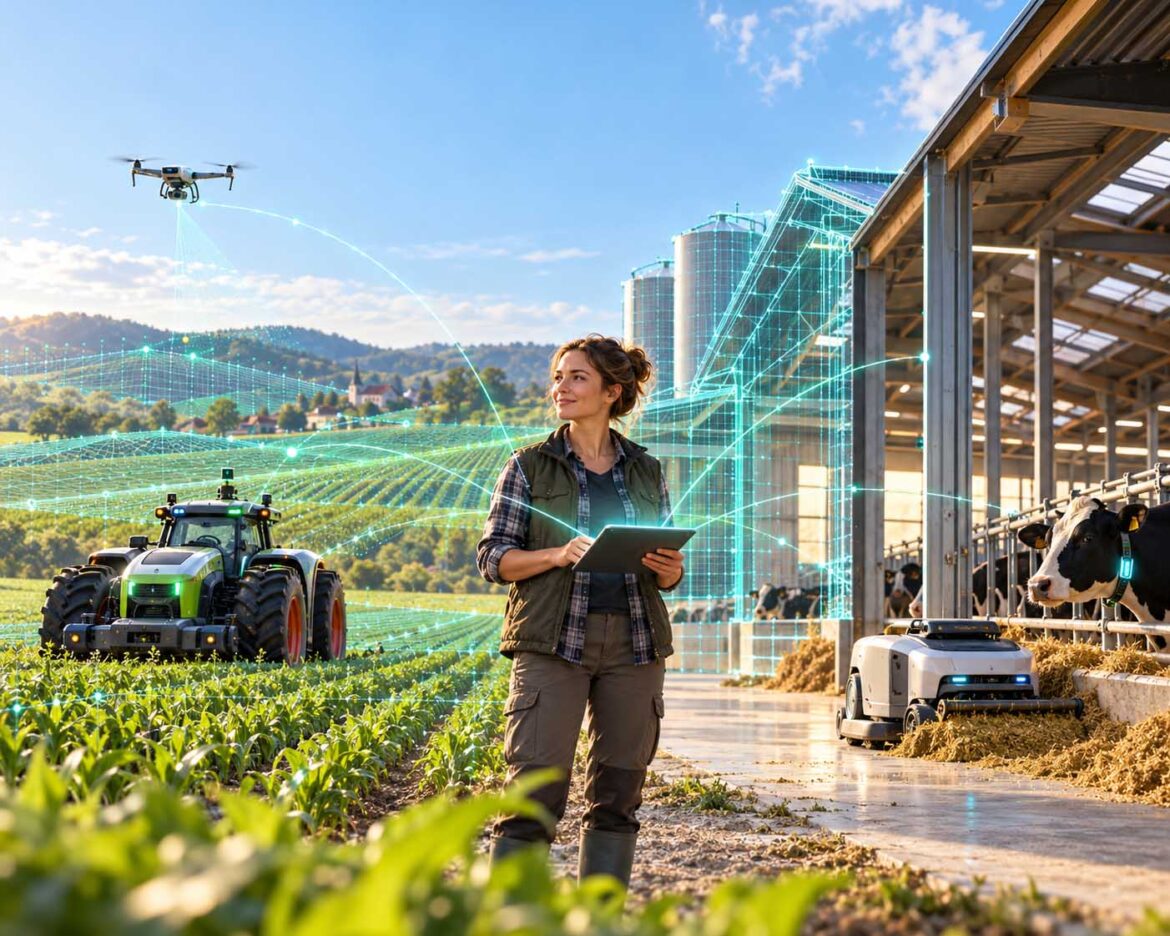
Sensors, robots, drones and AI agents only unlock their value when they work together on the farm.
Visualization: The autonomous farm emerges from connected building blocks, with people at the center keeping responsibility | Image: © Ulrich Buckenlei | XR Stager Online Magazine | VISORIC GmbH
The autonomous farm is often told as a story of ever more capable robots. A feed pusher drives through the barn on its own, a drone flies over the pasture, and an AI agent reports which animal needs attention. Images like these shape expectations of digitalization in agriculture. Yet they show only the visible surface of a development whose real work happens in the background. Behind each of these images are data flows, interfaces and decisions that no video shows.
A lively expert discussion under a post on LinkedIn drew attention to exactly this point. The focus was less on the machines themselves than on what happens between them. Sensors need to share data, artificial intelligence needs to classify situations, machines need secure interfaces, and people need to be able to step in at the decisive moment.
Many of these building blocks already exist on farms. Electronic animal identification, milking robots, activity sensors and connected agricultural machinery are part of everyday life on numerous farms. The task is to connect them into an understandable and economically viable workflow that relieves people and supports animal welfare. What is missing is rarely another device. More often, it is shared data models, clear responsibilities and handovers that still work when a connection drops or a sensor fails.
For farms, agricultural machinery manufacturers and providers of digital solutions, this is an investment question. Anyone investing in sensors, software or robotics today determines how well these systems will be able to work together later. This article examines the development step by step on the basis of current research and European rules: from existing data through interfaces, AI agents, robotics and digital twins to animal welfare and human responsibility. It is aimed at farmers as well as manufacturers, consultants and innovation managers planning the digitalization of livestock farming.
- Many digital building blocks are already in use on farms.
- Their value only emerges through their connection.
- AI agents coordinate, people decide.
- Animal welfare requires measurement and verification in the barn.
- A measurable pilot comes first.
The following article shows where the connected farm stands today, how measurements become readable situations, why integration is the real hurdle, what role AI agents, physical AI and digital twins play, and what limits animal welfare and human oversight set.
The Connected Farm Is Already a Reality
The digitalization of agriculture began long before the current discussions about artificial intelligence. Many farms work with electronic animal identification, herd management software, milking and feeding technology, activity and rumination sensors, weather stations, and machine and field data. Each of these systems captures one part of the operation. The next stage of development is to bring observations from different sources together in a way that leads to reliable action.
Behind this lies the basic principle of the Internet of Things, meaning the networking of physical devices through data connections. A sensor measures a change, a device transmits the value, software compares it with a pattern, and a person decides what to do. In livestock farming, this approach is called precision livestock farming. A research team around Christopher Wathes and Daniel Berckmans weighed the opportunities and risks of continuous, automatic animal monitoring as early as 2008.[1] In 2017, Berckmans described the goal as the continuous collection of animal data that brings decisions closer to the individual animal.[2]
In practice, several generations of technology meet: new cloud services alongside older controllers, proprietary manufacturer platforms alongside standardized machine connections, mobile internet alongside dead zones. A farm is an evolved system of technology, animals and people. Its devices have to work reliably even when the internet connection fails. New AI functions therefore build on an infrastructure that first has to be understood. On top of that come seasonal workload peaks, changing staff and devices that remain in use for many years. A solution that only works under laboratory conditions quickly fails in the barn because of dust, moisture or missing network coverage.
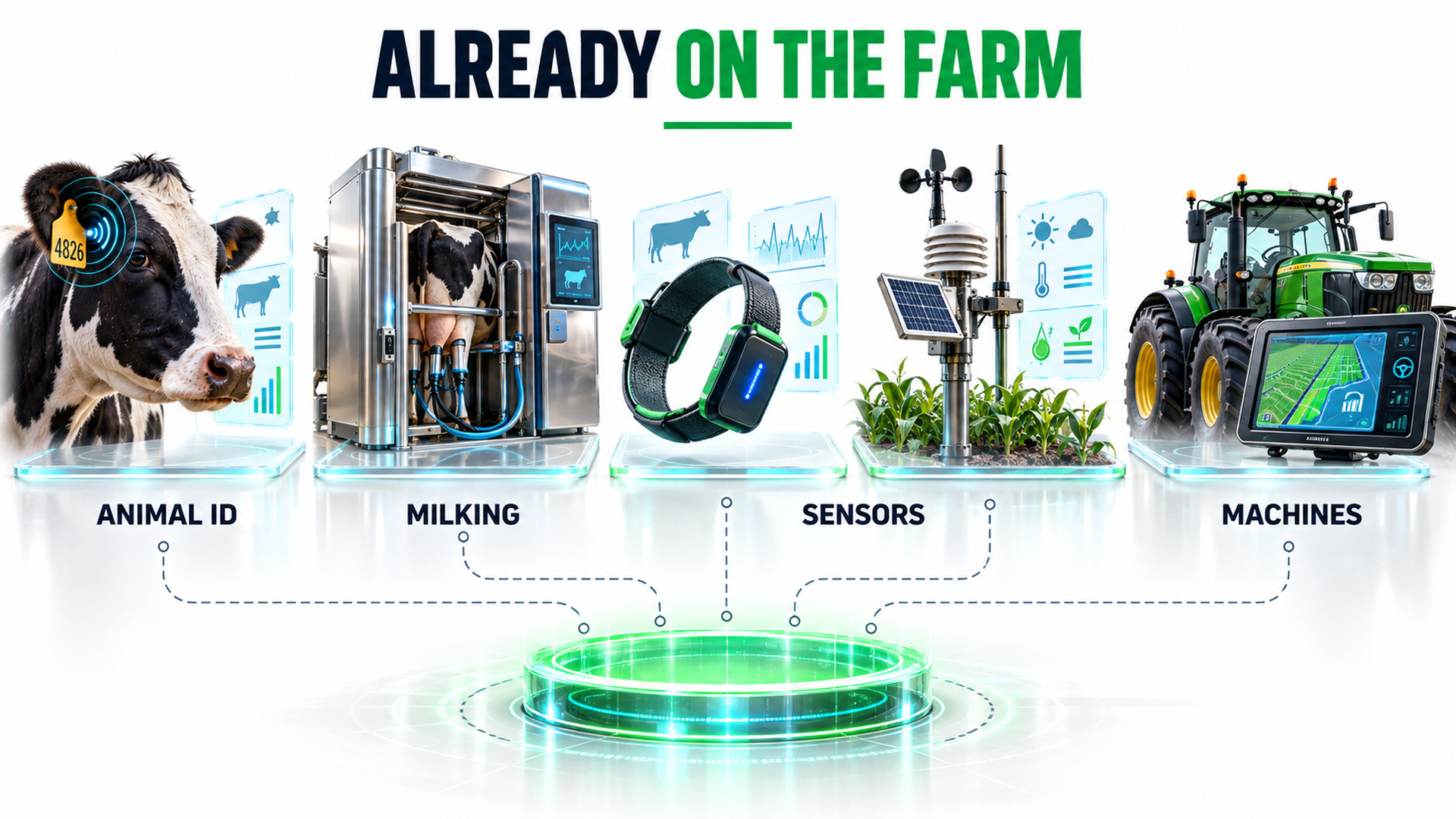
The building blocks are there, their connection is still missing.
Infographic: Most building blocks of a connected farm are already in use, their value only emerges through the connection | Graphic: © Ulrich Buckenlei | XR Stager Online Magazine | VISORIC GmbH
For farms and their technology partners, the next stage therefore begins with a sober inventory. What data is already being generated? Who owns it? How often is it updated? Which systems can read it, and which actions may it trigger? Only with these answers can one judge whether an AI agent removes a real bottleneck or merely creates another interface. A language model, meaning an AI that understands and formulates text, can make scattered information accessible and take over routine communication. The physical measurement and the connection between devices, however, must already be in place. Anyone who starts with the agent without knowing the data situation and responsibilities risks an impressive demonstration that creates additional work in everyday operations.
The starting question is therefore whether a farm’s digital building blocks work together and deliver a traceable benefit in daily operations. The next chapter shows how individual measurements become usable information for this.
- Many farms already use sensors, animal identification and connected machinery.
- Precision livestock farming has been capturing animal data continuously for years.
- A farm is an evolved infrastructure spanning several generations of technology.
- An inventory of the data comes before any AI investment.
- A language model uses existing data, the measurements must already exist.
The intelligent farm thus emerges from connecting existing signals for a concrete operational purpose. That is exactly where the following chapters begin.
Data Must Become Readable Situations
A measurement only gains meaning in context. A cow that eats less may be ill, suffering from heat stress, simply resting or reacting to a change in the barn routine. An activity sensor delivers a signal, not a diagnosis. Only when identity, time, location, comparison values and the context of observation come together does a deviation become a situation that a person can meaningfully assess.
How broad the possible measures are is shown by a widely cited review in the Journal of Dairy Science. In it, Dutch researchers evaluated sensor systems for health management on dairy farms, from movement and rumination behavior to body temperature and milk parameters. They classified the systems in levels from pure measurement to decision support and found that most studies stopped at measurement and interpretation, while the level of decision support was hardly reached.[3]
A 2023 review in the journal Animals accordingly describes precision livestock farming as an interplay of sensors, algorithms and applications whose value depends on the intended use.[4] For an integrated system, every data point therefore needs a clear origin: a stable animal or machine identifier, a timestamp, the measurement method, the unit, how current it is and a statement of how certain the assignment is. For spatial data, the coordinate system and position are added. Without this information, a platform can display a lot of data but can hardly decide reliably whether two observations concern the same animal, the same area or the same process.
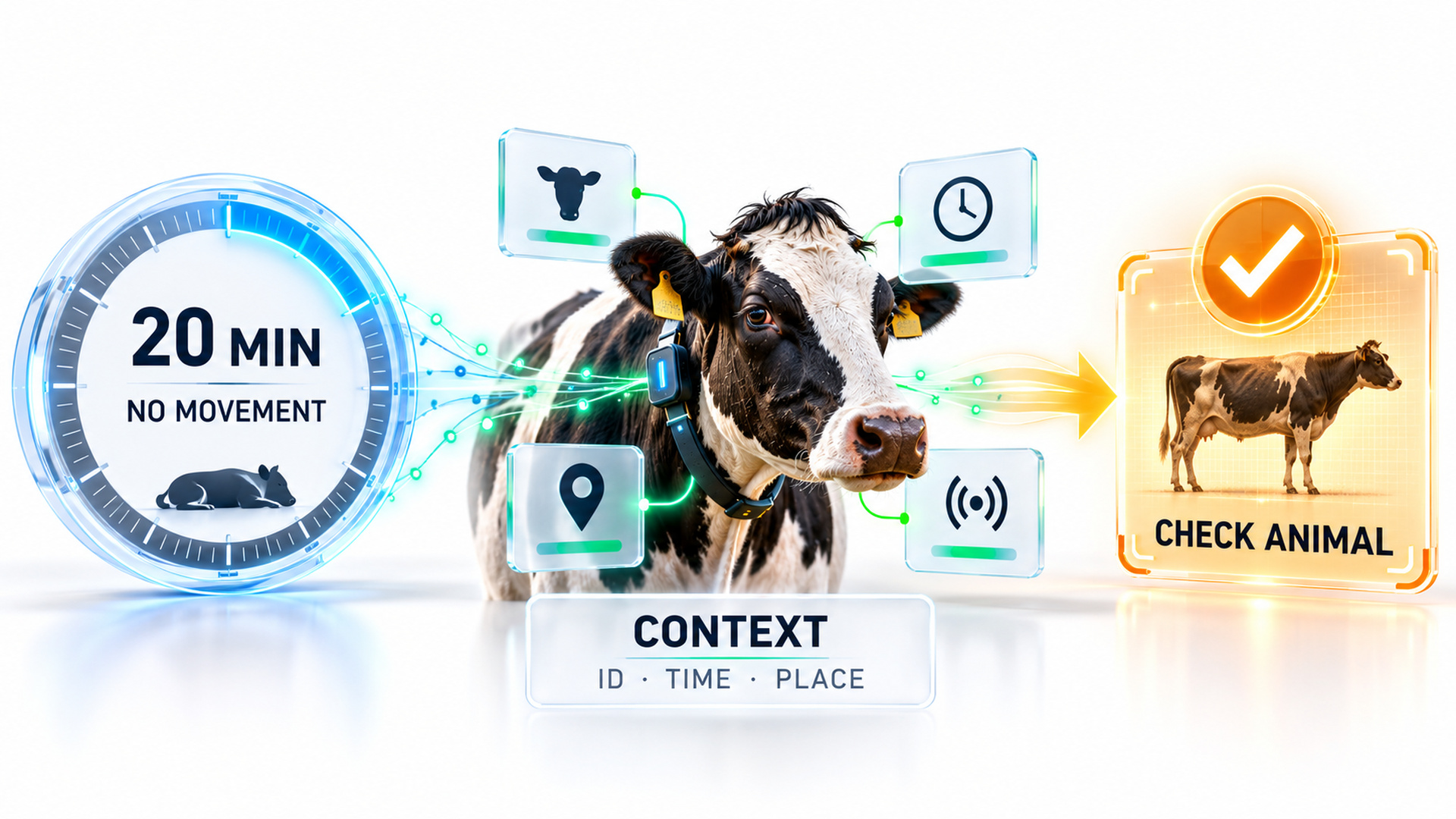
A number only becomes a situation with context.
Infographic: Identity, time, location and measurement quality turn a signal into a cue that a person can check | Graphic: © Ulrich Buckenlei | XR Stager Online Magazine | VISORIC GmbH
For farms and solution providers, this becomes important as soon as AI reads several sources together. A language model can write a summary or find entries from herd management and work logs. But it cannot create missing sensor information after the fact and must not present an uncertain assignment as fact. An example: 20 minutes without movement cannot be assessed in isolation. Was the animal in the lying area, was it registered in the milking parlor, is the sensor still active, and how does this animal usually behave at this time of day? Only the combination of history, barn context and measurement quality produces a meaningful cue that a person checks on site if needed.
Systems should therefore make visible what was measured, what was derived and what is unknown. This readability determines whether an alarm builds trust or triggers alarm fatigue. An alarm that regularly turns up nothing will be ignored after a few weeks, even if it is right at the decisive moment. The next chapter shows why connecting the sources is the real hurdle here.
- A measurement only becomes information in context.
- Raw data needs identity, time, location and measurement context.
- A warning signal is a cue, the diagnosis is made by a person.
- AI cannot create missing measurements after the fact.
- Visible uncertainty builds trust in warnings.
Numbers thus become verifiable situations, and the line between observation, interpretation and diagnosis remains clearly visible.
The Real Hurdle Is Integration
On many farms, the building blocks already exist, but they do not automatically speak the same language. A sensor manufacturer keeps its data in its own app, the milking robot in another platform, the machine terminal in a third system. The farmer searches for information, switches between screens and establishes connections himself. The result is islands of information that each work on their own but together hardly reveal any connections. Every additional app without a clear handover model makes this problem bigger.
Agriculture has long known the value of shared interfaces. The international standard ISO 11783, known in practice as ISOBUS, defines a data network for communication and control between tractors and implements. It describes the exchange between sensors, actuators, control elements and display units.[5] This is an important precedent, because a standardized connection brings machines from different manufacturers into a shared workflow. However, ISOBUS covers a defined segment. Animal databases, cameras, barn climate, work orders and autonomous robots require additional interfaces.
Legal questions add to this. The Data Act has applied in the EU since September 12, 2025. It governs access to and use of data generated through the use of connected products and related services.[6] Which rights apply in an individual case depends on the product, the contract and the parties involved. What is clear: when farm data, animal identifiers and machine logs sit in different contracts, technical compatibility does not yet produce practical cooperation between systems. The accessibility of data therefore belongs early in the planning.
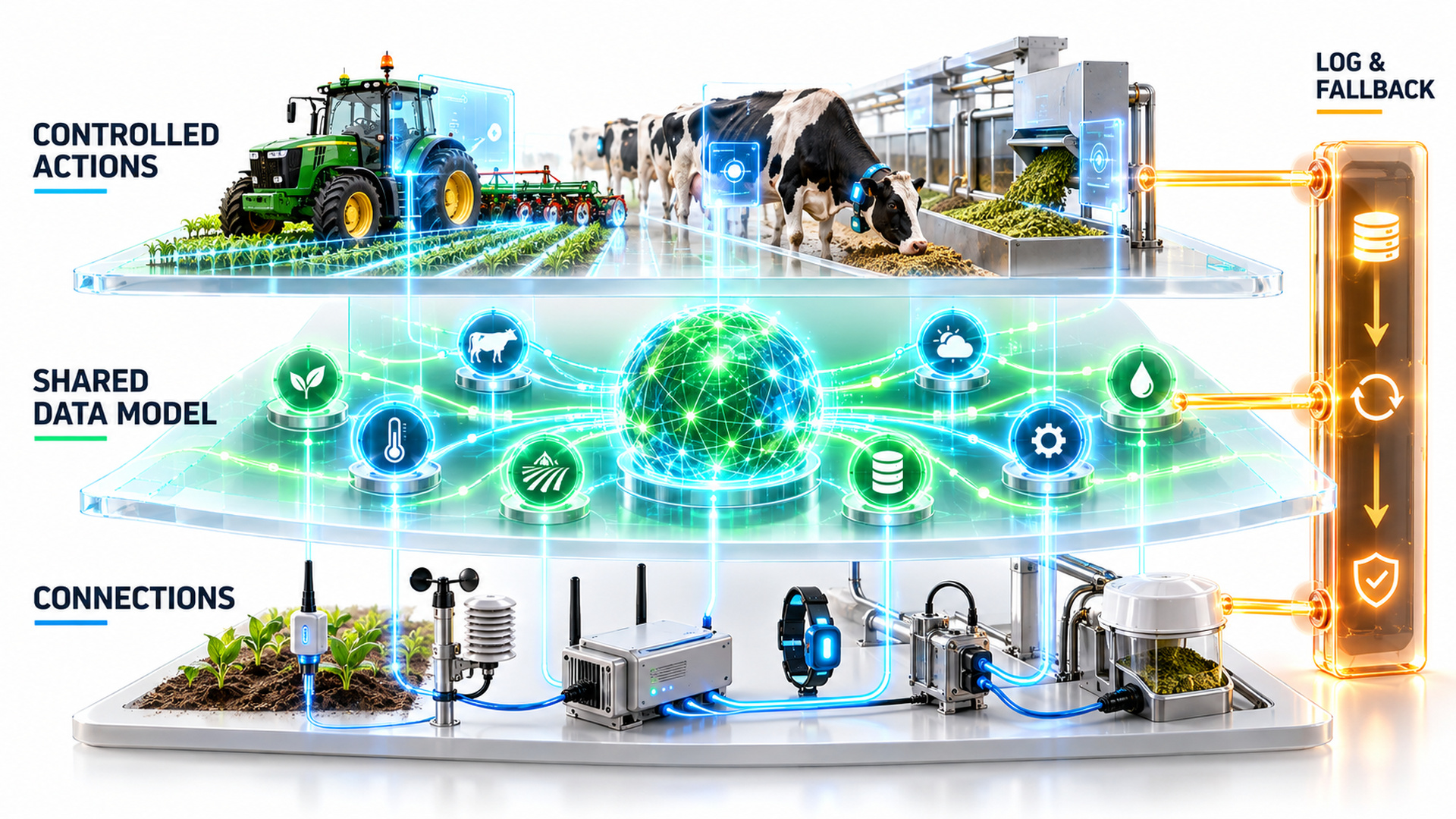
Integration is an architecture, not another dashboard.
Infographic: Connections, a shared data model and controlled actions together form the foundation of every connected farm | Graphic: © Ulrich Buckenlei | XR Stager Online Magazine | VISORIC GmbH
For farms, this results in an architecture of three layers: reliable connections to existing systems, a shared data model with identities and context, and controlled functions that turn information into actions. Between these layers, it must be traceable who triggered something and on what basis. This includes planned fallback paths in case a sensor fails, the connection drops or a machine does not confirm a command. Just as important is the question of how a farm can switch providers without losing its data. Version levels also need to be documented, because a software update on a machine can change the meaning of a data field. Data sovereignty thus becomes a prerequisite for long-term investment security.
A connected thermostat in a household communicates with a heating system. A farm is more complex because more parties, larger areas, living animals and safety-relevant machinery come together. The principle remains the same: open, verified handovers are more valuable than another isolated dashboard. The next chapter shows what role AI agents can take on this basis.
- Many farm systems today work on separate platforms.
- ISOBUS shows that machine standards are established in agriculture.
- Animal data, cameras and robots need further interfaces.
- Since 2025, the EU Data Act has governed access to device data.
- Fallback paths and data sovereignty belong in every architecture.
Integration is therefore more than a shared plug. It connects technology, data rights and responsibility into a process that a farm can trust.
AI Agents Connect Observation and Workflow
A classic monitoring system usually reports that a threshold has been exceeded. An AI agent goes one step further. This means software that uses artificial intelligence to summarize several sources of information, prepare a suitable task, inform the responsible person and document the processing. The software thus delivers more than another signal. It coordinates a limited workflow.
In everyday herd management, this could look like the following: a sensor detects a change in the activity pattern. The platform checks whether further observations exist for the identified animal. The agent writes a short summary, assigns it to a responsible person and suggests a check. After the feedback, the system updates the case and, if necessary, requests a veterinary examination. The agent organizes information and handovers, the professional assessment remains with people. This creates a closed loop of observation, task, feedback and documentation that can later also be used for evaluations and records.
Research describes this development as a transition to digital livestock farming. In 2021, Suresh Neethirajan and Bas Kemp outlined how sensors, data analysis and artificial intelligence work together in livestock farming.[7] A review published in 2026 in the journal Animal Bioscience treats the integration of AI and emerging technologies as the next step in precision livestock farming.[8] The potential grows when scattered information becomes accessible in natural language. A farm manager could ask which animals received several warnings today or which inspection tasks are still open. Language models are well suited as a flexible interface and summarizer. Real-time control, safety-critical machine functions and diagnoses, on the other hand, require verified, rule-based components and professional validation. The line runs where a wrong decision could endanger animals, people or machines.
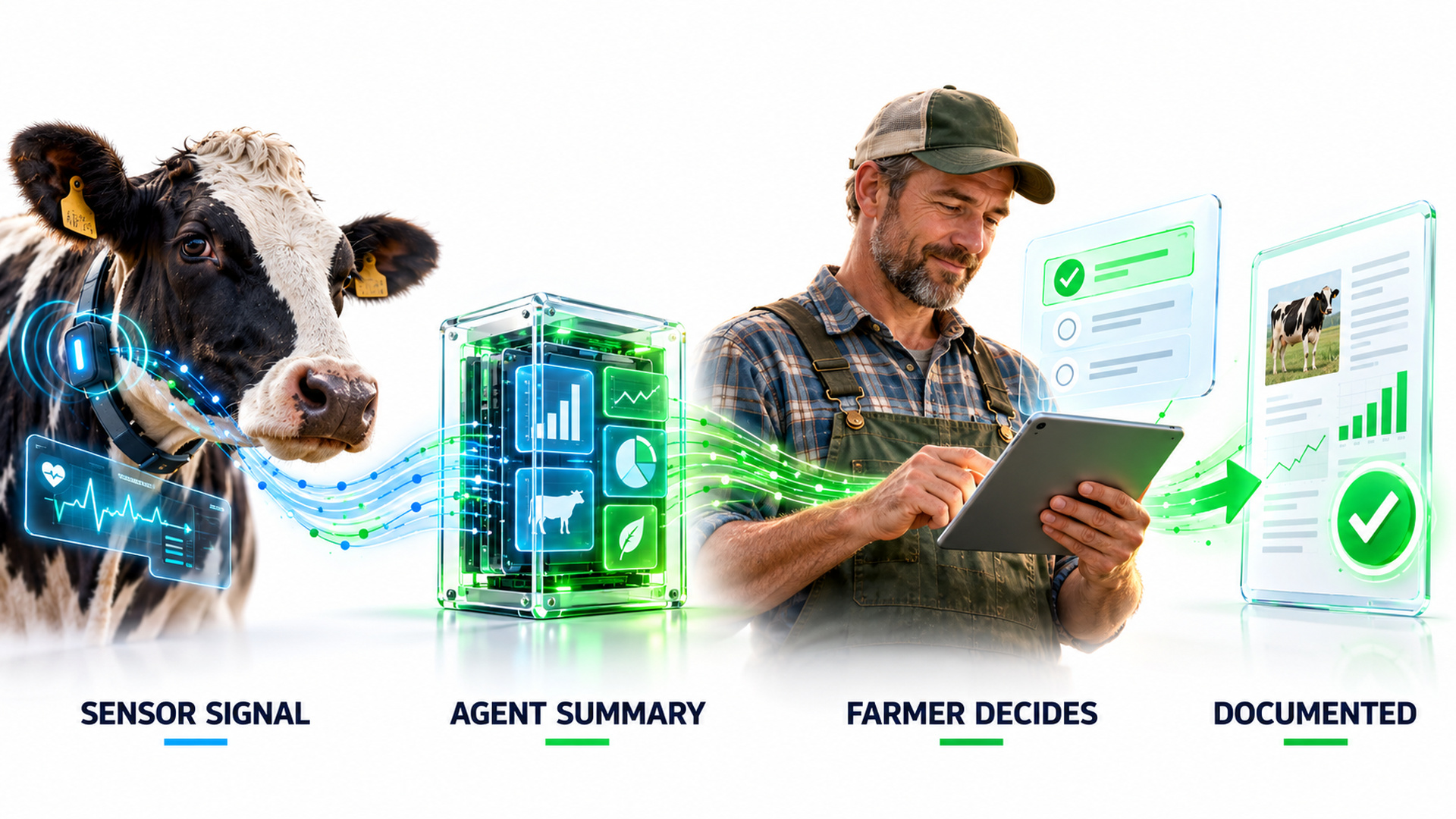
The agent organizes, the person decides.
Infographic: An AI agent connects observation, task and documentation, the professional assessment remains with people | Graphic: © Ulrich Buckenlei | XR Stager Online Magazine | VISORIC GmbH
For farms, the value of an agent is decided by its permission matrix. Reading, summarizing, recommending, creating a work order and starting a machine are different rights. A system can, for example, automatically prepare an inspection order but only send it after confirmation by an authorized person. Every step remains traceable: which observation started the process, why was this person notified, and what does a person still have to decide? Such limits build trust because employees know what the software does on its own and where they deliberately keep control.
The agent is thus a coordination layer that works as well as the data, rules and interfaces beneath it. Without a traceable process, automation is hard to control and hard to improve. The next chapter shows what happens when this layer involves real machines.
- AI agents bundle information and coordinate tasks.
- The professional assessment remains with the responsible people.
- Language models are well suited as an interface and summarizer.
- Reading, recommending and triggering are separate rights.
- Every agent step needs a traceable record.
A well-defined agent thus makes the farm clearer and leaves responsibility where it belongs.
Physical AI Brings Decisions onto the Farm
As soon as software involves real devices, experts speak of physical AI, meaning artificial intelligence that perceives and acts in the physical world. On the farm, this can be an autonomous feed pusher, a milking robot, a driverless transport vehicle, a drone for field observation or a robot for defined barn tasks. These machines have their own sensors and local controllers. They perceive their surroundings, plan movements within a limited task scope and carry them out. Many of these machines are already in use, but often as standalone solutions with their own operation.
The special challenge lies in the physical environment. A machine moves between people, animals, doors, equipment and changing ground conditions. It has to assign objects spatially, plan movements safely and switch to a safe state when it encounters obstacles or unclear observations. A barn places higher demands than a tidy factory hall, because light, dust, moisture and animals that move unpredictably constantly change the situation. The reaction time of the controller, the quality of the local sensors and a reliable emergency stop are at least as important as the intelligence of the higher-level agent. Standardized communication such as ISOBUS makes coordinated processes easier, but it does not entitle an AI agent to command every machine on its own.[5]
The EU has included this development in its new Machinery Regulation, which applies from January 20, 2027. It contains requirements for autonomous mobile machinery that operates within a defined working area and can be stopped, restarted or brought into a safe state through a supervisory function. Machinery with self-evolving behavior based on machine learning must also be assessed by a notified body, and a connection failure must not lead to a dangerous situation.[9] For manufacturers of autonomous agricultural machinery, this creates a clear planning horizon.
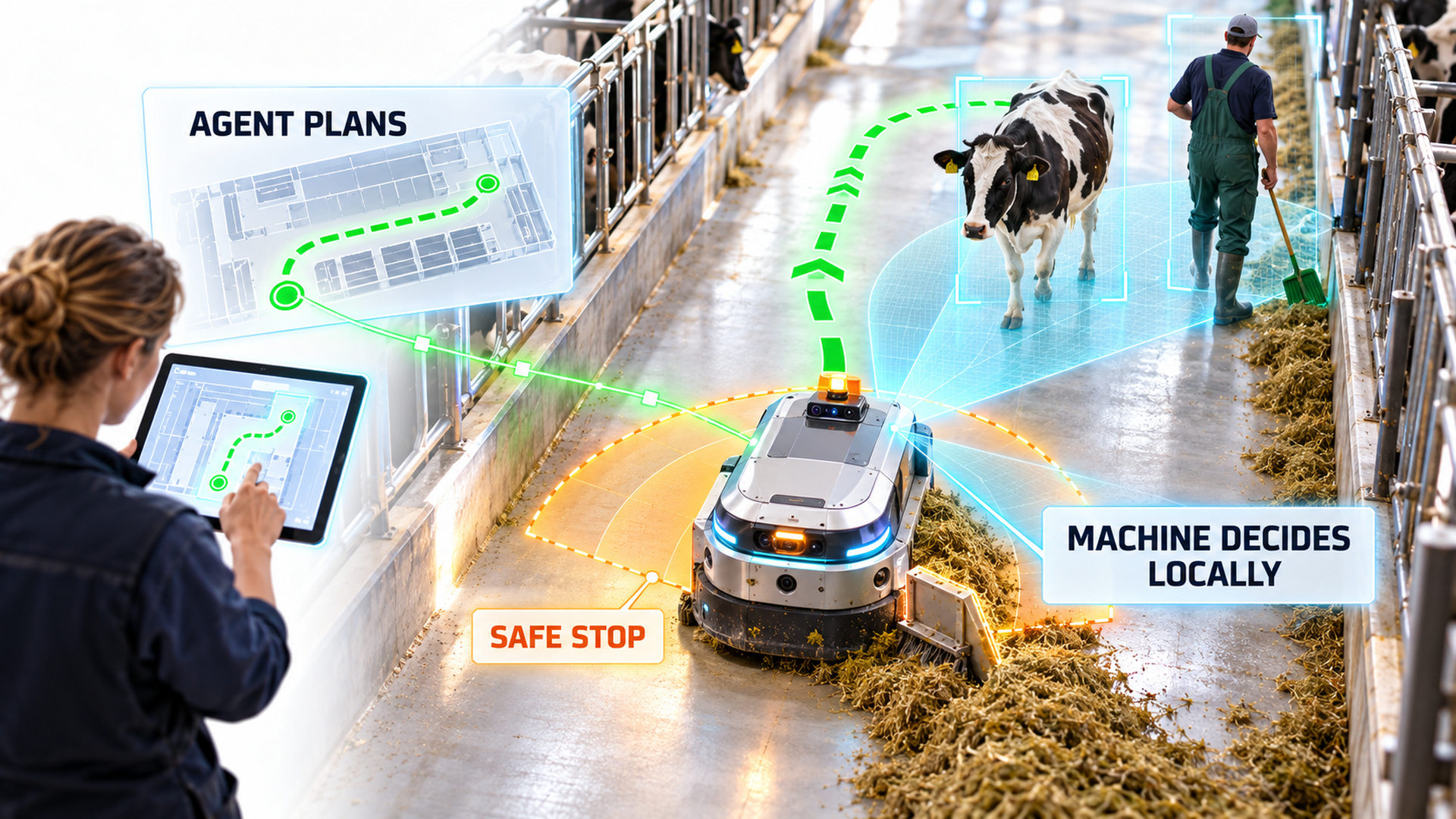
The agent plans, the machine checks and stops when in doubt.
Infographic: Physical AI needs a local safety controller that can reject commands, abort them and hand them over to people | Graphic: © Ulrich Buckenlei | XR Stager Online Magazine | VISORIC GmbH
For farms and agricultural machinery manufacturers, this results in a clear architecture in which planning and execution are separated. An agent can propose a job or hand a task over to an approved fleet management system. The local machine controller then checks whether all conditions are met and can reject the command, abort it or pass it on to a person. When several machines work together, such as a feed pusher, a cleaning vehicle and a transport robot, they need coordinated routes, priorities and rules for encounters with animals and employees. In a sense, the farm needs an orchestra in which every instrument has its own sheet music and a safe way to stop.
Drones also show that some capabilities only arise with physical infrastructure. An AI can only track animal movements if a drone or camera captures the necessary image data. The agent interprets existing data, it does not replace the measurement platform. The next chapter shows how this data comes together spatially.
- Physical AI connects software decisions with real machines.
- Local safety control takes priority over the higher-level agent.
- From 2027, the EU Machinery Regulation governs autonomous mobile machinery.
- Planning and execution remain technically separate.
- Data only exists where sensors and cameras capture it.
Physical AI thus becomes an interplay of spatial perception, communication, local control and human oversight.
The Digital Twin Makes the Farm Readable
A digital twin is a digital representation of something real that can be used to work, test and plan. On the farm, it would be more than a 3D model of the barn. It links animals, areas, machines, sensors, tasks and operating states in a shared spatial and temporal view. Anyone who receives a warning immediately sees which animal it refers to, where it was last located, which sensors were involved and who should act next. It thus answers the question that costs the most time in everyday work: what is where, and what needs to be done next?
Spatial context is fundamental for autonomous systems. A point cloud, meaning a three-dimensional survey made of millions of individual points, or a camera image only becomes useful when geometry is linked to meaning: this area is a feed alley, this position belongs to the milking parlor, this marker describes a specific animal, this route is closed to vehicles. This turns a representation into a working context that people can check and machines can use for clearly defined tasks.
Research has been working on this approach for years. In 2019, Tomas Norton, Daniel Berckmans and colleagues described digital representations as a way to systematically capture important behaviors and events and to bring animals on growing farms closer to the farmer’s attention.[10] The IUMENTA framework, presented in 2024, investigates digital twins of individual animals and links measurements with models of biological processes.[11] It is a research approach. Complete, professionally validated twins for every farm animal are not yet available today.
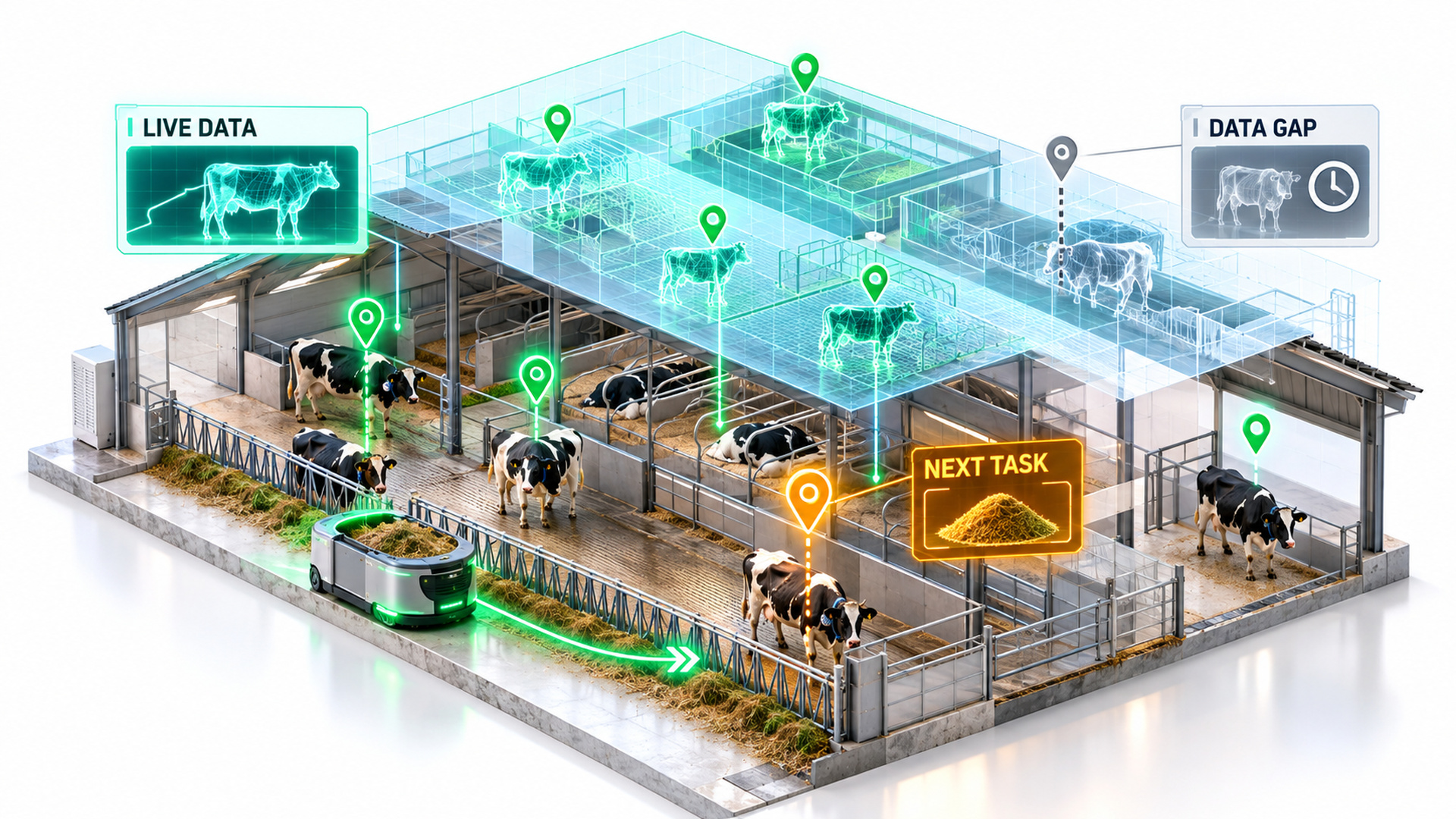
The twin shows not only locations but also how current they are.
Infographic: A farm twin becomes a working interface when it shows how current the data is and where gaps exist, just as it shows animals and tasks | Graphic: © Ulrich Buckenlei | XR Stager Online Magazine | VISORIC GmbH
For farms, this means clearly limiting the scope of a farm twin. A first use case can represent one barn area and one process, such as feed intake, climate monitoring, animal movement or machine coordination. The twin has to show how current the data is and where gaps exist: a position that has not been updated for hours must not look like a live display, and contradictory sources must remain recognizable. In addition, the farm changes. New partitions, rearranged feeding places or a new machine quickly make a model outdated if it is not maintained. Version level, update process and responsibility therefore belong in the concept from the very beginning. A small, well-maintained twin of a barn section is often more valuable than a complete but outdated model of the entire farm.
At best, the twin bundles information, makes connections visible and becomes a shared working interface for people, agents and machines. Whether the data shown there actually serves the animal is a separate question, which the next chapter addresses.
- A farm twin links space, data and tasks.
- Geometry only becomes a working context through meaning.
- Research approaches such as IUMENTA are not yet complete systems.
- How current the data is and where gaps exist must be visible.
- A small, maintained twin beats a large, outdated model.
The digital twin thus complements the walk through the barn and bundles information exactly where it is needed.
Animal Welfare Must Be Measured and Verified
Animal welfare covers more than the values a sensor records. A system can measure activity, feed intake or body values and still overlook important aspects: social relationships, comfort, pain, stress or the opportunity for positive behavior. The decisive question is therefore whether the measured indicators actually improve the animal’s living conditions. The positive sides of animal life in particular, such as rest, play or social closeness, are technically harder to capture than signs of illness.
Science names opportunities and risks alike. Precision livestock farming can make deviations visible earlier and increase attention to individual animals. In 2022, however, a British research team compiled twelve risks to animal welfare, including technical failures and the danger that technology displaces direct observation and contact between people and animals.[12] In 2023, Suresh Neethirajan also described the ethical questions of digital livestock farming, from responsibility for data to the consequences for the relationship between people and animals.[13] Both studies make clear that the benefit of the technology depends on how it is used in everyday work.
Every welfare indicator therefore needs a professional definition and verification on the farm. What does an unusual feeding pause mean in a specific barn? How large must a deviation be before a person is notified? How often is the system wrong, and which animals or situations does it detect less well? The answers must be checked on a real farm, not only in the laboratory or on a selected data set. If warnings are too frequent or hard to understand, trust declines. A pilot farm should therefore record from the start which warnings were confirmed and which were not.
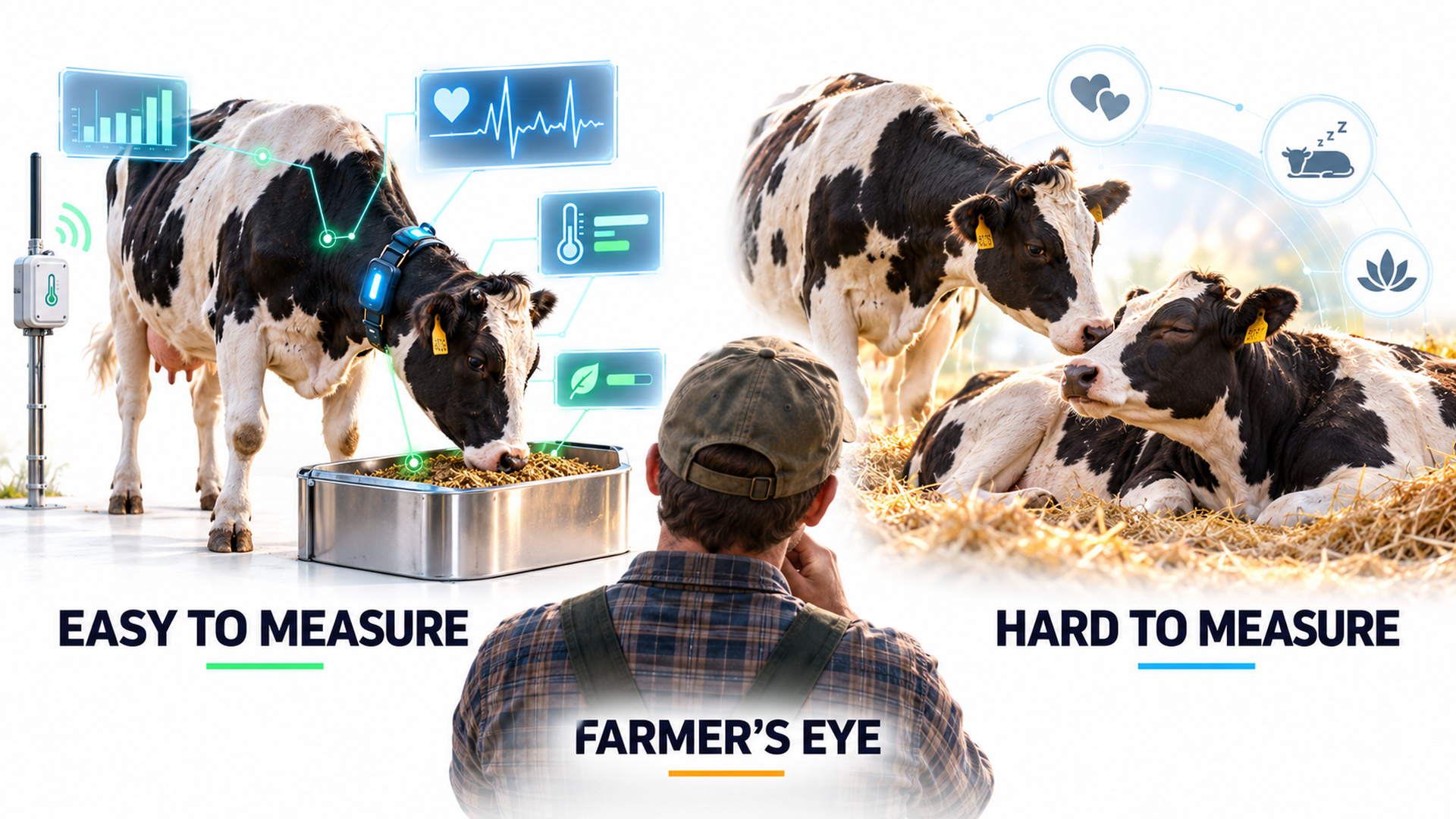
Measurability and animal welfare are not the same thing.
Infographic: Sensors capture part of animal welfare, people see the rest when they observe in the barn | Graphic: © Ulrich Buckenlei | XR Stager Online Magazine | VISORIC GmbH
For farms, this means measuring a pilot against animal, labor and system indicators at the same time. These include the time to inspection, confirmed and unconfirmed alarms, response times, repeated warnings, measures actually taken and feedback from the farm team. Where possible, indicators of positive well-being should be added instead of only recording illness and performance deviations. Then there is the question of how time saved is used: for targeted observation and care or for more animals per employee. The technical effect only becomes an improvement if employees still have the opportunity to perceive individual animals.
Digital observation is valuable when it expands attention and enables better decisions. On its own, it is not yet proof of good husbandry. The next chapter answers who decides in unclear moments.
- Animal welfare covers more than measurable body values.
- False alarms and missed cases must be evaluated on the farm.
- Technology complements direct observation and contact with the animal.
- Good pilot projects measure animal, labor and system indicators.
- Time saved should benefit the individual animal.
Technology supports farmers best when it enables a good life for the animals and does not reduce animal welfare to what a camera or a collar can easily measure.
Autonomy Needs Clear Limits and Handovers
The decisive test of an autonomous system is the moment something unexpected happens. An animal behaves differently than predicted, a sensor delivers contradictory signals, a machine reaches a restricted area, or the connection to another system drops. It must then be clear whether the software continues, stops or calls in a person.
A good handover names the responsible person, the urgency, the reason for the alarm, the observations used and the next safe step. It also documents what has already been done, so that nobody has to start from scratch. This is crucial for smaller farms in particular: an alarm is of little use if it remains unclear who receives it, how the task is confirmed and when it counts as resolved. Employees must be able to understand, question and override recommendations.
The legal framework also relies on human control. Article 14 of the European AI Regulation, the AI Act, requires effective human oversight of AI systems classified as high-risk systems.[14] This does not mean that every AI application on a farm is automatically classified that way, what matters is the intended purpose and the regulatory classification. For autonomous machinery, the requirements of the Machinery Regulation for supervisory functions and safe states also apply.[9] Regardless of this, human control is a central design requirement in livestock farming.
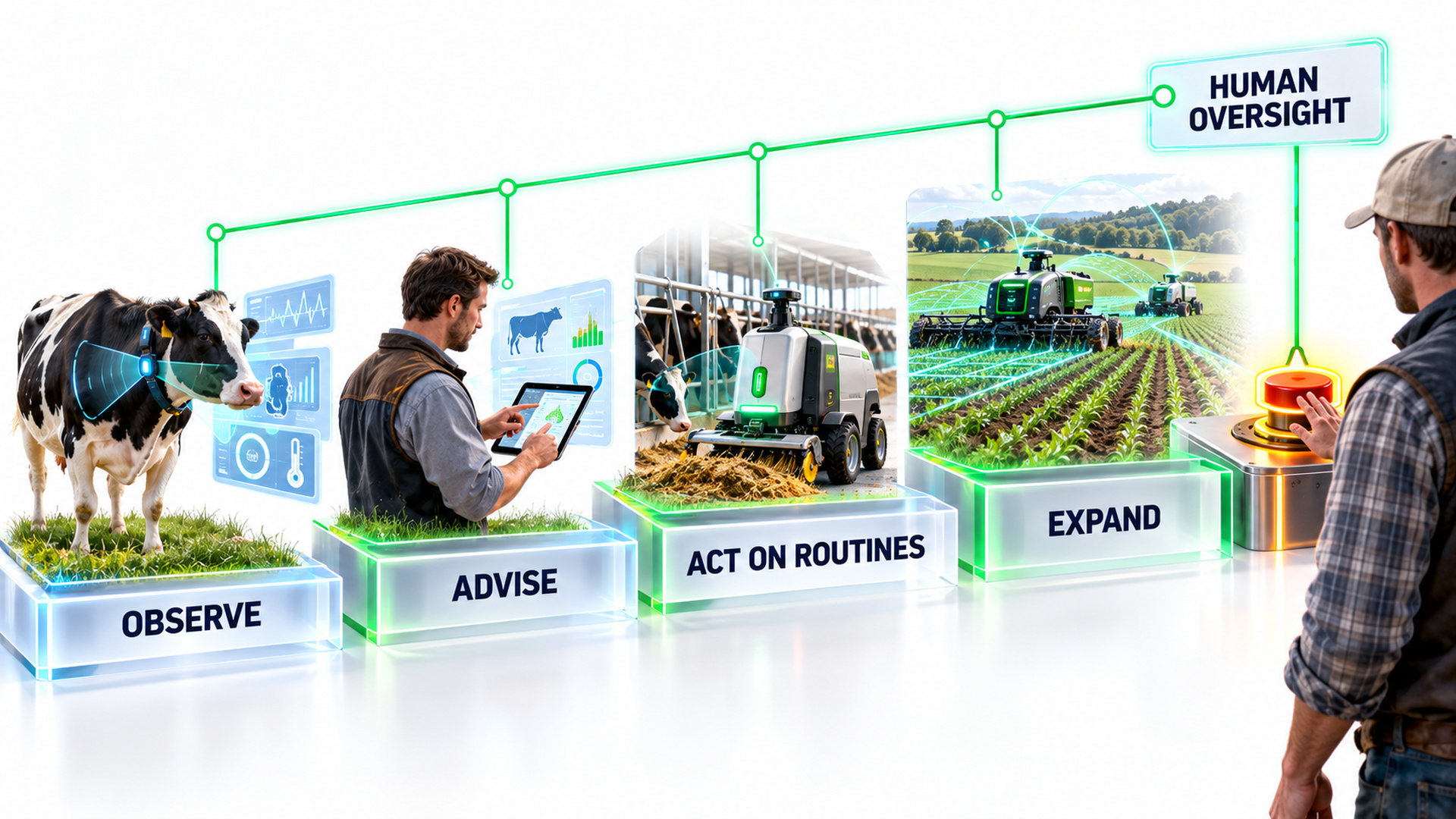
Autonomy grows step by step, oversight remains.
Infographic: A farm introduces autonomy gradually and defines responsibility and fallback mode for each level | Graphic: © Ulrich Buckenlei | XR Stager Online Magazine | VISORIC GmbH
| Task | Possible consequence | Appropriate level of autonomy | Role of people |
|---|---|---|---|
| Sorting a work log | Low | Can be automated early | Spot checks |
| Animal welfare warning | Affects a single animal | System prioritizes and suggests an inspection | On-site inspection |
| Diagnosis or change in feeding | Professional decision affecting animal health | Proposal and documentation | Specialist or veterinarian decides |
| Machine movement in an area with animals | Safety-relevant | Execution only with local safety control, fixed limits and abort | Supervision with the ability to stop |
Overview: Levels of autonomy by the possible consequence of a decision, own classification based on the cited sources | Table: © Ulrich Buckenlei | XR Stager Online Magazine | VISORIC GmbH
For farms, this results in a gradual introduction. First, the system observes and documents, then it gives cues, after that it carries out clearly limited routines, and only after proven reliability does it take on further tasks. Responsibility and fallback mode are defined for each level. The level of autonomy depends on the possible consequence of a decision, as the overview below the graphic shows. Every decision needs a clear responsibility, even if the degree of oversight differs from task to task.
The right question is therefore which decisions can be safely automated, which escalation threshold applies and how quickly a qualified person can intervene. The following video shows how these ideas come together in a single image.
- Unexpected situations are the acid test for autonomy.
- Handovers name the person, reason, urgency and next step.
- The AI Act requires human oversight of high-risk AI.
- Autonomy is introduced gradually and graded by consequences.
- People must be able to understand and override recommendations.
The farm of the future becomes more capable when technology gives people the right information at the right time and reliably takes over routine work.
From Data Point to an Understandable Farm on Video
The starting point of this article was a video that appeared on LinkedIn as part of Ulrich Buckenlei’s daily analyses and triggered a lively expert discussion. It shows how individual animals are visually marked, feeding information appears in spatial context and a dashboard brings the farm data together.
The animation illustrates why a spatial image can achieve more than a list of sensor values. Anyone who immediately recognizes which animal and which barn area is meant can classify a cue more easily and plan an inspection more precisely. It should be read as a vision of the future. Whether every element shown is already available as an integrated product cannot be inferred from the video.
Research on camera-based animal monitoring confirms the direction and at the same time names open tasks. A systematic review of image-based methods for animals on large outdoor areas describes the technical challenges at every step of image processing.[15] An analysis of 58 public image data sets for precision livestock farming shows a lack of high-quality annotated, diverse data and missing contextual information.[16] Contactless sensing is nevertheless considered an important building block of smart farms.[17]
Video: Vision of a connected farm with marked animals, spatially overlaid feeding data and a farm dashboard | Visuals by original creators | Analysis, voiceover script, editorial work and video editing: © Ulrich Buckenlei | XR Stager Online Magazine | VISORIC GmbH
It is remarkable how clearly the video raises the real system question: how do image data, animal identity, herd management, machine status and human feedback become a traceable workflow? That is exactly where its value lies as a starting point for a technical discussion.
For context, it is equally important to note: a visual marker does not yet prove that a problem has been correctly detected or diagnosed. A real project would have to test the functions shown individually, name data sources, measure accuracy and clearly show where a person decides.
- The video shows marked animals and spatially overlaid data.
- Spatial images make cues easier to understand.
- The animation is a vision of the future, not proof of a product.
- Image-based methods need more diverse, annotated data.
- Every function shown must be tested individually on the farm.
The video makes visible what the chapters describe: the autonomous farm emerges where data, space and human decisions come together.
You Know Your Farm, We Connect Data and Space
A successful farm pilot arises from two kinds of knowledge. The farm knows its animals, processes and bottlenecks. Implementation requires experience with interfaces, 3D data, digital twins and spatial interfaces that people understand without lengthy training. This combination is at the core of the work of VISORIC GmbH.
For more than 15 years, the Munich-based expert team has been developing applications in 3D, AI and XR for companies ranging from mid-sized businesses to DAX-listed corporations. VISORIC brings data and processes together in an understandable spatial interface and uses the XR Stager platform for this, in the browser, on large displays or in XR. For agriculture, this means designing a limited use case and testing its benefit together with the future users.

Farm knowledge and technology knowledge together make a reliable pilot.
Image: The farm contributes animals, processes and goals, the expert team contributes data, space and interfaces | © Ulrich Buckenlei | XR Stager Online Magazine | VISORIC GmbH
Getting started does not have to be big. A single process in which data already exists makes sense, such as prioritizing animal welfare inspections or handing a machine notification over to the right person. What is measured is technical quality, workload and response time, confirmed and missed warnings, and the effect on animal welfare and costs. Research from the farmers’ perspective shows that the acceptance of such systems depends on design, data access and actual benefit.[18] Trust and risk perception also shape whether farms use precision technology.[19] A case study from Germany also shows that investment costs help determine adoption.[20]
- Inventory of data, interfaces and responsibilities.
- Spatial interface for a clearly limited barn area.
- Pilot with pre-agreed indicators and clear handovers.
Precisely because the EU put the resilience and competitiveness of livestock farming at the center with its first livestock strategy in 2026, now is a good time to connect existing building blocks in a targeted way.[21]
How far should autonomy go on your farm when animal welfare, profitability and responsibility all count at the same time?
Talk to the VISORIC expert team in Munich. Together, we review your data situation, select a suitable process and develop a pilot that shows within a few weeks whether it actually makes daily work easier.
Contact:
Email: info@visoric.com
Phone: +49 89 21552678
Sources and References
- Wathes, C. M., Kristensen, H. H., Aerts, J.-M., Berckmans, D. Is precision livestock farming an engineer’s daydream or nightmare, an animal’s friend or foe, and a farmer’s panacea or pitfall? Computers and Electronics in Agriculture 64(1), 2-10, 2008. doi.org/10.1016/j.compag.2008.05.005.
- Berckmans, D. General introduction to precision livestock farming. Animal Frontiers 7(1), 6-11, 2017. doi.org/10.2527/af.2017.0102.
- Rutten, C. J., Velthuis, A. G. J., Steeneveld, W., Hogeveen, H. Invited review. Sensors to support health management on dairy farms. Journal of Dairy Science 96(4), 1928-1952, 2013. doi.org/10.3168/jds.2012-6107.
- Kleen, J. L., Guatteo, R. Precision Livestock Farming. What Does It Contain and What Are the Perspectives? Animals 13(5), 779, 2023. doi.org/10.3390/ani13050779.
- ISO. ISO 11783-1:2017, Tractors and machinery for agriculture and forestry, Serial control and communications data network. Confirmed 2023. iso.org/standard/57556.html.
- European Union. Regulation (EU) 2023/2854 (Data Act) on harmonised rules on fair access to and use of data. eur-lex.europa.eu/eli/reg/2023/2854/oj.
- Neethirajan, S., Kemp, B. Digital Livestock Farming. Sensing and Bio-Sensing Research 32, 100408, 2021. doi.org/10.1016/j.sbsr.2021.100408.
- Tedeschi, L. O., Guarnido-Lopez, P., Menendez, H. M., Seo, S. Advancing precision livestock farming. Integrating artificial intelligence and emerging technologies for sustainable livestock management. Animal Bioscience 39(4), 2026. doi.org/10.5713/ab.25.0289.
- European Union. Regulation (EU) 2023/1230 on machinery, including essential health and safety requirements and safety-related control systems. Applies from January 20, 2027. eur-lex.europa.eu.
- Norton, T., Chen, C., Larsen, M. L. V., Berckmans, D. Precision livestock farming. Building digital representations to bring the animals closer to the farmer. Animal 13(12), 3009-3017, 2019. doi.org/10.1017/S175173111900199X.
- Youssef, A. et al. IUMENTA. A generic framework for animal digital twins within the Open Digital Twin Platform. arXiv preprint, 2024. arxiv.org/abs/2411.10466.
- Schillings, J., Bennett, R., Rose, D. C. Twelve Threats of Precision Livestock Farming for Animal Welfare. Frontiers in Veterinary Science 9, 889623, 2022. doi.org/10.3389/fvets.2022.889623.
- Neethirajan, S. The Significance and Ethics of Digital Livestock Farming. AgriEngineering 5(1), 488-505, 2023. doi.org/10.3390/agriengineering5010032.
- European Union. Regulation (EU) 2024/1689 (AI Act), Article 14, Human oversight. eur-lex.europa.eu/eli/reg/2024/1689/oj.
- Scott, S. D. et al. Systematic Literature Review of Vision-Based Approaches to Outdoor Livestock Monitoring with Lessons from Wildlife Studies. arXiv preprint, 2024. arxiv.org/abs/2410.05041.
- Bhujel, A., Wang, Y., Lu, Y., Morris, D., Dangol, M. Public Computer Vision Datasets for Precision Livestock Farming. A Systematic Survey. arXiv preprint, 2024. arxiv.org/abs/2406.10628.
- Yin, M., Ma, R., Luo, H., Li, J., Zhao, Q., Zhang, M. Non-contact sensing technology enables precision livestock farming in smart farms. Computers and Electronics in Agriculture 212, 108171, 2023. doi.org/10.1016/j.compag.2023.108171.
- Krampe, C., Ingenbleek, P. T. M., Niemi, J. K., Serratosa, J. Designing precision livestock farming system innovations. A farmer perspective. Journal of Rural Studies 111, 103397, 2024. doi.org/10.1016/j.jrurstud.2024.103397.
- Boyer, C. N., Cavasos, K. E., Greig, J. A., Schexnayder, S. M. Influence of risk and trust on beef producers’ use of precision livestock farming. Computers and Electronics in Agriculture 218, 108641, 2024. doi.org/10.1016/j.compag.2024.108641.
- Munz, J., Maurmann, I., Schüle, H., Doluschitz, R. Digital transformation at what cost? A case study from Germany estimating the adoption potential of precision farming technologies under different scenarios. Smart Agricultural Technology 9, 100585, 2024. doi.org/10.1016/j.atech.2024.100585.
- European Commission. EU Livestock Strategy. A strategy for a resilient, competitive and sustainable livestock sector, 2026. agriculture.ec.europa.eu.
- VISORIC practical projects in the fields of digital twins, real-time 3D and spatial computing.
- XR Stager platform for real-time 3D, digital twins and industrial spatial computing applications.
Contact Us:
Email: info@xrstager.com
Phone: +49 89 21552678
Contact Persons:
Ulrich Buckenlei (Creative Director)
Mobil +49 152 53532871
Mail: ulrich.buckenlei@xrstager.com
Nataliya Daniltseva (Projekt Manager)
Mobil + 49 176 72805705
Mail: nataliya.daniltseva@xrstager.com
Address:
VISORIC GmbH
Bayerstraße 13
D-80335 Munich