

Virtual Showrooms, Why 3D Environments Are Becoming an Economic Medium
Visualization: © Ulrich Buckenlei | Concept illustration of a spatial commerce medium as a 3D environment | Editorial representation without claim to technical completeness
Virtual showrooms are often understood as a visual extension of traditional product pages. As immersive surfaces that generate attention, yet functionally go little beyond existing e commerce logics. This classification falls short. What is emerging here is not a new interface, but a new medium.
A virtual showroom organizes perception, comparison, and decision making structurally differently from page based commerce systems. As soon as products require explanation, variants have spatial impact, or emotional security becomes part of the purchase decision, page logic reaches its limits. The catalog loses its central role. Value increasingly emerges in the environment in which understanding is built.
Empirical research in VR and AR commerce consistently shows that presence, interactivity, and experienced context measurably influence engagement and purchase intention. The reason is not novelty, but a shift in cognitive workload distribution. Scale, relation, and usage context become experientially accessible instead of having to be mentally constructed.[1][2]
The core point is as simple as it is far reaching. In two dimensional systems, value is primarily optimized through information density, price logic, and friction reduction. In spatial environments, value emerges through context, comparability, judgment confidence, and situational experience. A 3D environment does not merely explain a product, it structures the decision. Those who interpret virtual showrooms solely as a UX extension underestimate their function as an independent economic system.[2][4]
From Pages to Environments, Why the Medium Changes the Decision
In traditional e commerce structures, people make decisions based on abstracted information. Images, text, tables, reviews, and videos provide facts that must be cognitively integrated. This model works well as long as products are self explanatory and differences remain clearly quantifiable. It reaches limits when proportions, material impact, spatial integration, or functional interaction become relevant.
At that point, a structural problem emerges. Context must be mentally simulated. Users must imagine how something appears in space, how large it is relative to alternatives, how it behaves in usage scenarios, or whether it fits their own environment. Research on cognitive load shows that this integration work fosters uncertainty, delay, and misjudgment, especially when many variants must be weighed against each other.[3]
Page logic forces complex offerings into a linear structure. Information is consumed sequentially, comparisons occur in the mind, relations must be imagined. Spatial environments fundamentally shift this logic. They do not replace the page with another layout, but with a situation. Content no longer stands isolated side by side, but in relation to one another. Variants can be experienced as spatial alternatives, not just as rows in a table.
The economic effect is not cosmetic. When context becomes experiential, uncertainty decreases. This stabilizes decisions, reduces inquiries, and minimizes misinterpretations. At the same time, signals emerge that are closer to the actual decision path than pure click data.[1][4]
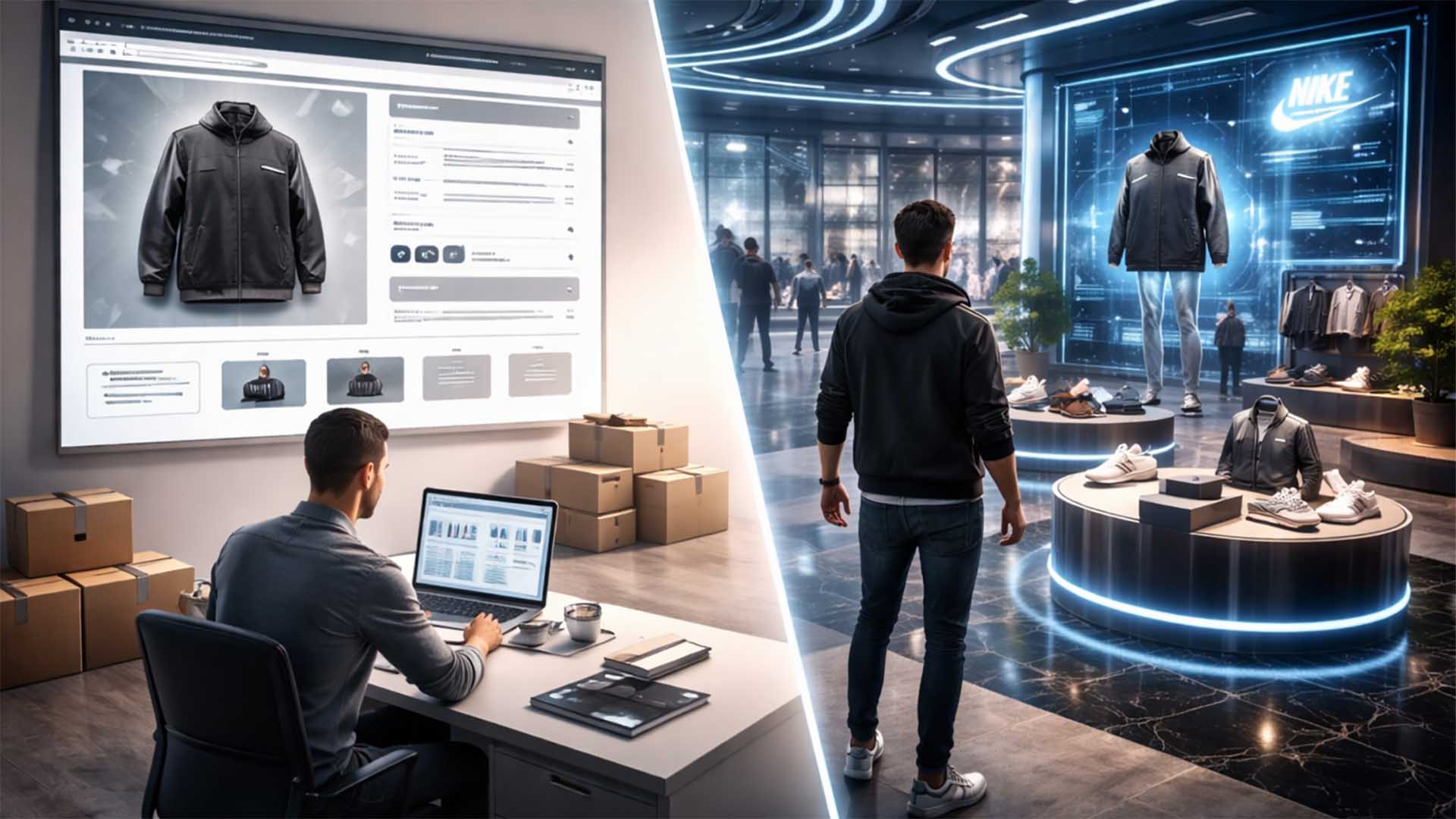
From Page Layout to Decision Environment, Identical Content, Different Logic
Concept illustration contrasting linear information structure and relational spatial logic
The media shift from page to space can be condensed into four effects that directly influence decision quality:
- Page → linear information intake
- Context → must be mentally constructed
- Space → relations become visible
- Decision → uncertainty decreases through context
These effects are not a UX detail, but a structural shift. The page forces the user into mental synthesis. The space provides relations as visible order. That is precisely how interpretative load decreases.
In practice, this feels like a reduction in decision risk. When proportions, variants, and usage context no longer need to be extrapolated, decisions become more robust and less prone to later doubt.
This makes the transition clear. When context becomes experiential, a measurable resource emerges. The next chapter shows why this resource can be described as presence.
Presence Becomes a Measurable Resource
As soon as spatial environments actively support understanding, the business perspective shifts. Metrics such as conversion rate or cost per click measure transaction efficiency, yet hardly capture the quality of the decision basis. They show whether a purchase occurred, not how secure that decision was or how high the risk of later revision might be.
Presence describes the subjective feeling of being in a situation rather than merely observing it. In 3D environments, this feeling arises through scale, perspective change, movement, interaction, and spatial coherence. Studies on VR and AR shopping show that presence often acts as a mediating factor influencing engagement, trust, and purchase intention.[1][2]
Presence becomes economically relevant where wrong decisions entail high follow up costs. Returns, advisory effort, purchase abandonment, or post purchase uncertainty often arise not from missing information, but from insufficient judgment confidence. Especially for products with high variance, many configurations, or strong contextual relevance, presence becomes a resource because it replaces mental assumptions.
In terms of measurement, this means that dwell time is not the core value. Instead, the quality of the decision is central. Relevant metrics include likelihood of purchase after interaction, inquiry rate, comparison intensity, abandonment points, and the stability of the choice during later reevaluation.[4]

Presence as an Economic Variable, Spatial Experience Stabilizes Decisions
Concept illustration linking presence, trust, and decision quality
What presence means economically can be summarized in four consequences that go beyond traditional web metrics:
- Presence → situation instead of surface
- Trust → emerges through context
- Stability → lower revision rates
- Measurement → quality metrics instead of time
This shifts measurement logic. The goal is not duration of interaction, but the quality of the decision that results from it. Presence is valuable when it reduces uncertainty and stabilizes choice.
Companies that interpret presence merely as an experience factor measure in the wrong place. Decisive indicators show whether people hesitate less, inquire less, and revise less after interaction.
The next chapter makes clear that this stability is not only rational. It can also transport meaning and identity, thereby strengthening brand attachment.
Identity Economics, Why People Buy Meaning
Virtual showrooms unfold their strategic impact particularly where products are not only functional solutions but also carry symbolic meaning. In many markets, people do not decide solely along specifications. They decide along self image, belonging, and social positioning. The product is a signal, not only utility.
The virtual showroom expands this principle because not only the object becomes part of meaning, but also its spatial context. Materiality, lighting, spatial openness, dramaturgy, and interaction logic create an experiential brand world. The showroom thus becomes a space of meaning that implicitly communicates for whom a product is intended, which values it embodies, and which role it can play within one’s self concept.
Self congruity research shows that purchase decisions become more likely when the perceived brand world aligns with one’s own self concept. In digital contexts, this effect intensifies because identity is not only communicated but lived in environments, for example through digital self presentation, community dynamics, or avatar based cultures.[5]
Economically, this mechanism works long term. Price and feature advantages can drive short term action. Coherence between brand, space, and self concept supports loyalty, repeat purchase, and perceived value. Virtual showrooms therefore do not only sell objects, they reduce dissonance. The decision feels not only rationally plausible, but personally coherent.
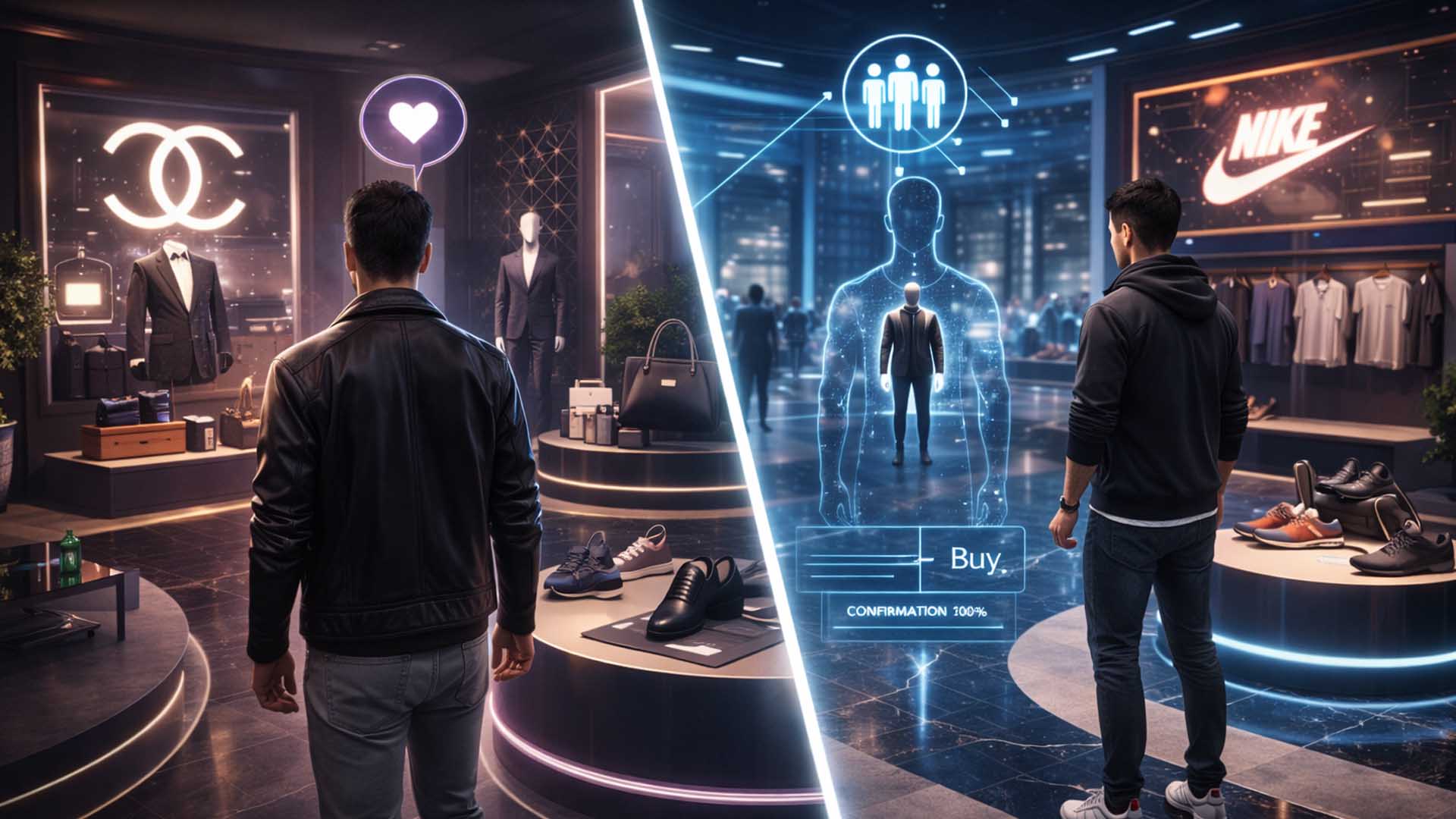
Identity as a Decision Layer, Spaces Convey Belonging and Values
Concept illustration linking spatial design, brand world, and self concept
The identity effect of virtual showrooms can be translated into four mechanisms:
- Identity → consumption as self positioning
- Fit → increases purchase likelihood
- Space → makes values experiential
- Loyalty → strengthens repeat purchase
Here lies the difference between staging and coherence. Spectacle does not create value. Coherence between space, brand, and self concept does. This coherence reduces internal friction and increases the likelihood that a decision feels appropriate.
Economically, this works over time. When fit is established, loyalty increases. People do not buy only once, they remain in a world that feels consistent. This is a different logic from short term performance optimization.
The next chapter shows that this world not only generates meaning, but also higher quality signals. Spatial behavior is more interpretable than click paths.
Intent Data, Why Spatial Interaction Generates Better Signals
A central difference between traditional shops and virtual showrooms lies in data quality. Page based systems capture discrete events such as clicks, scroll depth, or cart abandonment. These signals are useful, but ambiguous. A click may indicate interest or confusion. Dwell time may signal engagement or overload.
Spatial environments, by contrast, generate patterns. Gaze direction, approach, distance, switching between variants, sequences, repetitions, and interaction intensity form trajectories that represent decision processes more precisely. Intent is not inferred from a single event, but from a sequence.
Eye tracking studies in VR store environments show that gaze patterns and fixation trajectories closely correlate with attention, comparison behavior, and later purchase intention. What matters is the combination of signals, not a single data point.[6]
The economic leverage is clear. Higher quality intent data improves forecasting, personalization, assortment decisions, and budget allocation. At the same time, sensitivity increases. When interaction data moves closer to cognitive processes, clear purpose limitation, transparency, and governance become essential, otherwise value creation turns into loss of trust.

Intent as a Spatial Pattern, Interaction Becomes Interpretable
Concept illustration visualizing gaze paths, approaches, and comparison sequences
The higher signal quality of spatial data can be condensed into four core points:
- Sequences → behavior as pattern
- Context → comparison becomes measurable
- Intent → better predictions
- Governance → trust as prerequisite
This changes the data economy. Instead of counting more events, behavior becomes interpretable as a trajectory. This is particularly relevant for products with high variance, because decisions rarely emerge in one step, but through comparison, approach, and feedback.
At the same time, the need to frame this data responsibly increases. The closer signals move toward attention and cognitive processes, the more important purpose limitation and transparency become. Without governance, advantage turns into acceptance risk.
The next chapter shows why virtual showrooms remain attractive despite this sensitivity. They scale like software and thereby become infrastructure.
Scaling Like Software
Economically, virtual showrooms follow a different logic than physical retail spaces. Stationary spaces are locally bound, personnel intensive, and infrastructurally limited. Virtual spaces structurally behave like software. They are developed, versioned, optimized, and then scaled.
The leverage lies not only in low marginal cost per additional user. It lies in reproducibility and consistency. A once defined decision space can be deployed identically across different markets without varying dramaturgy, explanation, or comparison logic. Knowledge is not only documented, but translated into spatial structure.
At the same time, virtual showrooms become multi purpose systems. The same space can support sales, standardize training, relieve support, differentiate recruiting, or condense investor communication. This multi use changes the investment character. Setup requires investment, but usage amortizes over repeated deployments.

One Space, Many Markets, Reusable Structure
Concept illustration of reusability and modular extensibility of virtual environments
Why virtual showrooms scale like software can be translated into four structural properties:
- Reproducible → globally deployable
- Updatable → modularly extendable
- Multi purpose → sales, training, support
- System → infrastructure instead of campaign
This shifts the investment character. A showroom is not a one time launch, but a platform that accumulates value over time. The more frequently the same architecture is used, the lower the relative cost per use.
This logic also generates organizational effects. Once showrooms become versionable, questions arise regarding ownership, release cycles, data integration, and governance. At this point, scaling reveals itself as not only technical, but operational.
The next chapter makes the decisive condition visible. Without governance and trust, scaling becomes a burden rather than leverage.
Governance and Trust
Virtual environments are not neutral presentation spaces. They structure perception, organize comparison possibilities, and influence decision processes. Once space becomes decision architecture, responsibility emerges.
Governance begins in design. Which options are visible, which are not. Which comparison logic is suggested. Which interactions are recorded and how they are evaluated. The more AI models are deployed, the more important transparency becomes, especially when profiling or automated inferences feed into personalization and offer logic.
From a legal perspective, it is also relevant that user rights may be affected in the context of automated processing and profiling. Even if not every use case is highly critical, it is strategically wise to make mechanisms understandable and to offer choice. Data protection principles such as purpose limitation, data minimization, and transparency provide the foundation.[7]

Responsibility as a Design Principle
Concept illustration linking transparency, accountability, and data ethics
For trust to emerge, four governance building blocks must be established as standards:
- Transparency → understandable logic
- Purpose limitation → clear data use
- Fairness → guidance instead of distortion
- Responsibility → defined accountability
These building blocks are not a brake, but an enabling structure. They connect spatial systems to legal frameworks, compliance, and internal responsibilities. Without this connectivity, the showroom remains a pilot project. With it, it becomes infrastructure.
Precisely because virtual spaces structure decisions, governance becomes part of the experience. Users quickly notice whether logic is fair, whether choices are transparent, and whether data use remains comprehensible.
In the following practical example, it becomes visible how these mechanisms converge in a real environment and which aspects can be transferred across industries.
Video, Virtual Showrooms in Practice
The following video condenses the mechanics of this article into a concrete example. The NOOON Virtual Showroom demonstrates how spatial logic transforms representation into a decision environment. The focus is not on effects, but on orientation, comparison, and a consistent world that structures behavior.
At its core, the example shows how five value mechanisms interact. The space functions as a product because it carries attention, meaning, and dramaturgy. Identity is not only communicated, but spatially experienced. Digital assets scale globally at low marginal cost. Interaction generates usable intent signals. And spatial exploration increases decision confidence.
The model is not limited to fashion. The same mechanisms can be transferred to furniture, automotive, electronics, and complex industrial products.
Virtual Showrooms as Decision Environments, NOOON Case Example
Original video via Instagram (nooon.os) | Analysis and classification: Ulrich Buckenlei
This closes the circle. The virtual showroom does not merely replace the page. It establishes a new infrastructure of digital value creation.
Sources and References
- Journal of Retailing and Consumer Services, 2024. Studies on AR and VR shopping, presence, engagement, and purchase intention. [1]
- Telematics and Informatics, 2023. Research on immersion, interactivity, and context in digital commerce. [2]
- Computers in Human Behavior Reports, 2023. Work on cognitive load and decision quality. [3]
- Journal of Decision Analytics, 2024. Decision architecture, uncertainty reduction, and context integration. [4]
- Research on Self Congruity Theory, overviews on alignment of self concept and brand in consumption contexts. [5]
- Fashion and Textiles, 2023. Eye tracking studies in VR stores, gaze patterns, and purchase intention. [6]
- GDPR and Guidelines on Transparency and Profiling, purpose limitation, data minimization, user rights in automated processing contexts. [7]
Thinking Virtual Showrooms Strategically
Virtual showrooms are not a design question. They are an architectural question. When conceived correctly, they structure decisions, generate high quality signals, and create scalable value creation.
The decisive factor is not whether a 3D environment is possible. The decisive factor is which uncertainty it reduces, which decisions it supports, and which data is generated responsibly.
This is precisely where the Visoric expert team in Munich comes in. We analyze virtual showrooms as an economic system and translate potential into clear models, measurable metrics, and actionable next steps.

The Visoric Expert Team, Analysis, Classification, and Visual Translation of Spatial Media
Source: VISORIC GmbH | Munich
Typical entry points that quickly prove effective are:
- Use case mapping, defining target decisions and application fields
- Experience architecture, designing spaces as decision media
- Measurement model, operationalizing presence, intent, and decision quality
- Governance, establishing data structures and responsibilities properly
If you wish, send us your scenario or question. You will receive a well founded initial assessment, clearly structured and without hype.
Contact Us:
Email: info@xrstager.com
Phone: +49 89 21552678
Contact Persons:
Ulrich Buckenlei (Creative Director)
Mobil +49 152 53532871
Mail: ulrich.buckenlei@xrstager.com
Nataliya Daniltseva (Projekt Manager)
Mobil + 49 176 72805705
Mail: nataliya.daniltseva@xrstager.com
Address:
VISORIC GmbH
Bayerstraße 13
D-80335 Munich