
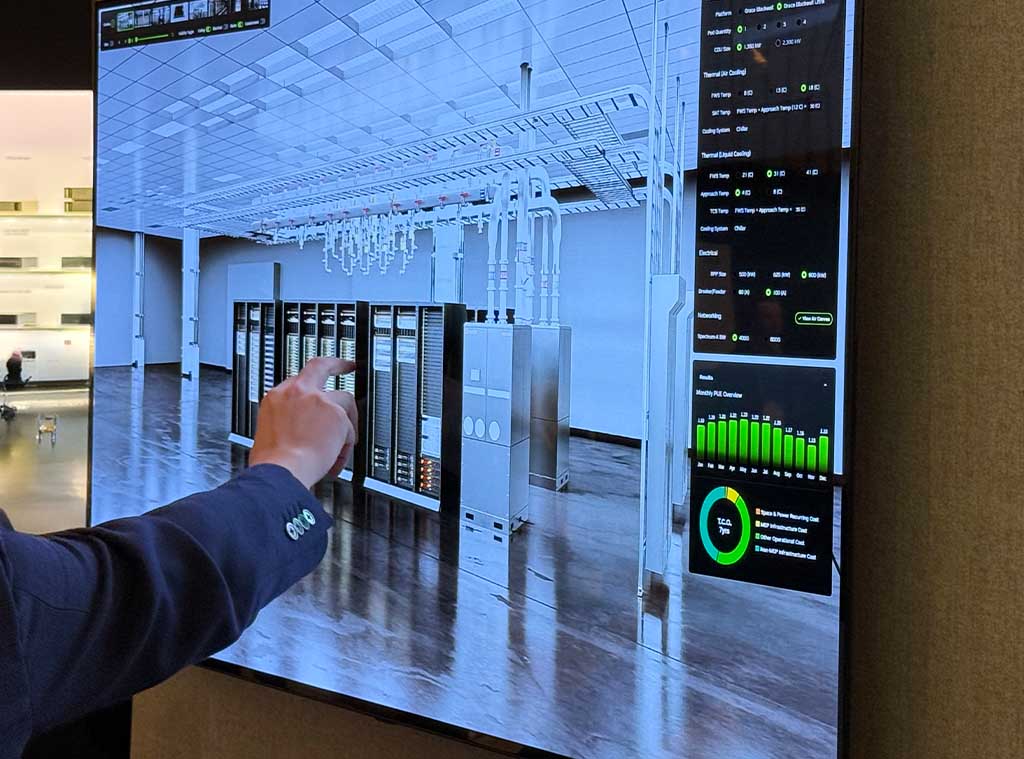
Digital twin of a data center infrastructure with real time operational data, interactively accessible on a large format display
Photo: © Ulrich Buckenlei | Visoric GmbH | Recorded at the NVIDIA booth, CES Las Vegas 2026 | Editorial documentation
Public discussions about digital transformation are often dominated by buzzwords such as AI strategy, data platforms, or cloud migration. Yet while technology providers have long been working with immersive visualizations, autonomous systems, and Physical AI, the structural handling of complex real time data remains largely unchanged in many companies: dashboards, reports, two dimensional screens.
At the same time, current studies show that the demands placed on decision speed are shifting dramatically. According to McKinsey, 88 percent of companies already use AI in at least one business function, yet only one third have begun to scale AI systematically.[5] Deloitte shows that 92 percent of manufacturing leaders are testing at least one metaverse use case and expect performance improvements of 12 to 14 percent.[8]
The real question, then, is not whether Spatial Computing is being used in industrial contexts. It is this: Is the logic of decision making itself changing?
When data is no longer available only as tables and static charts, but instead as spatially experienceable, physically situated layers of information directly at the machine, within the production process, and in collaboration, the bottleneck shifts. The bottleneck is no longer primarily access to data, but the ability to understand systems in their physical complexity, classify relationships spatially, and act in real time.
What research describes as embodied cognition, namely that physical interaction fundamentally improves the understanding of complex systems, finds its technological expression in Spatial Computing.[2] The dashboard becomes a spatial control layer. AI structures decision pathways. Digital twins visualize complex processes. Physical AI makes abstract system logic tangible.
Costs do not disappear in the process. Their structure changes. Instead of investing primarily in data center infrastructure, the focus moves toward interaction concepts, data architecture, spatial interface design, and the integration of physical systems. Competitive advantage does not emerge from data volume alone, but from the ability to orchestrate systems meaningfully.
This raises a central question: What might industrial decision making look like if Spatial Computing were conceived not as an add on, but as an integral part of a new decision architecture?
Spatial data changes decisions
Industrial decisions rarely fail today because of missing data, but because of the challenge of making complex system relationships understandable and actionable. While data is available at any time, the question remains how processes, interactions, and anomalies can be prepared in such a way that genuine physical understanding emerges, rather than mere data consumption.
Spatial Computing addresses exactly this point. Not because it replaces engineers or operators, but because it brings forward the moment of understanding. What was previously explained as an abstract chart can become directly experienceable in the working context as a spatial model, a living digital twin, or physically situated data annotation. The real gain lies not in spectacular visualization, but in the quality of decisions per unit of time.
- Previous bottleneck: data availability and reporting speed determine reaction speed
- New bottleneck: model quality and spatial interaction design determine the depth of system understanding
- New routine: decision processes are conceived across media

From traditional dashboards to the spatial digital twin, real time data becomes spatially experienceable and directly action guiding
Graphic: © Ulrich Buckenlei | Visoric GmbH | The illustration shows the structural shift from isolated data display through data integration toward the spatial digital twin as a spatial control layer | The image serves analytical classification
The graphic does not show a single technology, but a process. On the left is the familiar pattern: people stand in front of dashboards and consume data. In the middle is the integration layer, where cloud and on premises data are brought together, enriched through AI analytics, and made available in real time. On the right is the goal: a spatial digital twin in which teams jointly understand, analyze, and act directly on spatial data.
Not consuming charts, but understanding the space. That is precisely the core of the shift from reactive reporting to spatially contextual decision making.
As soon as this layer becomes available, the focus moves away from data volumes and toward interaction quality, spatial contextualization, and strategic interface design. [1]
The next chapter analyzes under which conditions this possible shift in industrial decision processes can become sustainable.
The tool does not decide. The system does.
Many Spatial Computing projects in companies begin with an obvious question: Which devices do we need? AR glasses, VR headsets, digital twin platforms, sensor infrastructure. The technology choice takes center stage. Yet this is often where a structural error in thinking begins. Individual tools do not change decision logic on their own. They merely complement it. [8]
The decisive question is therefore not: Which hardware is current? It is: How do all elements interact as a coherent system? [10]
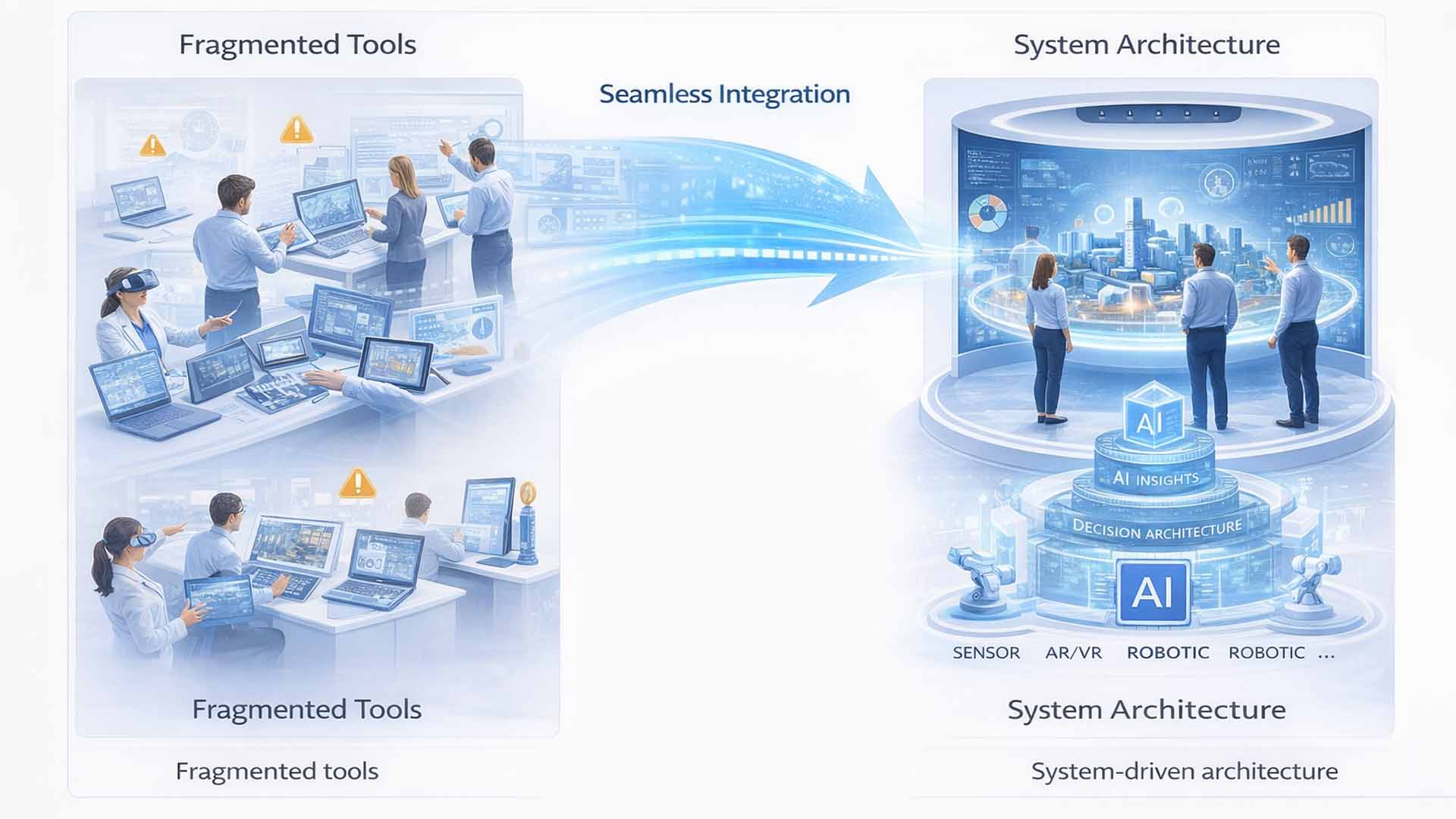
From fragmented tools to integrated system architecture, seamless integration through AI, decision architecture, and connected layers
Graphic: © Ulrich Buckenlei | Visoric GmbH | The illustration shows the structural shift from isolated tool integration toward an AI supported, connected decision architecture with sensor, AR/VR, and robotic as interconnected system layers | The image serves analytical classification.
The left side of the graphic shows a familiar pattern. Individual Spatial Computing tools are introduced, often one after another and independently of each other. AR for maintenance here, VR training there, a digital twin pilot in one plant. Each solution serves a purpose, but remains isolated. This leads to high fragmentation, parallel data silos, and rising integration costs. [8]
The value curve in this model rises quickly at first because of the novelty effect, but then flattens as usage increases. Coordination, interface maintenance, and quality assurance create additional effort. Strategic impact often falls short of expectations because no continuous system emerges.
The right side of the graphic shows a different approach. Here, the focus is not on the individual tool, but on an architecture. [10]
At the center is an orchestrating layer, a digital twin as a living system model that connects different data sources. Above it, an AI layer can structure decision options, prioritize anomalies, and synchronize different systems. Beneath it lie sensor infrastructure, spatial AR interfaces, or physical robotic systems. [1][3]
- The digital twin becomes the control center for physical system states
- AI takes over pattern recognition, prioritization, and decision preparation
- Content and processes are structured modularly and reusably
- Physical AI translates data logic into physically experienceable intervention
This model creates a different logic. Insights can be contextualized, shared, and translated into action in real time. The system becomes iteratively developable and scalable to additional locations. [12]
The graphic therefore shows not only a technical difference, but a strategic shift. From isolated tools toward an integrated decision infrastructure. [10]
The next chapter examines which organizational and technical requirements must be fulfilled so that such an architecture becomes not only feasible, but sustainably effective.
Organizational and technical requirements
Technology alone does not change a decision culture. Even the best architecture of AI, spatial interfaces, and digital twins remains ineffective if it is not embedded in sustainable structures. Sustainable transformation therefore begins not with hardware, but with governance, data strategy, and clear strategic direction. [8][10]
The central question is: Under which conditions can an integrated Spatial Computing architecture become effective in the long term?

Requirements for sustainable decision transformation, from governance and data quality to scalable Spatial Computing infrastructure
Graphic: Editorial analysis | Visualization: © Ulrich Buckenlei | Visoric GmbH | The illustration shows four structural layers that are decisive for the sustainable integration of Spatial Computing, digital twins, and Physical AI into industrial decision processes.
The graphic deliberately reduces complexity to four core areas.
1. Governance
Transformation requires strategic planning. Without clear goal definition, data ownership, responsibilities, and investment frameworks, pilot projects may emerge, but not sustainable systems. Studies on AI implementation show that missing governance structures are one of the most common reasons transformation initiatives fail, with 70 to 85 percent of AI projects missing their expected results. [6]
2. Data quality
Spatial Computing is only as good as the data on which it operates. Missing sensor integration, inconsistent data models, or insufficient real time synchronization between the physical system and the digital twin make spatial visualization worthless. Data quality is not a technical side condition. It is the foundation of any meaningful decision architecture. [1][3]
3. Human expertise
Spatial Computing does not replace domain expertise. Engineers, operators, and decision makers remain the central factor. Their role shifts, however, from reactive data consumer to active system designer. For this to succeed, targeted qualification, continuous support, and user centered interface design are necessary. [2][12]
4. Scalable infrastructure
Technical infrastructure must be edge capable, low latency, and maintainable across locations. A system that works only in a pilot plant creates frustration. Sustainability means organizational viability as much as technical stability and open interface standards. [10]
The core of the graphic lies in its simplicity. It shows that decision transformation is not a technology project, but a structural project. AI, Spatial Computing, and Physical AI are tools. What matters is the system into which they are embedded.
For companies, industrial firms, or public institutions, this means successful transformation does not emerge from isolated tool decisions, but from architectural thinking. Those who procure only devices modernize the surface. Those who develop structures change the effect.
The next chapter therefore examines in concrete terms how such a decision architecture can be built in practice, from initial analysis through pilot phases to scalable implementation.
From analysis to scaling
The introduction of an integrated Spatial Computing architecture is not a one time project. It is a structured development process. Anyone who wants to anchor digital twins, spatial interfaces, and Physical AI sustainably in decision processes needs more than enthusiasm and budget. It requires a clearly defined sequence of phases that build on one another and reinforce each other. [8][10]
The following graphic shows such an implementation path, reduced to five central phases. Each phase fulfills a specific function in the maturity process of an organization.
The introduction of an integrated Spatial Computing architecture is not a one time project. It is a structured development process. Anyone who wants to anchor digital twins, spatial interfaces, and Physical AI sustainably in decision processes needs more than enthusiasm and budget. It requires a clearly defined sequence of phases that build on one another and reinforce each other. [8][10]
The following graphic shows such an implementation path, reduced to five central phases. Each phase fulfills a specific function in the maturity process of an organization.
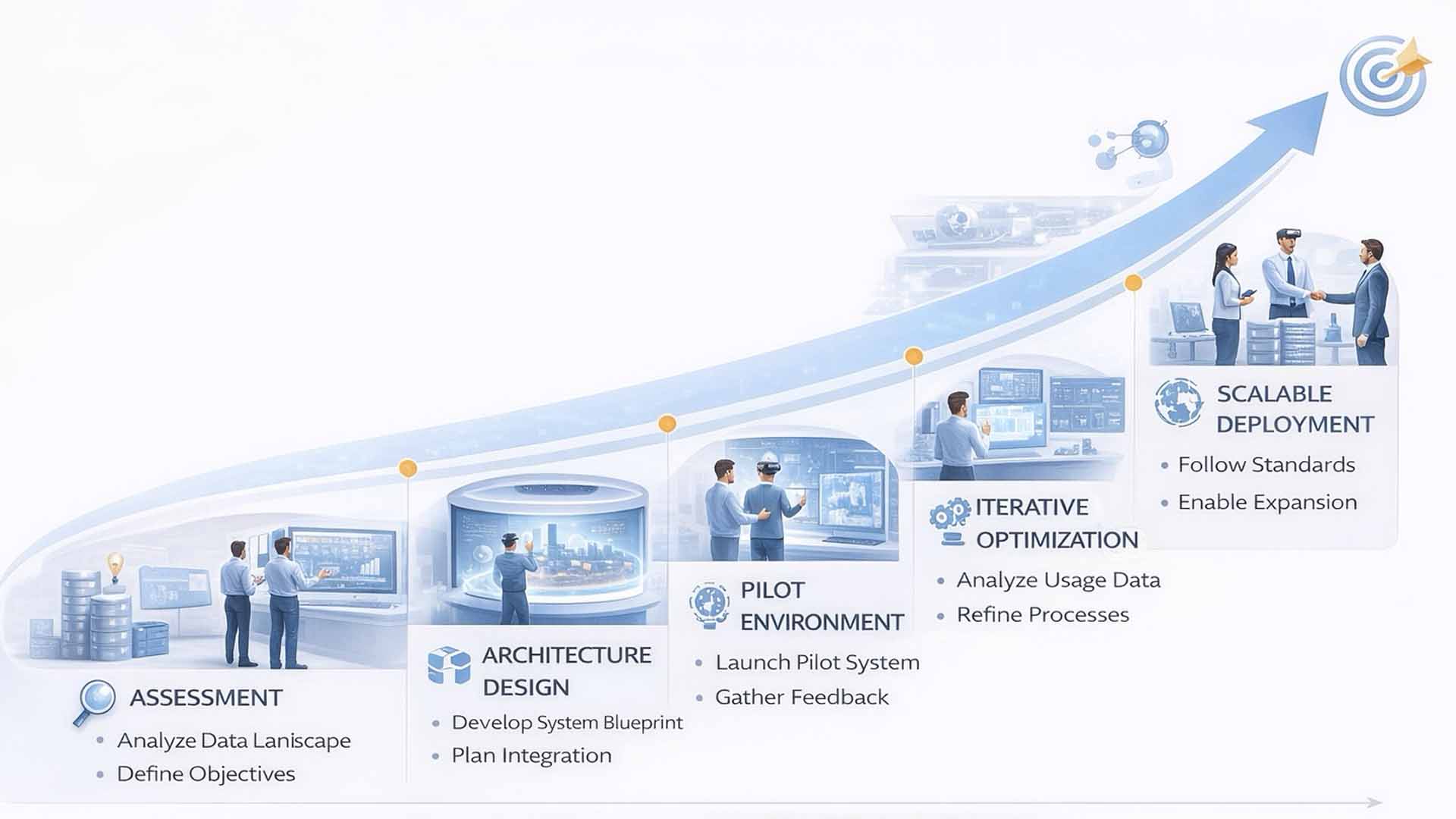
Implementation path for scalable decision architectures, from analysis and piloting to a sustainable Spatial Computing structure
Graphic: Editorial analysis | Visualization: © Ulrich Buckenlei | Visoric GmbH | The illustration shows five sequential implementation phases and the increasing system maturity along the time axis.
The lower curve in the graphic illustrates the central idea: with each phase, system maturity increases. Transformation is not a leap, but a continuous maturation process.
Phase 1 – Assessment
At the beginning, there is no technology decision, but an analysis.
Here, existing data infrastructure, decision processes, organizational conditions, and relevant stakeholders are systematically recorded. Which systems already exist? Where are the media breaks in decision pathways? Which domain expertise is available? [8]
Equally important is the definition of impact goals. Should reaction time to anomalies be shortened? Cross site collaboration improved? Maintenance intervals refined? Without clearly defined goals, every architecture remains vague.
Assessment creates orientation. It prevents technology driven activism.
Phase 2 – Architecture Design
Only after the analysis comes the system architecture.
In this phase, a technical and processual blueprint is created. What role does the digital twin play? Where is Physical AI integrated? Which data flows are necessary? How do sensor layers, spatial interfaces, and AI decision layers interact? [10]
This is where it becomes clear whether a company introduces individual tools or develops a coherent decision system.
Architecture design means thinking through interdependencies. Integration is consciously planned, not produced by chance.
Phase 3 – Pilot Environment
No transformation without a test environment.
In the pilot environment, selected processes, plants, or decision scenarios are introduced in a controlled way. Operators and decision makers receive targeted support. Workflows are observed. Feedback is collected in a structured way. [2]
Piloting has two functions:
It reduces risk.
And it creates experiential knowledge that no provider can deliver.
Only here does it become visible how theory works in real industrial contexts.
Phase 4 – Iterative Optimization
Transformation does not end with the first productive deployment.
In this phase, usage data is evaluated, operator feedback is analyzed, and interface adjustments are made. AI models are fine tuned. Visualizations are simplified. Data structures are optimized. [12]
Iteration is not a sign of uncertainty. It is a sign of professional system development.
The graphic makes it clear: optimization is its own clearly defined step, not a side effect of operations.
Phase 5 – Scalable Deployment
Only now does the actual scaling begin.
Standards are defined. Governance models are established. Interface specifications are documented. Training structures for operators and decision makers are institutionalized. [10]
Scaling does not mean copying a pilot project. It means establishing an architecture that is sustainably viable and expandable.
The rising curve in the graphic symbolizes exactly this level of maturity. With every phase, the system becomes more stable, more integrated, and more effective for decisions.
The central difference therefore lies not in the technology, but in the approach. Companies that implement in a structured way develop long term system competence. Companies that pilot in isolation create expensive isolated solutions.
And it is precisely here that the next, perhaps most decisive question arises:
How does the role of the human being actually change within such a decision architecture?
The next chapter therefore examines how the professional profile shifts from data consumer to system designer, and why this shift is the real key to transformation.
From data consumer to system designer
Spatial Computing can visualize processes.
It can contextualize, simulate, and anticipate.
But it cannot judge.
The real transformation in industrial decision processes therefore begins not with AI, digital twins, or spatial interfaces. It begins with the role of the human being.
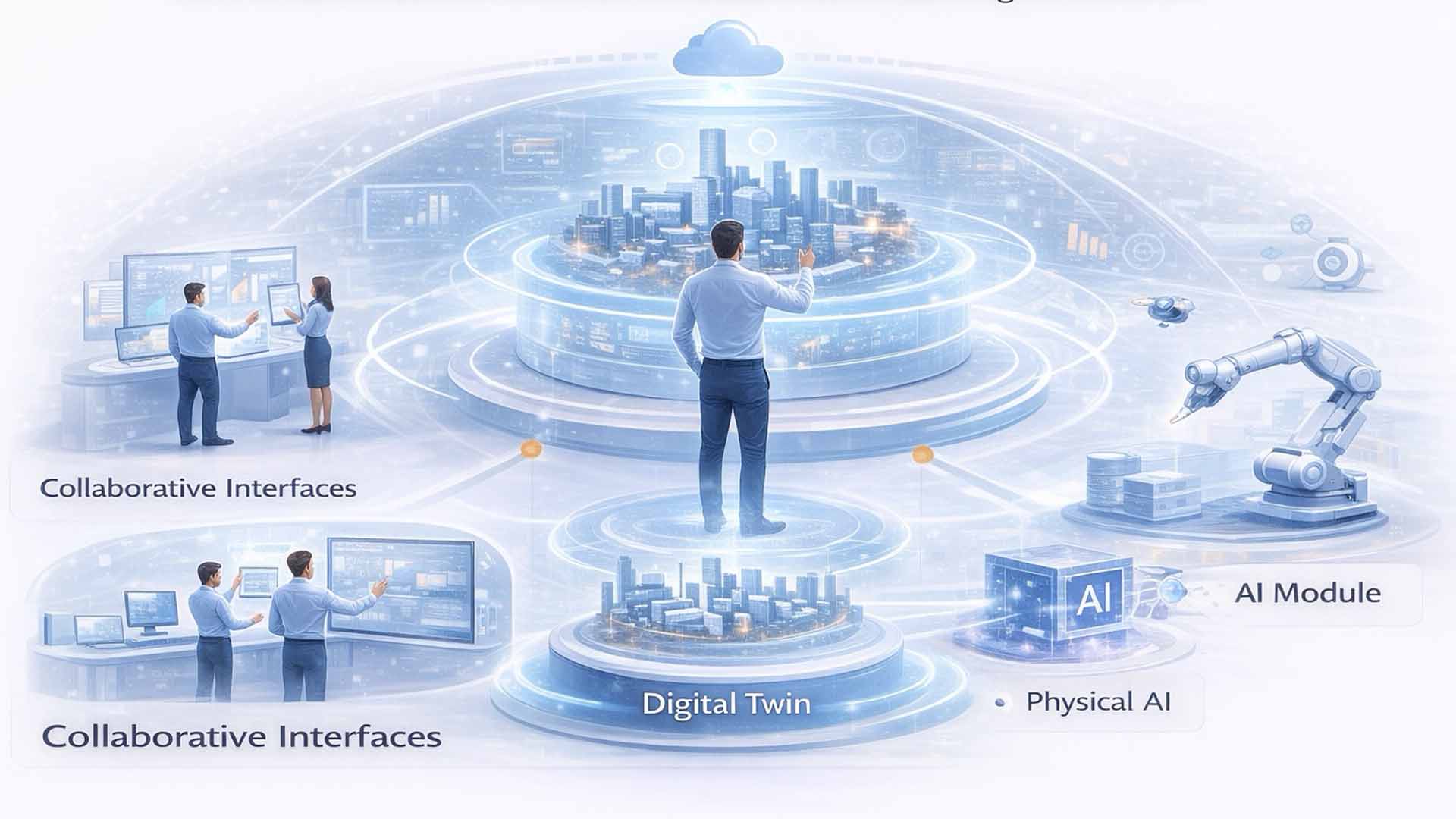
The human as system designer, Spatial Computing becomes a tool, the expert remains the designer and center of judgment
Visualization: © Ulrich Buckenlei | Visoric GmbH | Editorial concept image on the shift in the expert role from data consumption to the active design of spatial decision environments.
The image does not show a classic control room situation.
The decision maker no longer stands isolated in front of a monitor wall. Instead, the person is located at the center of a dynamic decision environment. Digital twins, an AI module, a Physical AI system, and collaborative interfaces visually orbit around them.
What is decisive, however, is this: the technology does not dominate.
It arranges itself.
The expert steers, connects, evaluates, and structures. The digital systems expand the space for action, but do not replace it.
Colleagues are actively working at the interfaces, remotely and on site at the same time. They interact with models, analyze anomalies, evaluate scenarios, and make decisions. Decision making becomes visible. Not as the consumption of reports, but as active system interaction.
This representation illustrates a fundamental shift.
In the past, industrial decision making was often organized sequentially:
Sensor → Data → Report → Decision.
In an integrated Spatial Computing architecture, a different pattern emerges:
Expert at the center → orchestrated data environment → active system intervention in real time.
The role changes on several levels:
First, the expert becomes a curator. They decide which data, models, and scenarios should be combined meaningfully.
Second, they become a moderator. They guide collaborative decision processes, ask the right questions, and create context.
Third, they become an architect. They design decision spaces consciously and strategically. [2][12]
This shift is not a loss of significance. Quite the opposite.
The more complex systems become, the more important human judgment becomes. AI can recognize patterns. It can suggest options. But meaning, contextual evaluation, and strategic fine tuning remain human capabilities.
This is exactly where the key to transformation lies.
If companies introduce Spatial Computing without further developing the role of decision makers, overload emerges. If experts are understood as designers of an expanded decision environment, empowerment emerges.
The image is therefore deliberately dynamic and human centered. It does not show a technical system. It shows an attitude.
And with that, the next central question arises:
How can this new role be concretely supported, qualified, and structurally anchored so that it does not depend on individual affinity for technology, but is systematically fostered?
The next chapter therefore focuses on enablement, change management, and structural support, and on how transformation can be sustainably anchored in practice.
How transformation is anchored in the long term
Spatial Computing architectures do not emerge through technology alone. They emerge through people who understand them, shape them, and continuously develop them further. This is exactly where it is decided whether a strategic vision becomes sustainable practice, or remains stuck at the pilot stage.
The following visualization shows that professional enablement does not take place on a single level, but must be conceived systematically across multiple levels.
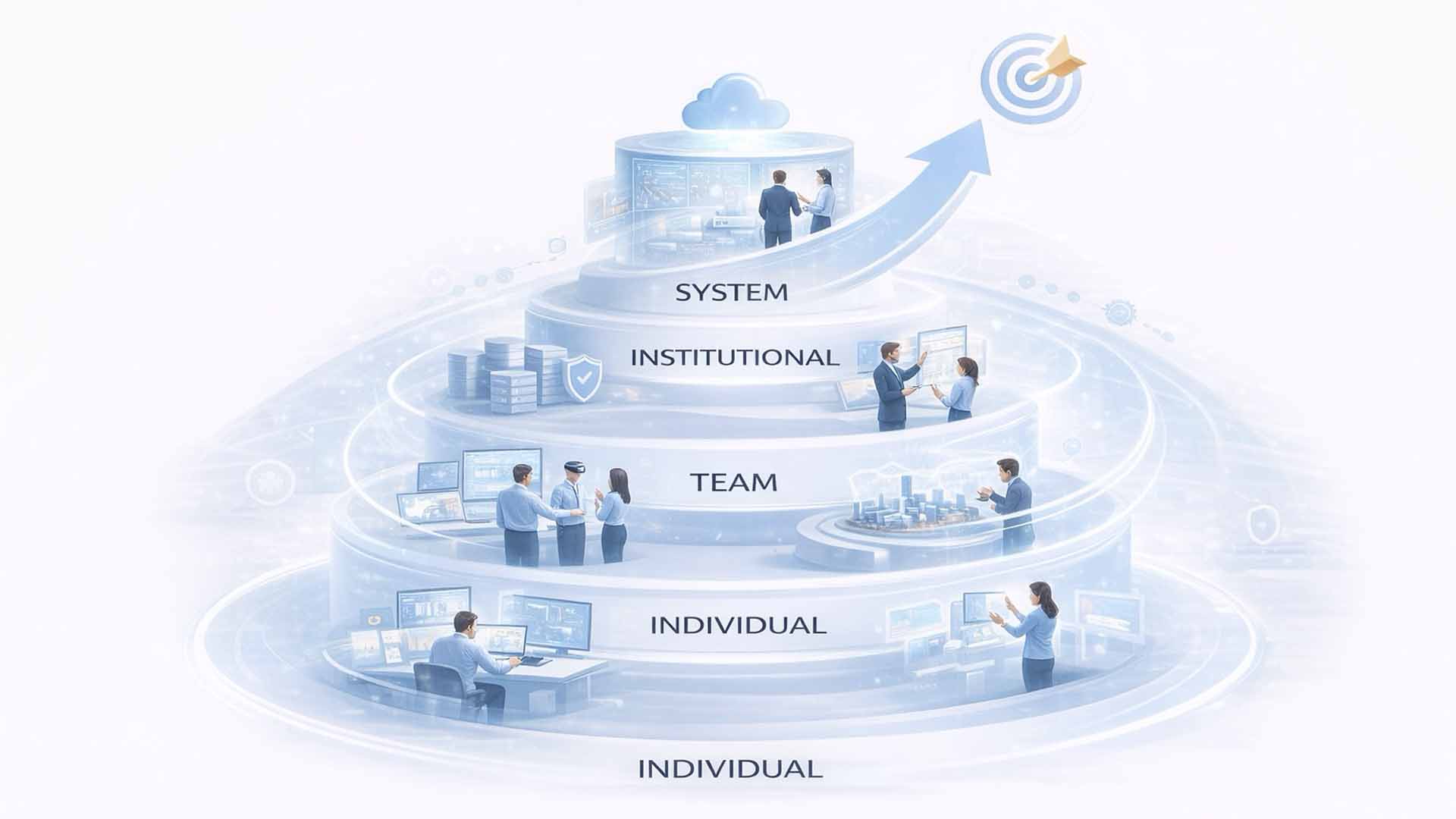
Professional Enablement Model for Spatial Transformation, four sequential enablement levels for a sustainable decision architecture
Concept graphic: Multi level enablement model for the sustainable anchoring of Spatial Computing, digital twins, and Physical AI in industrial decision structures | Visualization: Editorial model | © Visoric GmbH
The graphic structures transformation into four sequential levels. Every level is necessary. None can function in isolation.
1. Individual Level – Competence begins with the person
At the individual level, the focus is on basic capabilities that enable safe and reflective interaction with Spatial Computing systems.
- Technical skills – confident handling of spatial interfaces and digital twin tools
- Analytical skills – context aware interpretation of AI generated decision options
- Reflection and adaptation – continuous adjustment to evolving system environments
Transformation here does not mean that every operator becomes a data scientist. What matters is the ability to use spatial systems consciously and to critically assess their decision support. Without this personal confidence, resistance emerges, and resistance blocks innovation.
2. Team Level – Decision making as a collective process
Technology oriented individuals alone are not enough. Sustainable change only emerges when teams work together and learn from one another.
- Shared scenario reviews in collaborative digital twin environments
- Collaborative decision formats across site boundaries
- Community of practice as a lasting exchange structure for best practices
Only when experiences are shared, decision scenarios are reflected on together, and system architectures are developed cooperatively does innovation become the norm. Otherwise, new methods remain isolated experiments.
3. Institutional Level – Structure creates stability
Even committed teams reach limits if organizational conditions are missing. Sustainable transformation requires structural safeguarding.
- Capacity planning – dedicated time and resources for further system development
- Dedicated roles – clearly defined responsibilities for Spatial Computing architecture
- Resource allocation – financial and organizational safeguarding beyond the pilot
Transformation must not depend on the commitment of individual technology enthusiasts. It must be institutionally anchored. Only then does stability emerge.
4. System Level – Sustainability through governance
The highest level considers the company architecture as a whole. This is where it is decided whether change is strategically secured.
- Structured evaluation and continuous impact measurement of the architecture
- Long term strategic commitment beyond individual project budgets
Digital transformation is not a project with an end date. It is a development process. And this process requires clear governance structures that endure independently of technology trends.
Overall conclusion – Why this model matters
The visualization makes it clear that transformation is not defined by devices or platforms. It emerges through the coordinated interaction of individual competence, collective collaboration, institutional structure, and systemic anchoring.
Technology can enable processes.
Architecture can reorder decision spaces.
But enablement determines whether change has a lasting effect.
Only when all four levels work together does a decision architecture emerge that can continue to evolve, independently of individual tools or market trends.
The concluding video condenses this argument once again. It shows how Spatial Computing, digital twins, and Physical AI should not be viewed in isolation, but as part of a new decision architecture that connects technology, structure, and human expertise.
The video summarizes the core ideas and poses the central question:
If these technologies are already fundamentally changing industry and business, how consciously are we shaping their role in our decision structures?
Video analysis – When mixed reality becomes physics
The following video does not show an abstract vision of the future. It shows something you can touch.
A display embedded in a physical surface runs a fluid simulation in real time that reacts directly to human touch. Every interaction injects energy into a simulated field in which speed, pressure, and direction are calculated live. Movement becomes immediately visible behavior.
What happens here is more than visualization. It is interactive physics.[2]
Users do not press buttons. They interact with forces, flows, and behavior. Physical principles become the control system itself. Input, simulation, and visualization run continuously. GPU based solvers update thousands of particles per frame and create immediate feedback.[1]
The interface exists in physical space. Users perceive structure, depth, and movement directly instead of interpreting flat graphics. That is precisely the core of Spatial Computing: data is not read, but experienced.[3]
From industrial simulation to medical training to interactive learning environments, this example shows how complex systems become intuitive as soon as they can be explored physically.
Mixed reality becomes physics, real time fluid simulation reacts to touch and makes complex system dynamics directly experienceable
Demonstration environment: real time fluid simulation with physical interaction |
Analytical classification: Ulrich Buckenlei |
Credits: 11d.agency x thirdroom AVL | Built with TouchDesigner
This example stands as a representative case of the potential of spatial data. It does not replace existing systems. It shows what becomes possible when data leaves the two dimensional screen and enters physical space.
If Spatial Computing already enables experiences like this today, the question is no longer whether companies should respond, but how consciously and structurally this integration is designed.
The concluding chapter brings this perspective together and places it in an overall strategic context, with a view toward companies and organizations that want to shape transformation actively.
Sources and references
- Zheng, M., Lillis, D. & Campbell, A.G., “Augmented Reality Data Visualization to Support Decision Making”, Visual Informatics, Vol. 8, 2024, pp. 80–105.
Systematic review on AR supported decision support: taxonomy of AR visualization strategies and their effect on decision efficiency and contextual understanding. [1] - Renata, A., Guarese, R., Takac, M. & Zambetta, F., “Assessment of Embodied Visuospatial Perspective Taking in Augmented Reality”, Frontiers in Virtual Reality, Vol. 5:1422467, 2024.
Peer reviewed study on embodied cognition in AR: physical interaction with virtual 3D objects fundamentally improves system understanding compared with 2D representations. [2] - Chheang, V. et al., “Enabling Additive Manufacturing Part Inspection of Digital Twins via Collaborative Virtual Reality”, Nature Scientific Reports, 2024.
Evidence that collaborative VR inspection of digital twins leads to faster error detection rates and better team collaboration than conventional 2D views. [3] - Baratta, A., Cimino, A., Longo, F. & Nicoletti, L., “Digital Twin for Human–Robot Collaboration Enhancement in Manufacturing Systems”, Computers & Industrial Engineering, Vol. 187, 2024, 109764.
Systematic review on digital twin supported human robot collaboration: improvements in cycle time, ergonomics, and operator satisfaction are documented. [4] - McKinsey & Company, “The State of AI in 2025”, McKinsey Global Survey, 2025.
88 percent of companies use AI in at least one function; only one third have scaled it systematically. Success factors: governance, workflow redesign, human competence. [5] - Fullview.io / MIT / RAND Corporation, “200+ AI Statistics and Trends for 2025”, 2025.
70 to 85 percent of all AI projects fail to meet result goals. Data quality and governance as decisive success factors. [6] - Classic Informatics, “AI Development Statistics 2025”, 2025.
Edge AI market forecast: USD 66.47 billion by 2030 (CAGR 21.7%). Local data processing without cloud latency as a central driver. [7] - Deloitte Insights, “Tech Trends 2024 – Spatial Computing and the Industrial Metaverse”, 2024.
92 percent of manufacturing leaders are testing metaverse use cases; 12 to 14 percent performance improvement expected. Spatial Computing market forecast: USD 600 billion by 2032. [8] - Deloitte Consulting Central Europe, “Spatial Computing: The Future of Business Innovation”, 2025.
XR and Spatial Computing enable real time decision support through spatial data contextualization. [9] - McKinsey & Company, “Technology Trends Outlook 2024”, 2024.
Digital twins, immersive technologies, and AI as converging megatrends with exponentially growing enterprise adoption. [10] - Benton, K. Jr. et al., “Mixed Reality Digital Twin Environments for Human Robot Collaboration”, Procedia Computer Science, Elsevier, 2024.
Framework for MR digital twins in manufacturing; proof of feasibility for spatial physical interaction with digital twins. [11] - PwC, “The Effectiveness of Virtual Reality Soft Skills Training in the Enterprise”, PwC US Research, 2020, updated 2024.
VR training is 52 percent more cost efficient than classroom training at 3,000 learners; 275 percent higher confidence in application. [12] - Rupp, M. et al., “VR for Monitoring Additive Manufacturing Processes”, RWTH Aachen VR Lab, 2024.
VR based real time monitoring of manufacturing processes: anomaly detection significantly faster than with conventional dashboard approaches. [13]
Shaping transformation means taking responsibility
The integration of Spatial Computing, digital twins, and Physical AI into industrial decision processes is not a question of individual tools. It is a structural decision. As soon as decision architectures are spatially expanded, role models, process logics, and requirements for data quality, governance, and change management all begin to change.
The decisive question is therefore not whether the technology is available. What matters is how it is meaningfully embedded. Which decision processes should be improved. Which system relationships need to become spatially experienceable. Which organizational requirements must be created. And how a sustainable competitive advantage for companies, teams, and institutions can emerge from this.
Anyone who wants to rethink industrial decision processes needs more than hardware or platform licenses. It requires a clean end to end perspective. From the analysis of suitable use scenarios to the design of a viable decision architecture, the evaluation of technological options, the definition of organizational roles, and structured piloting and impact measurement.
It is precisely at this intersection that we work as an interdisciplinary team of experts in Munich. We support industrial companies, system integrators, and public institutions in the strategic classification of Spatial Computing and Physical AI. We develop viable concepts for digital decision architectures, assess feasibility and impact, and support implementation, not as isolated showcases, but as resilient structures.

Interdisciplinary concept work, analysis, architecture, and strategic support for Spatial Computing transformation
Source: VISORIC GmbH | Munich
- Strategic analysis → evaluation of potential and realistic use scenarios for Spatial Computing
- Architecture development → design of integrated digital twin and decision models
- Piloting → structured testing under real industrial conditions
- Evaluation → measurement of impact, user acceptance, and scalability
- Organizational development → roles, processes, and governance structures for sustainable anchoring
- Long term support → sustainable integration into existing system landscapes and decision cultures
If you would like to examine how decision processes, operational workflows, or industrial collaboration structures can be systematically developed further through Spatial Computing, it is worth taking a shared look at your current situation.
Not as a sales presentation, but as an analytical conversation about where spatial decision support is operationally meaningful, technically viable, and effective in the long term.
Transformation does not begin with technology.
It begins with a clear architecture, and with the willingness to shape it consciously.
Contact Us:
Email: info@xrstager.com
Phone: +49 89 21552678
Contact Persons:
Ulrich Buckenlei (Creative Director)
Mobil +49 152 53532871
Mail: ulrich.buckenlei@xrstager.com
Nataliya Daniltseva (Projekt Manager)
Mobil + 49 176 72805705
Mail: nataliya.daniltseva@xrstager.com
Address:
VISORIC GmbH
Bayerstraße 13
D-80335 Munich