
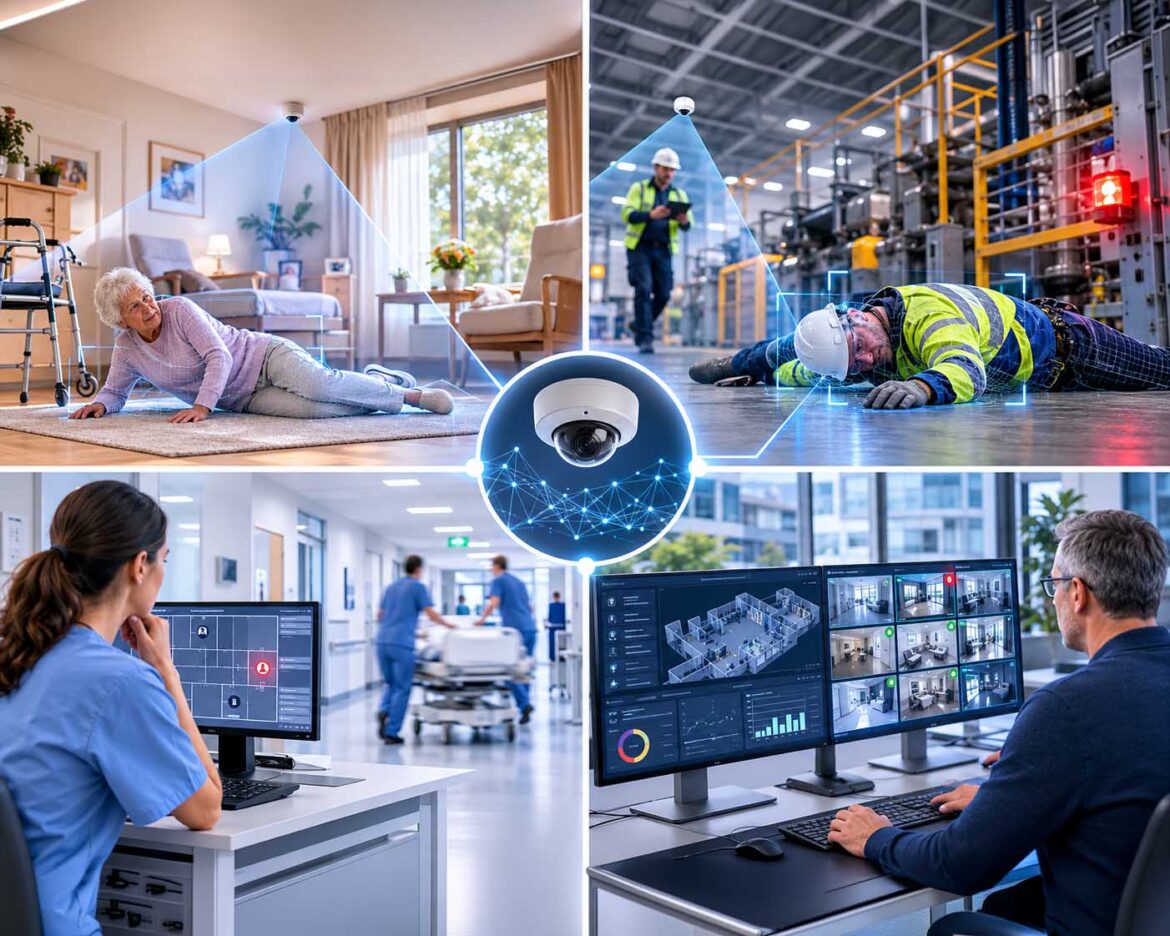
Whether in a care room, an industrial hall, or a facility management control room: the same camera detects in real time when someone has fallen, and instantly alerts the right people.
Visualization: Four scenes show the same camera-based fall-detection system in action, a person who has fallen in a care room, a fallen worker in an industrial hall, medical staff at an alert dashboard in a clinical corridor, and a facility management control room monitoring multiple rooms, all connected through a central camera | Image: © Ulrich Buckenlei | XR Stager Online Magazine | VISORIC GmbH
A fall is one of the most common and most dangerous events in care settings, healthcare, and many work environments. If nobody responds in time, what starts as a harmless fall can turn into serious health consequences. Classic solutions like emergency buttons or wearable sensors only help if they’re actually worn and actively used at the critical moment, a requirement that, surprisingly often, doesn’t hold up in everyday life.
Camera-based AI systems take a different approach. Instead of waiting for a device someone has to wear, a camera feed continuously observes body posture and independently recognizes the moment a fall happens. Modern systems rely on so-called pose-estimation models from the YOLO family, which automatically detect body keypoints in every frame, shoulders, hips, knees, ankles, and derive posture and movement patterns from them.
As logical as that sounds, the real challenge isn’t detecting a fall. It’s telling a genuine fall apart from everyday movements that briefly look identical: bending down, sitting quickly, reaching for something on the floor. That exact distinction determines whether a system earns trust in real-world use or becomes useless through constant false alarms, whether in care, industry, or an office building.
For spatial computing and physical AI, camera-based behavior detection is a logical next step. It adds a third dimension to persistent object recognition and streaming 3D reconstruction: understanding what people are actually doing in a space.
- Camera-based AI detects falls from body posture alone, with no wearable or emergency button.
- YOLO pose-estimation models capture body keypoints like shoulders, hips, and knees in real time.
- The real challenge isn’t detection itself, it’s distinguishing genuine falls from everyday movements.
- False alarms are the deciding factor for whether such systems gain practical acceptance, in any industry.
- Behavior detection adds a third dimension to persistent object recognition and streaming 3D reconstruction within physical AI.
This article explains how camera-based fall detection works technically, why false alarms remain the core problem, where privacy and technology need to strike a sensible balance, and what applications are already emerging in care, industry, and facility management.
From Emergency Button to Camera as Sensor
For decades, the emergency button was the standard tool for fall detection: a pendant or wristband that has to be pressed in an emergency for help to arrive. Later came automatic wearables that measure acceleration and orientation to detect a fall on their own. Both approaches share one fundamental problem: they only work if the device is actually worn on the body.
That’s exactly where one of the most widely documented weaknesses of wearable-based systems lies. Many older adults don’t wear the devices consistently, forget them, find them stigmatizing, or take them off to shower and sleep, precisely the situations with the highest fall risk. A system that isn’t worn can’t protect anyone.[1]
Camera-based systems sidestep this problem entirely. A camera installed in a room observes continuously, without the monitored person having to do or wear anything actively. For people who reject wearables or regularly forget them, that’s a decisive practical advantage, one that’s increasingly tipping the scales toward camera-based solutions in many care facilities.
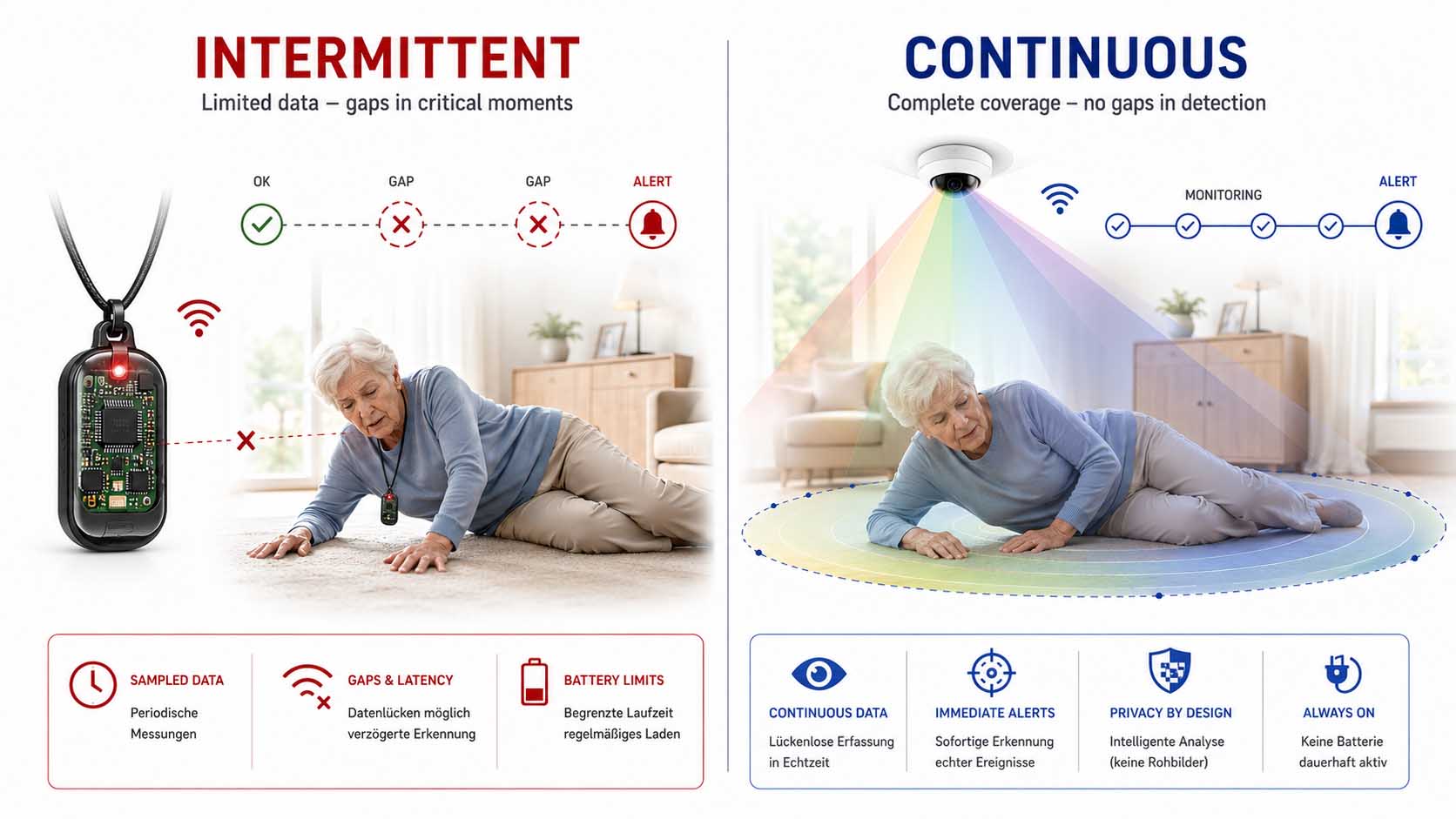
Emergency buttons and wearables only work if they’re actually worn, a requirement that often goes unmet in everyday life. Camera-based systems monitor continuously, with no active involvement required from the person being watched over.
Infographic: From wearable emergency systems to continuous, camera-based fall detection | Graphic: © Ulrich Buckenlei | XR Stager Online Magazine | VISORIC GmbH
This shift is more than a convenience gain. It fundamentally changes how reliably a safety system performs in real everyday life. A wearable can only protect if it’s actively worn; a camera protects regardless of whether the person remembers to wear anything at all.
That also raises the technical bar. It’s no longer enough to evaluate acceleration readings from a single device. A camera-based system has to understand a person’s body posture from a continuous video stream and derive a reliable assessment from it in real time.
- Emergency buttons and wearables only work if they’re actually worn.
- Many users don’t wear wearables consistently, especially in fall-prone situations like showering.
- Camera-based systems monitor continuously, with no active involvement from the person required.
- This reliability, independent of user behavior, is a key practical advantage.
- The technical bar shifts from simple sensor readings to genuine understanding of body posture.
For a camera to truly understand body posture, a single image isn’t enough. How modern systems reliably determine from a video stream whether someone has fallen is the subject of the next chapter.
Why a Single Frame Can’t Detect a Fall
A single photo of a person lying down says surprisingly little. Someone relaxing on the sofa, doing floor exercises, or actually having fallen can all look nearly identical in a single frame. Reliable fall detection therefore needs two ingredients: precise understanding of body posture, and observation of how that posture changes over time.
For body posture, modern systems rely on pose-estimation models from the YOLO family. These models automatically detect keypoints of the human body in every camera frame, head, shoulders, elbows, hips, knees, ankles, and calculate the body’s tilt angle and the ratio between body width and height from them. A recent study on YOLOv7-W6-Pose shows how this combination of object detection and pose analysis identifies falls in real time over a simple webcam feed, with no specialized sensors at all.[2]
The second ingredient is the time dimension. A fall isn’t a state, it’s a sequence: upright posture, a rapid change in tilt angle, impact, followed by a characteristic resting phase on the floor. A recent method called PIFR uses nine biomechanically significant angle features tracked across multiple frames to distinguish falls from everyday activities, with markedly improved accuracy over simple single-frame approaches.[3]
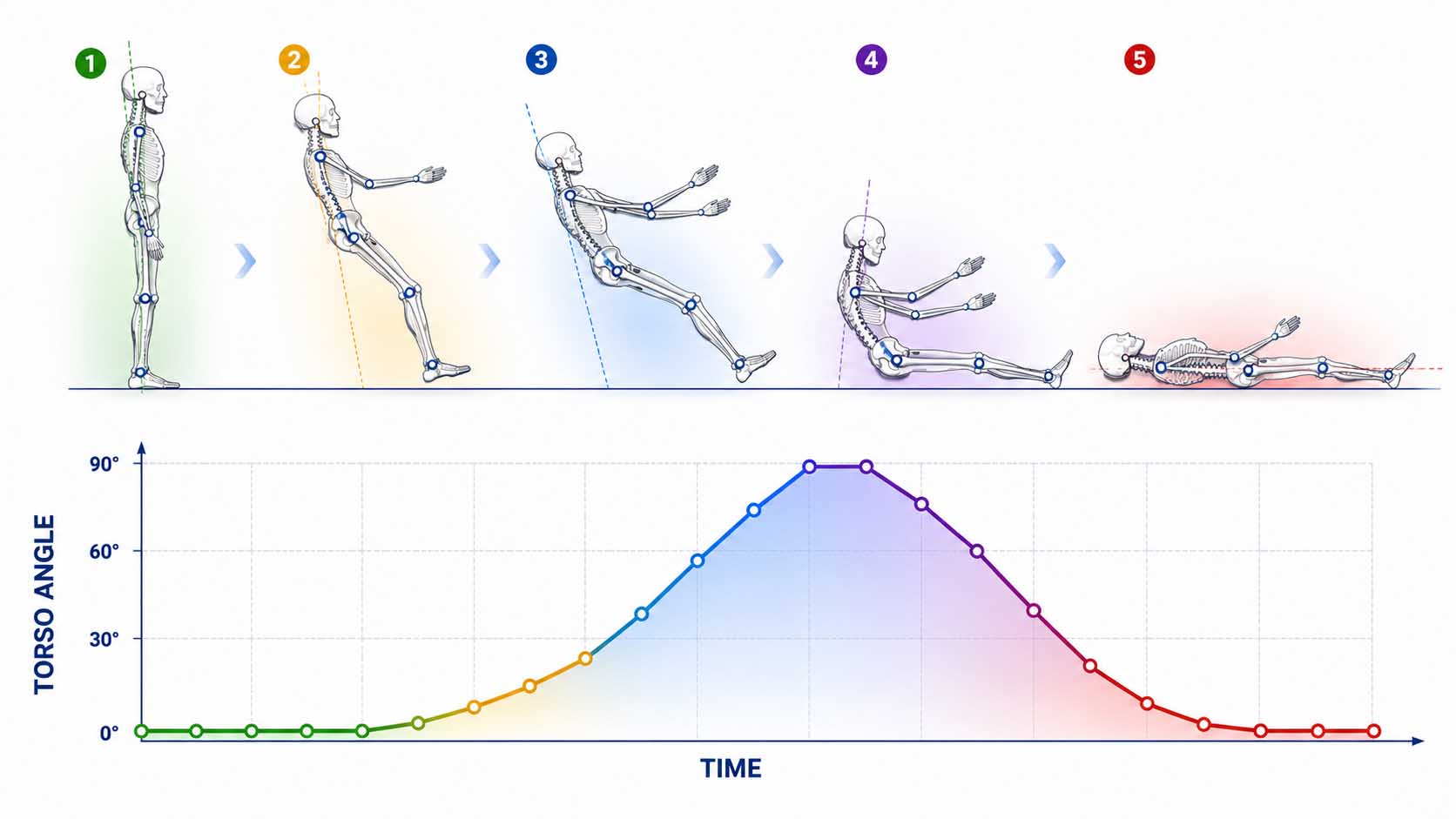
Reliable fall detection combines precise posture analysis with observation over time across multiple frames. Only the characteristic sequence, a rapid change in angle followed by a resting phase on the floor, distinguishes a genuine fall from similar-looking everyday movements.
Infographic: Pose estimation and temporal motion analysis as the foundation of camera-based fall detection | Graphic: © Ulrich Buckenlei | XR Stager Online Magazine | VISORIC GmbH
Current systems don’t just distinguish between “fallen” and “not fallen,” they model the entire sequence as a series of states, such as standing, falling, fallen, and recovering. This more granular state logic makes it possible to trace a person’s actual movement, instead of evaluating a single binary snapshot.
This exact combination of precise posture recognition and temporal logic marks the decisive technical advance over older approaches. A system that evaluates only a single frame will inevitably trigger many false alarms. A system that understands the movement sequence over time can drastically cut that error rate.
- A single camera frame can barely distinguish a fall from similar-looking everyday movements.
- YOLO pose models detect body keypoints and calculate tilt angle and body shape from them.
- Temporal sequence analysis across multiple frames is essential for reliable fall detection.
- Modern systems model the entire movement as a sequence of states rather than a yes-no decision.
- Precise posture recognition combined with temporal logic significantly reduces false alarms.
This technical foundation delivers far more than individual alert messages. How camera-based behavior detection gets embedded into buildings and digital twins is the subject of the next chapter.
Digital Twins and Buildings Gain Safety Awareness
A single camera frame that detects a fall is valuable. Its full potential, though, only unfolds once that information is embedded into a larger spatial model that knows exactly where in the building the event took place and what consequences follow.
Research into edge-computing approaches for fall detection shows how behavior detection can be processed directly on local hardware, instead of continuously streaming video data to a central server. That not only cuts latency and bandwidth needs, it also enables decentralized evaluation, right at the given camera or building section.[4]
For buildings and facilities, this means: a digital twin can represent not just a property’s geometry and operating state, but also where people are located in the space and whether a situation needs attention. This approach is also taking hold in industrial manufacturing: fall monitoring is increasingly treated as a complement to existing safety systems, for example combined with systems that check personal protective equipment, to create a continuous safety picture of a facility.[5]
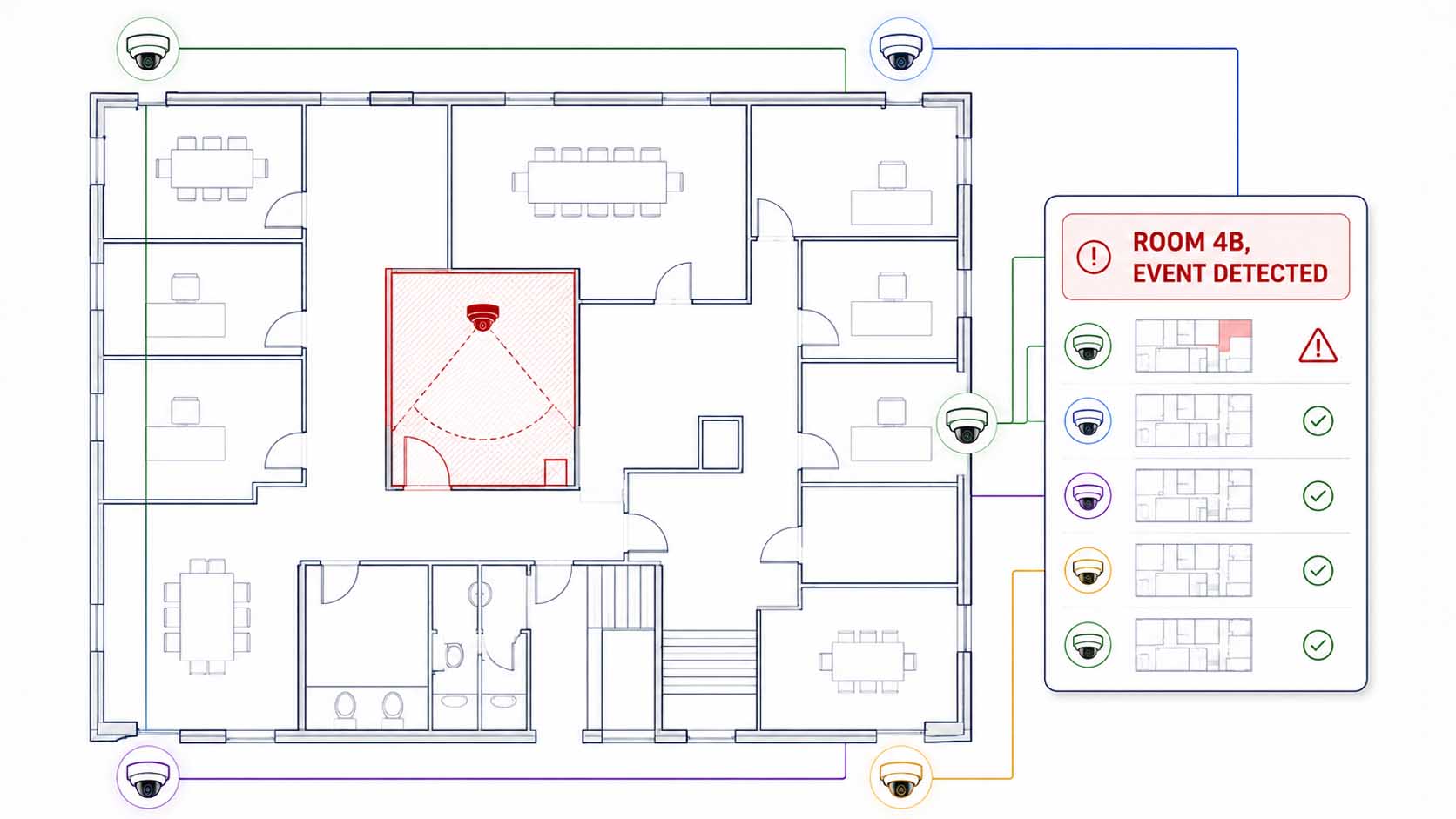
Camera-based fall detection becomes a building block of a larger spatial safety model. A digital twin shows not just the building’s geometry, but also where in the space an event is happening and what response is needed.
Infographic: Camera-based behavior detection as an extension of digital twins with spatial safety awareness | Graphic: © Ulrich Buckenlei | XR Stager Online Magazine | VISORIC GmbH
This principle transfers directly across different types of buildings. Care facilities can track which rooms or corridors see events cluster. Industrial sites can combine fall events with other safety data, such as access control or environmental sensors. A digital twin thereby becomes more than a representation of the facility, it becomes an active part of its safety concept.
That puts camera-based behavior detection in the same category as other building blocks of modern building infrastructure: not an isolated alarm system, but a continuously running, spatially anchored layer of information.
- Edge computing processes fall detection locally, without continuously streaming video to central servers.
- Digital twins can spatially pinpoint exactly where in a building a fall event is occurring.
- In industry, fall monitoring is increasingly combined with existing safety systems.
- Event data can be linked with other building and safety data.
- Camera-based behavior detection becomes a continuous, spatially anchored safety layer.
As promising as this integration sounds, it stands or falls on a single technical detail: how reliably the system distinguishes real emergencies from harmless everyday movement. That exact core problem is the subject of the next chapter.
Why False Alarms Remain the Biggest Problem
The real challenge in camera-based fall detection isn’t detecting a fall. It’s recognizing when no alarm should be triggered at all. Bending down, sitting quickly, reaching for something on the floor, all these movements can briefly look exactly like a fall. A system that raises the alarm at every one of these movements loses user trust within a very short time, regardless of how precisely it detects genuine falls.
This is exactly where an insight runs through current research: more detections don’t automatically mean a better system. What matters is the ability to weigh probability and context against each other, instead of reacting instantly to every unusual movement. A system that responds with calibrated restraint is often more valuable in practice than one chasing maximum sensitivity.
That restraint becomes technically possible once a system evaluates not just a single snapshot, but movement angle, speed, and the sequence across multiple frames. This exact temporal logic helps distinguish normal movements like bending or sitting quickly from genuine emergencies, and noticeably reduces false alarms as a result.[3]
Technical conditions play a decisive role too. Classic camera-based systems hit their limits in poor lighting, a problem that’s especially relevant at night or in dimly lit rooms, precisely the situations where falls occur disproportionately often. Newer approaches address this with image-enhancement techniques that brighten footage before the actual analysis, so the system stays reliable even under unfavorable lighting.[6]
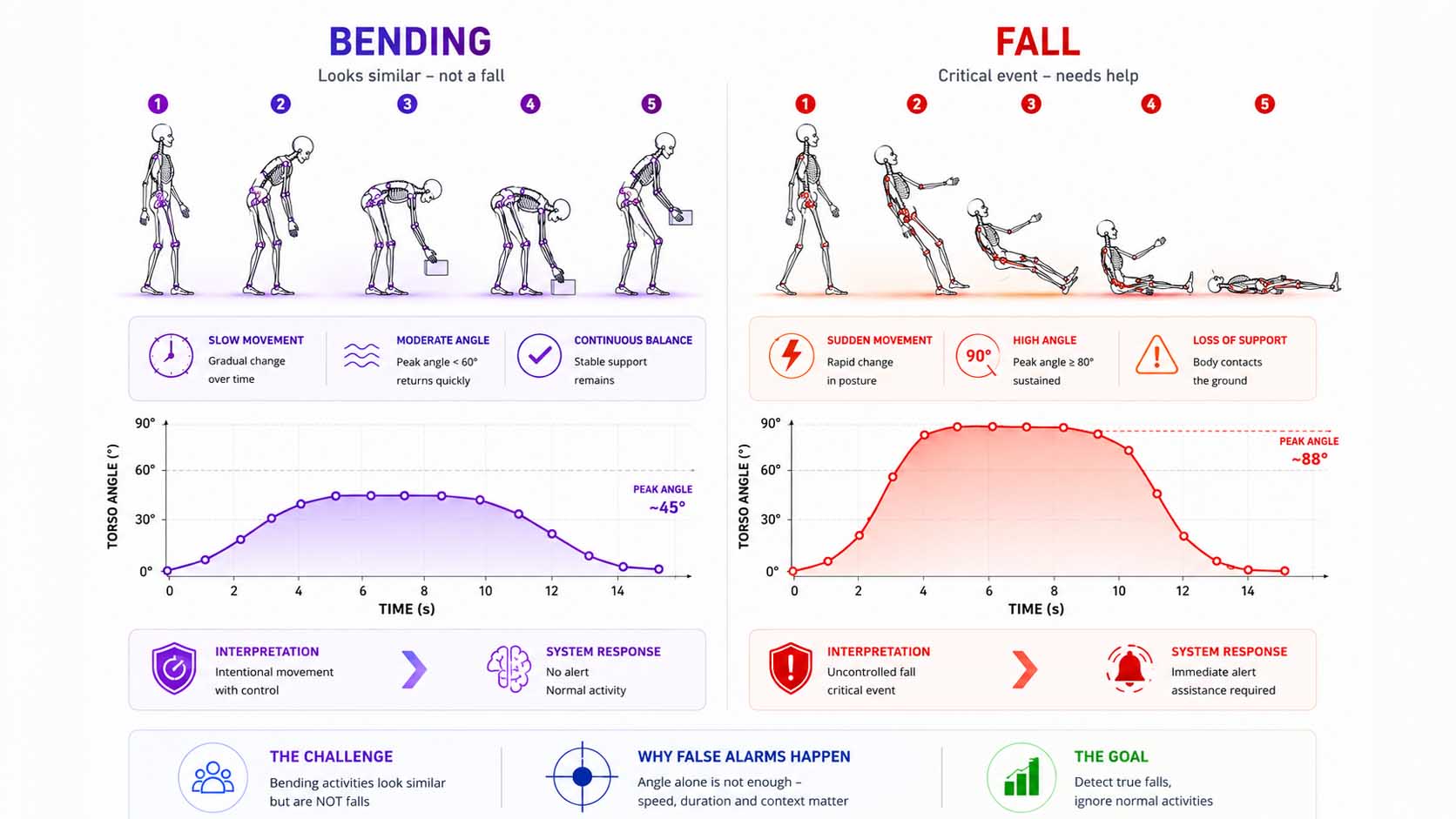
The biggest technical challenge isn’t detecting falls, it’s reliably distinguishing genuine emergencies from similar-looking everyday movements. Temporal motion analysis and robust image processing noticeably reduce false alarms.
Infographic: Why avoiding false alarms is the central technical challenge of camera-based fall detection | Graphic: © Ulrich Buckenlei | XR Stager Online Magazine | VISORIC GmbH
For real-world deployment, that means: a system can’t be judged on its detection rate alone. Just as important is how rarely it falsely raises the alarm, especially in sensitive environments like care facilities or clinics, where every false alarm ties up staff and erodes trust in the entire system.
Knowing where that line sits leads to a more realistic assessment of systems and the right questions when choosing a solution. That exact knowledge also determines which industries are already putting camera-based fall detection to good use today. That’s the subject of the next chapter.
- The real challenge isn’t detection, it’s avoiding false alarms.
- More detections don’t automatically mean a better or more trustworthy system.
- Temporal motion analysis distinguishes normal movements from genuine emergencies more reliably.
- Poor lighting conditions remain a technical challenge, especially at night.
- False alarm rate matters at least as much for real-world usability as raw detection accuracy.
A Technology for Care, Industry, and Facility Management
Once it’s clear where the technical strengths and limits of camera-based fall detection lie, its practical value becomes easy to place: anywhere people move through spaces unsupervised and a fall could go unnoticed.
In elderly care and assisted-living facilities, camera-based fall detection delivers its greatest value exactly where staff are stretched thinnest. Instead of regular check-in rounds that cost time and interrupt residents even in harmless situations, care staff can focus on genuine care while the system runs continuously in the background, only raising an alarm when help is actually needed. Current research explicitly names care and nursing facilities as a primary use case, aiming to shorten response times and improve outcomes.[3]
In industrial work environments, the same technology is deployed in hazardous areas to automatically detect falls and trigger real-time alerts, complementing classic safety equipment. That’s especially valuable for so-called lone workers, people working without immediate colleagues nearby, where nobody would be around to help right away in an emergency.[7]
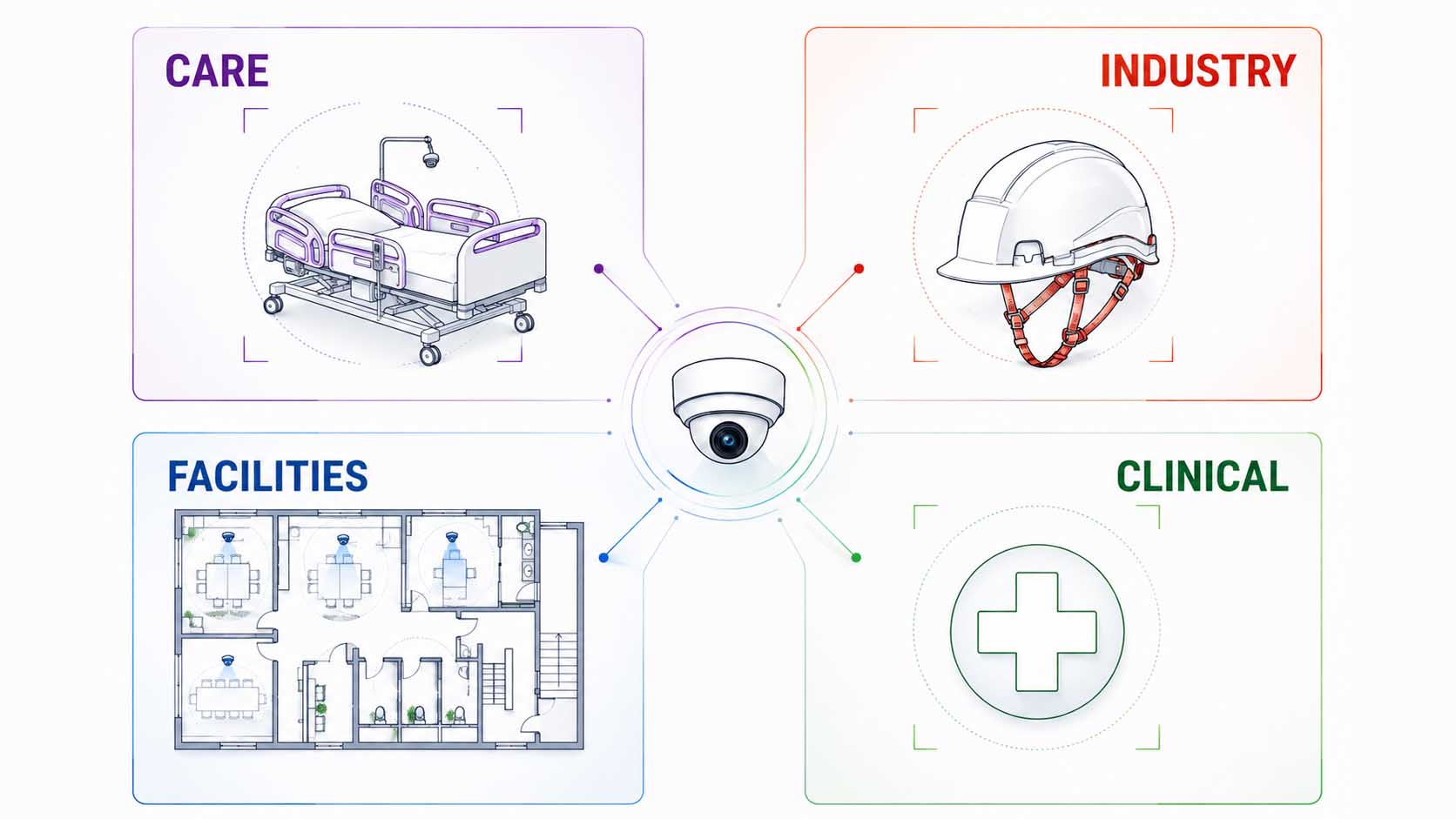
Camera-based fall detection is already in use across industries: from elderly care through industrial lone-worker settings to clinical environments and facility management.
Infographic: Application fields for camera-based fall detection in care, industry, and building management | Graphic: © Ulrich Buckenlei | XR Stager Online Magazine | VISORIC GmbH
Clinical settings are also increasingly adopting this approach. Wherever response time directly determines treatment outcomes, every second counts, and a system that reliably distinguishes genuine emergencies from normal movement buys medical and care staff valuable time, instead of burdening them with unnecessary false alarms.
What all these application fields share is a central economic advantage: response times drop because incidents are detected immediately, while care and safety staff are noticeably relieved because not every observation has to happen manually. For operators with high safety and care demands, that’s a double win, more safety alongside less staff time tied up.
- Elderly care and assisted living use camera-based systems to relieve staff while raising safety.
- Fewer manual check-in rounds give care staff more time for genuine care.
- Industrial work environments deploy the technology especially at lone-worker stations.
- Clinical settings benefit from shorter response times for genuine emergencies.
- Shorter response times and relieved staff are the central economic advantage.
The more cameras observe people in everyday life, the more valid the question of privacy and dignity becomes for those being monitored. How safety and data protection can be reasonably reconciled is the subject of the next chapter.
When Cameras Protect Instead of Watching
The moment a camera continuously observes people in their own homes or at work, a critical question is justified and necessary: is this protection, or surveillance? That question can’t be argued away, it has to be answered technically and organizationally.
Current research shows that safety and privacy don’t have to be mutually exclusive. A central approach is on-device processing: raw footage never leaves the camera or local computer in the first place, only abstracted event data, like body posture or a triggered alarm, is processed and passed on, never recognizable video. This exact principle minimizes the risk that sensitive footage ever leaves the device or gets stored at all.[8]
Complementing this, research projects are exploring alternative sensor technologies that never produce recognizable images to begin with, such as low-resolution thermal cameras or combinations of motion and distance sensors that detect falls without ever capturing a face or identifiable detail.[9] For especially sensitive areas like bathrooms or bedrooms, that’s a practical alternative to classic camera footage.
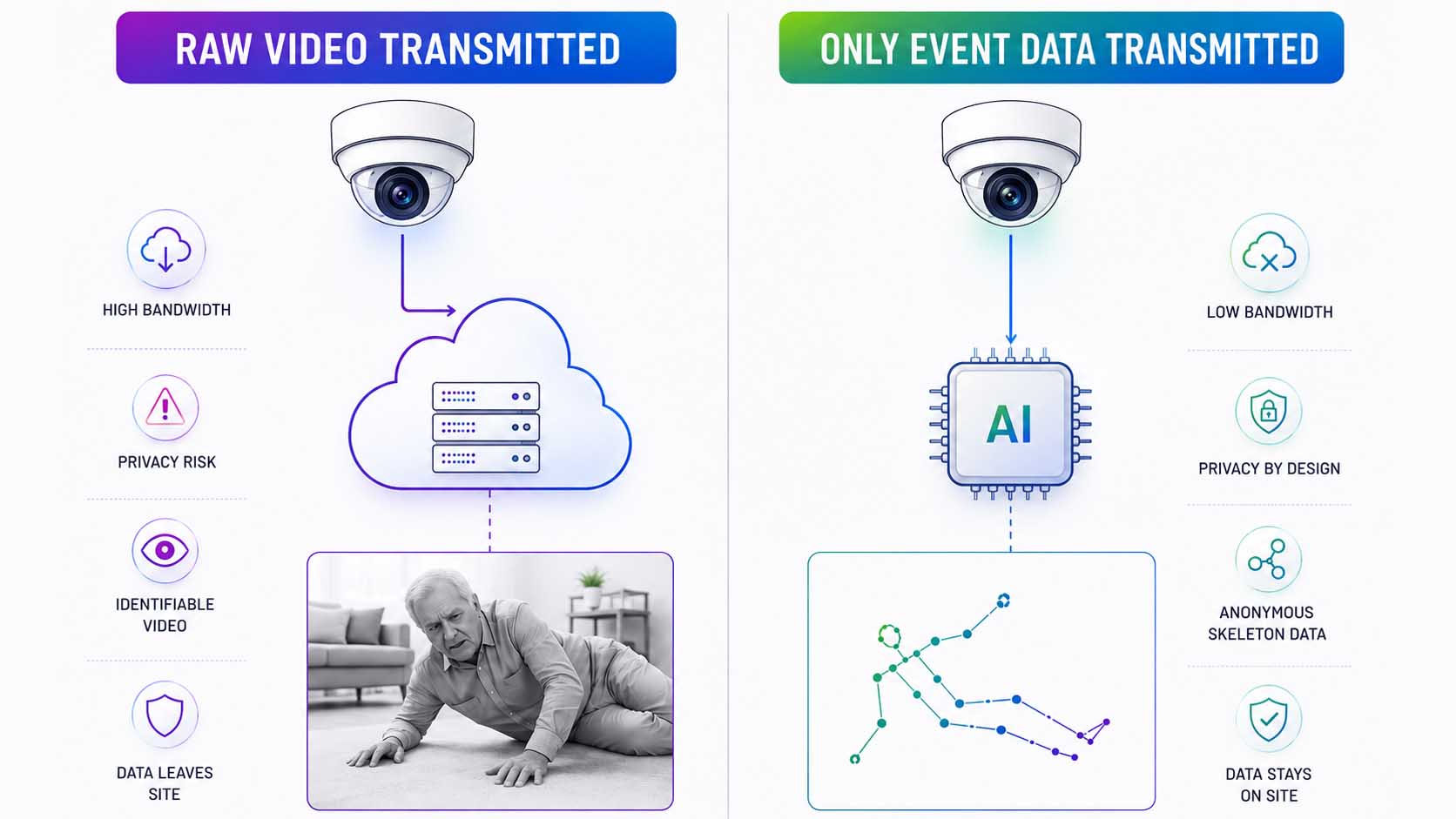
On-device processing and abstracted event data instead of identifiable images enable reliable fall detection without violating the privacy of the people being monitored.
Infographic: Privacy-by-design approaches for camera-based fall detection, from edge processing to anonymized sensing | Graphic: © Ulrich Buckenlei | XR Stager Online Magazine | VISORIC GmbH
Just as decisive as the technology is the organizational framework. People being monitored, and their families, need to clearly understand what a system actually captures, who has access to which information in an emergency, and that under normal circumstances, no recognizable image of a person is ever seen by anyone, only an alarm is triggered. That transparency isn’t an add-on feature, especially in sensitive environments like care, it’s a basic requirement for acceptance.
Well-implemented camera-based fall detection therefore isn’t the opposite of privacy, it’s a matter of technical and organizational care. Systems designed from the start around data minimization and transparency protect people without watching them in the conventional sense.
- On-device processing prevents raw footage from ever leaving the device or being stored.
- Only abstracted event data gets passed on, never recognizable video material.
- Alternative sensing like thermal imaging or motion sensors can detect falls without capturing faces.
- Transparency toward those monitored and their families is a basic requirement for acceptance.
- Data minimization from the outset makes safety and privacy compatible.
This careful, privacy-conscious approach isn’t a coincidence, it reflects a broader trend in the research itself. Why camera-based fall detection is today largely researched and published openly is the subject of the next chapter.
Open Research Instead of Closed Systems
What stands out about current research into camera-based fall detection is its openness. Instead of individual, closed corporate solutions, a broad, publicly accessible knowledge base is emerging, carried by universities, independent research teams, and an active open-source community around the YOLO model ecosystem.
Within just a few years, several generations of YOLO pose models have emerged, YOLOv5, YOLOv7, YOLOv8, YOLOv11, each bringing its own improvements in speed and accuracy. A recent study on YOLOv11-Pose reaches frame rates of roughly 95 frames per second for smaller model variants, while larger variants achieve a detection accuracy of 99.43 percent, evidence of just how fast this open research field is advancing.[10]
This openness shows up in system architecture too. A recently published, lightweight fall-detection network combines improved feature extraction with a leaner architecture, specifically built to run reliably even on resource-constrained hardware like embedded systems, and was published in full as a scientific paper with reproducible results.[11]
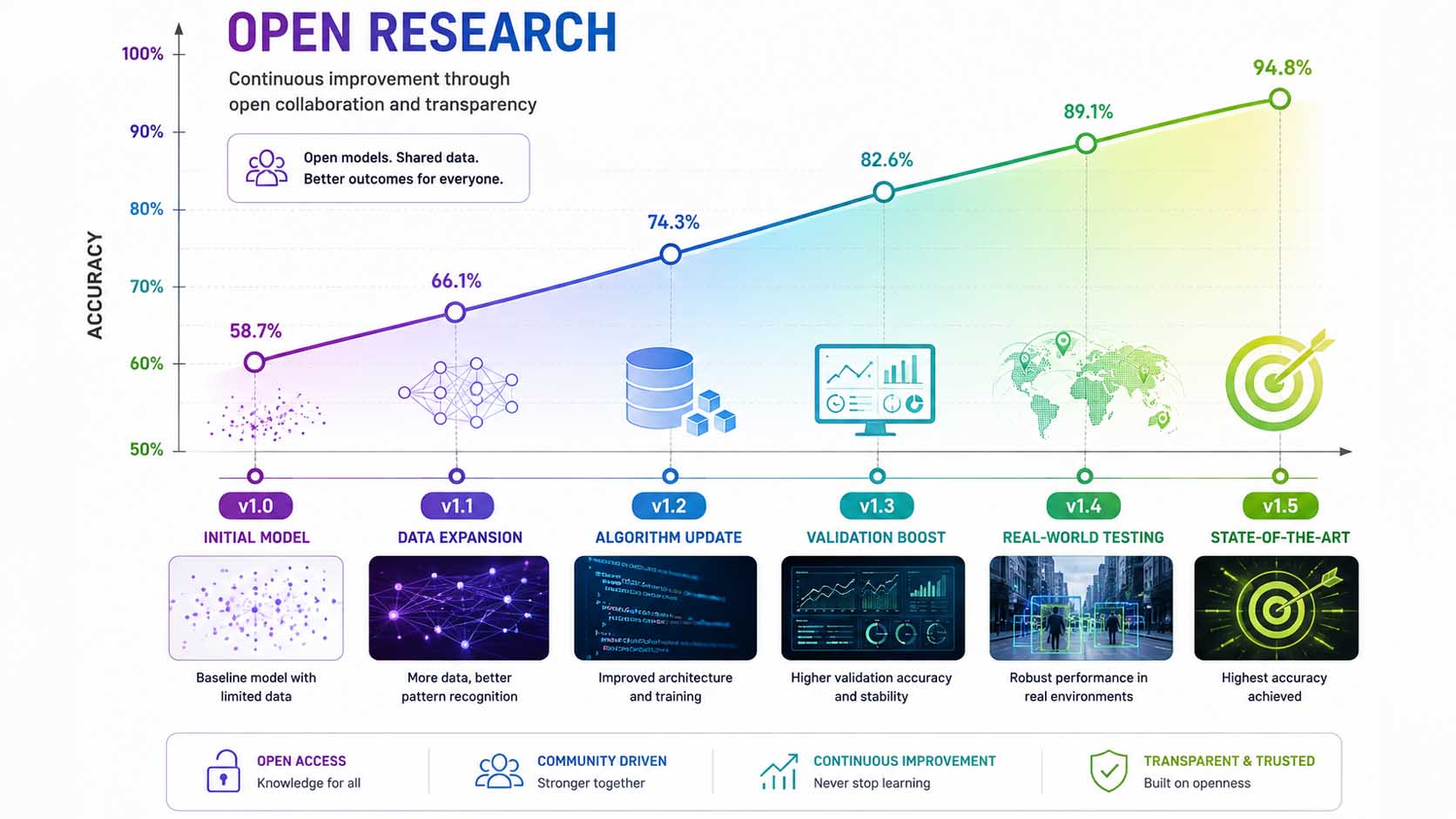
An open, rapidly evolving YOLO-Pose ecosystem forms the shared technical foundation for research, startups, and industrial applications of camera-based fall detection.
Infographic: Open research ecosystem around YOLO-Pose models as the shared foundation of camera-based fall detection | Graphic: © Ulrich Buckenlei | XR Stager Online Magazine | VISORIC GmbH
For companies outside pure research, this openness means a considerably lower barrier into a demanding technology. Instead of building a detection model entirely from scratch, it’s possible to build on already proven, openly documented models and tailor them specifically to the use case at hand, whether that’s a care facility, an industrial site, or an office building.
At the same time, this open character shows how progress in physical AI is increasingly taking hold: not through individual, closed specialty solutions, but through openly accessible research jointly advanced by a broad community across science and industry.
- Camera-based fall detection is developing largely as an openly accessible research field.
- Multiple generations of YOLO-Pose models continuously improve speed and accuracy.
- Current models reach up to 99.43 percent detection accuracy at high frame rates.
- Lightweight architectures enable deployment even on resource-constrained hardware.
- Open research lowers the barrier to entry for companies without their own AI research team.
Open research provides the foundation. Its real significance, though, only becomes clear in the bigger picture of a development that reaches far beyond individual fall-detection systems. Why camera-based behavior detection is becoming a core building block of the next generation of physical AI is the subject of the final chapter.
Camera-Based Behavior Detection as the Next Stage of Physical AI
The previous chapters have shown how camera-based fall detection works technically, why false alarms remain the real challenge, how privacy and safety can be reconciled, and which industries are already using the technology today. Together, these building blocks form a principle that reaches well beyond individual fall events.
Much AI research has so far focused on recognizing individual objects or spaces. Camera-based behavior detection extends that focus to human action itself: a system understands not just which object is visible or how a space is structured, but also what a person is actually doing in that space, and whether that behavior needs attention.
That fits seamlessly into the larger development already visible across the previous articles in this series. Persistent object recognition gives robots a memory for objects. Streaming 3D reconstruction gives systems a memory for space. Camera-based behavior detection gives them an understanding of human action itself, the third building block of a perception that increasingly understands what’s actually happening in the physical world.
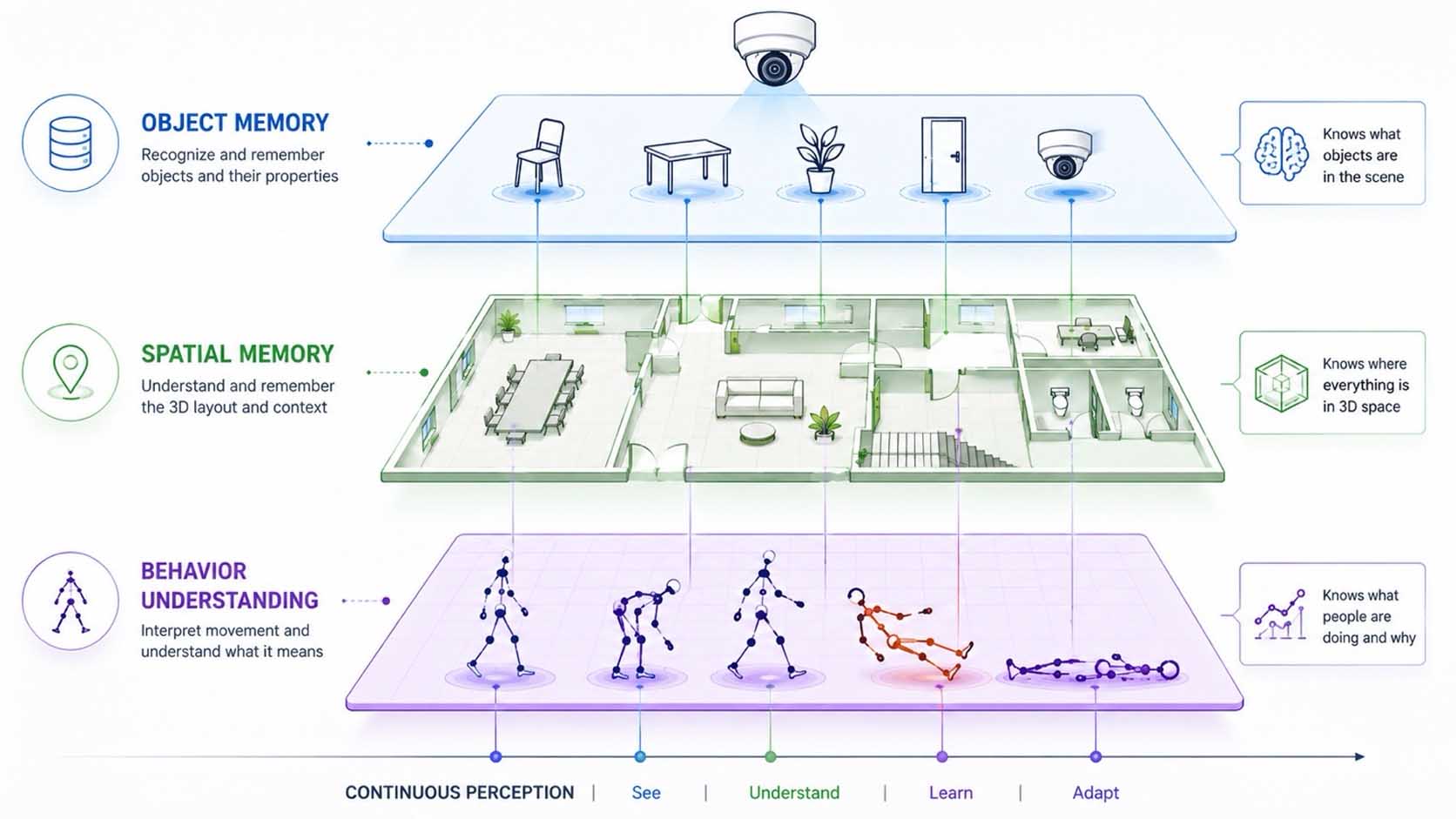
Behavior detection adds a third building block to persistent object recognition and streaming 3D reconstruction: understanding human action. Together, all three form the foundation for the next generation of physical AI.
Infographic: Camera-based behavior detection as a third building block alongside object and spatial memory within physical AI | Graphic: © Ulrich Buckenlei | XR Stager Online Magazine | VISORIC GmbH
For companies investing in care, industry, or building safety, this leads to a clear strategic conclusion. Safety systems that react only to isolated signals will eventually hit a wall. Systems that understand behavior continuously and in spatial context are built from the ground up for the next generation of predictive safety technology, a field where research is already moving from pure detection toward genuine prediction, for example by analyzing gait and balance patterns that flag elevated fall risk before a fall even happens.
Research projects and early commercial systems show that this capability is already technically feasible, scientifically grounded, and successfully deployed in individual industries today. The path from academic research to broad industrial application has become considerably shorter than it was just a few years ago.
- Camera-based behavior detection extends AI perception to understanding human action.
- This principle complements persistent object recognition and streaming 3D reconstruction as a third building block.
- Together, all three building blocks form a solid foundation for physical AI.
- Research is increasingly moving from pure fall detection toward predictive risk detection.
- The path from academic research to industrial application is considerably shorter today than before.
This brings the article full circle. What starts with a single camera and the question of whether someone has fallen is turning into a foundational technology for the next generation of care, industrial safety, and physical AI. Just how convincing this principle already is in practice is shown in the following video.
When a Camera Tells a Fall Apart from Everyday Life
The previous chapters have shown how camera-based fall detection works technically, why false alarms remain the central challenge, and how safety and privacy can be reconciled. How convincing this principle already is in practice becomes most obvious in a direct look at a running system.
The following video shows a camera-based fall-detection system operating in real time. A YOLO pose-estimation model detects a person’s body keypoints in an indoor space, tracks their movement across multiple frames, and automatically triggers an alarm the moment the characteristic movement sequence of a fall is detected. Alongside the video feed, the visible analysis code makes it traceable how a concrete decision emerges from raw image data.
Particularly telling is a look at the system states visible in the video: the system doesn’t just distinguish between “fallen” and “not fallen,” it moves through clearly defined intermediate states, a direct result of the temporal motion analysis described in Chapter 2, which prevents brief, everyday movements from being misread as an emergency.
Video: Camera-based real-time fall detection with YOLO pose estimation | Visuals by original creators Laskenta Technologies Limited | Analysis, script, editing, and video production: © Ulrich Buckenlei | XR Stager Online Magazine | VISORIC GmbH
The video makes clear that camera-based fall detection isn’t some abstract research concept, it already works today with off-the-shelf camera and processing hardware. For companies weighing such systems for care, industry, or facility management, this example shows just how close a practical rollout already is.
At the same time, the video reveals the key conceptual difference: it’s not the individual detection of a fall that stands out, it’s the system’s ability to reliably tell normal movement apart from it. That’s exactly what separates a mere motion detector from a trustworthy safety system.
- The video shows a YOLO-Pose-based fall-detection system operating in real time.
- Body keypoints are tracked continuously to trace a person’s movement sequence.
- The system moves through clearly defined intermediate states instead of a simple yes-no decision.
- This state logic reduces false alarms triggered by brief, everyday movements.
- What matters is reliably distinguishing genuine emergencies from normal movement.
This example makes tangible where camera-based safety technology is heading: from simple motion detection to a system that genuinely understands human behavior and responds exactly where it truly matters.
From Idea to Reliable Safety System
Camera-based fall detection doesn’t come from a single model or a single camera, it comes from the precise interplay of pose estimation, temporal motion analysis, a well-thought-out privacy concept, and tight integration into existing building and safety systems. That exact combination sits at the core of what VISORIC builds for its clients.
The expert team at VISORIC GmbH in Munich combines over 15 years of experience in 3D, AI, and XR with hands-on expertise in computer vision, digital twins, and sensor integration, exactly the building blocks a reliable, privacy-compliant safety system needs. Whether it’s a care facility, an industrial site, or an office building, VISORIC builds camera-based behavior detection that reliably distinguishes genuine emergencies from everyday movement, tailored to the specific environment and its requirements.

15 years of experience in 3D, AI, and XR: the VISORIC expert team from Munich.
Image: © Ulrich Buckenlei | XR Stager Online Magazine | VISORIC GmbH
A well-thought-out pilot project, a single building area, a single application scenario, can often be realized considerably faster and more cost-effectively than many companies expect. VISORIC guides that journey from the first concept idea, through technical integration, to a deployment-ready, privacy-compliant safety system.
- Concept development and implementation of camera-based behavior and fall detection for care, industry, and facility management.
- Technical integration into existing camera infrastructure, digital twins, and building management systems.
- Privacy-compliant, edge-based processing from the first pilot application to a company-wide solution.
Want to implement camera-based fall or behavior detection for your facility, your site, or your building, while taking safety and privacy equally seriously?
Talk to the VISORIC expert team from Munich about computer vision, digital twins, and modern spatial computing platforms. Together, we’ll turn your requirements into a reliable, practical safety system, with a noticeable edge in response time, staff relief, and the trust of those being protected.
Contact:
Email: info@visoric.com
Phone: +49 89 21552678
Sources and References
- Privacy-aware IoT Fall Detection Services For Aging in Place. arXiv:2506.22462.
- Enhanced Fall Detection Using YOLOv7-W6-Pose for Real-Time Elderly Monitoring. MDPI Future Internet, December 2024.
- PIFR: A Novel Approach for Analyzing Pose Angle-Based Human Activity to Automate Fall Detection in Videos. PLOS One, 2025.
- Edge Computing Transformers for Fall Detection in Older Adults. International Journal of Neural Systems.
- Fall Detection in Manufacturing Improves Worker Safety. Visionplatform.ai, industry article.
- Fall Detection System for Monitoring Elderly People Using YOLOv7-Pose Detection Model. ResearchGate, June 2023.
- AI-Powered Slip & Fall Detection. Visionify, industry article on industrial use cases.
- Fall Detection Camera: AI Elderly Monitoring Guide. Fora Soft, industry article on edge-first processing and privacy.
- Privacy-Preserving Bathroom Monitoring for Elderly Emergencies Using PIR and LiDAR Sensors. arXiv:2505.18242.
- Fall Detection in Elderly People at Home Using the YOLOv11-Pose Model. ICAIIT Conference Proceedings, 2025.
- LFD-YOLO: A Lightweight Fall Detection Network with Enhanced Feature Extraction and Fusion. Scientific Reports (Nature), February 2025.
- Laskenta Technologies Limited. Demonstration material on camera-based real-time fall detection with YOLO pose estimation, Python, and OpenCV.
- VISORIC practice projects in computer vision, digital twins, sensor integration, and spatial computing.
- XR Stager platform for real-time 3D, digital twins, knowledge AI, and industrial spatial computing applications.
Contact Us:
Email: info@xrstager.com
Phone: +49 89 21552678
Contact Persons:
Ulrich Buckenlei (Creative Director)
Mobil +49 152 53532871
Mail: ulrich.buckenlei@xrstager.com
Nataliya Daniltseva (Projekt Manager)
Mobil + 49 176 72805705
Mail: nataliya.daniltseva@xrstager.com
Address:
VISORIC GmbH
Bayerstraße 13
D-80335 Munich