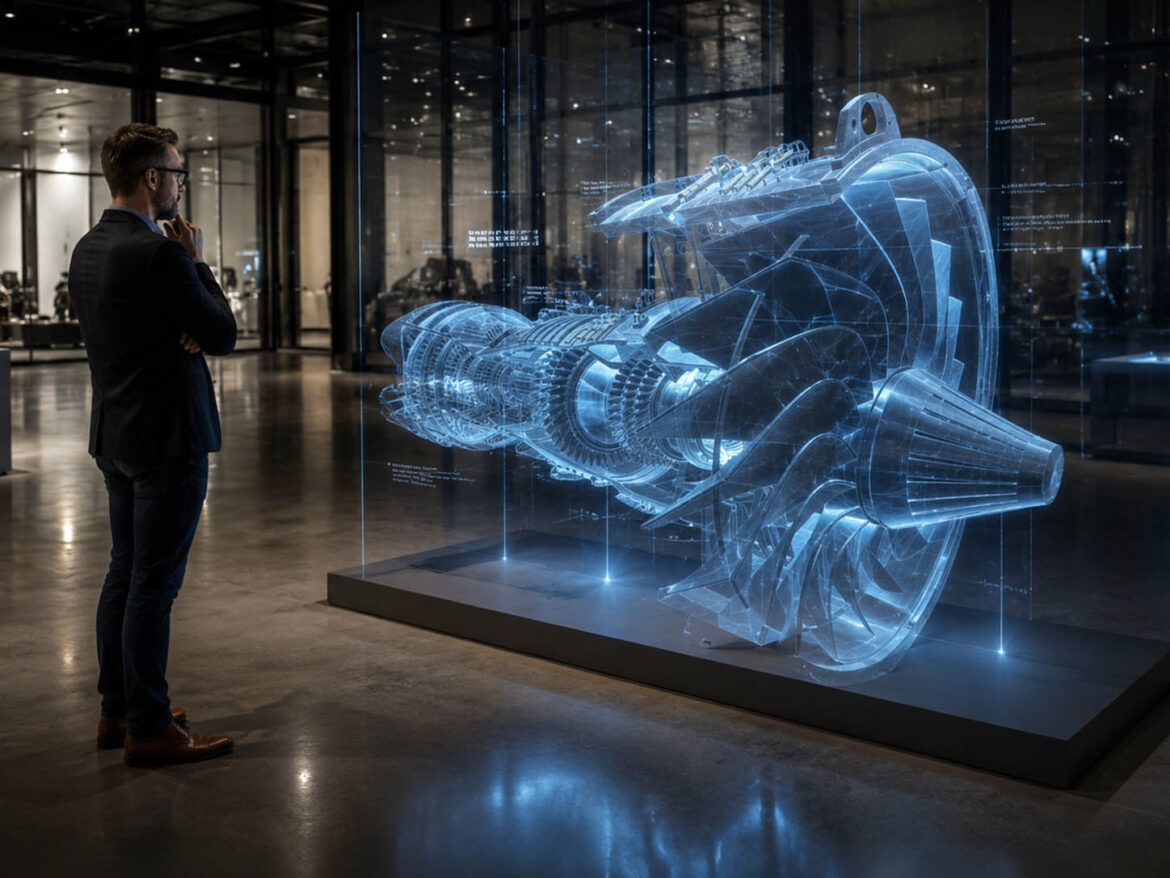
The concept image visualizes a possible future of spatial information systems, where holograms, digital twins, light fields, and intelligent interfaces make digital content visible directly within physical space.
Visualization: Spatial Computing, holographic information systems, digital twins, real time 3D, intelligent environments, and materialized information | Image: © Ulrich Buckenlei | VISORIC GmbH
For decades, the screen has served as the primary interface between humans and information. Computers, smartphones, tablets, and large display systems have shaped the digital world and revolutionized access to knowledge. At the same time, it is becoming increasingly clear that two dimensional displays are only partially suited for many complex information spaces. As data models, digital twins, and connected systems become more sophisticated, it becomes increasingly difficult to intuitively understand spatial relationships solely through flat surfaces.[1]
Particularly in industry, research, architecture, medicine, and product development, digital models are now being created whose understanding depends heavily on spatial perception. Users must mentally reconstruct information, switch perspectives, and assemble complex relationships in their minds. This creates additional cognitive load that can complicate analysis, decision making, and collaboration.[2]
The image in this chapter illustrates exactly this turning point. While information has traditionally been displayed primarily on screens, the demand for technologies that make digital content directly visible within physical space continues to grow. The question is therefore no longer only how information is displayed, but how it can be experienced in the future.
The visualization illustrates the transition from conventional screen based interfaces to spatial information systems that make digital content directly experienceable within the physical environment.
Visualization: Human computer interaction, spatial interfaces, Spatial Computing, beyond screen technologies, and future information visualization | Image: © Ulrich Buckenlei | VISORIC GmbH
This is precisely why research institutions around the world are exploring new forms of interaction. Spatial Computing, Mixed Reality, and volumetric displays aim to move digital content beyond traditional screens and embed it directly into the physical environment. Information thereby becomes not only visible, but spatially experienceable.
- Two dimensional displays reach their limits in complex information spaces
- Spatial relationships require new forms of visualization
- Spatial Computing extends traditional screen concepts
- Digital content is increasingly becoming part of the physical environment
- The future of human computer interaction is three dimensional
The critical question therefore becomes: What happens when information completely leaves the screen and becomes part of physical reality itself?
When Information Becomes Physical
For a long time, the primary goal of digital systems was to display information as efficiently as possible. Future technologies, however, are taking a step further. They no longer seek merely to make data visible, but to give it a physical presence. Information should no longer only be viewed, but directly experienced, touched, and spatially understood.[3]
This is exactly where research into programmable matter, tangible interfaces, and materialized information systems begins. Digital data is no longer understood solely as pixels on a display. Instead, systems are emerging in which information can assume physical forms, change its structure, or actively respond to users.[4]
The image in this chapter illustrates the transformation from a traditional two dimensional representation through a digital structural model and ultimately into a spatially materialized form. It highlights the transition from abstract data to physical information objects.
The graphic visualizes the shift from digital information toward physically experienceable structures and spatial information objects.
Visualization: Materialized Information, Tangible User Interfaces, programmable matter, and physical information systems | Image: © Ulrich Buckenlei | VISORIC GmbH
Such concepts could find applications across many industries in the future. Engineers could inspect digital models as physical objects. Scientists could analyze complex datasets spatially. Educational institutions could make abstract concepts immediately tangible. As a result, the boundary between information and object begins to blur.
- Information develops a physical presence
- Tangible interfaces connect the digital and physical worlds
- Complex data becomes more intuitive to understand
- Spatial interaction extends traditional user interfaces
- Digital content becomes experienceable objects
If information can become physically experienceable, the next question naturally follows: Which technologies make such spatial representations visible in the first place?
Holograms and Volumetric Displays
One of the most fascinating developments on the path toward materialized information is the emergence of holographic and volumetric displays. Unlike traditional screens, they do not create flat images but spatially perceivable information objects that can be viewed from multiple angles. Information visibly leaves the display surface for the first time.[5]
Modern light field technologies and holographic systems generate three dimensional visualizations without requiring traditional headsets. Users can inspect models spatially, change perspectives, and understand relationships more intuitively. Particularly in industry, medicine, science, and design, this opens entirely new possibilities for analysis and collaboration.[6]
The image in this chapter illustrates the evolution from a two dimensional technical representation through a three dimensional model and ultimately into a holographic visualization appearing freely within space. It demonstrates how digital content increasingly acquires a spatial presence.
The visualization illustrates the transition from traditional digital models toward holographic information objects in space.
Visualization: Holographic displays, volumetric displays, light field technologies, and spatial information visualization | Image: © Ulrich Buckenlei | VISORIC GmbH
The significance of such systems extends far beyond visualization alone. Holographic representations enable entirely new forms of collaboration, analysis, and decision making. Teams can observe the same data simultaneously from different perspectives and understand complex models more intuitively than on traditional displays.
- Holographic systems create spatially perceivable information
- Light field technologies enable natural perspective changes
- Volumetric displays extend traditional visualization concepts
- Complex models become easier to understand intuitively
- Collaboration becomes more spatial and interactive
Yet even holograms represent only an intermediate step. The broader vision goes much further and explores how digital information may actively merge with the physical world in the future.
Lasers, Fog, and Projections as New Media Surfaces
Laser, fog, and projection technologies demonstrate particularly well how digital content can leave the traditional screen behind. Information no longer appears on a fixed surface but becomes visible through light, particles, spatial depth, and movement. As a result, media surfaces emerge that are no longer made of glass or pixels, but of air, light, and precise control systems.[7]
Such systems can temporarily transform spaces without permanently modifying their architecture. A fog curtain can become a projection surface. Laser lines can mark data within space. Projection mapping can overlay objects, walls, or machines with digital information. This creates visual experiences that exist somewhere between installation, interface, and spatial information.[8]
The visualization demonstrates how light, fog, and projection technologies can make digital information visible as spatial media surfaces.
Visualization: Laser projections, fog curtains, projection mapping, volumetric light systems, and spatial media surfaces | Image: © Ulrich Buckenlei | VISORIC GmbH
This development is especially exciting for museums, showrooms, industrial presentations, training facilities, and experiential architecture. Complex content can not only be explained but also atmospherically staged. Visitors no longer encounter a separate user interface. Instead, they move through environments where information itself becomes part of the space.
For businesses, this also creates entirely new opportunities. Products can be explained spatially, processes can be visualized, and data can be anchored directly onto real world objects. Projection thereby becomes more than a visual effect and evolves into a tool for communication, orientation, and understanding.
- Lasers and projections make information visible in space
- Fog and light can create temporary media surfaces
- Projection mapping connects digital content with real world objects
- Spaces become dynamic information environments
- Digital content appears independently of traditional displays
If light and projections can transform spaces, the next question arises: What happens when not only individual surfaces, but entire buildings become user interfaces?
Architecture as a User Interface
The next stage of development begins where digital content is no longer confined to individual media surfaces. Architecture itself becomes the user interface. Walls, floors, façades, glass surfaces, and entire rooms take on functions that were previously reserved for screens, terminals, or mobile devices.[9]
In intelligent buildings, information could appear exactly where it is needed. Navigation paths emerge on the floor. Machine status information becomes visible directly on equipment. Spaces respond to visitor flows, times of day, or usage scenarios. As a result, the role of architecture changes fundamentally. Buildings are no longer simply constructed but increasingly digitally enhanced and contextually controlled.[10]
The concept image illustrates intelligent architecture in which spatial information, light guidance, and digital content are directly integrated into the built environment.
Visualization: Responsive architecture, intelligent environments, spatial user interfaces, digital wayfinding, and adaptive media architecture | Image: © Ulrich Buckenlei | VISORIC GmbH
This creates entirely new concepts for public spaces, airports, museums, hospitals, industrial facilities, and branded environments. Information no longer needs to be searched for. It appears within the appropriate context. Navigation, product knowledge, safety information, and data visualization become part of the environment itself.
The VISORIC expert team in Munich examines these developments particularly through the combination of real time 3D, Spatial Computing, media control systems, and digital twins. The decisive factor is not the technical effect alone, but how spatial information can genuinely support people.
- Architecture becomes an active information surface
- Digital content appears directly within spatial context
- Buildings can respond to usage and situational requirements
- Navigation and communication become more intuitive
- Spaces evolve into intelligent interfaces
This development becomes even more exciting when artificial intelligence begins not only to populate such spaces but to actively understand and adapt them.
AI Controlled Adaptive Spaces
Artificial intelligence could fundamentally transform spatial interfaces. While traditional systems display fixed content, AI controlled environments can analyze situations, recognize relationships, and dynamically adapt content. As a result, space becomes not only a display, but a system that understands context.[11]
Multimodal AI systems can connect language, gestures, gaze directions, sensor data, and spatial information. This creates environments that respond to people, prioritize information, and provide digital content appropriate to each specific situation. A showroom can display different content than a training room. An industrial facility can highlight different data than a museum or educational institution.[12]
The visualization shows an adaptive space in which artificial intelligence dynamically controls light, data, digital content, and spatial interactions.
Visualization: AI controlled spaces, adaptive interfaces, multimodal interaction, real time 3D, and context based information systems | Image: © Ulrich Buckenlei | VISORIC GmbH
Such adaptive spaces could provide targeted support for people in the future. They could reduce complexity, highlight relevant data, or take different levels of experience into account. In industry, maintenance information could be made visible directly on machines. In education, abstract content could be explained spatially. In experiential spaces, content could be personalized and atmospherically adapted.
For companies, this creates a new field between spatial design, software development, artificial intelligence, and experience design. Anyone who wants to use digital content beyond the screen in the future needs not only strong visualizations, but also intelligent logic behind them.
- AI recognizes situations, user behavior, and spatial contexts
- Digital content dynamically adapts to people and places
- Multimodal systems connect language, gestures, and sensor data
- Adaptive spaces reduce complexity and improve orientation
- Information becomes more personal, more relevant, and more situational
Such spaces become particularly powerful when real objects, systems, and processes become visible as digital twins directly outside traditional monitors.
Digital Twins Outside the Monitor
Digital twins are now among the most important technologies in industrial transformation. Until now, however, they have mostly been viewed on screens, dashboards, or in dedicated software environments. The next stage of development is to make digital twins visible directly in space. Machines, buildings, cities, or processes then appear exactly where they need to be understood, explained, or changed.[13]
This creates a new relationship between the real object and the digital model. A turbine model can appear as a hologram in space. A production line can be analyzed spatially. A city can emerge as a digital representation on a table, in a showroom, or directly inside a control room. The digital twin leaves the monitor and becomes a shared working object.[14]
The visualization shows how digital twins of machines, buildings, and infrastructures become experienceable as spatial information objects outside traditional monitors.
Visualization: Digital twins, Spatial Computing, real time simulation, industrial data spaces, and spatial 3D visualization | Image: © Ulrich Buckenlei | VISORIC GmbH
For companies, this step can bring enormous advantages. Complex systems become easier to explain. Teams can work together on the same models. Decisions can be made faster because spatial relationships no longer have to be reconstructed from two dimensional views.
This development could become especially relevant in industry, infrastructure, energy, architecture, and smart city applications. Digital twins thereby become not only analysis tools, but spatial communication platforms. This is exactly where new application fields for real time 3D, Spatial Computing, and interactive media architecture are emerging.
- Digital twins become visible outside traditional monitors
- Complex systems and processes can be understood spatially
- Teams can work together on digital models
- Spatial Computing makes industrial data more intuitively accessible
- Digital twins evolve into spatial working objects
When digital twins, AI, and spatial interfaces come together, a new generation of intelligent environments emerges that reaches far beyond today’s screens.
The Future of Intelligent Spatial Interfaces
The future of digital interaction will probably not be determined by a single technology. What matters is the interplay of Spatial Computing, artificial intelligence, holography, projection, digital twins, and intelligent architecture. Only through this combination does a new class of spatial interfaces emerge, one that no longer merely displays information, but embeds it into environments.[15]
Such interfaces could transform a wide range of fields in the coming years. In industry, they help make machines, processes, and data more intuitive to understand. In museums and educational institutions, they make abstract content experienceable. In architecture and showrooms, they create new forms of spatial presentation. In smart spaces, they combine orientation, information, and interaction into a shared experience.[16]
The visualization shows a possible future of intelligent spatial interfaces, where digital content, architecture, AI, and Spatial Computing merge into a shared environment.
Visualization: Intelligent spatial interfaces, Ambient Computing, Spatial Computing, adaptive architecture, and materialized information | Image: © Ulrich Buckenlei | VISORIC GmbH
The real transformation does not lie in the disappearance of the screen. Screens will remain important. But they will lose their role as the only central interface. In the future, information can appear where it is needed: in space, on the object, within the process, or inside an intelligent environment.
For companies, this means new opportunities. Those who begin designing spatial information systems today can develop new forms of presentation, training, analysis, and customer interaction early on. This is where projects emerge that are not only technologically fascinating, but also create real practical value.
- Spatial interfaces connect information, space, and interaction
- AI makes digital content context aware and adaptive
- Holography and projection extend traditional media surfaces
- Digital twins become experienceable information objects
- The future of digital content is increasingly emerging beyond the screen
This marks the beginning of a new phase in digital design. The central question is no longer only which content appears on a display. What matters is how information itself can become part of our physical environment.
When Digital Content Enters Space
The development beyond the screen shows how profoundly the relationship between humans, information, and environment could change. Digital content no longer appears only as an image, text, or interface on a surface. It becomes spatial, situational, and increasingly physically experienceable.
The following video illustrates this development through artistic and technological approaches in which information appears to materialize. Light, movement, particles, and space become carriers of digital content. This creates an impression of how future interfaces beyond traditional displays could feel.
Video source and artistic inspiration: A.A. Murakami | Technological classification: spatial media installations, light systems, materialized information, and interactive environments | Analysis, storyline, and editorial work: © Ulrich Buckenlei | VISORIC GmbH
The true significance of such experiments lies not only in their visual impact. They make visible that digital content can be conceived differently in the future. Not as a window on a surface, but as a spatial experience. Not as a static display, but as information in space that feels physically present.
For industry, education, museums, architecture, branded spaces, and experience centers, this opens up new possibilities. Information can be explained more intuitively, products can be staged spatially, and complex relationships can be made emotionally easier to understand. This is exactly where a new field emerges between technology, spatial design, real time 3D, and artificial intelligence.
The VISORIC expert team in Munich sees this development as an important next step in digital communication. What matters is not the effect alone, but how spatial information systems can be translated into real applications in a meaningful, robust, and economically viable way.
- Digital content increasingly leaves traditional screen surfaces
- Light, space, and projection become new carriers of information
- Spatial Computing makes digital content more physically experienceable
- AI and real time 3D enable adaptive spatial interfaces
- Companies can develop new experiential and working spaces beyond the screen
The future of digital content will therefore not only take place on better displays. It will emerge where information begins to materialize in space.
From the Screen World to the Spatial Information Platform
The development beyond the screen shows that digital content will no longer have to exist exclusively on displays, monitors, or mobile devices in the future. Spatial Computing, real time 3D, holography, projection technologies, digital twins, and artificial intelligence open up new possibilities for integrating information directly into spaces, products, architecture, and experiential environments.
This development becomes especially interesting wherever digital content does not merely impress, but creates real added value. Machines can be explained more clearly. Complex data can be made spatially experienceable. Showrooms can stage products without traditional displays. Museums can communicate knowledge as an experience. Industrial companies can make digital twins visible directly within the physical context. This creates new forms of communication, training, presentation, and decision support.
At precisely this intersection, the VISORIC expert team in Munich develops individual concepts, prototypes, and platform solutions for Spatial Computing, real time 3D, digital twins, holographic visualization, AI controlled spaces, and immersive media architecture. The focus is on applications that do not merely appear futuristic, but can be integrated into real projects in a clear, robust, and economically meaningful way.
The VISORIC expert team develops concepts for Spatial Computing, digital twins, holographic visualization, real time 3D applications, and intelligent spatial information systems.
Visualization: Future oriented platform architecture for Spatial Computing, digital twins, real time 3D visualization, holographic interfaces, and immersive media spaces | © VISORIC GmbH | Munich
From holographic product presentations and digital twins in space to adaptive experiential environments, new opportunities are currently emerging for companies, brands, educational institutions, museums, architecture partners, and industry. Digital content is no longer merely displayed, but designed as a spatial experience.
VISORIC supports companies from the first idea through feasibility analyses and prototyping to the technical implementation of market ready solutions. This includes real time 3D visualization, Spatial Computing concepts, digital twins, AI integration, media server architectures, projection technologies, interactive user experiences, and spatial data platforms.
The future of digital interaction will not only become more immersive. It will become more contextual, more spatial, and easier to understand. This is exactly where the most exciting fields of innovation are emerging for organizations that want to make information, products, processes, or knowledge experienceable beyond traditional screens.
Are you planning a Spatial Computing project, a digital twin in space, a holographic presentation, or an immersive information platform?
Talk to the VISORIC expert team in Munich about concept development, feasibility analyses, prototyping, and technical implementation.
Contact us:
Email: info@visoric.com
Phone: +49 89 21552678
Address: Bayerstr. 13, 80335 Munich
Sources and References
- MIT Media Lab, Tangible Media Group, research on human computer interaction, spatial interfaces, and the future of physical information visualization.
- Microsoft Research, Beyond Screens Research, Spatial Computing, and future human computer interaction.
- MIT Media Lab, Radical Atoms Project, research on programmable matter and physically experienceable information systems.
- ACM CHI Conference Proceedings, Tangible User Interfaces, and Materialized Information Research.
- Looking Glass Factory, light field display technology and holographic visualization systems.
- Nature Photonics, scientific publications on holographic displays, volumetric displays, and light field technologies.
- Fraunhofer Institute for Applied Optics and Precision Engineering IOF, research on laser projections and volumetric light systems.
- SIGGRAPH Conference Proceedings, projection mapping, fog displays, and spatial visualization technologies.
- MIT Senseable City Lab, intelligent environments, and adaptive architecture.
- Harvard Graduate School of Design, research on responsive architecture and interactive built environments.
- Stanford Human Centered AI Institute, research on intelligent environments and adaptive interfaces.
- OpenAI Research, multimodal AI systems, spatial interaction, and context based assistance systems.
- NVIDIA Omniverse, real time simulations, Spatial Computing, and digital twins.
- Siemens Digital Industries Software, digital twin technologies for industry, infrastructure, and smart spaces.
- Apple Vision Pro Developer Documentation, Spatial Computing, and spatial user interfaces.
- IEEE Computer Society, Future Interfaces Research, Ambient Computing, and Post Screen Computing.
- A.A. Murakami, artistic concepts for materialized information systems and physical data visualization.
- Ars Electronica Futurelab, research on spatial media installations, light systems, and interactive environments.
- VISORIC GmbH, projects on real time 3D, digital twins, Spatial Computing, XR, and interactive media platforms.
- XR Stager Research, market analyses on future interfaces, Spatial Computing, and immersive technologies.
Contact Us:
Email: info@xrstager.com
Phone: +49 89 21552678Contact Persons:
Ulrich Buckenlei (Creative Director)
Mobil +49 152 53532871
Mail: ulrich.buckenlei@xrstager.comNataliya Daniltseva (Projekt Manager)
Mobil + 49 176 72805705
Mail: nataliya.daniltseva@xrstager.comAddress:
VISORIC GmbH
Bayerstraße 13
D-80335 Munich