

The title graphic illustrates how Artificial Intelligence analyzes modern football matches. Player movements, ball trajectories, passing lanes, and tactical structures are captured in real time and combined into a digital representation of the game, providing coaches, analysts, and clubs with entirely new insights.
Visualization: AI Football Intelligence, player tracking, computer vision, tactical shape analysis, predictive analytics, digital twins of athletes, and data driven decision support in professional football | Image: © Ulrich Buckenlei | VISORIC GmbH
What Football and Artificial Intelligence Have in Common
At first glance, football appears to have little in common with factories, logistics centers, or enterprise software. Yet it is precisely here that the capabilities of modern Artificial Intelligence become remarkably visible. A football match consists of 22 players, one ball, and countless decisions made within seconds. For AI systems, this level of complexity is particularly fascinating because it closely resembles many of the challenges that organizations face every day.[1]
While millions of fans follow goals, dribbles, and game defining moments, intelligent systems are already analyzing movements, patterns, and relationships behind the scenes. Cameras capture every position on the field, algorithms identify tactical structures, and machine learning models calculate probabilities for future developments. As a result, a football match becomes a highly dynamic data model.[2]
The title graphic of this article visualizes exactly this transformation. The players appear not only as athletes but also as elements of an intelligent network of data points, movements, and relationships. Artificial Intelligence analyzes not isolated actions but the interaction of all participants within a complex system.
What makes this particularly exciting is that the same technologies are already being used far beyond sports. In factories, AI systems analyze machine movements. In logistics, they monitor material flows. In healthcare, they identify patterns within medical data. Everywhere, the objective remains the same: understanding large volumes of data, revealing hidden relationships, and enabling better decisions.
Football therefore becomes a highly accessible example of the future of Artificial Intelligence. The playing field serves as a laboratory for technologies that are already transforming business, industry, and society. Anyone who understands how AI analyzes a football match often gains insight into how it optimizes production processes, identifies risks, or controls complex systems.
For businesses, this represents an important lesson. The true innovation is not the sport itself. It lies in AI’s ability to recognize patterns, predict developments, and transform data into actionable knowledge. This capability will become a critical competitive advantage in the years ahead.
- Football is an ideal model for complex AI analysis
- Artificial Intelligence identifies patterns, relationships, and dynamics
- The same technologies are already being deployed across industry and business
- Machine learning enables predictions and better decision making
- Sport demonstrates how data driven systems are shaping the future
One of the most visible examples of this transformation emerges when Artificial Intelligence begins analyzing and visualizing an entire team’s tactical structure in real time.
AI Analyzes Tactical Team Structures in Real Time
Football has always been a game of space. Coaches talk about compactness, player spacing, pressing lines, and formation discipline. For decades, these assessments were primarily based on experience, observation, and manual video analysis. Modern AI systems are fundamentally changing this situation. Today, cameras and computer vision systems can continuously capture the position of every player on the field and generate a precise digital representation of the team’s tactical structure.[3]
At the center of this process is what is known as Tactical Shape Analysis. Artificial Intelligence no longer focuses solely on individual players or ball contacts. Instead, it analyzes the entire team as a dynamic network. Distances between players, available passing lanes, open spaces, and pressure situations are continuously calculated and visualized. This creates a far deeper understanding of how teams control space and generate tactical advantages.
Particularly fascinating is the fact that AI can identify relationships that are difficult even for experienced analysts to recognize during a live match. Changes in formation, emerging defensive gaps, and new passing opportunities can be detected automatically. This creates an entirely new form of football analysis that extends far beyond traditional statistics.[4]

The visualization demonstrates how Artificial Intelligence analyzes player positions, team spacing, spatial control, and tactical networks in real time during a football match.
Visualization: AI powered analysis of team structures, passing networks, spatial control, pressure zones, and tactical relationships in modern football | Image: © Ulrich Buckenlei | VISORIC GmbH
The title graphic of this chapter reveals how modern football analytics works today. Every player is viewed as part of a larger system. AI does not merely recognize individual actions. It analyzes the relationships between all players on the field. This creates a digital team model that makes tactical patterns and spatial structures visible.
One of the most valuable capabilities is the measurement of spatial control. While spectators primarily focus on the ball, AI continuously evaluates areas without possession. Open spaces, numerical advantages, pressing traps, and potential passing lanes can be identified automatically. This reveals which team is truly controlling the game and where strategic advantages are emerging.
Coaches and analysts also benefit significantly from these capabilities. Instead of spending hours reviewing video footage, critical situations can be detected automatically. Systems flag unusual formation changes, unexpected movement patterns, or tactical weaknesses, supporting both match preparation and post match analysis.
As computing power continues to increase, this technology is rapidly evolving toward predictive intelligence. AI systems no longer analyze only past actions. They calculate probabilities for future movements, passing options, and game situations. This creates an entirely new layer of tactical decision support that could fundamentally reshape football.
- AI analyzes team structures and formations in real time
- Player spacing, spatial control, and passing lanes are automatically detected
- Computer vision makes tactical patterns visible
- Coaches gain objective insights into match dynamics
- Tactical Shape Analysis is increasingly evolving toward the prediction of future game situations
However, analyzing team structures represents only the first layer of modern football intelligence. Behind these insights operates a complex infrastructure that processes enormous amounts of data in real time and delivers actionable information to coaches, analysts, and media organizations.
How Real Time Football Intelligence Is Transforming the Game
Modern football matches generate enormous amounts of data. Every player movement, every pass, every acceleration, and every ball touch can be captured through camera systems, sensors, and tracking platforms. While spectators simply observe the flow of the game, a complex digital representation of the entire match is being created in the background. Artificial Intelligence takes on the task of analyzing these data streams, interpreting them, and transforming them into actionable insights.[5]
At the center of this development are so called Football Intelligence platforms. They combine tracking data, video streams, match events, and statistical information into a shared information environment. This allows coaches, analysts, and technical teams to access up to date performance data at any time and identify emerging developments while a match is still in progress.
The real challenge, however, is not data collection but processing speed. Modern systems must analyze thousands of events per minute and convert them into meaningful insights. This form of real time intelligence is only possible through powerful cloud infrastructures, machine learning models, and automated analytics workflows.[6]

The visualization shows a modern Football Intelligence Center where player data, tracking information, and AI driven analytics are integrated in real time.
Visualization: Real time processing of football tracking data, cloud analytics, computer vision, match events, and AI powered decision support for clubs and analysts | Image: © Ulrich Buckenlei | VISORIC GmbH
The title graphic of this chapter illustrates how dramatically the technical infrastructure behind modern football has evolved. Instead of isolated statistics, centralized data platforms now combine information from a wide range of sources. Camera systems, tracking solutions, and analytical algorithms operate together as an integrated network.
Particularly important is the ability to provide information with virtually no delay. Coaching teams can monitor current performance trends, analysts receive immediate insights into tactical changes, and media platforms can visualize complex relationships for audiences. As a result, raw data becomes a continuous flow of intelligence.
Clubs also benefit from entirely new opportunities. Match preparation, opponent analysis, and performance evaluation are increasingly based on objective data models. AI systems can identify patterns that are difficult for humans to detect and thereby support more informed decisions in training and competition.
As cloud technologies and Artificial Intelligence become more deeply integrated, Football Intelligence is evolving into a strategic infrastructure. Data is no longer merely collected. It is actively used to support tactical processes, performance analysis, and operational decision making.
- Football Intelligence platforms process data in real time
- Tracking, video analysis, and statistics are combined within centralized systems
- Cloud technologies enable rapid analysis of massive datasets
- Coaches and analysts gain immediate operational insights
- AI transforms raw data into strategically valuable information
Yet even the most advanced data platform cannot fully answer where a match is heading. Artificial Intelligence becomes especially fascinating when it starts predicting ball movements and future game situations.
Predicting Ball Trajectories and Future Plays
The football of the future will not only be analyzed but increasingly predicted. Modern AI systems can already learn from thousands of match situations and derive probabilities for future events. This becomes particularly evident in the analysis of ball trajectories, passing options, and potential game developments. Observation alone is evolving into a form of predictive game intelligence.[7]
This is made possible through the combination of computer vision, tracking data, and machine learning. Cameras capture the position and velocity of both players and the ball in real time. AI compares this information with historical match situations and calculates possible continuations of an action. As a result, passing opportunities, shot trajectories, and likely player movements can be modeled.
While such systems were originally developed primarily for referee technologies and ball tracking applications, they now enable far broader use cases. Clubs can identify which decisions would have offered the highest probability of success, which spaces may open up, and how specific game situations are likely to evolve.[8]

The visualization demonstrates how Artificial Intelligence analyzes ball movements, passing lanes, and potential game developments while simulating future outcomes.
Visualization: AI powered analysis of ball trajectories, passing probabilities, game simulations, and predictive decision support in professional football | Image: © Ulrich Buckenlei | VISORIC GmbH
The title graphic of this chapter highlights how dramatically the role of data in modern football has evolved. AI does not merely track the current position of the ball. It continuously analyzes possible directions of movement and their impact on the overall game. This creates digital scenarios that reveal multiple potential match developments.
Particularly fascinating is the calculation of probabilities. Systems can determine which passing option has the highest chance of success or which movement creates the greatest threat to the opponent. Coaches and analysts therefore gain an additional perspective on decisions that were previously based largely on experience and intuition.
This technology is also becoming increasingly important for match preparation. Historical data can be used to identify typical behavioral patterns of opponents and simulate future match situations. Teams gain the ability to digitally rehearse multiple tactical scenarios before kickoff.
In the long term, these systems could lead to a new generation of intelligent assistant tools. Rather than simply evaluating past events, they help clubs identify potential developments at an early stage and support strategic decision making with greater confidence.
- AI analyzes ball trajectories and movement patterns in real time
- Machine learning calculates probabilities for future game situations
- Passing options and tactical decisions are evaluated objectively
- Simulations support match preparation and opponent analysis
- Football analytics is evolving from hindsight toward prediction
However, to accurately predict players and match situations, AI must first understand how athletes move. This is where digital twins and advanced capture technologies come into play.
The Digital Twin of the Athlete
The better Artificial Intelligence understands the human body, the more accurately performance, workload, and movement patterns can be analyzed. For this reason, clubs, federations, and technology companies are increasingly investing in digital twins of athletes. These virtual models are designed to replicate movement, posture, and athletic performance data as precisely as possible. The goal is not merely to capture a player statistically but to understand them as a dynamic digital representation.[9]
The foundation is provided by advanced capture technologies such as computer vision, volumetric scanning systems, and motion capture techniques. Hundreds of cameras can simultaneously record movements from multiple perspectives and generate highly accurate three dimensional models. AI then analyzes joint angles, running patterns, acceleration profiles, and biomechanical characteristics that are relevant to both performance and injury prevention.
While these technologies were originally used primarily in film production, gaming, and scientific research, they are becoming increasingly important in professional sports. Clubs gain detailed insights into the physical development of their players and can adapt training programs more precisely to individual needs.[10]

The visualization demonstrates how advanced capture technologies create a digital twin of a football player for analysis, training, and performance optimization.
Visualization: Athlete Digital Twin, volumetric capture, motion capture, biomechanical analysis, computer vision, and AI powered performance optimization in modern football | Image: © Ulrich Buckenlei | VISORIC GmbH
The title graphic of this chapter illustrates the transition from traditional player profiles to fully digital athlete models. Rather than recording only performance metrics or match statistics, a complete virtual representation of the player is created. Every movement can be analyzed, stored, and compared with previous performance data.
Particularly valuable is the ability to assess physical workload with greater precision. AI systems identify changes in movement patterns, asymmetrical stress, or early signs of fatigue. This enables coaches and medical teams to intervene earlier and reduce the risk of injuries.
The digital twin also opens entirely new possibilities in training. Exercises can be individually optimized, movement sequences simulated, and development opportunities identified. Players receive more detailed feedback about their performance and can work more effectively on technical or physical weaknesses.
In the long term, digital athlete models could become a standard component of professional performance centers. They combine computer vision, biomechanics, and Artificial Intelligence into a system capable of analyzing and supporting the human body with unprecedented precision.
- Digital twins represent athletes as virtual models
- Computer vision and motion capture record movements with high precision
- Workload and injury risks can be identified at an early stage
- Training programs can be tailored to individual players
- AI combines performance data with biomechanical analysis
However, before Artificial Intelligence can understand movement and create digital twins, it must first learn to reliably recognize players, the ball, and game situations. This is exactly what modern computer vision systems are trained to do.
Computer Vision Learns to Understand Football
Before Artificial Intelligence can identify tactical patterns, predict ball trajectories, or create digital twins, it must first learn to understand the game itself. This is where computer vision comes into play. Modern AI systems are trained using millions of images and video sequences to automatically recognize players, the ball, referees, field markings, and match situations. This capability forms the foundation for nearly all advanced football analytics.[11]
The training process resembles human learning in many ways. AI is provided with vast amounts of visual data in which player positions, ball contacts, and movement sequences are labeled. With each training cycle, the system improves its ability to reliably identify relevant objects and distinguish them from one another. As a result, AI can later analyze complex match situations under a wide variety of conditions.
One of the greatest challenges is the dynamic nature of the game. Players block each other’s view, movements occur at high speed, and lighting conditions constantly change. Modern computer vision models must therefore learn to deliver accurate results even under difficult circumstances. Advances in deep learning have significantly improved these systems over the past several years.[12]

The visualization demonstrates how computer vision systems are trained using massive datasets to automatically recognize and analyze players, the ball, and match situations.
Visualization: AI training with football imagery, automatic object recognition, deep learning, player tracking, ball detection, and computer vision models for modern sports analytics | Image: © Ulrich Buckenlei | VISORIC GmbH
The title graphic of this chapter highlights the enormous data foundation behind modern football analytics. Thousands of images and video sequences are used to teach AI which characteristics are relevant for identifying players, ball movements, and tactical situations. From individual pixels emerges a deep understanding of the structure of the game.
Particularly important is the capability of automatic recognition. While earlier systems often depended on manual data collection, modern computer vision platforms can perform large portions of this process autonomously. As a result, analytics become faster, more scalable, and more cost effective.
Clubs and media organizations also benefit substantially from these capabilities. Player data can be generated automatically, performance metrics can be captured more accurately, and entirely new forms of analysis can be developed. At the same time, the effort required for manual evaluation of large datasets is significantly reduced.
As AI capabilities continue to advance, computer vision systems are increasingly becoming digital observers of the game. They no longer capture only isolated actions but are beginning to understand the relationships between players, space, and match flow. This creates the foundation for the next stage in the evolution of football analytics.
- Computer vision forms the foundation of modern football analytics
- AI systems learn to automatically recognize players, the ball, and match situations
- Deep learning continuously improves accuracy
- Automated data collection reduces manual analysis effort
- Millions of training samples enable an increasingly deeper understanding of the game
However, recognizing match situations is only the first step. Artificial Intelligence becomes truly exciting when it begins simulating entire match scenarios and calculating potential future developments in advance.
Simulating Future Match Situations
The next stage in the evolution of football analytics begins where Artificial Intelligence no longer merely observes and evaluates but starts calculating potential future scenarios. Modern simulation systems can model different match developments based on historical data, current game situations, and complex probability models. This creates a new form of digital decision support that provides coaches and analysts with additional perspectives on the game.[13]
These systems are built upon vast amounts of tracking data, match events, and movement patterns. AI learns from millions of situations how players behave within specific contexts and what consequences result from those actions. Based on this knowledge, different scenarios can be modeled, including alternative passing decisions, pressing variations, or attacking patterns. The result is a series of digital simulations representing possible match developments.
Particularly fascinating is the ability to visualize probabilities. Rather than delivering a single prediction, simulation systems can calculate multiple possible pathways. Coaches gain insights into potential opportunities, risks, and tactical options before a situation actually unfolds on the pitch.[14]
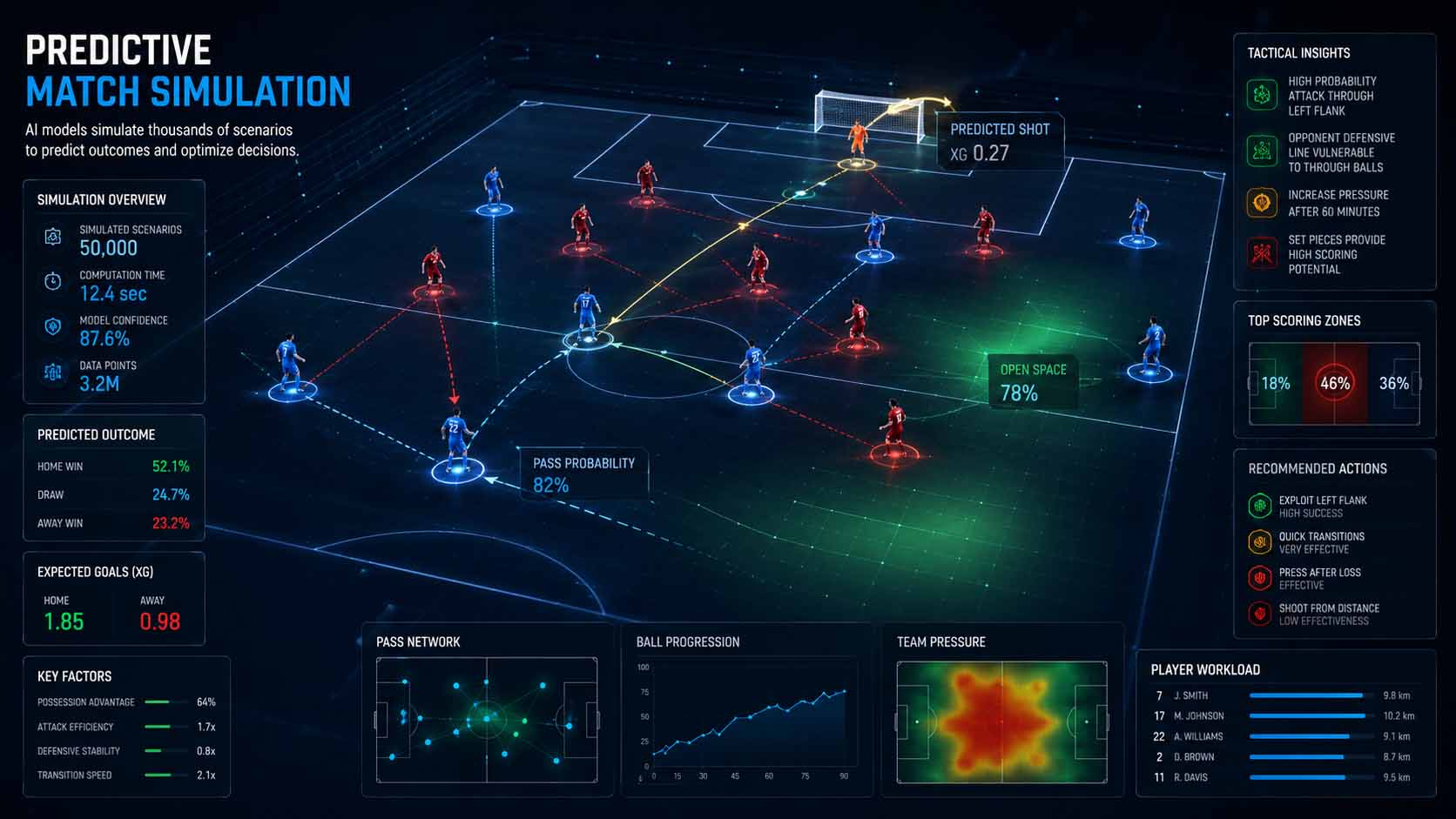
The visualization demonstrates how Artificial Intelligence simulates different match scenarios and analyzes potential tactical developments before they occur in reality.
Visualization: Predictive Match Simulation, probability models, AI powered game predictions, tactical scenarios, and data driven decision support in professional football | Image: © Ulrich Buckenlei | VISORIC GmbH
The title graphic of this chapter illustrates how virtual match scenarios emerge from raw game data. AI does not focus solely on the current state of play. Instead, it simultaneously calculates numerous possible continuations. This reveals which decisions are most likely to lead to specific outcomes.
For coaches and analysts, this creates an additional layer of match preparation. Different tactical approaches can be simulated and compared before a game begins. Teams gain the opportunity to test multiple strategies digitally and better understand their potential consequences.
This technology also opens new opportunities in scouting and player development. Player profiles can be combined with different match situations to analyze their impact within specific systems. As a result, clubs can evaluate not only current performance but also future deployment possibilities with greater accuracy.
In the long term, simulation platforms could become a standard component of professional football organizations. They combine historical data, live match information, and Artificial Intelligence into a tool that supports strategic decision making with a significantly broader information base.
- AI simulates potential future match situations
- Probability models support tactical decision making
- Coaches can digitally compare different strategies
- Simulations improve match preparation and scouting
- Predictive analytics expands traditional football analysis with future scenarios
However, even the most advanced simulations require accurate performance data. For this reason, clubs are increasingly investing in systems that analyze fitness, workload, and match performance in real time and generate actionable recommendations from these insights.
Performance Intelligence for Coaches and Analysts
Modern football clubs analyze far more than goals, assists, or possession statistics. With the help of Artificial Intelligence, comprehensive Performance Intelligence systems are emerging that can simultaneously evaluate physical workload, running performance, sprint behavior, decision quality, and tactical efficiency. This provides coaches and analysts with a far more accurate understanding of a team’s actual performance capabilities.[15]
The foundation consists of large volumes of tracking data, biometric information, and match events. AI systems connect these data sources and identify relationships that would be difficult to uncover using traditional analytical methods. Performance peaks, declines in effectiveness, and particularly efficient movement patterns can therefore be identified automatically.
Particularly valuable is the ability to present information in a clear and understandable format. Instead of analyzing large spreadsheets and raw datasets, coaches receive visual dashboards containing actionable recommendations. The analysis focuses not only on past performance but also highlights development trends and potential risks. This significantly improves the decision making process.[16]
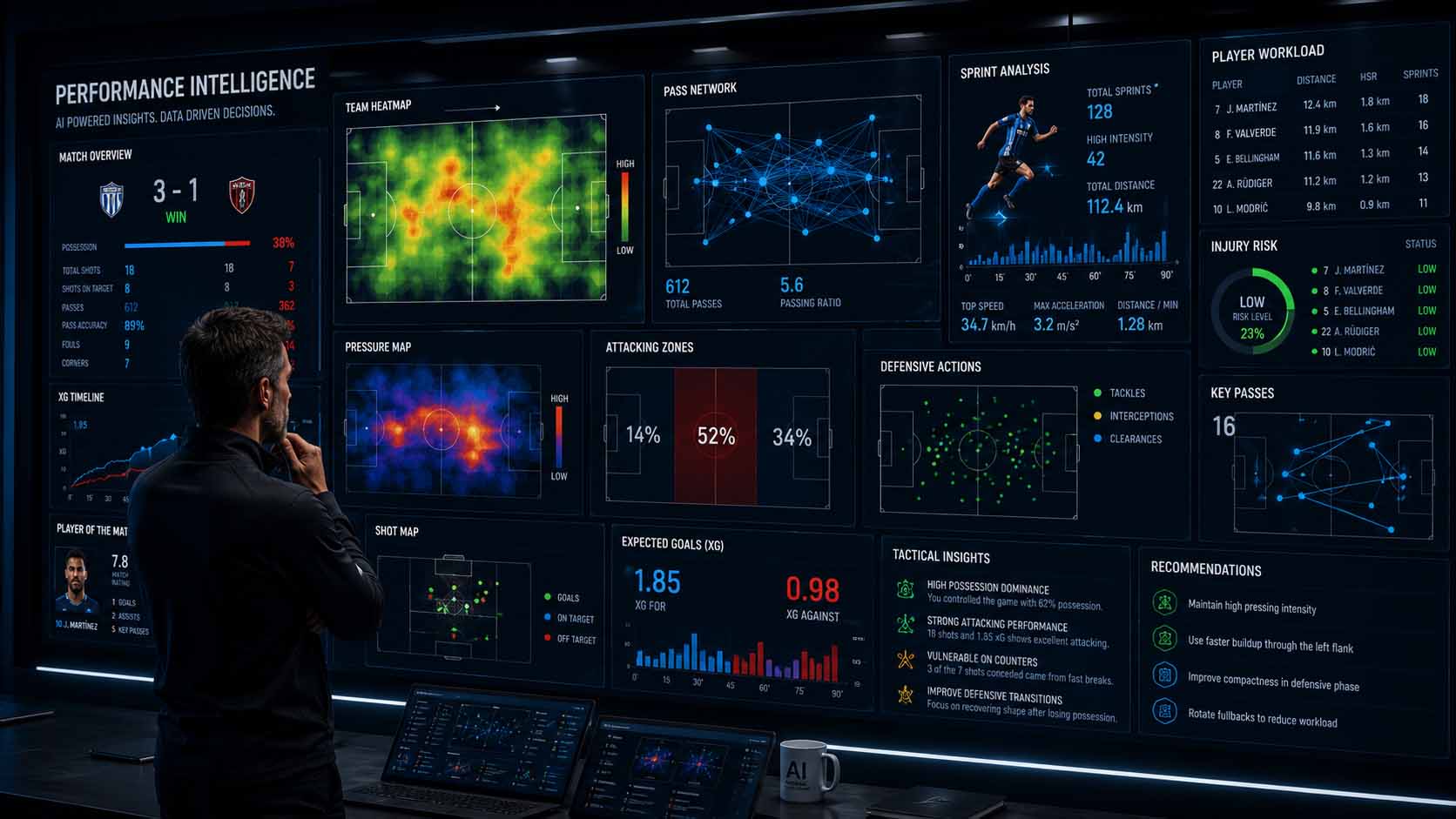
The visualization shows a modern analytics center where performance data, tracking information, and AI driven insights are combined for coaches and analysts.
Visualization: Football Performance Intelligence, real time dashboards, workload analysis, running metrics, sprint analytics, AI powered performance evaluation, and data driven decision support in professional football | Image: © Ulrich Buckenlei | VISORIC GmbH
The title graphic of this chapter illustrates how dramatically the work of modern analytics departments has evolved. Where individual statistics were once reviewed separately, integrated information platforms now monitor multiple performance dimensions simultaneously. Coaches gain a far more comprehensive overview of their team’s condition and development.
Particularly interesting is the combination of physical and tactical analysis. AI evaluates not only how far a player has run but also how effective those movements were and what impact they had on the game. This creates a far more nuanced performance assessment than traditional metrics alone.
Performance Intelligence is also becoming increasingly important in injury prevention. Changes in workload patterns or movement behaviors can be detected at an early stage. Coaches and medical teams receive valuable indicators regarding when recovery periods, training adjustments, or individualized interventions may be required.
As AI and data platforms continue to evolve, Performance Intelligence is becoming an increasingly strategic tool. Clubs can optimize training processes, develop talent more effectively, and make decisions based on objective information. Data is therefore becoming a central component of modern performance management in sport.
- AI combines performance data, tracking information, and match events
- Coaches receive intuitive dashboards instead of complex raw datasets
- Workload, efficiency, and tactical impact are evaluated together
- Performance Intelligence supports injury prevention and player development
- Data driven analytics improve sporting decisions
However, modern football organizations no longer analyze only the players on the field. Stadiums, visitor flows, and security operations are increasingly monitored and optimized through Artificial Intelligence as well.
AI Analyzes the Entire Stadium
Artificial Intelligence is transforming not only the game itself but also the operation of modern stadiums. While tracking systems analyze players and the ball, other AI platforms monitor crowd movements, visitor flows, security zones, and logistical processes. This creates a digital representation of the entire stadium operation that can improve safety, efficiency, and the visitor experience simultaneously.[17]
Modern camera systems and computer vision platforms enable the real time analysis of large crowds. These systems identify movement directions, congestion points, waiting areas, and unusual behavioral patterns. Stadium operators can therefore react to potential bottlenecks at an early stage and manage visitor flows more effectively.
Particularly interesting is the combination of real time data and predictive models. AI systems do not only analyze the current situation but also calculate likely developments over the coming minutes or hours. This allows security personnel, event organizers, and stadium operators to respond more quickly and with greater confidence to changing circumstances.[18]
The visualization demonstrates how Artificial Intelligence analyzes and optimizes visitor flows, security zones, and movement patterns within a stadium environment.
Visualization: Crowd Flow Intelligence, computer vision, visitor analytics, stadium security, movement patterns, real time monitoring, and AI powered decision support for modern sports venues | Image: © Ulrich Buckenlei | VISORIC GmbH
The title graphic of this chapter highlights how modern stadiums are increasingly viewed as intelligent systems. Thousands of visitors move simultaneously through entrances, seating areas, retail zones, and transportation corridors. AI platforms help make these complex processes visible, measurable, and manageable.
Beyond safety considerations, significant economic benefits also emerge. Operators can better understand visitor behavior, optimize service areas, and allocate resources more efficiently. Waiting times at entrances, concession stands, and restroom facilities can be reduced while visitor satisfaction improves.
Major sporting events also benefit substantially from these technologies. International tournaments, championship matches, and sold out stadiums place enormous demands on organization and security. AI systems help responsible teams identify critical situations early and respond appropriately.
In the long term, the stadium is evolving into a digital ecosystem where match analytics, visitor management, security, and infrastructure become interconnected. Artificial Intelligence supports not only sporting performance on the field but increasingly optimizes the entire football experience.
- AI analyzes visitor flows and movement patterns in real time
- Computer vision supports stadium operations and security
- Bottlenecks and risks can be identified early
- Service quality and visitor experience are improved
- Modern stadiums are evolving into intelligent data platforms
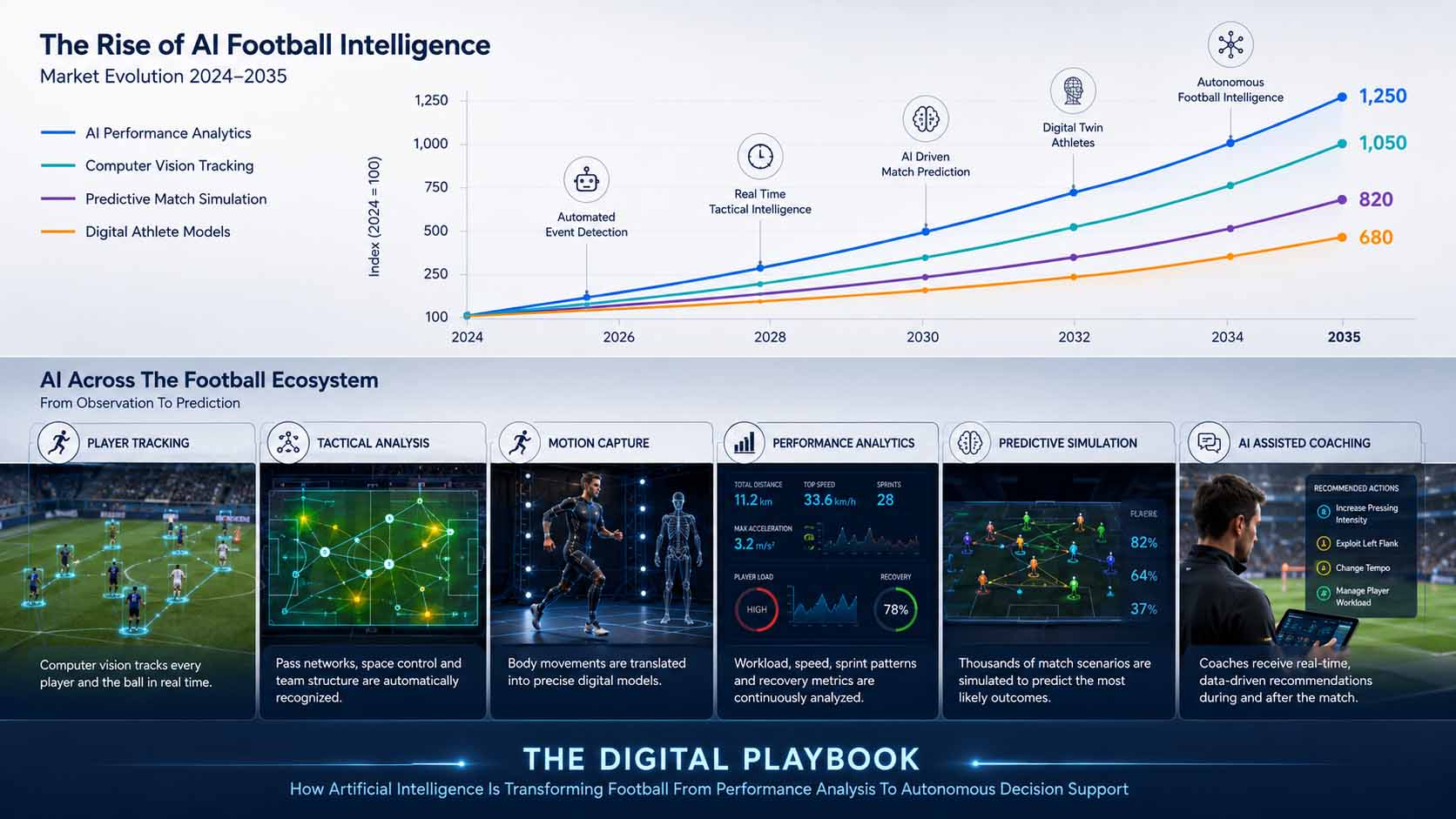
This concludes the journey through the most important applications of Artificial Intelligence in football. From tactical analysis and digital athlete models to intelligent stadiums, it becomes clear that AI is no longer merely a tool for statistics. It is increasingly evolving into a foundational infrastructure that is transforming the entire football ecosystem.
The FIFA World Cup as a Real World Laboratory for Artificial Intelligence
The FIFA World Cup 2026 demonstrates impressively how closely sport, data analytics, and Artificial Intelligence have become interconnected. What appears to spectators as a football match is, behind the scenes, evolving into a complex digital ecosystem built on real time data, computer vision, volumetric capture, digital twins, and intelligent analytics systems.
The following video illustrates how modern technologies are already being used to capture player movements, support referee decisions, create digital stadium representations, and enable entirely new forms of media production. The World Cup is therefore becoming a large scale technology testing ground for the next generation of data driven systems.
Video Source: Lenovo and FIFA | Topics: Artificial Intelligence, Computer Vision, Volumetric Capture, Digital Twins, Real Time Analytics, Spatial Computing, and Intelligent Stadiums | Analysis, Editorial Direction, and Commentary: © Ulrich Buckenlei | XR Stager
Particularly interesting is the fact that many of the technologies showcased are no longer limited to sports. The same AI models are now analyzing manufacturing facilities, monitoring logistics operations, supporting medical diagnostics, and optimizing energy infrastructures. The World Cup merely makes these developments visible because millions of people can directly experience the results.
At the same time, the video demonstrates how digital content is increasingly moving beyond the traditional screen. Volumetric player capture, spatial data visualization, and intelligent camera systems create entirely new perspectives on the game. Information is no longer simply displayed but becomes spatially accessible and contextually meaningful.
For businesses, the FIFA World Cup offers a glimpse into the future of intelligent systems. Anyone who understands how AI analyzes players, stadiums, and match developments can also recognize the principles behind modern digital twins, autonomous assistance systems, and data driven decision platforms.
- The FIFA World Cup is evolving into a global showcase for modern AI technologies
- Computer vision analyzes players, the ball, and spatial structures in real time
- Volumetric capture creates digital twins of players and match scenarios
- Spatial Computing enables new forms of analytics and media production
- The same technologies are already transforming industry, logistics, and infrastructure
The most important conclusion is therefore this: The future of Artificial Intelligence is not emerging solely within data centers or research laboratories. It is already visible on the world’s biggest stages, and the FIFA World Cup is one of the most compelling examples.
From Football Analytics to Intelligent Enterprise Platforms
The technologies that become visible during the FIFA World Cup reach far beyond sport. Artificial Intelligence, computer vision, digital twins, Realtime 3D, data platforms, and Spatial Computing are already transforming how companies analyze processes, prepare decisions, and make complex systems understandable.
The Munich based VISORIC expert team supports companies in translating these technologies into concrete applications. This does not result in abstract visions of the future but in practical solutions for industry, logistics, infrastructure, mobility, energy, education, retail, and digital communication.
Our services include strategic concept development, the creation of interactive data spaces, the integration of AI systems, the visualization of digital twins, computer vision applications, Realtime 3D platforms, Spatial Computing concepts, and the connection to existing enterprise data and operational systems.
In addition, we support the complete journey from the initial idea through feasibility analysis and prototyping to technical implementation, system integration, maintenance, and further development. This creates scalable platforms that make complex data understandable and provide real decision support.

The Munich based VISORIC expert team combines Artificial Intelligence, digital twins, Realtime 3D, computer vision, and Spatial Computing into intelligent platforms for analysis, visualization, and decision support.
Visualization: Development of intelligent enterprise platforms with Artificial Intelligence, Digital Twins, Realtime 3D, Computer Vision, Spatial Computing, and data driven decision support for industry, infrastructure, logistics, and digital transformation | Image: © Ulrich Buckenlei | VISORIC GmbH
The Munich based VISORIC expert team combines technological depth with hands on implementation experience. Individual technologies are transformed into integrated systems that do not merely display data but make it understandable, spatially accessible, and actionable.
Whether digital twins for production environments, AI powered analytics platforms, interactive control rooms, Realtime 3D visualizations, computer vision applications, XR training systems, or spatial decision platforms, what matters is not the individual technology but its intelligent combination. VISORIC has been developing individual solutions for companies, public institutions, and technology driven organizations at precisely this intersection for many years.
With experience from numerous projects around AI, XR, Digital Twins, Realtime 3D, and interactive data platforms, we support our clients from the first idea to long term operation. This creates systems that deliver real value, make processes easier to understand, and can flexibly adapt to new requirements.
- Strategy, consulting, and development of individual AI concepts
- Computer vision, tracking, pattern recognition, and data driven analytics
- Digital twins, Realtime 3D, and spatial data visualization
- Spatial Computing, XR applications, and interactive control rooms
- Technical implementation, system integration, and rollout
- Maintenance, support, further development, and long term platform operation
If you would like to discover how Artificial Intelligence, digital twins, computer vision, or data driven decision platforms can be used in your company, the Munich based VISORIC expert team looks forward to the exchange. Together, we develop individual solutions from strategic concept development through prototyping and AI integration to productive implementation, operation, and continuous development. This turns a technological opportunity into a reliable platform for digital transformation.
Sources and References
- FIFA, football data ecosystem, official match data, player tracking, advanced football analytics, and technology supported evaluations for international competitions.
- FIFA, innovations in football technology, semi automated offside technology, optical tracking, connected ball data, and AI supported decision processes in match operations.
- SoccerCPD, research on detecting formation and role changes in football matches using spatio temporal tracking data.
- Structural Pass Analysis in Football, research on passing networks, defensive structures, space gain, and tactical effects based on tracking data.
- FIFA, Football Data Platform and match data management, official data collection, distribution, and real time football analytics.
- Stats Perform Opta, football data feeds, live match data, player statistics, event data, and infrastructure for real time sports analytics.
- Hawk Eye Innovations, ball tracking, goal line technology, trajectory reconstruction, and camera based systems for match monitoring.
- FIFA semi automated offside technology, sensor data from the ball, player tracking cameras, and AI supported reconstruction of match situations.
- FIFA and Lenovo technology initiatives for player scans, physically accurate 3D player models, and AI supported visualizations for refereeing and broadcasting.
- EA Sports FC and sports technology research on volumetric capture, player modeling, motion realism, and machine learning for the digital representation of athletes.
- FootAndBall, research on detecting football players and balls in high resolution video streams using deep neural networks.
- Concurrent validity of computer vision AI player tracking software using broadcast footage, research on accuracy, camera systems, resolution, and reliability of player tracking.
- SciSports, research on learning football kinematics using two dimensional tracking data, trajectory modeling, and generative motion analysis.
- PlayeRank, research on data driven performance evaluation in football, player rankings, machine learning, and large scale football analytics.
- AWS Bundesliga Match Facts, Expected Goals, win probabilities, speed analysis, passing profiles, and real time performance analytics for football broadcasts.
- StatsBomb, football analytics, event data, freeze frame context, expected goals models, pressure data, and advanced performance analytics.
- FIFA guidelines for stadium safety and security measures, visitor management, stadium operations, safety planning, and event control.
- Fraunhofer research on crowd monitoring, computer vision, public safety, movement flow analysis, and AI supported detection of movement patterns in large event venues.
- FIFA, UEFA, Stats Perform, AWS Bundesliga Match Facts, and peer reviewed research papers on football analytics as the technological foundation for market development and ecosystem structure.
- Editorial visualization, scenario modeling, article concept, and technological classification: © Ulrich Buckenlei | VISORIC GmbH.
- Original inspiration based on AI powered football analytics, player tracking, tactical visualization, computer vision, predictive simulation, and sports analytics systems.
- Analysis, voiceover text, visual structure, and editorial classification: © Ulrich Buckenlei | VISORIC GmbH.
- VISORIC GmbH, project experience in AI visualization, Realtime 3D, digital twins, XR interfaces, data dashboards, and interactive decision support systems.
- XR Stager, immersive media workflows, Spatial Computing, AI powered visualization, storytelling for sports technologies, and interactive real time experience design.
Contact Us:
Email: info@xrstager.com
Phone: +49 89 21552678
Contact Persons:
Ulrich Buckenlei (Creative Director)
Mobil +49 152 53532871
Mail: ulrich.buckenlei@xrstager.com
Nataliya Daniltseva (Projekt Manager)
Mobil + 49 176 72805705
Mail: nataliya.daniltseva@xrstager.com
Address:
VISORIC GmbH
Bayerstraße 13
D-80335 Munich