
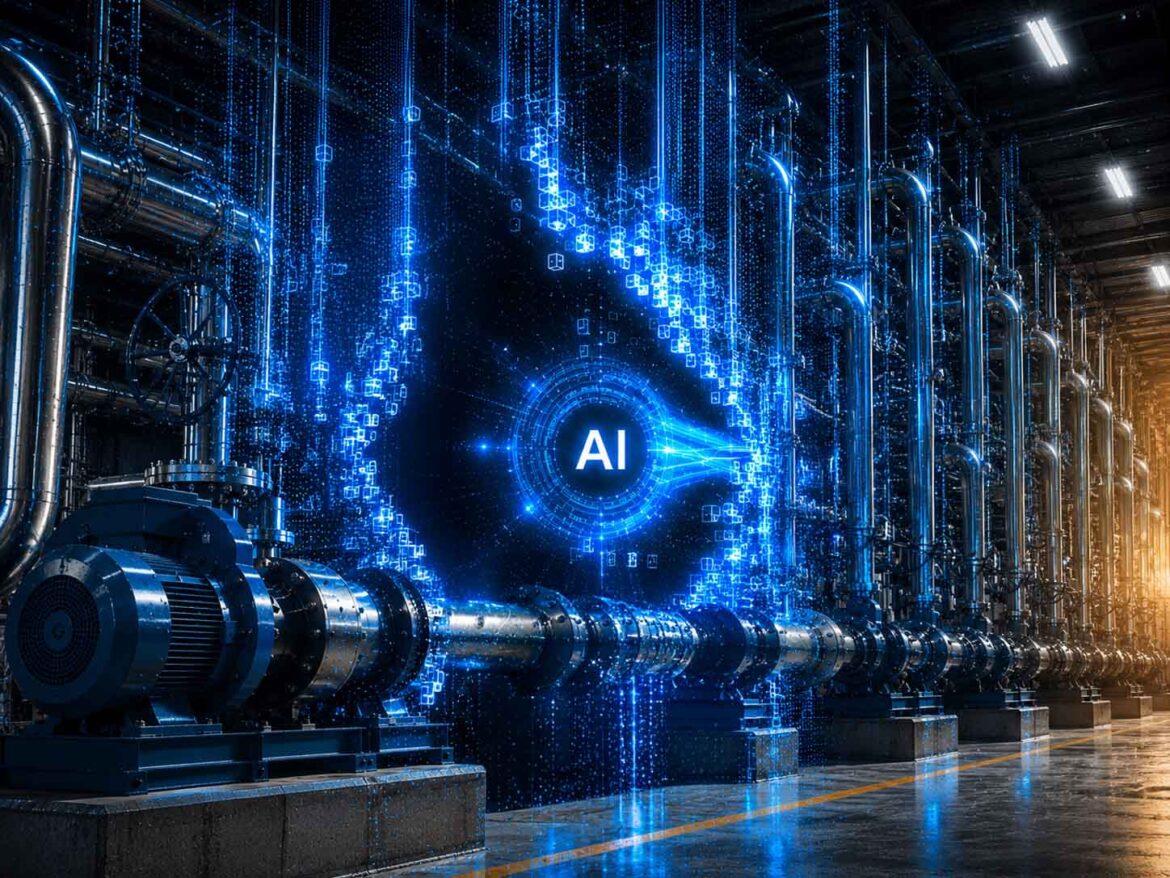
The concept image shows an industrial facility in which an incomplete 3D scan is analyzed, enhanced, and transformed into a usable digital twin using artificial intelligence.
Visualization: AI-assisted reconstruction of missing geometries, industrial 3D scans, digital twins, real-time 3D, and automated data completion for factories, industrial plants, and infrastructure | Image: © Ulrich Buckenlei | VISORIC GmbH
Digital twins have long been considered a strategic objective of industrial digitalization. However, their implementation has often involved significant costs. Extensive on-site scanning, manual remodeling, incomplete CAD data, data cleaning, and technical quality assurance made many projects complex and expensive. Especially for existing factories, older industrial facilities, or large-scale infrastructure, creating an accurate digital representation was often considerably more demanding than originally anticipated.[1]
This is precisely where artificial intelligence is fundamentally changing the situation. Modern AI systems can analyze incomplete scans, plausibly complete missing areas, clean point clouds, reconstruct geometries, and make 3D data usable for digital twins much faster. This not only reduces manual effort. Additional scans, correction cycles, and lengthy modeling processes can also be significantly reduced.[2]
The cover image of this article visualizes exactly this development. In an industrial environment, a visible data gap initially appears. Pipelines, pumps, and technical structures are not completely captured. Artificial intelligence detects this gap, analyzes the existing structures, and begins reconstructing the missing geometries step by step. An incomplete scan becomes a more reliable foundation for a digital twin.
This development is particularly relevant for industrial companies, plant operators, planners, and medium-sized businesses. Many organizations operate mature production environments, aging machinery, or building structures with incomplete digital documentation. If AI helps process such data faster and intelligently supplement missing areas, digital twins become significantly more attractive from an economic perspective.[3]
As a result, the role of digital twins is changing fundamentally. They are no longer viewed solely as large-scale projects for major corporations. Instead, they are evolving into flexible tools for maintenance, retrofit planning, spare parts management, XR training, remote support, simulation, and industrial process optimization. The key question is no longer whether all data is perfectly available from the start, but how intelligently missing information can be supplemented, verified, and made usable.[4]
Projects and concept developments by the Munich-based VISORIC expert team also demonstrate that the economic value of digital twins primarily emerges when existing data is used intelligently. 3D scans, CAD models, photogrammetry, Gaussian Splatting, real-time 3D, and AI-assisted reconstruction should not be viewed as separate technologies. Their greatest value is created when they are combined into a continuous digital production pipeline.
The central question is therefore no longer simply how accurately a digital twin can be created. Much more important is how quickly, economically, and reliably companies can generate a usable digital model from incomplete data. This is exactly where artificial intelligence becomes particularly important for the next generation of digital twins.
- AI reduces the effort required for scan cleanup and 3D reconstruction
- Incomplete data can be transformed into usable models more quickly
- Digital twins become economically feasible for more companies
- Factories, industrial facilities, and infrastructure can be digitized faster
- Real-time 3D, scan data, and AI are converging into new industrial workflows
This development becomes especially exciting where artificial intelligence not only analyzes existing data but actively helps complete missing reality for digital twins.
AI Reduces the Effort Required for Reality Capture
Digital twins often begin with capturing the real-world environment. Factories, industrial facilities, buildings, and infrastructure must be scanned, photographed, measured, and converted into usable 3D data. This initial step has traditionally been time-consuming and expensive. The larger and more complex a facility is, the more on-site visits, scan positions, and manual post-processing tasks were required.[5]
Artificial intelligence is fundamentally changing this process. Modern methods can analyze scan data faster, interpret image information more effectively, and intelligently process incomplete areas during reconstruction. As a result, the effort required for reality capture decreases significantly. Companies no longer need to capture every detail with perfect data quality before creating an initial digital twin.[6]
The image in this chapter shows a complex architectural and industrial environment that could serve as the foundation for a digital twin. Such environments contain numerous details, overlapping structures, shadows, vegetation, metal components, and difficult-to-access areas. This clearly illustrates why traditional scanning processes quickly become expensive and why AI-supported workflows are so economically attractive.
Data gaps frequently occur in existing industrial facilities, campus environments, and technical outdoor areas. Some areas are difficult to access, obstructed, or only visible from unfavorable viewing angles. AI can help clean such data more quickly, better interpret missing information, and create a usable overall representation from multiple incomplete perspectives.[7]
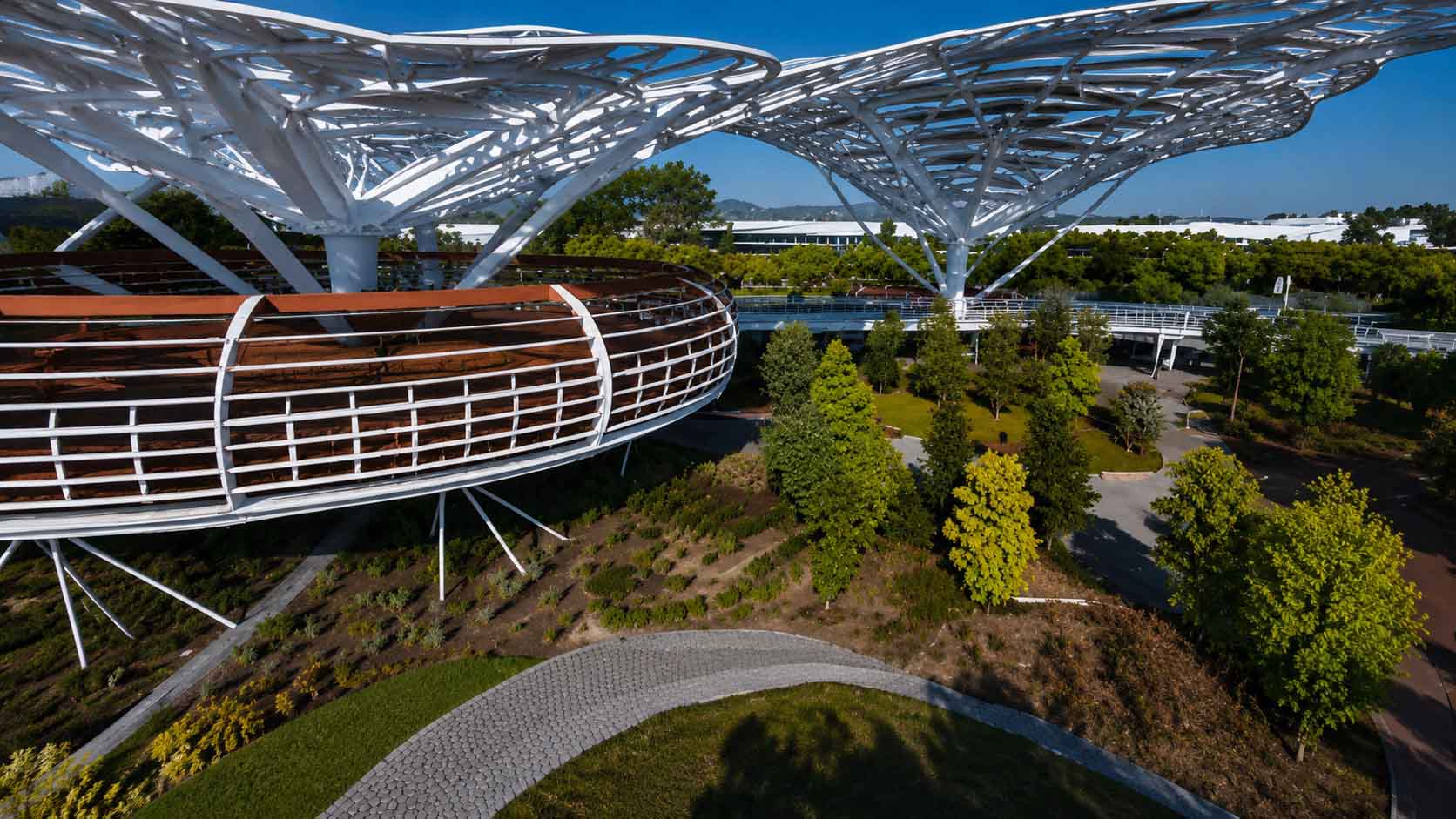
The concept image shows a modern architectural and industrial environment that can serve as the foundation for a digital twin and can be made usable more quickly through AI-assisted reality capture technologies.
Visualization: AI-assisted reality capture, 3D scanning, Gaussian Splatting, digital twins, architectural reconstruction, and industrial data acquisition | Image: © Ulrich Buckenlei | VISORIC GmbH
The economic benefit lies not only in improved image quality. More importantly, fewer rescans, fewer manual corrections, and shorter project durations become possible. For companies, this means digital twins can be created faster, updated more frequently, and used earlier for planning, maintenance, training, or documentation.
The Munich-based VISORIC expert team also considers reality capture not as an isolated scanning process, but as part of a digital production pipeline. Only when 3D scans, CAD data, photogrammetry, Gaussian Splatting, real-time 3D, and AI reconstruction work together effectively does a digital twin become practically usable within an enterprise.
This shifts the focus fundamentally. The goal is no longer simply to capture real-world environments with maximum effort. Much more important is how efficiently a reliable digital model can be generated from existing data. This is where AI becomes a decisive cost reducer for digital twins.
- AI reduces scanning effort and manual post-processing
- Fewer on-site visits can significantly reduce project costs
- Gaussian Splatting and 3D reconstruction accelerate digital capture
- Even complex existing facilities become digitally usable more quickly
- Reality capture becomes part of a scalable digital twin pipeline
However, the greatest progress occurs where artificial intelligence not only evaluates existing scan data but also automatically supplements missing areas, making digital twins more complete.
AI Automatically Completes Missing Areas
One of the greatest challenges in creating digital twins is incomplete data. No scan is perfect. Lines of sight are obstructed, surfaces reflect light, areas remain blurry, or some regions cannot be captured for technical reasons. In the past, such gaps often required additional scanning sessions, manual modeling, or extensive corrections by specialists.[8]
New AI technologies are changing this situation. Systems such as NVIDIA ArtiFixer demonstrate how generative AI can analyze and plausibly complete missing areas within a 3D reconstruction. The objective is not to generate arbitrary fantasy geometry. Instead, the generated content must match the existing environment, perspective, materials, and spatial structure.[9]
The image in this chapter illustrates this difference very clearly. On the left side, an incomplete, noisy, and inaccurate reconstruction is visible. Geometries are distorted, details are missing, and the scene is hardly usable. On the right side, the same environment appears much cleaner, more complete, and easier to understand. This step is economically decisive for digital twins.
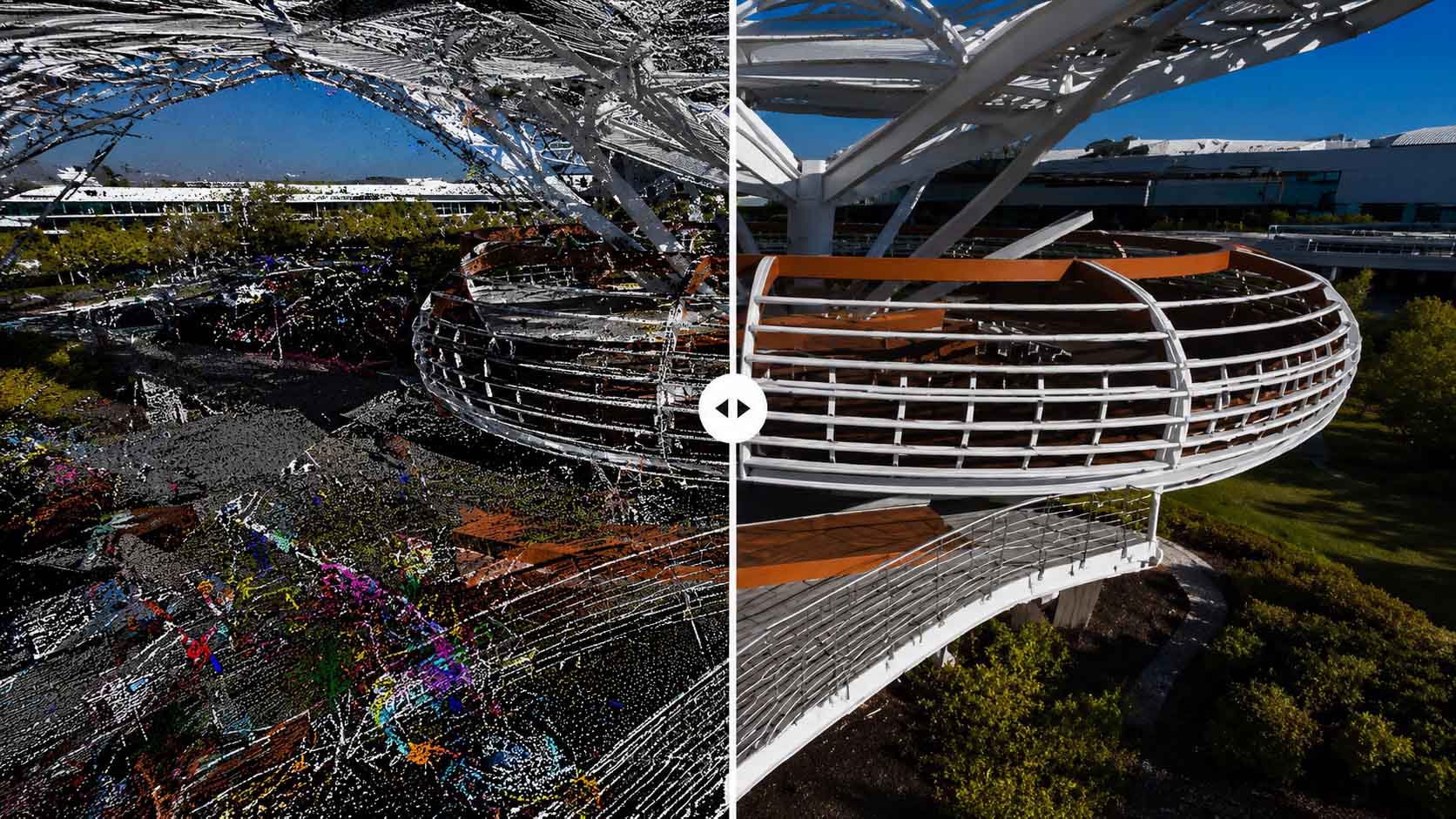
The concept image shows the comparison between an incomplete 3D reconstruction and an AI-enhanced scene that becomes significantly more useful as the foundation for digital twins.
Visualization: AI-assisted completion of missing scan areas, automatic 3D reconstruction, digital twins, Gaussian Splatting, and industrial reality capture workflows | Image: © Ulrich Buckenlei | VISORIC GmbH
For companies, this progress is particularly important because many digital twin projects fail not because of the concept itself, but because of the effort required for data preparation. When missing areas can be supplemented more quickly and faulty reconstructions can be improved automatically, costs and project durations decrease significantly. As a result, digital twins become not only more accurate but, above all, more practical.[10]
Especially in factories, infrastructure projects, existing buildings, and technical installations, data availability is rarely perfect. Machines obstruct the view, pipelines conceal other components, security areas cannot be accessed, or older CAD documentation is unavailable. AI can help generate a reliable digital foundation from incomplete information much more quickly.
This does not mean that human expertise becomes unnecessary. On the contrary. Specialists must continue to evaluate, verify, and decide which reconstructions are technically reliable. The difference is that AI accelerates many time-consuming intermediate steps and thereby makes more projects economically feasible.
- AI can automatically supplement missing scan areas
- Incomplete reconstructions become usable more quickly
- Rescans and manual corrections can be reduced
- Digital twins become more robust and economically viable
- Generative AI becomes an important tool for industrial 3D workflows
When missing areas can be automatically completed, the next major opportunity emerges: the processing of point clouds, meshes, and textures also becomes significantly faster through artificial intelligence.
AI Accelerates 3D Reconstruction
The actual digitization process only begins after scanning. Millions of individual measurement points must be transformed into complete 3D models. In the past, this step was one of the most time-consuming parts of a digital twin project. Point clouds had to be cleaned, meshes generated, topologies optimized, and textures manually refined. Modern artificial intelligence is fundamentally changing this process.[13]
Current methods automatically analyze point clouds, identify structures, and generate clean surfaces much faster. Missing areas are intelligently supplemented, meshes are optimized, and textures are reconstructed. As a result, manual effort is significantly reduced while quality and speed increase simultaneously.[14]
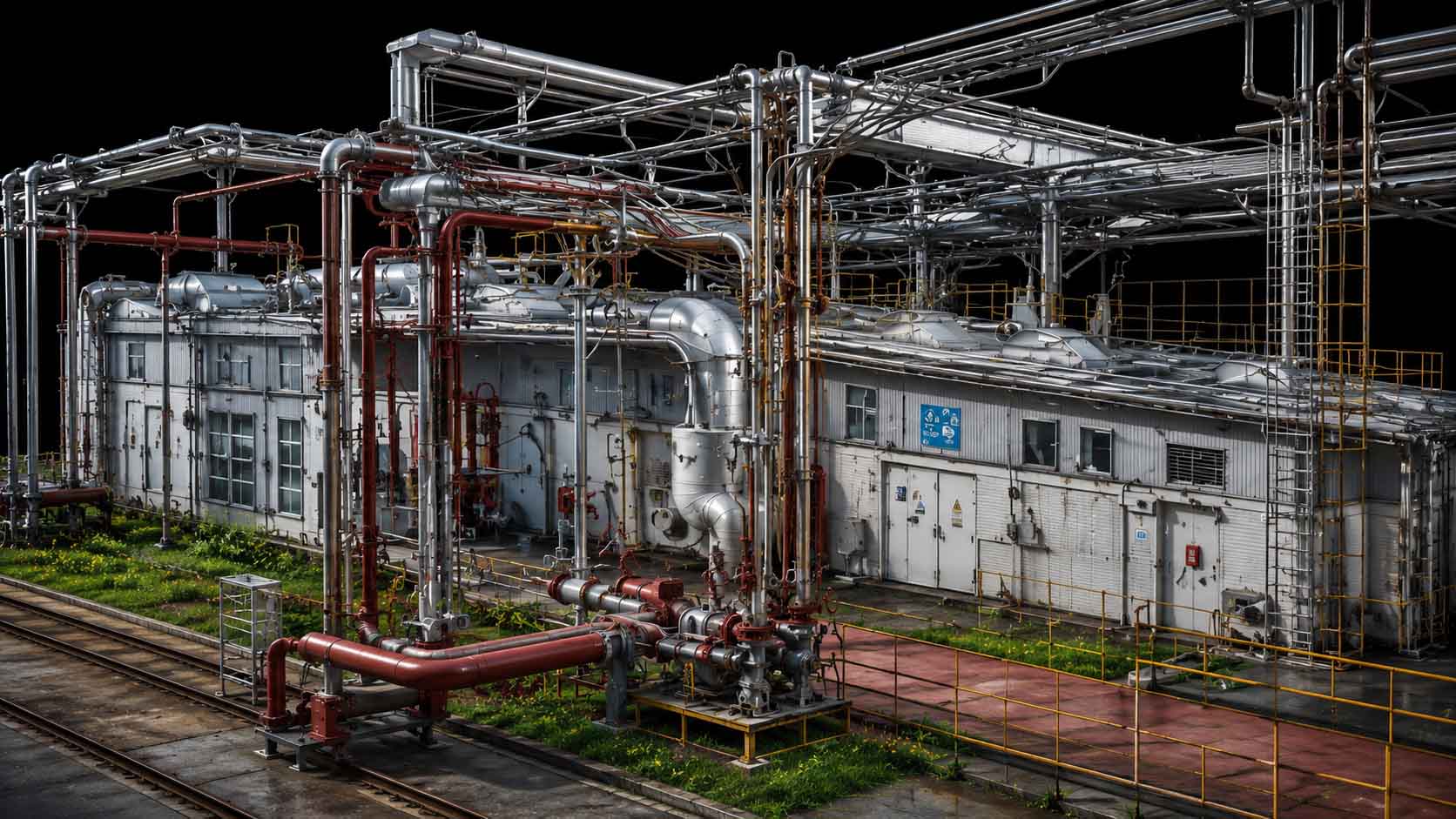
The visualization shows the transition from an unstructured point cloud to a complete digital twin through AI-assisted reconstruction technologies.
Visualization: Automatic processing of point clouds, mesh generation, topology optimization, and AI-assisted texture reconstruction | Image: © Ulrich Buckenlei | VISORIC GmbH
Large industrial facilities particularly benefit from these advances. Instead of requiring weeks of manual post-processing, high-quality digital models can now be created within significantly shorter timeframes. At the same time, errors are reduced and a more consistent modeling process becomes possible.[15]
- AI automatically processes millions of measurement points
- Meshes are generated faster and with higher quality
- Topology and geometry are intelligently optimized
- Textures are reconstructed automatically
- 3D reconstruction becomes significantly more economical
Once the geometry has been reconstructed, the next step already begins: a pure 3D model evolves into an intelligent digital twin with semantic understanding.
AI Creates Digital Twins Faster
A complete 3D model alone is rarely sufficient for industrial applications. A true digital twin only emerges when machines, pipelines, valves, and sensors are automatically identified and classified. This is precisely the area where artificial intelligence is currently advancing particularly rapidly.[16]
Modern AI systems automatically recognize components, assign semantic information to them, and connect them with existing CAD, BIM, or plant information. Many tasks that previously had to be performed manually can now be completed largely automatically.[17]
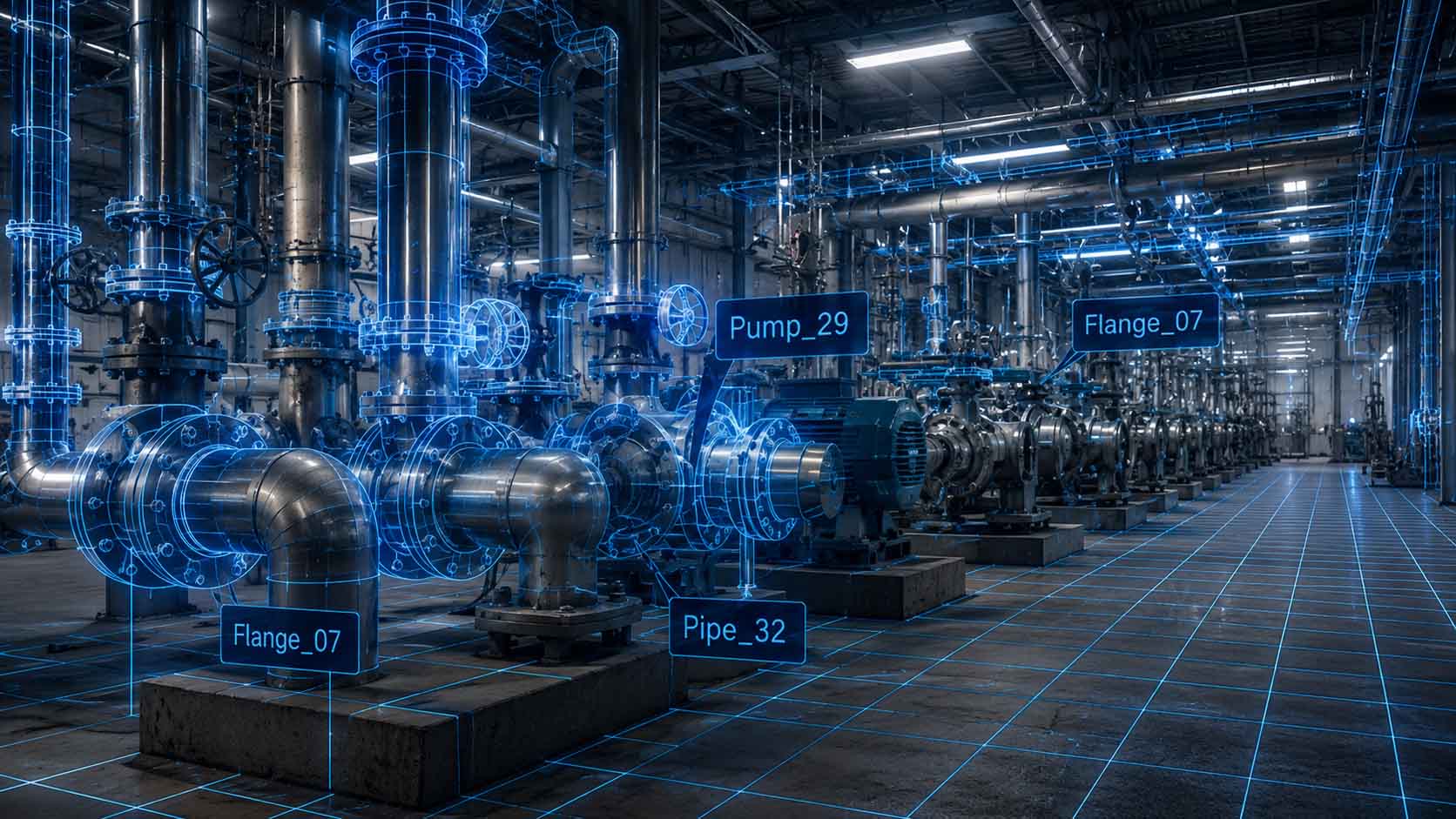
The visualization shows how artificial intelligence automatically detects, classifies, and transforms real industrial facilities into intelligent digital twins.
Visualization: AI-assisted object recognition, semantic analysis, CAD integration, and automatic model structuring | Image: © Ulrich Buckenlei | VISORIC GmbH
As a result, digital twins can not only be created faster but also updated more easily. Changes in existing facilities can be transferred into digital models much more efficiently. Pure 3D data evolves into structured information models that support analysis, maintenance, and simulation.[18]
- Automatic object recognition reduces modeling effort
- Semantic information is generated directly during digitization
- CAD and BIM data are integrated intelligently
- Digital twins can be updated more quickly
- Structured models provide the foundation for simulation and AI
The faster digital twins can be created, the more economically viable they become. This advantage no longer benefits only large corporations, but increasingly also small and medium-sized enterprises.
Digital Twins Become Economically Viable for SMEs
For many years, digital twins were considered a technology reserved for large enterprises with correspondingly large budgets. Extensive scanning projects, long modeling times, and specialized software made adoption economically difficult for many small and medium-sized companies. This situation is now changing fundamentally.[19]
Today, artificial intelligence reduces effort across nearly all phases of digitization. From reality capture and automatic reconstruction to intelligent model preparation, both project duration and costs are significantly reduced. At the same time, cloud platforms enable much simpler deployment and collaboration.[20]
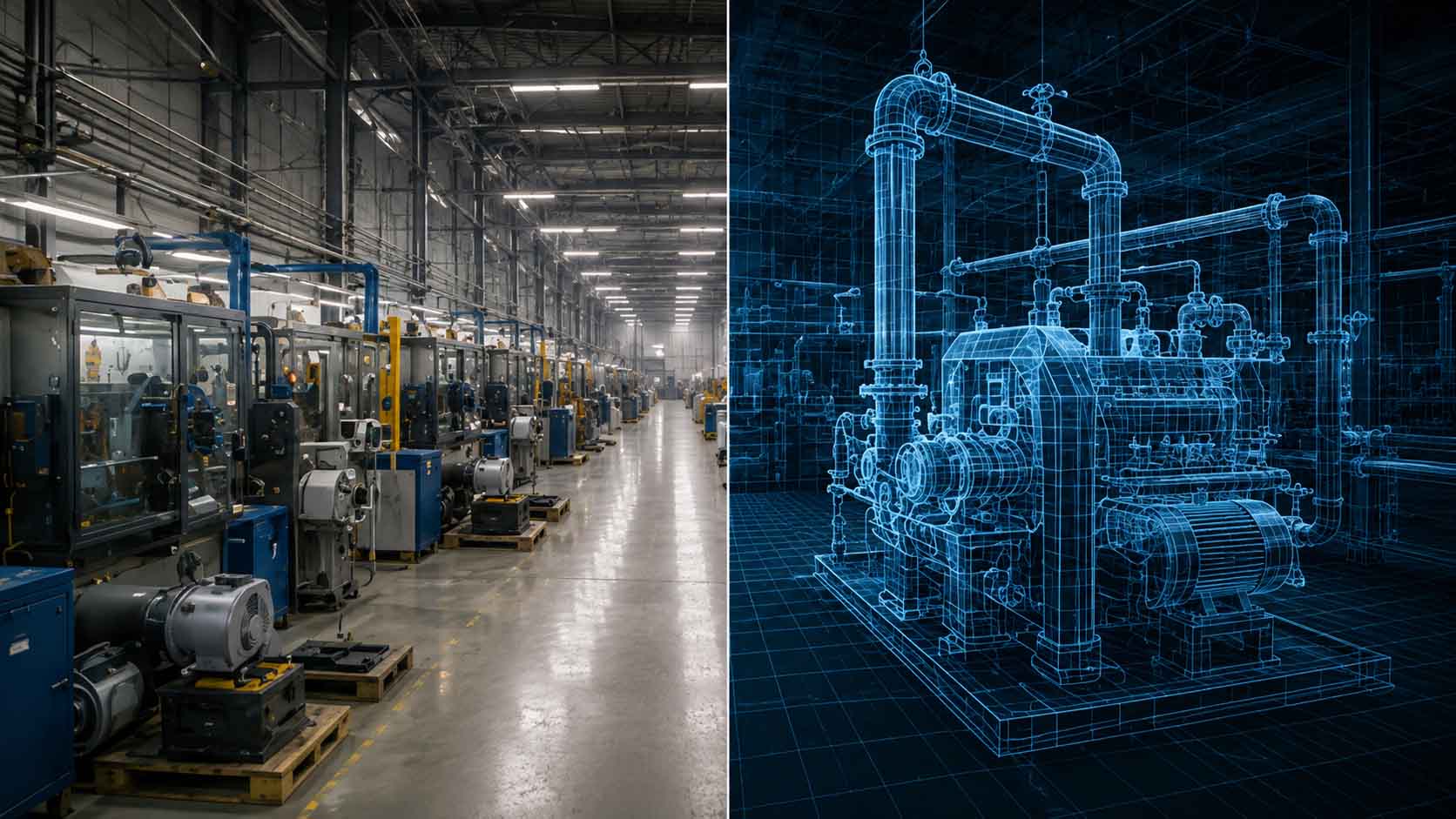
The visualization shows the transformation from traditional industrial facilities to economically viable digital twins for small and medium-sized enterprises.
Visualization: Digitization of industrial facilities, cloud platforms, AI-assisted modeling, and economically viable digital twin solutions for SMEs | Image: © Ulrich Buckenlei | VISORIC GmbH
As a result, the technology becomes attractive for companies that previously lacked economic access. Digital twins support maintenance, planning, training, documentation, and remote services, delivering measurable return on investment even for considerably smaller projects.[21]
- AI reduces project costs and development times
- Cloud platforms simplify deployment and collaboration
- Small and medium-sized enterprises also benefit from digital twins
- Automated workflows accelerate return on investment
- Digital twins are becoming a standard economic technology
As costs decrease, entirely new application areas emerge simultaneously. Digital twins are leaving the factory floor and becoming the foundation for smart buildings, infrastructure, and entire cities.
New Applications Are Emerging
Artificial intelligence not only makes digital twins less expensive to create. It also expands their practical value. What was previously used mainly for visualization, planning, or documentation is increasingly evolving into an interactive platform for maintenance, training, remote service, spare parts management, and industrial assistance systems.[25]
Today, a digital twin can not only represent real industrial facilities but also connect them with information, real-time data, and operational instructions. Employees can view maintenance procedures directly on machinery, identify relevant components more quickly, and train complex processes in a safe digital environment. This creates substantial value in day-to-day operations.[26]
This development becomes particularly interesting when combined with XR technologies. Digital twins can appear as spatial models within real industrial environments. Technicians receive instructions, inspection steps, or virtual markers directly within their field of view. In this way, the digital model becomes a practical tool for work, learning, and collaboration.
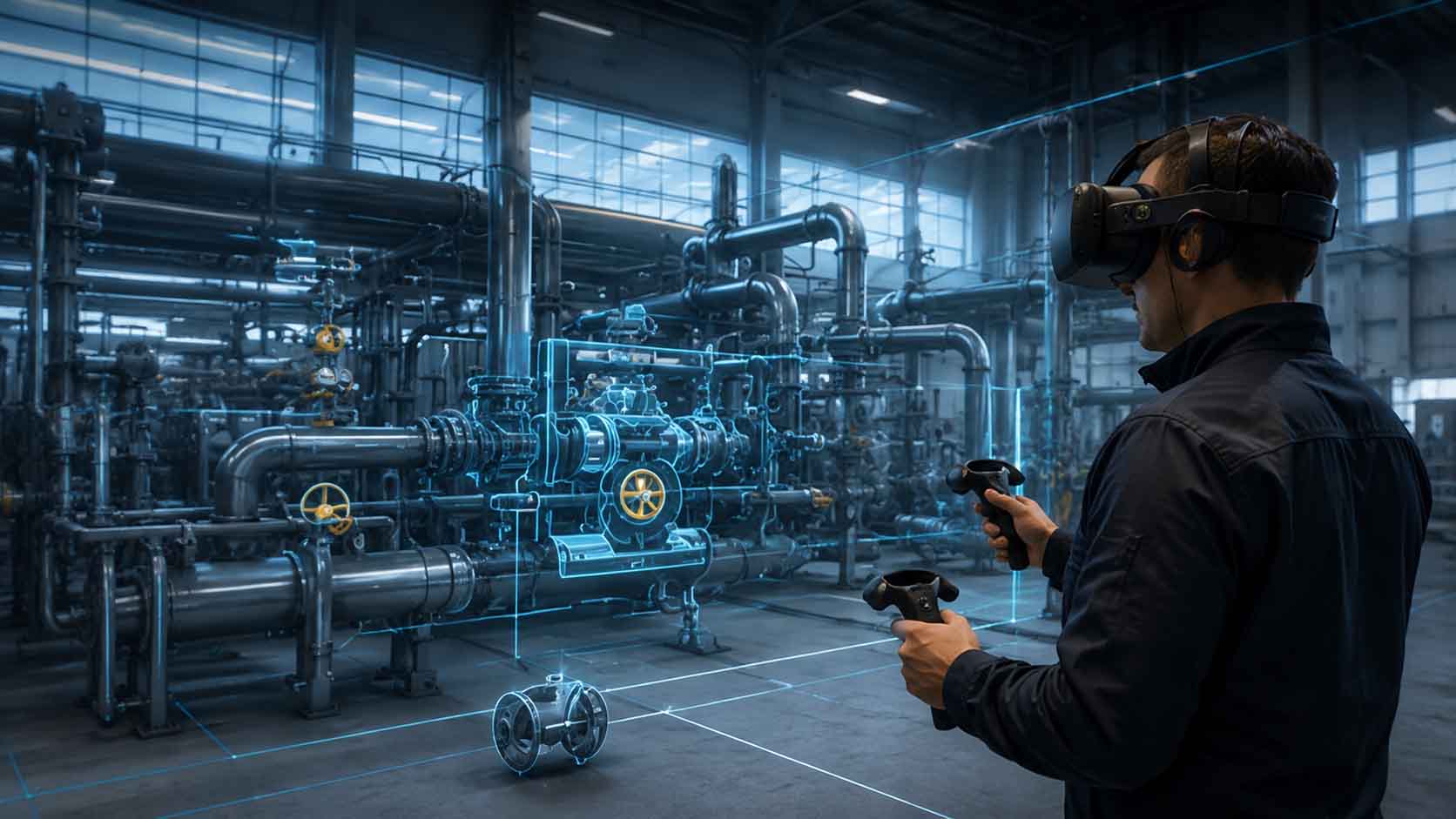
The visualization shows how digital twins can be used in combination with XR technologies for maintenance, training, remote service, and industrial assistance systems.
Visualization: Digital twins for XR training, maintenance, remote service, spare parts management, industrial assistance, and AI-assisted workflows | Image: © Ulrich Buckenlei | VISORIC GmbH
The image in this chapter illustrates how an intelligent digital twin can be used directly within an industrial environment. Real machines remain visible while digital information highlights individual components, explains procedures, and makes technical relationships easier to understand in a spatial context. This is precisely what transforms the digital twin from a static database into an active assistance system.
This creates new opportunities for companies to make knowledge available more efficiently. Service operations can be better prepared, employees can receive practical training, and expert knowledge can be distributed across multiple locations through digital systems. This value becomes particularly apparent where skilled labor is scarce or equipment downtime results in high costs.[27]
The Munich-based VISORIC expert team also views digital twins not as isolated 3D models but as the foundation for practical applications. The greatest value emerges when 3D data, AI, real-time 3D, XR hardware, and industrial processes are combined into usable workflows.
- Digital twins support maintenance, service, and training
- XR applications make technical information visible directly on site
- Remote support reduces travel effort and downtime
- AI can identify faults, processes, and spare parts more quickly
- Digital models evolve into practical industrial assistance systems
As costs decrease and new applications emerge, digital twins are increasingly moving beyond individual machine rooms. They are becoming the foundation for factories, buildings, infrastructure, and entire city models.
From the Factory to the Smart City
Digital twins are no longer used exclusively for individual machines or production lines. Through artificial intelligence, automated reconstruction, and scalable platforms, it is becoming increasingly possible to digitally represent larger and more complex systems. Factories, buildings, energy facilities, transportation infrastructure, airports, and even entire urban areas can now be transformed into digital models step by step.[29]
This transformation is particularly significant from an economic perspective. The more affordable digital twin creation becomes, the more application areas emerge. Companies can not only digitize individual assets but also analyze, plan, and optimize entire sites. Municipalities and infrastructure operators gain new opportunities to better understand complex systems and prepare decisions using data-driven insights.[30]
Artificial intelligence plays a central role in this process. It helps connect large amounts of data from scans, images, CAD models, GIS information, and sensor systems. This creates digital twins that are not only visually compelling but can also serve as platforms for analysis and simulation.
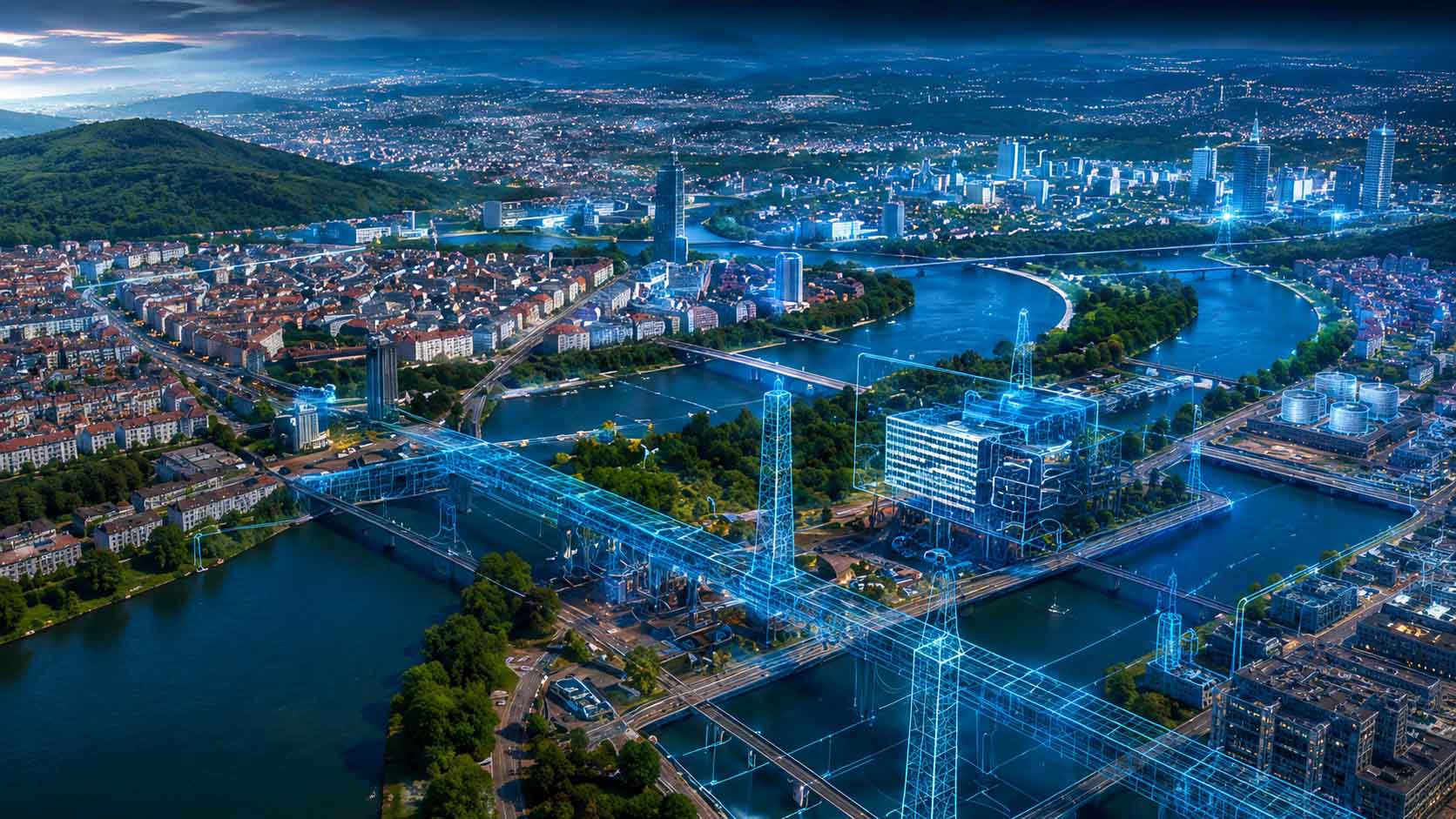
The visualization illustrates how digital twins can scale from industrial facilities to buildings, infrastructure, and interconnected urban environments.
Visualization: Digital twins for factories, buildings, infrastructure, energy systems, smart cities, AI analytics, and scalable 3D platforms | Image: © Ulrich Buckenlei | VISORIC GmbH
The image in this chapter presents an expanded perspective on digital twins. The focus is no longer on a single machine but on an interconnected industrial and urban environment. Pipelines, buildings, transportation systems, energy flows, and technical infrastructures become understandable as an integrated digital structure.
For industrial companies, this enables better planning, faster modifications, and greater transparency across complex sites. For infrastructure operators and cities, new opportunities arise in maintenance, safety planning, energy efficiency, simulation, and citizen communication. The digital twin thus becomes a tool that supports technical, economic, and organizational decision-making.[31]
This perspective is also important for small and medium-sized enterprises. Companies do not need to build complete smart city or factory models immediately. Adoption often begins with a specific area, a production hall, an industrial plant, or a process. If the platform is scalable, the digital twin can later be expanded step by step.
- Digital twins scale from individual machines to entire facilities
- AI combines scan, CAD, GIS, and sensor data into usable models
- Factories, buildings, and infrastructure can be analyzed and planned more effectively
- Smart city applications benefit from realistic digital representations
- Scalable platforms enable economically viable adoption
The next stage of development goes even further. Digital twins are not only becoming larger and more affordable but are increasingly evolving into systems capable of analysis, simulation, and prediction through artificial intelligence.
The Digital Twin Becomes an AI System
The next stage in the evolution of digital twins begins when they no longer merely represent physical objects but also understand their behavior and predict future developments. Through artificial intelligence, digital twins are increasingly evolving from static 3D models into intelligent systems for analysis, simulation, and decision support.[33]
While a traditional digital twin primarily visualizes the current state of a machine or industrial asset, an AI-powered digital twin can continuously analyze vast amounts of data. Sensor information, historical operational data, and real-time values are combined to identify patterns, detect anomalies at an early stage, and predict future developments.[34]
This development becomes particularly exciting through the use of predictive analytics. Artificial intelligence often identifies changes long before they become visible to human operators. Maintenance activities can therefore be planned proactively, failures can be reduced, and production processes can be continuously optimized. As a result, the digital twin evolves from a digital replica into an intelligent assistance system.
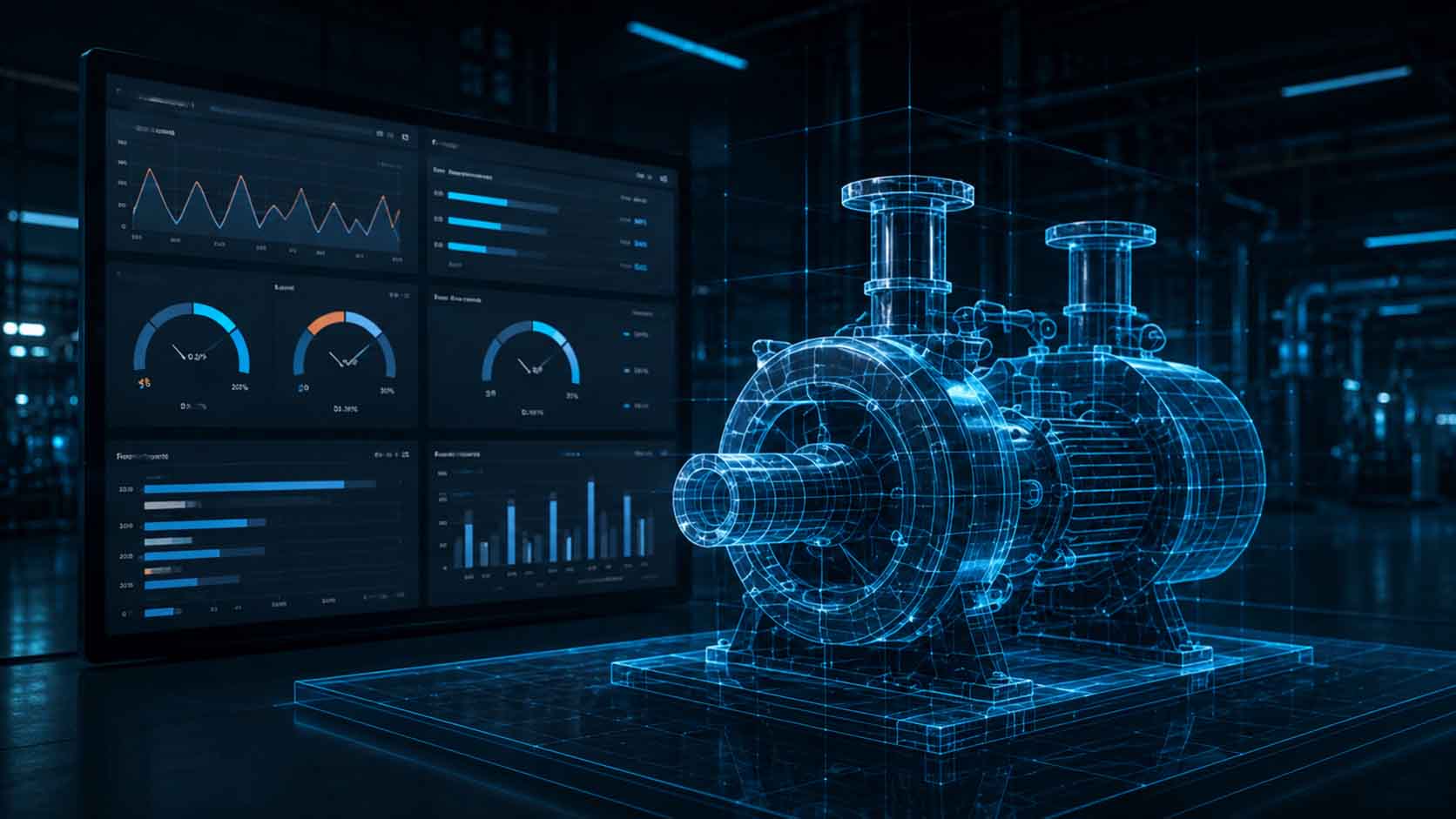
The visualization shows an intelligent digital twin that combines analytics, simulation, forecasting, and real-time data within a shared platform.
Visualization: AI-powered digital twin with analytics, simulation, predictive maintenance, automation, real-time data, and intelligent dashboards | Image: © Ulrich Buckenlei | VISORIC GmbH
The image in this chapter illustrates the fundamental transformation of modern digital twins. The focus is no longer exclusively on the virtual 3D model of a machine. Intelligent dashboards, analytical functions, and predictive models are added, generating new insights from continuously collected data. This creates systems that not only visualize processes but actively support them.
For companies, this opens entirely new possibilities. Production facilities can be continuously monitored, energy consumption can be optimized, and maintenance measures can be prepared automatically. At the same time, simulations can be performed before modifications are implemented in real-world systems. Decision-making increasingly relies on data-driven predictions rather than solely on experience.[35]
The Munich-based VISORIC expert team also sees this as the long-term evolution of digital twins. In the future, the decisive factor will no longer be the quality of the 3D model alone but the intelligent integration of real-time data, artificial intelligence, simulation, and spatial visualization. Only this combination transforms a digital twin into an active tool for analysis, planning, and optimization.
- AI extends digital twins with analytics and prediction capabilities
- Predictive maintenance reduces failures and maintenance costs
- Simulations support better decisions before real-world interventions
- Real-time data keeps digital twins continuously up to date
- Intelligent platforms combine visualization, analytics, and automation
As a result, digital twins become significantly more economical, powerful, and versatile. Artificial intelligence not only reduces the effort required to create them but simultaneously expands their value throughout the entire lifecycle of machines, industrial facilities, buildings, and infrastructure. This is where the true potential of the next generation of intelligent digital twins lies.
Why Digital Twins Are Experiencing Their Breakthrough Now
For a long time, digital twins were considered complex and highly specialized projects reserved for large industrial enterprises. The introduction of artificial intelligence fundamentally changes this situation. AI reduces the effort required for reality capture, automatically supplements missing information, accelerates 3D reconstruction, and supports the semantic processing of complex CAD and scan data. As a result, costs, development times, and barriers to entry are significantly reduced.
At the same time, the practical value of digital twins is expanding far beyond visualization. They support maintenance, remote service, training, production planning, and process optimization. Entire factories, buildings, infrastructure systems, and smart cities can now be digitized more economically than ever before. The digital twin itself is increasingly evolving into an intelligent system capable of analyzing, simulating, and predicting future developments.
The following NVIDIA video summarizes this development impressively. It demonstrates how artificial intelligence accelerates the entire creation process of digital twins while simultaneously providing the foundation for a new generation of intelligent industrial applications.
Video source: NVIDIA | Analysis, technological classification, storyline, and editorial work: © Ulrich Buckenlei | XR Stager Online Magazine | VISORIC GmbH
The real innovation lies not only in the automatic creation of high-quality 3D models. What truly matters is that digital twins become continuously more intelligent through artificial intelligence. They identify relationships, analyze operating conditions, support decision-making, and provide the foundation for automation, robotics, and future XR applications.
This development opens new opportunities, particularly for small and medium-sized enterprises. Companies no longer need to start with multi-million-euro digitalization projects. In many cases, a single digital twin of a machine, production line, or building is sufficient to create initial practical value and gradually establish a scalable digital infrastructure.
The Munich-based VISORIC expert team has been observing this development for many years. The most successful solutions are those in which reality capture, CAD data, artificial intelligence, real-time 3D, and XR technologies are combined into a shared platform. This is precisely where digital twins emerge that not only represent information but actively contribute to optimizing real-world processes.
- AI significantly reduces the effort required for reality capture and 3D reconstruction
- Digital twins become economically viable for industry and SMEs
- New applications emerge in maintenance, service, robotics, and XR
- Analytics, simulation, and prediction expand the value of digital twins
- The digital twin is evolving into an intelligent platform for industrial digitalization
Digital transformation no longer begins with a vision of the future. It begins with the first digital twin. Companies that digitize real-world processes today simultaneously create the foundation for artificial intelligence, automation, spatial computing, and the next generation of industrial applications.
Why Companies Should Start with Digital Twins Now
Digital twins are currently evolving from a specialized visualization technology into a central foundation of industrial digitalization. Artificial intelligence significantly reduces the effort required for data acquisition, 3D reconstruction, and model maintenance. As a result, digital twin projects are becoming economically viable not only for large corporations but increasingly also for small and medium-sized enterprises.
The key factor is not the introduction of a single technology but the gradual establishment of a digital infrastructure. Companies that digitize machines, buildings, production lines, or industrial facilities as digital twins today simultaneously create the foundation for artificial intelligence, automation, robotics, predictive maintenance, remote service, and future XR applications.
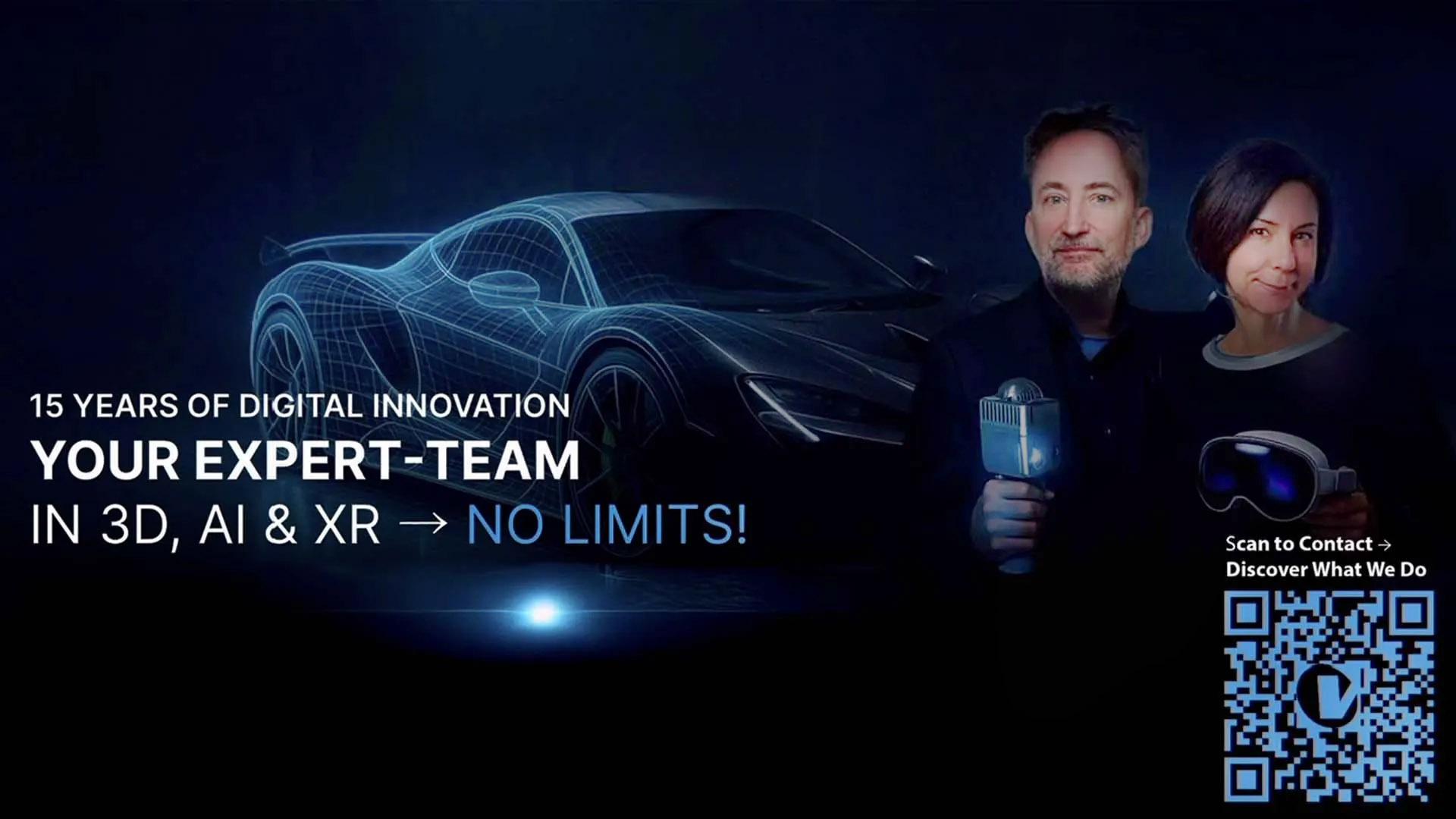
Digital twins provide the foundation for AI, automation, XR, and the next generation of intelligent industrial applications.
Visualization: Artificial intelligence, digital twins, real-time 3D, XR platforms, and industrial digitalization | © VISORIC GmbH | Munich
The real question is therefore no longer whether companies will adopt digital twins. The decisive question is when they will begin. Every digitized process expands the available data foundation and creates new opportunities for analytics, simulation, and intelligent assistance systems. Companies that start early create a sustainable competitive advantage for the years ahead.
The Munich-based VISORIC expert team supports companies in implementing this transformation in an economically viable and practical way. From reality capture and CAD integration to real-time 3D and AI-powered digital twins, scalable platforms are created that can flexibly adapt to existing processes and future requirements.
Companies that digitize their processes today create the foundation for artificial intelligence, automation, and future XR applications.
Whether an individual machine, a complete production line, a building, or an entire factory – every digital twin becomes another building block for the intelligent industry of tomorrow.
Are you planning a digital twin, a reality capture solution, or an AI-powered industrial platform?
Talk to the Munich-based VISORIC expert team about feasibility studies, concept development, prototyping, and the technical implementation of your digital twin strategy.
Contact us:
E-mail: info@visoric.com
Phone: +49 89 21552678
Address: Bayerstr. 13, 80335 Munich, Germany
Sources and References
- NVIDIA Omniverse – Industrial Digital Twins and AI Factory.
- McKinsey & Company – The Value of Digital Twins in Manufacturing.
- Deloitte Insights – Digital Twins and the Future of Smart Manufacturing.
- World Economic Forum – Digital Transformation of Industry.
- NavVis – Reality Capture and Mobile Mapping.
- Leica Geosystems – BLK2GO and Intelligent 3D Capture.
- Matterport – AI Spatial Data Platform.
- OpenAI Research – Generative AI and Automation.
- Microsoft AI – Copilot and AI-Assisted Productivity.
- Boston Consulting Group – Generative AI in Engineering.
- NVIDIA Research – Neural Reconstruction and AI Reconstruction.
- Epic Games – RealityCapture and Automated Mesh Generation.
- Autodesk Research – AI for Geometry Processing and Mesh Optimization.
- Siemens Digital Industries Software – Digital Twin Portfolio.
- Bentley Systems – Infrastructure Digital Twins.
- Autodesk Platform Services – AI and Digital Twin Integration.
- Fraunhofer IPA – Digital Twins for SMEs.
- PwC – Digital Factory and Smart Manufacturing.
- Deloitte – Smart Factory and Industry 4.0.
- Microsoft Mixed Reality – Remote Assist and Industrial Applications.
- PTC Vuforia – XR Service, Maintenance, and Remote Support.
- NVIDIA Omniverse – Robotics, Simulation, and Digital Twins.
- NVIDIA Omniverse – Industrial and Smart City Digital Twins.
- Bentley Systems – Infrastructure Intelligence.
- Esri – ArcGIS Digital Twins and Urban Analytics.
- NVIDIA AI Blueprint for Digital Twins.
- Microsoft Azure Digital Twins and AI Analytics.
- Siemens Industrial AI and Predictive Analytics.
- Original NVIDIA video material.
- NVIDIA Omniverse Platform.
- NVIDIA Isaac Sim and AI Factory.
- VISORIC practical projects in Digital Twins, XR, and AI.
- Unreal Engine – Real-Time 3D for Industrial Digital Twins.
- NVIDIA Omniverse Enterprise – Scalable AI and Digital Twin Platforms.
Contact Us:
Email: info@xrstager.com
Phone: +49 89 21552678
Contact Persons:
Ulrich Buckenlei (Creative Director)
Mobil +49 152 53532871
Mail: ulrich.buckenlei@xrstager.com
Nataliya Daniltseva (Projekt Manager)
Mobil + 49 176 72805705
Mail: nataliya.daniltseva@xrstager.com
Address:
VISORIC GmbH
Bayerstraße 13
D-80335 Munich