
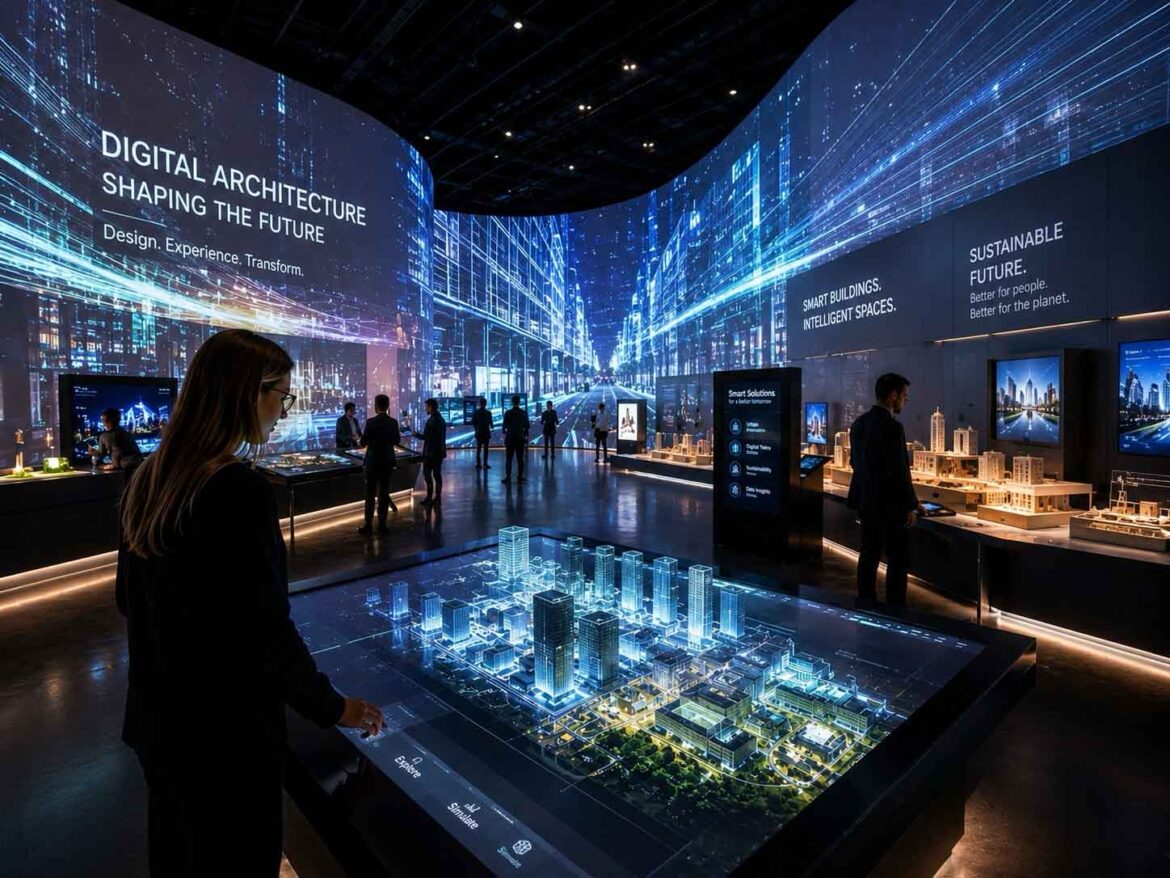
The concept illustration visualizes how digital architecture, artificial intelligence, spatial computing, and immersive media technologies could converge in the future to create intelligent experience environments, adaptive buildings, and new economic platforms.
Visualization: Digital architecture, immersive experience environments, intelligent buildings, spatial computing, artificial intelligence, digital twins, and programmable environments for business, cities, and society | Image: © Ulrich Buckenlei | VISORIC GmbH
What happens when buildings, spaces, and objects are no longer static, but can continuously evolve through software, artificial intelligence, and digital content? Walls, façades, display surfaces, projections, and physical objects are transforming into dynamic, programmable experience environments that can be repeatedly redesigned and adapted through digital content, holograms, and interactive technologies. Discover why this development is far more than entertainment and how digital architecture creates new business models and sustainable competitive advantages.
Digital architecture describes the convergence of physical architecture with software, real-time data, artificial intelligence, and immersive media technologies. Buildings are no longer merely constructed and designed but are increasingly programmed, extended, and continuously developed. This creates spaces that can communicate, respond, learn, and adapt to people, situations, and economic objectives.[1]
The cover image of this article visualizes exactly this transformation. Architecture no longer appears as a static shell but as an intelligent experience platform. Digital city models, interactive surfaces, immersive media façades, and adaptive information systems merge into an environment in which physical and digital reality become increasingly inseparable.
This transformation is already particularly visible today in hotels, restaurants, retail environments, museums, showrooms, corporate headquarters, and event venues. Rather than merely designing spaces, companies are increasingly creating dynamic experience environments that evoke emotions, communicate brands, actively engage visitors, and unlock new economic potential.[2]
At the same time, artificial intelligence is creating entirely new possibilities. In the future, spaces may recognize visitors, personalize content, interpret situations, and automatically adapt their atmosphere. As a result, architecture is becoming not only more digital but also more intelligent and increasingly autonomous. The boundaries between buildings, user interfaces, media platforms, and digital assistants are beginning to blur.[3]
Projects and concept developments by the Munich-based VISORIC expert team also demonstrate that the economic value of digital architecture emerges primarily where different technologies are intelligently combined. Projection mapping, real-time 3D, digital twins, spatial computing, XR, and artificial intelligence deliver their greatest value not in isolation but as a unified platform for communication, experiences, and business innovation.
The key question is therefore no longer whether digital architecture is technically feasible. Much more important is understanding which new business models, customer experiences, and sustainable competitive advantages companies can create through programmable spaces and intelligent environments.
- Buildings are evolving from static structures into programmable platforms
- Digital experience environments create new forms of economic value creation
- Artificial intelligence makes spaces adaptive and personalized
- Spatial computing connects physical and digital reality
- Digital architecture enables new business models and sustainable competitive advantages
This development becomes particularly exciting where experiences themselves become the actual architecture—and therefore the economic product.
When Experiences Become Architecture
For a long time, architecture was primarily understood as built form. A space had a fixed design, a defined function, and an atmosphere that could only be changed with significant effort. This understanding is now beginning to shift fundamentally through digital content, projection technologies, artificial intelligence, and interactive media. Spaces are no longer merely planned, constructed, and furnished. They can increasingly be staged, programmed, and continuously reactivated.[3]
This creates an entirely new quality of architecture. A restaurant can transform into an immersive experience environment in the evening. A hotel lobby can respond dynamically to visitors, brands, or events. A showroom can present different products, stories, and target audiences within the same physical space. Walls, façades, display surfaces, projections, and physical objects become dynamic media surfaces that extend far beyond traditional interior architecture.
The image in this chapter is intended to visualize exactly this transformation. It depicts a high-quality environment whose architecture is shaped not only by materials, lighting, and form, but also by digital content, projections, and adaptive media layers. The space does not appear as a technical demonstration but rather as an economically viable experience format for hospitality, retail, brand communication, culture, or corporate presentations.
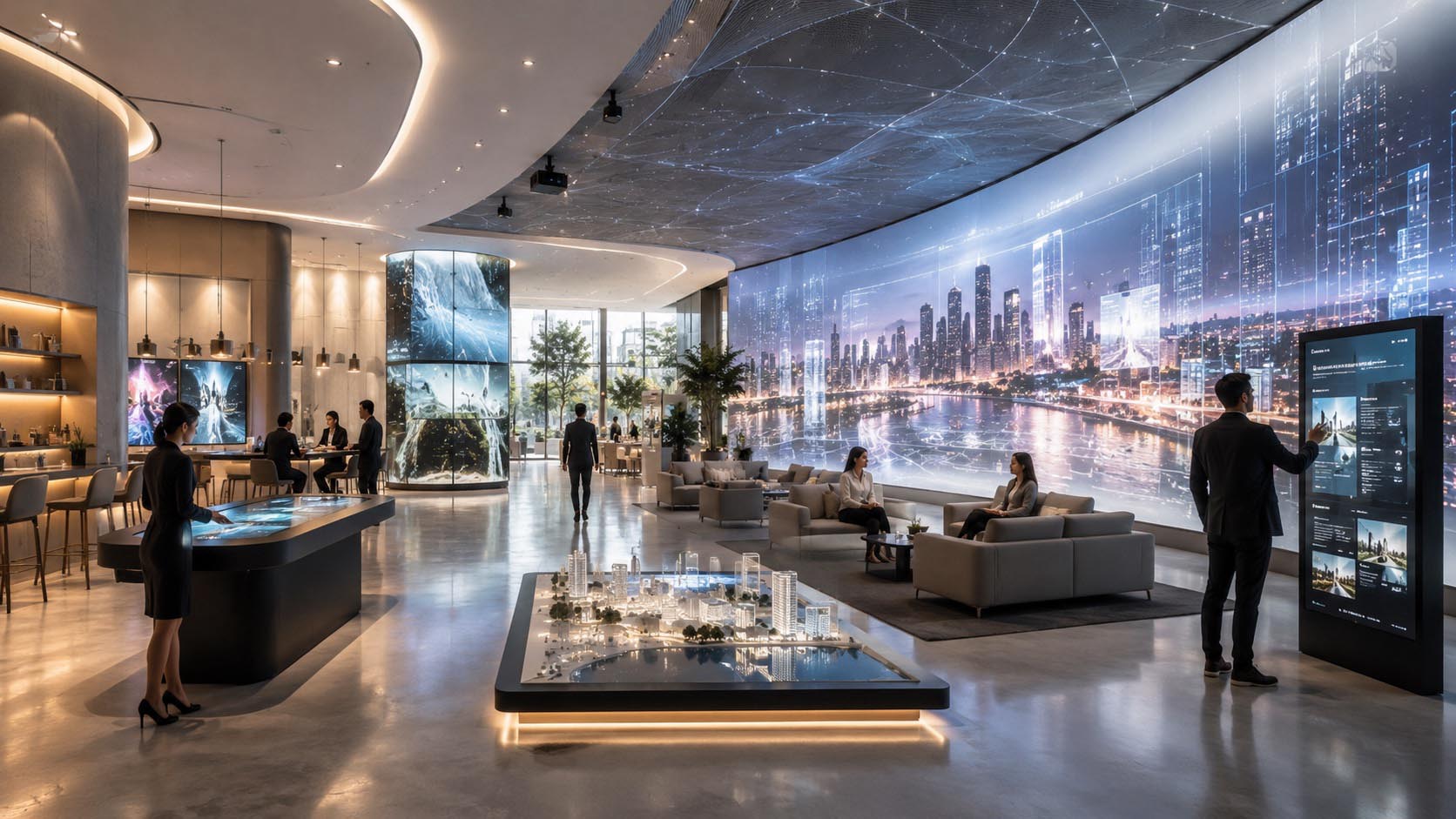
The concept image illustrates a modern experience environment in which architecture, projections, display surfaces, lighting, digital content, and interactive media merge into a programmable spatial brand and customer experience.
Visualization: Digital architecture, programmable spaces, immersive customer experiences, projection technologies, display surfaces, spatial computing, and AI-powered experience environments for hospitality, retail, culture, showrooms, and brand communication | Image: © Ulrich Buckenlei | VISORIC GmbH
From an economic perspective, this development becomes particularly interesting because experiences themselves become part of the offering. Customers no longer visit a location solely to purchase a product, use a service, or obtain information. They experience an environment that captures attention, intensifies emotions, and makes brand messages tangible in physical space. This represents one of the core concepts of the experience economy: companies create value not only through products and services, but through memorable and differentiating experiences.[3]
Digital architecture expands this concept through a new technological dimension. A physical space no longer has to maintain the same appearance permanently. It can change seasonally, react to campaigns, address different target groups, or support multiple business models. A single location can become multiple experience formats: a retail space, a stage, a training environment, a branded environment, an event venue, or an interactive information platform.
This creates an important strategic advantage for companies. While traditional architecture is often tied to long-term physical structures, digital architecture can be updated more quickly and adapted to changing requirements. Content can be modified, experiences expanded, and communication surfaces redesigned without requiring costly physical renovations. This creates a new combination of investment efficiency, flexibility, and reusability.
Especially in industries such as hospitality, retail, entertainment, culture, real estate, exhibition design, and corporate communications, this development may enable entirely new business models. Spaces become platforms where brands, products, services, and stories can be continuously reimagined and staged. Companies that intelligently design such environments create not only attention but also new opportunities for customer loyalty, differentiation, and revenue growth.[4]
Digital architecture is therefore far more than spectacular entertainment. It represents the transition from static spaces to programmable experience environments that can continuously evolve through software, artificial intelligence, digital content, and interactive technologies.
- Spaces are becoming programmable experience platforms
- Digital content expands traditional architecture with flexible layers of use
- Projections, display surfaces, and holograms create new communication environments
- Companies can adapt experiences more quickly to campaigns, target groups, and business models
- Digital architecture creates differentiation, customer loyalty, and new economic opportunities
This transformation becomes particularly evident where spaces themselves become media, and where walls, façades, projections, and displays are no longer merely decorative elements but active communication and experience surfaces.
When Restaurants, Hotels, and Spaces Become Media Platforms
Digitalization is not only transforming products, services, and communication channels. It is increasingly redefining the role of physical spaces themselves. Restaurants, hotels, showrooms, event venues, and public spaces are evolving from static environments into dynamic media platforms capable of changing content, atmosphere, and experiences in real time.[5]
This transformation is particularly visible where projection technologies, LED walls, digital display surfaces, real-time visualization, and interactive media become integral parts of architecture. Spaces no longer serve merely as a backdrop for experiences. They become the actual medium through which brands communicate, stories are told, and customers are emotionally engaged.
The image in this chapter is intended to visualize exactly this transformation. It depicts a premium restaurant, hotel, or experience environment whose atmosphere is no longer created solely through materials and interior design, but through digital content, projections, and programmable media surfaces. The space no longer possesses a fixed identity but can continuously adapt to new target audiences, themes, or business models.
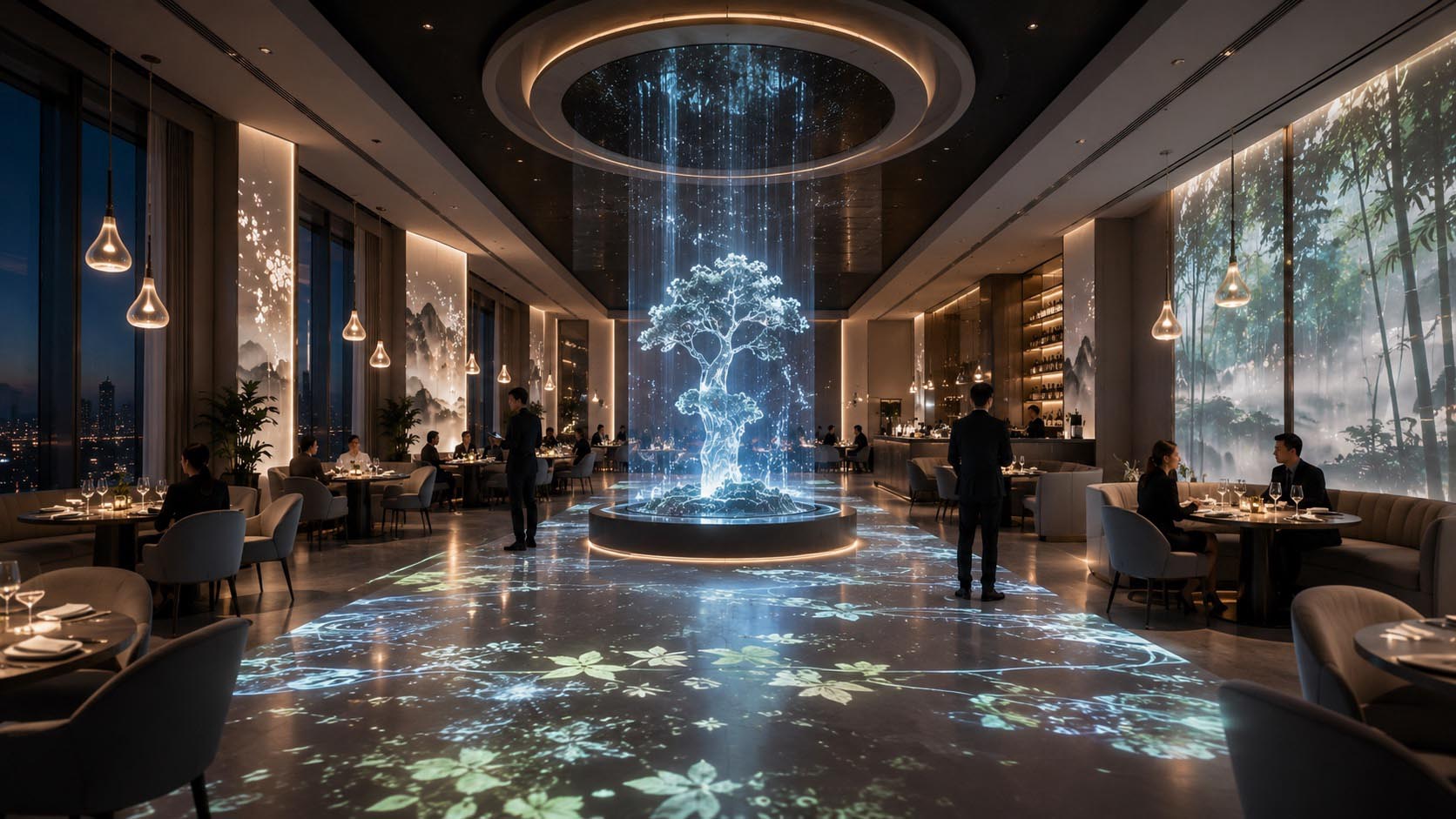
The concept image illustrates an immersive experience environment in which architecture, projections, display surfaces, and digital content merge into a dynamic media and brand platform.
Visualization: Digital architecture, immersive hospitality, programmable experience environments, projection technologies, LED media surfaces, real-time visualization, and interactive brand experiences | Image: © Ulrich Buckenlei | VISORIC GmbH
International projects already demonstrate the economic potential of this development. Immersive restaurants create entirely new dining experiences. Hotels develop adaptive experience environments for different guest groups. Retailers transform sales spaces into interactive brand worlds that go far beyond traditional product presentation.[6]
As a result, the economic function of physical spaces is also changing. In the future, a space will no longer have to fulfill only one purpose. The same environment can serve as a workspace in the morning, a showroom during the day, an event venue in the evening, and simultaneously function as a digital experience platform. The actual value creation no longer results solely from the physical space itself but from the experiences, content, and interactions generated within that space.
This development becomes particularly compelling due to the growing flexibility of digital architecture. Content can be adapted in real time, seasonal campaigns integrated, brand experiences updated, and entirely new experiences created without requiring physical reconstruction. This creates significant advantages in terms of investment protection, adaptability, and economic efficiency.
The Munich-based VISORIC expert team has also observed for years how companies are increasingly seeking ways to make physical spaces more flexible, emotional, and economically attractive. The most exciting projects often emerge precisely at the intersection of architecture, real-time visualization, spatial computing, and artificial intelligence.
- Spaces are evolving from static environments into dynamic media platforms
- Projections, LED surfaces, and digital content create new experience worlds
- A single physical space can support multiple business models simultaneously
- Digital content can be updated flexibly and economically
- Immersive customer experiences are becoming a key competitive advantage
Once spaces themselves become media, the next question inevitably arises: What happens when not only spaces, but also physical objects begin to develop their own digital identity and personality?
When Objects Develop Digital Personalities
The digitalization of physical spaces is only the first step in a much larger transformation. Increasingly, individual objects themselves are becoming the focus. Sculptures, products, exhibits, branded objects, and even everyday items are beginning to develop their own digital identities through projections, artificial intelligence, and interactive technologies.[7]
What has often been perceived as a spectacular light installation or artistic performance may, in the long term, evolve into a completely new form of human-object interaction. Physical objects are no longer merely observed. They can convey emotions, respond to people, tell stories, and continuously adopt new roles through digital content.
The image in this chapter is intended to visualize exactly this transformation. A physical sculpture or object no longer appears as a static artifact but as a living digital personality. Projections, facial expressions, animations, and interactive content create the impression that the object itself possesses character, emotions, and its own identity.
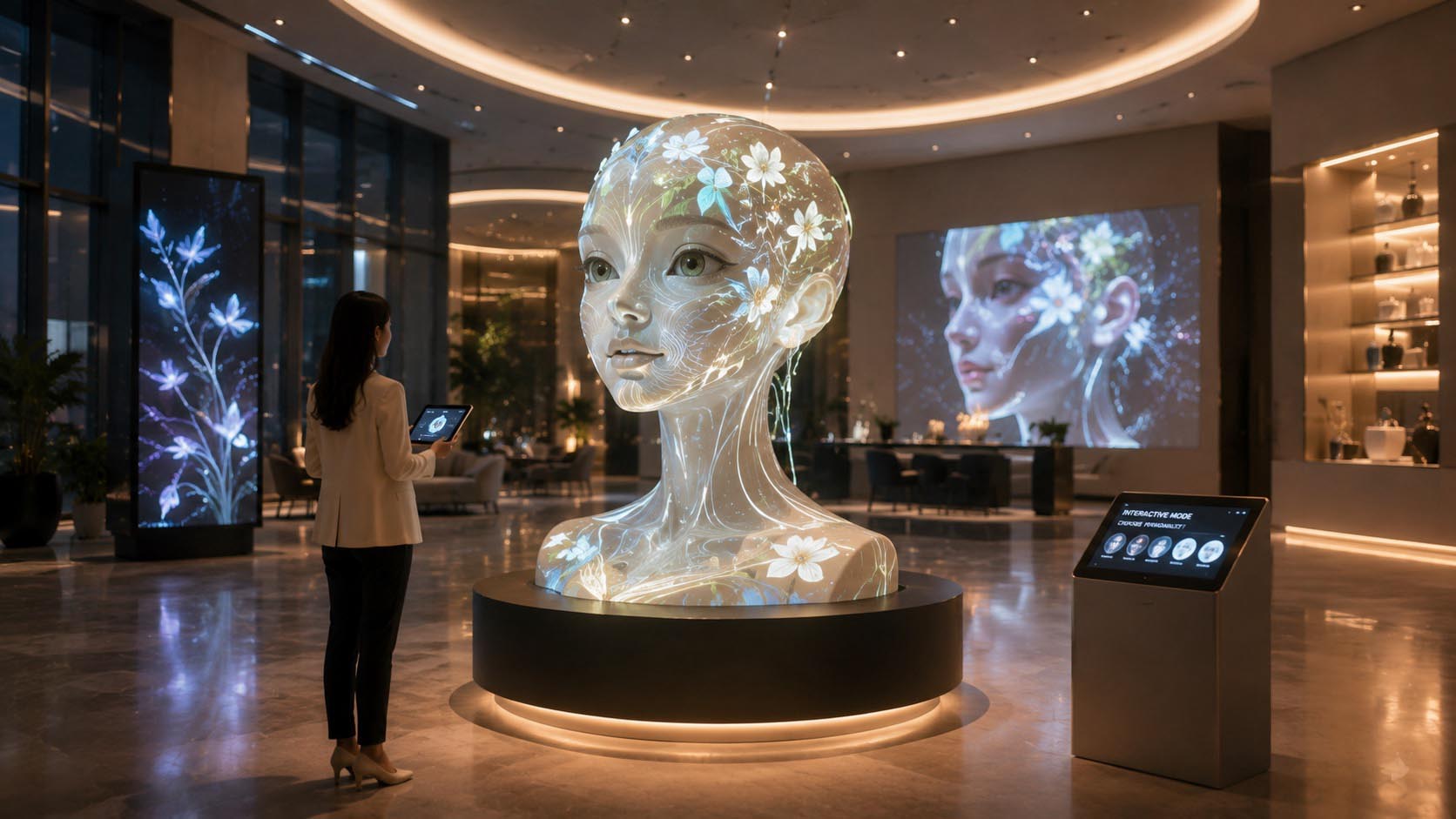
The concept image illustrates how physical objects become interactive and emotional experience artifacts through projections, digital content, and artificial intelligence.
Visualization: Digital personalities, interactive objects, projection technologies, artificial intelligence, immersive media experiences, and adaptive physical environments | Image: © Ulrich Buckenlei | VISORIC GmbH
The impact of such systems is based on a fundamental principle of immersive media: people do not respond solely to technical perfection but primarily to perceived presence, interaction, and emotional engagement.[8] Even simple projections can create the impression that an object is alive, thinking, or reacting to its surroundings. As artificial intelligence becomes increasingly integrated, entirely new forms of digital interaction emerge.
This development becomes particularly exciting when physical objects are permanently connected to digital systems. Museum exhibits could speak with visitors. Branded products could tell individualized stories. Store mannequins could react to customers. Sculptures could store memories, learn behaviors, and continuously evolve their personalities.
This creates an entirely new layer of digital architecture. Not only spaces become programmable, but also the objects within those spaces. Architecture, media, interaction, and artificial intelligence begin to merge, creating experiences that can continuously change and adapt.
The Munich-based VISORIC expert team is also observing this development with great interest. The true innovation often lies not in the projection technology itself, but in the question of how physical objects can become emotionally engaging and economically relevant experience platforms through digital content, artificial intelligence, and interactive systems.
- Physical objects develop digital identities and personalities
- Projections and AI create emotional and interactive experiences
- Objects can tell stories and respond to people
- Museums, retail, hospitality, and brand experiences gain new forms of interaction
- The boundaries between object, media platform, and digital assistant begin to blur
If objects can develop their own digital identities, the next question arises: What happens when entire spaces are no longer merely designed, but can be fully programmed and redefined at any time?
The Programmable Identity of Physical Spaces
The digitalization of spaces does not end with projections, display surfaces, or interactive installations. The real transformation begins when physical spaces lose their fixed identity and become programmable environments. A space no longer possesses just one function, one design, or one atmosphere. It can change, adapt, and assume different roles at any time.[9]
This development fundamentally changes how architecture is understood. A restaurant can be completely reimagined depending on the time of day, target audience, or event. A hotel can create different experience environments for different guests. A showroom can dynamically present products, brands, and stories without changing the underlying physical architecture itself.
The image in this chapter is intended to visualize exactly this concept. A single physical space appears simultaneously in multiple digital identities. Through projections, display surfaces, holograms, and digital content, different atmospheres, usage scenarios, and emotional experiences emerge, even though the underlying architecture remains unchanged.
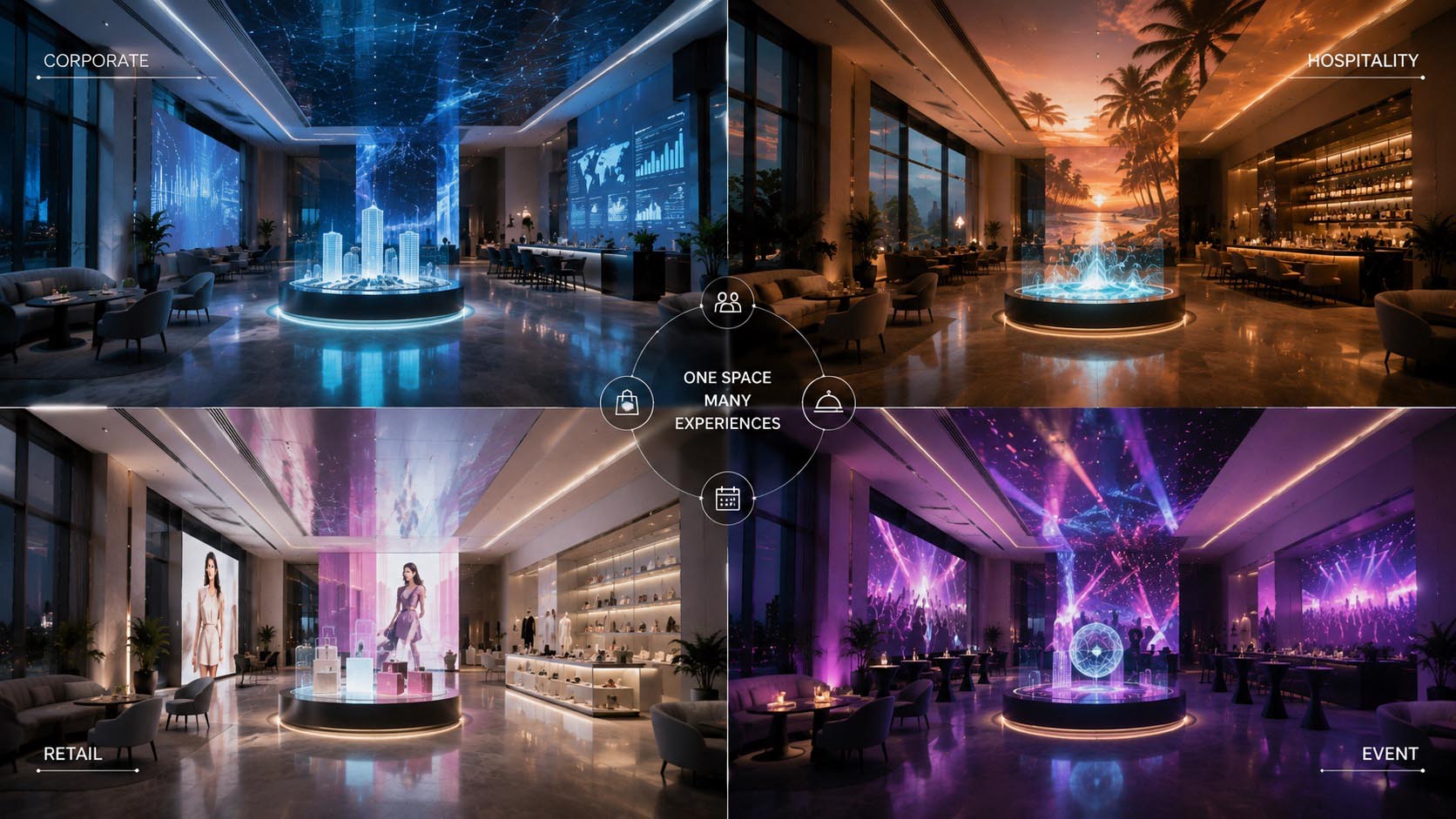
The concept image illustrates how a physical space can assume different identities and usage scenarios through digital content, projections, display surfaces, and artificial intelligence.
Visualization: Programmable architecture, adaptive experience environments, digital identities, projection technologies, holograms, spatial computing, and interactive media worlds | Image: © Ulrich Buckenlei | VISORIC GmbH
This represents one of the greatest economic advantages of digital architecture. A space no longer needs to be optimized for a single purpose. Instead, it becomes a flexible platform capable of adapting to different business models, target groups, and usage scenarios. Value creation increasingly shifts from physical infrastructure to digital experiences and content.[10]
This development becomes even more compelling through artificial intelligence. In the future, spaces may respond to visitors, personalize content, recognize moods, or automatically adapt to specific usage situations. Architecture itself evolves from a static environment into an active communication and interaction partner.
For companies, this creates entirely new opportunities for differentiation. Hotels can provide personalized stays. Retailers can dynamically adapt their sales environments. Museums can generate changing experience worlds. Corporate spaces can switch between presentation, collaboration, training, and event formats without requiring physical renovations.
The Munich-based VISORIC expert team has also observed that the most exciting innovation potential no longer emerges exclusively from new buildings, but increasingly from the ability to continuously redefine existing spaces through digital technologies. The architecture of the future may therefore be shaped less by concrete, glass, and steel, and increasingly by software, data, and intelligent content.
- Physical spaces evolve into programmable platforms
- A single space can adopt multiple identities and usage scenarios
- Digital content creates new forms of spatial experiences
- Artificial intelligence enables adaptive and personalized environments
- Companies gain flexibility, differentiation, and new business models
If spaces can assume different identities, the next question emerges: What happens when these spaces become not only programmable, but also self-learning and interactive through artificial intelligence?
The AI Layer – When Spaces Become Intelligent
The true revolution of digital architecture does not begin with projections, displays, or immersive media surfaces. It begins where artificial intelligence extends digital spaces with behavior, interaction, and decision-making capabilities. As a result, spaces become not only programmable, but increasingly intelligent.[11]
While digital architecture today often still relies on static content or predefined workflows, modern AI systems already enable adaptive and context-aware interactions. Spaces can respond to people, interpret information, personalize content, and adapt their digital appearance to situations, user groups, or individual preferences.
The image in this chapter is intended to visualize exactly this transformation. An intelligent experience environment recognizes its visitors, interprets their interests, and dynamically adapts digital content, projections, avatars, and interactive elements. Architecture itself becomes an active communication partner.
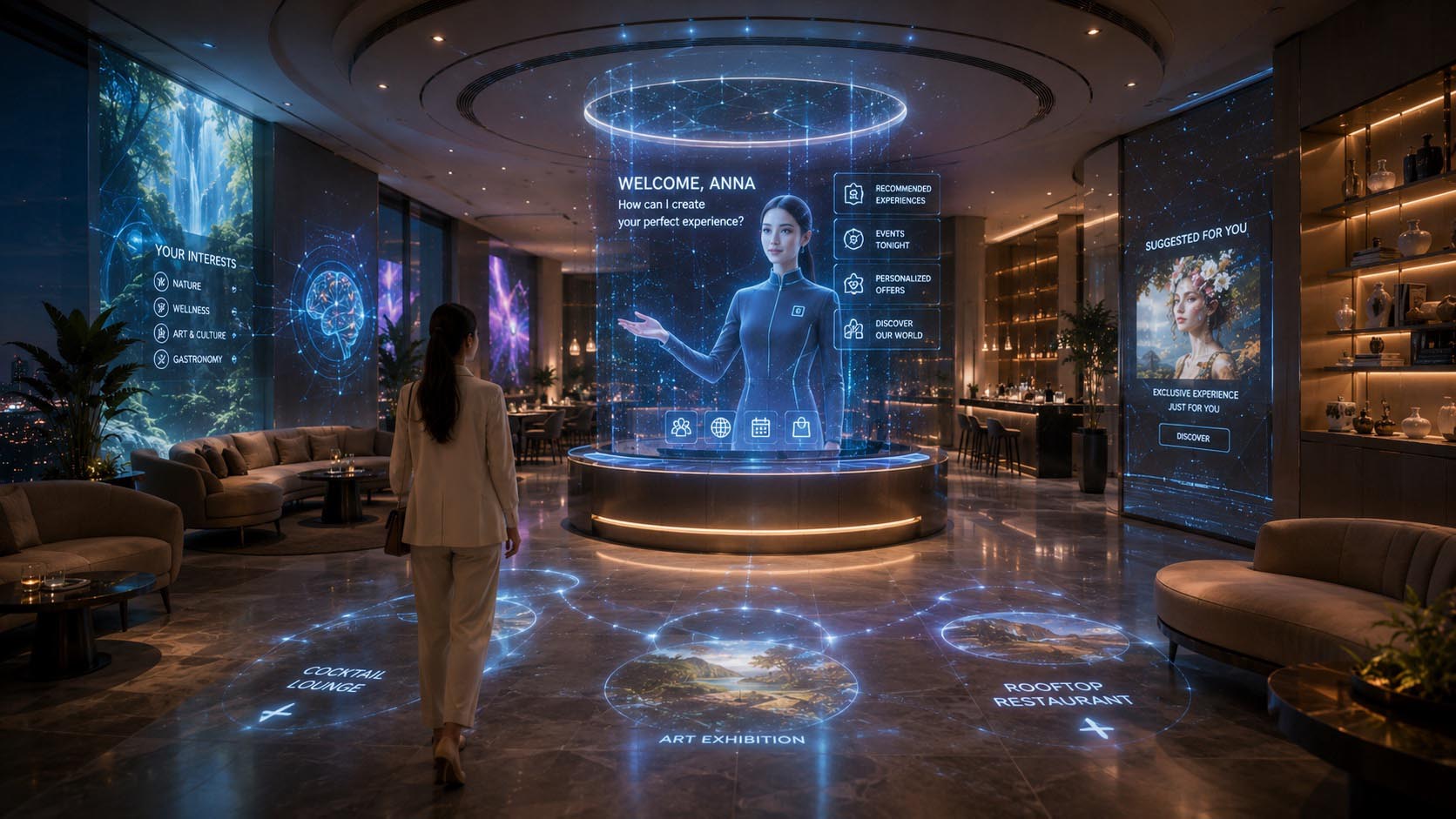
The concept image illustrates an intelligent experience environment that dynamically adapts digital content, projections, avatars, and interactive elements to its users through artificial intelligence.
Visualization: Artificial intelligence, multimodal interaction, intelligent spaces, adaptive environments, digital avatars, spatial computing, and interactive architecture | Image: © Ulrich Buckenlei | VISORIC GmbH
This development becomes particularly exciting through multimodal AI systems. Speech, gaze direction, gestures, spatial positioning, and contextual information can all be processed simultaneously. This creates entirely new forms of human-space interaction. Spaces are no longer merely observed or utilized; they begin to actively communicate with people.[12]
A hotel room could automatically adapt to a guest’s preferences. A museum could generate personalized guided tours. A showroom could present products based on interests and behavior. A restaurant could dynamically adjust its atmosphere according to the occasion, time of day, or visitor groups. The true innovation emerges not from individual technologies, but from their intelligent integration.
This fundamentally changes the economic significance of physical spaces. Companies no longer create merely standardized environments but adaptive experience platforms that can continuously evolve. Customer experiences become personalized, processes become optimized, and physical spaces become significantly more flexible.
The Munich-based VISORIC expert team has also observed that the greatest innovation potential lies not only in immersive technologies themselves, but increasingly in the integration of artificial intelligence. The combination of AI, digital architecture, spatial computing, and interactive media may ultimately give rise to a new generation of intelligent environments.
- Artificial intelligence makes digital architecture adaptive and capable of learning
- Spaces can respond to people, situations, and contextual information
- Multimodal AI enables natural interactions with physical environments
- Personalized experiences create new economic opportunities
- The boundary between space, media platform, and digital assistant begins to blur
As spaces become intelligent, the next question arises: What role will XR, augmented reality, and spatial computing play when digital content is no longer merely projected, but directly integrated into human perception?
XR, Spatial Computing, and Digital Architecture
The digitalization of physical spaces does not necessarily have to remain limited to projections, display surfaces, or permanently installed media systems. With the emergence of modern XR technologies and spatial computing, a new layer of digital architecture is being created in which digital content is integrated directly into human perception.[13]
While projections and media façades extend physical surfaces, augmented reality and spatial computing enable the creation of entirely new spatial layers. Digital objects, information, avatars, and interactive content no longer appear on screens but become part of the real environment itself. This creates an architecture that exists simultaneously in physical and digital dimensions.
The image in this chapter is intended to visualize exactly this transformation. People move through a real environment that is enhanced through spatial computing, augmented reality, and digital content. Holographic objects, interactive information surfaces, and digital characters merge with physical architecture to create a shared experience environment.
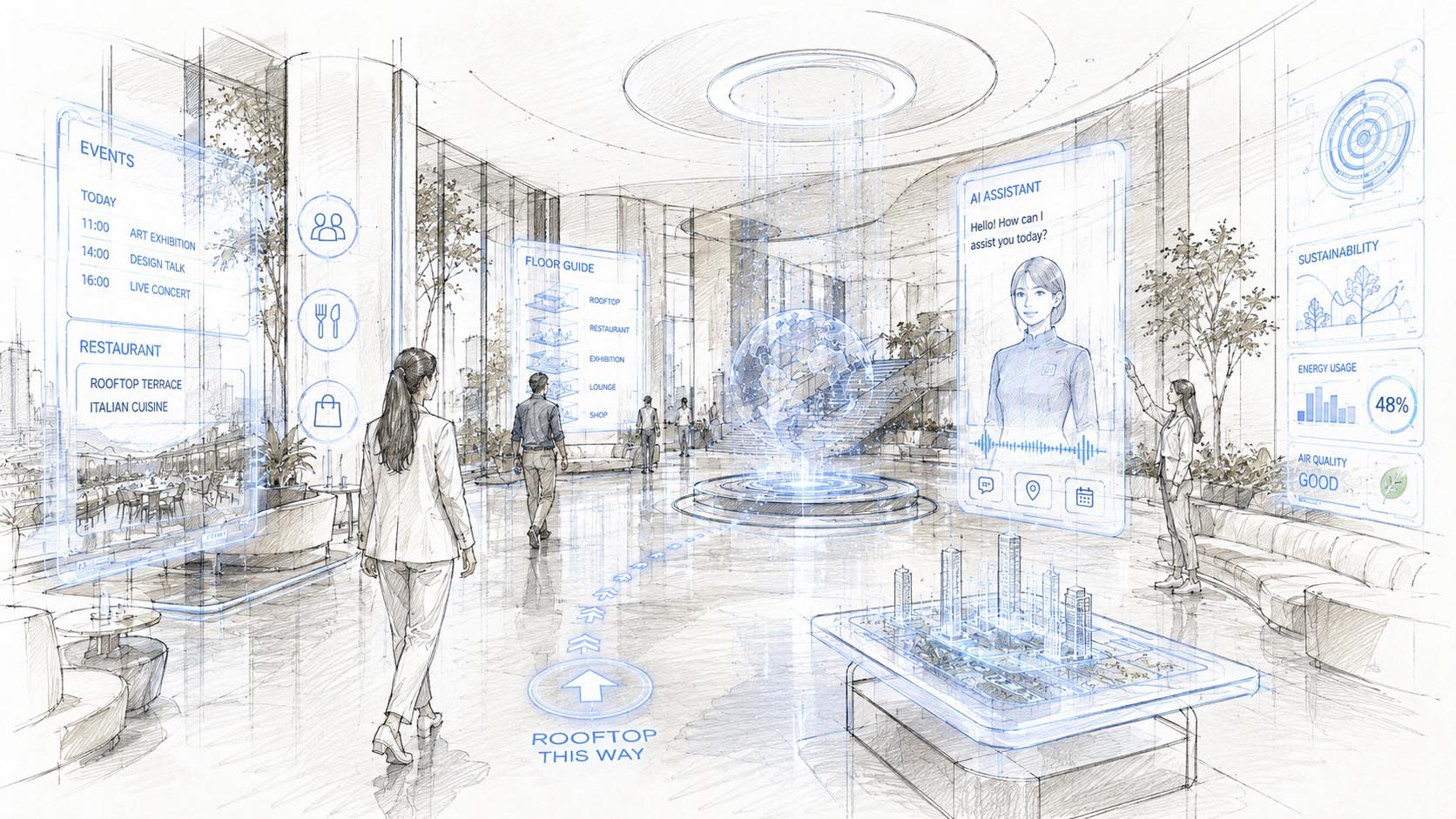
The concept image illustrates how spatial computing, augmented reality, and digital content extend physical architecture with interactive and intelligent experience environments.
Visualization: Spatial computing, augmented reality, XR, digital architecture, holographic user interfaces, intelligent spaces, and immersive interaction systems | Image: © Ulrich Buckenlei | VISORIC GmbH
What makes this development particularly exciting is the fact that digital architecture no longer has to appear identical to everyone. Different users can perceive completely different information, content, and experiences within the same physical environment. Architecture therefore evolves from a static environment into a personalized and context-dependent experience.[14]
A museum could display individualized information to each visitor. A hotel guest could receive personalized services and digital assistants. A service technician could see technical information directly attached to machinery. A showroom could dynamically adapt products and content according to interests, language, or level of expertise.
This creates not only new forms of interaction but also entirely new economic opportunities. In the future, companies may no longer need to create separate physical spaces for every target audience. Instead, digital layers within the same architectural environment can enable different customer experiences, services, and business models.
The Munich-based VISORIC expert team has also observed that the most exciting developments in spatial computing are not limited to new hardware devices. The true transformation emerges where physical architecture, digital content, artificial intelligence, and human perception converge into a unified spatial platform.
- Spatial computing extends physical spaces with digital layers
- Augmented reality makes information spatially accessible
- Digital architecture becomes personalized and context-dependent
- A single space can appear completely different to different users
- New forms of interaction create additional business models and competitive advantages
As digital architecture, artificial intelligence, and spatial computing continue to converge, the key question becomes: What new business models and sustainable competitive advantages will emerge for companies?
New Business Models and Sustainable Competitive Advantages
The technological evolution of digital architecture would have little economic relevance if it did not simultaneously enable new business models and sustainable competitive advantages. Yet this may represent its greatest potential. Buildings, spaces, and physical objects are increasingly evolving from static capital assets into dynamic platforms for experiences, communication, services, and value creation.[15]
While traditional architecture often remains unchanged for decades, digital architecture enables continuous adaptation to changing customer needs, markets, and business models. Spaces can address different target groups, communicate new content, and flexibly adapt to economic changes. This creates a new form of investment in which not only physical infrastructure but also its digital extensibility and reusability become increasingly important.
The image in this chapter is intended to visualize exactly this economic perspective. Different industries, including hospitality, retail, industry, culture, entertainment, education, and corporate communications, become interconnected through programmable spaces, digital experiences, and intelligent interactions. The real innovation lies not in a single technology but in the emergence of entirely new economic ecosystems.
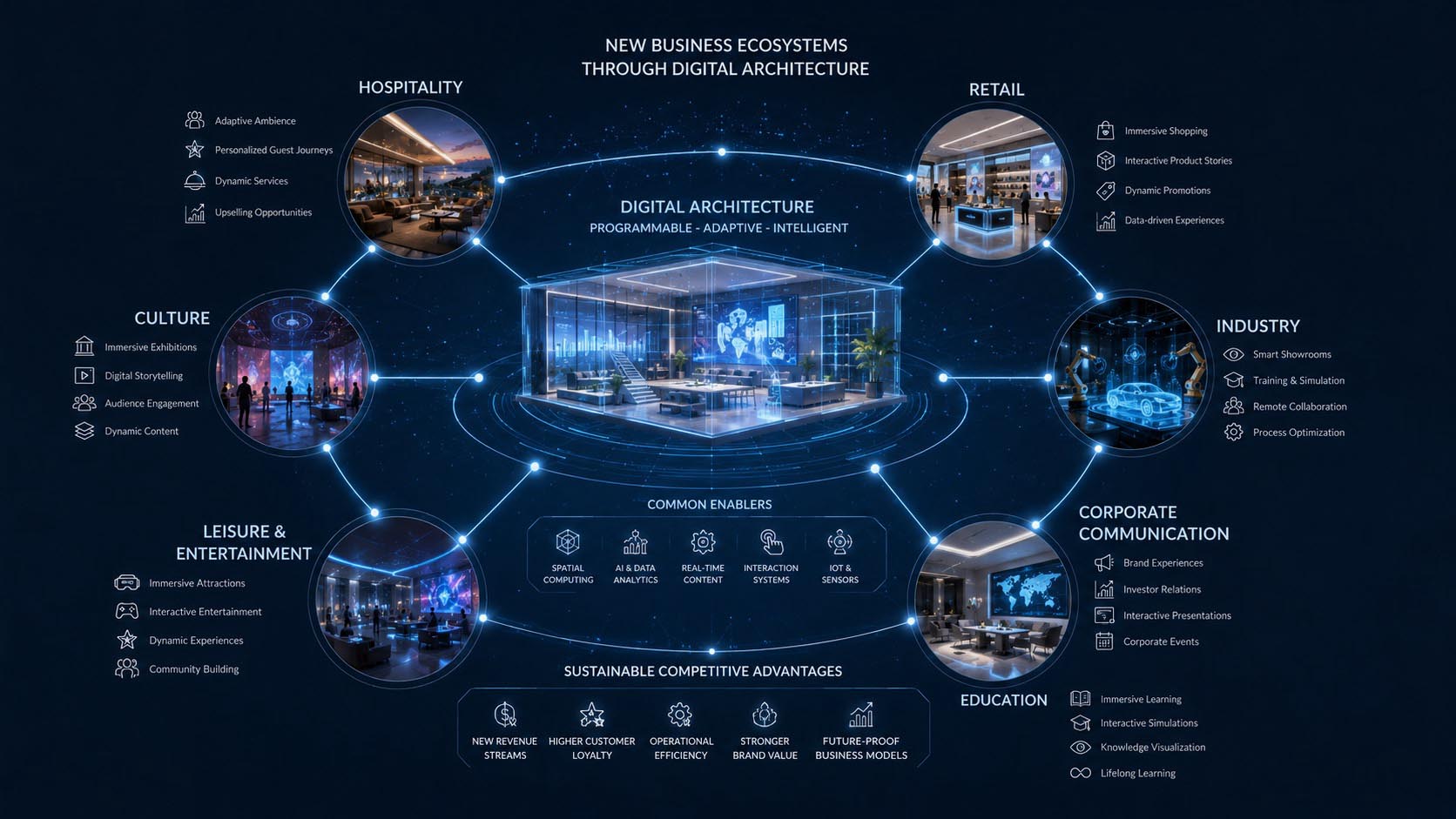
The concept image illustrates how digital architecture enables new business models, customer experiences, and sustainable competitive advantages across various industries.
Visualization: Digital architecture, new business models, programmable experience environments, hospitality, retail, industry, culture, spatial computing, and intelligent customer experiences | Image: © Ulrich Buckenlei | VISORIC GmbH
This transformation becomes particularly evident in the experience economy. Customers increasingly expect personalized, interactive, and emotional experiences. Companies therefore compete not only through products, pricing, or services, but increasingly through the quality and uniqueness of customer experiences.[16]
Digital architecture creates entirely new possibilities in this context. Hotels can create personalized guest experiences. Restaurants can dynamically adapt their atmosphere. Museums can generate individualized experience worlds. Retailers can continuously transform sales environments and make brands emotionally tangible. Companies can flexibly use presentation, training, and communication spaces for different audiences.
In addition, entirely new business models are emerging that were previously difficult to realize. Spaces can be operated as services, content can be continuously updated, digital experiences can be rented, and personalized premium services can be offered. Value creation increasingly shifts from one-time investments toward ongoing digital services and recurring revenue models.
The Munich-based VISORIC expert team has also observed that companies are increasingly asking not about individual technologies, but about sustainable competitive advantages. The decisive question is no longer which projection technology, AI system, or XR hardware is used. The real question is how physical spaces can become more flexible, economically efficient, and attractive through digital technologies over the long term.
- Digital architecture creates new business models and revenue streams
- Customer experiences become a key competitive advantage
- Physical spaces can be used flexibly and economically for multiple purposes
- Personalization and interaction increase customer loyalty and brand value
- Value creation increasingly shifts toward digital services and experiences
The key question is therefore no longer whether digital architecture will become economically relevant. Much more exciting is the question of how our buildings, cities, and physical environments will evolve when they are understood as programmable and intelligent platforms.
The Future of Programmable Reality
The development of digital architecture is likely still in its early stages. Today, programmable spaces, interactive objects, artificial intelligence, and spatial computing often appear as separate technologies or spectacular demonstrations. In the long term, however, they may converge into a shared technological infrastructure that fundamentally changes our understanding of buildings, cities, and physical environments.[17]
When physical spaces can be defined through software, controlled by artificial intelligence, and extended through digital content, a new form of programmable reality emerges. Buildings, spaces, and objects are no longer static constructions but dynamic platforms that can continuously adapt to people, situations, and requirements.
The image in this chapter is intended to visualize exactly this future. An intelligent urban landscape combines architecture, digital media, projections, holographic content, artificial intelligence, and spatial computing into a unified experience and information environment. The boundaries between physical and digital reality increasingly begin to dissolve.
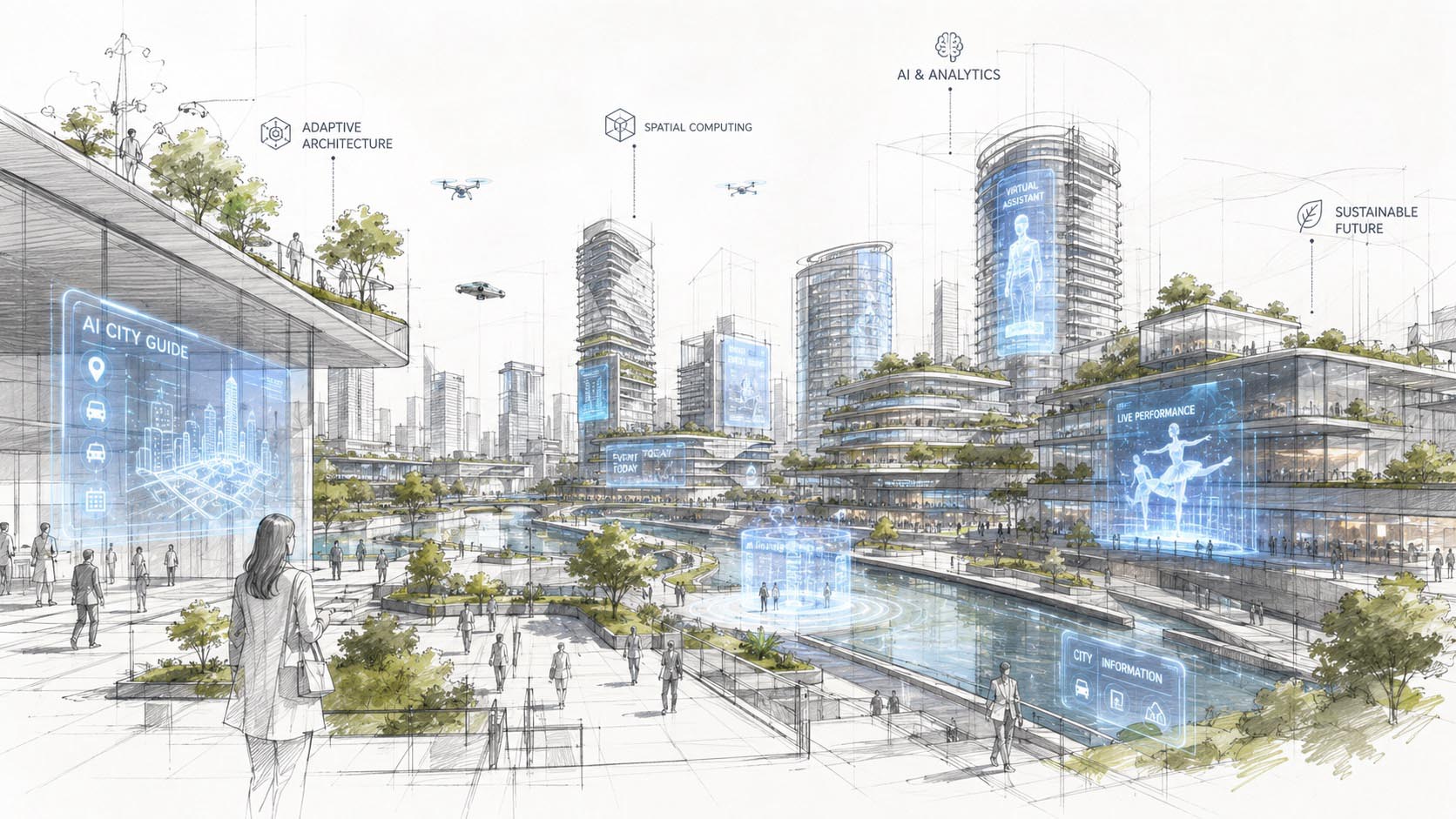
The concept image illustrates a future urban environment in which digital architecture, artificial intelligence, spatial computing, and interactive media converge into a shared programmable reality.
Visualization: Programmable reality, intelligent cities, digital architecture, artificial intelligence, spatial computing, holographic content, and adaptive experience environments | Image: © Ulrich Buckenlei | VISORIC GmbH
This development becomes particularly interesting because digital content can increasingly become personalized and context-dependent. Different individuals may experience different information, services, and experiences within the same physical environment. Architecture therefore evolves from a universal infrastructure into an individualized, dynamic, and intelligent experience.[18]
An airport could automatically adapt to different travelers. Cities could display information depending on the current situation. Museums could create personalized experiences. Companies could flexibly adapt workspaces, learning environments, and experience spaces to people, tasks, and business models. The real innovation emerges not through individual devices or applications, but through the ability to intelligently connect physical and digital reality.
In the long term, this may fundamentally change our understanding of architecture itself. Buildings will no longer be merely designed and constructed. They will increasingly be configured, updated, and continuously developed. Digital content, artificial intelligence, and interactive systems will become an integral part of architectural planning and economic value creation.
The Munich-based VISORIC expert team has also observed that the discussion is increasingly shifting away from individual technologies toward more fundamental questions. How will people interact with their environments in the future? What role will artificial intelligence and digital content play? And what new economic opportunities will emerge when physical spaces become programmable?
- Buildings, spaces, and objects evolve into programmable platforms
- Artificial intelligence enables adaptive and personalized environments
- Spatial computing connects physical and digital reality
- Architecture is increasingly extended through software and data
- New business models emerge through intelligent experience and interaction environments
The central thesis of this article is therefore: The most economically successful buildings, spaces, and physical products of the future may no longer be merely constructed, but increasingly programmed, personalized, and continuously developed.
When Digital Architecture Becomes an Economic Platform
The examples presented in this article demonstrate that digital architecture extends far beyond spectacular projections or visual effects. When buildings, spaces, and physical objects are enhanced through software, artificial intelligence, and digital content, entirely new forms of economic value creation emerge. Architecture increasingly becomes a programmable platform for communication, experiences, interaction, and business development.
This transformation is particularly visible in hospitality, retail, entertainment, culture, education, and corporate communications. Today, spaces can dynamically respond to visitors, times of day, events, and individual preferences. Instead of static architecture, adaptive experience environments emerge that can continuously evolve and transform.
The following example from Chongqing illustrates this development particularly well. The true innovation does not lie solely in the projection technology itself, but in the transformation of an ordinary physical space into an entirely new emotional and economic experience. Guests no longer simply visit a location. They experience a staged reality that combines atmosphere, identity, and value creation.
Video source: @projection_mapping_world | Original project and visual realization by the respective creators and production teams | Analysis, technological classification, storyline, and editorial work: © Ulrich Buckenlei | XR Stager Online Magazine | VISORIC GmbH
The economic significance of this development is often underestimated. As soon as experience environments become programmable, entirely new business models emerge. Restaurants no longer sell only food, hotels no longer sell only overnight stays, and retailers no longer sell only products. Instead, emotional, personalized, and digital experience environments are created that enable additional value creation, stronger customer loyalty, and more powerful brand identities.
At the same time, artificial intelligence is evolving into the next layer of digital architecture. In the future, spaces may recognize visitors, interpret situations, personalize content, and automatically adapt their atmosphere. Digital identities, language models, holographic content, and intelligent assistance systems may become integral components of physical environments.
The Munich-based VISORIC expert team has also observed that the boundaries between architecture, media, artificial intelligence, and spatial computing are increasingly dissolving. The key question is no longer whether digital architecture is technically feasible. What matters far more is which economic advantages, business models, and competitive advantages companies can create from it.
- Experience environments are evolving into economic platforms
- Architecture becomes programmable through software, media, and AI
- Digital content creates new revenue streams and business models
- Personalized spaces increase customer loyalty and brand value
- AI and spatial computing extend physical environments with intelligent interaction
The central insight is therefore: The most successful buildings, spaces, and physical products of the future may no longer be merely constructed. They will be programmed, continuously developed, and transformed into intelligent economic platforms.
From Digital Experience Environments to Sustainable Competitive Advantages
The development of digital architecture demonstrates that immersive experience environments are no longer merely spectacular installations or temporary marketing campaigns. Programmable spaces, intelligent objects, digital twins, artificial intelligence, and spatial computing are increasingly becoming strategic tools for customer loyalty, brand communication, and new business models.
This development becomes particularly interesting where digital architecture is understood not as a standalone installation but as a long-term strategic platform. Restaurants, hotels, showrooms, retail spaces, corporate headquarters, museums, events, and public spaces can continuously be enhanced through digital content, projections, real-time data, and artificial intelligence. This creates experience environments that are flexibly adaptable, economically scalable, and capable of delivering long-term differentiation.
At this exact intersection, the Munich-based VISORIC expert team develops customized concepts for digital architecture, immersive experience environments, spatial computing applications, digital twins, and AI-powered interaction systems. The focus lies on solutions that make real-world environments more intelligent, create new customer experiences, and simultaneously generate sustainable economic value.

The VISORIC expert team develops digital architecture, immersive experience environments, spatial computing applications, digital twins, and AI-powered interaction systems for industry, retail, hospitality, culture, and brand communication.
Visualization: Digital architecture, immersive experience environments, spatial computing, AI-powered interaction systems, digital twins, and programmable environments | © VISORIC GmbH | Munich
The most exciting innovations are currently emerging where physical spaces and digital technologies converge. Buildings become media platforms. Objects acquire digital identities. Spaces respond to visitors, data, and business processes. At the same time, entirely new opportunities arise for customer interaction, knowledge transfer, brand experiences, and economic value creation.
VISORIC supports companies from the initial idea through strategic concept development, feasibility studies, and prototyping to technical implementation and the long-term operation of digital experience platforms. This includes digital twins, projection mapping, interactive media installations, holographic systems, real-time 3D platforms, spatial computing, XR applications, and the integration of artificial intelligence.
As a result, the future of architecture will become not only more digital. It will become programmable, adaptive, and economically measurable. This is where the most exciting innovation opportunities emerge for companies, brands, and organizations seeking sustainable differentiation and new business models.
Are you planning digital architecture, immersive experience environments, spatial computing applications, or AI-powered interaction systems?
Speak with the Munich-based VISORIC expert team about strategy development, feasibility studies, prototyping, and technical implementation.
Contact us:
E-Mail: info@visoric.com
Phone: +49 89 21552678
Address: Bayerstr. 13, 80335 Munich, Germany
Sources and References
- Pine, B. Joseph & Gilmore, James H.: The Experience Economy. Harvard Business School Press. Foundations of the experience economy and value creation through experiences.
- Gerhard Schulze: The Experience Society. Campus Verlag. Social and economic transformation toward experience-oriented markets.
- Harvard Business Review: The Experience Economy Revisited. Economic importance of immersive customer experiences and experience design.
- World Economic Forum: The Future of Consumption. Experience-driven business models and digital customer experiences.
- Obscura Digital: Large-Scale Projection Mapping and Immersive Architecture. International reference projects for digital architecture and media façades.
- Deloitte Insights: The Future of Hospitality Experiences. Digital experience environments and new business models in hospitality and retail.
- QUALINET White Paper on Immersive Media Experience (IMEx). Foundations of immersive media experiences and spatial presence.
- MIT Media Lab: Responsive Environments and Interactive Spaces Research. Research on interactive and adaptive physical environments.
- Digital Architecture Research. Foundations of digital architecture and programmable building structures.
- McKinsey & Company: Next Generation Customer Experience. Competitive advantages through personalized experiences and adaptive spaces.
- OpenAI Research: Multimodal AI Systems and Human Interaction. Development of multimodal AI interaction systems.
- Stanford Human-Centered AI Institute: Human AI Interaction and Adaptive Systems. AI-powered assistance systems and adaptive environments.
- Apple Vision Pro and Spatial Computing Research. Spatial user interfaces and spatial computing platforms.
- IEEE XR Research: Extended Reality, Spatial Computing and Immersive Environments.
- PwC: Seeing Is Believing. Economic impact of immersive technologies and XR applications.
- Accenture Technology Vision: Human by Design. New business models through AI, XR, and intelligent environments.
- MIT Media Lab: Future of Human Environment Interaction. Research on intelligent environments and spatial AI.
- World Economic Forum: Future of Digital Transformation and Human Experience Platforms.
- Original video material and visual inspiration from projection_mapping_world.
- Original project material and visual inspiration from the Addlumens Archive.
- VISORIC practical projects in XR, spatial computing, digital twins, and immersive experience environments.
- XR Stager platform for interactive 3D, XR, and digital experience environments.
Contact Us:
Email: info@xrstager.com
Phone: +49 89 21552678
Contact Persons:
Ulrich Buckenlei (Creative Director)
Mobil +49 152 53532871
Mail: ulrich.buckenlei@xrstager.com
Nataliya Daniltseva (Projekt Manager)
Mobil + 49 176 72805705
Mail: nataliya.daniltseva@xrstager.com
Address:
VISORIC GmbH
Bayerstraße 13
D-80335 Munich