
Gestures Instead of Buttons – How AI Is Creating a New Era of Interaction
Image: © Ulrich Buckenlei | Visoric 2025
The End of Buttons: A New Form of Interaction
Gestures instead of buttons. The natural movement of humans becomes the language of machines. Modern AI systems recognize bodies, read intentions, and respond to the smallest gestures – in real time and without touch.
This development marks the beginning of a new era of interaction. Where switches, levers, and touchscreens once dominated, interfaces now emerge that respond to movement and context. It is the transition from mechanics to intelligence – from manual control to communication through motion.
- Intuitive operation → Gestures become commands without physical contact
- Adaptive systems → AI learns from motion patterns and adapts accordingly
- New experience quality → Technology responds naturally, not mechanically

Movement replaces touch: AI recognizes gestures, positions, and intentions in real time.
Image: © Ulrich Buckenlei | Visoric 2025
Artificial intelligence shifts the boundaries between humans and machines. Control becomes more intuitive, more human, and at the same time more precise. Instead of pressing buttons, we communicate with systems through posture, gaze, and the smallest movements.
From Sensors to Semantics: How Machines Learn to Understand Movement
For AI to not only detect but also correctly interpret motion, it needs a deep understanding of patterns, intentions, and context.
This is where modern Motion Intelligence comes in: systems analyze millions of motion points, capturing angles, accelerations, and spatial relationships – and deriving meaning from them.
A simple hand gesture can thus become a universal command, a body turn navigation, a weight shift an interaction.
This new level of sensing changes not only how we operate machines but also how we connect with digital content.
A technical measurement becomes an intuitive dialogue. AI recognizes not only *what* moves, but *why*.
That makes the difference between mere detection and true understanding – between data and experience.
- Precise detection of motion data through neural networks
- Contextual interpretation – AI understands meaning and intention
- Real-time response to complex gestures and body postures

From motion to meaning: AI learns to interpret gestures and translate them into actions.
Image: © Ulrich Buckenlei | Visoric 2025
Movement becomes a carrier of information.
Machines perceive it as a language that can be translated in real time.
In industrial environments, this could mean: a hand movement starts a simulation, a body turn opens a digital machine view.
In art and design, performances emerge where the human becomes the control center of audiovisual worlds.
Thus, a new form of interaction arises where technology no longer separates us – but connects us intuitively.
Sensor Technology, AI, and Body Intelligence in Harmony
The real revolution begins when sensor technology, artificial intelligence, and human movement merge into a unified system.
Cameras, radar signals, or WiFi waves capture position, posture, and dynamics, while neural networks analyze these data streams in real time and interpret them semantically.
Thus, movement is no longer merely measured – it is understood, predicted, and translated into meaningful actions.
This opens new pathways for training, robotics, industry, and immersive spaces.
An employee no longer needs to touch a surface to operate a machine.
A digital object can react when someone raises an arm or changes their gaze.
The combination of sensors and AI creates an environment that reads human behavior and responds instantly – intuitively, fluidly, and safely.
- Real-time sensing → Capturing motion, depth, and distance
- AI interpretation → Analysis of intention, context, and dynamics
- Adaptive interaction → Systems respond to gestures instead of commands

Process graphic: Sensors capture motion, AI interprets it, and creates adaptive responses in real time.
Image: © Ulrich Buckenlei | Visoric GmbH 2025
The illustration shows how body motion becomes the interface of a digital process chain.
Sensors provide raw data, AI translates them into meaning, and the digital twin reacts instantly in space.
What once had to be expressed as a command now happens through natural motion.
As a result, the boundaries between human, machine, and space blur – creating a new intuitive way of working, learning, and designing.
This real-time symbiosis makes technology invisible yet tangible.
It creates a new relationship between perception and control – an understanding conveyed not through code but through movement itself.
From Signal to Intelligence – How AI Understands Motion
Before movement can become control, it must be translated into data.
The graphic shows the process from detection through analysis to intelligent reaction.
Cameras, sensors, or WiFi systems detect motion impulses whose raw data are fed into neural networks.
These learn to derive patterns and intentions from millions of parameters – transforming them into actions systems can understand.
Thus, a learning loop emerges in which perception, interpretation, and reaction continuously improve one another.
The more movements are recorded, the more precise the system becomes – and the more natural the interaction.
- Input Layer → Motion signals from camera, radar, or WiFi
- Neural Mapping → Pattern recognition and classification through deep learning
- Output Response → Intelligent real-time reaction to motion

Infographic: The path from physical motion to digital intelligence.
Source: © Visoric GmbH | Graphic: Ulrich Buckenlei 2025
The diagram illustrates how machine perception increasingly resembles human perception.
While earlier systems merely reacted, modern models recognize the meaning of movement.
They distinguish between intention, emotion, and context – and respond appropriately.
This makes AI not only functional but empathetic: it understands when someone acts, points, or explains – and reacts accordingly.
This emotional intelligence is the key to making technology truly human.
From Motion to Impact – New Interfaces for Work, Art, and Industry
When movement is understood, an entirely new space of interaction emerges.
The second diagram shows how AI Motion Intelligence connects physical action, data analysis, and application.
Between human, machine, and environment, a loop forms in which every motion carries meaning – and every reaction creates an experience.
This technology transforms not only how we use systems but also how we communicate, design, and make decisions.
In design processes, models are moved intuitively; in training, gestures become learning impulses; in industry, body motion becomes a tool of precision.
- Human Motion → The body as a natural controller
- AI Understanding → Semantic analysis and contextual interpretation
- Application Layer → Real-time response in simulation, training, or stage environments

The chain of impact from motion to application in real-time environments.
Source: © Visoric GmbH | Graphic: Ulrich Buckenlei 2025
The diagram illustrates how versatile motion functions as an input source.
A dancer, a technician, and a surgeon use the same mechanism – interpretation through AI.
This creates universal interfaces that simplify complex processes, reduce errors, and enable new forms of creativity.
For companies, this means:
Control, training, and simulation become more immersive, intuitive, and accessible.
For artists and designers, it opens a stage where gestures become code – a language that no one needs to learn because it is deeply rooted in humanity.
Thus, from the fusion of motion, data, and intelligence emerges a new form of communication that bridges technology and emotion.
When Motion Becomes Visible: The AI Motion Intelligence Video
The video shows how artificial intelligence detects, interprets, and responds to human movement in real time.
Here, there is no controller, no keyboard, no touchscreen – only the human being.
Cameras capture motion, neural networks interpret it, and digital systems respond immediately.
Each gesture, rhythm, and position becomes a message that machines can understand.
Motion becomes the interface that functions naturally.
It is a dialogue between body and code, between energy and data, between expression and reaction.
The technology remains invisible, but its effect is tangible – in light, sound, space, and visual dynamics.
Demonstration: AI detects human movement as input and responds in real time.
Source: © XR Stager | Voiceover text Ulrich Buckenlei 2025
The video illustrates how humans and technology can merge into one.
Where a stage was once separated by projection, performers and visuals now merge in real time.
The camera becomes the sensor, sound becomes the trigger, movement becomes the control impulse – and AI becomes the conductor of a visual performance.
This symbiosis opens new creative fields as well as practical applications:
In industry, movement can become intuitive machine control; in retail, immersive product presentation; in training, physical experiential learning.
AI Motion Intelligence is therefore more than an effect – it is the next logical step in the evolution of human-technology interaction.
A step that makes technology more human and experiences more tangible.
The Visoric Expert Team in Munich
Behind this Motion Intelligence production stands an interdisciplinary team from Munich that has worked for years at the intersection of humans, technology, and communication.
Visoric combines deep knowledge in artificial intelligence, 3D visualization, and extended reality with design precision and a clear understanding of industrial and creative applications.
From the first idea to the final installation, the experts accompany their clients with technical depth and creative ambition.
Whether in industry, training, brand communication, or stage performance – Visoric develops immersive systems that make technology understandable, emotional, and applicable.
- Consulting & Concept → Tailored strategies for industry, events, retail, and training
- Design & Content → High-quality 3D visuals, interactions, and real-time simulations
- Technical Implementation → AI-driven control, motion intelligence, and XR integration
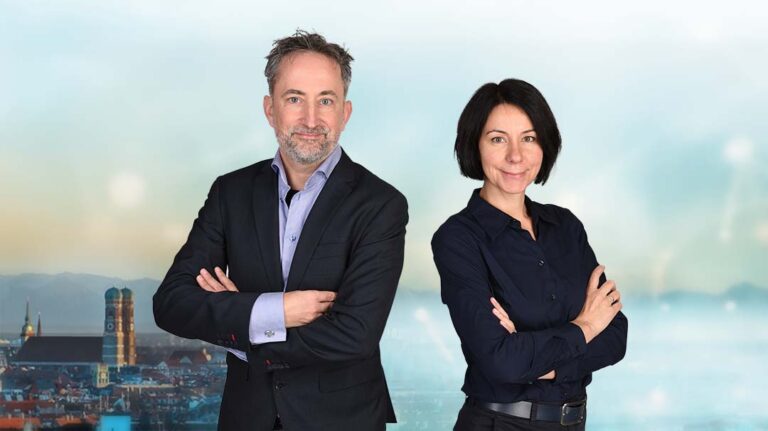
The Visoric Expert Team: Ulrich Buckenlei & Nataliya Daniltseva
Source: Visoric GmbH | Munich 2025
Ulrich Buckenlei and Nataliya Daniltseva represent the fusion of technological excellence and creative vision.
The team works to make AI, XR, and real-time visualization tools that bridge gaps – between data and emotion, between industry and art, between idea and implementation.
Every collaboration results in an experience that goes beyond technology:
A project that moves, inspires, and shows how close the future and present already are.
Those who truly want to make innovation tangible will find in Visoric the partner who turns vision into reality.
Contact Us:
Email: info@xrstager.com
Phone: +49 89 21552678
Contact Persons:
Ulrich Buckenlei (Creative Director)
Mobil +49 152 53532871
Mail: ulrich.buckenlei@xrstager.com
Nataliya Daniltseva (Projekt Manager)
Mobil + 49 176 72805705
Mail: nataliya.daniltseva@xrstager.com
Address:
VISORIC GmbH
Bayerstraße 13
D-80335 Munich