
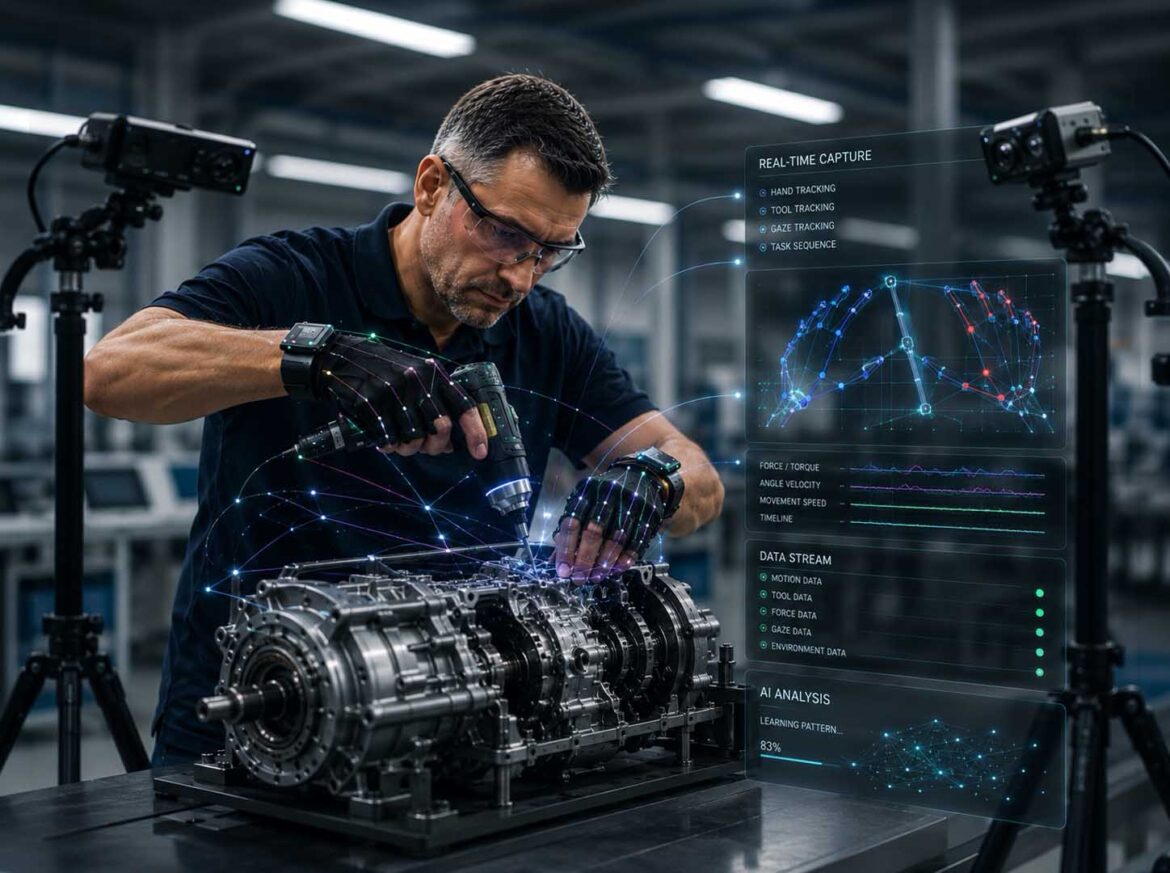
Human expert knowledge is captured during real industrial operations using sensor gloves, intelligent tools, eye tracking, and spatial cameras, and prepared for analysis by artificial intelligence.
Visualization: Multimodal capture of human movements, tool data, and industrial workflows as the foundation for Knowledge AI | Image: © Ulrich Buckenlei | XR Stager Online Magazine | VISORIC GmbH
Human experience is one of the most valuable assets of any organization. Experienced professionals often recognize irregularities long before digital systems do, intuitively select the most appropriate course of action, and solve complex problems based on knowledge accumulated over many years. Yet a significant portion of this expertise is neither fully documented nor stored in databases. Instead, it is reflected in movements, decisions, visual attention, task sequences, and subtle adjustments that are often performed unconsciously during everyday work.
This represents one of the greatest challenges of industrial transformation. When experienced employees leave a company, change positions, or retire, a considerable amount of valuable knowledge often disappears with them. Work instructions, checklists, and training videos can document standardized processes, but they rarely capture the subtle differences between a correctly executed task and the highly efficient techniques of an experienced expert.
At the same time, artificial intelligence is fundamentally transforming industrial work. Modern AI systems no longer analyze only production data, machine conditions, or quality metrics. They are increasingly able to understand how people interact with tools, components, and their working environment. This creates the opportunity not only to document human experience, but also to capture, analyze, and reuse it systematically for assistance, workforce training, and process optimization.[1]
The term Knowledge AI, as used in this article, describes precisely this development. It refers to AI-powered systems that capture human expertise from multiple data sources, connect these sources, and transform them into a digital knowledge model. Experience is no longer reduced to a text document or a video. Instead, movements, eye gaze, tool parameters, spatial relationships, and decision-making processes are synchronized over time and analyzed within their specific operational context.
The foundation of this approach is a new generation of industrial sensing technologies. Computer Vision recognizes hands, body postures, tools, and components. Sensor gloves and motion capture systems measure movements down to individual finger motions. Eye tracking records where an expert is looking and which components require their attention. Intelligent tools capture torque, applied force, angle, and vibration. At the same time, reality capture systems reconstruct both the workplace and the machine as a spatial Digital Twin.
Only by combining these diverse data sources does a comprehensive representation of real human work emerge. AI can therefore understand not only what was performed, but increasingly also how, when, and under which conditions a task was completed most successfully. Individual measurements evolve into a digital model of human expertise that can be reused for onboarding new employees, intelligent assistance systems, simulations, and automated industrial processes.[2]
This development is also reshaping the concept of industrial digitalization. Until now, Digital Twins have primarily focused on machines, production equipment, and products. Today, the knowledge of the people who operate, maintain, optimize, and continuously improve these systems is increasingly becoming part of the digital model. Alongside the Digital Twin of a machine, a Digital Twin of human expertise and operational knowledge is beginning to emerge.
This approach is particularly valuable in areas where quality depends heavily on experience and fine motor skills. These include assembly, maintenance, industrial painting, welding, medical procedures, quality inspection, and the operation of complex production systems. In such activities, measuring only the final result is insufficient. What truly matters is the path taken: the speed of movement, the applied force, the correct angle, the sequence of individual actions, and the ability to respond appropriately to unexpected situations.
Knowledge AI opens entirely new possibilities in these fields. Organizations can capture proven procedures, compare different experts, and derive robust best practices from their collective experience. Training systems can do more than simply indicate the next procedural step—they can evaluate movements in real time and provide personalized feedback. Digital assistants can support employees without taking over every decision. At the same time, this creates a foundation on which humans and AI continuously learn together and improve industrial processes over time.
The objective is not to replace people with technology. On the contrary, humans become the most valuable source for building powerful industrial AI systems. Their experience provides contextual understanding, exceptions, and solution strategies that cannot easily be derived from machine data alone. Knowledge AI makes this expertise accessible, transferable, and sustainably available for future generations.
- Knowledge AI captures human expertise from movements, eye tracking, tool data, and spatial relationships.
- Computer Vision, advanced sensing technologies, and Spatial Computing connect real-world activities with digital knowledge models.
- Expert knowledge can be reused for workforce training, intelligent assistance, quality assurance, and process optimization.
- Digital Twins are evolving beyond machines and industrial assets to include human skills and operational workflows.
- Humans are not being replaced—they become the central source of knowledge for industrial artificial intelligence.
This article explains how human experience can be digitally captured and transformed into valuable knowledge for Industrial AI. It explores the technologies behind this development, demonstrates how intelligent training and assistance systems are created, and explains why Digital Twins of human expertise will play a key role in the future of industry. Through current technologies and practical approaches, it illustrates how observed human activities are transformed into structured knowledge models that help organizations improve workforce qualification, product quality, and productivity in a sustainable way.
Why Human Experience Is Becoming Digital
A large portion of industrial knowledge is tacit. Experienced employees can often immediately recognize when a machine sounds unusual, a component is misaligned, or a task has not been performed optimally. Yet when asked to explain this knowledge, they frequently find it difficult to describe it completely. It has been built over many years through observation, repetition, mistakes, and successful problem solving, and is closely linked to specific situations.
Traditional documentation methods capture only part of this expertise. Work instructions describe individual process steps, photographs show specific conditions, and videos document visible workflows. What is usually missing are the spatial, temporal, and sensory relationships behind these activities. A video may show that a tool was moved, but it does not automatically record the exact angle, applied torque, the operator’s line of sight, or the forces generated during the movement.
Knowledge AI therefore relies on multimodal data acquisition. Multiple technologies are combined to document a task from different perspectives. Each data source answers a different question. Cameras capture visible actions. Motion sensors measure body and hand movements. Eye tracking records visual attention. Intelligent tools provide process parameters. Reality Capture describes the spatial environment. Artificial intelligence then integrates all of this information into a unified knowledge model.[3]
The following illustration presents six core building blocks of this digitalization process. The numbered elements do not represent a single linear workflow but rather different technologies that can be deployed individually or combined depending on the specific application.
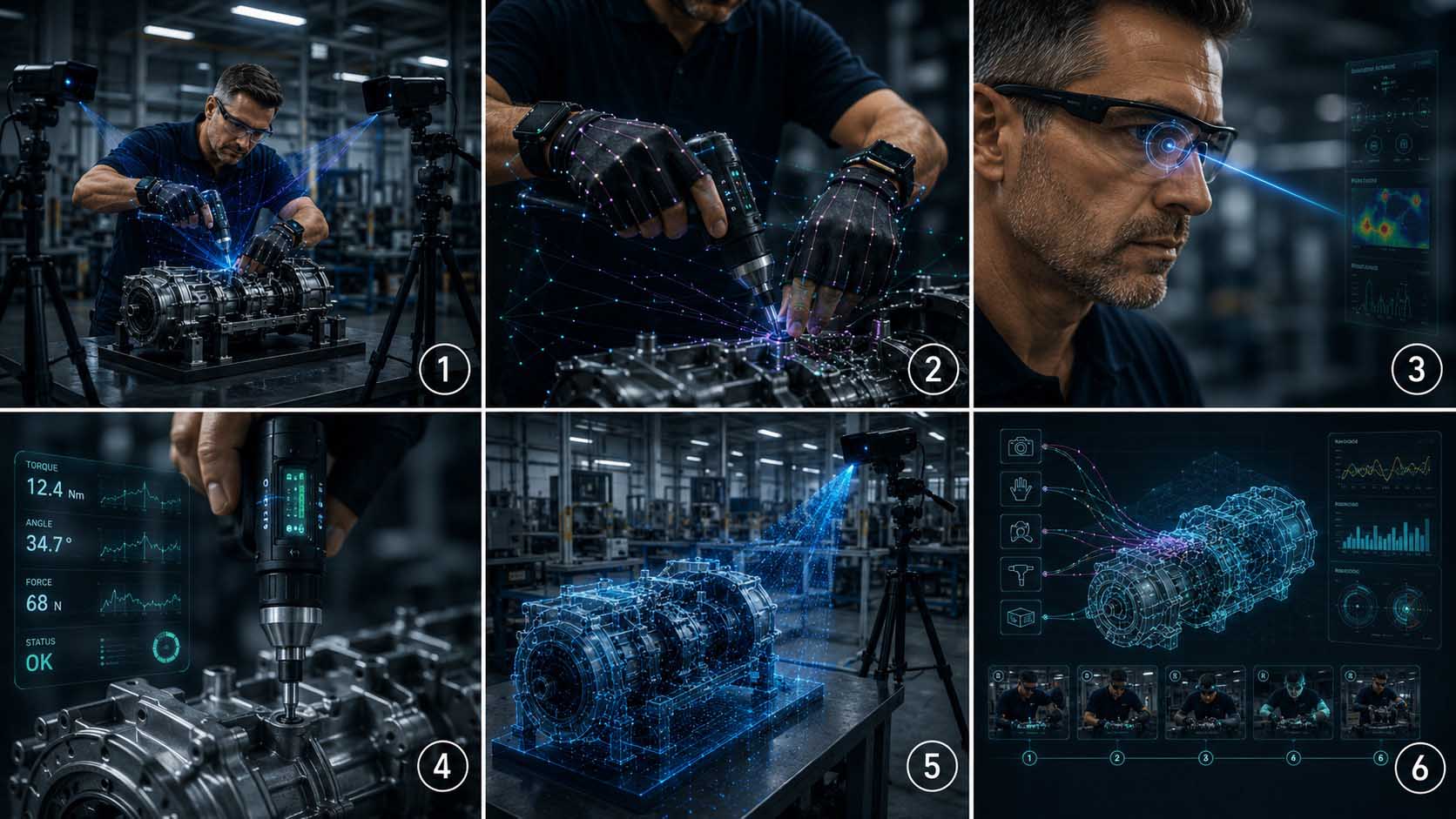
Six complementary technologies capture human movements, visual attention, tool data, and spatial context, transforming them into an AI-powered knowledge model.
Visualization: Technologies for digitizing industrial expert knowledge – 1 Computer Vision, 2 Motion Capture, 3 Eye Tracking, 4 Smart Tools, 5 Reality Capture, 6 Knowledge AI | Image: © Ulrich Buckenlei | XR Stager Online Magazine | VISORIC GmbH
1. Computer Vision uses one or more cameras to recognize hands, body movements, tools, and components. Modern systems can track people and objects without physical markers and assign individual actions to a precise timeline. This makes it possible to determine which tool was used, which component was touched, and in what sequence a process was executed. Multiple synchronized cameras additionally enable three-dimensional reconstruction of movements.
2. Motion Capture increases the accuracy of recording hand, finger, and body movements. Data gloves, inertial sensors, and wearable devices measure position, orientation, and acceleration. Particularly during highly dexterous manual tasks, these systems provide information that cannot be reliably derived from camera images alone. The captured movement data can then be linked to individual work steps and stored as repeatable movement patterns.
3. Eye Tracking records gaze direction and therefore captures an important aspect of an expert’s attention. It reveals which components are inspected before making a decision, which displays are considered relevant, and in what sequence visual inspections take place. Especially in complex maintenance, diagnostic, or quality assurance processes, gaze behavior provides valuable insight into the information experienced employees instinctively prioritize.
4. Smart Tools transform the tools themselves into data sources. Electronic torque screwdrivers, measuring devices, and instrumented hand tools can record force, angle, torque, position, acceleration, and vibration. This documents not only that a tool was used, but also how it was used. Combining tool data with human motion enables a far more precise analysis of the actual task execution.
5. Reality Capture records the machine, workplace, and surrounding environment. Depth cameras, LiDAR, and photogrammetry generate a three-dimensional model of the relevant workspace. Movement and tool data can therefore be assigned precisely to individual components or specific spatial positions. The result is a spatial context that clearly documents where an activity took place and which objects were involved.
6. Knowledge AI integrates all previously captured data. Artificial intelligence synchronizes movements, gaze behavior, tool parameters, object states, and workflow steps along a shared timeline. It can then identify recurring patterns, deviations, highly successful procedures, and potential sources of error. Individual recordings evolve into a structured knowledge model that documents not only the activity itself but also the relationships that define expert performance.
The true value lies in combining these technologies. A camera alone can recognize that an employee tightens a screw. A smart tool adds the applied torque. Motion Capture describes the movement of the hands. Eye Tracking reveals whether the operator first checked a marking or measuring instrument. Reality Capture assigns the action to the correct position on the machine. Only by combining all of these data sources can the entire workflow be interpreted reliably.
This fundamentally distinguishes Knowledge AI from conventional video recording. A video remains primarily a visual document that must be viewed and interpreted by a person. An AI-powered knowledge model, by contrast, structures the contained information automatically. Individual process steps become searchable, comparable, and suitable for automated analysis. Movements can be transferred directly into simulations or reused as reference data for digital training systems.
It also becomes possible to compare multiple experts. Different working methods can be analyzed side by side without automatically declaring one individual as the single standard. AI can identify which aspects of a task remain consistent and where experienced professionals make different decisions depending on the situation. This makes it possible to establish best practices that combine standardized procedures with the flexibility required for real-world operations.
For organizations, this creates an entirely new approach to knowledge management. Expertise is no longer documented only after work has been completed, but is captured directly during real operations. Documentation therefore remains much closer to the actual process and preserves information that is often forgotten when described retrospectively. At the same time, the digital knowledge model can continuously evolve as new product variants, processes, or operational scenarios are added.[4]
The choice of technologies depends on the specific application. For a simple assembly process, multiple cameras and a smart tool may be sufficient. Highly precise manual operations may additionally benefit from data gloves and Eye Tracking. Complex industrial facilities often require a Digital Twin of the surrounding environment. The objective is not to deploy as many sensors as possible, but to capture precisely the information required to understand and later reuse valuable expert knowledge.
- Computer Vision recognizes people, hands, tools, and workflow steps directly within real industrial operations.
- Motion Capture and sensor gloves capture fine motor movements with high precision.
- Eye Tracking reveals where experienced employees focus their visual attention.
- Smart Tools provide force, angle, torque, and motion data.
- Reality Capture connects activities with machines, components, and the spatial workplace.
- Knowledge AI combines all captured information into an analyzable and reusable knowledge model.
These technologies make human experience digitally accessible for the first time in a form that extends far beyond text, images, or video. Movements, decisions, and spatial relationships become structured data from which intelligent training, assistance, and simulation systems can be created. The next chapter explains how these technologies enable the creation of a Digital Twin of human expertise and what information such a model can contain.
Digital Twins of Human Expertise
Capturing human movements, gaze behavior, tool parameters, and spatial relationships initially produces nothing more than an extensive collection of individual data points. On their own, however, these data do not explain why an experienced employee makes a particular decision, performs individual tasks in a specific sequence, or responds to process deviations in a certain way. Only when these different sources of information are synchronized over time, placed into their operational context, and jointly analyzed by artificial intelligence do they evolve into a digital model of human expertise.[5]
At this point, the traditional concept of the Digital Twin expands significantly. In industrial applications, a Digital Twin typically represents a machine, a product, a manufacturing process, or an entire factory. It connects real-world conditions with a digital model, enabling simulations, analyses, and continuous optimization. A Digital Twin of human expertise extends this concept to include human knowledge, movements, and decision-making processes.
This does not create a digital copy of a person in a biological or personal sense. Instead, it represents only those skills, behavioral patterns, and process relationships that are relevant to a specific task. These may include the sequence of an assembly operation, the movement of a tool, the visual inspection of a component, the applied torque, or the response to a detected deviation. From this information, a digital knowledge model emerges that describes how a task is successfully performed under real operating conditions.
The key technological foundation behind this approach is multimodal data fusion. Different data sources are not analyzed independently but are connected along a shared timeline. AI can therefore determine, for example, which component an employee is observing while picking up a specific tool, which movement follows next, and which measurement values are generated during that operation. Only by integrating these different sensor streams does meaningful human behavior emerge from individual measurements.
The following illustration demonstrates this transition from real human activity to a digital knowledge model. On the left, an expert’s work is captured using Computer Vision, Motion Capture, Eye Tracking, Smart Tools, and Reality Capture. In the center, artificial intelligence synchronizes and analyzes the different data streams. The result is a Digital Twin of human expertise that can subsequently be applied to workforce training, intelligent assistance, process optimization, quality assurance, simulation, and automated systems.
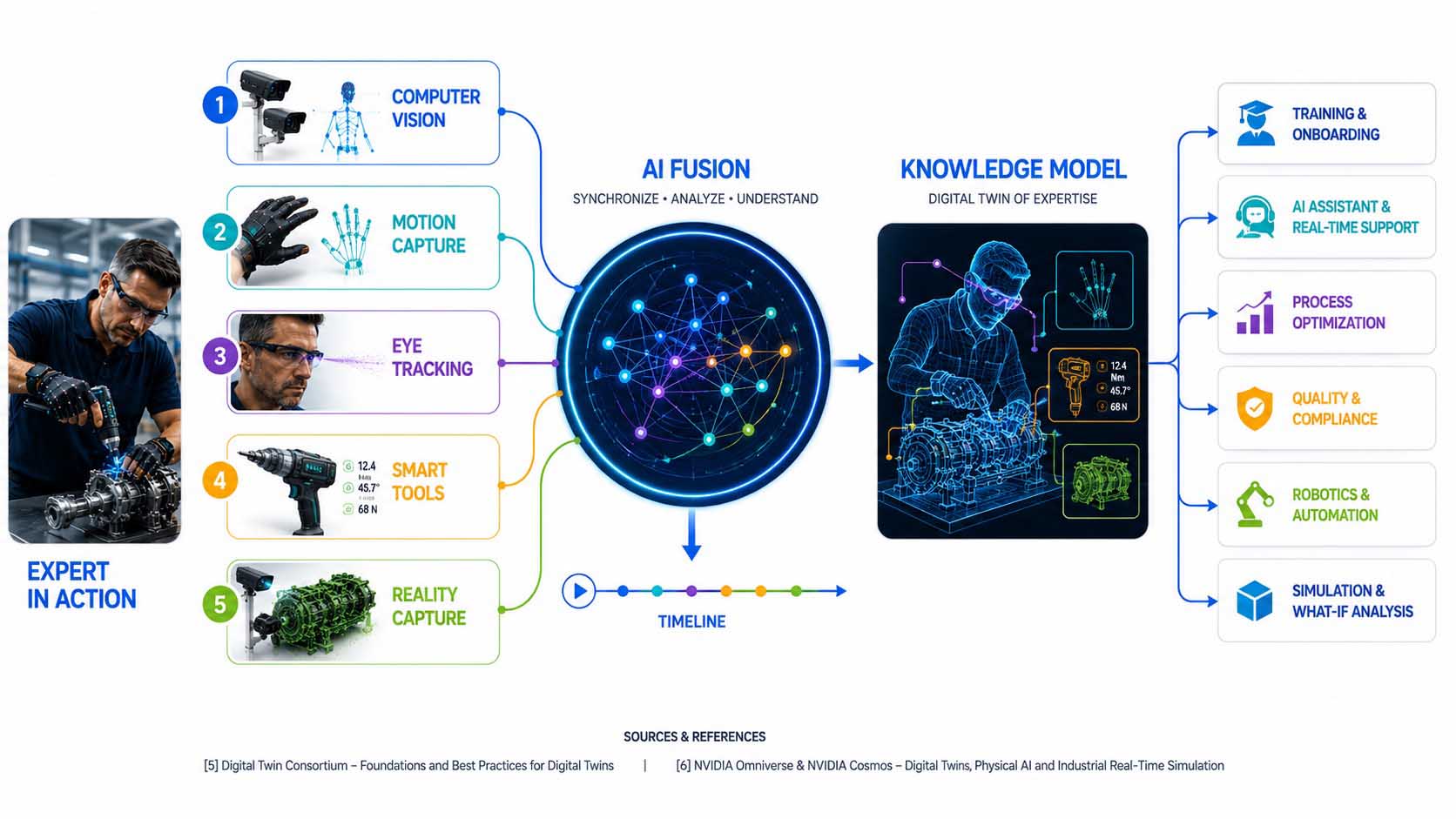
Computer Vision, motion data, gaze behavior, Smart Tools, and spatial capture are combined through artificial intelligence into a Digital Twin of human expertise.
Diagram: From multimodal capture of human activities through AI-powered data fusion to a digital knowledge model for training, assistance, quality assurance, simulation, and automation | Graphic: © Ulrich Buckenlei | XR Stager Online Magazine | VISORIC GmbH
At the center of the illustration is AI-powered data fusion. It performs three essential tasks: synchronizing information, identifying recurring relationships, and assigning the results to specific process steps. This makes it possible to understand precisely which movement occurred at which moment, which tool was used, where the expert focused attention, and how the condition of the component or machine changed throughout the process.
The shared timeline is of fundamental importance. Without precise temporal synchronization, movement data, gaze behavior, and tool parameters would remain isolated from one another. Through synchronization, AI can recognize, for example, that an expert visually inspects a seal immediately before tightening a bolt, then repositions the tool, and only afterward applies the full torque. What initially appears to be a simple task is transformed into a structured behavioral pattern.
In addition, the digital knowledge model requires spatial context. A movement gains meaning only when it is known which component it relates to and where on the machine it was performed. Digital Twins of the working environment therefore connect geometric information with movement data, tool parameters, and process states. A hand movement is not merely stored as a trajectory but linked to a specific object and a defined process step.
Such a model can also distinguish between fixed procedural rules and situational decision-making. Some activities follow clearly defined sequences that must always be executed identically. Others require experience because employees must adapt their actions according to machine conditions, material properties, or measurement results. Knowledge AI is capable of representing both levels: standardized process logic and context-dependent expert knowledge.
This capability becomes particularly valuable when multiple experts perform the same task using different approaches. AI can compare recorded workflows and identify which actions remain consistent across all successful executions. At the same time, it reveals variations that are relevant only under specific operating conditions. The result is not a rigid representation of one individual but a robust knowledge model that combines diverse experiences and proven best practices.
These principles closely follow the fundamental concepts of modern Digital Twins. A Digital Twin is far more than a three-dimensional model; it is a dynamic connection between real-world data, digital representation, and continuous analysis. Applied to human expertise, this means that the knowledge model evolves and improves with every newly recorded activity. New variants, exceptional cases, errors, and successful solutions continuously increase its accuracy and practical value.[6]
For industrial training systems, this represents a significant advancement. New employees receive more than static instructions—they can be compared with a reference model of successful task execution. The system identifies deviations in movement patterns, workflow sequences, or tool parameters and provides targeted guidance. Feedback can be adapted to each individual’s level of experience instead of delivering identical instructions to every learner.
The knowledge model also becomes the foundation for intelligent digital assistance systems. If AI detects during a real operation that an essential inspection step has been omitted or that a tool is being used outside its intended operating parameters, it can provide immediate support. Crucially, this assistance is based not merely on written work instructions but on previously captured and analyzed expert workflows.
Quality assurance also benefits significantly. Successful reference processes can be continuously compared with current operations. Deviations become visible during production rather than only after the final product has been completed. This enables earlier corrective action and is especially valuable for complex manual tasks where preventing errors before they occur can avoid substantial downstream costs.
Furthermore, digital knowledge models can be transferred into simulation environments and automated systems. Human movement sequences can be recreated within virtual training scenarios, new process variants can be validated before deployment, and selected behavioral patterns can serve as templates for robot programming. Industrial real-time simulation platforms make it possible to combine human workflows, machine models, and physical operating conditions within a single virtual environment.
At all times, however, the Digital Twin of human expertise remains tied to a clearly defined application. Its objective is not to represent every characteristic of an individual but only the information required to understand and successfully perform a specific task. This limitation not only improves the technical quality of the model but is also essential for data protection, transparency, and user acceptance.
Organizations should therefore define at an early stage which data are required, for what purpose they will be used, and how long they will be retained. Equally important is the active involvement of the employees whose expertise is being digitized. Knowledge AI can only be successfully implemented when it is understood as a tool for preserving and transferring expertise—not as an invisible system for monitoring employee performance.
- A Digital Twin of human expertise represents task-specific movements, decisions, and process relationships.
- Artificial intelligence synchronizes Computer Vision, Motion Capture, Eye Tracking, tool data, and spatial information along a shared timeline.
- Individual sensor measurements are transformed into a structured knowledge model containing workflow steps, variants, and decision logic.
- Workflows from multiple experts can be compared and consolidated into robust best practices.
- Digital knowledge models provide the foundation for training, intelligent assistance, quality assurance, simulation, and automation.
- Clearly defined application boundaries, transparency, and employee involvement are essential for responsible implementation.
In this way, a recorded activity becomes a permanently reusable digital knowledge model. Its greatest value, however, lies not merely in preserving experience but in applying it effectively. This becomes particularly evident wherever real-world mistakes are expensive, hazardous, or associated with significant material costs. The next chapter explains how simulation-based training systems transform such processes into safe, repeatable, and highly effective learning environments.
Simulation Replaces Costly Mistakes
The digitization of expert knowledge delivers its greatest value not merely after data has been captured or a digital knowledge model has been created. Its true impact emerges where this knowledge is applied every day—in training new employees, onboarding workers for complex processes, and ensuring the safe execution of demanding industrial tasks. This is precisely where Knowledge AI fundamentally transforms industrial education and workforce development.[7]
Traditional training often takes place directly on real production equipment. New employees learn under the guidance of experienced colleagues while machines, tools, and materials remain occupied. Mistakes are an unavoidable part of the learning process. They consume valuable time, increase material waste, and in the worst case can damage equipment or create safety-critical situations. The more complex a production system becomes, the greater the cost and risk associated with conventional training.
Digital knowledge models introduce an entirely new approach. Instead of relying solely on manuals or demonstrations, employees train using an AI-powered Digital Twin of real industrial workflows. The system understands the optimal sequence of individual process steps, detects common mistakes while they occur, and provides immediate feedback. Learning becomes interactive, repeatable, and independent of the availability of individual experts.
The following illustration highlights the difference between conventional training and an AI-powered training system. On the left, errors are detected only during practical work or after a task has been completed. Knowledge AI, by contrast, continuously accompanies the learning process. Digital work instructions, real-time feedback, and intelligent assistance systems support employees precisely at the moment when decisions need to be made.
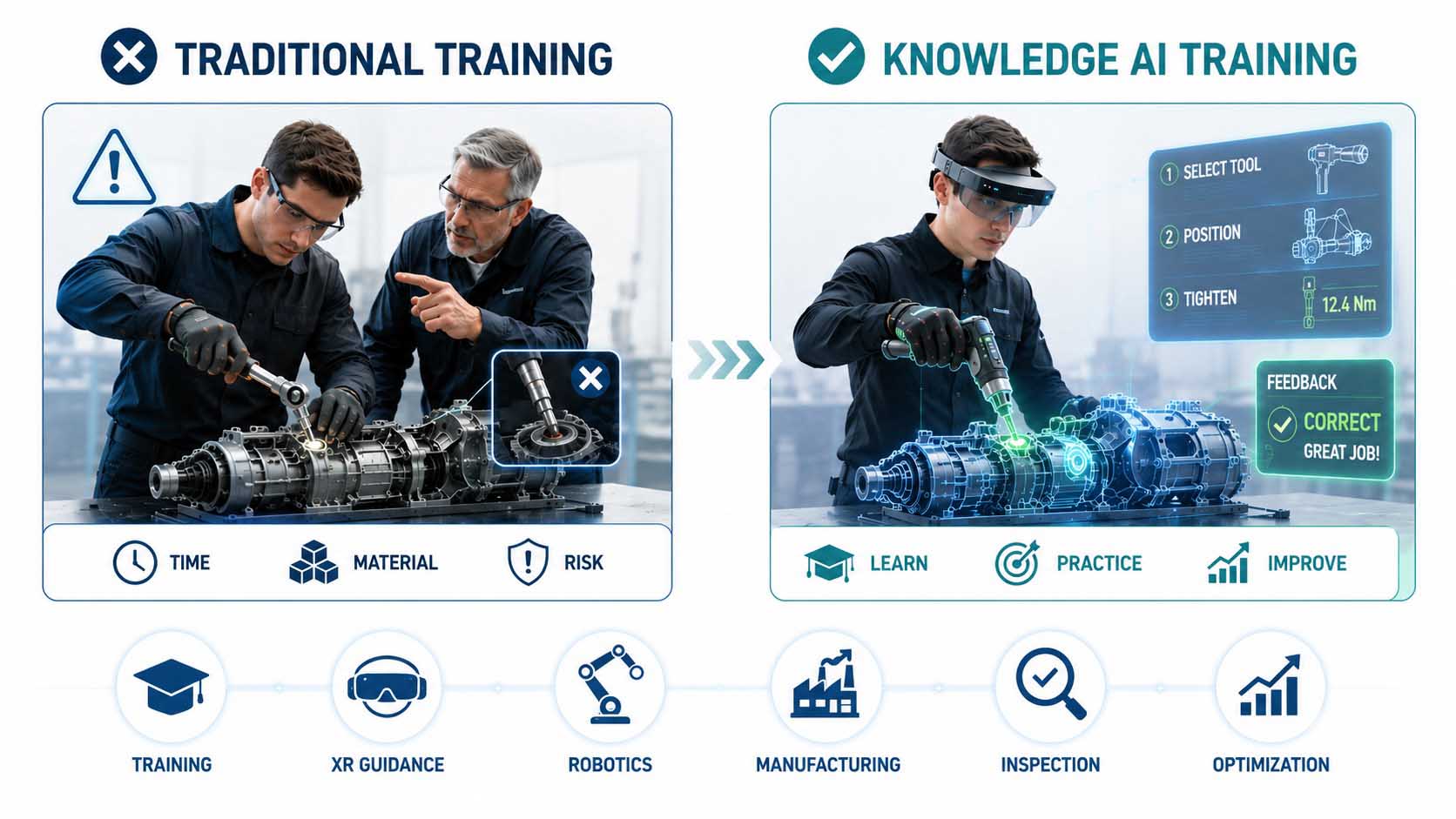
Knowledge AI supports industrial training processes in real time. Digital Twins, intelligent assistance systems, and continuous feedback enable faster learning, lower error rates, and more efficient knowledge transfer.
Visualization: Comparison between traditional onboarding and AI-powered training using digital knowledge models | Graphic: © Ulrich Buckenlei | XR Stager Online Magazine | VISORIC GmbH
The difference becomes particularly apparent during complex assembly and maintenance procedures. Traditional training concepts often identify mistakes only after a task has been completed or during the final quality inspection. Knowledge AI, however, continuously evaluates the entire workflow. While an employee is still handling a tool, the system can already detect deviations in position, sequence, torque, or movement patterns and immediately provide corrective guidance.
This also changes the role of experienced professionals. They spend less time repeating standard training sessions and can instead focus on exceptional situations, process improvements, and transferring new expertise. Their knowledge remains permanently available within the organization while simultaneously benefiting many employees.
Another major advantage is standardization. Different production sites, factories, and international service teams can access identical knowledge models. Updated procedures can be distributed centrally and deployed worldwide almost instantly. This significantly shortens onboarding times while simultaneously improving process quality.
The economic benefits are equally substantial. Reduced scrap, lower material consumption, shorter downtime, and faster employee qualification generate measurable cost savings. At the same time, organizations greatly reduce the risk of losing valuable expertise when experienced specialists retire or leave the company.
Knowledge AI therefore evolves beyond a documentation technology into an active learning platform. The system not only demonstrates how a task should be performed but also evaluates actual execution, identifies opportunities for improvement, and continuously adapts its guidance to each employee’s individual learning progress. Static work instructions evolve into intelligent training systems that become more capable with every new execution.
The combination of Spatial Computing, Digital Twins, and artificial intelligence creates an entirely new generation of industrial learning. Training no longer takes place separately from real operations but directly within the actual working environment. Virtual assistance, physical machinery, and human expertise merge into a unified workspace in which knowledge is continuously transferred, refined, and preserved for the long term.[8]
- Knowledge AI supports the entire learning process and identifies mistakes while they are occurring.
- Digital Twins enable safe training without production downtime or material waste.
- Real-time feedback assists employees immediately during task execution.
- Expert knowledge remains permanently available and can be reused across multiple locations.
- Shorter onboarding times, higher process quality, and lower error costs improve overall operational efficiency.
The digitization of expert knowledge creates far more than intelligent training systems. The next stage of development is for artificial intelligence to actively support employees during their actual work. The following chapter explains how Knowledge AI evolves into a personal industrial assistant that provides real-time guidance throughout everyday operations.
Knowledge AI Becomes a Personal Industrial Assistant
Once expert knowledge has been digitally captured, analyzed, and transformed into a digital knowledge model, the true value of Knowledge AI begins during everyday industrial operations. Knowledge is no longer stored only in databases or training materials but accompanies employees directly throughout their work. Artificial intelligence therefore evolves from an analytical tool into an intelligent assistance system that provides exactly the right support at the right moment.[9]
While traditional work instructions are typically static, an AI-powered industrial assistant dynamically adapts to the current situation. It recognizes the active process step, tracks task progress, and provides precisely the information required at that moment. Instead of searching through extensive manuals, employees receive context-aware guidance directly at the machine.
Knowledge AI combines Computer Vision, Digital Twins, advanced sensing technologies, and real-time analytics into a unified working environment. Cameras identify the current state of the equipment, Smart Tools provide live process data, and the Digital Twin maintains knowledge of the optimal sequence of every workflow step. Artificial intelligence continuously compares the ongoing operation with the underlying knowledge model and detects deviations as they emerge.
The following illustration demonstrates this paradigm shift. Whereas conventional assistance systems often rely on extensive user interfaces or static work instructions, Knowledge AI presents information only where and when it is actually needed. Employees remain fully focused on their tasks while digital assistance operates discreetly in the background.
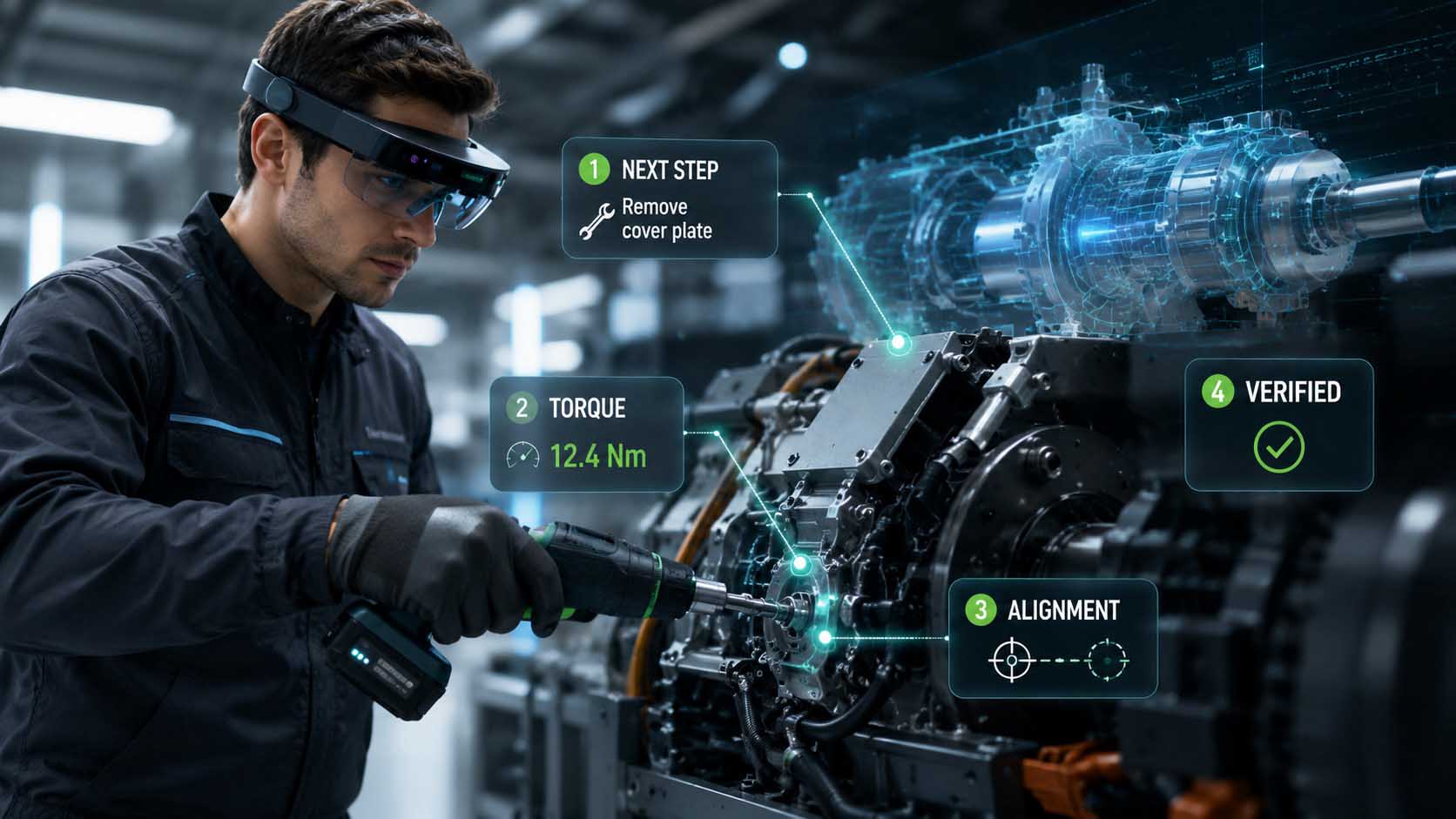
Knowledge AI provides context-aware assistance throughout real industrial workflows. Digital Twins, Computer Vision, and artificial intelligence deliver precisely the information required for each individual process step.
Visualization: AI-powered industrial assistance combines Digital Twins, Computer Vision, and real-time information into an intelligent workplace support system | Graphic: © Ulrich Buckenlei | XR Stager Online Magazine | VISORIC GmbH
The strength of such a system lies not in displaying as much information as possible but in presenting only what is truly relevant. Instead of overwhelming users with large dashboards or complex menus, Knowledge AI highlights only the elements required for the next workflow step. Tool parameters, assembly positions, or quality criteria appear exactly where they are needed and disappear again once they are no longer relevant.
This significantly reduces cognitive workload. Employees no longer need to mentally transfer information between manuals, computer screens, and machines. Artificial intelligence connects digital information directly with the physical object, supporting decisions within the actual working context.
This approach is particularly valuable for maintenance, service, and assembly operations. AI automatically recognizes the current stage of the task, verifies tool parameters, confirms successfully completed workflow steps, and identifies potential deviations at an early stage. Errors are therefore prevented while they are developing instead of being discovered only after the work has been completed.
Experienced professionals also benefit from this support. Knowledge AI does not replace their expertise—it enhances it through immediate access to technical documentation, previous service cases, maintenance histories, and live sensor data. Even highly complex industrial systems can therefore be maintained and analyzed more efficiently.
At the same time, collaboration between humans and artificial intelligence improves significantly. While people continue to make decisions, interpret situations, and assume responsibility, AI continuously analyzes large volumes of data and delivers context-specific information exactly when it is needed. The traditional human-machine interface evolves into a truly collaborative working environment.
Over time, Knowledge AI becomes a personal industrial assistant that accompanies employees throughout their entire workflow. Every successfully completed task expands the digital knowledge model and improves future recommendations. The assistance system continuously learns and adapts to new products, changing processes, and evolving industrial environments.[10]
- Knowledge AI supports employees directly during real industrial operations.
- Digital information appears contextually at the exact component where it is needed.
- Computer Vision and Digital Twins automatically recognize current workflow progress.
- Real-time feedback reduces errors while improving process quality and operational safety.
- Artificial intelligence enhances human expertise rather than replacing it.
Knowledge AI therefore evolves from a digital knowledge repository into an active industrial assistant. The next stage goes even further: individual assistance systems become part of a shared knowledge platform where humans, machines, and artificial intelligence continuously learn from one another. The following chapter explores how this leads to the emergence of the self-learning factory.
Knowledge AI Connects People, Machines, and Locations
Once artificial intelligence begins supporting individual employees in their daily work, the true value emerges at the organizational level. Knowledge AI evolves into a shared knowledge platform that continuously connects insights from training, manufacturing, maintenance, quality assurance, and robotics. Isolated workstations become part of a learning ecosystem in which knowledge is no longer stored locally but becomes available to everyone across the organization in near real time.[11]
Traditionally, every department develops its own information silos. Service technicians accumulate maintenance expertise, production workers optimize assembly procedures, quality engineers document defect patterns, and robotic systems continuously generate new process data. Although all departments contribute to the same product, their knowledge is often stored separately. This is precisely where Knowledge AI introduces a new approach.
Instead of merely archiving information, artificial intelligence connects all knowledge sources into a unified digital model. Computer Vision, Digital Twins, sensor data, technical documentation, and human expertise are continuously analyzed and correlated. Every successfully completed task enriches the shared knowledge model and immediately becomes available to other employees, teams, or production sites.
This concept becomes particularly evident across the entire industrial lifecycle. Valuable experience is first generated during training and later applied in assembly. Insights gained from maintenance and service flow back into engineering and production. Quality assurance improves future manufacturing processes, while robotic systems continuously adopt successful movement patterns from real industrial workflows. Individual applications become part of a closed knowledge loop that continuously evolves and improves.
The following illustration demonstrates how Knowledge AI expands across different organizational domains. Each application fulfills its own purpose while simultaneously contributing to the others. Training, assembly, maintenance, quality inspection, robotics, and continuous optimization together form a learning knowledge platform for the entire industrial enterprise.
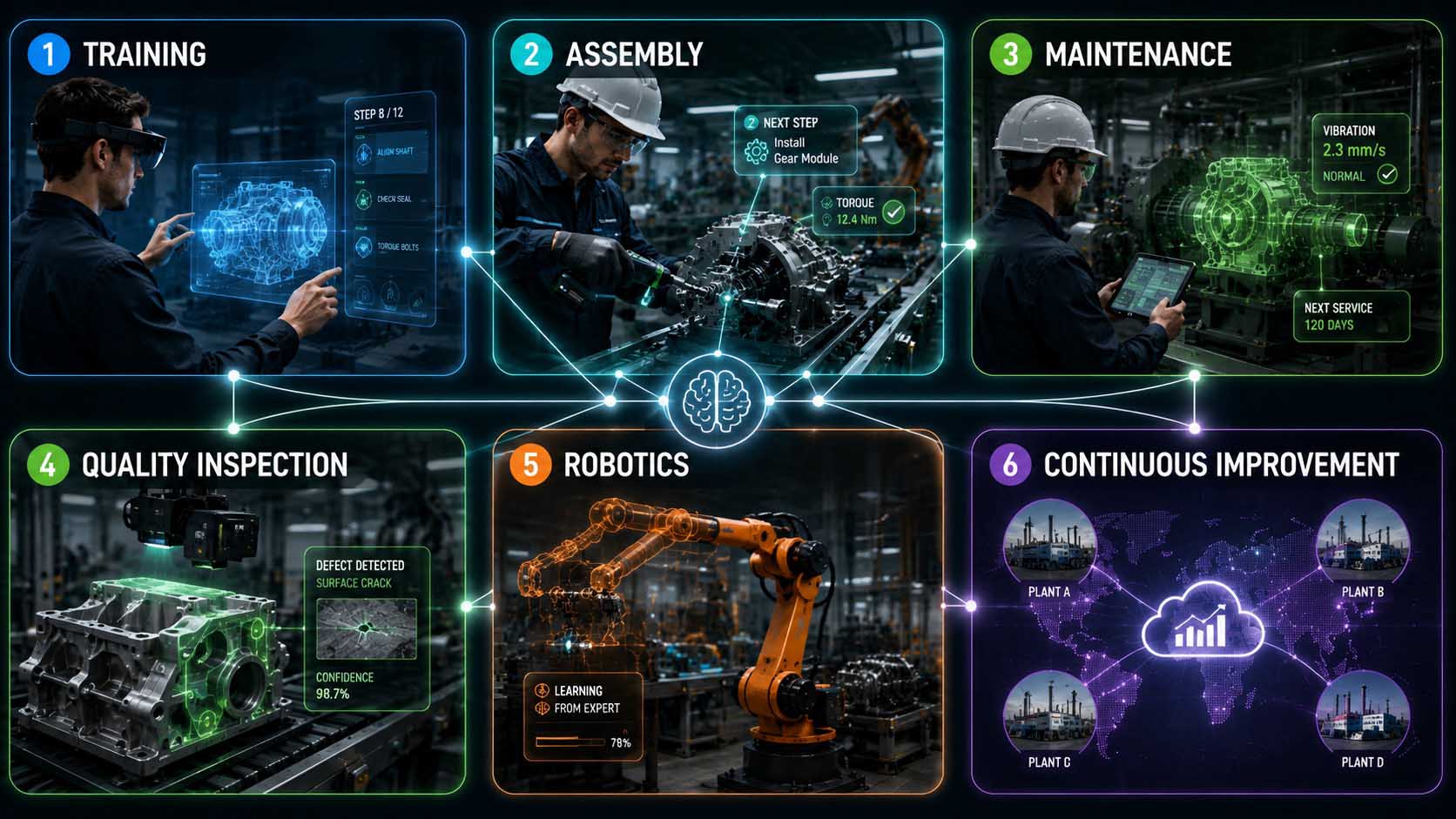
Knowledge AI connects training, assembly, maintenance, quality assurance, robotics, and continuous process optimization into an enterprise-wide knowledge platform.
Infographic: Connected industrial knowledge platform integrating Computer Vision, Digital Twins, robotics, and continuous learning | Graphic: © Ulrich Buckenlei | XR Stager Online Magazine | VISORIC GmbH
The greatest strength of this approach lies in continuous learning. Every new experience expands the existing knowledge model. Errors are not merely documented—they are automatically analyzed. Successful solutions then become immediately available to all employees, regardless of their location or native language. Knowledge evolves from individual experience into a scalable organizational asset.
Robotic systems also benefit directly from this knowledge network. Motion sequences, assembly procedures, and quality characteristics can be transferred from real industrial operations into automated production processes. At the same time, robots continuously contribute new process data back to the AI, further improving recommendations for human employees. Humans and machines no longer learn independently but continuously develop their knowledge together.
For globally operating organizations, this approach creates entirely new opportunities. Experience gained at one production site can become available worldwide in near real time. New employees immediately benefit from existing expert knowledge, while improvements are automatically incorporated into future training programs, maintenance procedures, and quality standards. Knowledge AI therefore becomes the central knowledge infrastructure of a learning organization.[12]
- Knowledge AI connects training, manufacturing, maintenance, quality assurance, and robotics through a shared knowledge platform.
- Knowledge is continuously exchanged between people, machines, and locations.
- Digital Twins and Computer Vision establish a common operational information context.
- Successful workflows automatically improve future recommendations and training programs.
- Organizations evolve from isolated information silos into continuously learning enterprises.
As this shared knowledge network continues to grow, future assistance systems become increasingly intelligent. The next stage of development is therefore no longer simply the exchange of information but the continuous mutual learning between humans and artificial intelligence, allowing both to expand their capabilities together.
Humans and AI Learn Together
Knowledge AI transforms not only individual workflows but also the way humans and artificial intelligence collaborate. While traditional automation systems simply execute predefined rules, a new form of cooperation is emerging. Humans contribute experience, creativity, and contextual judgment, while artificial intelligence analyzes vast amounts of data, identifies patterns, and provides relevant information in real time. Both continuously expand their knowledge and benefit from one another.[13]
For decades, industrial digitalization focused primarily on automating processes and simplifying human work. Knowledge AI follows a fundamentally different philosophy. Its goal is not to replace people but to enhance their capabilities. Expert knowledge is digitally captured, structured, and made available across the organization. At the same time, artificial intelligence learns from every new task, continuously refining its recommendations.
This collaborative learning process begins during everyday operations. Computer Vision recognizes workflows, sensors capture process data, and Digital Twins document the current state of industrial assets. Artificial intelligence analyzes this information in real time and compares it with previously acquired knowledge. At the same time, human experts evaluate AI recommendations, correct them when necessary, and enrich them with their own expertise. This continuous exchange creates a dynamic learning process through which both humans and AI constantly improve.
This approach becomes especially valuable in complex industrial tasks where no single standardized solution exists. Experienced professionals make decisions based on expertise, practical experience, and contextual understanding. AI complements these abilities by recognizing hidden relationships, evaluating millions of comparable data points, and identifying potential optimizations. As a result, decisions become faster, more informed, and more transparent.
The following illustration demonstrates this principle. Human expertise and artificial intelligence do not operate independently but form a shared knowledge cycle. Observations, experience, and process data continuously flow between both sides. Every successfully completed task generates new insights that are immediately incorporated into future workflows while expanding the shared knowledge model.
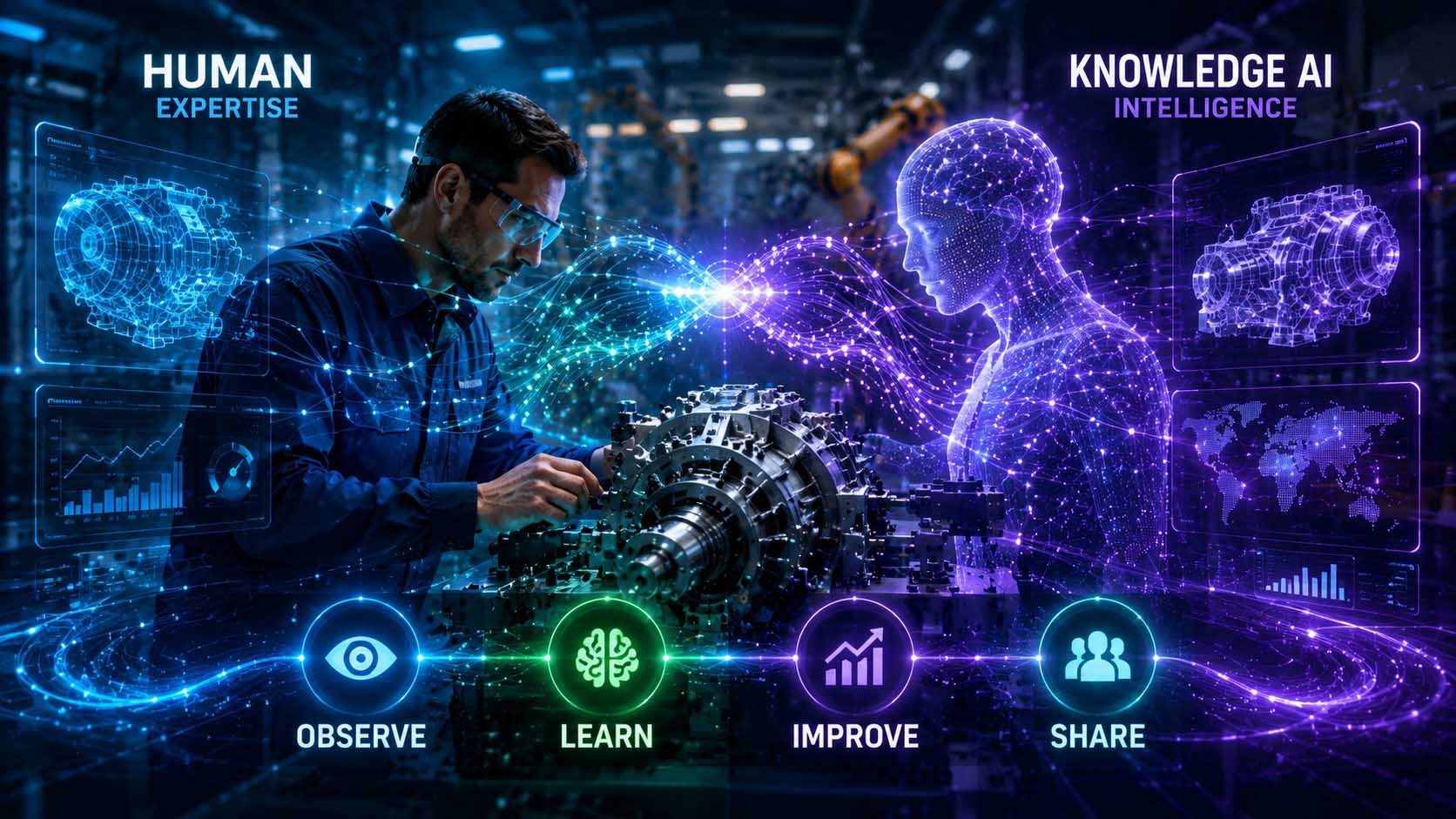
Knowledge AI combines human experience with artificial intelligence in a continuous learning process. Observing, learning, improving, and sharing become integral parts of a unified industrial knowledge platform.
Visualization: Continuous learning between Human Expertise and Knowledge AI through Computer Vision, Digital Twins, and intelligent knowledge networking | Graphic: © Ulrich Buckenlei | XR Stager Online Magazine | VISORIC GmbH
A key principle is that artificial intelligence does not become an autonomous decision-maker. Instead, it provides recommendations, identifies relationships, and supports complex analysis. Responsibility remains firmly with human experts. This creates transparent decision-making processes that combine the complementary strengths of human experience and algorithmic intelligence.
With every successfully completed project, the digital knowledge model continues to grow. New assembly procedures, maintenance strategies, and quality characteristics are automatically documented, evaluated, and made available for future applications. This knowledge is no longer confined to individual employees or locations but becomes accessible throughout the entire organization. Individual expertise evolves into a continuously learning knowledge organization.
Over time, this also changes the role of employees. Professionals increasingly become knowledge creators who actively contribute their expertise to digital systems while simultaneously benefiting from insights generated by artificial intelligence. Human-AI collaboration therefore develops into an ongoing innovation process in which both sides continuously learn from and improve one another.[14]
- Knowledge AI enhances human capabilities rather than replacing them.
- Humans and artificial intelligence continuously learn from one another.
- Computer Vision, Digital Twins, and sensor data establish a shared knowledge context.
- Every successfully completed task improves future recommendations and operational workflows.
- Organizations evolve into learning enterprises where knowledge is permanently preserved.
The more experience is integrated in this way, the more intelligent the entire organization becomes. The next stage of industrial evolution is therefore no longer limited to the learning of individual people or isolated AI systems, but moves toward an industry in which knowledge is permanently preserved and continuously evolves across generations of products, machines, and employees.
From Expert Knowledge to the Learning Factory
The more human experience is digitally captured and made available across an organization, the more profoundly the entire industrial value chain is transformed. Knowledge AI no longer supports only individual employees or departments but evolves into the central nervous system of a learning factory. People, machines, robotic systems, and Digital Twins continuously exchange knowledge and collectively improve every aspect of industrial production.[15]
In conventional factories, improvements often remain local. A service technician develops a more efficient maintenance procedure, a production worker optimizes an assembly step, or a quality engineer identifies recurring defect patterns. Yet these valuable insights frequently remain confined to individual teams or production sites. Knowledge AI fundamentally changes this principle. Every new insight immediately becomes part of the shared knowledge model and is subsequently available throughout the entire organization.
This creates a continuous learning cycle. New employees benefit from the accumulated expertise of previous generations from their very first day. Production systems learn from every manufacturing batch, robotic systems adopt optimized movement sequences, and artificial intelligence identifies relationships between production, maintenance, and quality that would otherwise remain hidden. Knowledge evolves from an individual capability into a permanent organizational asset.
The learning factory is built upon continuous information exchange. Computer Vision monitors production processes, intelligent sensors capture machine conditions, and Digital Twins document every change throughout the entire product lifecycle. Knowledge AI continuously analyzes this information, identifies opportunities for optimization, and automatically distributes new insights across all relevant business areas. Improvements are therefore no longer isolated but simultaneously propagated throughout the entire production network.
The following illustration demonstrates the concept of the learning factory. At its center is a shared Knowledge AI platform connecting training, assembly, quality assurance, maintenance, robotics, and continuous learning. Every domain continuously exchanges knowledge, forming a closed learning loop. Every successfully completed task strengthens the overall system and accelerates future decision-making.
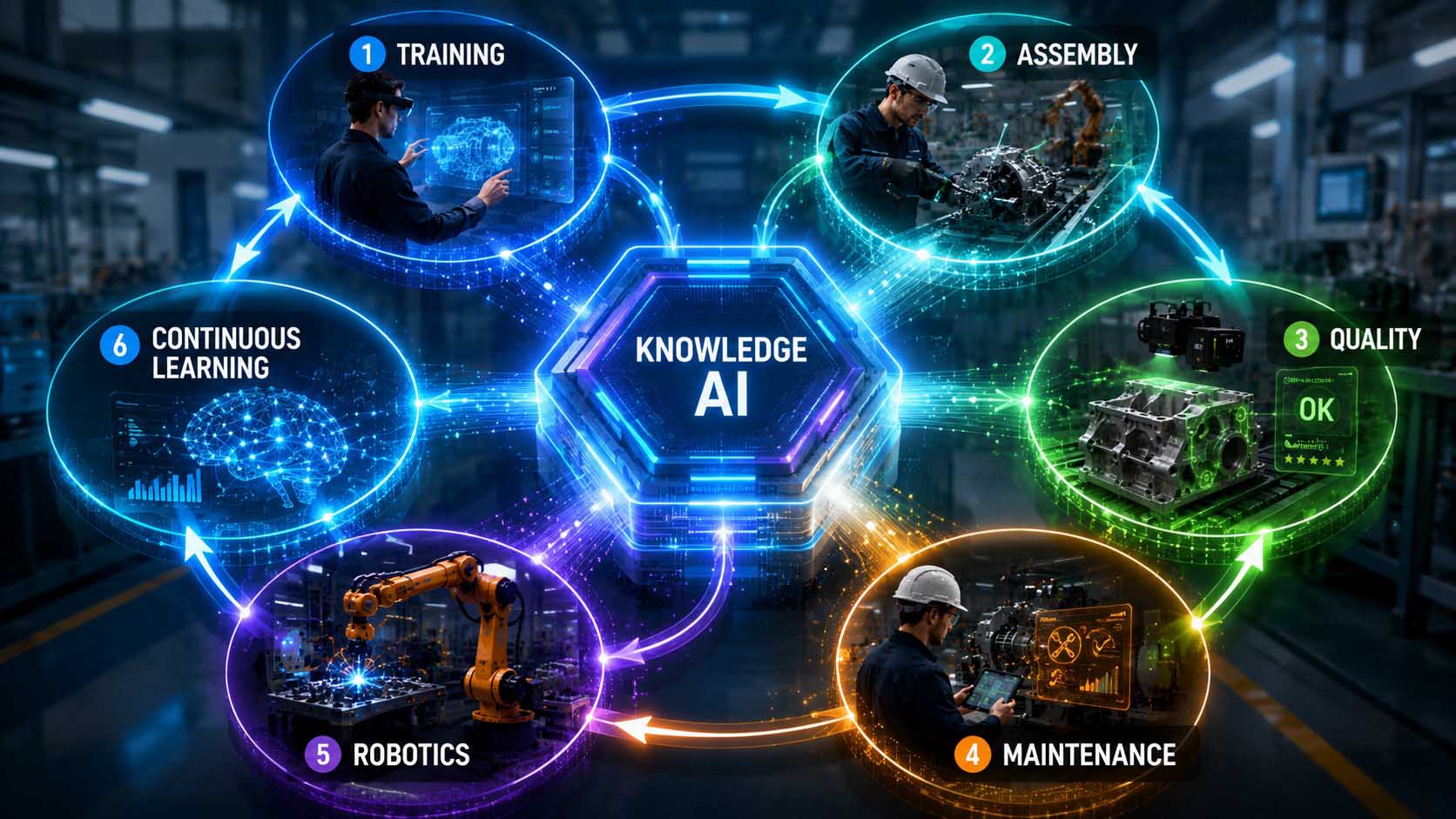
Knowledge AI connects training, assembly, quality assurance, maintenance, robotics, and continuous learning into an intelligent factory where experience is permanently preserved and shared throughout the organization.
Infographic: Knowledge AI as the central knowledge platform of a learning factory integrating Computer Vision, Digital Twins, robotics, and continuous process optimization | Graphic: © Ulrich Buckenlei | XR Stager Online Magazine | VISORIC GmbH
The key difference compared to previous digitalization concepts is that knowledge is no longer tied to individual people, machines, or locations. Experience is continuously documented, evaluated, and automatically shared. As a result, the organization becomes more intelligent with every maintenance activity, every production cycle, and every quality inspection.
Innovation also spreads much faster. When one facility develops a more efficient assembly process or artificial intelligence discovers new optimization opportunities, these insights become available to all connected locations in near real time. Every improvement immediately benefits the entire organization. Local success evolves into global corporate knowledge.
At the same time, the role of employees continues to evolve. Routine activities become increasingly automated, while human experience, creativity, and problem-solving skills grow even more valuable. Skilled professionals become active contributors to a learning organization by continuously expanding their expertise and developing it together with artificial intelligence. Knowledge AI therefore creates not only more efficient processes but an entirely new model of industrial collaboration.[16]
- Knowledge AI connects every business area through a shared organizational knowledge cycle.
- Experience from training, manufacturing, maintenance, and quality assurance becomes available across the entire enterprise.
- Digital Twins, Computer Vision, and robotics continuously learn from one another.
- Local process improvements are distributed across all locations in near real time.
- The factory evolves into a learning organization that becomes more intelligent with every completed task.
Yet the evolution does not end there. The next generation of industrial systems will not only share knowledge within individual organizations but connect expertise across entire value networks. The final chapter explores the role Knowledge AI will play for industry, society, and the future of work.
The Future of Industrial Learning
The digital transformation of industrial processes is still in its early stages. Today, artificial intelligence, Digital Twins, and Computer Vision already support numerous industrial workflows. In the years ahead, however, these technologies will increasingly converge into a shared knowledge infrastructure. Knowledge AI will evolve from an intelligent assistance system into a cross-organizational ecosystem that permanently connects people, machines, and artificial intelligence.[17]
The real transformation is not about automating an ever-growing number of processes. What truly matters is ensuring that experience is permanently preserved and continuously expanded. Every successfully completed task, every maintenance operation, every quality inspection, and every new product generation enriches the shared knowledge model. Organizations will no longer lose valuable expertise through employee turnover or generational change. Instead, they will build a digital knowledge foundation that grows continuously with every new experience.
At the same time, the technological foundations are evolving. Advanced sensors, powerful AI models, Spatial Computing, robotics, and Digital Twins are increasingly merging into a unified platform. Information is no longer generated in isolation within individual applications but exchanged in real time between manufacturing systems, service teams, robotic platforms, and engineering departments. Individual digital solutions are becoming an intelligent industrial infrastructure capable of continuously improving itself.[18]
One of the most exciting developments is the growing exchange of knowledge beyond organizational boundaries. In the future, suppliers, manufacturers, service providers, and operators may collaborate through shared knowledge models without exposing confidential business information. Standardized interfaces and intelligent AI systems will enable experience to be exchanged across entire value chains. Knowledge will evolve from an internal organizational resource into a strategic driver of innovation for entire industries.
The following illustration summarizes this vision. At its center is a unified Knowledge AI platform connecting human expertise, intelligent machines, Digital Twins, Computer Vision, robotics, and global manufacturing networks. Individual applications converge into an intelligent and sustainable industrial ecosystem in which knowledge continuously grows, optimizes itself, and becomes globally accessible.
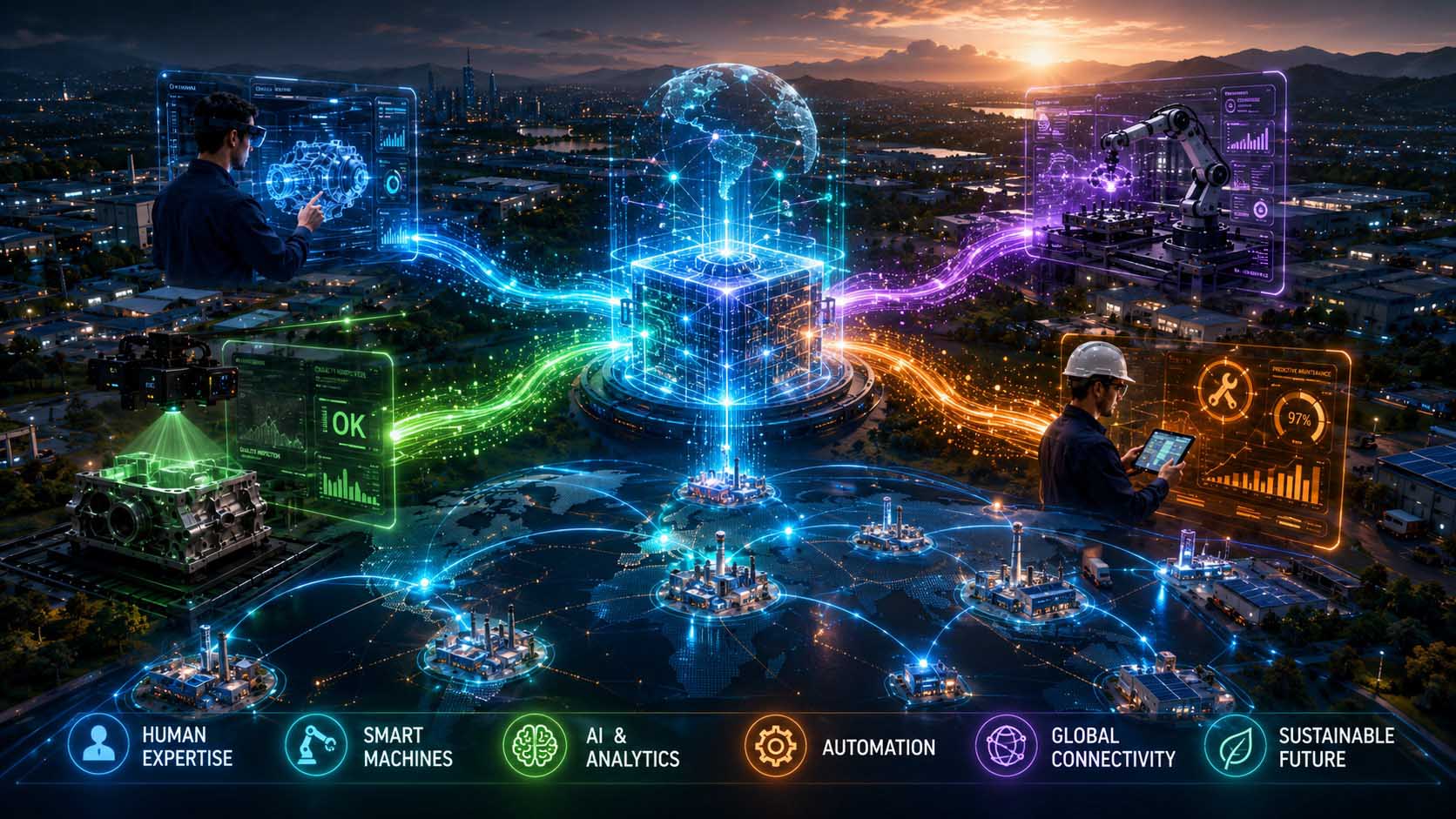
Knowledge AI connects human expertise, intelligent machines, Digital Twins, and global manufacturing networks into a sustainable learning industry of the future.
Infographic: The future of industrial learning with Knowledge AI, Computer Vision, Digital Twins, robotics, global connectivity, and sustainable industry | Graphic: © Ulrich Buckenlei | XR Stager Online Magazine | VISORIC GmbH
The future of industrial learning will therefore not be defined by a single technology. Only the combination of human experience, artificial intelligence, robotics, Digital Twins, and connected knowledge platforms creates the foundation for a new generation of industrial value creation. Knowledge AI becomes the connective layer between humans and machines, enabling a level of collaboration that extends far beyond traditional automation.
At the same time, the role of people changes fundamentally. Routine tasks will increasingly be automated, while creativity, problem-solving capabilities, and experiential knowledge become even more valuable. Employees evolve into active architects of learning organizations by continuously expanding their expertise and developing it together with artificial intelligence. Technology does not replace people—it preserves their experience and makes it permanently available for future generations.
Industry 5.0 introduces an additional perspective. Industry should become not only more productive but also more sustainable, resilient, and human-centric. Knowledge AI supports these objectives by enabling more efficient use of resources, earlier detection of errors, optimized energy consumption, and continuous improvement of production processes. At the same time, it creates workplaces where people and intelligent systems combine their respective strengths to achieve better outcomes.
- Knowledge AI evolves into the central knowledge infrastructure of modern industry.
- Human expertise is permanently preserved and continues to grow with every new task.
- Digital Twins, Computer Vision, robotics, and AI converge into a unified industrial ecosystem.
- Global knowledge networks accelerate innovation across entire industrial value chains.
- Industry 5.0 combines productivity, sustainability, and human expertise to create the learning industry of the future.
Knowledge AI therefore represents far more than the next stage of digital transformation. It lays the foundation for an industry in which human experience is never lost but continuously expands, becomes globally accessible, and—together with artificial intelligence—drives the innovations of tomorrow. This is the true potential of a genuinely learning industry.
When Human Experience Becomes Trainable Artificial Intelligence
Knowledge AI becomes particularly tangible when theoretical concepts are demonstrated in real industrial applications. This is precisely where modern AI-powered training systems come into play. They no longer capture only machine conditions or sensor data but, for the first time, analyze human movements, tool handling, and manual skills in real time. Practical experience is transformed into measurable data that can be objectively evaluated, compared, and continuously improved.
Instead of consuming valuable materials or discovering mistakes only during production, employees can practice complex tasks repeatedly under realistic conditions. Computer Vision measures movement patterns, working distance, speed, tool angle, and application quality, while artificial intelligence identifies individual error patterns and provides personalized recommendations for improvement. The result is an intelligent learning process that continuously adapts to each employee’s level of experience.
The following demonstration video presents this concept through an AI-powered industrial training system. What makes this approach particularly exciting is not only the digital simulation itself but the possibility of transforming human expertise into an integral part of a Digital Twin. This is where the next stage of industrial artificial intelligence begins.
Video: AI-powered industrial training system for capturing human expertise | Analysis, narration, editorial content, and video production: © Ulrich Buckenlei | XR Stager Online Magazine | VISORIC GmbH
While Digital Twins have traditionally represented machines, industrial equipment, or production lines, Knowledge AI extends this concept to people. Manual skills, experiential knowledge, and proven working methods can now be captured in a structured manner and permanently preserved. Artificial intelligence is no longer learning only how machines operate—it is increasingly learning how people become experts.
For Industry 5.0, this approach opens entirely new opportunities. Rather than replacing skilled professionals, intelligent assistance systems are emerging that enhance human capabilities, preserve valuable expertise over the long term, and enable new employees to master complex tasks much more quickly. Individual training systems are evolving into a shared knowledge foundation for the entire industrial ecosystem.
- Computer Vision captures human movements and manual skills in real time.
- Knowledge AI transforms practical experience into measurable and trainable knowledge.
- Artificial intelligence identifies individual error patterns and creates personalized training strategies.
- Digital Twins will increasingly represent not only machines but also human expertise.
- Industry 5.0 combines human skills with intelligent artificial intelligence.
This example illustrates the direction in which industrial artificial intelligence is evolving: away from pure process automation and toward a continuously learning knowledge platform where human experience is permanently preserved and, together with AI, enables the next generation of industrial innovation.
From Knowledge AI to a Successful Pilot Project
Knowledge AI does not begin with a single software application or AI model. The first step is identifying which expert knowledge should be captured digitally, which workflows offer the greatest business value, and how this knowledge can be preserved and shared across the organization over the long term. Only when Computer Vision, Digital Twins, artificial intelligence, and industrial workflows are designed together does a scalable knowledge platform with measurable business value emerge.
Many successful projects deliberately begin on a small scale. A single assembly process, maintenance procedure, quality inspection, or training scenario provides an ideal pilot project. This allows technologies, user experience, and AI models to be validated under real operating conditions before being gradually expanded across additional business areas.
Successful Knowledge AI projects begin with a clearly defined use case, a scalable software architecture, and the intelligent integration of people, AI, and Digital Twins.
Visualization: Knowledge AI, Computer Vision, Digital Twins, Spatial Computing, Industrial AI, robotics, and intelligent knowledge platforms | Image: © Ulrich Buckenlei | XR Stager Online Magazine | VISORIC GmbH
Typical Knowledge AI pilot projects:
- Digital capture of expert knowledge using Computer Vision and artificial intelligence.
- AI-powered assistance systems for assembly, maintenance, and field service.
- Digital Twins for training, simulation, and process optimization.
- Computer Vision for quality assurance and automated inspection.
- Industrial AI platforms for knowledge management and learning factories.
- Scalable pilot projects as the foundation of an enterprise-wide Knowledge AI strategy.
VISORIC supports industrial organizations in developing intelligent knowledge platforms—from initial strategy and feasibility studies to pilot projects and the productive deployment of Knowledge AI within existing manufacturing and service operations.
- Knowledge AI strategy and Industrial AI consulting.
- Computer Vision, AI models, and intelligent assistance systems.
- Digital Twins, Spatial Computing, and industrial XR applications.
- Real-time 3D, visualization, and interactive engineering platforms.
- Cloud architectures and scalable knowledge platforms.
- Robotics, process optimization, and AI-powered quality assurance.
- Pilot implementation, system integration, and globally scalable enterprise solutions.
Would you like to implement Knowledge AI within your organization or evaluate your first pilot use case?
Talk to the VISORIC expert team in Munich about digitally capturing expert knowledge, Computer Vision, Digital Twins, and building a scalable Knowledge AI platform for your manufacturing, service, or maintenance operations.
Contact:
Email: info@visoric.com
Phone: +49 89 21552678
Sources and References
- World Economic Forum: Future of Jobs Report. Developments in workforce upskilling, artificial intelligence, and the future of industrial work.
- Microsoft Research: Knowledge Mining and Artificial Intelligence. Methods for structuring and utilizing knowledge in intelligent assistance systems.
- Fraunhofer IPA. Research on industrial assistance systems, digitalization, and human-machine interaction.
- Siemens Industrial AI. Industrial AI applications, automation, and intelligent assistance systems.
- Digital Twin Consortium. Fundamentals and best practices for Digital Twins.
- NVIDIA Omniverse and NVIDIA Cosmos. Digital Twins, Physical AI, and industrial real-time simulation.
- PTC Vuforia. Spatial Computing and industrial training and service applications.
- Siemens. Digital training systems and industrial simulation solutions.
- Microsoft Copilot and Azure AI. AI-powered assistance systems for enterprises.
- NVIDIA Industrial AI. Intelligent assistance systems and AI-driven optimization of industrial processes.
- Microsoft Mixed Reality. Spatial user interfaces for industrial applications.
- Qualcomm Snapdragon XR Platform. Technologies for Spatial Computing and industrial XR solutions.
- Stanford HAI – Human-Centered Artificial Intelligence. Research on human-AI collaboration.
- MIT Computer Science and Artificial Intelligence Laboratory (CSAIL). Research on human-AI collaboration and intelligent assistance systems.
- Siemens Industrial AI and the Industrial Metaverse. Industrial digitalization and intelligent factories.
- World Economic Forum. Future of Advanced Manufacturing and Industry Transformation.
- European Commission: Industry 5.0. A human-centric and sustainable vision for the industry of the future.
- OECD: Artificial Intelligence and the Future of Skills. Competencies, knowledge management, and AI in the workplace.
- Original demonstration video of an AI-powered industrial training system (BRTECH Korea).
- Recent developments in Industrial AI, Spatial Computing, Human Digital Twins, and intelligent training systems.
- VISORIC practical projects in Industrial AI, Spatial Computing, Computer Vision, Digital Twins, and Mixed Reality.
- XR Stager platform for real-time 3D, Digital Twins, Knowledge AI, and industrial Spatial Computing applications.
Contact Us:
Email: info@xrstager.com
Phone: +49 89 21552678
Contact Persons:
Ulrich Buckenlei (Creative Director)
Mobil +49 152 53532871
Mail: ulrich.buckenlei@xrstager.com
Nataliya Daniltseva (Projekt Manager)
Mobil + 49 176 72805705
Mail: nataliya.daniltseva@xrstager.com
Address:
VISORIC GmbH
Bayerstraße 13
D-80335 Munich