Two weeks after electronica, the automation industry meets in Nuremberg. SPS 2026 shows how Industrial AI and the Cyber Resilience Act are shaping tomorrow’s production.
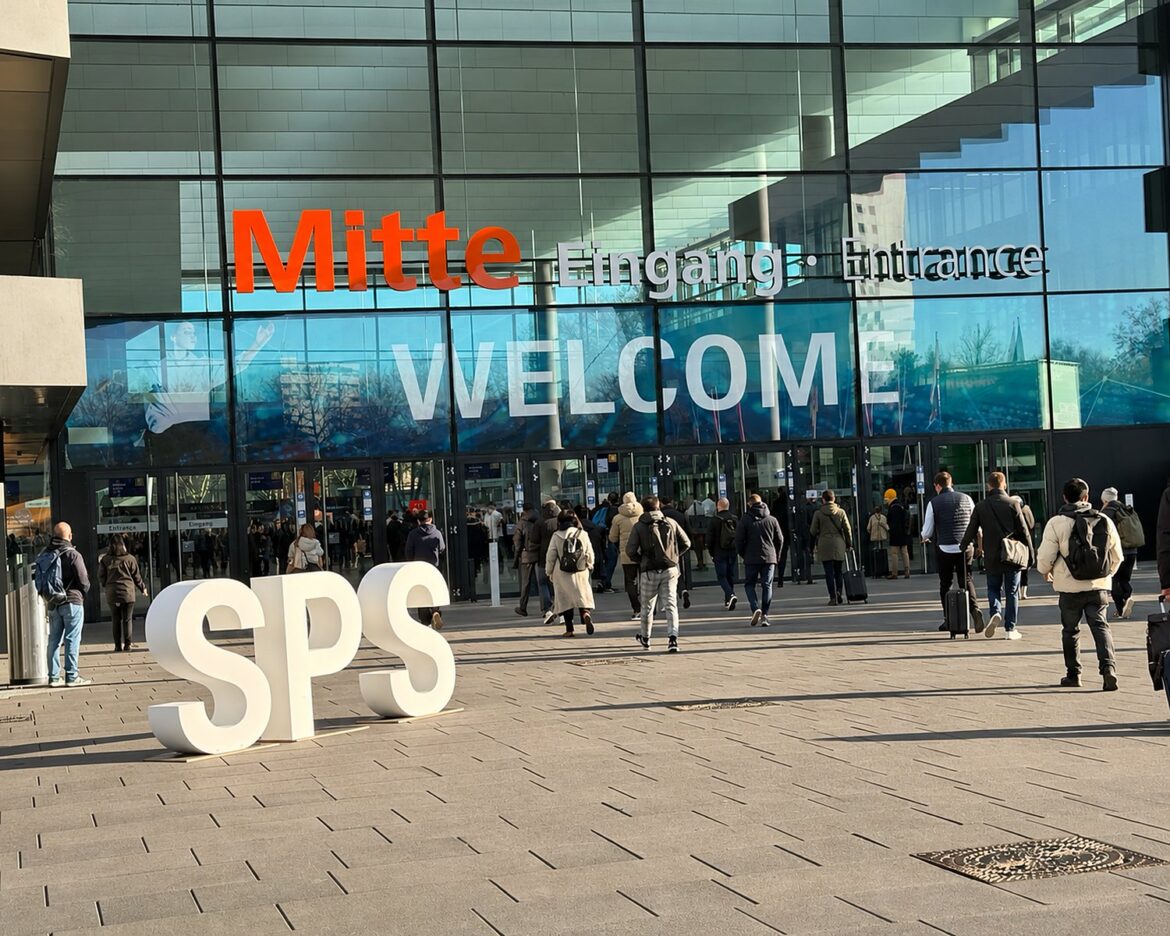
Opening day at the Mitte entrance: on the morning of 24 November, the first visitors stream into the 35th edition of SPS in Nuremberg. | Photo: SPS 2026 / XR Stager Newsroom
SPS in Nuremberg is the meeting place of industrial automation. From 24 to 26 November 2026, around 1,180 exhibitors, almost half of them from abroad, show where factories, controllers and software are heading. According to organizer Mesago, two topics shape the agenda: the practical use of Industrial AI and the implementation of the Cyber Resilience Act.[1]
For the XR Stager Newsroom, SPS is the logical continuation of electronica. Munich was about AI on the chip. Nuremberg is about how this intelligence arrives in machines, plants and processes: in robotics, in digital twins and in connected manufacturing.
By the first morning, the aisles are full. Crowds gather in front of the large stands, the stages are packed, and humanoid robots draw the audience in. Above all, it is striking how concrete the topics have become: Industrial AI no longer appears as a promise on posters but as a running demo, from the AI assistant in engineering to the camera that inspects bread rolls on a conveyor.
- SPS 2026 brings around 1,180 exhibitors to Nuremberg, almost half of them from abroad.
- The lead topics are Industrial AI and the Cyber Resilience Act.
- Around 30 expert talks and panel discussions accompany the show.
- Guided tours show Software Defined Industry and Industrial 5G in practice.
- Industrial AI has arrived in concrete tools, from AI agents in engineering to AI-based visual inspection in production.
The first chapter looks at the expectations the industry brings to Nuremberg.
SPS 2026 in Numbers: An Industry Between AI and Regulation
With around 1,180 exhibitors, SPS 2026 matches the strong level of the previous year. Almost half of the companies come from abroad, confirming the show’s role as an international platform for industrial automation.[1]
In terms of content, the industry has two tasks to solve at the same time. It needs to bring the potential of artificial intelligence into industrial practice while meeting growing cybersecurity requirements. The show management describes exactly this dual role as the core of this year’s SPS.
For companies, this means that AI projects and security requirements can no longer be planned separately. Anyone bringing an AI function into a product today has to build it to withstand the requirements of the Cyber Resilience Act at the same time.

Packed aisles on the first day: trade visitors between the DOLD and Finder stands in Hall 9.
DOLD / Finder, SPS 2026 | Photo: SPS 2026 / XR Stager Newsroom
Industrial AI is everywhere in the halls, from the stand motto at Phoenix Contact to AI-based visual inspection at Siemens. The Cyber Resilience Act mainly appears in the talk program, but it also shows up in exhibitor messages, for example when Phoenix Contact puts “secure” right next to “AI-powered”. By the first morning the aisles are full, for instance in Hall 9 between the DOLD and Finder stands.
- Around 1,180 exhibitors, almost half of them from abroad.[1]
- Industrial AI and the Cyber Resilience Act are the two lead topics.[1]
- AI functions and cybersecurity need to be planned together.
- Packed aisles and full stages from the very first day.
The next chapter shows where Industrial AI becomes concrete at SPS.
Industrial AI: From Vision to Practice
While the potential of AI is still being debated in many places, the automation industry is already working on implementation. At SPS, exhibitors show how AI is used today in engineering, production and maintenance and what value it creates.[1]
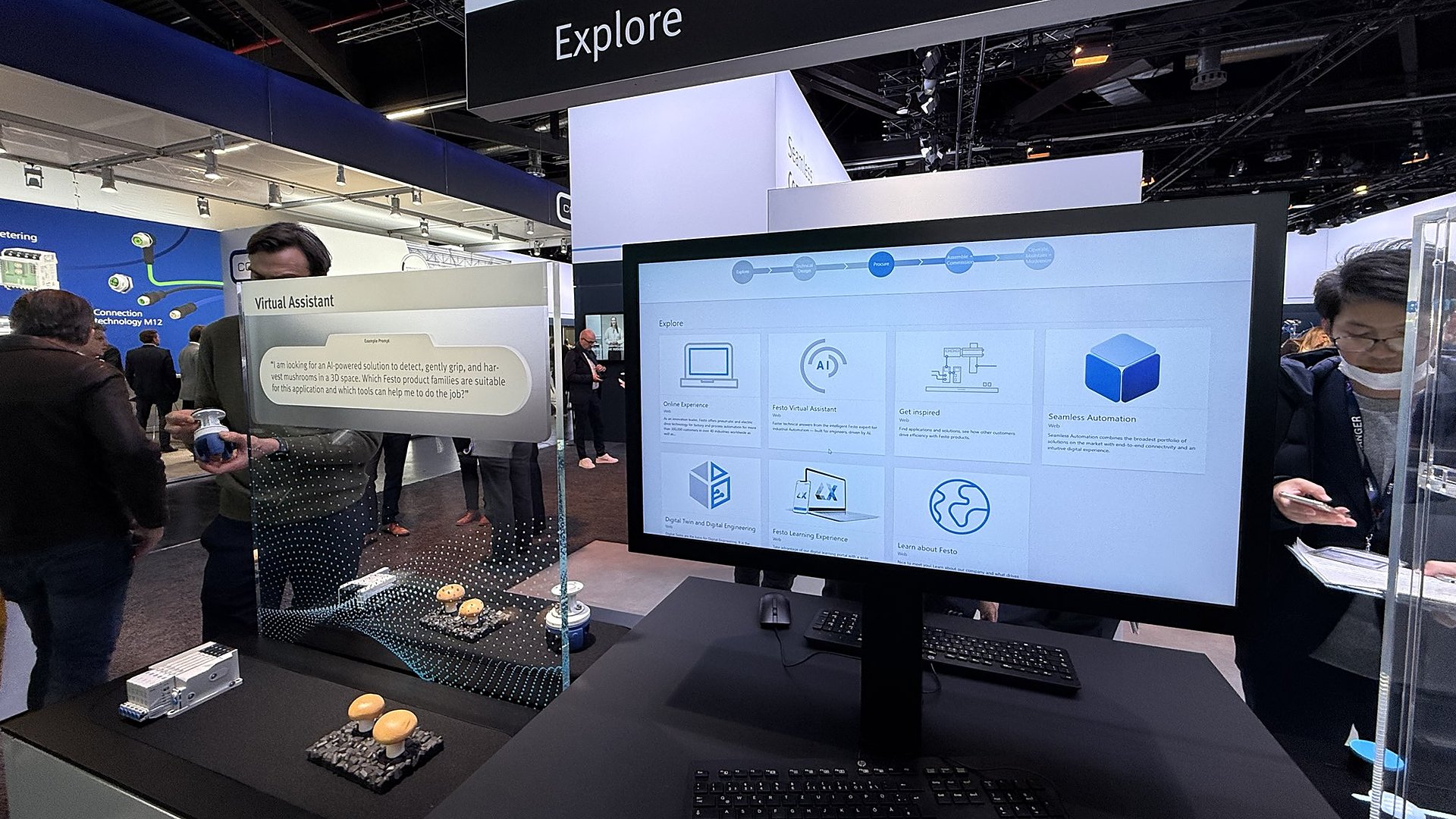
Engineering: AI assistants help program controllers, create documentation and check configurations. Siemens relies on AI agents here: the Eigen Engineering Agent handles tasks such as programming controllers, designing operator interfaces and configuring devices. For SPS, Siemens has extended it to the process industry, for the SIMATIC PCS 7 control system and for chemicals and pharma. According to Siemens, the number of paid licenses more than tripled between July and October 2026, and the company cites time savings of up to 60 percent for selected engineering tasks.[6] At the press conference, Siemens showed that the agent is now directly connected to the TIA Portal. There it is meant to verify and simulate code, generate standardized projects, create safety configurations and help modernize existing operator panels. The slide summed up the goal in a few words: higher quality, faster safety. Festo shows a virtual assistant at its stand that accompanies customers along the entire journey, from product search through technical design and procurement to commissioning and operation. The sample task on the screen makes the ambition tangible: the goal is an AI-powered solution that detects mushrooms in a room, grips them gently and harvests them. The assistant is meant to suggest suitable product families and tools. Behind this is a continuous digital chain: according to Festo, the System Configurator saves up to 70 percent of engineering time, and Festo AX Controls and the Automation Suite are said to cut commissioning time by up to 50 percent. In operation, Festo AX Industrial Intelligence takes over monitoring and optimizing the machines.
Production: Image processing and learning control systems detect deviations before they turn into scrap. This closes the loop with electronica: the computing power for this increasingly sits directly in the device. Festo shows the path “from the robot axis to AI-assisted gripping” at its stand: a soft gripper lifts delicate parts so gently that even 3D-printed succulents remain undamaged. Siemens shows what AI-based image processing looks like in practice with AI-VISION: in the “Visual Inspection Cockpit”, a camera checks bread rolls running in four rows on a conveyor for quality and alignment. The AI marks each item in color on the screen, and the controller triggers the inspection. Siemens sums up the ambition in two terms: “AI-made Simplicity” and “AI-made Flexibility”.
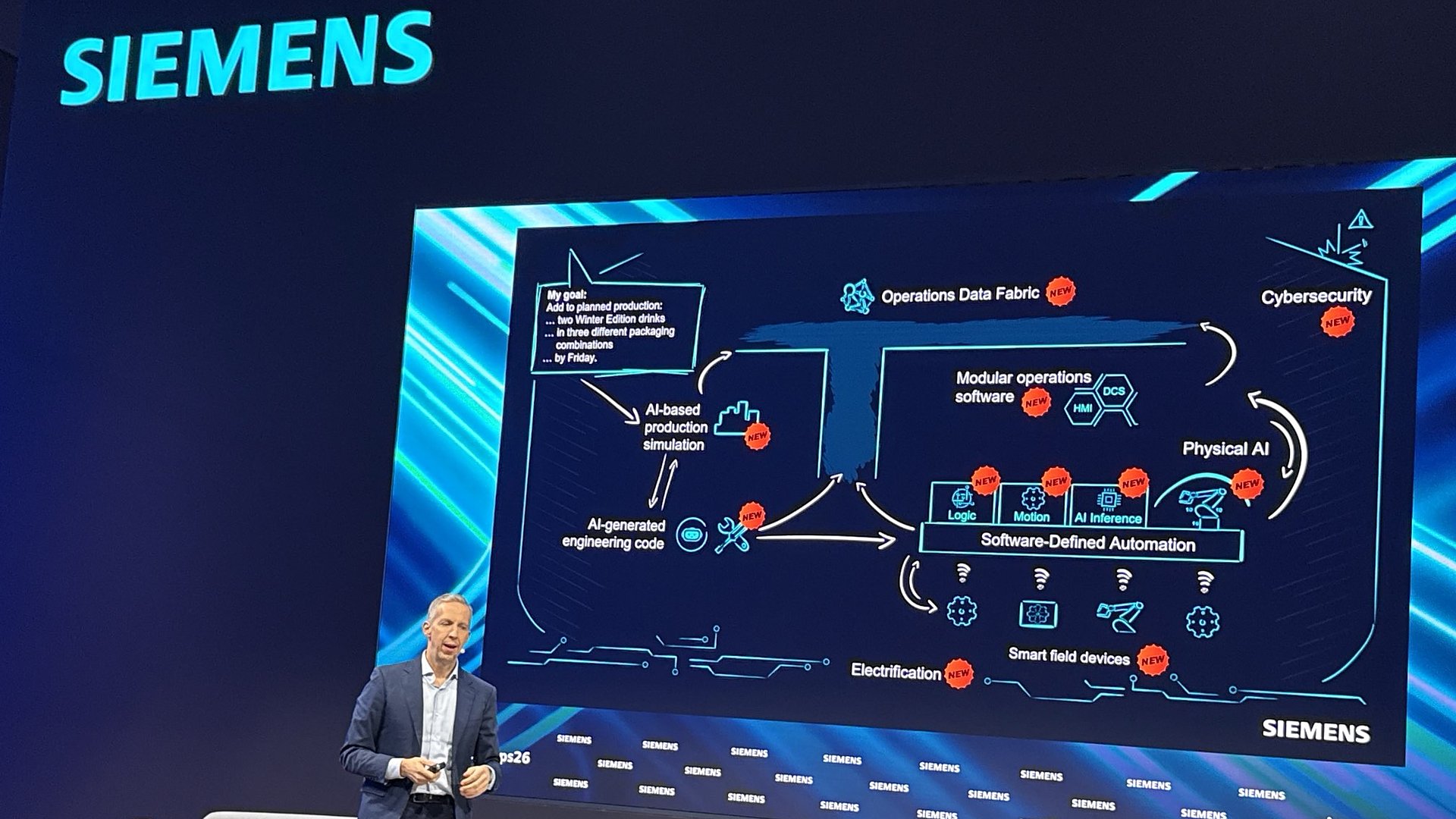
From goal to production: How far Siemens takes the idea became clear at the press conference on the evening of the first day, where Rainer Brehm, President of Automation at Siemens, presented the company’s strategy.[6] The starting point is not a program but a goal in everyday language: two winter edition drinks in three packaging variants, finished by Friday. An AI-based production simulation checks how this can be achieved, AI generates the matching engineering code, and software-defined automation with logic, motion control and AI inference executes it. Physical AI, meaning AI that lets machines act in the real world, takes on tasks such as picking component reels out of a cardboard box, which a robot arm unpacked on its own in a video demonstration. Everything is connected through a shared data layer and protected by cybersecurity. Siemens confidently cited an assessment by analyst firm Gartner describing the company as the one to beat in Physical AI services.
Maintenance: Models analyze machine data and report when a component needs servicing. Festo combines Industrial Intelligence with its Smartenance maintenance platform, digital spare parts management and targeted software updates. Siemens shows at its stand how condition data can be retrofitted: the SITRANS MS200 multisensor captures data directly on pumps and motors, and the SITRANS CC220 gateway delivers calculated key figures via MQTT to its own platform or to third-party solutions.
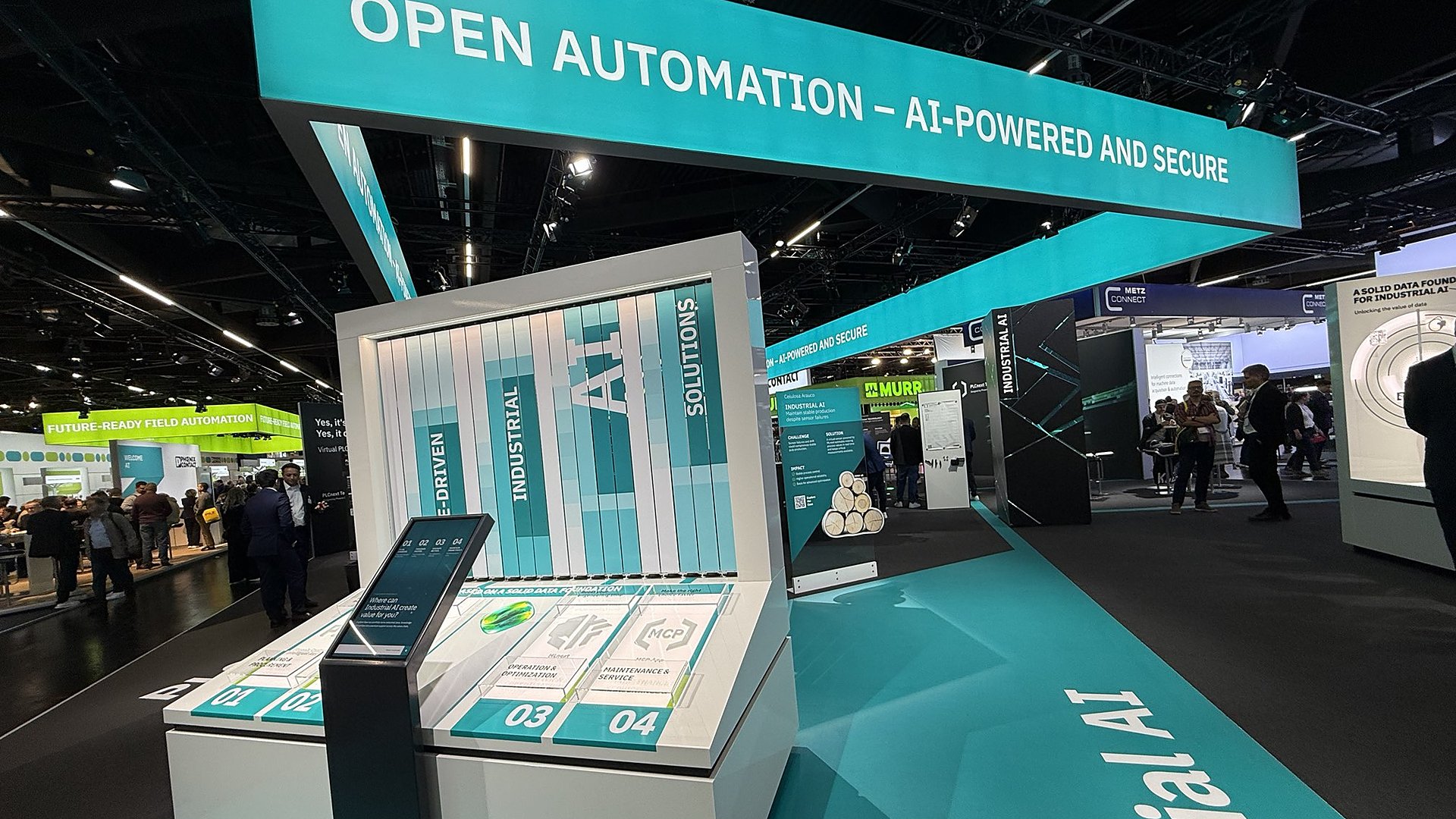
Phoenix Contact shows how closely the two lead topics belong together in its stand motto alone: “Open Automation, AI-powered and secure”. At an interactive station, visitors can explore where Industrial AI creates value in their own operations, across four fields from planning and procurement to maintenance and service. According to the company, the basis for this is a solid data foundation.
The Industrial AI topic block on the Technology Stage powered by VDMA/ZVEI on the second day offers deeper insights. It includes the talk “Open SmartFactory Architecture: The Blueprint for the Software Defined Industry” by Prof. Martin Ruskowski, Chairman of the Board of SmartFactoryKL.[1]
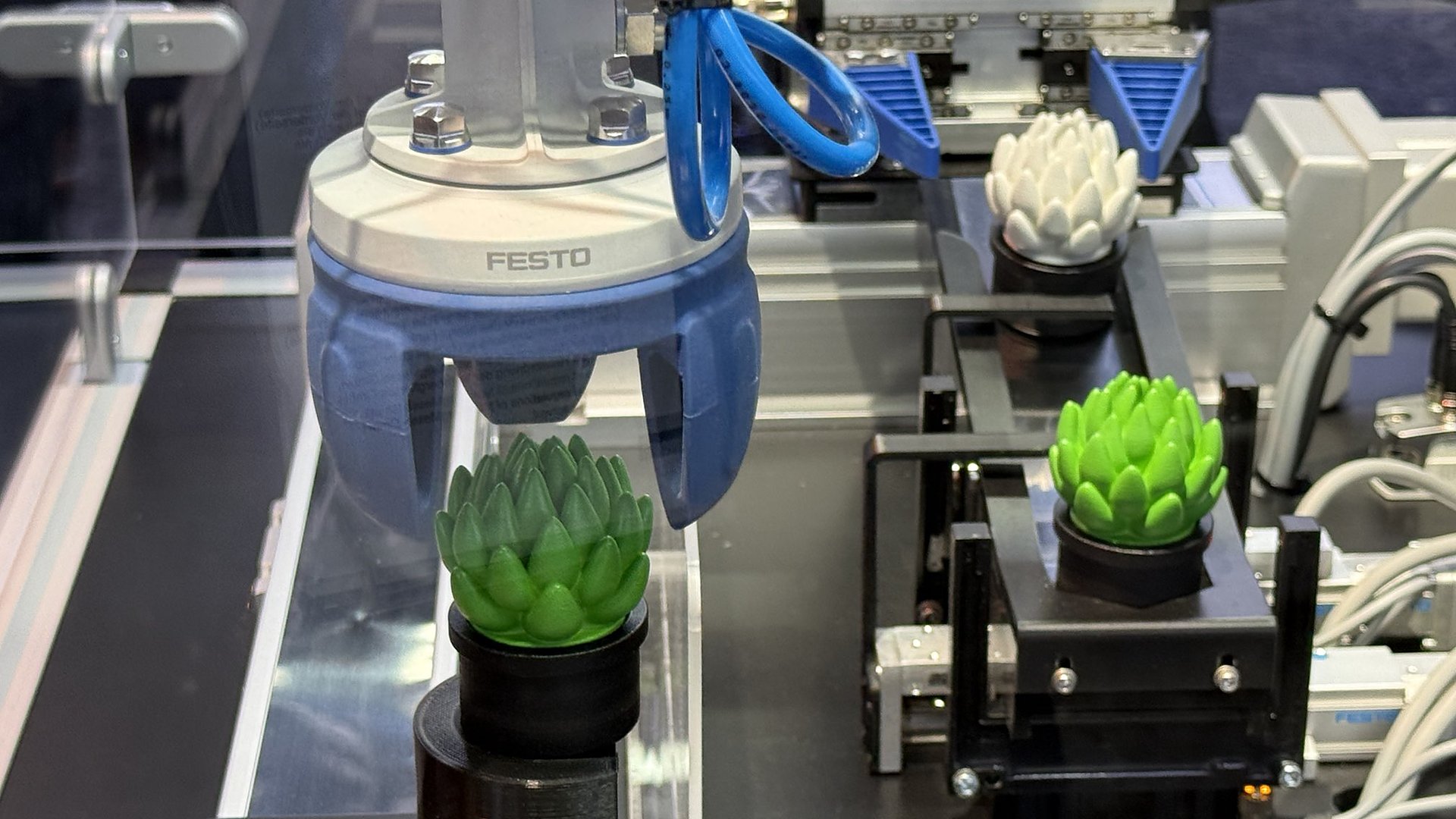
Gripping with a delicate touch: Festo shows the path from the robot axis to AI-assisted gripping.
Festo, SPS 2026 | Photo: SPS 2026 / XR Stager Newsroom
What stands out is how tangible the demos have become. A camera inspects bread rolls on a conveyor, an assistant puts together a gripping solution for mushrooms, and a soft gripper lifts succulents without damaging them. Every visitor understands examples like these immediately, and that is exactly what makes them more convincing than any slide.
- Industrial AI is on display at SPS in engineering, production and maintenance.[1]
- Industrial AI topic block on the Technology Stage on day two.[1]
- The computing power for AI is moving closer to the machine.
- The demos are concrete: AI-based visual inspection, AI assistants and sensitive gripping.
The next chapter is dedicated to the second lead topic: the Cyber Resilience Act.
Cyber Resilience Act: Guidance in Times of New Requirements
The first reporting obligations have applied since September 2026, and the Cyber Resilience Act comes fully into force at the end of 2027. The EU regulation covers all products with digital elements that are manufactured, imported or sold in the EU. Manufacturers and operators alike are affected.[1][4]
For automation, this is a fundamental change. Controllers, drives, sensors and software must be secured, maintained and documented over their entire life cycle. Vulnerabilities must be reported and updates provided.
At SPS, visitors get guidance on impacts, deadlines and implementation options. The most important talks on the topic take place on the Technology Stage in Hall 3.[1]
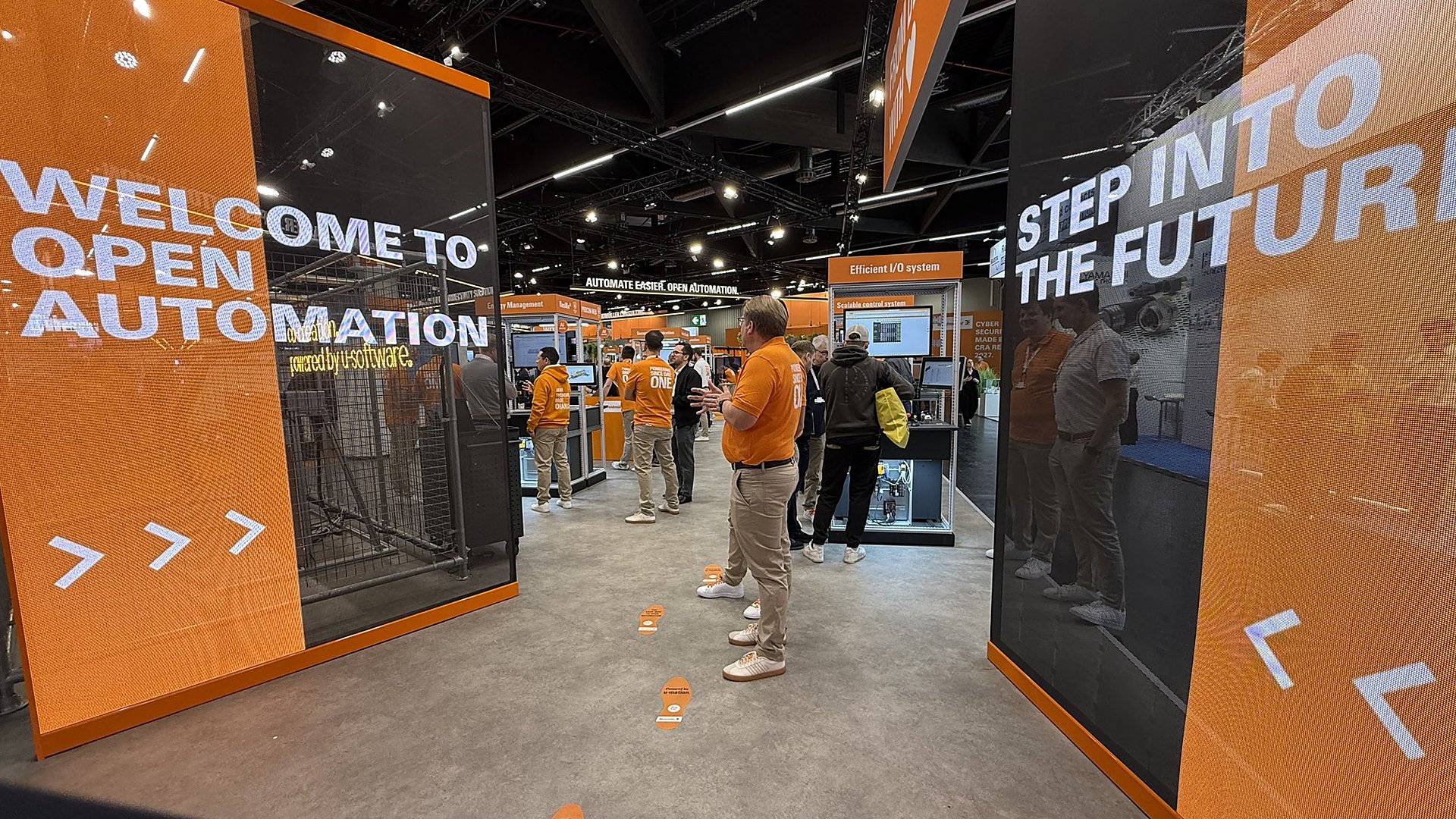
Welcome to Open Automation: Weidmüller combines open automation with the path to CRA compliance.
Weidmüller, SPS 2026 | Photo: SPS 2026 / XR Stager Newsroom
On the stands, the Cyber Resilience Act is quieter than Industrial AI, but it is there. Several exhibitors explicitly link their AI messages to security. The direction is clear: security is turning from a mandatory exercise into a selling point.
- Reporting obligations have applied since September 2026, full application at the end of 2027.[1]
- All products with digital elements on the EU market are affected.[1][4]
- CRA talks on 25 November on the Technology Stage in Hall 3.[1]
- Alongside AI, security is becoming a fixed part of many exhibitors’ messages.
The next chapter shows how connected machines become a software-defined factory.
Software Defined Industry: When the Factory Becomes a Platform
In the classic factory, a plant’s function is tied to its hardware. The Software Defined Industry reverses this principle: functions are created in software, managed centrally and can be updated without rebuilding the machine. IT and OT grow together into a shared platform.
The “Software Defined Industry Live” guided tour by SmartFactoryKL shows what this looks like in practice. It takes visitors to selected hardware and software companies, including WIBU-SYSTEMS, XITASO, Yaskawa, B&R Industrial Automation and Pilz.[1]
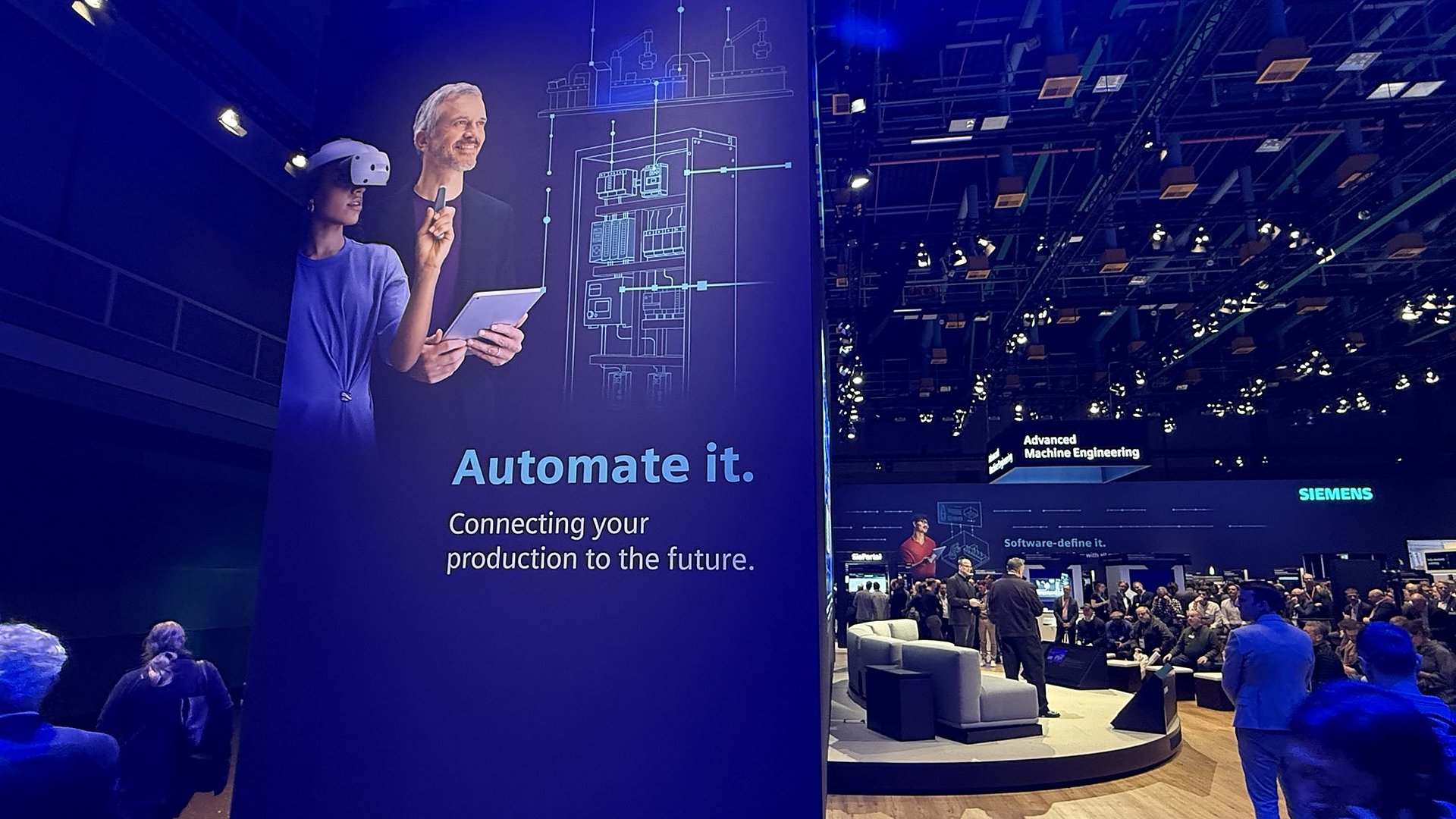
Siemens makes the principle the motto of its stand: “Automate it.” and “Software-define it.” On the large entrance wall, an engineer wearing mixed reality glasses plans a digital control cabinet together with a colleague holding a tablet, while behind it listeners crowd around talks on Advanced Machine Engineering. On the main Siemens stage, a talk built around the question “Why Fast Forward?” used an image everyone knows: the journey of music from vinyl through cassette and MP3 player to streaming. Fixed hardware became a service that keeps evolving. Automation is now meant to take exactly this step with software-defined plants. Siemens itself sums up its presence in Hall 11 under four themes: Connected Automation, Software-Defined Automation, the Comprehensive Digital Twin and Industrial AI. This becomes concrete with SIMATIC AX, whose engineering with Motion Control now supports IT-style ways of working such as version control with Git, and with TIA Portal V21.1, which will keep users on the latest software without project upgrades within the version.[6] Siemens puts it in a formula: “Buy features, not versions.” This is complemented by multicore support for the S7-1500 controller and machine-readable project data that opens the TIA Portal to AI tools. The occasion for the talk was an anniversary: 30 years of Totally Integrated Automation (TIA). The timeline on stage showed how automation at Siemens has moved step by step toward software: 1996 one system instead of many individual tools, 2010 the TIA Portal as shared engineering for controllers, drives and HMIs, 2016 the Industrial Cloud for production data, 2019 artificial intelligence directly in the controller and 2024 the Industrial Copilot, bringing generative AI into everyday engineering.
The Murrelektronik stand shows what this looks like in practice. Under the motto “Home of Decentralized Automation”, a real system with a SCARA robot and transport system is running there. Above it hang large screens showing the digital twin of entire production lines. Next to it, a KUKA industrial robot works in a cell bearing the motto “Co-Creation”. Weidmüller also relies on open, software-based automation with “Open Automation” and its own u-mation software. Festo shows the principle on a small scale: a conveyor demonstrator receives its synchronized motion via EtherCAT and AX Motion with CODESYS, from software and apps instead of rigid mechanics.

Dreaming bigger: at Murrelektronik, the real system and the digital twin of the production line run side by side.
Murrelektronik, SPS 2026 | Photo: SPS 2026 / XR Stager Newsroom
Software is the key word at the large stands. Siemens writes “Software-define it.” on the wall, Weidmüller talks about Open Automation, and at Murrelektronik the digital twin of the production line runs directly above the real system. The talks on the topic are full, with many visitors listening standing up.
- Software Defined Industry separates function from hardware.
- IT and OT are growing together into a shared platform.
- SmartFactoryKL guided tour with stops at WIBU-SYSTEMS, XITASO, Yaskawa, B&R and Pilz.[1]
- Siemens celebrates 30 years of TIA and focuses on Software-Defined Automation.
The next chapter goes one level deeper: to the connectivity all of this builds on.
Connected Production: Industrial 5G and OPC UA FX
A software-defined factory needs networks that transport data reliably and across vendors. At SPS, two approaches take center stage: wireless via Industrial 5G and standardized via OPC UA.
Industrial 5G: The 5G-ACIA guided tour shows how private 5G networks are already being used in production, logistics and automation today. Stops include Siemens, Phoenix Contact, Ericsson Enterprise Wireless Solutions, NXP Semiconductors Germany, the Fraunhofer Institute for Production Technology IPT and DRUID SOFTWARE.[1]
OPC UA FX: OPC UA is the widely used standard for data exchange in industry. With OPC UA FX, short for Field eXchange, the OPC Foundation extends the standard down to the field level. Controllers and devices from different manufacturers are meant to communicate directly with each other. This is exactly the focus of the OPC Foundation’s Learn@Lunch on 25 November.[3]
Data spaces: Connectivity does not end at the factory gate. On the Technology Stage, ZVEI showed how data sharing between companies is implemented at industrial scale. Projects such as Manufacturing-X lay the foundation for data spaces, and initiatives such as Catena-X already show how the exchange works in practice. Three building blocks are needed: concrete use cases along the value chain, such as predictive maintenance or supply chain management, common standards such as MX-Ports for machine-readable exchange without individual integration, and an ecosystem in which OEMs, suppliers and technology providers work on a shared basis. For companies, the association outlined six steps: clarify data availability, secure data quality and access, prioritize standards and cooperation, introduce use cases in a targeted way, develop a company data strategy and take part in initiatives and pilot projects instead of just watching.
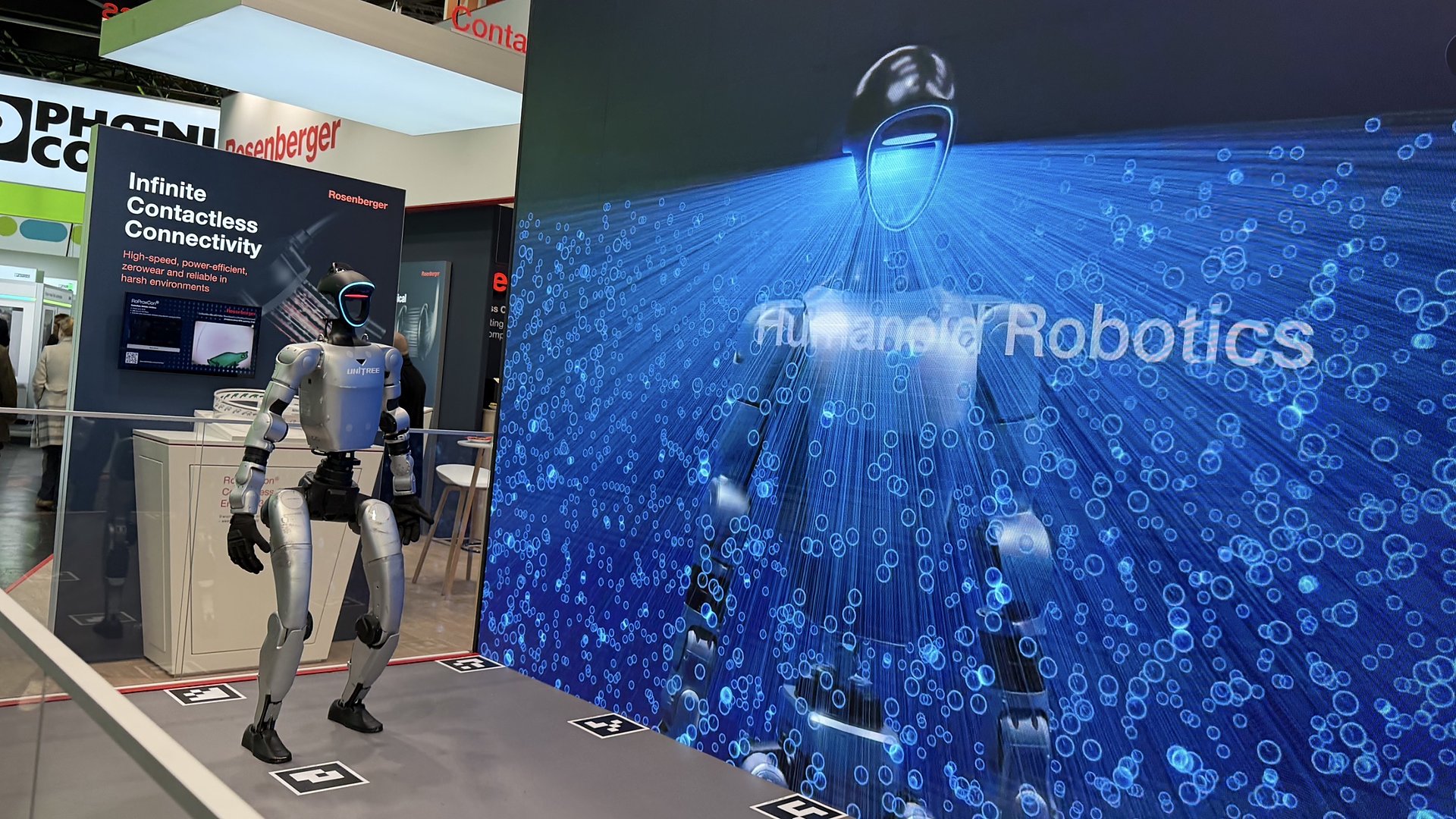
Infinite Contactless Connectivity: at Rosenberger, connectivity becomes a prerequisite for motion.
Rosenberger, SPS 2026 | Photo: SPS 2026 / XR Stager Newsroom
At the show, connectivity is most visible in the components. Connector and cable manufacturers such as Rosenberger and TE Connectivity are among the most striking stands. On the Technology Stage, the view reaches even further, toward data spaces in which companies share data across their boundaries.
- Private 5G networks have arrived in production and logistics.[1]
- 5G-ACIA guided tour with stops at Siemens, Phoenix Contact, Ericsson and others.[1]
- OPC UA FX extends OPC UA down to the field level.[3]
- Data spaces such as Manufacturing-X and Catena-X connect companies along the value chain.
- Connection technology is becoming a visible show topic.
The next chapter shows what sets all this technology in motion: robotics.
Robotics at SPS: Where Intelligence Moves
Robotics is where Industrial AI, connectivity and safety visibly come together. A robot has to perceive its surroundings, decide in real time and work safely alongside people. At electronica, the chips for this were maturing. At SPS, it becomes clear how they arrive in applications.
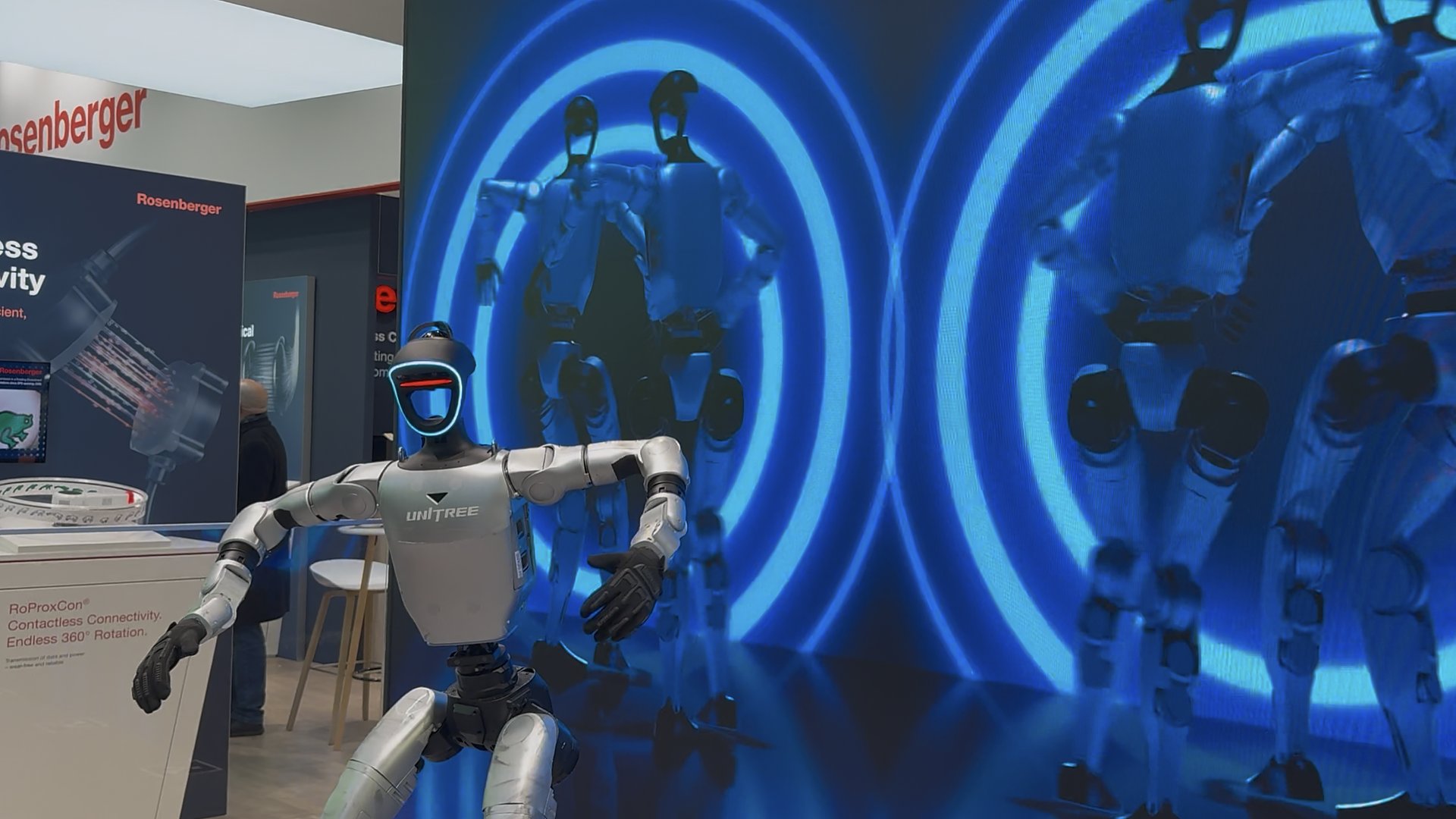
The most striking feature of SPS 2026 is the presence of humanoid robots. At the joint stand of Dassault Systèmes and Agile Robots, a humanoid with glowing blue camera eyes and a display on its chest is linked to its virtual twin. At Rosenberger, a Unitree robot performs choreographed movements in front of an LED wall and constantly draws a crowd.
At the same time, classic industrial robotics remains the backbone of manufacturing. At the Murrelektronik stand, a KUKA robot with a gripper works above a conveyor, supplied via decentralized I/O modules directly at the machine. Festo uses its soft gripper to show how sensitive parts can be handled safely.
It is striking how strongly suppliers are picking up on the topic: Rosenberger promotes “Robotic Cables” and contactless transmission for joints that rotate endlessly. The more mobile robots become, the more connection technology determines their reliability. TE Connectivity also puts its stand under the motto “Every Connection Counts”.
The stage at the Siemens stand shows how much interest there is: at the talk “SINAMICS E210 and SIMOVE: Driving Flexible Production with Mobile Robots”, every seat is taken and many visitors listen standing up. The focus is on mobile robots that move material flexibly through production, powered by compact drive technology and controlled via the SIMOVE platform. To match this, Siemens has introduced a new extra-low-voltage drive solution for 24 and 48 volts designed specifically for automated guided vehicles and mobile robots.[6] Right next door, Siemens shows the principle live: in the “Future Autonomous Factory” demo cell, an autonomous mobile robot picks up small load carriers at a transfer station while the control software displays the vehicle’s position, order and battery level on a screen in real time.

A humanoid with an eye for detail: the Agile Robots robot at the joint stand with Dassault Systèmes.
Agile Robots, SPS 2026 | Photo: SPS 2026 / XR Stager Newsroom
Humanoid robots are the crowd magnets of the first day. At least as interesting for practice are the less spectacular demos, such as the mobile robot at Siemens that picks up boxes at a transfer station on its own while the control software displays every step.
- Robotics brings together Industrial AI, connectivity and safety.
- From the chip level at electronica to applications at SPS.
- Humanoid robots from Agile Robots and Unitree are crowd magnets.
- Cables and contactless connections are becoming critical components of mobile robots.
The next chapter closes the loop: with the digital twin.
Digital Twins: The Factory Before It Is Built
The more functions move into software, the more important an accurate digital representation of the plant becomes. A digital twin combines geometry, behavior and operating data. It makes it possible to plan processes, test software and train employees before a machine goes into operation.
This is doubly relevant for the lead topics of SPS. AI models need realistic training and test environments. And the Cyber Resilience Act requires updates to be checked before they go into the field. In both cases, the digital twin is the safe environment for the first step.
Several talks on the Technology Stage showed how far this already goes. One topic was training AI in simulation. In manufacturing, there is often not enough real data to train AI models, for example images of rare defects. In simulation, such data can be generated artificially in large quantities, and robots can learn there before they work on the real system. Even virtual cameras can now be connected to image processing software as if they were real industrial cameras. This makes it possible to test a visual inspection before the first real camera is mounted, for example whether a code on a product can still be read reliably at changing angles and lighting.
A second talk reduced the foundation to a simple formula: a digital twin is only as reliable as its behavior model. Virtual commissioning only becomes robust when three levels work together: the 3D geometry with shape, installation space and motion, the signal model with inputs and outputs, parameters and diagnostics, and the behavior with states, timing and fault cases. Component manufacturers increasingly provide ready-made digital models of their products, for example of safety switches on a protective door. Those who adopt them instead of rebuilding them save time and can rely on the component behaving in simulation as it does in reality. Providers cite time savings of 60 to 80 percent for virtual commissioning, because software errors are fixed before the real plant is in place. These are manufacturer figures, but they show where the economic lever of the digital twin lies.
At SPS, the digital twin is present at many stands. Under the motto “A Real Robot, A Virtual Twin”, Dassault Systèmes and Agile Robots show how a real humanoid robot and its virtual counterpart work together. At Murrelektronik, a touchscreen shows the welding gun of a KUKA robot as a 3D model in the VarioX visualization, while the real robot works behind it and entire production lines run as digital twins above the stand.

A Real Robot, A Virtual Twin: Dassault Systèmes and Agile Robots connect a real humanoid with its virtual twin.
Dassault Systèmes / Agile Robots, SPS 2026 | Photo: SPS 2026 / XR Stager Newsroom
At SPS, the digital twin is part of the standard equipment of large stands. Almost everywhere, the virtual counterpart runs next to the real system. At the same time, the talks show where the real work lies: in clean behavior models and in data that truly matches the real plant.
- A digital twin is only as reliable as its behavior model: geometry, signals and behavior belong together.
- Ready-made component models from manufacturers speed up virtual commissioning.
- AI models need realistic training and test environments.
- CRA-compliant updates can be checked in the twin in advance.
- The digital twin is part of the standard equipment of large stands.
The final chapter sums up what remains from SPS 2026.
What Remains: Industrial AI Gets Real, Security Becomes Mandatory
SPS 2026 shows an industry that has taken the step from announcement to application. Industrial AI is built into tools engineers can use today: AI agents that write and check control code, cameras that assess products in real time and robots that grip components on their own. Automation is increasingly defined by software, and the digital twin is the tool for planning and testing all of this in advance.
What is surprising is less the technology than its maturity. A year ago, many of these topics were still on slides. Today they run as demos at the stands. At the same time, it is clear that AI alone is not enough. Without clean data, reliable models and secure connectivity, it remains piecemeal.
For companies, this means that Industrial AI, software-defined automation and the Cyber Resilience Act belong in a single plan. Those who start now with clearly defined use cases, organize their data and test plants in the digital twin first lay the foundation for automation that can keep evolving without compromising security.
SPS 2026 connects two developments that have often been discussed separately. Industrial AI makes machines more capable. The Cyber Resilience Act makes them more accountable.
- Industrial AI has moved from promise to running application.
- Software increasingly defines what a plant can do.
- The digital twin is the test bed for AI, software and security.
- Industrial AI and the Cyber Resilience Act belong in a single plan.
SPS 2026 in Pictures
The gallery shows SPS 2026 as it presented itself on the show floor: from opening day at the Mitte entrance to the big stages, robotics and digital twins.
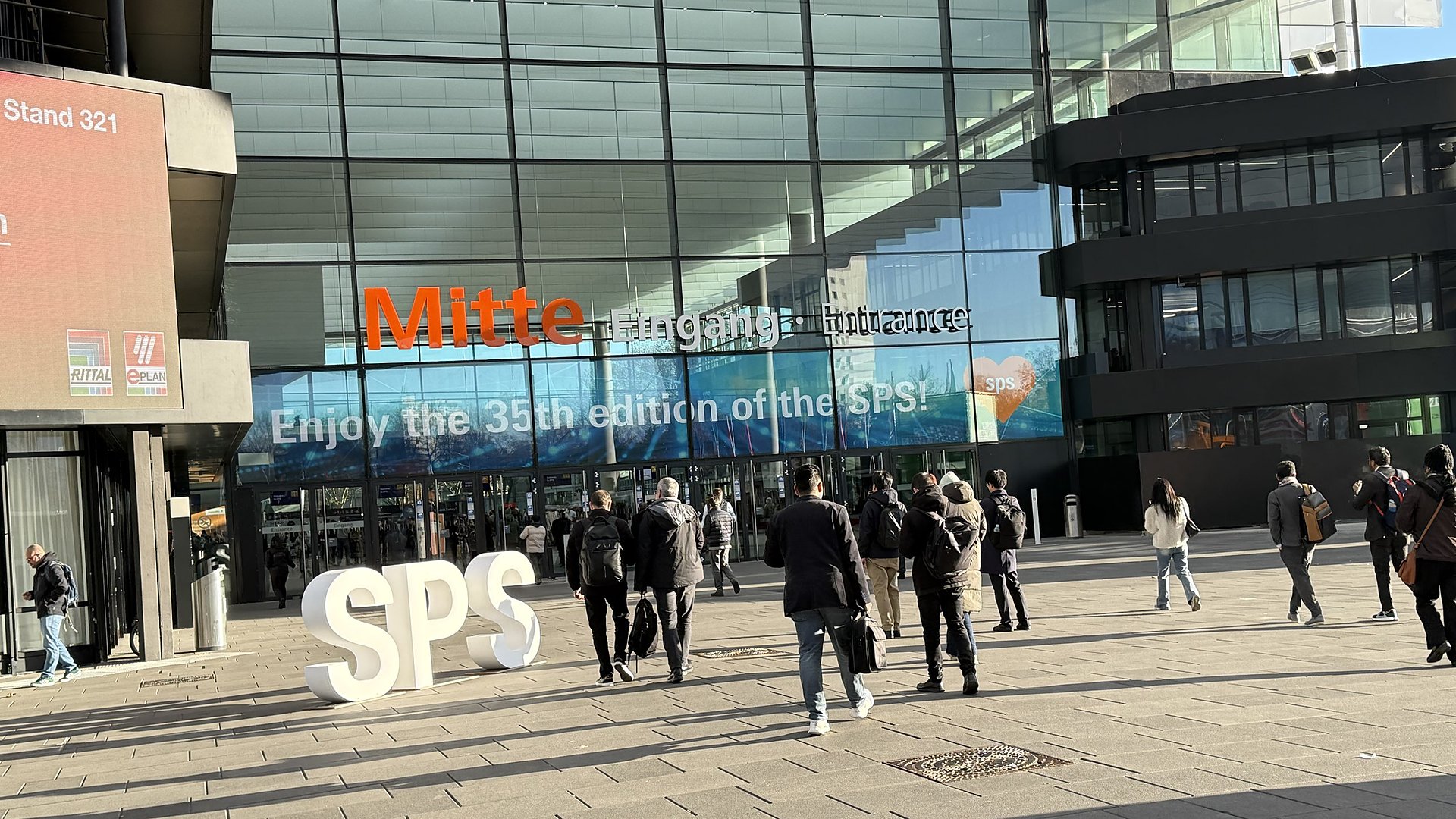 1 / 15
Opening day at the Mitte entrance
On the morning of 24 November, SPS opens its doors for the 35th time. Around 1,180 exhibitors, almost half of them from abroad, spend three days showing where industrial automation is heading.
Exhibition Centre Nuremberg, SPS 2026 | Photo: SPS 2026 / XR Stager Newsroom
2 / 15Packed aisles in Hall 9
Trade visitors crowd between the DOLD and Finder stands in the morning. This is where the fundamentals of automation live: relays, safety switches and control components that every plant depends on.
DOLD / Finder, SPS 2026 | Photo: SPS 2026 / XR Stager Newsroom
 3 / 15
Open Automation, AI-powered and secure
Phoenix Contact puts its stand under a motto that unites both lead topics of the show: open automation, AI-powered and secure. An interactive table shows in four stations where Industrial AI creates value, from planning and procurement through operations and optimization to maintenance and service.
Phoenix Contact, SPS 2026 | Photo: SPS 2026 / XR Stager Newsroom
 4 / 15
Bread rolls under the eye of AI
In the Smart Manufacturing area, Siemens uses AI-VISION to check whether bread rolls on a conveyor are correctly shaped and aligned. The AI marks every roll in color on the screen, and the inspection is triggered by a SIMATIC controller.
Siemens, SPS 2026 | Photo: SPS 2026 / XR Stager Newsroom
5 / 15Gripping with a delicate touch
A soft gripper from Festo lifts delicate 3D-printed succulents without damaging them. At its stand, Festo shows the path from the classic robot axis to AI-assisted gripping: automation is meant to become faster, simpler and smarter.
Festo, SPS 2026 | Photo: SPS 2026 / XR Stager Newsroom
 6 / 15
An AI assistant for the entire customer journey
3D-printed mushrooms, a soft gripper and a screen with the Festo Virtual Assistant: the sample task is to find an AI-powered solution that detects mushrooms in a room, grips them gently and harvests them. The assistant is meant to suggest suitable product families and tools.
Festo, SPS 2026 | Photo: SPS 2026 / XR Stager Newsroom
7 / 15Welcome to Open Automation
Weidmüller greets visitors with LED walls and the promise of open automation based on its own u-mation software. The Cyber Resilience Act is also on the agenda: manufacturers want to get their products ready for 2027 in time.
Weidmüller, SPS 2026 | Photo: SPS 2026 / XR Stager Newsroom
 8 / 15
Automate it. Software-define it.
Siemens welcomes visitors with a large visual: an engineer wearing mixed reality glasses next to a colleague with a tablet in front of a digital control cabinet. Behind it, a packed audience follows a talk in the Advanced Machine Engineering area, under the second motto “Software-define it.”
Siemens, SPS 2026 | Photo: SPS 2026 / XR Stager Newsroom
 9 / 15
From a goal to finished production
At the Siemens press conference, the factory of the future begins with a single sentence: two winter edition drinks in three packaging variants by Friday. AI then simulates production, generates the control code and hands it over to software-defined automation with Physical AI.
Siemens, SPS 2026 | Photo: SPS 2026 / XR Stager Newsroom
 10 / 15
Future Autonomous Factory
In a demo cell at Siemens, an autonomous mobile robot picks up small load carriers at a transfer station. The SIMOVE software on the screen in front shows the vehicle's position, order and battery level live, while a fully automated warehouse runs on the LED wall behind it.
Siemens, SPS 2026 | Photo: SPS 2026 / XR Stager Newsroom
11 / 15Dreaming bigger: decentralized automation at Murrelektronik
A real system with a SCARA robot and transport system runs beneath large screens, while above it the digital twin shows entire production lines. Murrelektronik focuses on decentralized automation, moving intelligence and wiring directly to the machine.
Murrelektronik, SPS 2026 | Photo: SPS 2026 / XR Stager Newsroom
12 / 15Infinite Contactless Connectivity
At Rosenberger, a Unitree humanoid robot stands in front of an LED wall reading “Humanoid Robotics”. Next to it, the connector specialist promotes contactless transmission of data and power: fast, wear-free and robust, even for joints that rotate endlessly.
Rosenberger, SPS 2026 | Photo: SPS 2026 / XR Stager Newsroom
 13 / 15
A humanoid in motion
The Unitree robot performs choreographed movements at the Rosenberger stand while the LED wall behind it repeats its poses in blue. A crowd magnet with a serious background: every one of these movements needs cables and connections that keep up for the long run.
Rosenberger / Unitree, SPS 2026 | Photo: SPS 2026 / XR Stager Newsroom
14 / 15A humanoid with an eye for detail
Glowing blue camera eyes, a display on its chest and arms with many joints: the humanoid robot from Agile Robots draws attention at the joint stand with Dassault Systèmes. It stands for the step from industrial arm to versatile helper designed to work in existing environments.
Agile Robots, SPS 2026 | Photo: SPS 2026 / XR Stager Newsroom
 15 / 15
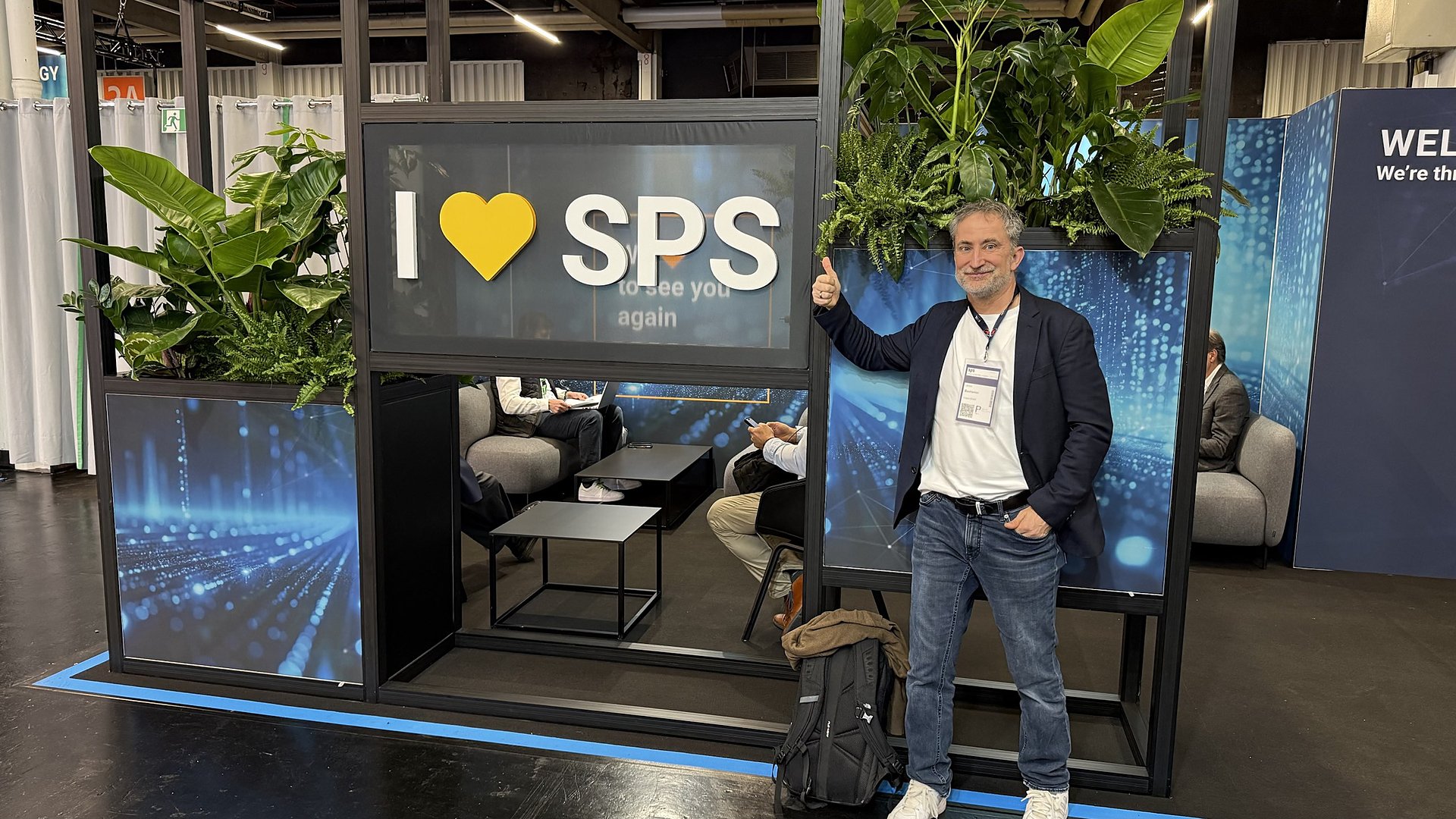
On site for the XR Stager Newsroom
Ulrich Buckenlei, publisher of the XR Stager Newsroom, reports live from SPS 2026 in Nuremberg. His takeaway after the first day: Industrial AI, software-defined factories and digital twins have arrived on the show floor.
XR Stager Newsroom, SPS 2026 | Photo: SPS 2026 / XR Stager Newsroom
The pictures show what lies behind the big buzzwords: plants, demos and packed stages where AI, software and security come together in the factory.
What This Means for Your Automation Strategy
Industrial AI, software-defined factories and new security requirements are changing how plants are planned, built and operated. The key question is not whether these developments will reach your company, but how teams can prepare for them early.
VISORIC helps companies make complex plants and processes understandable: with digital twins, XR training and real-time 3D applications. This makes it possible to plan new processes, test software and AI functions in a safe environment and train employees before the real plant is running.
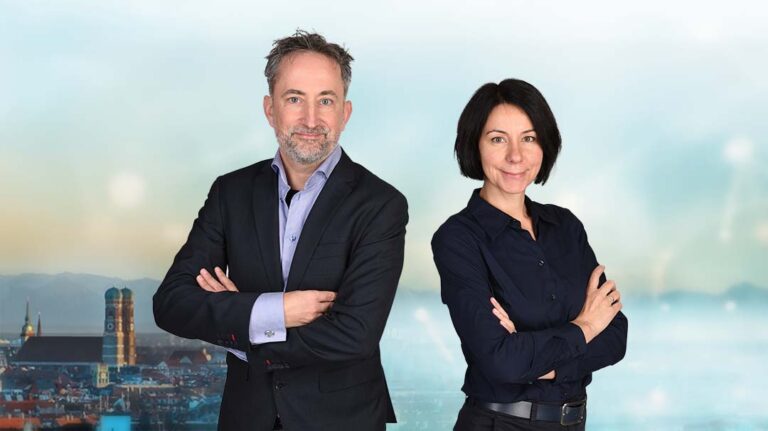
The VISORIC expert team from Munich combines over 15 years of experience in 3D, AI and XR with practical expertise in Spatial Computing, real-time visualization and digital twins.
- Digital twins for planning, testing and training on plants.
- XR training for new processes, safety zones and human-robot collaboration.
- Visualization of complex automation solutions for sales, trade shows and training.
A clearly scoped first use case can often be implemented faster and more cost-effectively than many companies expect.
Which plant or process in your company would benefit most from a digital twin?
Speak with the VISORIC expert team from Munich about digital twins, XR training and Spatial Computing. Together we turn your challenge into a precise, traceable next step.
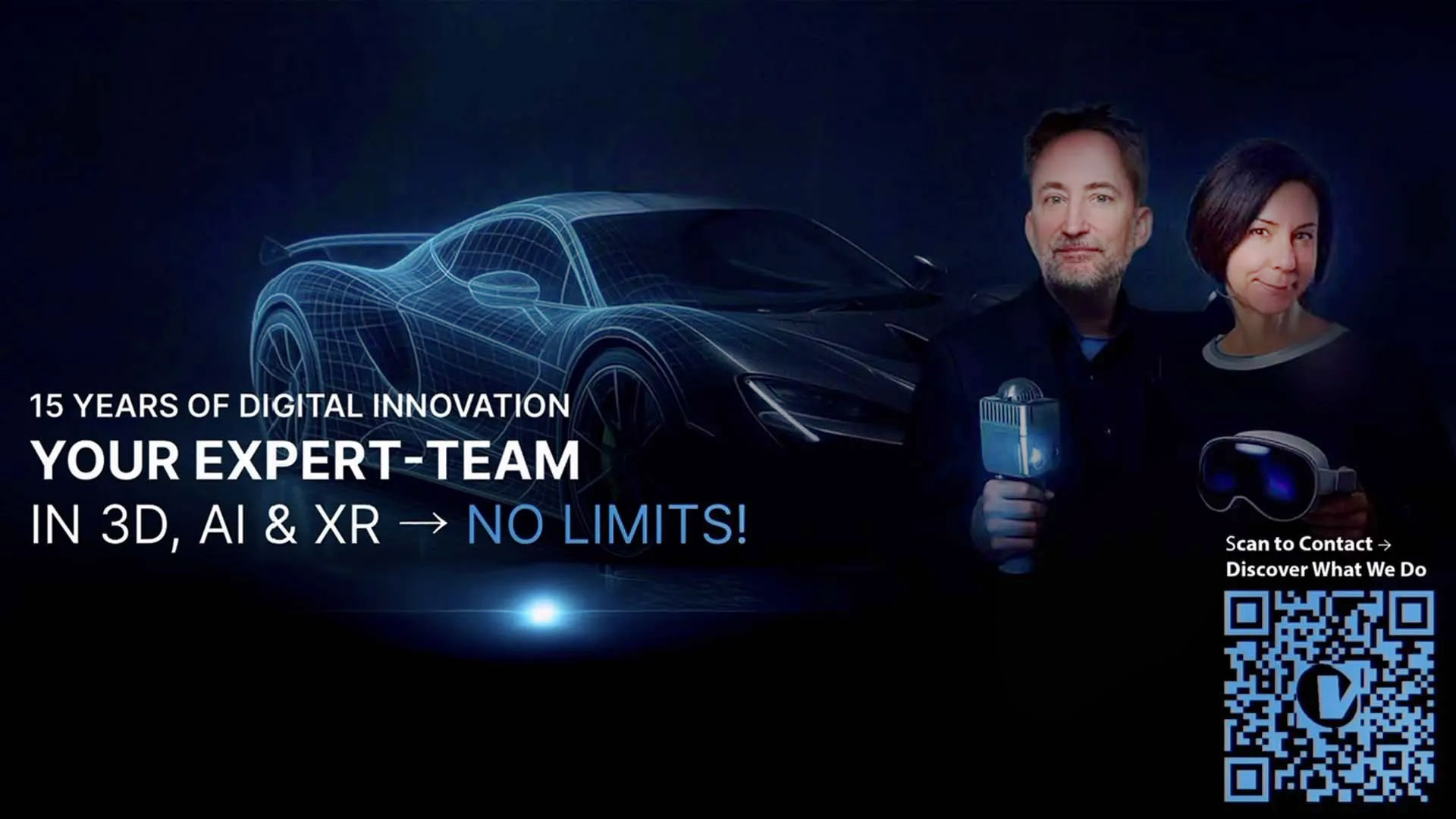
15 years of experience in 3D, AI and XR: the VISORIC expert team from Munich.
Image: © Ulrich Buckenlei | XR Stager Newsroom | VISORIC GmbH
Sources
- Mesago Messe Frankfurt GmbH: Press release “SPS 2026 shows ways to more cybersecurity and Industrial AI in production”, Stuttgart, 5 November 2026. sps-messe.de
- SPS Smart Production Solutions: Information on tickets, guided tours, exhibitors and supporting program. sps-messe.de
- OPC Foundation: OPC UA FX Learn@Lunch, SPS 2026, Exhibition Centre Nuremberg, 25 November 2026. opcfoundation.org
- Regulation (EU) 2024/2847 on horizontal cybersecurity requirements for products with digital elements (Cyber Resilience Act). eur-lex.europa.eu
- XR Stager Newsroom: electronica 2026. AI on the Chip. What Happens When Intelligence Moves Into the Device. November 2026.
- Siemens AG: Siemens at SPS fair 2026, press kit with releases on the Eigen Engineering Agent, TIA Portal V21, SIMATIC AX and drive technology, November 2026. press.siemens.com
Contact us:
Email: info@xrstager.com
Phone: +49 89 21552678
Contact persons:
Ulrich Buckenlei (Creative Director)
Mobile: +49 152 53532871
Email: ulrich.buckenlei@xrstager.com
Nataliya Daniltseva (Project Manager)
Mobile: +49 176 72805705
Email: nataliya.daniltseva@xrstager.com
Address:
VISORIC GmbH
Bayerstraße 13
D-80335 Munich