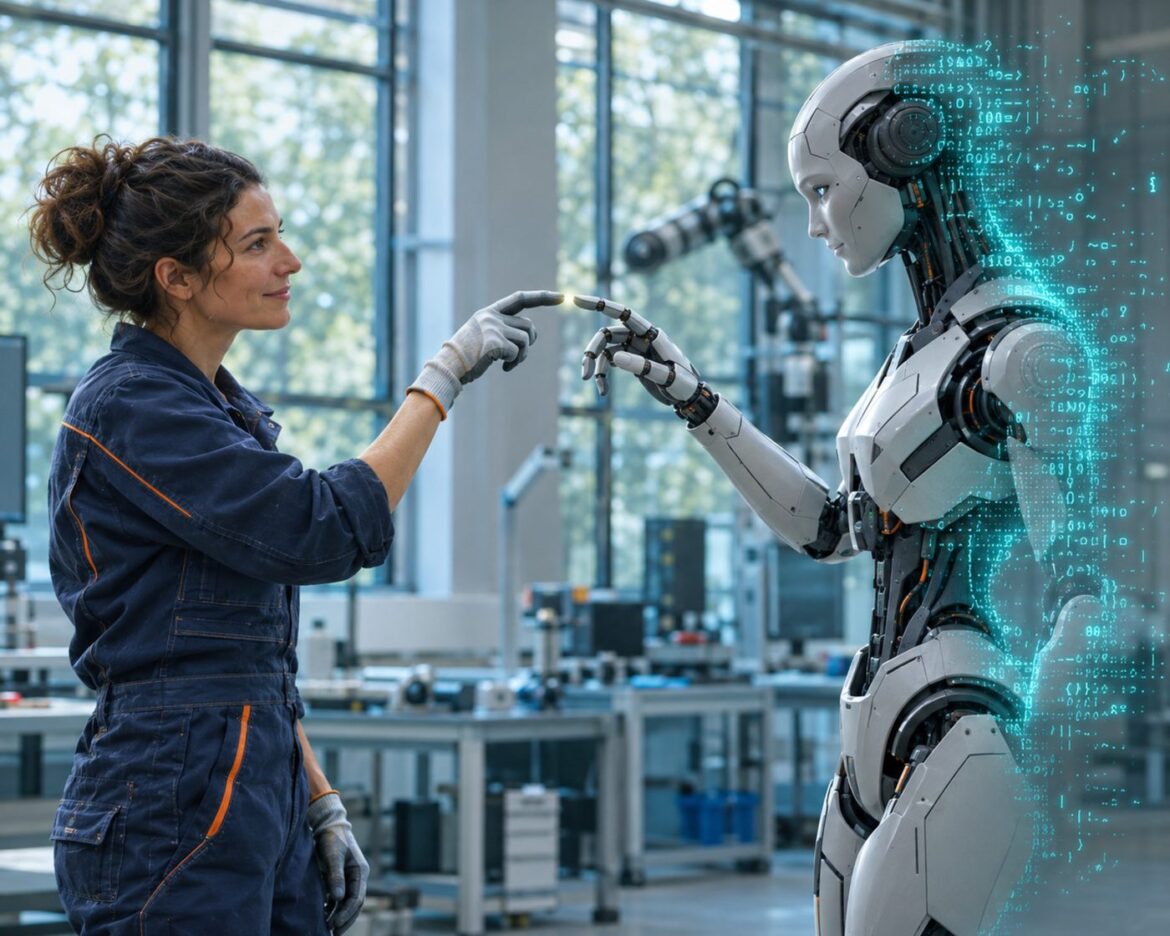
A small robot stumbles through 70 obstacles and shows what Physical AI can do today and where it still fails.
Visualization: An engineer and a humanoid robot almost touch, the robot side dissolving into glowing characters, people and robot are freely designed | AI-assisted illustration, not a product photo | XR Stager Online Magazin | VISORIC GmbH
A small robot runs through a city made of characters, trips over crates, slips on an oil spill and falls into a hole. Klonki is clumsy, and that makes him a good guide to a topic that is moving industry: Physical AI. It means artificial intelligence that does not just generate text but perceives, decides and acts in the real world.
This article follows Klonki through eight stages, from the first obstacle to a conversation with specialists. It explains why everyday movements are so hard for machines, how robots practice in simulation, why a household is harder than a factory and which rules apply in Europe. Klonki, the scenes and the people in the images are invented. The technical statements draw on publications named in the text. Assessments and recommendations are marked as such.
In the seventh stage, reading turns into a game. Klonki runs through 70 obstacles, and at each one a question on AI, robotics or Physical AI with three answers is waiting. A right answer means running on, a wrong one costs a battery. At the end, the evaluation shows how much knowledge you bring and, if you wish, leads to a conversation with the VISORIC expert team. If you want to start right away, jump straight to the game: to the game.
- Physical AI brings artificial intelligence into machines that perceive, decide and act.
- What humans do effortlessly often stays hard for machines. Researchers call this Moravec's paradox.
- Robots now learn a great deal in simulation, and transferring that to the real world is the critical step.
- Safety and rules decide whether a robot may stay in operation.
- The game makes your own knowledge visible and, if you wish, leads to an expert conversation.
The first stage begins where every robot project begins: with an obstacle.
Why a Robot Trips Over a Crate
Stage 1 of 8 · Stumbling
An employee walks through the hall, sees a crate in the aisle and steps over it without a second thought. For Klonki the same crate is a problem with many parts. He has to recognize it, estimate its height, place his foot in the right spot and keep his balance, all within a fraction of a second.
In 1988 the roboticist Hans Moravec described that tasks such as chess or arithmetic take comparatively little effort for computers, while the perception and agility of a small child demand enormous computing power.[1] Since then this has been called Moravec's paradox. The reason lies in evolution: humans have optimized perceiving and moving over a very long time, which is why they do not notice the work behind it.
For companies this has a practical consequence. Tasks an employee does on the side are often the hardest for robots, such as grasping loose parts, routing cables or walking through a crowded warehouse. Tasks that look like expert knowledge, by contrast, are often easier to delimit. Anyone planning a robotics project should therefore ask not what looks difficult, but what is actually difficult for a machine.
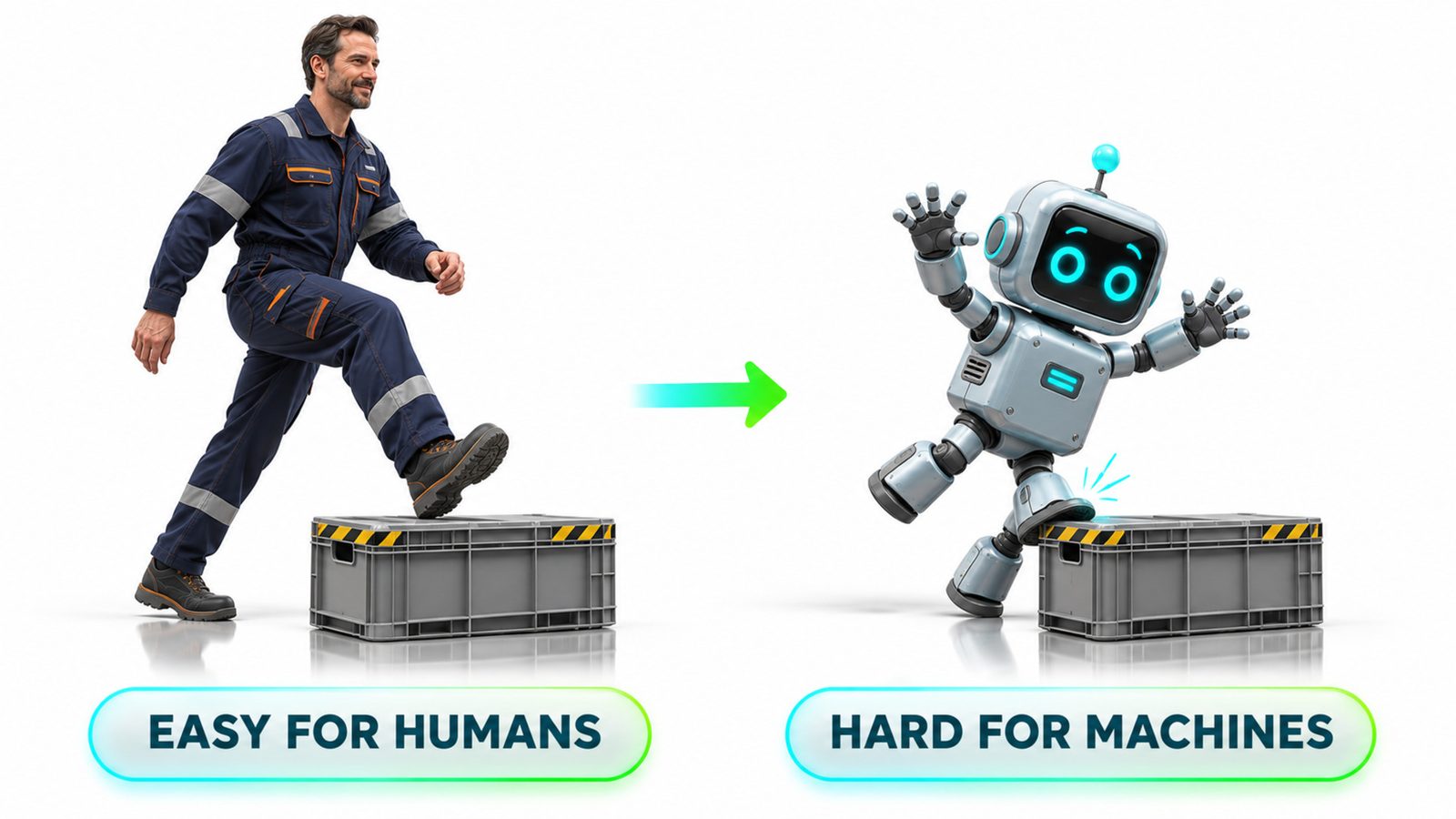
The same crate, two worlds: easy for humans, hard for machines.
Image: Stage 1 of the article, human and robot at the same crate, effortless on the left, stumbling on the right[1] | AI-assisted illustration, not a product photo | XR Stager Online Magazin | VISORIC GmbH
The image shows it in two stations. On the left the human steps over the crate, on the right Klonki struggles with the same obstacle. The two pills below name the paradox, and the arrow between them stands for the path every robotics development takes: from the task that is easy for humans to the machine that has to learn it first.
- Perceiving and moving are harder for machines than arithmetic and chess.[1]
- What a human does on the side consists of many sub-tasks for a robot.
- Evolution explains why humans do not notice this work.
- A good first use case is clearly delimited and not just easy at first glance.
How software becomes a machine that notices such an obstacle at all is the subject of the second stage.
When Artificial Intelligence Leaves the Screen
Stage 2 of 8 · Embodiment
Most of the artificial intelligence people meet today works in digital data. It writes texts, recognizes images or sorts requests. In the worst case a mistake costs a click and a correction. Physical AI leaves this protected environment. It gets a body, and a mistake can damage a workpiece, stop a plant or endanger a person.
A system needs three things for this that software alone does not bring. Sensors such as cameras, lidar or force sensors capture the environment. Actuators such as servo motors and grippers turn decisions into motion. In between, a computer has to respond in real time, even when the connection wobbles or the battery runs low. In this article, Physical AI means exactly this combination: AI systems that perceive their physical environment, derive decisions from it and act through actuators. The term is still young and is defined more or less broadly by different vendors.
This body creates new requirements. Speed, energy consumption, maintenance and failure behavior become selection criteria that hardly matter for pure software. Anyone introducing Physical AI therefore buys not just a model, but a system of hardware, software and operations.
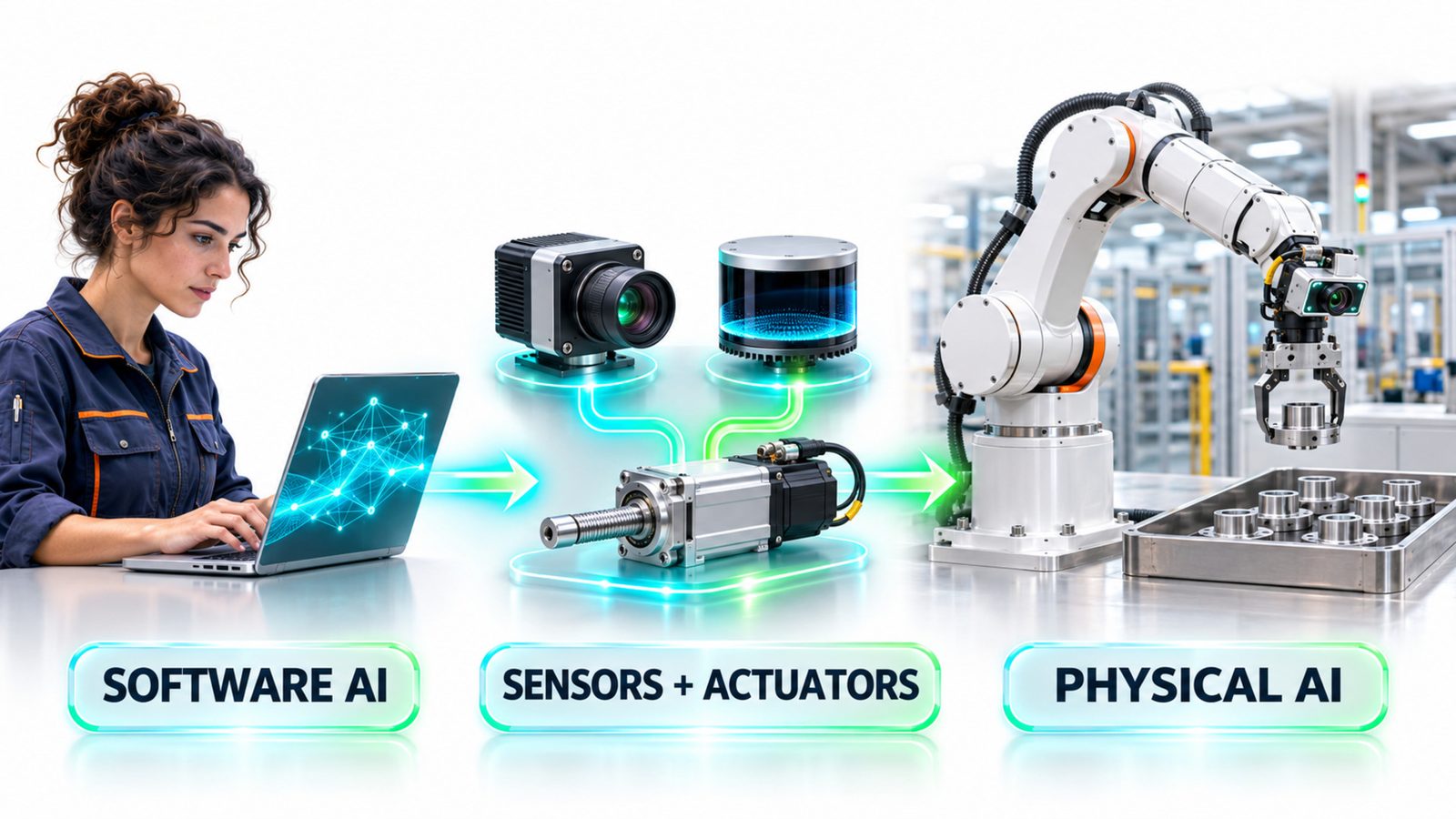
Physical AI begins where software gets a body.
Image: Stage 2 of the article, from AI on the laptop via sensors and drives to the robot arm in the hall | AI-assisted illustration, not a product photo | XR Stager Online Magazin | VISORIC GmbH
The image shows the path in three stations. On the left is the software, in the middle the building blocks that connect it to the world, on the right the robot that works with them. The middle part is the one a pure AI project does not know: it decides reaction time, accuracy and reliability.
- Software AI works in data, Physical AI works in the real world.
- Sensors capture, actuators act, a computer decides in real time.
- A mistake here can affect material, plants and people.
- What you buy is a system of hardware, software and operations.
How these three building blocks work together is shown in the third stage.
Sense, Decide, Act, Learn
Stage 3 of 8 · Loop
Every robot follows the same loop. It perceives, decides, acts and learns from the result. In the game this happens with every step Klonki takes: the sensors capture the crate, the model decides on the jump, the legs carry it out, and success or failure is the feedback.
In sensing, cameras and lidar deliver raw data that can be noisy, occluded or badly lit. In deciding, a model evaluates this data, recognizes objects, plans a motion and chooses an action. In acting, precision, force and speed count. Learning finally improves the model with data from operation.
A distinction is worth making here. In operation, learning does not mean that a robot constantly changes itself. In safety-relevant applications, new model versions are usually collected, tested and rolled out in a controlled way. Why that is the case is shown in the sixth stage.
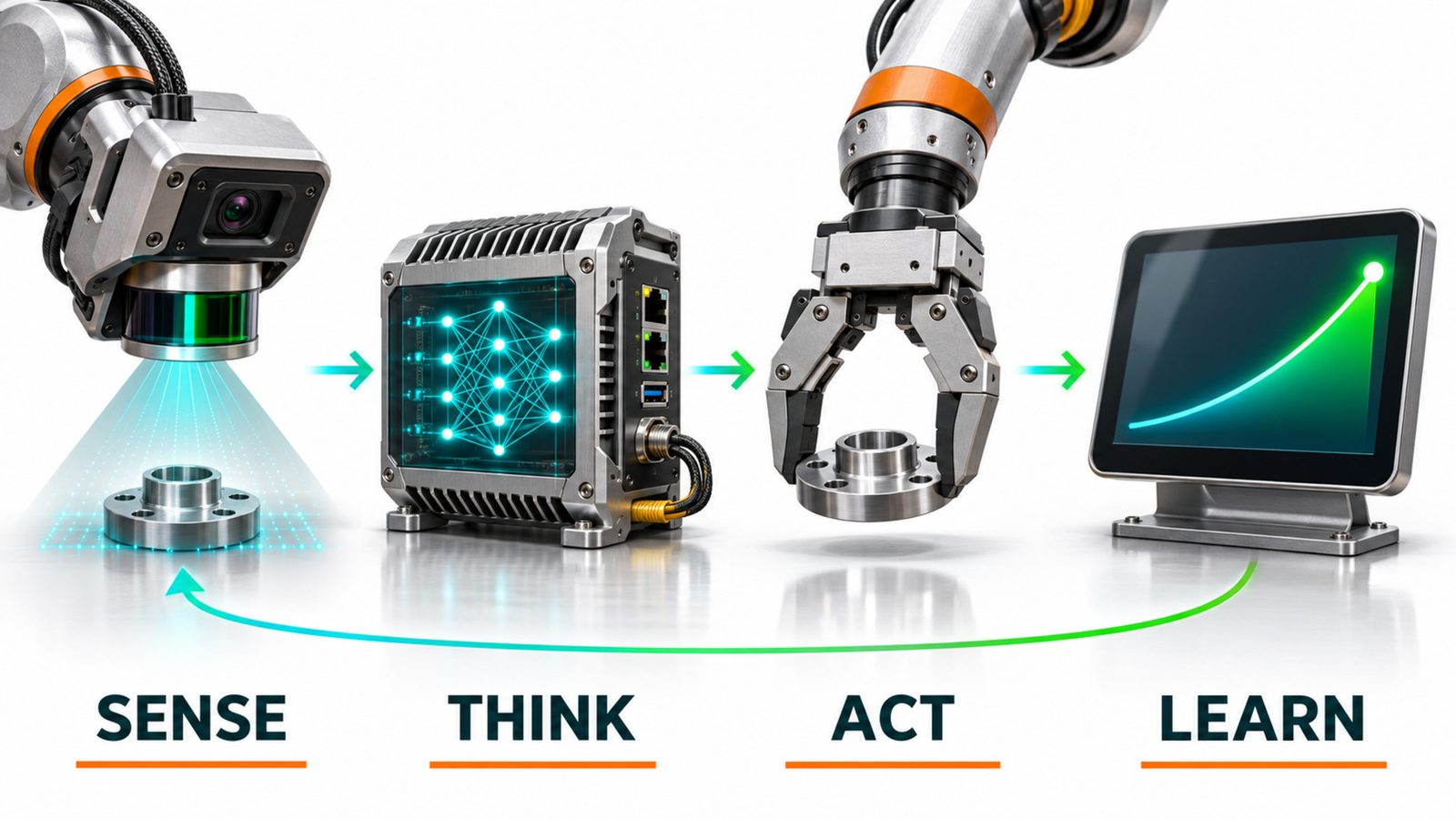
The loop of every robot: sense, decide, act, keep learning.
Image: Stage 3 of the article, the four stations of the robot loop with feedback | AI-assisted illustration, not a product photo | XR Stager Online Magazin | VISORIC GmbH
The image closes the loop with an arrow beneath the four stations. It stands for feedback: what the robot experiences flows into the next model. Whether that happens automatically in operation or in tested steps is a deliberate decision and not a law of nature.
- Sense: cameras, lidar and force sensors deliver noisy raw data.
- Think: a model recognizes, plans and chooses an action.
- Act: grippers and drives carry out the action precisely.
- Learn: feedback improves the model, usually in a controlled way in safety-relevant applications.
Where a robot can practice this loop without damaging anything is shown in the fourth stage.
Practicing in the Digital Twin
Stage 4 of 8 · Simulating
Real robots learn slowly, are expensive and can do damage when they fail. That is why a large part of the training is moved into simulation. Thousands of runs happen in parallel, mistakes cost nothing, and situations can be repeated at will. A digital twin, a virtual copy of robot and work cell, is the practice ground.
The catch is called sim-to-real. Friction, light, sensor noise and materials behave differently in simulation than in the hall, and a model that has only practiced on a computer often fails on small things. A well-known remedy is domain randomization. In 2017, Tobin and colleagues deliberately varied textures, lighting and camera position in simulation so that the model treats reality as just another variant.[3] This way an object was localized from real camera images without any real training images.
An impressive application followed in 2019. A robot hand turned a Rubik's Cube, trained in simulation with automatically growing randomization and then transferred to the real hand. The success rate was limited for difficult cube positions.[4] The example shows both: the transfer can succeed, and it remains a challenge.
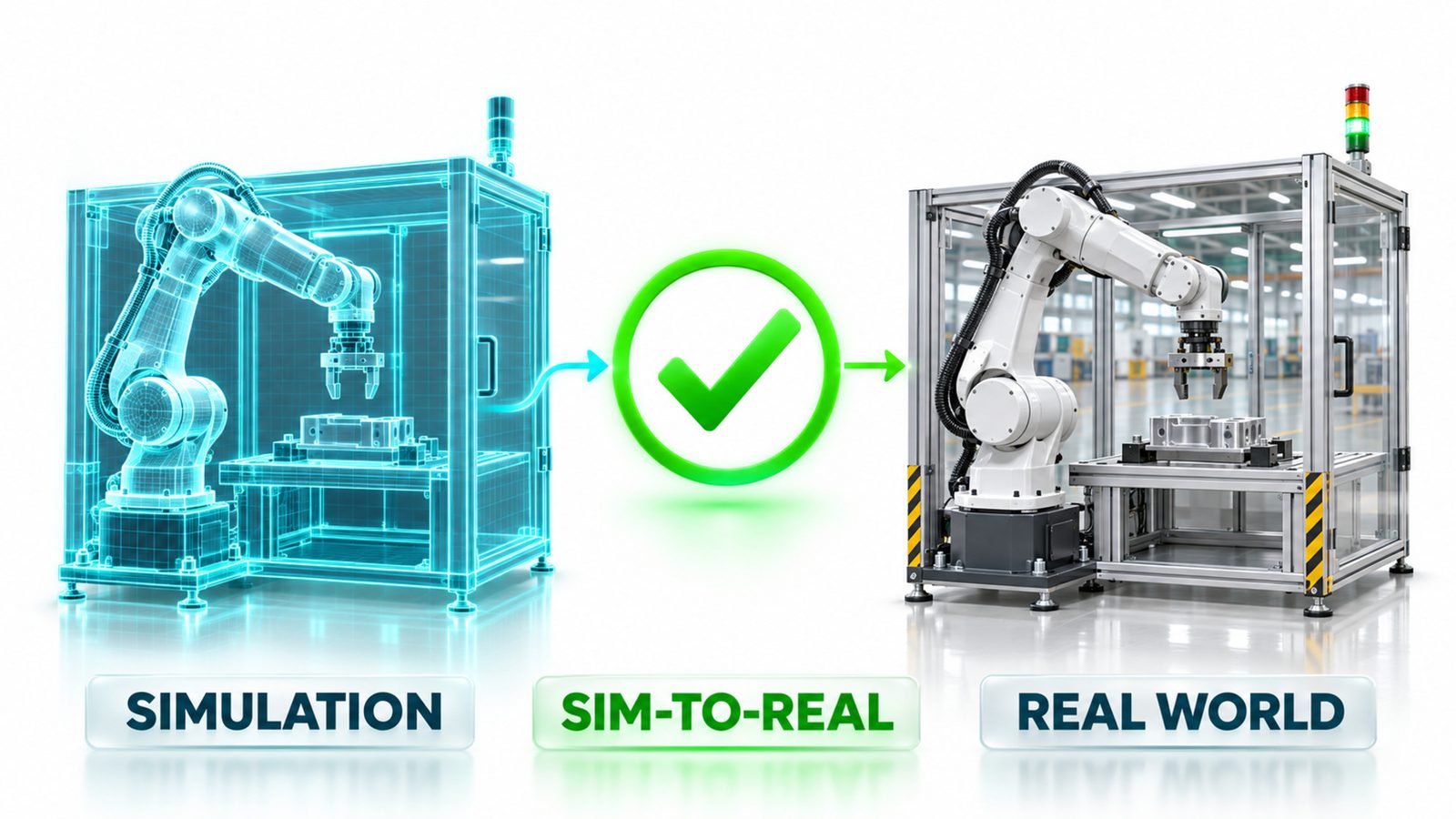
Practice in the digital twin first, then prove it on the shop floor.
Image: Stage 4 of the article, digital twin, transfer and real cell[3][4] | AI-assisted illustration, not a product photo | XR Stager Online Magazin | VISORIC GmbH
The image shows the three stations in the order they are passed through. The green check mark in the middle is the part a simulation alone does not deliver. Whether what was learned holds up in the hall only shows in the test with the real robot.
- Simulation saves time and material because mistakes cost nothing.
- Sim-to-real describes the gap between the virtual and the real world.
- Domain randomization makes models more robust against differences.[3]
- The test with the real robot remains indispensable.
How large the gap becomes when the environment is no longer orderly is shown in the fifth stage.
Why Everyday Life Is Harder Than the Factory
Stage 5 of 8 · Surprises
A robot cell in a factory is a controlled world. The parts are identical, lie in fixed places, and a fence keeps people out. A warehouse is harder because cartons change in size, shape and position. A living room is hardest: a stuffed toy, a cable and a knocked-over cup are everyday life for a human, but three unknown objects for a robot.
There is also a data problem. Language models learn from huge text collections that are readily available online. For robot movements there is no comparable archive, because every recording has to be made with a real robot. A research milestone is the Open X-Embodiment dataset, assembled by 21 institutions. It contains data from 22 different robots, more than a million motion sequences and 527 skills.[2] That is a lot for robotics, but in scale it stays far below the text collections used to train language models.
The practical conclusion is sober. Physical AI takes hold first where the environment is limited and the task is clearly defined. The more surprises an environment offers, the more data, tests and safeguards a project needs, and the later deployment pays off.
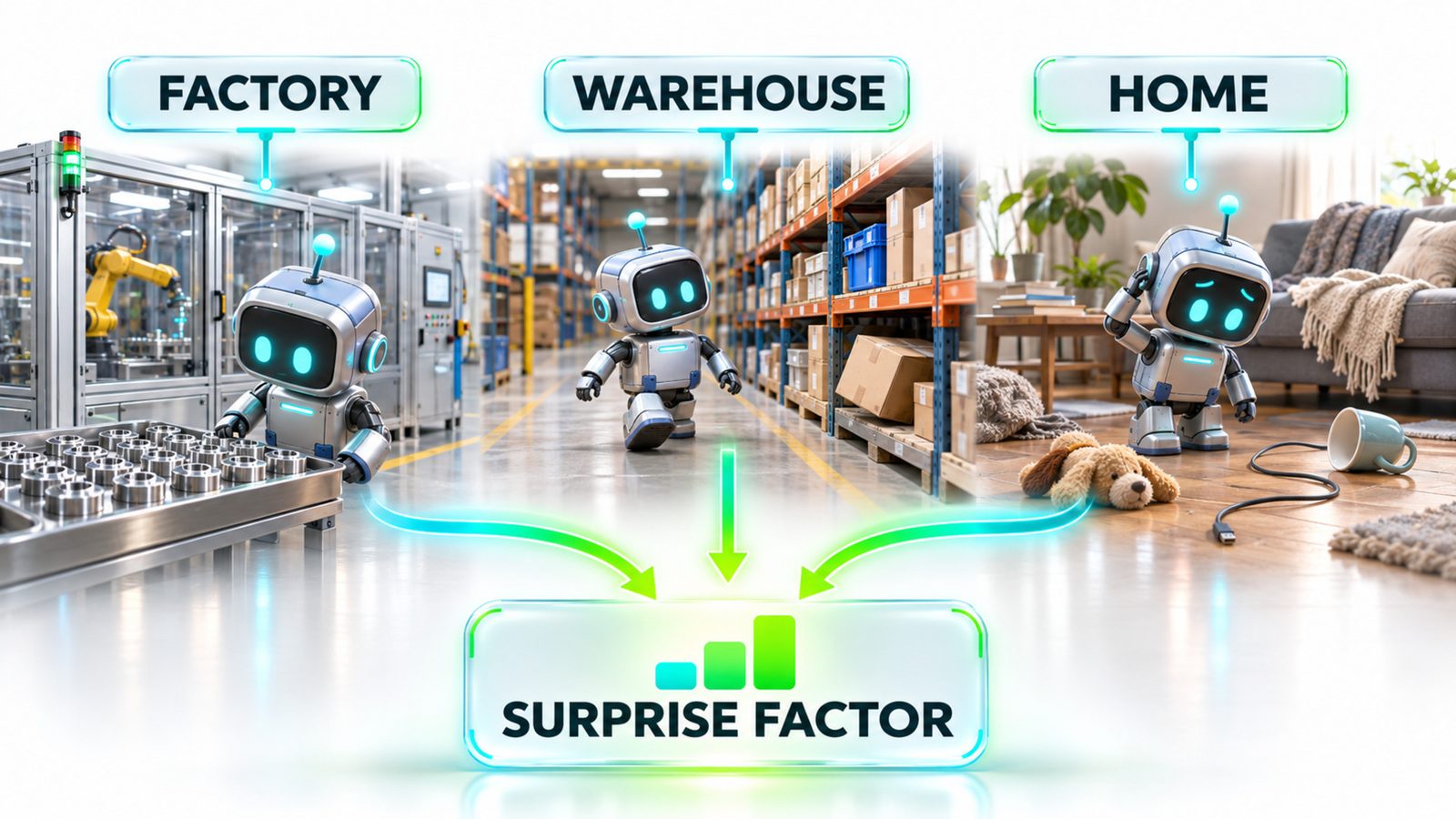
The less order, the more surprises for the robot.
Image: Stage 5 of the article, factory, warehouse and home compared by surprise factor[2] | AI-assisted illustration, not a product photo | XR Stager Online Magazin | VISORIC GmbH
The image places three environments side by side and lets all arrows end in one box. This box is the quantity that matters: the surprise factor. It determines how many cases a model has to know before it works reliably.
- Factory, warehouse and home differ in the degree of order.
- The more surprises, the more data and tests are needed.
- For robot movements there is no text archive like the one for language models.[2]
- First deployments pay off where environment and task are limited.
Whether such a deployment may stay in operation is decided by safety and rules, the sixth stage.
Stopping Safely and Following the Rules
Stage 6 of 8 · Safeguarding
A robot that meets people must above all be able to stop safely. That includes protective zones, sensors that detect people, and a risk assessment that goes through hazards in advance. The standard for industrial robots, ISO 10218 with parts 1 and 2, was fundamentally revised in 2025 for the first time since 2011. Content on collaboration between human and robot was incorporated.[6]
At EU level, the Machinery Regulation (EU) 2023/1230 is the framework. It replaces the previous Machinery Directive and applies from January 20, 2027. It explicitly names safety components with self-evolving behavior through machine learning as a special category.[5] This concerns exactly the question from the third stage: a system that changes in operation must still remain demonstrably safe.
For AI systems, the AI Act (EU) 2024/1689 comes on top. Its obligations for high-risk systems were postponed by the Digital Omnibus on AI. For stand-alone high-risk systems December 2, 2027 now applies, for AI in regulated products August 2, 2028.[7] This is an assessment and not legal advice. Which obligations apply to a specific product is clarified by conformity specialists case by case.
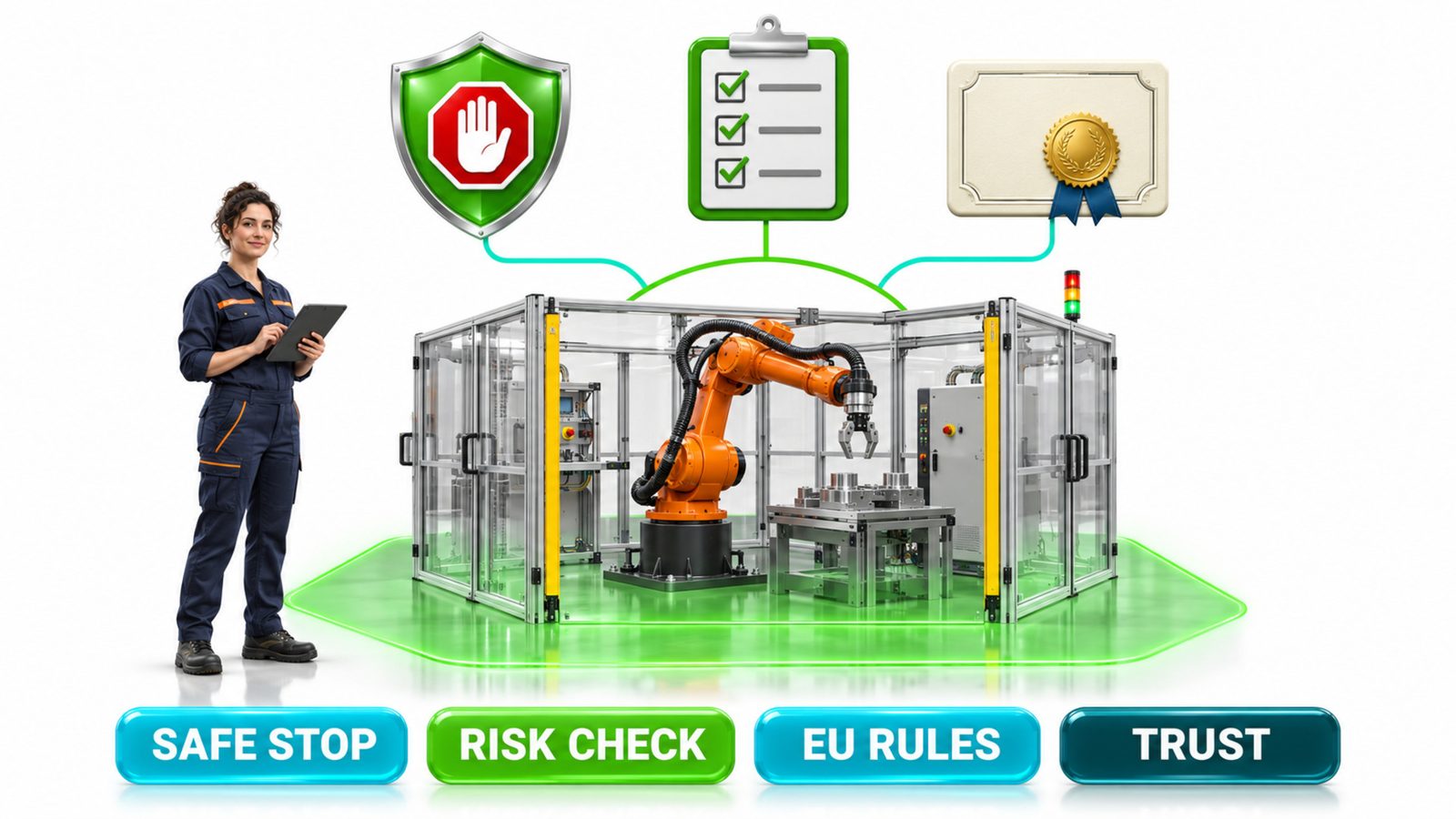
Stop safely, check risks, follow the rules: trust comes from proof.
Image: Stage 6 of the article, protective zone, risk assessment and regulations[5][6][7] | AI-assisted illustration, not a product photo | XR Stager Online Magazin | VISORIC GmbH
The image shows the employee outside the green protective zone. The four pills below give the order: first be able to stop safely, then check risks, then follow the rules, and at the end stands trust that rests on proof and not on promises.
- Stopping safely and protective zones are the basis of every deployment with people.
- ISO 10218 was fundamentally revised in 2025.[6]
- The Machinery Regulation (EU) 2023/1230 applies from January 20, 2027.[5]
- After the postponement, the high-risk obligations of the AI Act apply from December 2, 2027 and August 2, 2028 respectively.[7]
Now it is Klonki's turn, and yours. The seventh stage turns what you have read into a game.
The Game with 70 Obstacles and 200 Questions
Stage 7 of 8 · Playing
Klonki runs through a city of characters. The game world is created in the browser as a three-dimensional scene and converted into letters and symbols in real time. The game is a single page, needs no installation and works on smartphone, tablet and computer. It is controlled with a tap: tapping jumps, tapping again triggers a rocket jump, holding jumps higher.
What makes it special begins at the obstacle. When Klonki bumps into a crate, a spike or a drone, a question with three answers, A, B and C, appears. A correct answer lets him run on. A wrong one costs one of three batteries, and the correct answer is shown with a short explanation. Every ten collected bolts refill one battery.
In total, 200 questions from three fields are waiting: artificial intelligence, robotics and Physical AI. They are spread over five levels, and the difficulty rises with each level, much like a quiz show. About every tenth obstacle is a gate that cannot be jumped, so that every run contains several questions. After 70 obstacles the goal appears.

Obstacle, question, go on: this is how Klonki learns Physical AI, and you learn with him.
Image: Stage 7 of the article, the game flow in three steps | AI-assisted illustration, not a screenshot | XR Stager Online Magazin | VISORIC GmbH
The image shows the game flow in three steps. On the left Klonki meets the obstacle, in the middle the question with the three answers stands, on the right he runs on after the right answer. The real screen looks different, the sequence is the same.
- Tapping jumps, tapping twice triggers a rocket jump, holding jumps higher.
- Every obstacle brings a question with three answers, right means go on.
- A wrong answer costs one of three batteries, ten bolts refill one.
- There are 200 questions in five levels on AI, robotics and Physical AI.
- After 70 obstacles the goal appears with an evaluation.
Now it is your turn. The game is right below this paragraph.
Play Now, Klonki Is Waiting
The game runs right here in the article. On a smartphone it helps to hold the device sideways or to open the game in full screen. While you play, the game field captures your finger movements. To keep reading, scroll outside the game field.
At the end, the evaluation shows how far you got and how much knowledge you bring, split into the three fields. The button Arrange an expert talk opens a prefilled email to the VISORIC expert team (expert.team@visoric.com) with your result. You decide whether to send it. Nothing is stored.
Interactive game: Klonki News Game | Concept and development: Ulrich Buckenlei | Implementation: VISORIC GmbH | The questions draw on established fundamentals, see sources | XR Stager Online Magazin | VISORIC GmbH
- The game has 70 obstacles, 200 questions and five levels.
- It runs in the browser, without installation and without sign-in.
- The questions are a learning aid and not a validated test.
- The result can be discussed by email, nothing is stored.
What follows from the result is shown in the eighth and final stage.
From Game Result to Pilot Project
Stage 8 of 8 · Applying
The game result is the start of a conversation. It shows which terms stick and where clarification is needed, and it makes a bulky topic tangible. A pilot project can grow out of the conversation if a use case fits.
Such a start follows a simple logic. First a task is chosen that is clearly delimited and measurable. Then it is checked whether a robot can solve it in simulation and where surprises lurk. After that the pilot is set up at a real cell with a safety concept, and only at the end comes the decision on expansion. The first stage provides the filter: tasks that are easy for humans and hard for machines need more preparation and do not belong at the beginning.
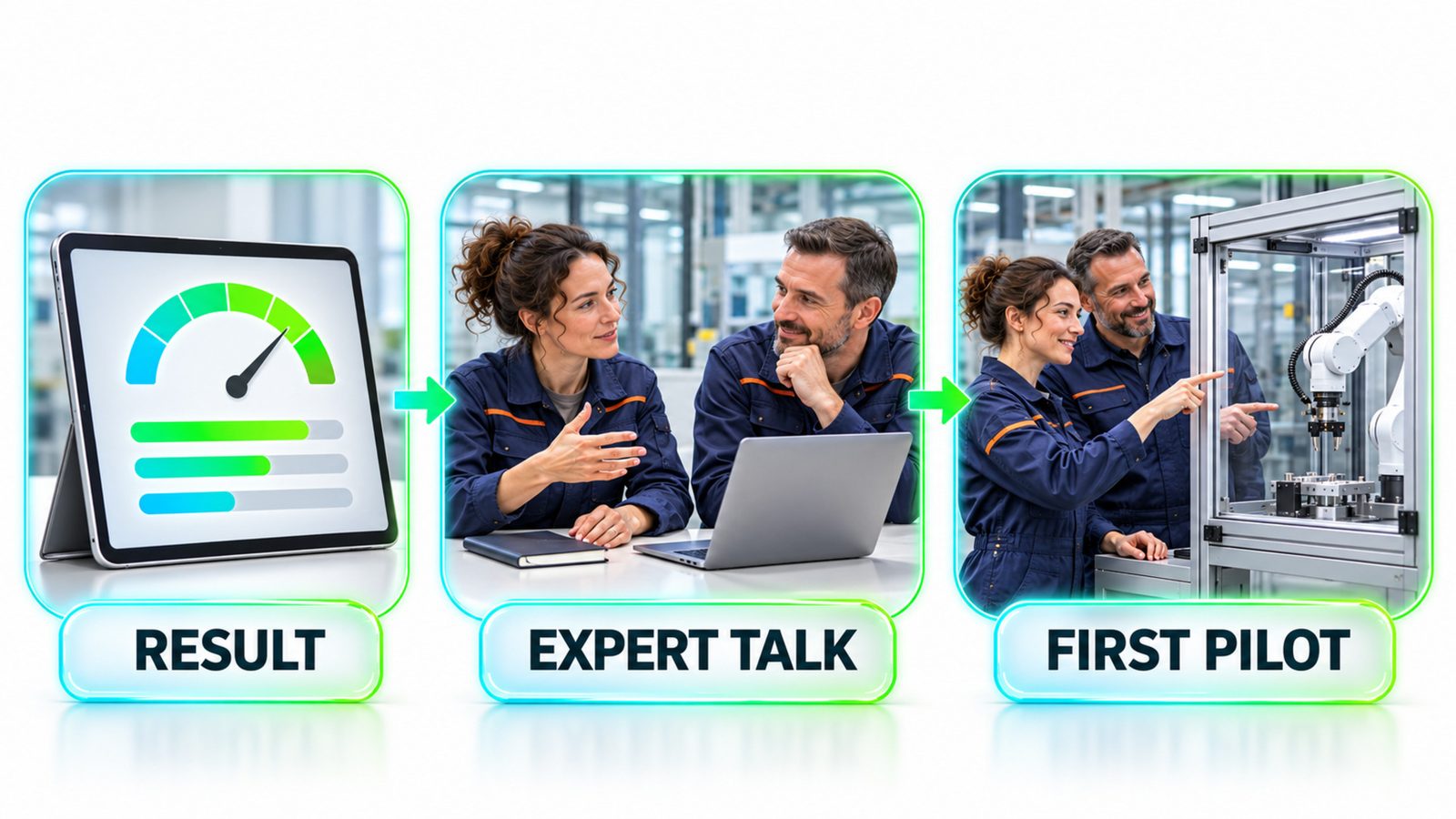
From game result to expert talk to a first pilot project.
Image: Stage 8 of the article, evaluation, expert talk and first pilot | AI-assisted illustration, not a product photo | XR Stager Online Magazin | VISORIC GmbH
The image shows the path in three stations. The result stands at the beginning, the conversation in the middle, and on the right the same people stand in front of a real robot cell. The pilot is not an end in itself but the test of whether a task holds up under real conditions.
- The game result shows knowledge and gaps and works as a conversation starter.
- A pilot starts with a clearly delimited, measurable task.
- Simulation and safety concept come before the test at the real cell.
- Expansion is decided only after the pilot.
This is exactly the starting point for a conversation with the expert team.
From Idea to a Physical AI Application That Holds Up in Operation
Somewhere in every company there is a task that people do effortlessly and that still poses obstacles for machines. Physical AI can take over such tasks when three things come together. The task is clearly delimited, the system has been practiced in simulation and tested on the real setup, and the safety concept is part of the planning from the start.
The VISORIC GmbH expert team from Munich combines more than 15 years of experience in 3D, AI and XR with practical experience in spatial computing, real-time 3D and digital twins. VISORIC develops digital twins, simulations and interactive 3D applications for technical processes and accompanies companies from the first idea to a working application. Together with you, the team clarifies which use case suits the start, how it is prepared in simulation and how success can be measured.[8][9]
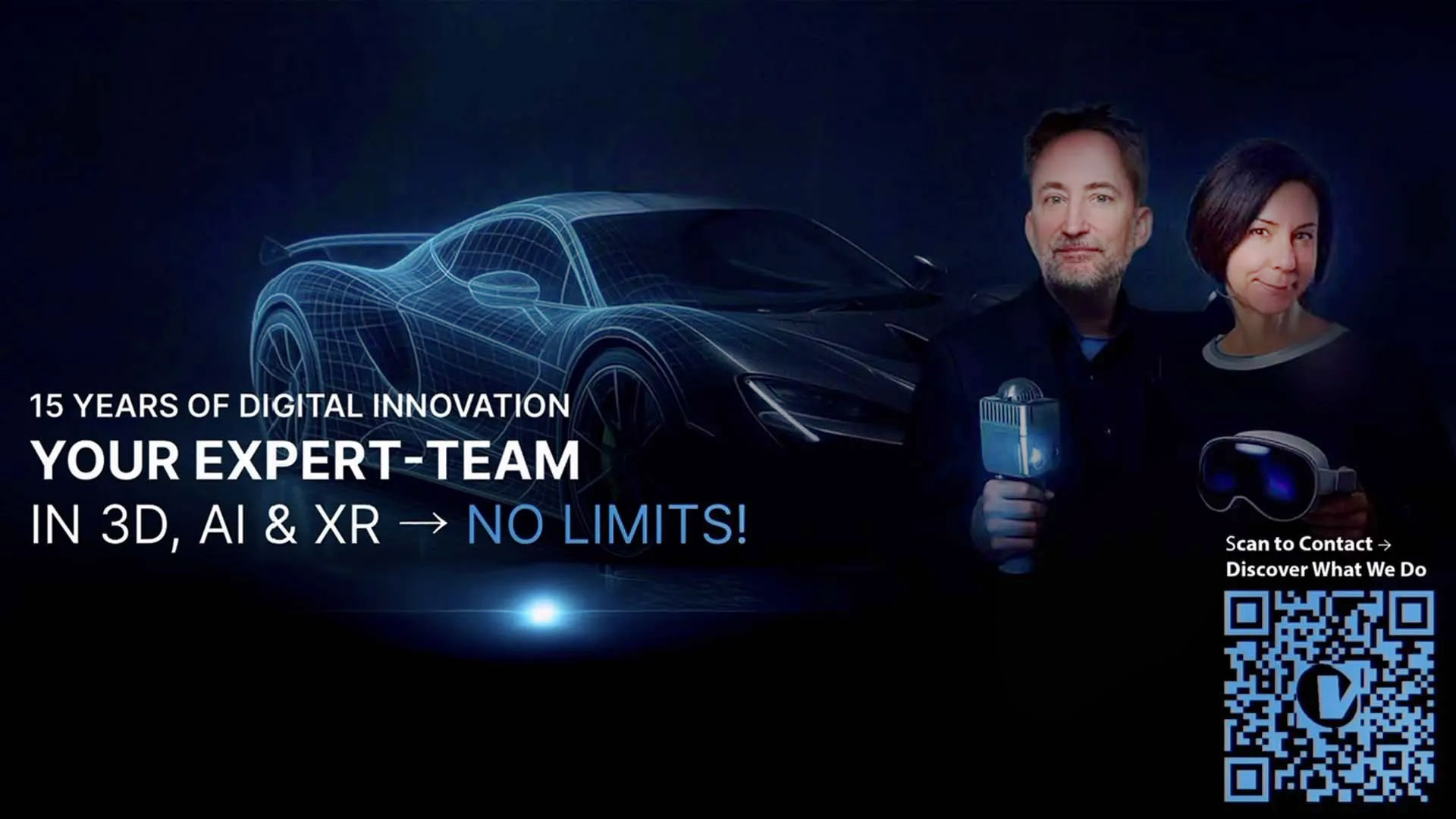
15 years of experience in 3D, AI and XR: the VISORIC expert team from Munich.
Bild: © Ulrich Buckenlei | XR Stager Online Magazin | VISORIC GmbH
A well-considered first step with a single use case can often be implemented much faster and at lower cost than many companies expect. The start consists of three steps:
- Sharpen task and goal, including the question of whether it is actually suited to a machine.
- Try the use case in the digital twin and make the surprises visible.
- Set up a pilot with a safety concept and a measurement plan at the real cell.
This is exactly the starting point for a conversation: not the big vision, but a clearly delimited first step that can be implemented quickly.
Which task in your company is second nature for people and still an obstacle for machines, and would it be the best first pilot?
Talk to the VISORIC expert team from Munich about Physical AI, digital twins and simulation. Together we turn your use case into a precise, traceable next step.
Contact:
Email: info@visoric.com
Phone: +49 89 21552678
Sources and References
- Moravec, H. Mind Children, The Future of Robot and Human Intelligence. Harvard University Press, 1988.
- Open X-Embodiment Collaboration. Open X-Embodiment, Robotic Learning Datasets and RT-X Models. arXiv 2310.08864, 2023, presented at ICRA 2024.
- Tobin et al. Domain Randomization for Transferring Deep Neural Networks from Simulation to the Real World. IEEE/RSJ IROS 2017, pp. 23 to 30. DOI 10.1109/IROS.2017.8202133.
- OpenAI et al. Solving Rubik's Cube with a Robot Hand. arXiv 1910.07113, 2019.
- Regulation (EU) 2023/1230 of the European Parliament and of the Council on machinery, Official Journal of the EU L 165 of 29.06.2023, applicable from 20.01.2027.
- ISO 10218-1:2025 and ISO 10218-2:2025, Robotics, Safety requirements for industrial robots and robot applications. On the revision: Association for Advancing Automation (A3), Updated ISO 10218, 2025.
- Regulation (EU) 2024/1689 (AI Act) as amended by the Digital Omnibus on AI (Regulation (EU) 2026/1744, published 24.07.2026), application dates 02.12.2027 and 02.08.2028 for high-risk systems.
- VISORIC practice projects in digital twins, real-time 3D and spatial computing.
- XR Stager platform for real-time 3D, digital twins, Knowledge AI and industrial spatial computing applications.
Contact us:
Email: info@xrstager.com
Phone: +49 89 21552678
Contact persons:
Ulrich Buckenlei (Creative Director)
Mobile: +49 152 53532871
Email: ulrich.buckenlei@xrstager.com
Nataliya Daniltseva (Project Manager)
Mobile: +49 176 72805705
Email: nataliya.daniltseva@xrstager.com
Address:
VISORIC GmbH
Bayerstraße 13
D-80335 Munich