
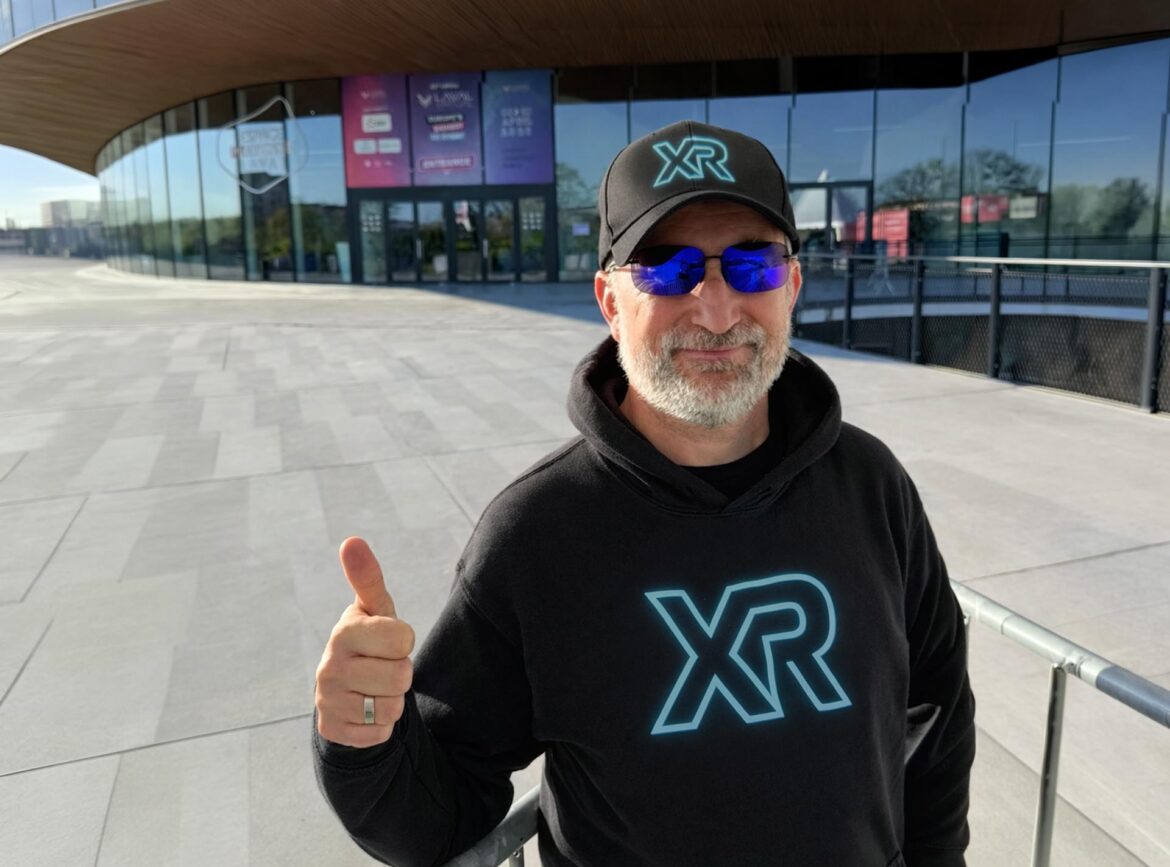
XR, AI, and real time systems before practical deployment at Europe’s largest XR event
Visualization: © Ulrich Buckenlei | Visoric GmbH | Editorial concept image for the analysis of XR, AI, and real time systems before the start of Laval Virtual 2026 in Laval, France | The depiction serves the analytical classification of current technology trends in an industrial context
A few days before the start of Laval Virtual 2026, an impression is becoming clearer that is especially relevant for understanding the current XR market. From April 9 to 11, 2026, in Laval, France, it will once again become visible which technologies are making the step from demonstration to operational application and which approaches attract attention but still lack the necessary maturity for real world processes.
Especially in the environment of XR, AI, and 3D real time, a clear shift has become visible over the past few years. Systems are no longer judged only by how impressive they appear at a trade fair. What increasingly matters is whether they run reliably, can be integrated into existing processes, and generate real value over time. This is exactly where the analytically interesting phase begins. XR is no longer evaluated only as a visual innovation, but as part of digital value creation.
Current analyses by McKinsey and Gartner show that immersive technologies, spatial interfaces, and AI supported systems are increasingly being considered by companies in relation to productivity, simulation, training, and decision support.[19][20] This also changes the way events such as Laval Virtual are viewed. They are no longer only showcases for technological visions, but early indicators of which systems may prove themselves under real market conditions.
The connection between artificial intelligence and real time environments is especially relevant here. AI not only reduces complexity in the background, but changes the usability of entire systems. Interactions become smoother, content more context aware, and access to complex applications broader. At the same time, the demands on technical stability increase. If tracking, rendering, logic, and AI do not work together cleanly at all times, even the most convincing demonstration quickly loses credibility.
Laval Virtual therefore offers a particularly interesting point of observation. This is where it becomes visible which solutions still feel experimental, which are already moving toward product maturity, and where concrete new fields of application for industry, communication, and training are emerging.
This leads to a central question: Even before the trade fair actually begins, how can we tell whether XR systems are becoming truly operationally relevant today?
From show effect to system maturity, how operational XR relevance can be identified
Today, XR applications rarely fail because of a lack of visual impact. The greater challenge lies in turning an impressive experience into a resilient system. This is exactly where the real dividing line begins between trade fair effect and operational relevance. While early XR applications were primarily intended to attract attention, it is now becoming clear that companies apply different standards. They ask about integration capability, reliability, scalability, and economic impact.
Against this background, the way an event such as Laval Virtual is viewed is also changing. What is interesting is no longer only which headsets, platforms, or demos are being shown. What matters is whether the systems presented can be transferred into real workflows. Can they improve training. Can decisions be secured earlier. Do they lead to faster processes, lower error rates, or a better shared understanding of complex content.
It is precisely at this point that the new maturity of the market becomes visible. XR is increasingly being combined with AI and real time processing. This creates applications that do not only visualize, but also respond, analyze, and support in a context aware way. The value then no longer lies in the novelty effect, but in the quality of decision making in each application scenario.
- Earlier focus, attention and technical show effect shape perception
- New focus, stability, integration capability, and process value determine relevance
- New routine, XR is conceived together with AI and real time logic as an operational system
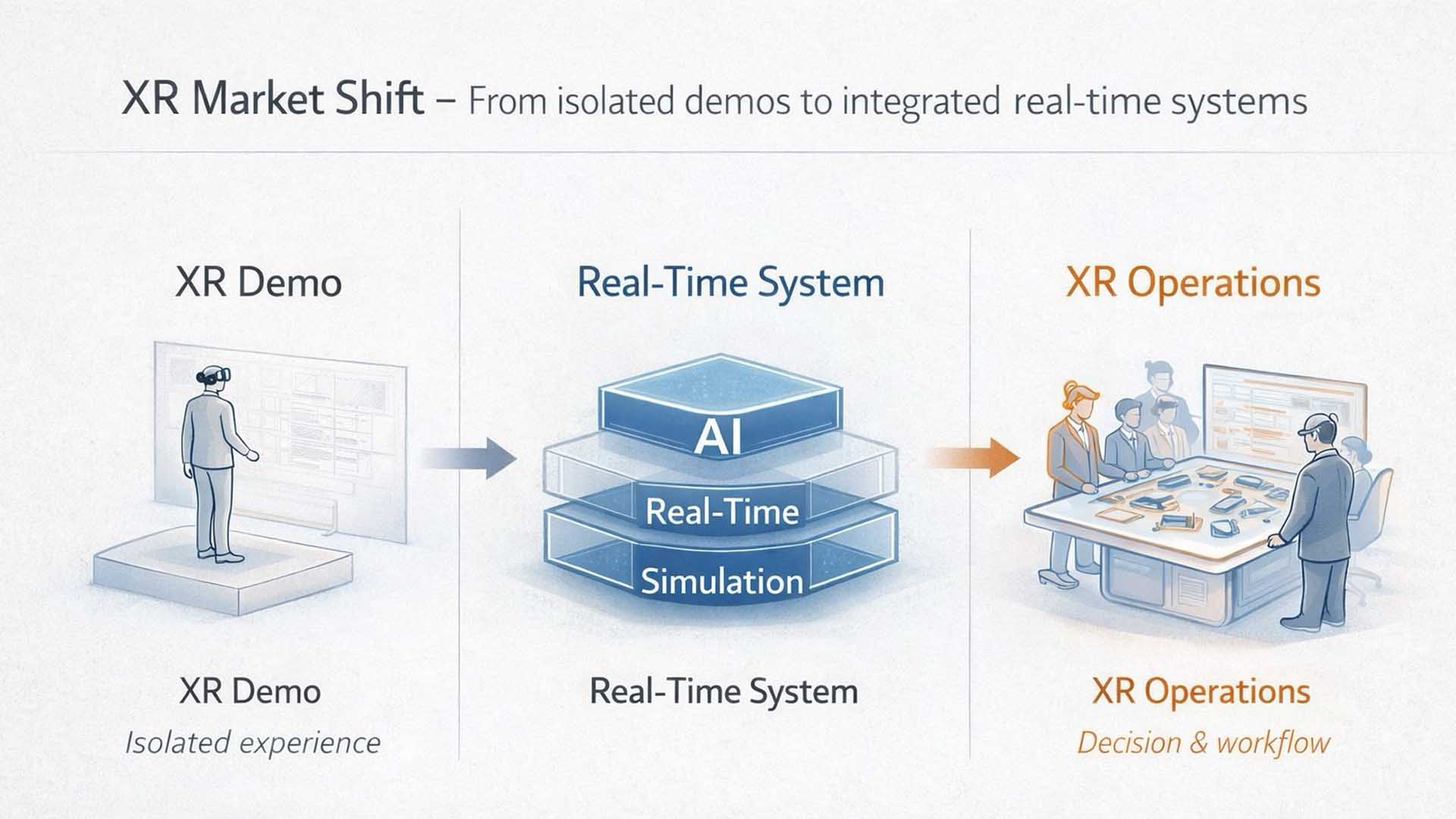
XR Market Shift, from demo to integrated real time application between AI, simulation, and operational use
Motif: Editorial concept image | Visualization: © Ulrich Buckenlei | Visoric GmbH | Depiction of a strategic market shift from isolated XR demos toward integrated, AI supported real time systems | The image serves analytical classification
The image therefore does not show only a single device or a specific trade fair application, but a structure. On the left are classic XR demonstrations strongly designed around staging, with headset, stage, and individual use. In the center, the technological layer of AI, real time data, and interaction logic becomes denser. On the right, this turns into an operational scenario in which XR is used as a tool for training, simulation, product presentation, or collaborative evaluation.
What matters is the connection between these levels. Hardware alone does not mark the change, but the quality of orchestration between content, system logic, and real usage context. This is exactly where it becomes visible whether XR is being conceived as an isolated visualization tool or as part of digital infrastructure. Analyses of the development of immersive systems and spatial interaction indicate that precisely this connection between real time capability, intelligent assistance, and structural integration is shaping the next phase of the market.[17][19][20]
As soon as this connection succeeds, the evaluation also shifts. Companies then no longer invest primarily in attention, but in a system that supports decisions, makes processes easier to understand, and enables new forms of collaboration. This is exactly where the operational relevance lies that can be observed particularly closely at an event such as Laval Virtual.
The next chapter therefore analyzes which specific technology fields are especially in focus at Laval Virtual 2026 and why the connection between XR, AI, and real time processing is currently considered the decisive driver of development.
XR, AI, and real time, which technology fields make the difference at Laval Virtual 2026
Anyone evaluating XR today can no longer look at individual technologies in isolation. The actual momentum emerges from the interaction of several levels. This is exactly what becomes especially visible at Laval Virtual 2026. It is not individual devices or platforms that take center stage, but the question of how XR, artificial intelligence, and real time processing can be combined into functioning systems.
Several technology fields are emerging that are currently considered especially relevant. These include powerful real time 3D engines, AI supported interaction systems, spatial computing interfaces, and data driven simulations. None of these fields is new on its own. What is decisive, however, is their increasing integration into shared system architectures. [5][12]
The central question is therefore no longer: Which technology is leading? But rather: How do these technologies interlock in order to enable stable, scalable applications? This is exactly where it becomes visible whether a system has durability beyond the demonstration. [6]
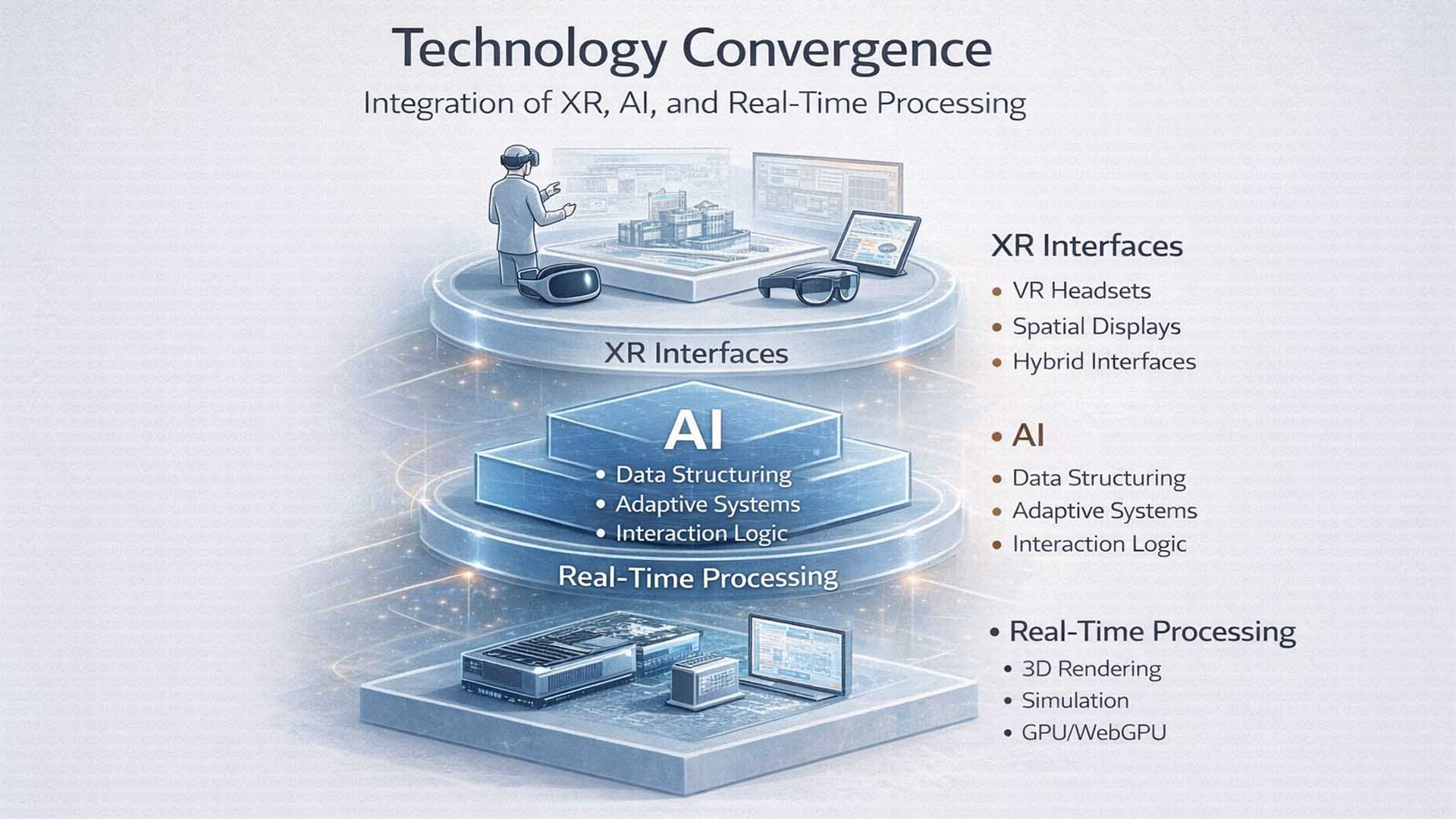
Technology Convergence – interaction of XR, artificial intelligence, and real time processing as an integrated system architecture
Motif: Editorial concept image | Visualization: © Ulrich Buckenlei | Visoric GmbH | Depiction of an integrated technology stack consisting of XR interfaces, AI layer, and real time rendering | The graphic serves the analytical classification of current system architectures
The graphic is deliberately structured as a layered model. At the lowest level is real time processing. It forms the technical foundation and ensures that complex 3D data, simulations, and interactions can be displayed without delay. Technologies such as GPU based rendering architectures or WebGPU play a central role here. [16]
Above that lies the AI layer. It handles the structuring of data, supports interactions, and enables adaptive systems. AI not only decides what is displayed, but also how content is adjusted in a context aware way. This creates systems that are not static, but react dynamically and adapt to users and situations. [5][6]
The top level is formed by XR interfaces. These include headsets, spatial displays, or hybrid interfaces. They create the connection to the user and determine how intuitive and accessible a system actually is. Spatial computing is increasingly becoming the central interface between human and digital model here. [10]
The decisive point, however, does not lie in the individual layers, but in their connection. Only when rendering, AI, and interface work synchronously over time does a system emerge that can be used under real conditions. It is exactly this synchrony that is increasingly becoming the decisive quality criterion at events such as Laval Virtual. [12][15]
- Real time processing forms the foundation for stable, high performance systems
- AI handles structuring, adaptation, and interaction logic
- XR interfaces define accessibility and user experience
- Only the integration of all levels creates operational relevance
This combination creates a new system logic. XR is no longer understood as visualization, but as an interactive interface within data driven processes. Applications become more flexible, more adaptive, and in many cases more economically relevant. [19][20]
The graphic makes it clear that competition is increasingly shifting toward the quality of this integration. It is not the individual technology that decides, but the ability to develop a functioning overall system from it.
The next chapter therefore examines which organizational and structural prerequisites must be met so that such systems not only function technically, but can also be used sustainably in companies.
From technology to organization, why XR systems only become scalable through structure
Technological maturity alone is not enough to successfully establish XR systems in companies. Even the most convincing combination of XR, artificial intelligence, and real time processing remains ineffective if it is not embedded in viable organizational structures. Sustainable use does not arise through technology, but through integration into processes, roles, and decision logics. [6][17]
The central question is therefore: Under which conditions can XR systems not only be implemented, but also operated and further developed over the long term?
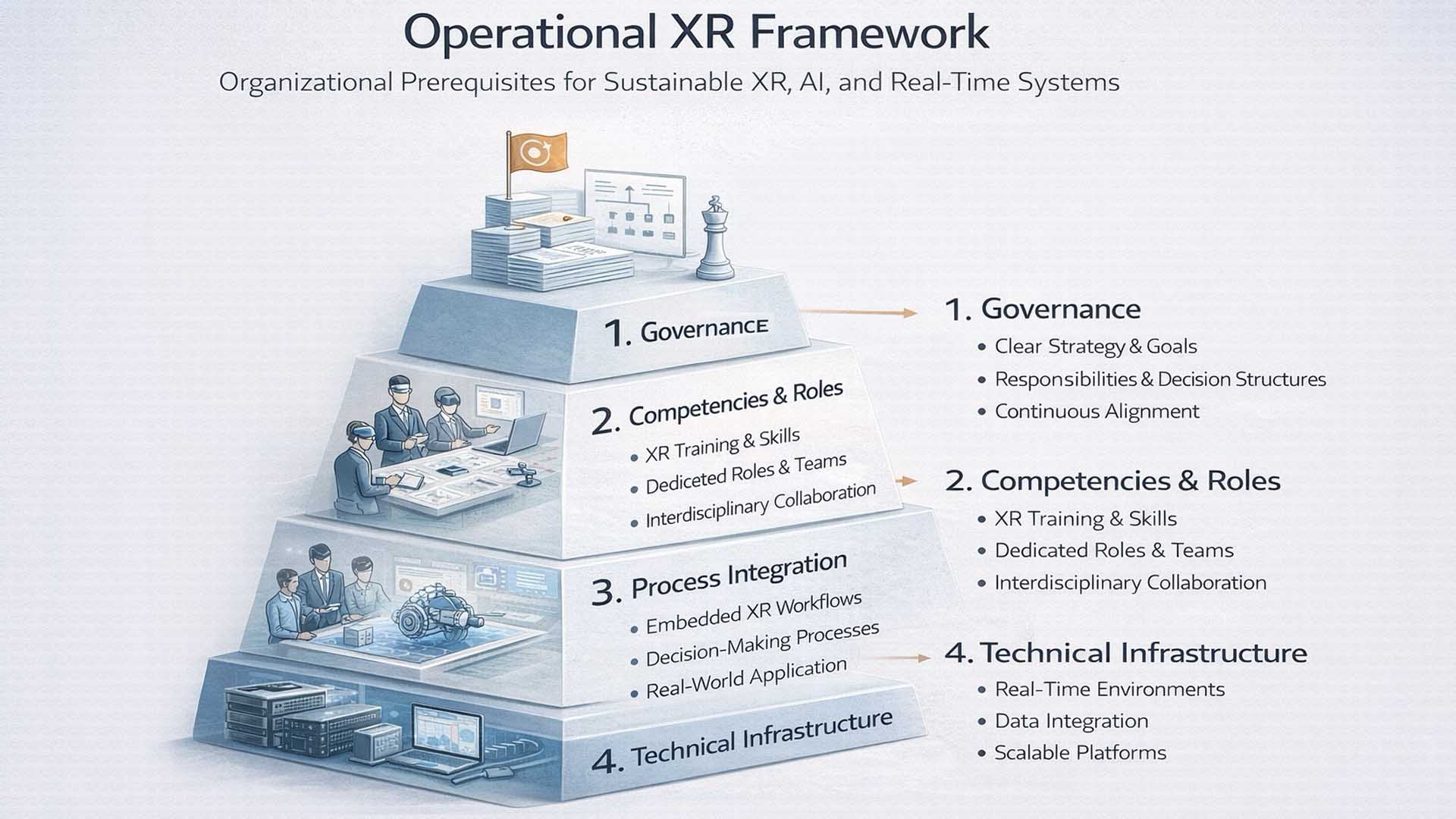
Operational XR Framework – organizational prerequisites for the sustainable use of XR, AI, and real time systems
Graphic: Editorial analysis | Visualization: © Ulrich Buckenlei | Visoric GmbH | Depiction of a four level organizational model for the integration of XR systems in companies | The illustration serves analytical classification
The graphic deliberately reduces complexity to four central levels that together form the basis for stable XR applications.
1. Governance
XR systems require clear strategic embedding. Without defined goals, responsibilities, and decision structures, applications remain isolated. Companies that use XR successfully do not treat these technologies as an experiment, but as part of their digital strategy. [4][6]
2. Skills and roles
The introduction of XR changes work processes. New roles emerge at the intersection of technology, content, and application. Employees must not only operate systems, but also understand their logic. Training, interdisciplinary teams, and continuous development therefore become a central success factor. [5][14]
3. Process integration
XR only unfolds impact when it is embedded into existing workflows. Applications must connect to real decision making processes. Whether training, simulation, or product development, what matters is that XR is not used in parallel, but within existing processes. [17][18]
4. Technical infrastructure
Stable systems require a resilient technical foundation. This includes high performance real time environments, data integration, and scalable platforms. A system that only works in demo mode creates no sustainable value. Real value creation only emerges when operation, maintenance, and expansion are secured over the long term. [12][16]
The central insight value of the graphic lies in its clarity. It shows that XR implementation is not an isolated technology project, but an organizational project. XR, AI, and real time systems are tools. What matters is the structure in which they are used.
For companies, this means: success does not arise through individual pilot projects, but through systematic architectural thinking. Those who only test XR gather experience. Those who integrate XR in a structured way transform processes.
This also shifts the focus from technology to implementation. The actual challenge no longer lies in what is technically possible, but in how these possibilities can be used in a controlled, efficient, and scalable way.
The next chapter therefore analyzes how resilient systems can be developed from initial pilot projects and which steps are necessary to move XR applications from the testing phase into broad deployment.
From pilot projects to scaling, how XR systems are systematically moved into operational deployment
The introduction of XR systems in companies is not a one time project, but a multi stage development process. Initial pilot applications provide important insights, but are not enough to generate sustainable impact. Anyone who wants to establish XR, AI, and real time systems over the long term needs a clear sequence of phases that build on one another systematically and lead deliberately toward scaling. [6][17]
The following graphic shows such a transformation path reduced to five central phases. Each phase fulfills a specific function in the maturity process of an XR system and determines whether an isolated application becomes a resilient, integrated system.
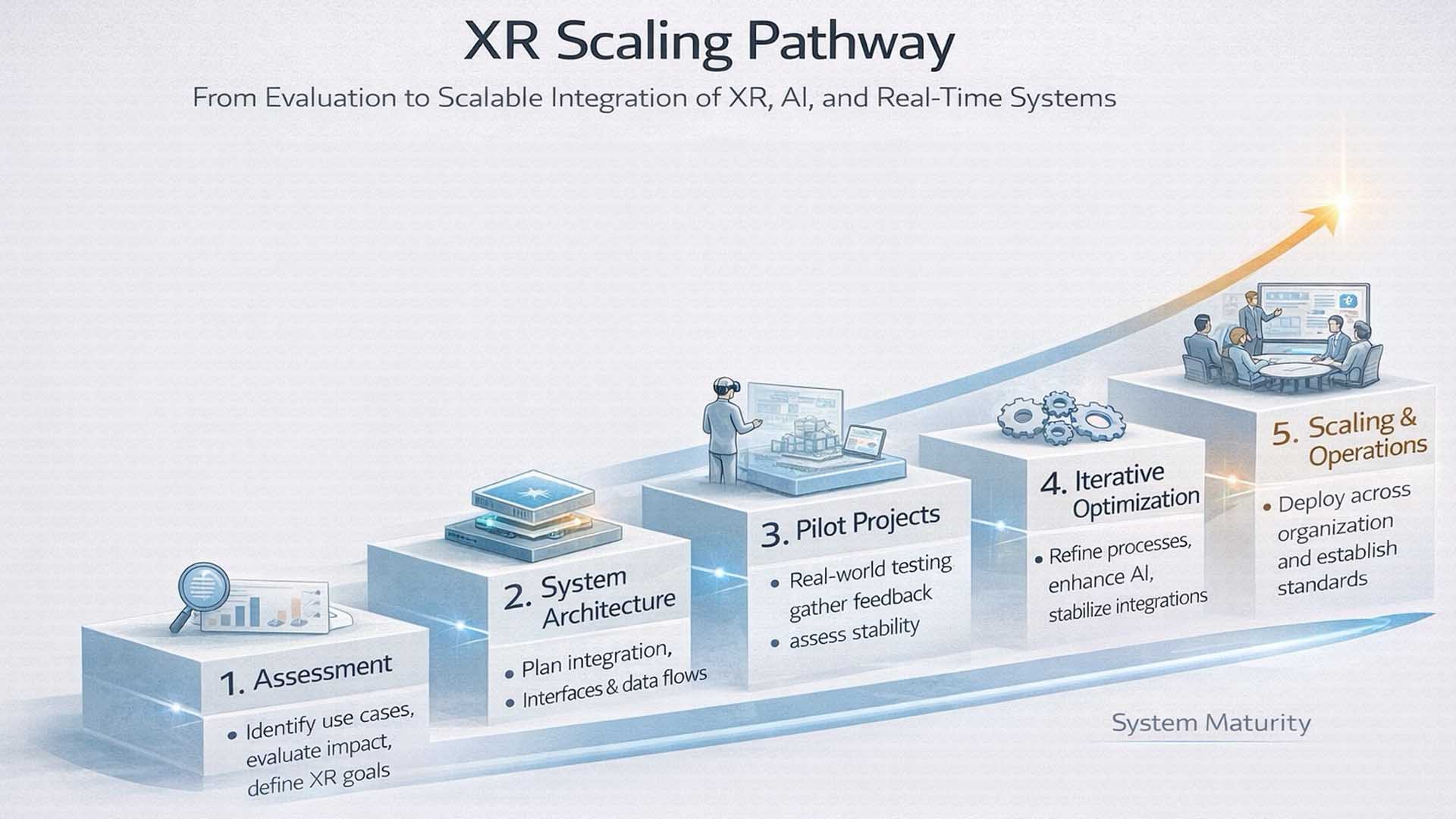
XR Scaling Pathway – from analysis through pilot projects to scalable integration of XR, AI, and real time systems
Graphic: Editorial analysis | Visualization: © Ulrich Buckenlei | Visoric GmbH | Depiction of a five phase implementation model for transferring XR pilot projects into scalable, operational systems | The illustration serves analytical classification
The lower curve of the graphic highlights the central connection: with each phase, system maturity increases. XR transformation does not happen abruptly, but as a continuous development process that connects technical, organizational, and economic factors.
Phase 1 – Assessment
At the beginning, there is no technology decision, but an analysis.
Companies capture existing processes, identify relevant use cases, and assess where XR can actually generate added value. Which decisions can be simulated more effectively? Where do error costs arise? Which workflows benefit from spatial visualization? [2][6]
Assessment creates clarity and prevents investment in applications without operational value.
Phase 2 – System architecture
Based on the analysis, the technical and organizational architecture is developed.
This is where it is defined how XR, AI, and real time processing work together. Data flows, interfaces, and integrations are planned. What matters is whether an isolated tool is created or a system that can be embedded into existing processes. [15][16]
System architecture means designing integration deliberately.
Phase 3 – Pilot projects
No transformation without controlled testing.
Pilot applications are used deliberately in real scenarios. User feedback is collected, technical stability is checked, and initial effects are made visible. This phase reduces risks and provides decisive practical insights for further development. [5]
Piloting is not an endpoint, but the beginning of resilient system development.
Phase 4 – Iterative optimization
After the first deployment, the real work begins.
Systems are adapted, processes refined, and technical components optimized. AI models are trained, interactions improved, and integrations stabilized. Iteration ensures that functioning applications become robust systems. [12]
Optimization is not a side effect, but a central part of scaling.
Phase 5 – Scaling and operation
Only now does broad usage begin.
XR systems are rolled out to larger parts of the organization. Standards, governance structures, and operating models are established. Training, maintenance, and further development become part of ongoing operations. [17][18]
Scaling does not mean copying a pilot project. It means building a system that is viable over the long term.
The graphic makes it clear that the decisive difference lies not in the technology, but in the approach. Companies that implement in a structured way develop resilient systems. Companies that conduct isolated pilot projects remain in experimental states.
As system maturity increases, the focus shifts. Technical questions move into the background, while organizational and human factors gain importance.
And this is exactly where the next central question arises:
How does the role of people change within these systems, and which new skills become necessary in order to use XR, AI, and real time environments effectively?
The next chapter therefore examines how role models in companies are changing and why, despite technological progress, humans become the decisive factor of transformation.
From user to system designer, why people are becoming the decisive factor in XR transformation
Technology can accelerate processes.
It can visualize, analyze, and automate.
But it cannot decide.
The real transformation in companies therefore does not begin with XR, artificial intelligence, or real time systems. It begins with the role of people within these systems. Because the more powerful technologies become, the more responsibility shifts to those who use, interpret, and steer them. [6][14]
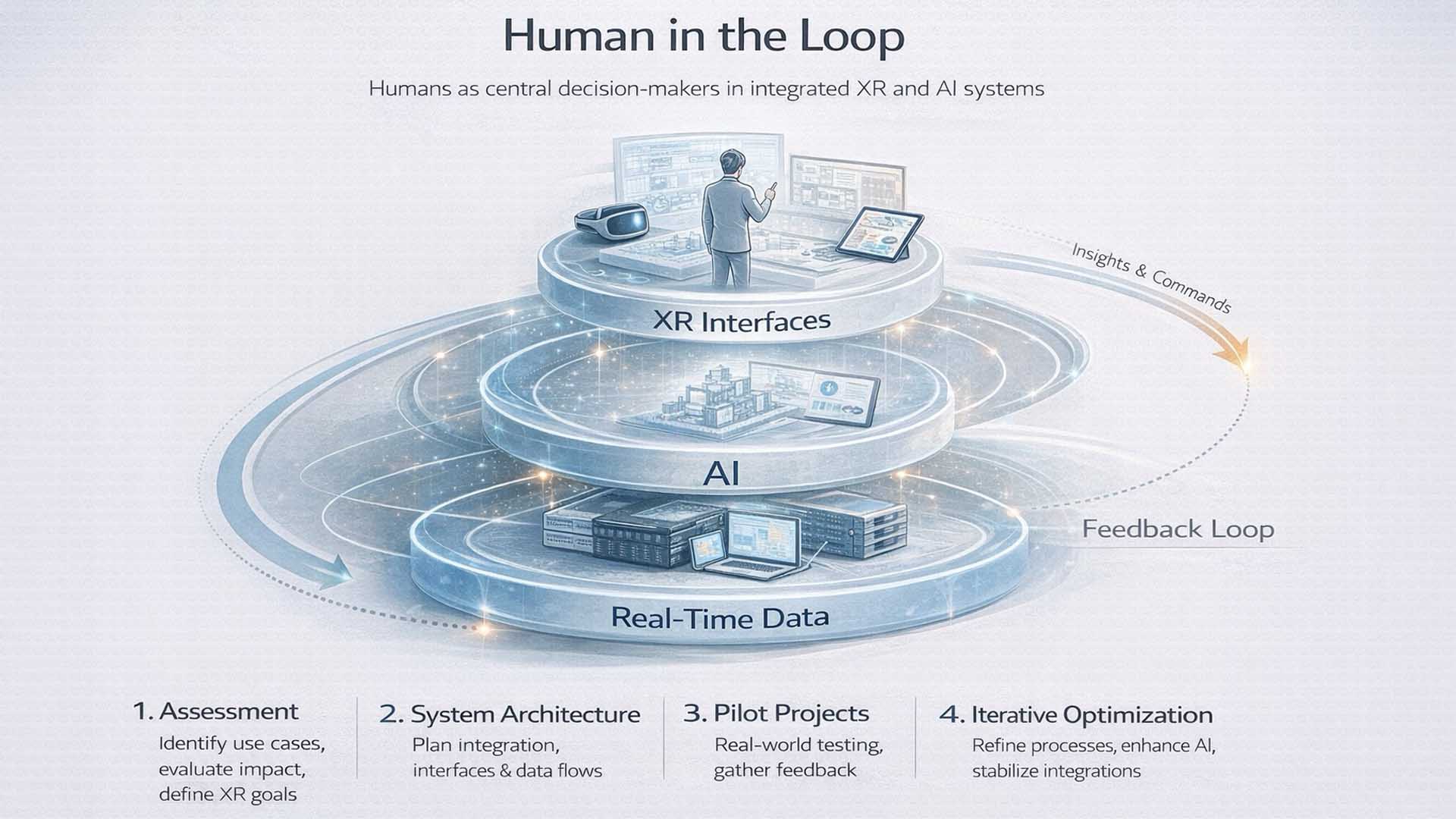
Human in the Loop – the human as the central decision making and control instance in integrated XR and AI systems
Visualization: © Ulrich Buckenlei | Visoric GmbH | Editorial concept image on the role of people in connected XR, AI, and real time systems | The depiction serves analytical classification
The image does not show a classic usage scenario, but a system structure. At the center is the human, surrounded by several layers of technological systems. XR interfaces, AI modules, and real time data streams are visually connected and form a dynamic network.
What matters here is the arrangement. Technology is not at the center.
It is organized around the human.
The human not only interacts with the system, but actively controls it. Decisions are not made automatically, but prepared, visualized, and supported. XR becomes the interface, AI becomes assistance, and real time data becomes the basis for situational evaluation.
This depiction makes a central shift visible.
In the past, systems were often structured linearly:
System → User → Result.
In integrated XR environments, a different model emerges:
Human at the center → connected systems → continuous feedback.
The role changes fundamentally:
First, the human becomes a curator. They decide which data is relevant and how it should be interpreted.
Second, they become an operator. They actively steer systems and intervene depending on the situation.
Third, they become an architect. They shape processes, workflows, and interactions consciously and strategically. [5][12]
This development does not mean a loss of importance, but an enhancement of the human role. The more complex systems become, the more important contextual understanding, experience, and judgment become. AI can recognize patterns and generate suggestions, but it does not replace responsibility.
This is exactly where the decisive point lies for companies.
Those who introduce XR systems without considering the role of people create friction, uncertainty, and inefficiency. Those who consciously understand the human as a central part of the system architecture create the foundation for effective use and sustainable integration.
The image therefore deliberately shows no technical detail, but a perspective. It is not about devices or software, but about the question of who controls the system and how decisions are made.
This creates the next central challenge:
How can companies concretely support, develop, and anchor these new roles over the long term so that they do not depend on individual people, but are built systematically?
The next chapter therefore examines which qualification, organizational, and development models are necessary in order to establish XR, AI, and real time systems sustainably in companies.
Enablement as the key, how XR, AI, and real time systems are sustainably anchored in the company
The successful introduction of XR systems does not end with technical implementation. It begins there. Sustainable impact arises only when organizations are able to understand these systems, develop them further, and actively integrate them into their processes.
This is exactly where it is decided whether a technological possibility becomes a resilient system, or whether applications disappear again after the first pilot phases. XR, AI, and real time systems therefore require not only infrastructure, but above all targeted enablement on several levels. [6][5]
The following graphic shows that this enablement cannot be conceived in isolation, but must be understood as a multi stage model that connects different organizational levels.
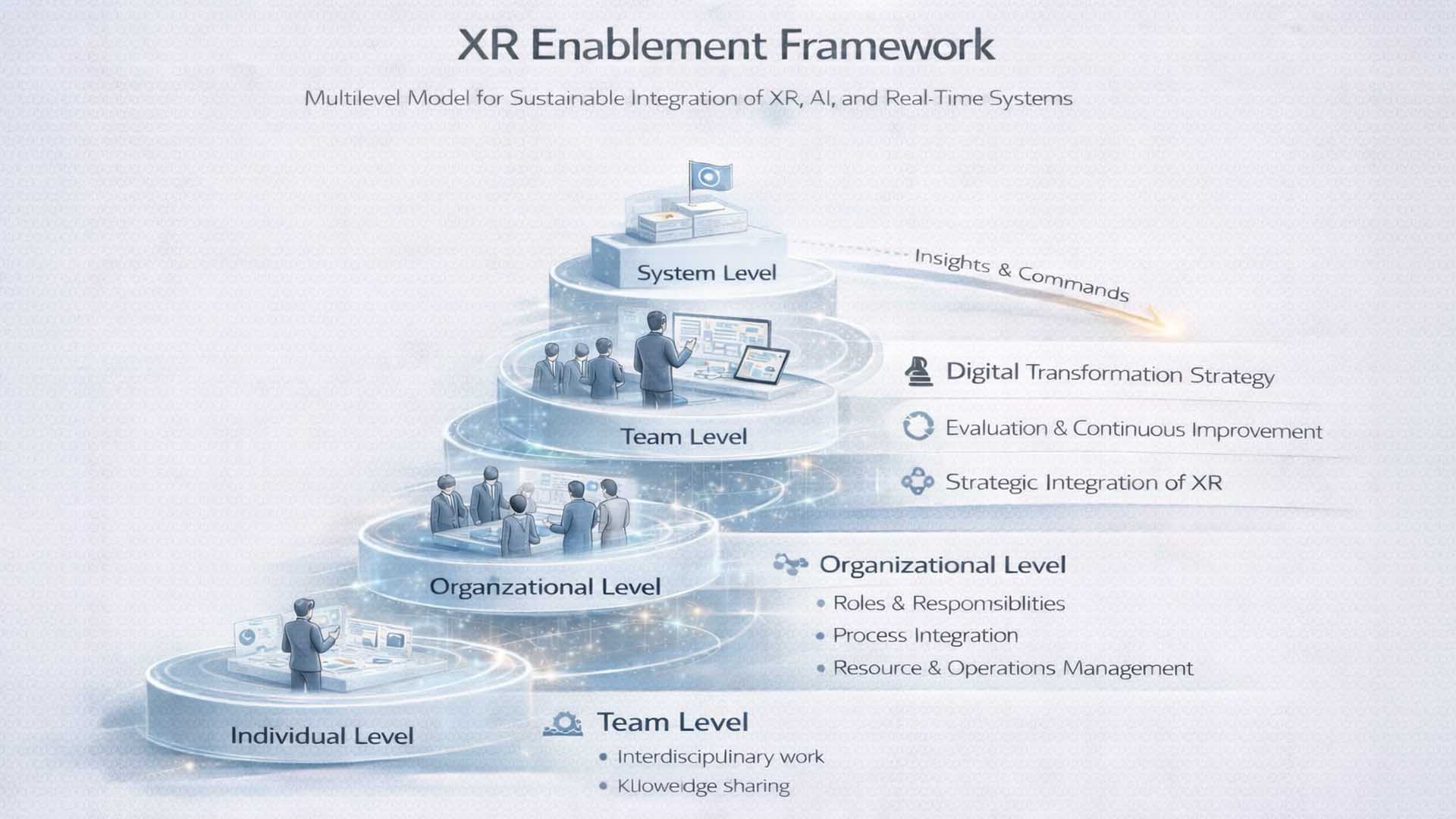
XR Enablement Framework – multi stage model for the sustainable integration of XR, AI, and real time systems in companies
Concept graphic: Editorial analysis | Visualization: © Ulrich Buckenlei | Visoric GmbH | Depiction of a four level enablement model for the sustainable use of immersive technologies | The illustration serves analytical classification
The graphic deliberately structures transformation into four levels. Each of these levels is necessary. None can function in isolation.
1. Individual Level – competence as the foundation
At the individual level, the focus is on the ability to use XR systems safely and meaningfully.
- Technical understanding of XR, AI, and real time systems
- Ability to interpret visual and simulation based content
- Reflection and situational decision making capability
Employees do not need to be developers. What matters is that they understand systems and can classify their results. Without this foundation, uncertainty arises, and uncertainty prevents use. [14]
2. Team Level – collaboration as an amplifier
Transformation only becomes effective when it is carried collectively.
- Interdisciplinary teams from technology, specialist departments, and application
- Structured knowledge exchange and feedback processes
- Joint further development of use cases
XR systems often unfold their impact only through the interaction of several perspectives. Teams therefore become the central unit of innovation. [5][12]
3. Organizational Level – structure creates scalability
Without organizational anchoring, XR applications remain isolated.
- Clear responsibilities and role models
- Integration into existing processes and decision structures
- Long term resource planning and operating concepts
Organization determines whether XR is operated as an experiment or as a system. Scalability only emerges through structural embedding. [17][18]
4. System Level – governance and strategic anchoring
The highest level defines the long term direction.
- Strategic classification of XR within digital transformation
- Continuous evaluation of value, impact, and efficiency
- Long term integration into company strategy and innovation processes
XR becomes relevant when it is no longer viewed as a project, but as part of digital infrastructure. [2][6]
Overall conclusion – why enablement is the decisive factor
The graphic makes it clear that successful XR transformation is not defined by technology. It arises through the interaction of competence, collaboration, structure, and strategy.
Technology can create possibilities.
System architecture can transform processes.
But only enablement determines whether these changes have a lasting effect.
Companies that deliberately develop these four levels create the foundation for sustainable use. Companies that focus exclusively on technology remain in isolated applications.
This development is condensed in the final video. It shows how XR, AI, and real time systems already work together today and which forms of integrated applications emerge from them.
The video is based on impressions in the context of Laval Virtual and was analyzed and classified at the start of the event on April 8, 2026.
It makes visible how individual technologies become a coherent system and thereby raises the central question of this article:
If the technology is ready, how consciously are we shaping its use?
Video analysis – XR, AI, and real time systems in operational use at Laval Virtual 2026
The following video shows not a theoretical vision, but a condensed snapshot of current developments around XR, artificial intelligence, and real time systems. It is based on official visual materials from Laval Virtual and was analytically classified at the opening of the event on April 8, 2026.
The focus is not on a single application, but on the interaction of central technology fields. It becomes visible how tracking, rendering, and AI supported interaction must be continuously synchronized in order to create stable and usable systems. This is exactly where the greatest technical challenge currently lies, and at the same time the decisive lever for operational use. [12][16]
At the same time, the video shows that XR is increasingly taking on a new role. Applications no longer serve only for visualization, but are actively used for decision support. Simulations make it possible to assess scenarios before implementation and identify risks at an early stage. XR is therefore becoming an integral part of operational processes. [6][17]
The central insight lies in integration. Only when XR, AI, and real time systems are conceived as a coherent architecture does a system emerge that works under real conditions. Individual technologies are not enough. What matters is the synchrony and stability of the entire system chain. [15][12]
The video makes this development visible. It shows how the focus shifts from experimental demonstrations toward resilient applications that can be used in industrial contexts.
XR, AI, and real time systems in practice – analysis of current developments in the context of Laval Virtual 2026
Source: Laval Virtual (official event material from previous years) |
Analytical classification: Ulrich Buckenlei |
Context: On site analysis at the opening of Laval Virtual on April 8, 2026
The example highlights a central development: XR is no longer a demonstration medium, but is evolving into an operational tool. Systems are used, tested, and continuously optimized under real conditions.
This also changes the evaluation of technology. It is not visual quality alone that matters, but the ability to function in a stable, synchronous, and integrated way. These are exactly the criteria that determine whether XR systems can prove themselves in practice.
The scenarios shown are representative of a broader development in the market. XR is increasingly used where decisions need to be prepared, processes optimized, and complex relationships made understandable.
And this is exactly where the circle of this article closes:
The question is no longer whether XR is being used.
The question is how consciously and systematically these systems are being developed, integrated, and operated.
Sources and references
- UNESCO, “AI and Digital Transformation in Society”, 2024.
Foundations on the role of artificial intelligence in societal transformation processes and its effects on work and knowledge systems. [1] - OECD, “Digital Economy Outlook 2024”, 2024.
Analysis of global developments in digital technologies, including XR, AI, and data driven systems in economic contexts. [2] - World Economic Forum, “Future of Jobs Report 2025”, 2025.
Report on future skill requirements in the context of automation, AI, and immersive technologies. [3] - European Commission, “Industry 5.0 and Human-Centric Innovation”, 2025.
Strategic classification of AI, XR, and digital systems in Europe’s industrial transformation. [4] - Stanford University – Human-Centered AI Institute, “AI Index Report 2026”, 2026.
Current data evaluation on the development and diffusion of AI systems in business and industry. [5] - McKinsey & Company, “The State of AI in 2025”, 2025.
Analysis of AI implementation in companies with a focus on productivity, decision support, and system integration. [6] - OECD, “Technology and Innovation Outlook”, 2025.
Assessment of technology trends such as XR, simulation, and digital platforms in the global innovation context. [7] - World Bank, “Digital Transformation and Economic Development”, 2024.
Study on the role of digital technologies in economic development and productivity growth. [8] - MIT Media Lab, “Interactive and Immersive Systems Research”, 2025.
Research on new interfaces, spatial interaction, and AI supported systems. [9] - Apple Inc., “Spatial Computing and Vision Pro”, 2025.
Classification of spatial computing as a new interface category for 3D interaction and real time applications. [10] - Meta Reality Labs, “Immersive Technologies and Presence Research”, 2024.
Study on the impact of immersive systems on interaction, perception, and collaboration. [11] - IEEE, “Real-Time Systems and Human-Machine Interaction”, 2025.
Overview of real time systems and their importance for interactive applications and industrial use. [12] - International Federation of Robotics, “World Robotics Report”, 2025.
Market data on the development of robotic systems and their integration into industrial processes. [13] - Harvard Business Review, “AI and the Future of Work”, 2024.
Analysis of how AI and automated systems are changing work processes. [14] - W3C, “WebXR Device API – Snapshot 2025”, 2025.
Technical foundation for integrating XR applications into web based systems. [15] - W3C, “WebGPU – Candidate Recommendation Snapshot”, 2026.
Modern interface for GPU accelerated real time 3D applications in the browser. [16] - ISO, “ISO 23247-1: Digital Twin Framework for Manufacturing”, 2021.
Standard for structuring digital twins and their use in industrial applications. [17] - Plattform Industrie 4.0, “Digital Twin and Interoperability”, 2024.
Position paper on the integration of connected systems and data architectures in industry. [18] - EdTech Europe, “Learning Metaverse Report 2025”, 2025.
Analysis of immersive platforms and their transferability to industrial and organizational applications. [19] - Brookings Institution, “AI, Automation and Economic Impact”, 2024.
Study on the long term effects of AI and automation on the economy and productivity. [20]
Using XR successfully means designing systems consciously
The development around XR, artificial intelligence, and real time systems clearly shows that technological possibilities are growing faster today than their structured application. Many companies are no longer facing the question of whether these technologies are relevant, but how they can be used meaningfully, reliably, and economically.
The real challenge does not lie in the technology itself. It lies in the connection between strategy, architecture, and implementation. Which use cases generate real added value? How can XR systems be integrated into existing processes? And under which conditions do resilient, scalable solutions emerge from them?
Anyone who wants to use XR successfully therefore needs a clear end to end perspective. From the initial analysis through the development of viable system architectures to structured implementation and further development in ongoing operations.
This is exactly where the difference arises between experiment and impact.
XR system design in practice – analysis, architecture, and implementation as an integrated development process
Source: VISORIC GmbH | Munich
- Analysis → Identification of relevant application scenarios with real added value
- Concept design → Development of integrated XR, AI, and real time architectures
- Prototyping → Building and validating the first functioning systems
- Integration → Embedding into existing processes and system landscapes
- Evaluation → Measuring impact, efficiency, and scalability
- Further development → Continuous optimization in operational use
Companies that follow this path in a structured way create more than individual applications. They develop systems that are viable over the long term and generate real added value.
If you would like to assess a concrete scenario, further develop an existing idea, or take the next step from demonstration to operational application, it is worth taking a shared look at your starting point.
Not as traditional consulting.
But as a well founded analysis with the goal of developing functioning systems.
Because this is exactly where success is decided:
XR does not unfold its value through technology alone.
But through the way it is conceived, integrated, and implemented.
Contact Us:
Email: info@xrstager.com
Phone: +49 89 21552678
Contact Persons:
Ulrich Buckenlei (Creative Director)
Mobil +49 152 53532871
Mail: ulrich.buckenlei@xrstager.com
Nataliya Daniltseva (Projekt Manager)
Mobil + 49 176 72805705
Mail: nataliya.daniltseva@xrstager.com
Address:
VISORIC GmbH
Bayerstraße 13
D-80335 Munich