
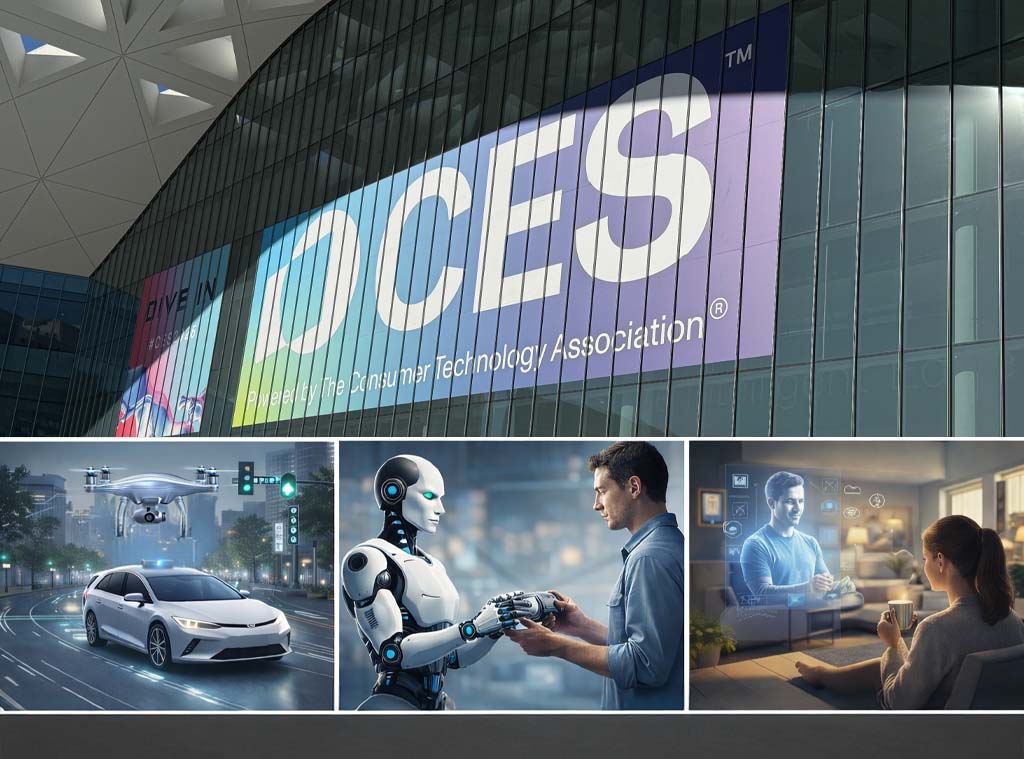
CES in Las Vegas is regarded as a leading trade show for technological trends shaping the use of artificial intelligence in industry and everyday life.
Photo: Ulrich Buckenlei (CES 2025) | Visualizations: Visoric Research Lab
In just a few days, the CES 2026 press days will begin in Las Vegas. Even ahead of the event, it is becoming clear that artificial intelligence will be discussed less as a standalone application and increasingly as part of integrated systems. The focus is shifting away from spectacular individual products toward the question of which approaches can fundamentally sustain themselves in industry and everyday life.
With the official opening of the show on January 6, it will become apparent which of the announced developments go beyond pure announcements. I will be attending CES 2026 on site and will observe where robust directions are emerging and which topics gain practical relevance over the course of the year.
Arriving in Las Vegas: Why CES 2026 Matters
CES 2026 is less a classic product exhibition and more a place of consolidation. You will not find finished answers here, but you can identify clear directions. Anyone who wants to understand how artificial intelligence is being embedded in industry and everyday life will find early signals at CES indicating which concepts are viable and which merely generate short term attention.
The relevance of the show lies not in individual exhibits, but in the overall picture. In Las Vegas, hardware, software, platforms, and AI converge and become visible for the first time as interconnected systems. Not as visions for a distant future, but as functioning demonstrators that show what is technically possible and under which conditions it can become economically viable.

The Sphere in Las Vegas during CES: As a projection surface for technology showcases, it illustrates how digital systems are increasingly becoming part of public spaces.
Photo: Ulrich Buckenlei | CES 2025, Las Vegas
The image shows the CES exhibition environment in Las Vegas and conveys the spatial scale and atmosphere in which central presentations and events take place. It does not represent specific products or levels of technological maturity, but rather marks the place where technological developments converge and become publicly visible for the first time.
This is precisely where the special role of CES lies. The show is less a classic product showcase and more a place for early assessment. It is not about mass market readiness or widespread rollout, but about viewing developments in context and identifying which technological trajectories are gaining substance. What becomes visible is how AI, computing power, sensor technology, and interfaces are combined into functional systems and where the first robust application scenarios are emerging.
- Early assessment instead of market readiness → CES shows directions, not finished markets.
- Systemic perspective → Technologies are viewed in interaction, not in isolation.
- Sober observation → It becomes clear what already works and where further development is required.
Next, we turn our attention to the technological trajectories that are concretely emerging at CES 2026 and which of them are gaining relevance for industry and everyday life.
Technological Trajectories at CES 2026: What Is Taking Shape Now
Anyone trying to understand CES 2026 should not read it like a product list. What matters are the trajectories that repeat across many booths. Individual demos can be impressive, but only the underlying patterns reveal what will gain importance over the course of the year. That is precisely why an analytical view of connections is worthwhile: which technologies appear not just as showpieces, but as building blocks of repeatable systems, which themes feel like short term signals, and which resemble robust directions.
For industry and everyday life, a common denominator is emerging. Artificial intelligence is becoming the control layer that connects different technological domains. The focus is no longer on AI as a feature, but on AI as the orchestration of hardware, software, data streams, and interfaces. The following diagram summarizes this development in a clear structure and highlights four trajectories that are expected to be particularly visible at CES 2026.
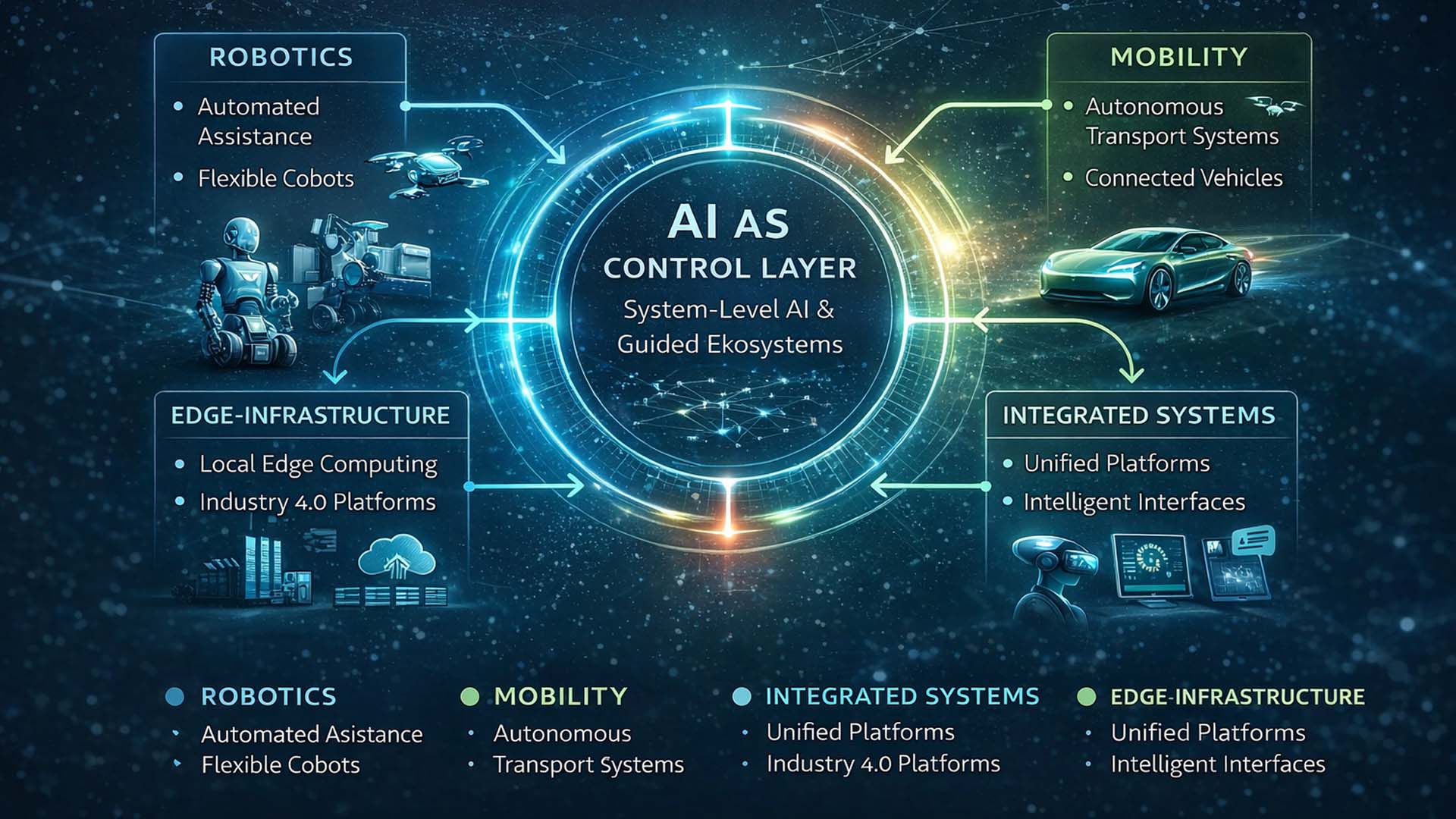
Key technology lines ahead of CES 2026: Artificial intelligence acts as a central control layer, connecting robotics, mobility, integrated systems, and edge infrastructure into scalable real world applications.
Visualization: © Visoric Research Lab 2025 – Analytical overview of converging technology domains observed ahead of CES 2026
At the center of the diagram is AI as Control Layer. This position is deliberately chosen. It describes the role of AI as a connecting layer that brings together sensor technology, data processing, decision logic, and interaction. Around this core, four technological fields become visible that increasingly depend on each other.
Robotics represents AI acting in the physical world. Humanoid systems, flexible cobots, and assistive robotics are no longer controlled solely by predefined sequences, but by models that combine perception, planning, and action. This is relevant for industry because it enables new forms of automation that are less rigid and better able to adapt to changing tasks.
Mobility illustrates the next stage of data driven vehicles. Autonomy, connected vehicle functions, and software defined platforms are merging into integrated architectures. At CES, the final breakthrough into everyday use is less visible than the direction itself: sensor technology, AI models, and edge computing power are becoming a system that can continuously evolve.
The field of Integrated Systems reflects the fact that innovations no longer appear in isolation, but as platform logics. Devices, services, and interfaces are designed to work together, support updates, and absorb new functions. For everyday life, this means fewer standalone gadgets and more ecosystems. For companies, it means fewer isolated solutions and more end to end system chains.
The foundation for this is Edge Infrastructure. Computing power is moving closer to the point of application because latency, data protection, robustness, and availability are becoming critical. Edge AI, local inference, and industrial computing platforms are therefore not just technical details, but prerequisites for robotics, mobility, and integrated systems to scale reliably.
- AI as Control Layer → AI becomes the control layer that connects hardware, software, data, and interfaces.
- Converging domains → Robotics, Mobility, Integrated Systems, and Edge Infrastructure reinforce each other.
- Signals you can read early → Robust directions become visible even if large scale deployment still takes time.
In the next chapter, we look at how these trajectories appear in concrete demonstrators and use cases. The focus will be on real setups, early implementations, and the question of which systems already function reliably today and where maturity is still lacking.
From Technological Trajectories to Concrete Demonstrators
After the central technological trajectories of CES 2026 have taken shape in the previous chapter, the decisive question now is where these developments are already becoming visible in real systems. This chapter focuses on concrete demonstrators and early use cases. The emphasis is on functioning setups, integrated environments, and the question of which combinations of AI, hardware, and software already work reliably today.
At CES 2026, it will become clear to what extent previously separate technologies can be combined into coherent systems. Many of the announced demonstrators aim to present AI models no longer in isolation, but embedded directly in vehicles, machines, devices, or digital infrastructures. The decisive factor will be how stable this interaction between sensor technology, computing power, and interfaces is under real world conditions.
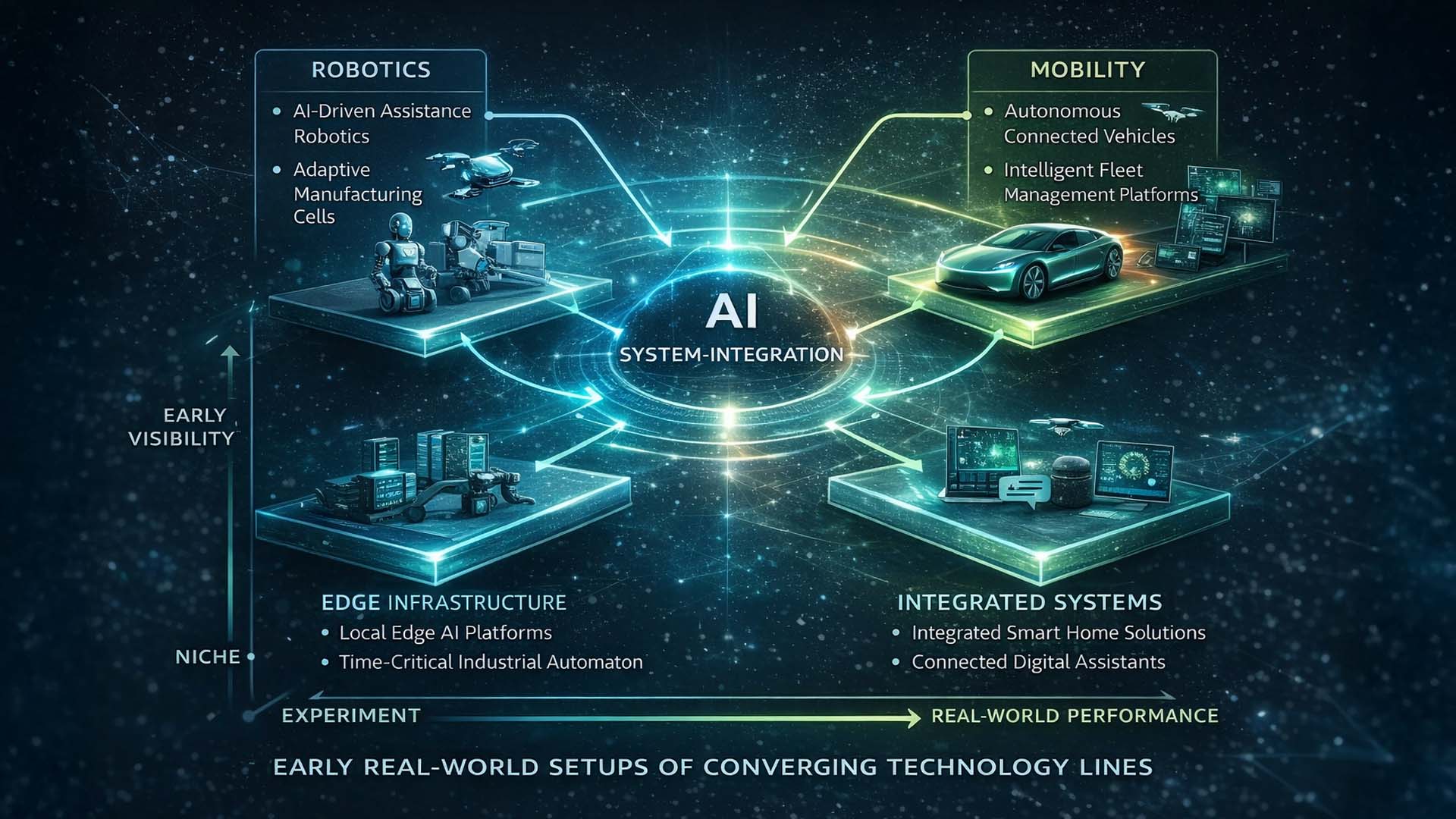
Demonstrators at CES 2026 show how AI models, sensor technology, computing power, and interfaces are combined into functioning systems, moving away from individual components toward operational setups.
Visualization: Conceptual system overview based on CES 2026 exhibition focus areas
The central graphic in this chapter serves as an analytical organizing model. It does not depict finished solutions, but condenses the way different technological layers are intended to interact within announced and in some cases already functioning demonstrators. What becomes particularly visible is the interplay between perception, data processing, and interaction across different application contexts.
In mobility, it becomes clear that autonomous functions are built on the combination of sensor technology, decision logic, and vehicle control. In industrial scenarios, the focus is on integrated setups that bring together digital models, AI driven analyses, and operational real time data. Applications in everyday life, in turn, show how AI assistants, connected devices, and new interface concepts are increasingly conceived as holistic systems.
What matters less here is the visual representation of the systems than their functional coupling. The question of how stable this interaction is under realistic conditions remains a key evaluation criterion. This is precisely where the presented approaches differ significantly.
- Functioning demonstrators → Systems are shown in concrete processes, not just as abstract concepts.
- Integrated architectures → AI, sensor technology, and interfaces are coordinated, but at different levels of maturity.
- Different maturity levels → Some applications appear robust, others remain clearly experimental.
These differences are precisely what make the demonstrators at CES 2026 analytically valuable. They allow for a realistic assessment of where scaling is already foreseeable and where further development stages remain necessary. Taken together, they translate technological trajectories into observable systems and make both limitations and progress visible.
In the next chapter, we turn our attention to the role of key industry players and how companies such as Siemens and NVIDIA strategically position and contextualize these developments at CES 2026.
From Technological Trajectories to Real World Demonstrators
At CES 2026, it will become evident to what extent previously separate technologies can actually be combined into coherent systems. Many of the announced demonstrators aim to embed AI models directly into vehicles, machines, industrial plants, or digital infrastructures rather than presenting them in isolation. The decisive factor is less technical feasibility and more the question of how stable this interaction between sensor technology, computing power, and interfaces is under real world conditions.
In contrast to pure concept studies or marketing announcements, these setups allow for an initial, robust assessment. They show how abstract technological trajectories from previous chapters translate into concrete applications and where gaps, limitations, or dependencies still exist. This differentiation is exactly what makes CES relevant as an observation space.
Real world demonstrators at CES 2026: The image illustrates how autonomous mobility, industrial AI systems, and digital infrastructures are conceived and presented as integrated end to end systems.
Visualization: Original representation based on public CES announcements and industry presentations
The central graphic in this chapter condenses precisely this transition. It makes visible how different technological layers interact within real demonstrators. Autonomous mobility solutions combine perception, decision logic, and vehicle control into a closed system. Industrial setups connect digital twins, AI driven analytical models, and operational real time data. Everyday applications integrate AI assistants, connected devices, and increasingly spatial interfaces.
It is striking that the maturity levels of these systems differ significantly. Some demonstrators already show high stability in clearly defined deployment scenarios. Others only function under controlled conditions or still require manual intervention. These differences provide valuable indications of where scaling is realistic and where additional development stages remain necessary.
- Functioning demonstrators → Systems are shown in operation, not just as abstract concepts.
- Integrated architectures → AI, sensor technology, computing power, and interfaces act as a cohesive system.
- Different maturity levels → Some applications are close to deployment, others remain experimental.
Taken together, these demonstrators translate technological strategies into observable reality. They allow for a well grounded assessment of what already works today, where limitations become visible, and which systems could gain relevance over the course of the year.
Referenced and Further Sources for Contextualization
- Siemens Annual Report 2024
- Siemens Industrial AI and Digital Twin Strategy Papers
- NVIDIA GTC Keynotes and CES Statements
- McKinsey Global Institute – The State of AI in Industry
- World Economic Forum – AI in Industrial Systems
- CES 2026 Official Keynote Program (Consumer Technology Association)
The demonstrated setups provide early indications of how technological strategies can be implemented in practice. The next chapter therefore focuses on maturity levels, scaling, and the economic viability of the systems presented at CES 2026.
Maturity Levels, Scaling, and Economic Viability
Before technological strategies can have an impact in industry and everyday life, their relevance is decided elsewhere: in implementation. CES 2026 does not only show which systems are conceivable, but also how far they have already progressed toward stable use. It becomes clear that there are significant differences between a functioning prototype, a targeted deployment, and a scalable solution.
Many of the systems presented at the show exist precisely within this tension. They work technically, but are still highly dependent on specific conditions. Other applications already show clearly defined operating boundaries within which they function reliably. Still others are so well integrated that they can be considered economically viable solutions. These differences cannot be identified by individual features alone, but only by considering maturity, scalability, and profitability together.
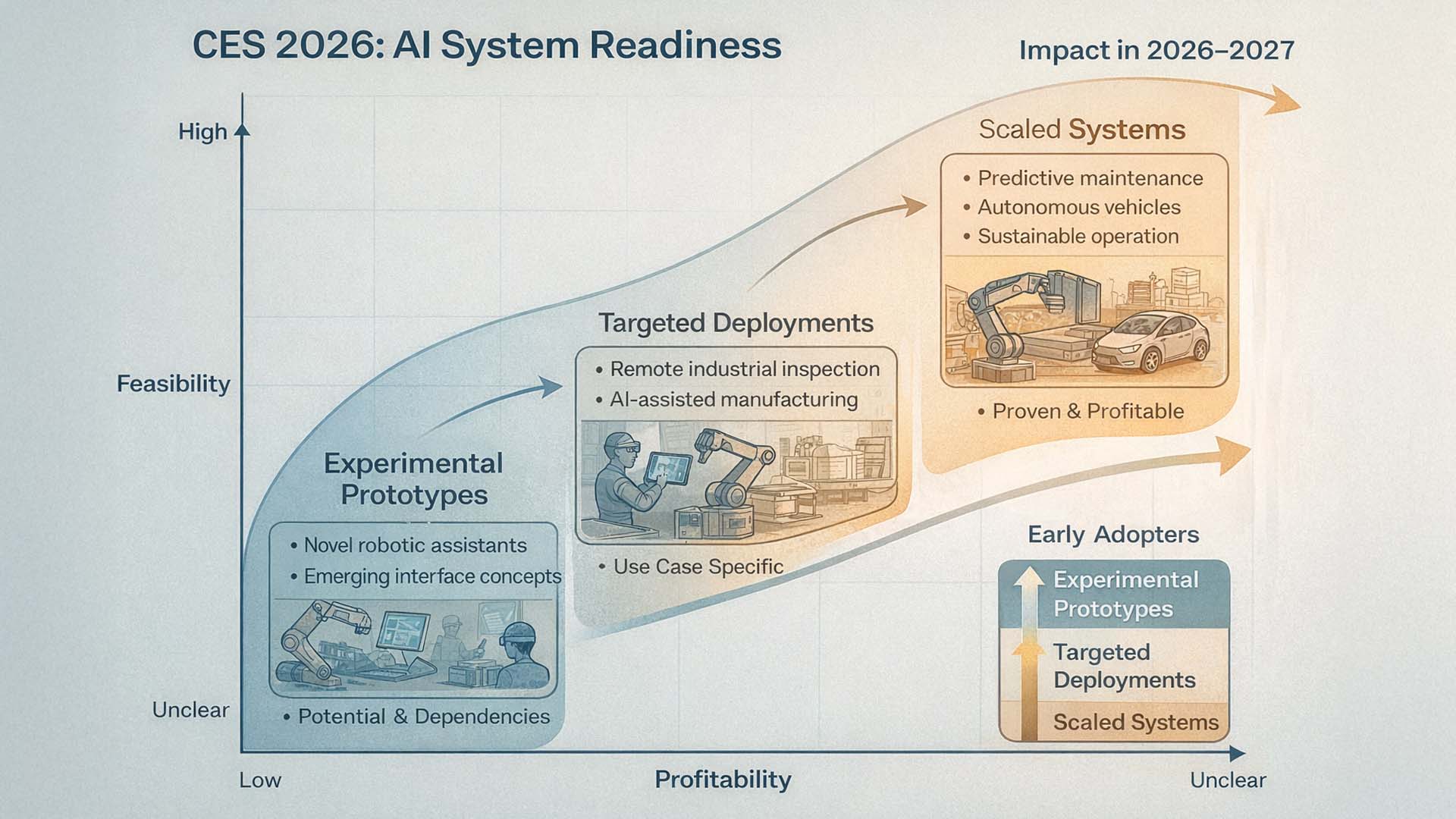
Maturity levels of AI systems at CES 2026: From experimental prototypes to targeted deployments and scalable, economically viable systems.
Visualization: Original representation based on trade show observations and analyses of industrial AI integration
The visualization positions the systems visible at CES 2026 along two central axes. The vertical axis represents technical feasibility, describing how stable, reproducible, and operationally reliable a system is. The horizontal axis reflects economic viability and indicates the extent to which a system is scalable, cost efficient, and market ready.
On the left side of the graphic are experimental prototypes. These systems demonstrate new forms of interaction, robotics approaches, or AI driven assistance concepts. They provide important impulses, but are often highly context dependent and not designed for continuous operation. Dependencies on specific hardware, data quality, or manual control are clearly visible here.
The middle zone represents targeted deployment scenarios. This includes applications that function reliably under clearly defined conditions. Examples include AI supported manufacturing processes, automated inspection systems, or specialized mobility solutions. These systems are technically stable, but not yet universally applicable. Their economic value arises from well defined use cases rather than broad scaling.
On the right side of the graphic are scaled systems. These combine high technical maturity with economic viability. Examples include predictive maintenance systems, autonomous mobility solutions in clearly regulated environments, or AI driven optimization of industrial processes. These applications are not only functional, but already integrated into existing value chains.
- Experimental prototypes → High innovation potential, but limited stability and scalability.
- Targeted deployments → Functioning systems within clearly defined application areas.
- Scaled systems → Technically mature, economically viable, and integrable.
The graphic makes it clear that technological relevance is not determined by the degree of innovation alone. What matters is the ability to operate systems reliably under real world conditions and to scale them economically. This is exactly where, at CES 2026, the visionary experiment separates from the implementable solution.
The next chapter therefore focuses on the overarching question of how key industry players strategically address these maturity levels. It examines the role of companies such as Siemens and NVIDIA and how they set technological frameworks at CES 2026 that make scaling possible in the first place.
Strategic Frameworks: How Industry Players Enable Scaling
Many of the technological maturity levels visible at CES 2026 do not emerge in isolation. They are the result of strategic decisions by key industry players who think beyond individual products and create long term technological frameworks. Only through these overarching architectures does scaling become possible, technically, organizationally, and economically.
While earlier trade shows were often characterized by individual innovations, CES 2026 increasingly brings to the forefront the question of who provides the infrastructure, platforms, and system logics on which AI based applications can grow sustainably. This is where companies such as Siemens and NVIDIA assume a key role. They do not define individual use cases, but rather the conditions under which industrial AI systems can be realistically operated, expanded, and economically utilized.
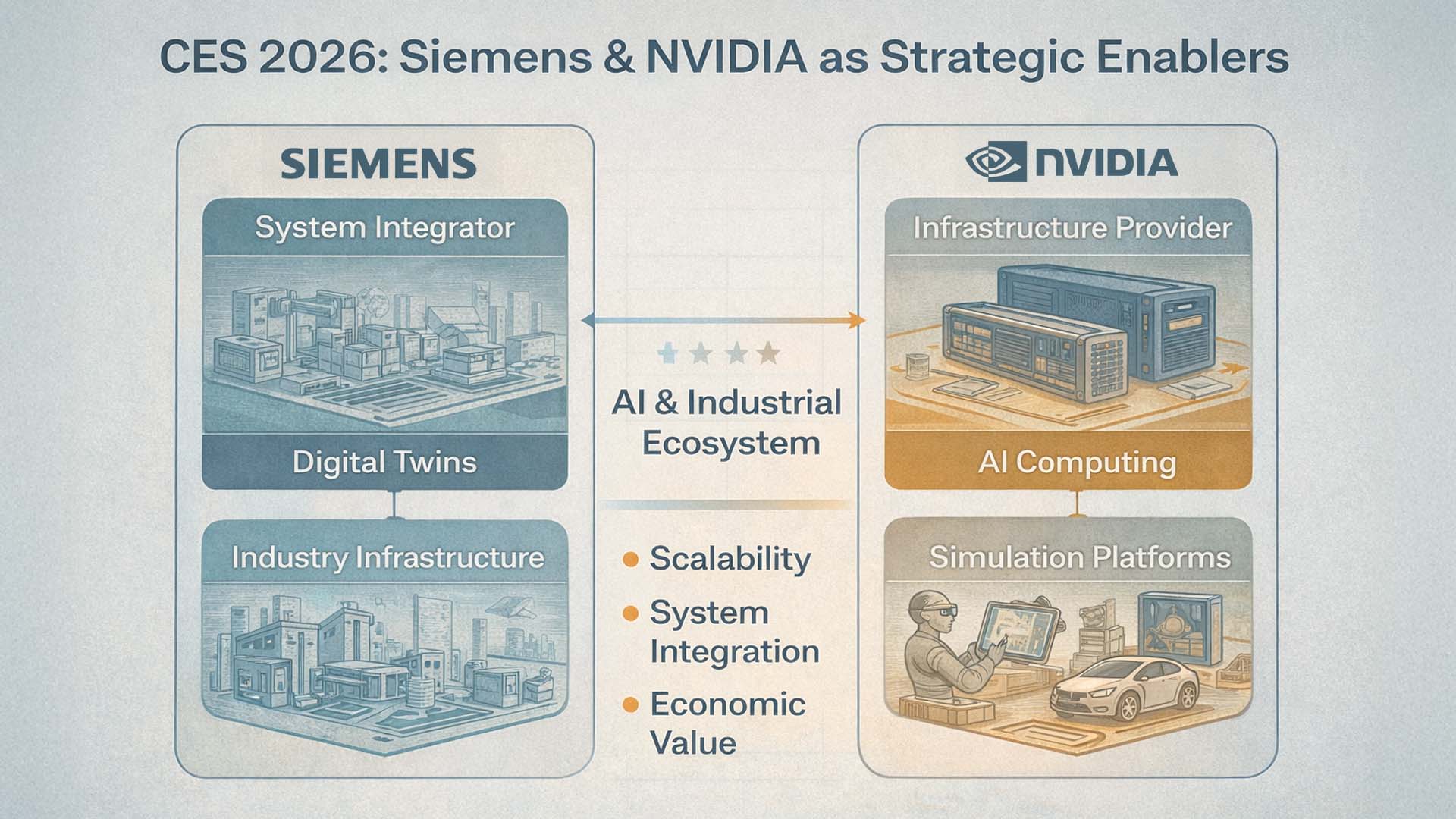
CES 2026: Siemens and NVIDIA as strategic enablers, platforms and architectures that enable scaling, system integration, and economic viability of industrial AI.
Visualization: Original analysis based on publicly communicated industry and platform strategies
The central graphic in this chapter illustrates this distribution of roles. On one side are system integrators that connect industrial processes, digital twins, and existing production landscapes. On the other side are providers of computing infrastructure and simulation platforms that deliver the performance required for AI models, virtual environments, and data intensive workflows.
What matters is not individual technology, but the interaction of these layers. Digital twins only unfold their value when they can be continuously supplied with real time data, simulated, and analyzed. AI models remain theoretical if they are not integrated into stable industrial environments. Computing power alone generates no value if it is not embedded in concrete system architectures.
- Platform logic instead of individual products → Scaling emerges through stable technological frameworks.
- System integration in focus → Digital twins, AI models, and real time data only deliver value together.
- Industry players as enablers → Large providers create ecosystems, not isolated solutions.
At the same time, it becomes clear that these strategic frameworks are deliberately designed to be open. They allow different industries, partners, and applications to build on the same technological foundations. As a result, the focus shifts away from which product convinces toward which architecture is sustainable in the long term. This perspective shapes many of the central discussions and announcements at CES 2026.
This strategic layer forms the framework for everything visible at the show. It determines which technological trajectories are considered future proof and which approaches lose relevance over time.
In the final chapter, we therefore turn to practical implementation. Together with the Munich based Visoric expert team, we show how companies can concretely leverage these technological frameworks. With more than 15 years of experience in industrial digitalization, real time 3D, AI driven systems, and scalable platform architectures, we support companies in integrating modern technologies responsibly, economically, and sustainably into existing structures.
The VISORIC Expert Team in Munich
The technological developments visible at CES 2026 show that scaling does not emerge from technology alone, but from the ability to systematically integrate complex systems into existing industrial contexts. This is exactly where the VISORIC expert team in Munich operates. For more than 15 years, we have supported companies in introducing new digital technologies not in isolation, but by robustly embedding them into processes, organizations, and value chains.
Our focus lies in connecting industrial reality with modern digital infrastructure. We work with complex engineering data, digital twins, real time 3D systems, and AI driven workflows, translating them into functional applications for industry, communication, simulation, and decision making. The goal is not visual effects, but reliability, consistency, and scalability.
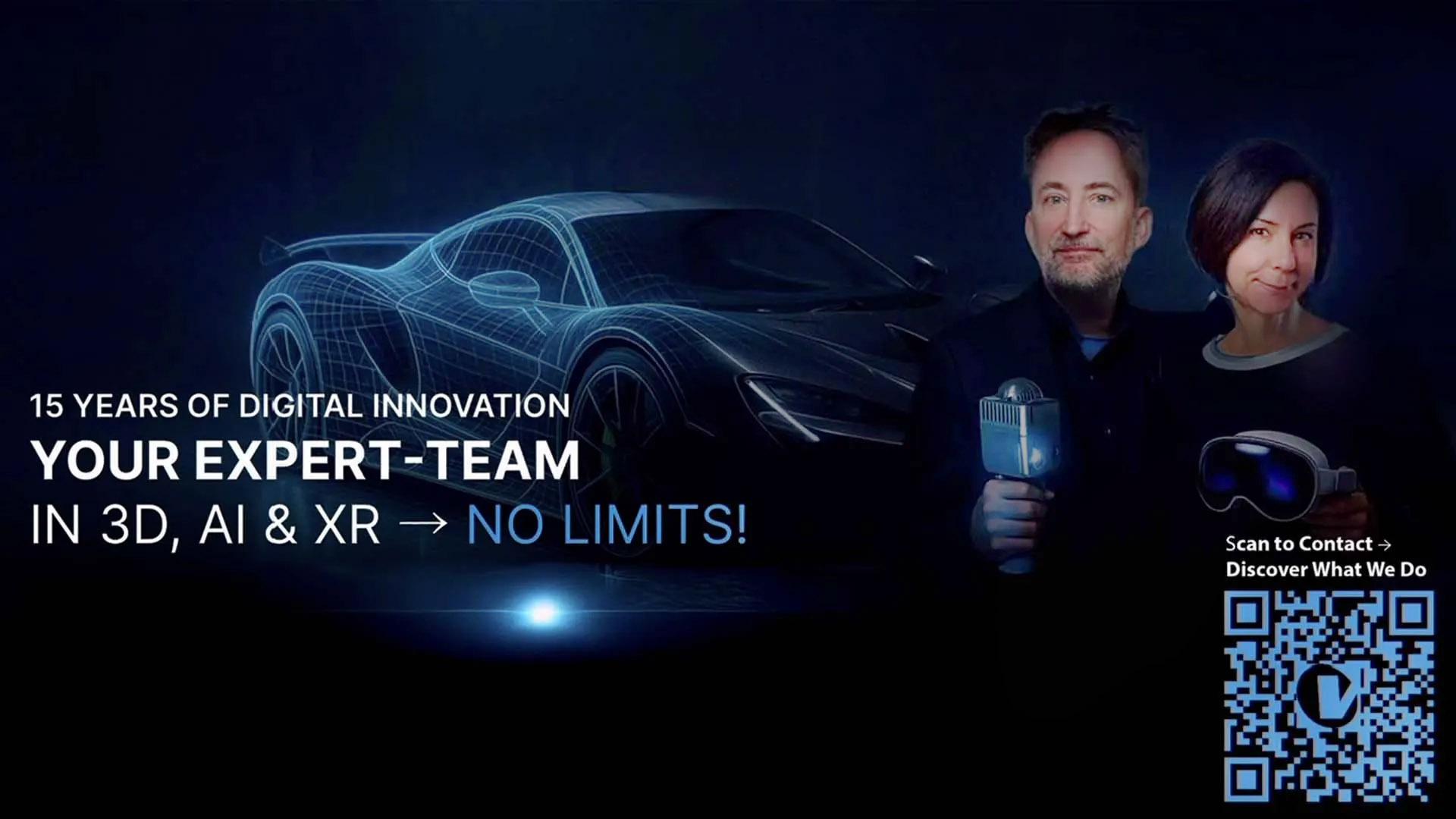
The VISORIC expert team: Ulrich Buckenlei and Nataliya Daniltseva discussing digital product strategies, industrial visualization, and scalable real time systems.
Source: VISORIC GmbH | Munich 2025
In our work, we combine technical expertise with strategic perspective. We support companies in developing robust digital assets from existing CAD and product data that remain usable beyond individual projects. These assets form the basis for photorealistic visualization, interactive applications, XR experiences, simulations, and AI driven decision models. The underlying data remains consistent, versionable, and expandable.
Another key focus is the development of modular visualization and real time pipelines. The goal is to enable companies to continue evolving their digital systems independently over the long term. This includes structured 3D workflows, variant logic, high performance real time setups, and the integration of new platforms and end devices. This approach aligns closely with that of many industry players at CES 2026, where open architectures and scalable platforms take center stage.
- Industry experience → More than 15 years working at the intersection of technology, visualization, and strategy
- Data driven approach → CAD, digital twins, and real time data as a consistent foundation
- Scalable systems → From individual applications to enterprise wide platforms
- Real time and XR → Applications for web, simulation, training, and immersive systems
- Strategic guidance → Contextualization, concept development, and implementation of new technologies
When companies face the question of how to meaningfully integrate new technologies such as AI, real time simulation, or digital twins into existing structures, we support them in developing realistic and sustainable solutions. This process often begins with a joint analysis of existing data, systems, and objectives. From there, concrete next steps emerge, technically sound, economically viable, and viable in the long term.
Contact Us:
Email: info@xrstager.com
Phone: +49 89 21552678
Contact Persons:
Ulrich Buckenlei (Creative Director)
Mobil +49 152 53532871
Mail: ulrich.buckenlei@xrstager.com
Nataliya Daniltseva (Projekt Manager)
Mobil + 49 176 72805705
Mail: nataliya.daniltseva@xrstager.com
Address:
VISORIC GmbH
Bayerstraße 13
D-80335 Munich