
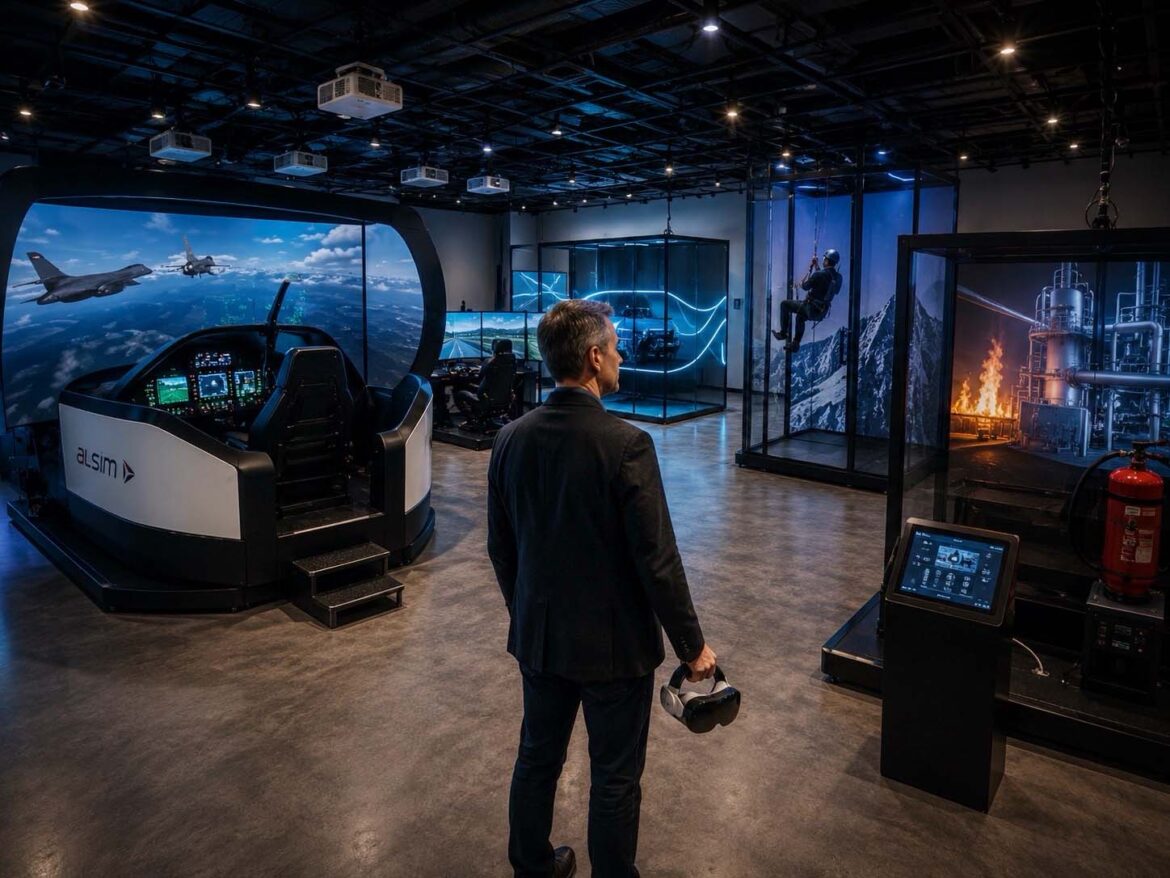
The concept image illustrates a modern simulation environment in which flight simulation, rescue training, industrial safety training, and XR technologies are integrated within a shared training platform.
Visualization: AI powered training simulations, digital twins, XR learning environments, real time 3D, and immersive simulation platforms for industry, educational institutions, and SMEs | Image: © Ulrich Buckenlei | VISORIC GmbH
Professional training simulations were long considered complex specialized solutions primarily used in aviation, large scale industry, research, or highly specialized training centers. Complex hardware, custom software development, and high investment costs made such systems difficult to access for many companies, educational institutions, and small to medium sized businesses. This situation is now fundamentally changing through artificial intelligence, modern XR hardware, and powerful real time platforms.[1]
What previously required large budgets, long development cycles, and specially constructed simulation facilities can now be implemented far more flexibly and cost effectively. Real time 3D engines, digital twins, AI powered development processes, and scalable XR systems are opening new opportunities to design professional training environments more quickly, create more realistic experiences, and deliver them more economically.[2]
The cover image of this article visualizes exactly this transformation. Different training scenarios no longer appear as isolated standalone solutions. Flight simulation, high angle rescue operations, industrial safety training, mixed reality applications, and digital analytics platforms are now being conceived within a common technological environment. This creates a new generation of immersive training systems built on shared data, real time models, and intelligent platform architectures.
This development is particularly relevant for industrial companies, educational institutions, and SMEs. Training can be conducted more realistically, more safely, and more frequently without permanently occupying machinery, recreating dangerous situations in reality, or building extensive physical training facilities. Digital twins make real world processes virtually accessible. AI assists with the creation of scenarios, content, and evaluations. XR hardware brings immersive learning environments closer to practical use within organizations.[3]
As a result, the role of professional training simulations is changing fundamentally. They are no longer viewed exclusively as expensive specialized systems for a limited number of use cases. Instead, they are evolving into flexible platforms for professional development, qualification programs, safety training, and technical knowledge transfer. Companies are therefore increasingly exploring how AI, real time 3D, and digital twins can work together to make training environments more efficient and accessible.[4]
Projects and concept developments carried out by the Munich based VISORIC expert team also demonstrate that modern simulation solutions no longer need to be associated with the cost structures of traditional large scale simulators. The key lies in an intelligent combination of technology, content, user interaction design, and economically scalable implementation. This is where the true value emerges for organizations that want to leverage professional training simulations without immediately investing in fully customized large scale systems.
The central question is therefore no longer simply how realistic a simulation can look. More importantly, it is about how economically, flexibly, and effectively it can be integrated into existing learning, training, and work processes. This is precisely where the significance of AI powered XR training environments begins.
- AI reduces development effort and production costs for professional simulations
- Digital twins make real world processes virtually trainable
- Modern XR hardware lowers barriers to entry for immersive learning environments
- Industry, educational institutions, and SMEs benefit from scalable training platforms
- Real time 3D combines visualization, interaction, and analytics within a shared environment
This development becomes especially exciting when individual simulators are no longer created as isolated systems but instead evolve into scalable platforms supporting a wide variety of training scenarios.
From Multi Million Euro Project to Scalable Training Platform
Professional training simulations have long been among the most expensive digital solutions. Flight simulators, industrial safety training systems, and complex rescue scenarios required specialized hardware, custom software development, and major investments in infrastructure. Many of these systems were developed exclusively for large corporations, military institutions, or specialized training centers. Today, this situation is beginning to change fundamentally.[4]
Modern real time platforms, artificial intelligence, and powerful XR hardware now enable an entirely new approach. Instead of developing every training environment completely individually, modular simulation platforms are increasingly emerging on which different scenarios can be built. This significantly reduces development effort, project costs, and implementation times.[5]
The image in this chapter visualizes precisely this shift. Different training worlds such as flight simulation, high angle rescue, industrial safety exercises, and mixed reality applications no longer appear as isolated individual solutions. Instead, they become part of a shared technological platform that connects content, interactions, and simulation logic.
For industrial companies, educational institutions, and medium sized businesses in particular, this development opens up new possibilities. Training sessions can be carried out more frequently, content can be updated faster, and new scenarios can be provided at significantly lower cost. At the same time, flexibility increases because existing platforms can be used for different training purposes.[6]
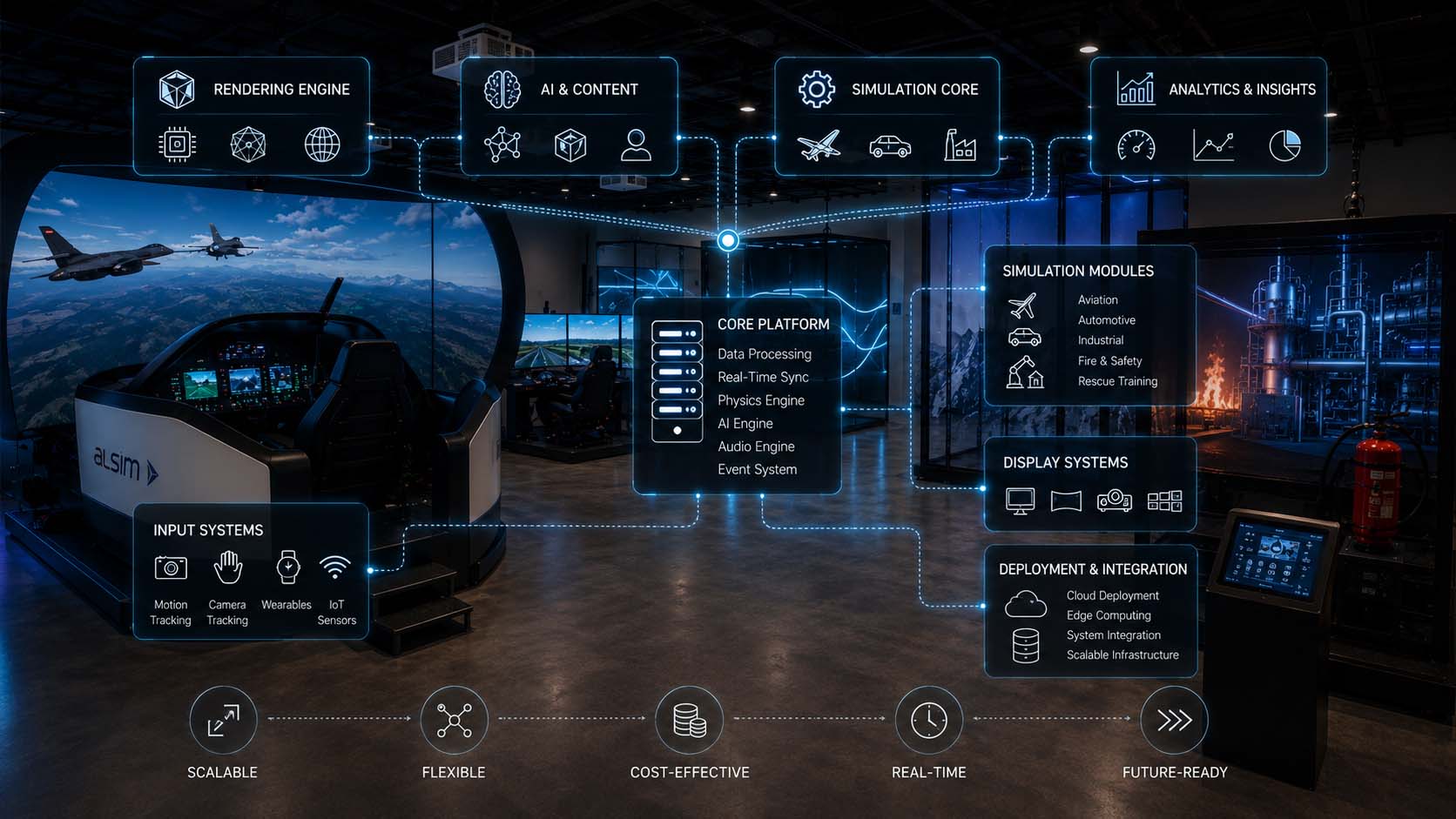
The concept image shows a central simulation environment in which different training worlds are brought together on a shared XR and real time platform.
Visualization: Scalable training platform with flight simulation, rescue training, industrial applications, real time 3D, XR hardware, and AI powered learning environments | Image: © Ulrich Buckenlei | VISORIC GmbH
Another decisive factor is added here. Artificial intelligence now supports many areas of development. 3D content can be created faster. Training sequences can be generated automatically. Analytics functions can evaluate learning success and adapt training content individually to participants. This reduces not only the development effort but also the long term operating effort of professional simulation solutions.[7]
The Munich based VISORIC expert team has also been observing this shift for years in numerous industrial projects. Concepts that build on reusable real time platforms, modular components, and scalable XR technologies are particularly successful. This is exactly where the economic advantage of modern simulation systems emerges.
As a result, professional training simulations are increasingly evolving from individual large scale projects into flexible platform solutions. Companies gain access to technologies that were previously often reserved for only a few organizations with very high budgets. The real innovation therefore lies not only in the technology itself, but in its much broader availability.
- Modular platforms replace many individual standalone solutions
- AI reduces development effort and production costs
- XR hardware lowers the entry barriers for professional simulations
- Training content can be updated and expanded faster
- Immersive learning worlds become accessible to significantly more organizations
Yet even the most flexible platform needs powerful tools for content creation. The development becomes particularly exciting where artificial intelligence begins to accelerate the production of complete training worlds.
How AI Accelerates the Development of Training Worlds
One of the most important changes in modern simulation platforms does not take place inside the training environment, but already during its development. Artificial intelligence now supports numerous processes that previously had to be carried out entirely manually. As a result, training worlds can be created, adapted, and expanded much faster than only a few years ago.[8]
This becomes particularly visible in the creation of 3D content, scenarios, and training sequences. AI systems can prepare models, analyze documentation, generate dialogues, or automatically vary training situations. Development teams gain tools that accelerate many time consuming tasks while also opening up new creative possibilities.[9]
The goal is not to replace human experts. Rather, new workflows are emerging in which AI takes over routine tasks, allowing specialists to focus more strongly on conception, user experience, and subject matter content. Especially in complex simulation projects, this leads to significant time and cost advantages.
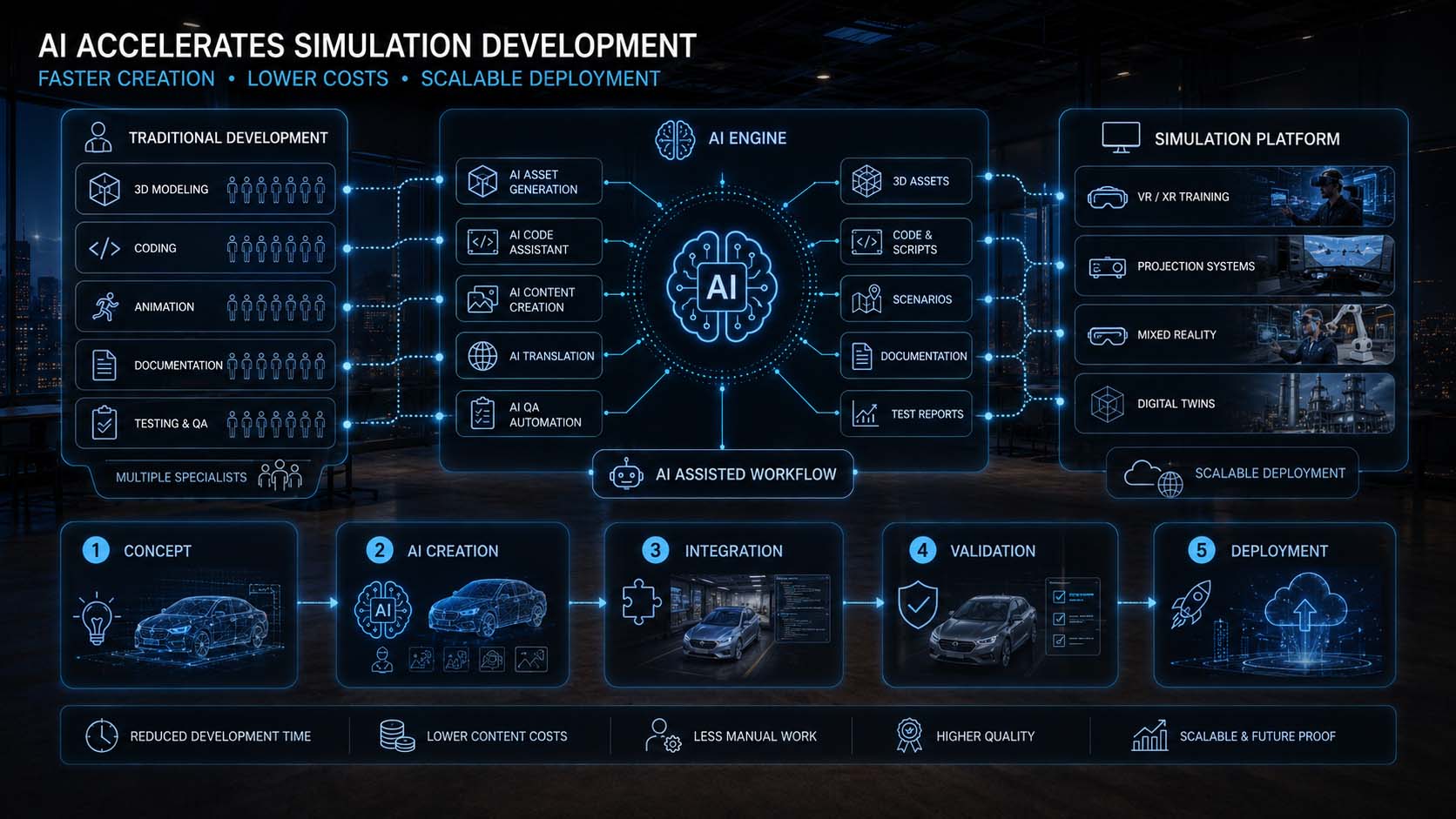
The graphic shows how artificial intelligence, real time 3D, and digital twins jointly contribute to the development of modern training environments.
Visualization: AI powered production pipeline for XR applications, digital twins, real time 3D content, and adaptive training scenarios | Image: © Ulrich Buckenlei | VISORIC GmbH
Digital twins also benefit from this development. Existing facilities, machines, or buildings can now be digitized and prepared for training purposes much faster. This creates realistic learning environments based on actual processes and operational workflows. Industrial companies in particular increasingly recognize the economic advantage of this, as training can be directly aligned with real working environments.[10]
At the same time, AI opens up new possibilities for adaptive learning systems. Training sessions can automatically respond to different experience levels, analyze learning progress, and provide individual recommendations. This makes simulation environments not only more realistic, but also more effective.
The Munich based VISORIC expert team is also working intensively on the question of how AI powered workflows can accelerate the development of immersive applications. The greatest potential often emerges where AI, real time 3D, and human expertise are intelligently combined.
- AI accelerates the creation of training content and scenarios
- Digital twins can be built and updated faster
- Adaptive learning systems respond to individual user needs
- Development times and project costs are significantly reduced
- Experts can focus more strongly on content and user experience
When content is created faster and digital twins become more readily available, the next question arises: On which hardware will these training worlds be used in the future? This is exactly where the next major transformation of modern simulation systems begins.
Here is the English translation with the HTML source preserved exactly:
When Digital Twins Become Intelligent Training Partners
The next stage in the evolution of modern training simulations begins where digital models no longer serve merely as static representations of real world objects. Digital twins are increasingly evolving into intelligent training partners capable of simulating processes, analyzing conditions, and responding to user interactions. This is precisely what creates learning environments that are significantly more realistic and flexible than traditional training systems.[13]
A digital twin of a production facility, for example, can simulate different operating conditions, generate fault scenarios, or support maintenance training procedures. Instead of predefined workflows, dynamic scenarios emerge that are based on actual process data. As a result, training becomes not only more realistic but also much closer to real operational procedures.[14]
Particularly exciting is the combination of real time data, artificial intelligence, and simulation. Sensor information, user actions, and process parameters can be continuously analyzed. This creates a training environment that adapts to different situations and enables individualized learning experiences.
The visualization shows how digital twins can simulate and analyze real processes, facilities, and workflows within an intelligent training environment.
Visualization: Digital twins with real time data, AI powered behavioral models, simulation logic, and adaptive training scenarios | Image: © Ulrich Buckenlei | VISORIC GmbH
The image in this chapter illustrates different layers of modern simulation models. Real processes are digitally replicated, analyzed, and made available for training purposes. What was once used primarily for visualization is increasingly evolving into an active training platform with its own logic and intelligent evaluation capabilities.
This creates entirely new opportunities in industry, aviation, logistics, and technical education. Employees can train complex procedures without risking real systems or interrupting production processes. At the same time, rare or critical situations can be specifically simulated and repeated as often as necessary.[15]
In the long term, digital twins could extend far beyond traditional training applications. They are increasingly developing into learning systems that understand processes, identify optimization opportunities, and actively support users. The boundary between simulation, analytics platforms, and intelligent assistance is becoming increasingly blurred.[16]
- Digital twins virtually replicate real processes and facilities
- AI enables adaptive and dynamic training scenarios
- Real time data increases realism and operational relevance
- Complex procedures can be trained safely and repeatedly
- Training environments are evolving into intelligent learning systems
However, digital twins alone are not enough. Only modern XR hardware makes these training environments directly immersive and significantly more accessible to users.
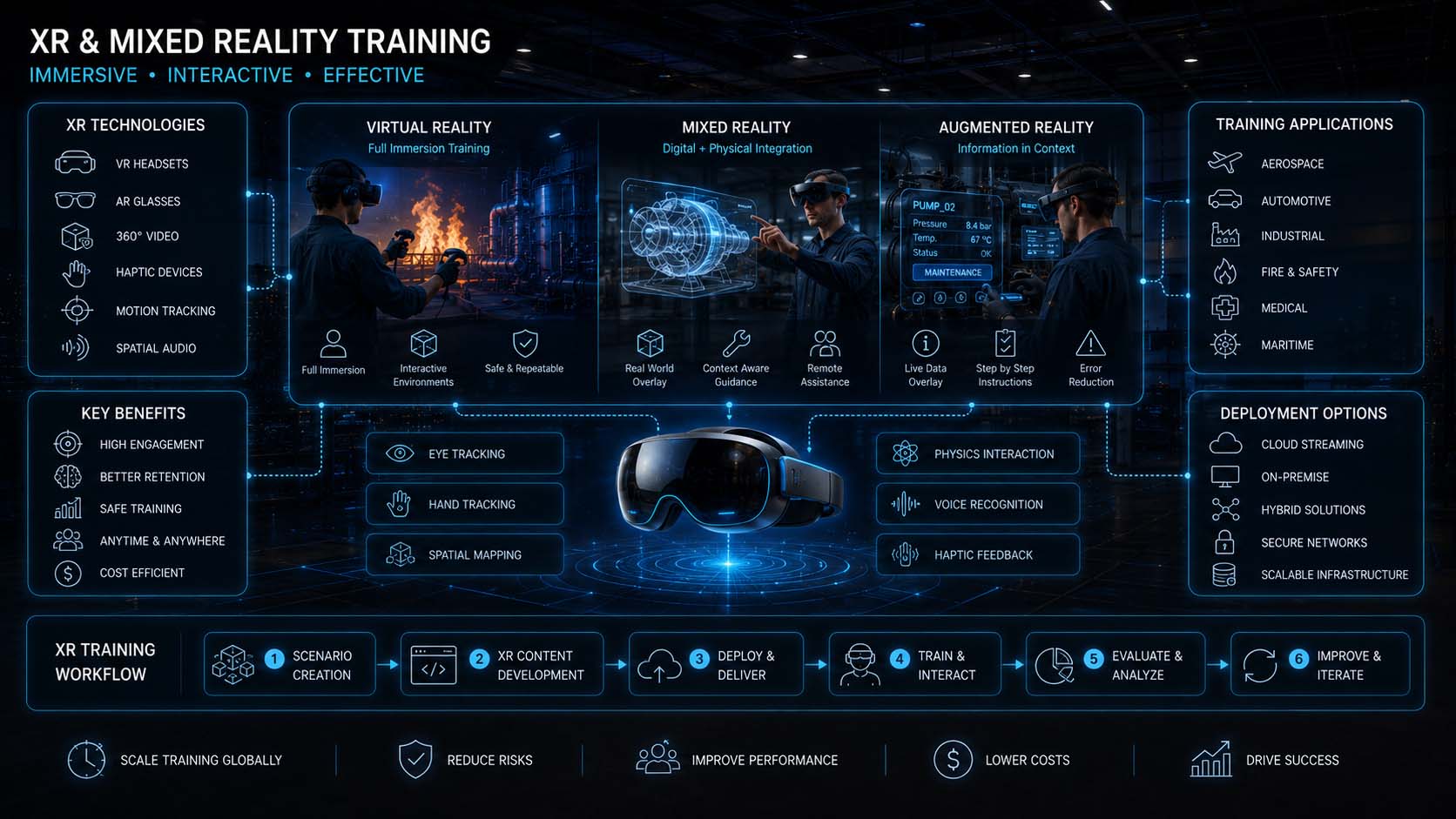
Mixed Reality and Spatial Computing as the Next Training Platform
The availability of modern XR hardware is fundamentally changing how training simulations can be used. While traditional simulators often depended on dedicated facilities, projection systems, or permanently installed hardware, Mixed Reality and Spatial Computing enable far more flexible deployment scenarios. As a result, training environments can move much closer to real workplaces, production facilities, and educational institutions.[17]
Modern headsets combine digital content with the real environment. Machines, workflows, and technical processes appear directly within the user’s field of view and can be explored interactively. This creates training environments that merge real situations with digital information, making complex content easier to understand.[18]
This development becomes especially interesting through the combination of Spatial Computing, real time 3D, and digital twins. Virtual objects can be displayed with accurate spatial positioning within real environments. Users move freely through physical space and interact directly with digital models. This creates learning environments that feel significantly more intuitive than traditional screen based applications.[19]
The visualization shows how digital twins, XR hardware, and Spatial Computing merge into a new generation of immersive training environments.
Visualization: Spatial Computing, Mixed Reality, digital twins, real time 3D content, and interactive training scenarios | Image: © Ulrich Buckenlei | VISORIC GmbH
The image in this chapter demonstrates how digital information can become directly visible within real environments. Machines, data, and work processes no longer appear on separate screens but become part of the surrounding space. This creates a more natural relationship between learning, working, and interaction.
For companies and educational institutions, this offers substantial advantages. Training can be conducted independently of location. Expensive dedicated facilities become partially unnecessary. At the same time, complex technical content can be visualized and communicated far more effectively. Small and medium sized businesses particularly benefit from the fact that professional XR hardware is now significantly more affordable than previous simulation systems.[20]
The Munich based VISORIC expert team is also actively exploring the integration of Spatial Computing, real time 3D, and digital twins into industrial learning environments. The greatest potential emerges where real processes and digital content are intelligently connected.
- Mixed Reality combines real and digital training environments
- Spatial Computing makes complex content spatially understandable
- Digital twins become visible directly within working environments
- XR hardware reduces infrastructure requirements and entry costs
- Training can take place more flexibly and closer to real processes
Yet even the most advanced XR hardware delivers its full value only when real machines, facilities, and work environments are available as digital models for training purposes.
Digital Twins for Industrial Training Environments
Modern training simulations benefit enormously from digital twins of real machines, facilities, and production environments. Instead of creating abstract training worlds, real workplaces can increasingly be replicated virtually and used for training purposes. This establishes a direct connection between training and everyday operational activities.[21]
Digital twins make it possible to represent processes, machine states, and technical workflows in real time. Employees can train maintenance procedures, commissioning operations, or fault scenarios without putting actual equipment at risk. At the same time, situations that rarely occur in practice but still require training can be safely simulated.[22]
This development becomes especially interesting through the growing availability of industrial data models. Many companies already possess CAD data, process information, and digital documentation. These resources can now be integrated into simulation platforms much more easily than just a few years ago. As a result, the costs of creating professional training environments are significantly reduced.[23]
The visualization shows how real machines and processes can be used as digital twins for immersive training and technical education.
Visualization: Industrial digital twins, technical training, real time data, XR training environments, and virtual commissioning | Image: © Ulrich Buckenlei | VISORIC GmbH
The image in this chapter highlights the transition from real facilities to digital training models. Machines, processes, and technical systems are not only visualized but transformed into interactive learning environments. This creates a level of training quality closely aligned with real operational workflows.
For companies, this means greater safety, reduced downtime, and more efficient training processes. Employees can practice procedures before working on real systems. Errors can be identified early. Knowledge can be transferred and standardized more effectively. In times of increasing complexity, this approach is becoming more important than ever.[24]
The combination of digital twins, real time 3D, and XR hardware makes industrial training environments more accessible today than ever before. What was once considered a large scale project is increasingly becoming an economically viable solution for organizations of all sizes.
- Digital twins enable realistic technical training
- Existing company data can be utilized directly
- Errors and risks can be simulated safely
- Training aligns closely with real processes and facilities
- Immersive learning environments become more economical and flexible
This potential becomes particularly impressive in safety critical training scenarios where real world exercises would be expensive, dangerous, or highly resource intensive.
High Angle Rescue and Technical Emergency Response Simulation
Safety critical training is one of the areas where immersive simulations can deliver particularly significant value. High angle rescue, industrial rope access, and technical emergency response scenarios can only be trained in reality with substantial effort, strict safety measures, and limited repeatability. Modern simulation systems introduce a new approach by combining real equipment with digital environments.[25]
At the center of this approach are physical training setups combined with tracking, projection systems, real time 3D, and artificial intelligence. A rescue worker can train on a real rope system while the environment is digitally represented as a cliff face, industrial facility, wind turbine, or emergency response scenario. This ensures that the physical actions remain real while the surrounding environment can be flexibly simulated.[26]
Particularly interesting is the integration of motion tracking, scenario management, and training analytics. Position, speed, load, reaction time, and errors can be analyzed. The system recognizes how participants behave within the scenario and can generate feedback for trainers, instructors, and learners.
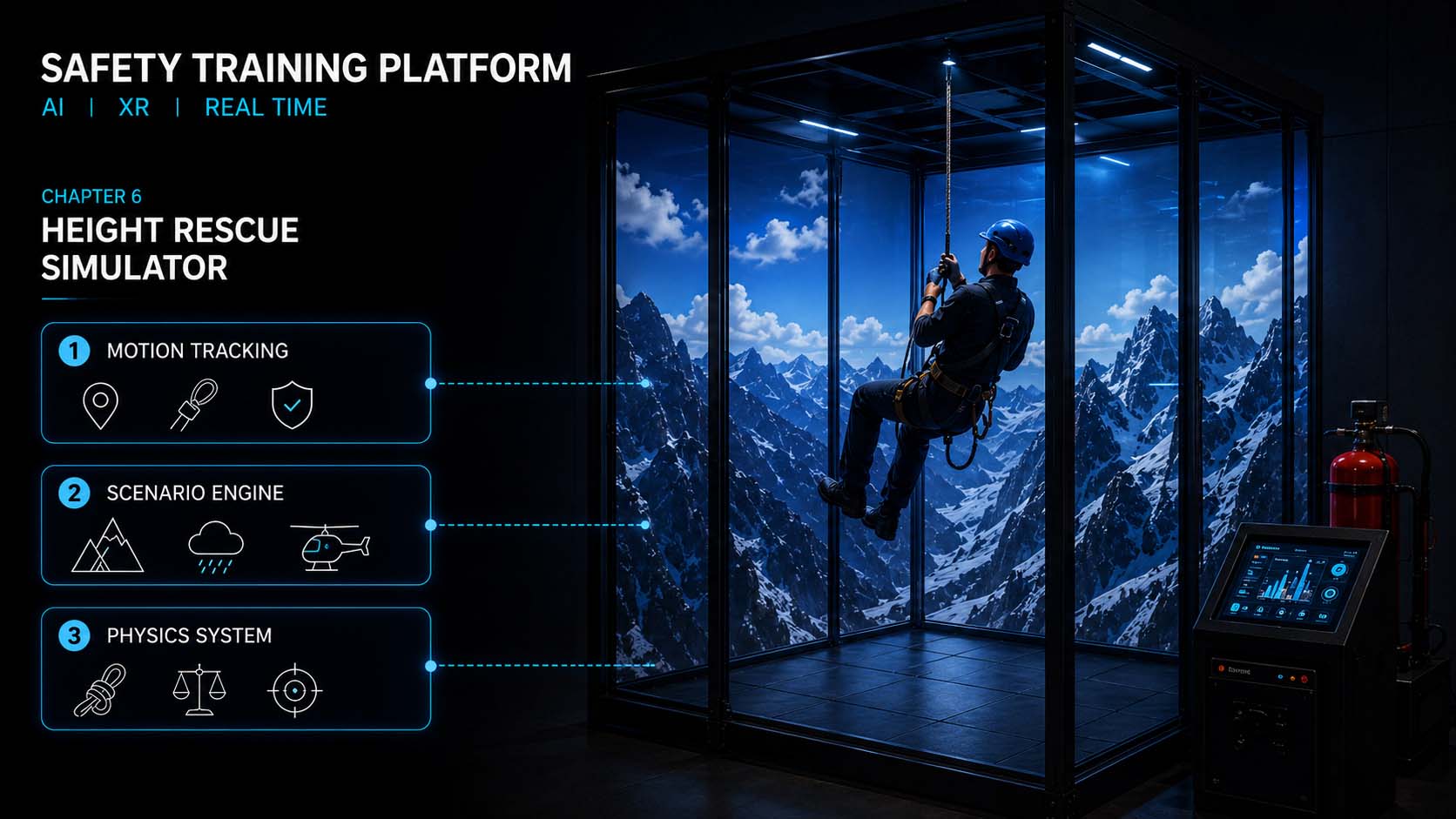
The visualization shows an immersive high angle rescue simulation where real rope equipment, motion tracking, and digital emergency scenarios are combined into a safe training environment.
Visualization: High angle rescue training with a real rope system, motion tracking, digital operational environments, real time 3D, and AI powered training analytics | Image: © Ulrich Buckenlei | VISORIC GmbH
The image in this chapter demonstrates how a physical training setup can be enhanced through digital layers. Real equipment provides physical feedback, load perception, and operational procedures. The digital environment creates different scenarios, weather conditions, height effects, and emergency situations. It is precisely this combination that makes training more realistic without requiring dangerous situations to be recreated in reality.
This creates new opportunities for fire departments, rescue services, energy companies, industrial organizations, and educational institutions. Challenging situations can be safely repeated. Different experience levels can be accommodated. Training becomes measurable and documentable. At the same time, effort is reduced because scenarios can be modified digitally instead of requiring entirely new physical training structures.[27]
This approach is also becoming increasingly interesting for small and medium sized businesses. Not every organization requires a large dedicated training facility. In many cases, a modular setup that combines real equipment with digital simulation is sufficient. The Munich based VISORIC expert team therefore views such applications not as isolated specialist solutions, but as examples of how immersive training platforms can now be designed far more flexibly.
- Real equipment is combined with digital emergency response scenarios
- Motion tracking makes movements and reactions measurable
- Dangerous situations can be safely repeated
- Digital scenarios reduce effort and training costs
- Rescue and safety training become more scalable and flexible
This advantage becomes particularly evident in industrial hazard scenarios where real fire, smoke, or equipment failures are difficult, risky, and expensive to train in reality.
Fire Safety Training with Digital Twins and Real Time Simulation
Industrial fire protection and safety training provide another example of how modern simulation technologies can make real risks easier to train. In traditional training programs, hazardous situations can often only be recreated to a limited extent. Real fire, smoke development, technical malfunctions, and complex industrial environments are expensive, time consuming, and cannot be repeated indefinitely.[29]
Digital twins and real time simulations create new possibilities. An industrial facility can be replicated virtually while fire events, smoke propagation, alarm conditions, and operator errors are digitally simulated. Participants train their responses in a realistic environment without endangering actual facilities or creating safety risks.[30]
The integration of sensor based training devices is particularly exciting. A specially equipped fire extinguisher can record position, angle, distance, and duration of use. The system determines whether the response was correct, whether the fire source was properly targeted, and how quickly the situation was brought under control. This transforms a simple exercise into a measurable training simulation.
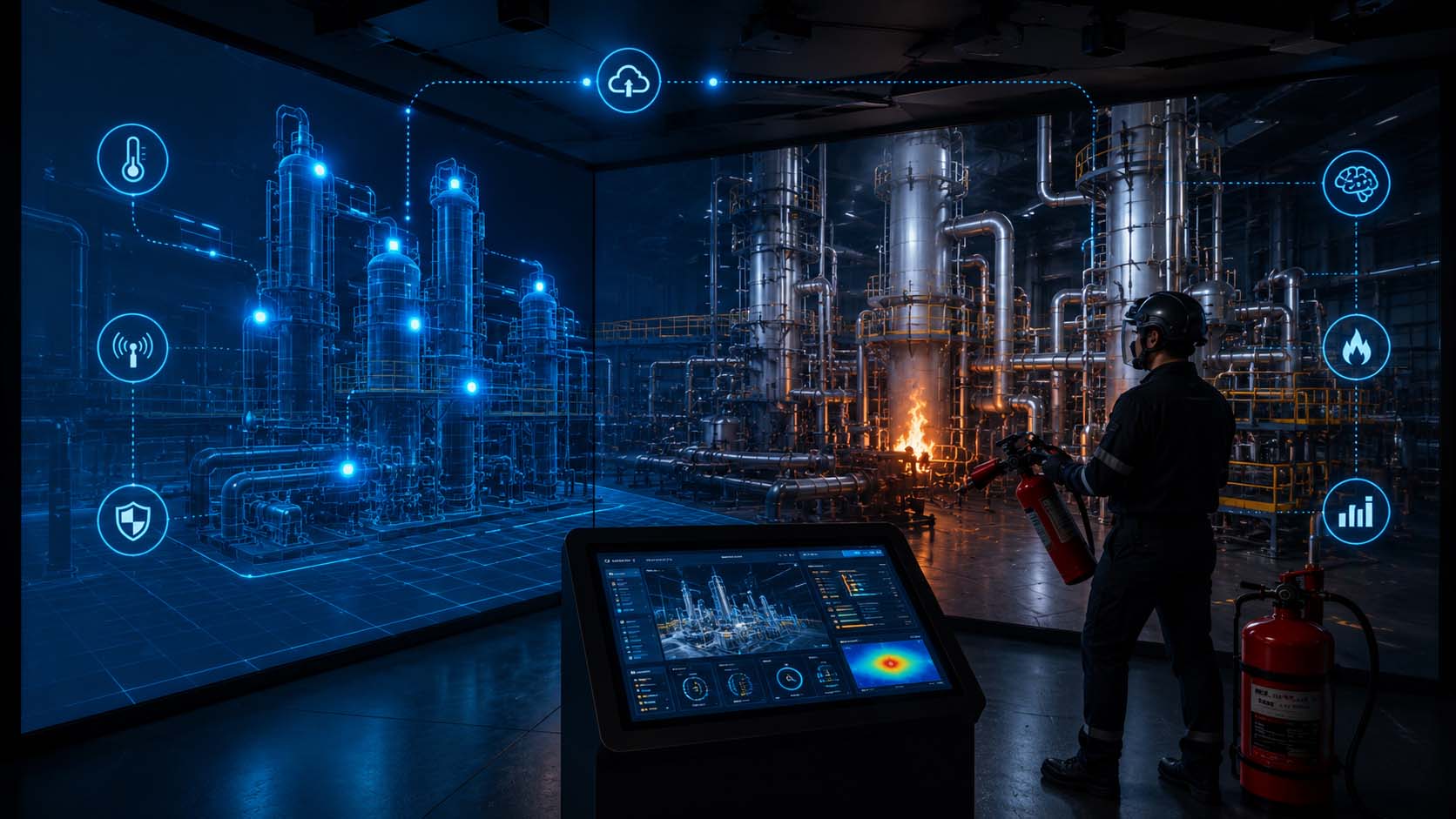
The visualization shows an industrial fire safety training environment where a digital twin, simulated hazard scenarios, and a sensor equipped fire extinguisher are combined into a measurable training platform.
Visualization: Industrial fire safety simulation with a digital twin, real time 3D, sensor equipped fire extinguisher, hazard scenarios, and training analytics | Image: © Ulrich Buckenlei | VISORIC GmbH
The image in this chapter illustrates how real and digital elements can work together. The industrial facility remains recognizable as a physical or digitally recreated training space. Overlaid on top is a digital twin with sensor points, hazard zones, and simulation logic. Fire is not generated as a real hazard but appears as a controlled digital event within a training environment.
This creates new training opportunities for industries such as manufacturing, chemicals, energy, logistics, and facility management. Employees can experience critical situations more realistically without creating actual hazards. At the same time, procedures become measurable, comparable, and repeatable. This improves not only training quality but also the traceability and documentation of training measures.[31]
From an economic perspective, this approach is particularly attractive because it makes training scalable. A digital hazard scenario can be modified, expanded, and adapted to different locations. Companies no longer need to physically rebuild every scenario. This clearly demonstrates why AI, digital twins, and real time platforms are making professional training simulations increasingly affordable.
- Hazard situations are digitally simulated rather than physically created
- Digital twins realistically replicate industrial facilities and processes
- Sensor based training devices make responses measurable
- Fire safety and safety training become repeatable and analyzable
- Organizations can adapt scenarios more quickly to locations and processes
The true strength of modern simulation systems, however, does not lie in individual applications. The key question is whether different forms of training can be combined on a shared platform.
When Training Systems Become a Unified Platform
Many immersive training solutions are still developed today as individual applications. A flight simulator, driving simulator, rescue simulation, or fire safety training system is often considered separately. The next stage of development lies in shared platforms that connect different training environments, digital twins, AI capabilities, and analytics systems.[33]
This fundamentally changes the economic logic of professional simulations. Companies no longer need to develop entirely new systems for every training requirement. Instead, existing modules, data, interaction logic, and analytics capabilities can be reused. A platform can provide different scenarios and be expanded step by step.[34]
This is especially relevant for small and medium sized businesses and educational institutions. They often do not require large standalone facilities but rather flexible training environments that can grow alongside their needs. Modern simulation platforms enable exactly this type of entry point. Small pilot projects can later evolve into comprehensive learning systems.
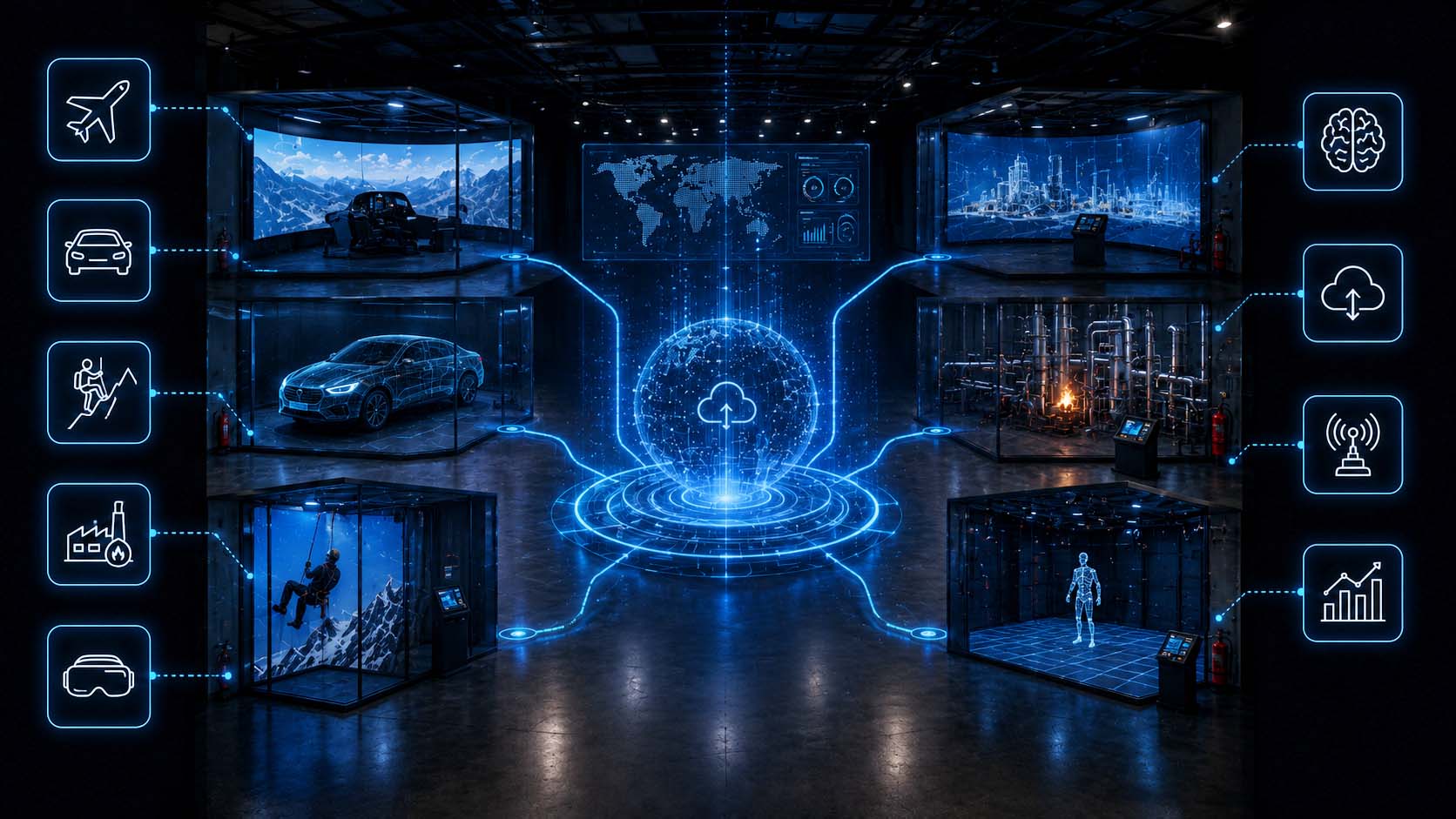
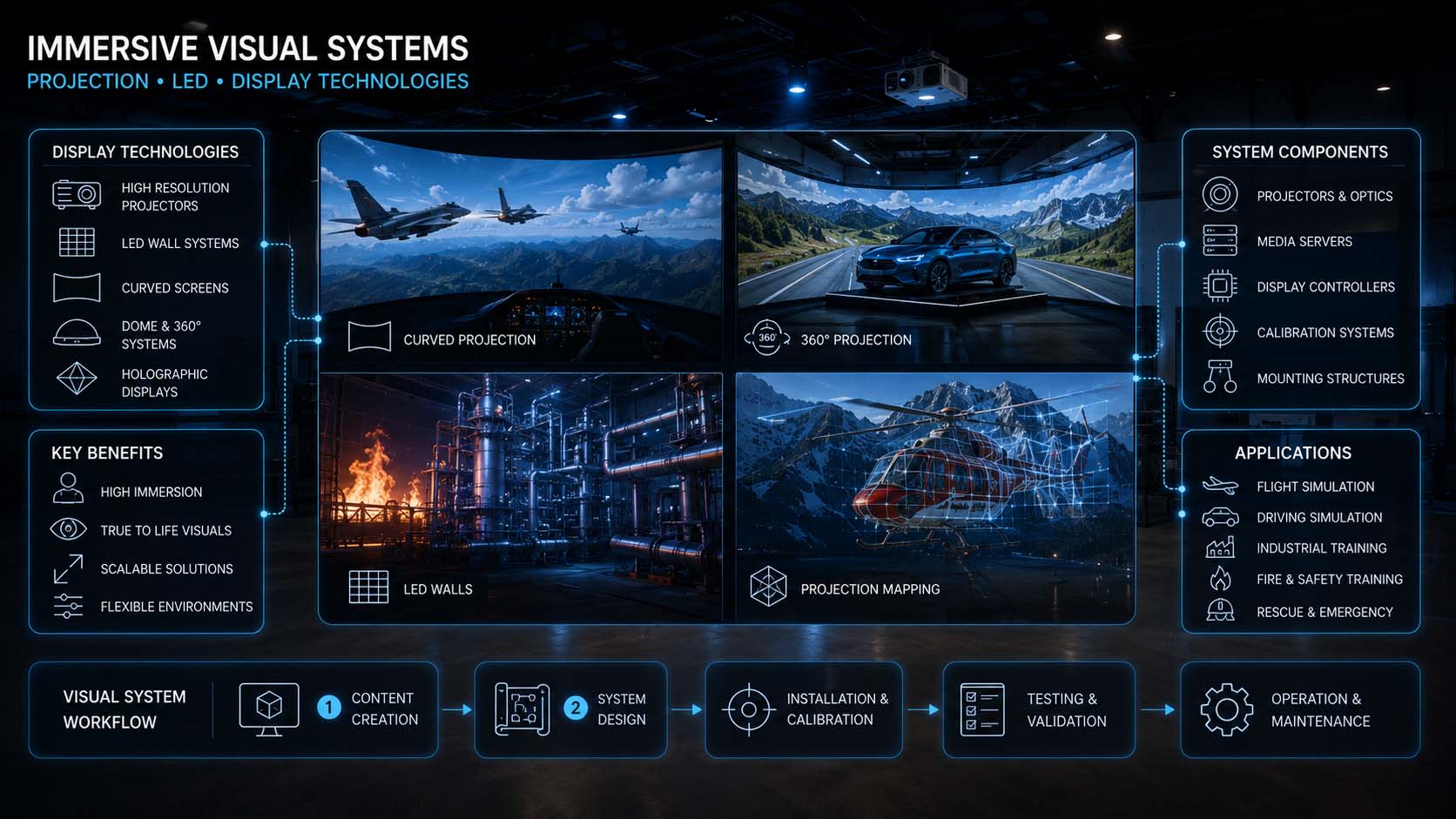
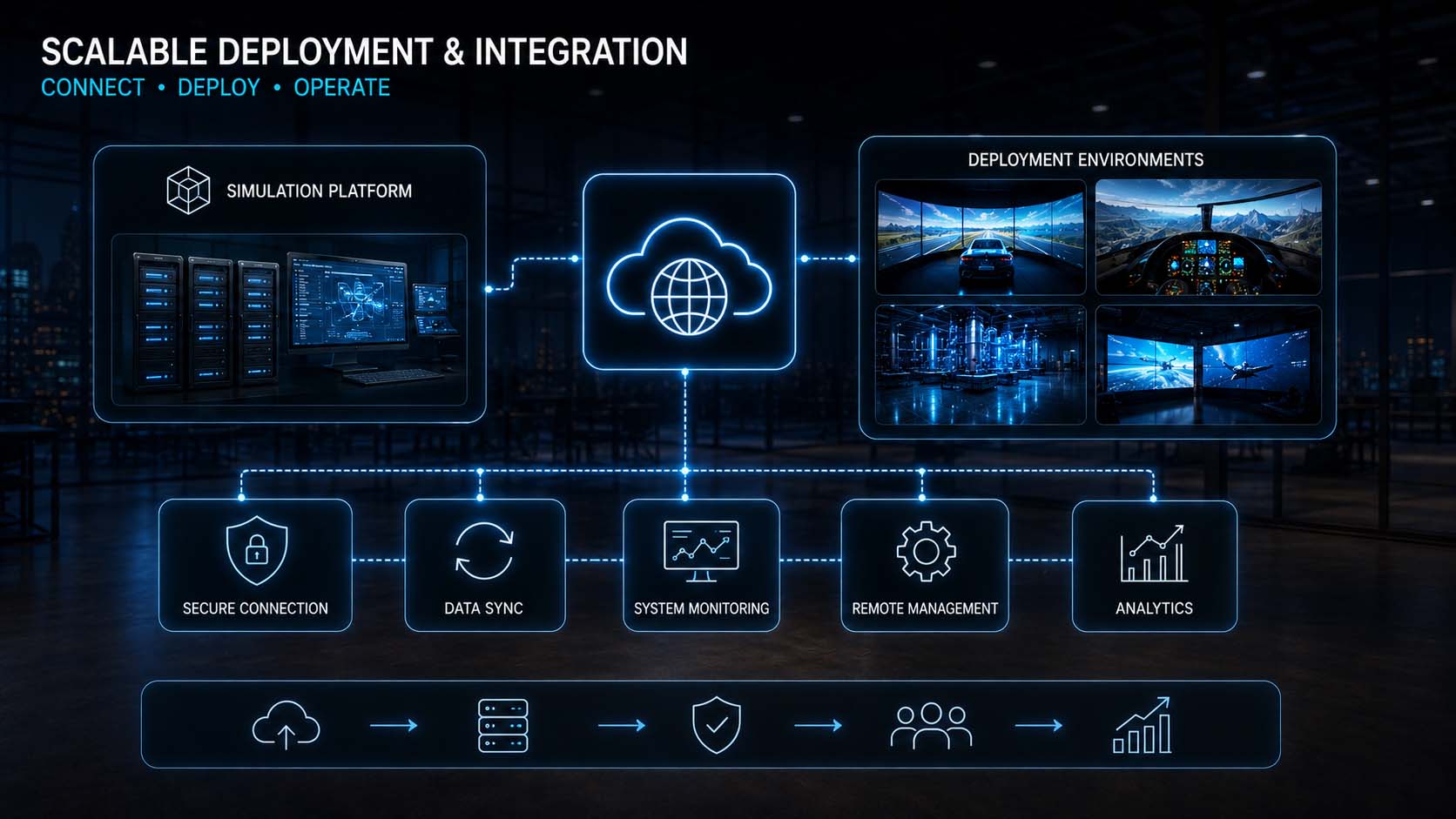
The visualization shows a connected training platform where different simulation domains are linked through AI, digital twins, real time data, and analytics capabilities.
Visualization: Unified XR training platform with flight simulation, rescue training, fire safety simulation, digital twins, AI analytics, and scalable real time 3D modules | Image: © Ulrich Buckenlei | VISORIC GmbH
The image in this chapter presents different training modules not as isolated exhibits but as parts of a shared system. Flight simulation, driving training, rescue operations, industrial training, and Mixed Reality applications are connected through data streams, analytics capabilities, and a central platform architecture. This creates a completely new understanding of simulation.
For organizations, this opens new possibilities in knowledge management. Training data can be analyzed, learning progress compared, and content continuously improved. AI can identify patterns, recommend personalized learning paths, and automatically adapt scenarios. As a result, training systems evolve from simple practice environments into intelligent learning platforms.[35]
For the Munich based VISORIC expert team, this platform approach is also central. The key question is not whether a simulation looks impressive. The key question is whether it can be used long term, expanded over time, and integrated meaningfully into existing processes. This is the difference between a standalone demonstration and a professional training solution.
- Different training modules evolve into a unified platform
- AI analytics make learning progress and training quality measurable
- Digital twins connect real processes with virtual scenarios
- Modular systems enable cost effective entry scenarios
- Training platforms can grow alongside organizational requirements
The future of professional training simulations therefore lies not only in better graphics or new hardware. The real value comes from combining AI, digital twins, real time 3D, and scalable platforms that make immersive learning environments accessible to an ever growing number of organizations.
When Technology Makes Exceptional Learning Experiences Accessible to Everyone
The development of modern training simulations demonstrates how artificial intelligence, XR hardware, digital twins, and real time 3D are redefining the boundaries of traditional education and training. What once required large training centers, specialized facilities, or substantial investments can now increasingly be implemented through flexible and scalable simulation environments.
This applies equally to flight simulations, rescue training, industrial safety programs, and technical education initiatives. Modern projection systems, powerful real time platforms, and AI powered analytics make it possible to train complex scenarios more realistically, more safely, and more economically.
The following video illustrates this evolution through examples of modern simulation environments. It demonstrates how immersive technologies create exceptional learning experiences and make professional training environments significantly more accessible for companies, educational institutions, and ambitious learners.
Video Source: @f16simexperience | Analysis, technology assessment, storyline, and editorial work: © Ulrich Buckenlei | XR Stager Online Magazine | VISORIC GmbH
The true innovation does not lie solely in graphics quality or increasingly powerful hardware. What matters is the ability to combine real processes, physical interactions, and digital twins into a shared learning environment. This creates training platforms that can be expanded flexibly, adapted individually, and utilized over the long term.
For industrial companies, educational institutions, and SMEs, this opens entirely new perspectives. Training becomes repeatable, measurable, and less dependent on physical location. At the same time, development effort and operating costs decrease because scenarios can be expanded and adapted digitally rather than requiring new physical training environments for every requirement.
The role of artificial intelligence is particularly important. AI can analyze learning progress, personalize training content, identify mistakes, and generate individual recommendations. Combined with digital twins, this creates a new generation of intelligent learning platforms capable of continuously adapting to users and organizations.
The Munich based VISORIC expert team has spent many years working at the intersection of real time 3D, XR technologies, simulation platforms, and digital twins. Wherever organizations seek to communicate complex processes more clearly, improve safety, or scale knowledge efficiently, new opportunities are emerging that would have been economically difficult to realize only a few years ago.
- AI reduces development effort and increases the adaptability of training systems
- Digital twins make real processes safely and realistically trainable
- XR and real time 3D enable professional level immersive learning experiences
- Modular platforms make training solutions accessible to SMEs and educational institutions
- Exceptional learning experiences are becoming available to a much broader audience
The future of professional training simulations will therefore not be determined by new hardware alone. What truly matters is the interaction between artificial intelligence, digital twins, real time platforms, and immersive technologies. Together, they make high quality training environments more economical, more scalable, and accessible to an ever growing number of people.
From Simulation to Scalable Learning Platform
The development of modern training simulations shows that immersive learning environments are no longer reserved exclusively for large corporations or specialized training centers. Artificial intelligence, digital twins, powerful XR hardware, and real time 3D platforms reduce development effort, increase flexibility, and make professional simulation solutions economically feasible for an increasing number of companies.
This development becomes particularly interesting where training systems are not viewed as individual applications, but as scalable platforms. Flight training, safety training, technical education, maintenance processes, rescue scenarios, and industrial training can be built on shared technological foundations and continuously expanded. This creates learning environments that can be used long term, adapted flexibly, and operated economically.
At exactly this intersection, the Munich based VISORIC expert team develops individual concepts, digital twins, XR training platforms, and real time 3D applications for industry, educational institutions, and SMEs. The focus is on solutions that communicate complex content clearly, make training processes measurable, and at the same time enable a high level of economic efficiency.
The VISORIC expert team develops digital twins, XR training platforms, real time 3D applications, and AI powered simulation systems for industry, education, and technical training.
Visualization: Scalable XR training platform with digital twins, real time 3D visualization, AI powered analytics, and immersive learning environments | © VISORIC GmbH | Munich
From technical training and safety and rescue simulations to complex industrial processes, new generations of digital learning environments are currently emerging. Companies are increasingly looking for ways to communicate knowledge more efficiently, reduce risks, and make training available worldwide. This is exactly where AI, digital twins, and immersive technologies unfold their greatest potential.
VISORIC supports companies from the initial concept phase through feasibility analyses and prototyping to the development of market ready platforms. This includes digital twins, real time 3D visualization, XR training systems, AI integration, data connectivity, simulation logic, and interactive user experiences.
As a result, the future of professional training is becoming not only more immersive. It is becoming more flexible, more measurable, and significantly more accessible. This is where the most exciting fields of innovation emerge for companies, educational institutions, and organizations that want to communicate knowledge efficiently and prepare their employees for future challenges.
Are you planning an XR training platform, a digital twin, a simulation environment, or an AI powered learning application?
Talk to the Munich based VISORIC expert team about concept development, feasibility analyses, prototyping, and technical implementation.
Contact us:
Email: info@visoric.com
Phone: +49 89 21552678
Address: Bayerstr. 13, 80335 Munich
Sources and References
- World Economic Forum, Future of Jobs Report, professional development and digital qualification in the world of work.
- PwC, Seeing Is Believing, economic impact of virtual reality and immersive learning environments.
- Deloitte Insights, immersive learning and digital transformation of training processes.
- McKinsey & Company, workforce development and digital qualification strategies.
- PwC VR Training Study, study on the effectiveness of immersive training environments.
- Accenture, Future Workforce Research and digital professional development.
- World Economic Forum, future skills and skills development.
- OpenAI Research, generative AI for knowledge transfer and intelligent assistance systems.
- Stanford Human Centered AI Institute, AI powered learning systems and adaptive assistance.
- MIT CSAIL, research on automation and intelligent development processes.
- Digital Twin Consortium, fundamentals of modern digital twin architectures.
- NVIDIA Omniverse Digital Twins, industrial real time simulations and virtual facility models.
- Gartner Research, digital twins as a key technology of industrial transformation.
- Apple Vision Pro, Spatial Computing and immersive visualization.
- Meta Quest for Business, XR hardware for education and professional qualification.
- Varjo Technologies, high resolution XR systems for professional training simulations.
- Siemens Digital Industries Software, digital twins for education, maintenance, and operations.
- IEEE VR Training Research, virtual training environments for industry and technology.
- ACM Digital Library, serious games and industrial learning simulations.
- CAE Inc., professional simulation systems for education and training.
- Microsoft Mixed Reality, industrial XR applications and training systems.
- Accenture Industrial Metaverse Research, immersive work and training environments.
- Fraunhofer IAO, XR technologies for safety training and professional development.
- Bitkom Research, use of immersive technologies in companies.
- McKinsey Digital Operations Research, productivity and safety through digital technologies.
- MIT Media Lab, adaptive learning environments and intelligent training systems.
- Stanford HCI Group, user centered learning platforms and human machine interaction.
- ACM Intelligent Learning Environments Research, intelligent education and training platforms.
- Original video material by @f16simexperience.
- NVIDIA Omniverse, real time visualization and simulation platforms.
- Unreal Engine, real time 3D for simulation, training, and digital twins.
- VISORIC practical projects in the fields of XR, real time 3D, and digital twins.
- Unreal Engine Enterprise, technical foundation of modern simulation platforms.
- NVIDIA Omniverse Enterprise, scalable digital twin and simulation environments.
Contact Us:
Email: info@xrstager.com
Phone: +49 89 21552678
Contact Persons:
Ulrich Buckenlei (Creative Director)
Mobil +49 152 53532871
Mail: ulrich.buckenlei@xrstager.com
Nataliya Daniltseva (Projekt Manager)
Mobil + 49 176 72805705
Mail: nataliya.daniltseva@xrstager.com
Address:
VISORIC GmbH
Bayerstraße 13
D-80335 Munich