
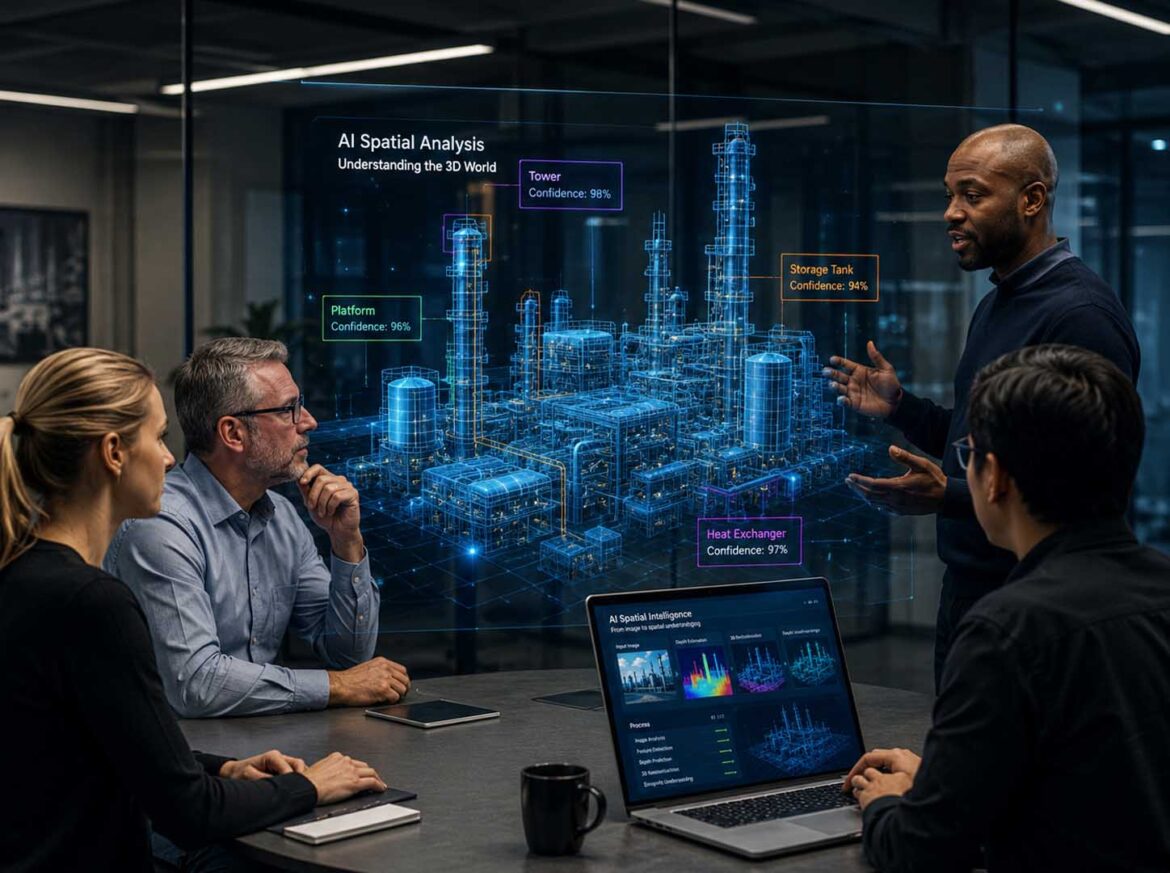
People, products and digital twins are becoming a shared platform for spatial communication.
Visualization: Spatial communication, Spatial Computing, digital presence, digital twins and immersive collaboration | Image: © Ulrich Buckenlei | VISORIC GmbH
Digital communication is moving beyond the screen. What was once primarily delivered through flat displays, video windows, presentations or traditional user interfaces is evolving into spatially immersive experiences. In the future, people, products, data and digital twins can be represented in ways that make them not only visible but seemingly physically present.
This development is far more than a new visual effect. It is transforming the way people work, learn, present ideas and make decisions. When digital content becomes spatial, a new form of communication emerges in which information is no longer simply viewed but experienced and understood together.[1]
This transformation is particularly evident in new forms of 3D telepresence, Spatial Computing and immersive collaboration. Technologies such as realistic spatial video communication, holographic visualization, XR applications and digital twins demonstrate that digital presence can move significantly closer to real-world interactions.[2]
For businesses, this creates new opportunities in sales, service, training, architecture, industry, education and entertainment. Products can be explained spatially, machines can be analyzed collaboratively, remote experts can participate naturally, and complex relationships can be communicated more intuitively. The real innovation does not lie in a single device but in the combination of 3D content, real-time data, artificial intelligence and spatial visualization.
Digital twins play a central role in this transformation. They make real-world objects, facilities, spaces and processes digitally accessible and can be integrated into new communication environments through Spatial Computing. As a result, they become more than technical models—they evolve into tools for shared understanding, decision-making and collaboration.
- Digital communication is evolving from flat displays to spatial presence.
- People, products and digital twins become immersive three-dimensional experiences.
- Spatial Computing enables entirely new forms of collaboration and interaction.
- Artificial intelligence enriches digital content with context and understanding.
- Businesses can communicate complex information more clearly and effectively.
This marks the beginning of a new era in digital communication. The key question is no longer simply how information is displayed, but how it can become spatially immersive and collaboratively accessible.
When Digital Communication Moves Beyond the Screen
For decades, digital communication has been based primarily on two-dimensional representations. Video conferences, presentations, product visualizations and digital training have become increasingly sophisticated, yet they remain constrained by the logic of flat displays. People, objects and data appear on a surface, even though many subjects are inherently spatial and should be understood in three dimensions.[3]
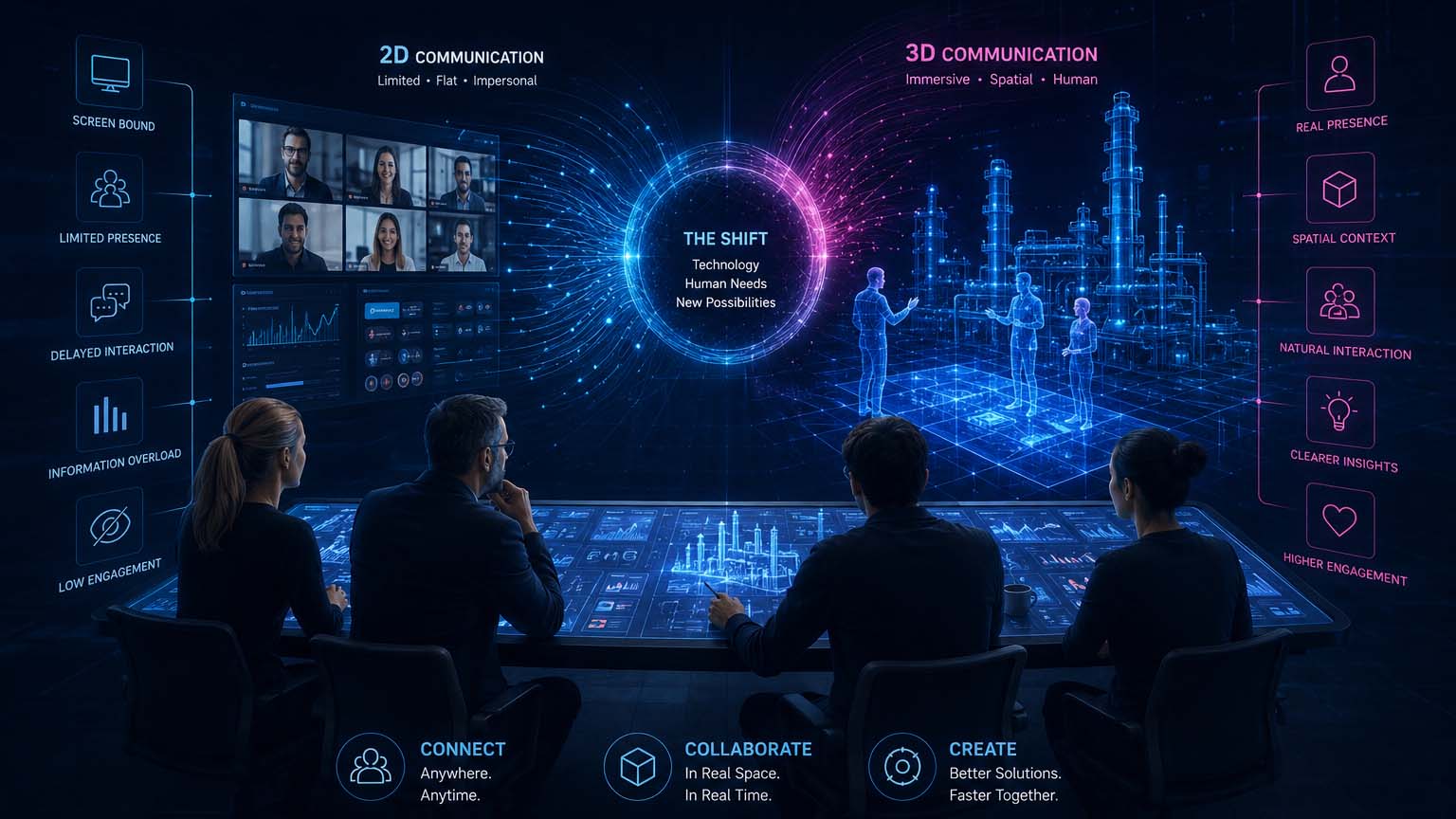
The transition from traditional screen-based communication to spatial digital collaboration.
Visualization: Spatial communication, Spatial Computing, digital twins, holographic content and immersive collaboration | Image: © Ulrich Buckenlei | VISORIC GmbH
With real-time 3D, artificial intelligence, Spatial Computing and new display technologies, this principle is beginning to change fundamentally. Digital content is increasingly breaking free from the screen and becoming spatially perceivable. A product can appear in the room, an expert can join remotely, and a digital twin can be viewed, analyzed and modified collaboratively.[4]
As a result, not only the presentation of information changes, but communication itself. Individual screens evolve into shared digital environments where people, objects and data exist within the same spatial context. Complex topics become easier to understand, more engaging and more intuitive.
For businesses, this development is particularly significant. Sales teams can present products spatially, service engineers can analyze equipment together with remote experts, training becomes more realistic, and planning processes can be explained directly using digital twins. Communication becomes not only more visual but also more practical and action-oriented.
The real strength emerges when spatial visualization is combined with intelligent data. A digital twin no longer represents only an object but also its conditions, relationships, processes and possible actions. Artificial intelligence can interpret, prioritize and present this information in ways that are meaningful for different users.
This creates an entirely new communication platform for businesses. The focus shifts away from files, images or presentations toward a shared spatial information environment. This is where Spatial Computing, digital twins, AI and immersive media converge into a new form of digital collaboration.
- Digital communication is increasingly moving beyond flat screens.
- Spatial content makes complex topics easier to understand.
- Digital twins become shared communication and collaboration models.
- AI helps organize data, context and recommendations into understandable insights.
- Businesses benefit across sales, service, training, planning and collaboration.
This transformation becomes particularly exciting when digital twins do more than visualize information—they begin to make real-world objects, processes and relationships intelligently understandable.
When Digital Presence Feels Real
Digital communication becomes truly powerful when people, products and technical systems no longer appear simply as images on a display but feel spatially present. This is where a new quality of digital collaboration emerges: content is no longer just viewed but experienced as a shared spatial reality.[5]
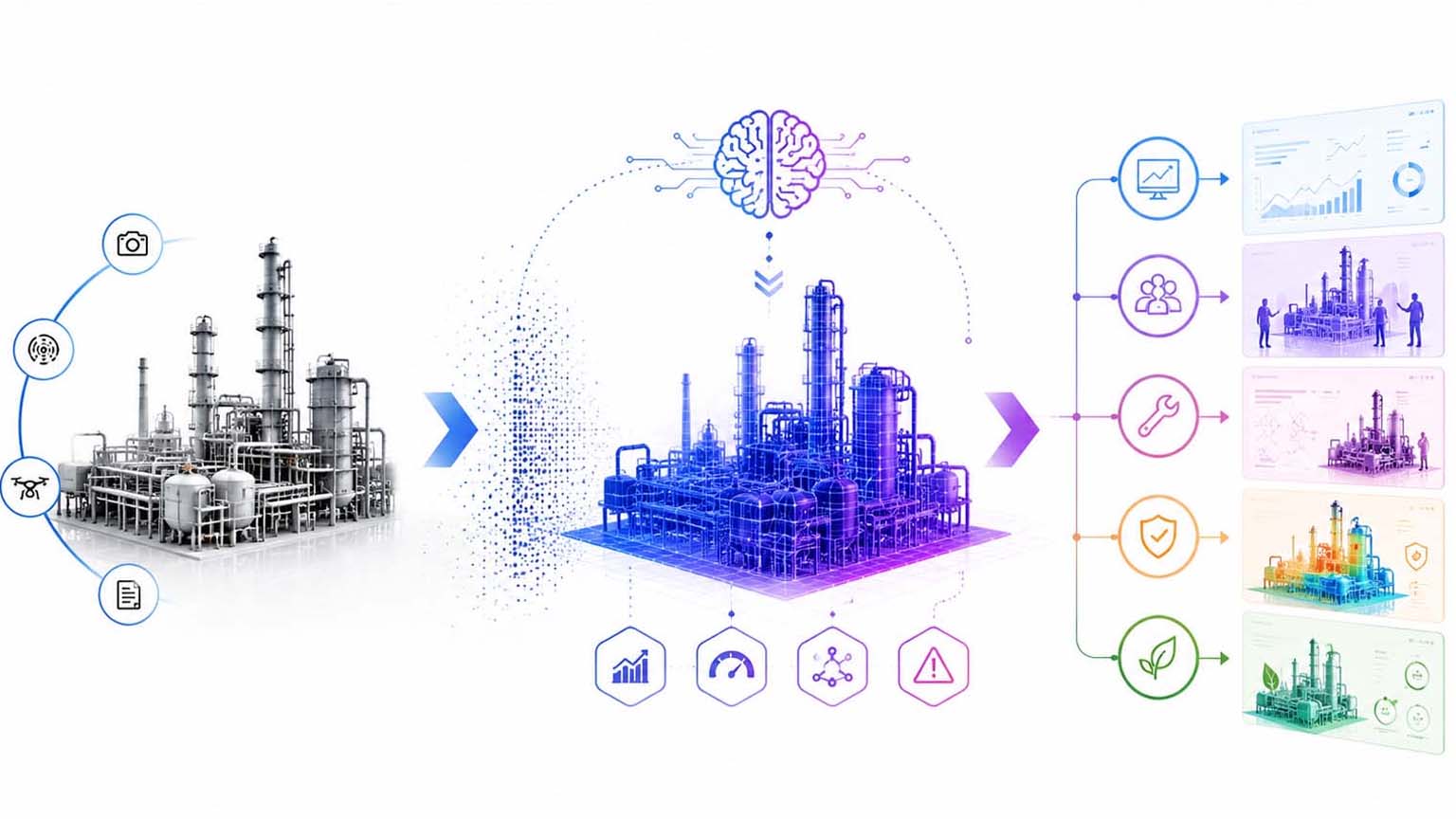
An intelligent digital twin combines 3D capture, sensor data and artificial intelligence into a shared decision-making platform.
Visualization: Digital twins, 3D capture, sensors, Spatial Computing and artificial intelligence | Image: © Ulrich Buckenlei | VISORIC GmbH
Technologies such as spatial video communication, digital avatars and immersive telepresence illustrate the future direction of digital communication. People will be able to interact far more naturally, even when they are located in different places. The key factor is not only the visual image but the perception of spatial presence, eye contact, depth and shared orientation.[6]
For businesses, this concept is especially relevant because many tasks cannot be explained effectively through spoken language or two-dimensional images alone. Machines, products, spaces and processes all have spatial relationships. Understanding them requires recognizing scale, position, movement and context. Three-dimensional presence makes this information significantly more tangible.
Digital twins extend this principle even further. They make physical assets available as interactive models connected with data, contextual information and analytical capabilities. This creates a new form of communication between people, machines and digital systems. Teams can move beyond simply discussing an asset to collaborating within the same shared spatial information environment.
This evolution becomes even more powerful when artificial intelligence is added. AI can recognize objects, interpret conditions, summarize data and prepare relevant information for different users. As a result, a digital model evolves into an intelligent communication environment capable of answering questions, explaining relationships and supporting decision-making.
For sales, service, training, planning and industrial collaboration, this development opens entirely new possibilities. Products can be presented more realistically, equipment can be explained more clearly, and expert knowledge becomes spatially accessible. Digital presence is no longer just a communication tool—it becomes the foundation for new ways of working.
- Digital presence makes people, products and facilities spatially immersive.
- Spatial communication provides depth, orientation and context.
- Digital twins combine 3D models with data and analytical capabilities.
- AI identifies, organizes and explains relevant information.
- Businesses gain new opportunities for presentations, service, training and collaboration.
The next step is for digital twins to become more than visible—they will begin to understand relationships, meaning and context.
New Opportunities for Business and Society
The third dimension of digital communication is transforming more than the way people communicate. It is also creating new opportunities for businesses, public institutions and entire industries. Spatial digital content is increasingly evolving into a shared platform for collaboration, planning, service, education and innovation.[7]
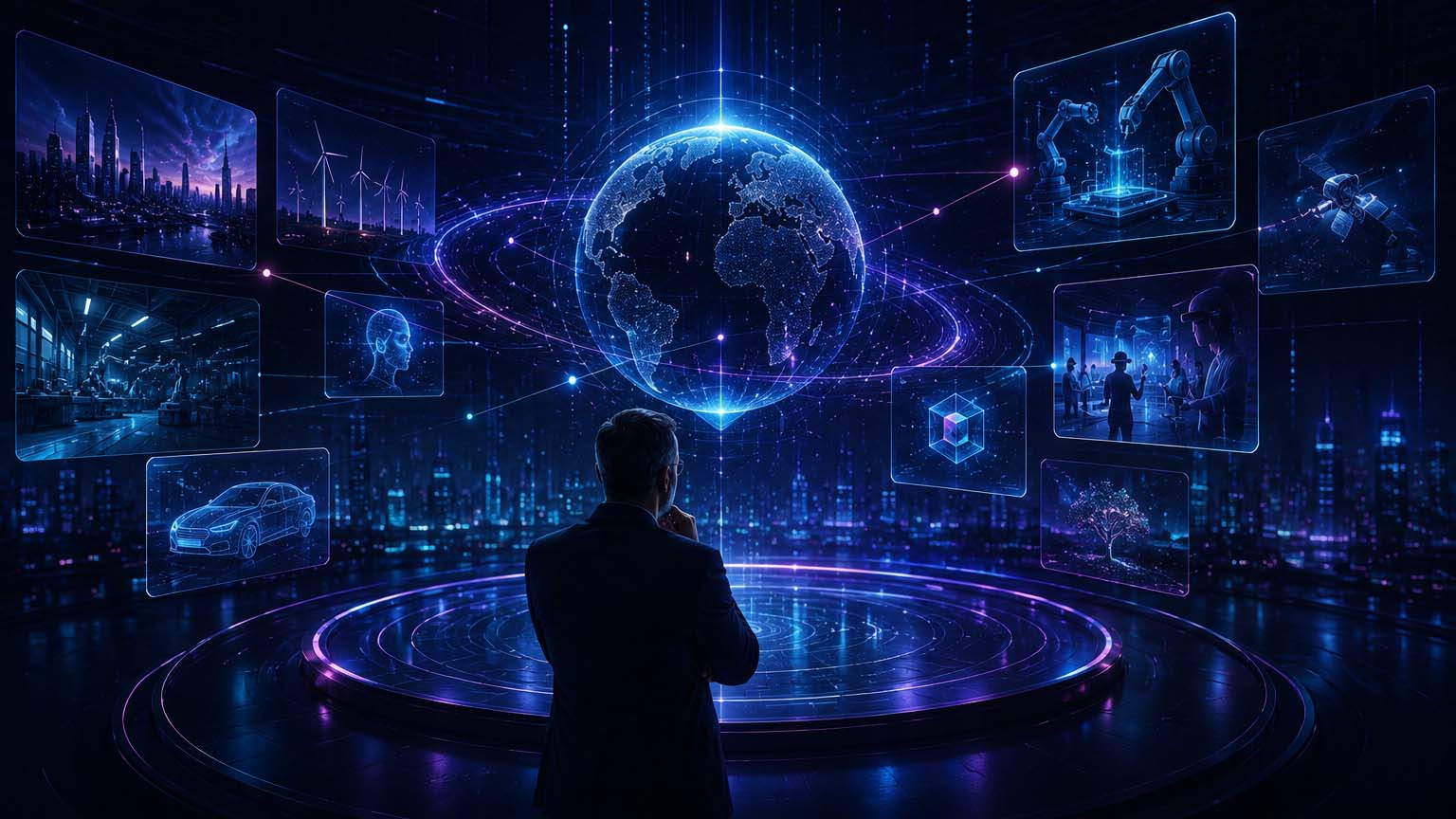
Digital presence connects business, industry and public institutions within a shared digital ecosystem.
Visualization: Digital presence, spatial communication, Spatial Computing, XR, digital twins and cross-industry digital ecosystems | Image: © Ulrich Buckenlei | VISORIC GmbH
The true strength of this development lies in the fact that the same technologies can be applied across entirely different sectors. A digital twin can represent a production facility, explain a building, simulate a vehicle, support training or make complex scientific concepts easier to understand. This creates platforms that connect knowledge, people and processes.[8]
For businesses, this means much more than a new form of visualization. Sales, engineering, service, marketing, planning and training teams will increasingly access the same digital models and collaborate using identical information. Information silos are reduced, while decisions become faster and better informed.
This transformation also opens new perspectives for society. Educational institutions can communicate complex concepts more effectively, cities can plan digital infrastructure more transparently, museums can create interactive knowledge spaces, and healthcare organizations can leverage three-dimensional training and assistance systems. Spatial communication is becoming a universal language for complex information.
Particularly interesting is the combination of artificial intelligence and digital twins. AI can analyze content, recognize relationships and personalize information for different users. As a result, intelligent communication platforms emerge that do more than display information—they actively support understanding and decision-making.
For businesses, this creates entirely new markets. The future demand will not focus on individual 3D models or XR applications but on fully integrated platforms for spatial communication. This is where new services emerge around digital twins, AI, Spatial Computing, real-time 3D, data integration and interactive enterprise communication.
- A single technology can simultaneously support industry, education, mobility, energy and healthcare.
- Digital twins become shared information platforms across different business functions.
- Spatial communication simplifies complex decisions and collaboration.
- Artificial intelligence makes digital content smarter and more personalized.
- Businesses gain new services, business models and competitive advantages.
The more digital communication becomes integrated into everyday life, the more important the question becomes of how physical and digital worlds will seamlessly converge in the future.
From Digital Twins to Real Experiences
A digital twin delivers its greatest value not as a static 3D model, but as an intelligent connection between the physical and digital worlds. Only when geometry, sensor data, documents, real-time information and artificial intelligence are brought together does a platform emerge that makes real processes understandable and supports people in making decisions.[9]
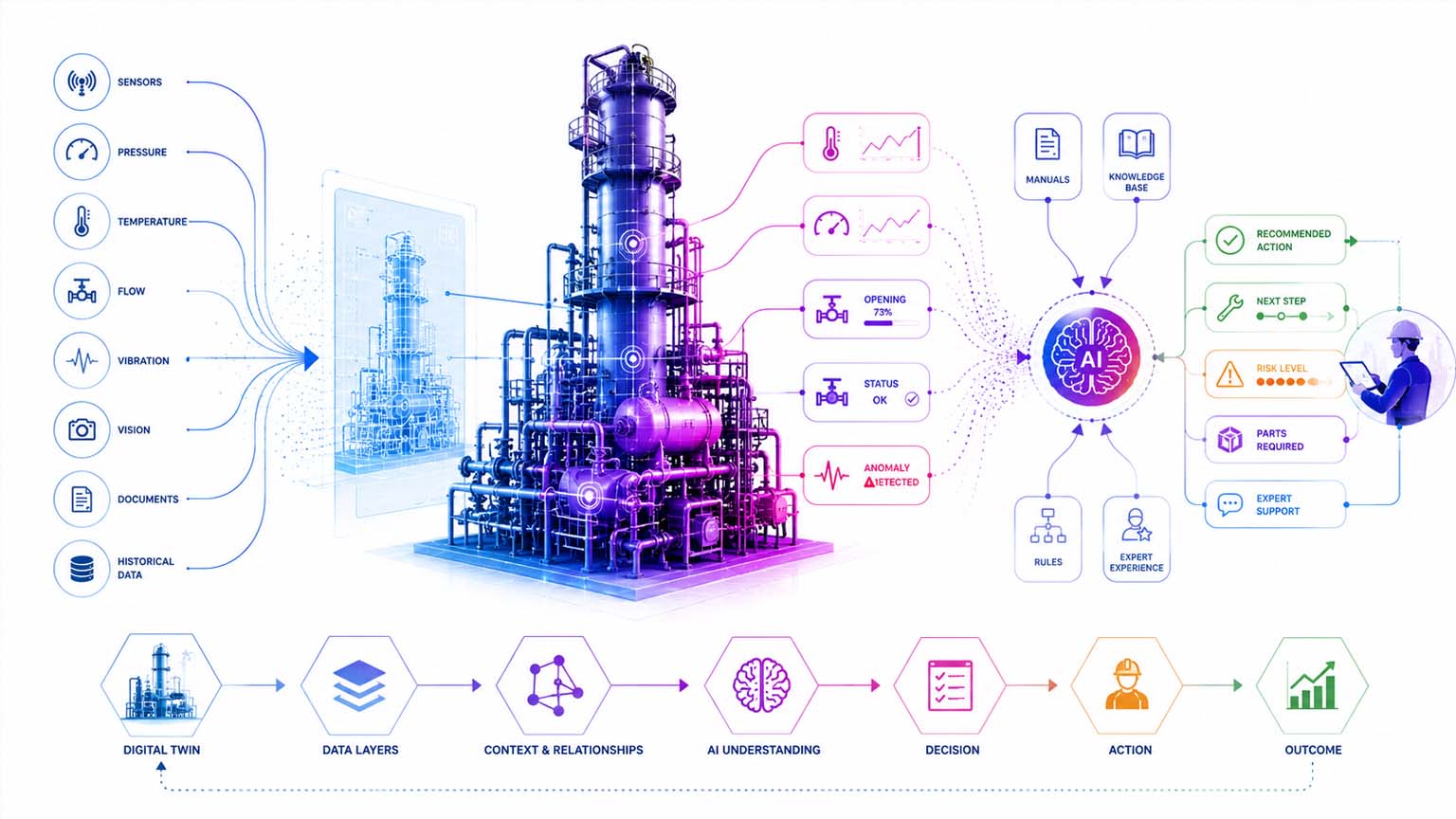
Sensor data, documents and expert knowledge merge with artificial intelligence to form an intelligent assistance system.
Visualization: Digital twin, artificial intelligence, industrial data platform, real-time analysis and assistance systems | Image: © Ulrich Buckenlei | VISORIC GmbH
A modern digital twin today consists of far more than a three-dimensional representation. It connects measurement values, camera images, maintenance information, operating data, documentation and historical information into one shared digital knowledge model. This creates a complete digital context that makes complex relationships visible.[10]
Artificial intelligence forms the next level of development. It recognizes patterns, evaluates conditions, classifies information and can derive recommendations for action. A digital model thus becomes an intelligent assistant that not only displays data but actively supports people in planning, maintenance, service or operations.
For companies, this creates significant advantages. Expert knowledge becomes permanently available, service processes are accelerated, downtime is reduced and decisions can be made on a much stronger information basis. At the same time, a shared platform emerges that development, production, sales and service can access equally.
This concept becomes particularly interesting when digital twins are represented spatially. Instead of searching for technical information in different tables, documents or dashboards, employees can work directly on the three-dimensional object. Conditions, relationships and recommendations for action become visible exactly where they actually arise.
This is precisely where the digital twin evolves from a technical model into a new form of digital communication. Information is no longer merely managed, but communicated spatially, understood collectively and used directly for decision-making.
- Digital twins connect geometry, data and expert knowledge.
- Artificial intelligence recognizes relationships and supports decisions.
- Spatial representation makes complex information intuitively understandable.
- Companies accelerate service, planning and collaboration.
- Digital twins become the intelligent communication platform of the future.
In the next step, digital twins will no longer merely provide information, but independently analyze, learn and interact with people through artificial intelligence.
AI Makes Communication Spatial
Artificial intelligence is changing not only how information is created. It is also changing how people interact with digital content. In combination with digital twins, cloud platforms and Spatial Computing, a new form of spatial communication is emerging, in which information becomes available directly at the object, in the room and within the respective context of use.[11]
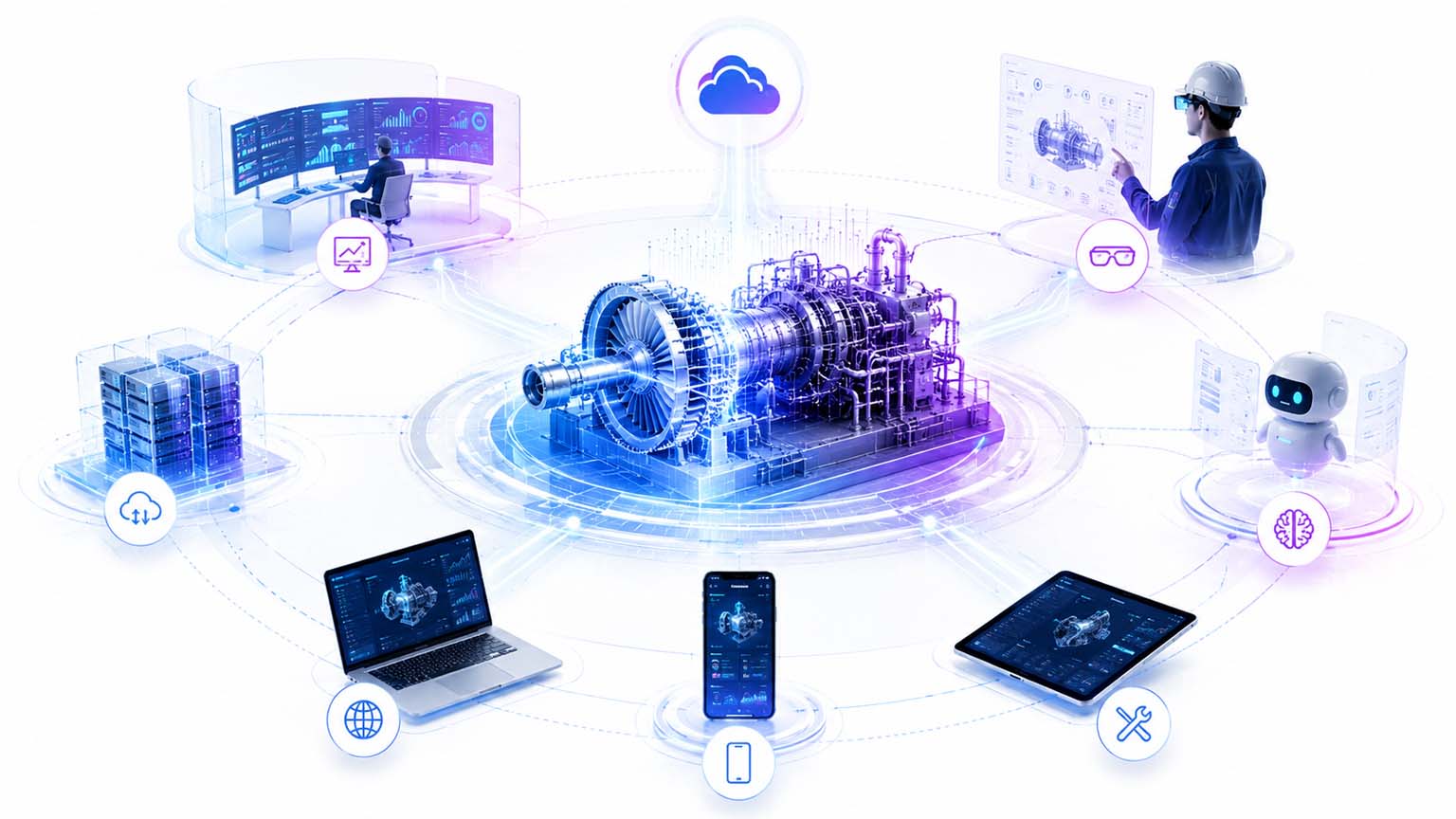
Digital twins, cloud platforms, mobile devices and XR form a shared intelligent working environment.
Visualization: Artificial intelligence, digital twins, cloud computing, Spatial Computing and XR | Image: © Ulrich Buckenlei | VISORIC GmbH
Instead of searching for information across different applications, documentation or dashboards, it will increasingly be linked directly to the real object. A digital twin thus becomes the central knowledge platform that employees can access at any time via smartphone, tablet, browser, XR headset or AI assistant.[12]
Artificial intelligence takes on a new role here. It analyzes sensor data, understands technical relationships, answers questions in natural language and provides exactly the information needed in a specific situation. Individual software solutions become an intelligent communication system that actively supports people.
For companies, this opens entirely new possibilities. Expert knowledge becomes available at any time, service operations can be accelerated and employees receive contextual support directly on site. At the same time, different end devices can access the same data basis and use the same digital twins collaboratively.
This concept becomes particularly powerful through cloud technologies. Digital twins no longer need to be stored locally, but can be synchronized worldwide, edited collaboratively and updated in real time. This creates global platforms for collaboration, training, maintenance and industrial communication.
The real innovation therefore does not lie in artificial intelligence alone or in individual XR devices. What matters is the interaction between cloud, AI, digital twins and spatial representation. Only this combination makes information location-independent, understandable and immediately usable.
- AI connects digital twins with natural communication.
- Cloud platforms make knowledge available worldwide.
- All end devices access the same spatial data basis.
- Contextual information improves service and collaboration.
- Digital communication becomes intelligent, spatial and available at any time.
When information becomes spatially available, the next question arises: How does Spatial Computing change our perception when digital content becomes a permanent part of our real environment?
Programmable Spaces Transform Architecture
Physical spaces are increasingly being extended by digital information. With Spatial Computing, XR and holographic user interfaces, new spatial layers are emerging in which machines, buildings and infrastructure can no longer only be viewed, but understood, analyzed and controlled directly within their context of use.[13]
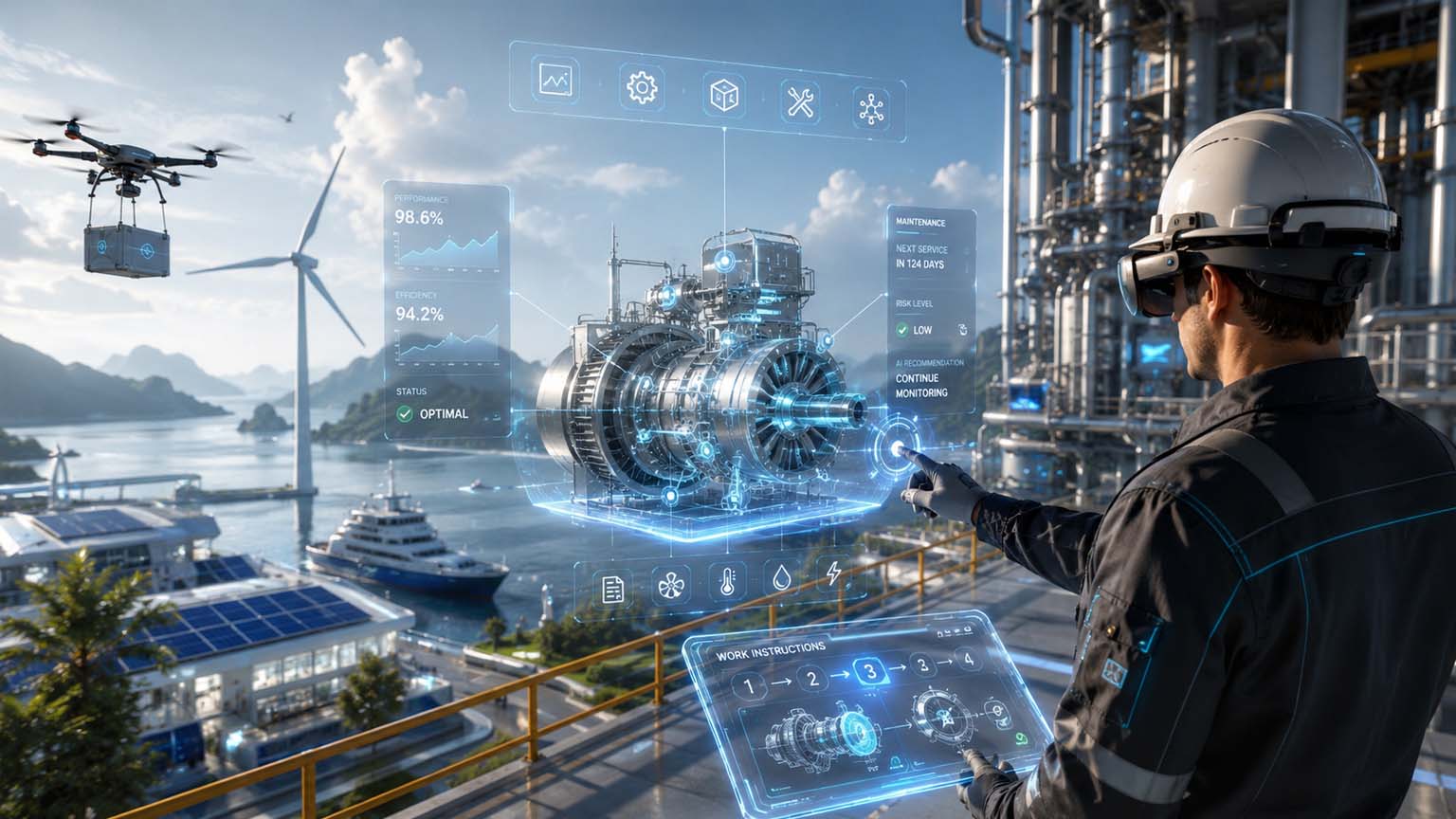
Spatial Computing brings digital twins and artificial intelligence directly into real industrial environments.
Visualization: Spatial Computing, Extended Reality, digital twins, holographic user interfaces and artificial intelligence | Image: © Ulrich Buckenlei | VISORIC GmbH
Unlike traditional screens, information will increasingly appear directly on machines, systems or buildings. Maintenance instructions, sensor data, safety information or workflows are spatially overlaid and remain permanently connected to the respective object. This creates a far more intuitive form of information communication.[14]
Especially in industry, energy supply, infrastructure and mechanical engineering, this creates new possibilities. Service technicians receive step-by-step instructions directly in their field of view, experts can provide remote support and digital twins can be compared directly with real systems. The physical and digital worlds merge into one shared working environment.
Spatial Computing changes not only the way information is displayed, but also the way people collaborate. Several people can view the same digital twin at the same time, discuss changes or jointly plan complex processes—regardless of where they are located.
With the combination of artificial intelligence, real-time data and spatial representation, intelligent assistance systems emerge that provide information depending on the situation and actively support employees. Passive documentation becomes interactive knowledge systems that understand the respective context and provide suitable recommendations for action.
- Digital information is linked directly to real objects.
- XR makes maintenance, training and collaboration significantly more intuitive.
- Digital twins accompany the entire lifecycle of a system.
- AI supports decisions directly within the spatial work context.
- Architecture evolves into an intelligent information and interaction platform.
When digital information becomes a permanent part of our real environment, the next question arises: What new opportunities does this create for companies, the economy and society?
What This Development Means for Companies
The third dimension of digital communication is changing not only how people perceive information. It is changing business processes, collaboration and value creation. Digital twins, artificial intelligence and spatial communication are increasingly evolving into a shared platform where development, production, service, training and collaboration grow together.[15]
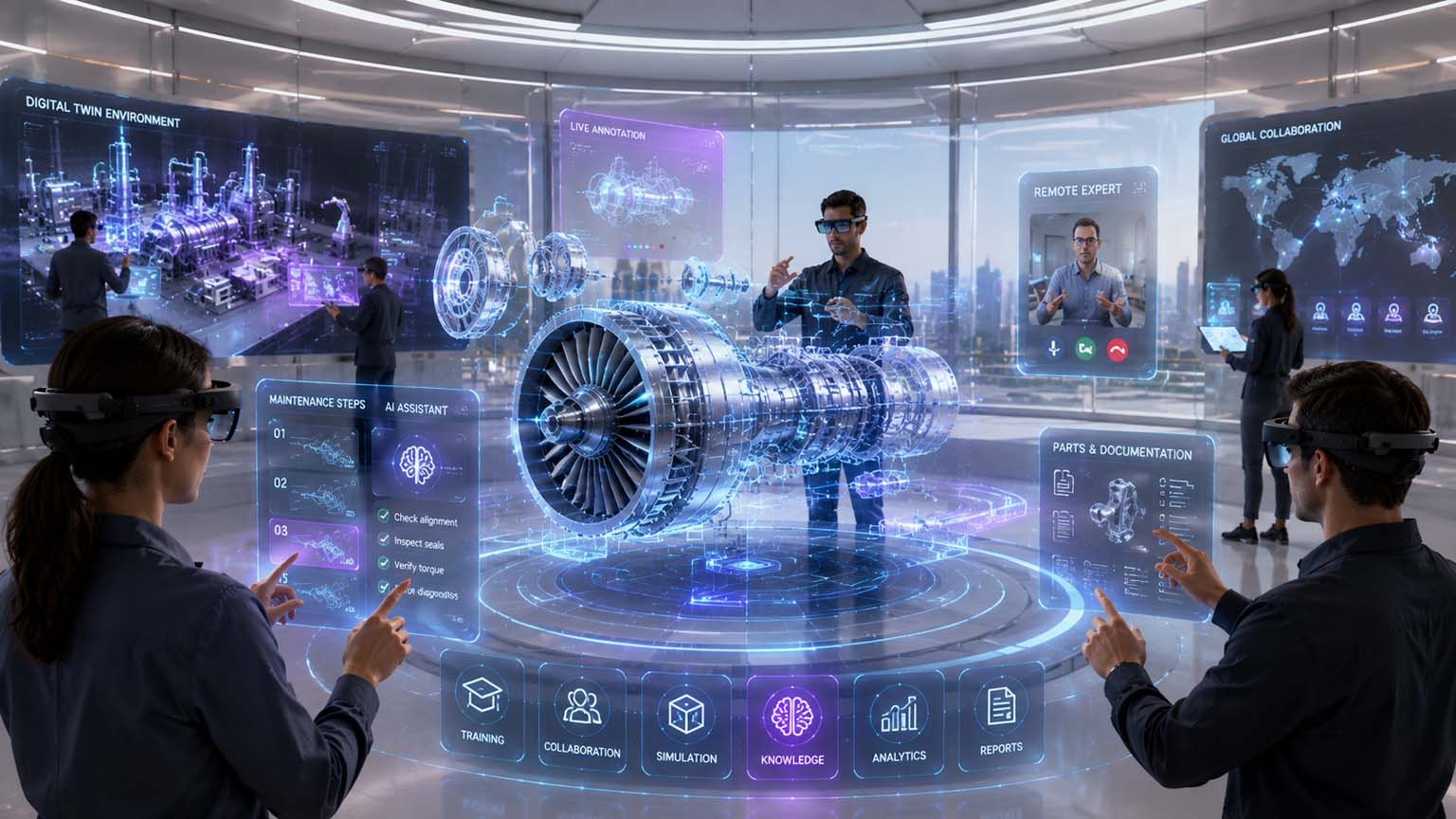
Digital twins, artificial intelligence and XR create new forms of industrial collaboration.
Visualization: Digital twins, artificial intelligence, Spatial Computing, Extended Reality and industrial collaboration | Image: © Ulrich Buckenlei | VISORIC GmbH
Instead of distributing information across different software solutions, a central working environment emerges in which all participants work with the same digital twin. Design, manufacturing, maintenance, training and management access identical data and can collaborate simultaneously—regardless of location.[16]
This creates entirely new opportunities for companies. Experts can provide support worldwide, employees can be trained directly on the digital twin and maintenance processes become significantly more efficient through AI-supported assistance systems. Knowledge is preserved permanently and is available whenever and wherever it is needed.
At the same time, business models are changing. Digital twins are evolving from technical visualizations into long-term enterprise platforms where service, training, simulation, documentation and collaboration merge. Economic value is no longer created only through individual applications, but through the continuous use of the same digital infrastructure.
The combination of artificial intelligence and spatial communication is particularly interesting. AI can explain information, provide recommendations, detect anomalies and support employees step by step. This creates intelligent assistance systems that increase productivity, reduce errors and secure knowledge sustainably.
- Digital twins connect development, production and service.
- XR enables location-independent real-time collaboration.
- AI supports employees with contextual information.
- Knowledge is stored permanently and made available worldwide.
- New platforms create sustainable competitive advantages and digital business models.
The next stage of development goes one step further. What happens when digital communication is no longer tied to devices, but when people, products and information appear permanently as spatially present elements of our environment?
The Future of Digital Presence
The development of spatial communication is only just beginning. Today, Spatial Computing, artificial intelligence, digital twins and immersive media often still exist as separate technologies. In the coming years, however, they will increasingly grow together into a shared platform and create a new form of digital presence.[17]
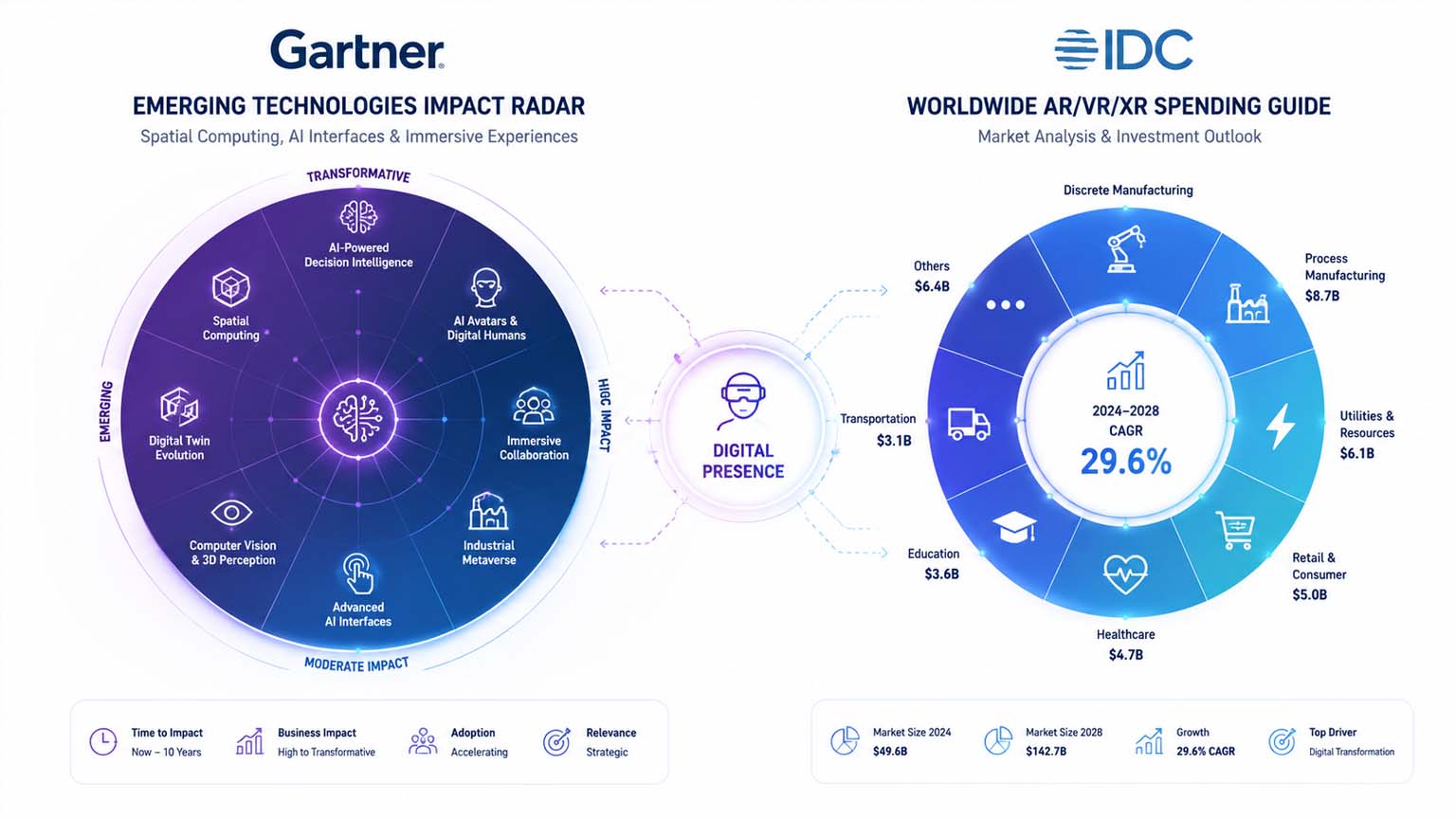
The diagrams show how Spatial Computing, artificial intelligence and XR rank among the most important future technologies and growth markets.
Diagrams: Own visualization based on current market analyses by Gartner and IDC | Design: © Ulrich Buckenlei | VISORIC GmbH
Current Gartner analyses show that technologies such as Spatial Computing, AI-supported user interfaces, digital humans and intelligent assistants are among the most important future fields of the coming years. At the same time, IDC market analyses forecast strong growth in investments in XR, immersive enterprise solutions and spatial communication platforms.[18]
The real change, however, is not created by individual devices. What matters is the connection of all technologies into a shared digital infrastructure. Information will increasingly be represented spatially, digital twins will accompany real products throughout their entire lifecycle and artificial intelligence will support people directly within the respective context of use.
This also changes the role of digital communication. Instead of displaying information on screens, people, products, data and knowledge are increasingly perceived as spatially present elements of our environment. Communication becomes more natural, more understandable and more strongly adapted to the respective context.
For companies, this opens new opportunities for collaboration, knowledge transfer, product development and customer communication. At the same time, new platforms emerge where digital services, intelligent assistance systems and spatial business models merge.
- Spatial Computing is evolving into the next user interface.
- Artificial intelligence makes digital communication contextual.
- Digital twins become the central knowledge platform.
- Immersive technologies connect people, data and products.
- Digital presence becomes a decisive competitive factor.
The central thesis of this article is therefore: The future of digital communication does not lie on larger screens, but in spatial presence. People, information and digital twins are increasingly becoming part of our real environment, opening entirely new possibilities for collaboration, industry, education and society.
“`html
From Information to Spatial Presence
The examples in this article show that digital communication is changing fundamentally. Information is increasingly leaving the traditional screen and becoming spatially experienceable content integrated directly into our environment. People, products, machines and digital twins will appear exactly where they are needed—in the respective context of use.
This development becomes particularly clear in modern holographic displays, volumetric media and spatial presentation systems. Digital content no longer feels like traditional visualization, but creates the impression of physical presence. This opens new possibilities for knowledge transfer, collaboration, product presentations, service and entertainment.
The following practical example impressively shows how spatial media can already be used today. Instead of displaying content only on a screen, it creates the impression of a three-dimensional object floating freely in space and viewable from different angles. This exact form of digital presence is likely to play an important role in more and more industries in the future.
Video source: Original demonstration material of the featured holographic 3D display | Analysis, technological classification, storyline and editing: © Ulrich Buckenlei | XR Stager Online Magazine | VISORIC GmbH
Such systems mark the transition from two-dimensional information display to spatial communication. They make it possible to present complex products, technical relationships and digital twins far more intuitively and to work on them collaboratively. This creates entirely new possibilities for collaboration, especially in industry, medicine, education, architecture and product development.
In combination with artificial intelligence, cloud platforms and digital twins, holographic media are increasingly evolving into interactive communication systems. Information is no longer merely displayed, but can be understood, explained, adapted and used collaboratively. Digital presence is thus developing into a new form of human-computer interaction.
The Munich-based VISORIC expert team also observes that the discussion is increasingly shifting away from individual devices toward new forms of communication. In the future, the decisive question will no longer be on which screen information appears, but how naturally people can interact with digital content.
- Digital content is displayed spatially instead of exclusively two-dimensionally.
- Holographic media create a significantly more natural communication experience.
- Digital twins can be understood and edited together more intuitively.
- AI expands spatial media with intelligent assistance functions.
- Digital presence is evolving into the next stage of communication.
The central insight is therefore: The future of digital communication is not about bringing information onto ever-larger screens. It is about making information, people and digital twins spatially present.
From Spatial Communication to Competitive Advantages
The third dimension of digital communication opens new opportunities for companies to communicate complex content more clearly, improve collaboration and make digital twins experienceable. Visualization becomes a spatial platform for knowledge, service, training, sales and decision-making processes.
VISORIC develops individual solutions for this purpose, intelligently connecting the physical and digital worlds: from the first idea and prototyping to technical implementation.
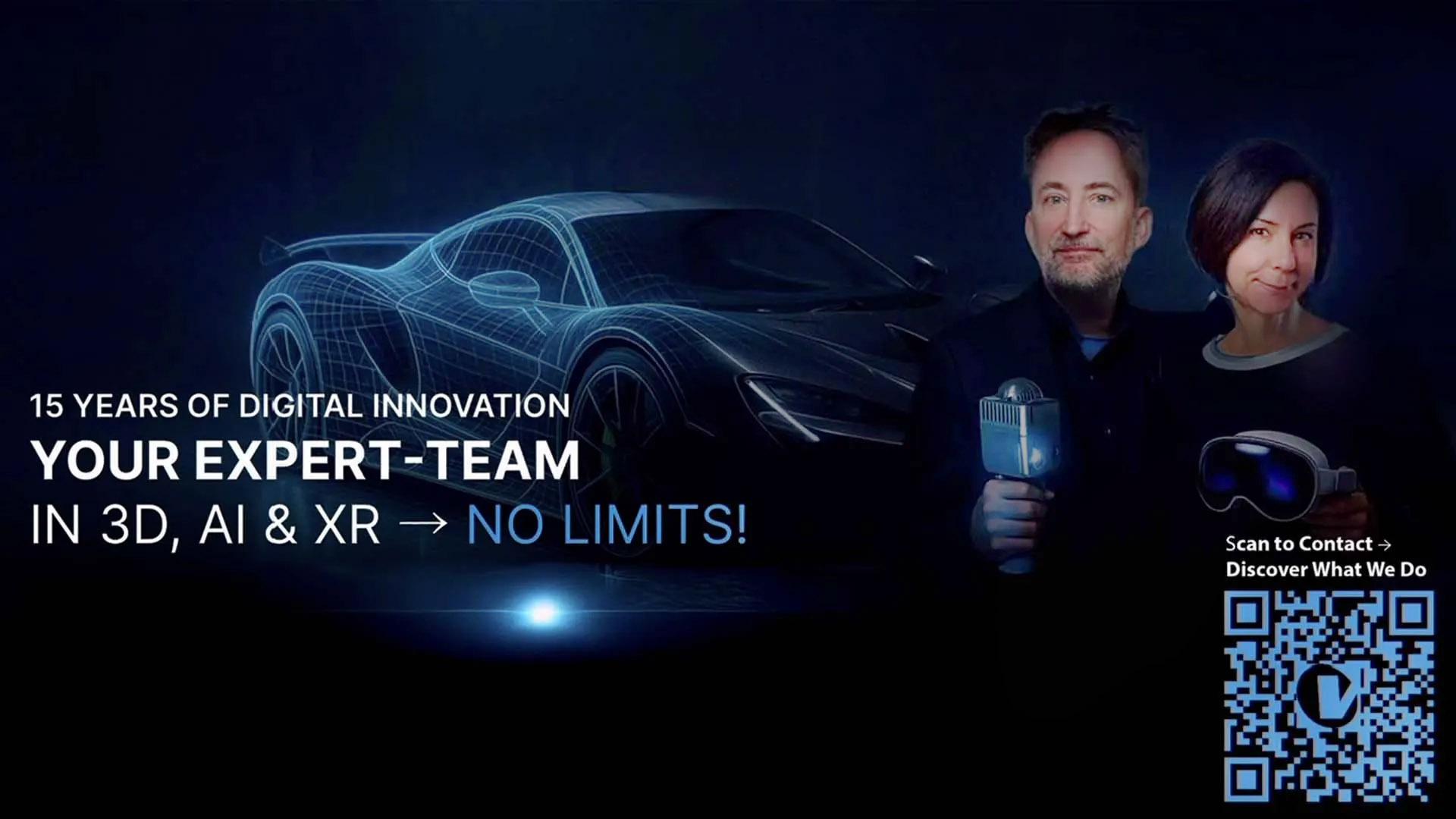
VISORIC develops spatial communication solutions with digital twins, Spatial Computing, XR and artificial intelligence.
Visualization: Spatial communication, digital twins, Spatial Computing, XR and AI-supported interaction | © VISORIC GmbH | Munich
VISORIC supports companies with:
- Strategy development for spatial communication and digital twins
- Concept development for XR, Spatial Computing and 3D applications
- Feasibility analyses, prototyping and technical planning
- Development of interactive 3D, cloud and real-time platforms
- Integration of AI-supported assistance and knowledge systems
- Implementation of applications for service, training, sales and collaboration
This creates solutions that not only display information, but make it spatially experienceable and directly available in the respective context of use.
Are you planning digital twins, Spatial Computing, XR applications or AI-supported communication systems?
Talk to the Munich-based VISORIC expert team about strategy, prototyping and implementation.
Contact us:
Email: info@visoric.com
Phone: +49 89 2155 2678
Address: Bayerstr. 13, 80335 Munich, Germany
Sources and References
- Google Beam, formerly Project Starline. Research and product development on realistic 3D telepresence and spatial communication.
- Apple: Vision Pro and Spatial Computing. Foundations of spatial user interfaces and digital presence.
- World Economic Forum: Future of Jobs Report 2025. Analysis of future work environments and digital collaboration.
- McKinsey & Company: Technology Trends Outlook. Developments around AI, Spatial Computing and digital platforms.
- Google Research: Project Starline. Research on spatial video communication and natural presence.
- Meta Reality Labs: Codec Avatars Research. Digital avatars and immersive telepresence.
- Deloitte: Tech Trends. Spatial Computing and new digital business models.
- Accenture: Technology Vision. AI, immersive technologies and future enterprise strategies.
- NVIDIA Omniverse. Digital twins, real-time simulations and industrial collaboration.
- Siemens: Industrial Metaverse and Digital Twin. Industrial applications of intelligent digital twins.
- Microsoft Research: Holoportation and Volumetric Communication. Research on volumetric communication and mixed reality.
- IEEE: Cloud Rendering Based Volumetric Video Streaming System. Research on volumetric media and real-time rendering.
- ACM SIGGRAPH: Emerging Technologies. Research on holographic displays and spatial media.
- MIT Media Lab: Tangible Media Group. Research on interactive spaces and physical human-computer interaction.
- PwC: Seeing Is Believing. Economic potential of immersive technologies.
- Capgemini Research Institute: The Immersive Economy. XR, digital experiences and new business models.
- Gartner: Emerging Technologies and Trends Impact Radar. Spatial Computing, AI interfaces and immersive technologies.
- IDC: Worldwide Augmented and Virtual Reality Spending Guide. Market analyses on XR and future investments.
- Original video material and visual inspiration of the featured modular 3D display.
- Current developments from research and industry on holographic displays and spatial communication.
- VISORIC practical projects in the fields of digital twins, Spatial Computing, AI and immersive communication.
- XR Stager platform for interactive 3D, XR and Spatial Computing applications.
Contact Us:
Email: info@xrstager.com
Phone: +49 89 21552678
Contact Persons:
Ulrich Buckenlei (Creative Director)
Mobil +49 152 53532871
Mail: ulrich.buckenlei@xrstager.com
Nataliya Daniltseva (Projekt Manager)
Mobil + 49 176 72805705
Mail: nataliya.daniltseva@xrstager.com
Address:
VISORIC GmbH
Bayerstraße 13
D-80335 Munich