
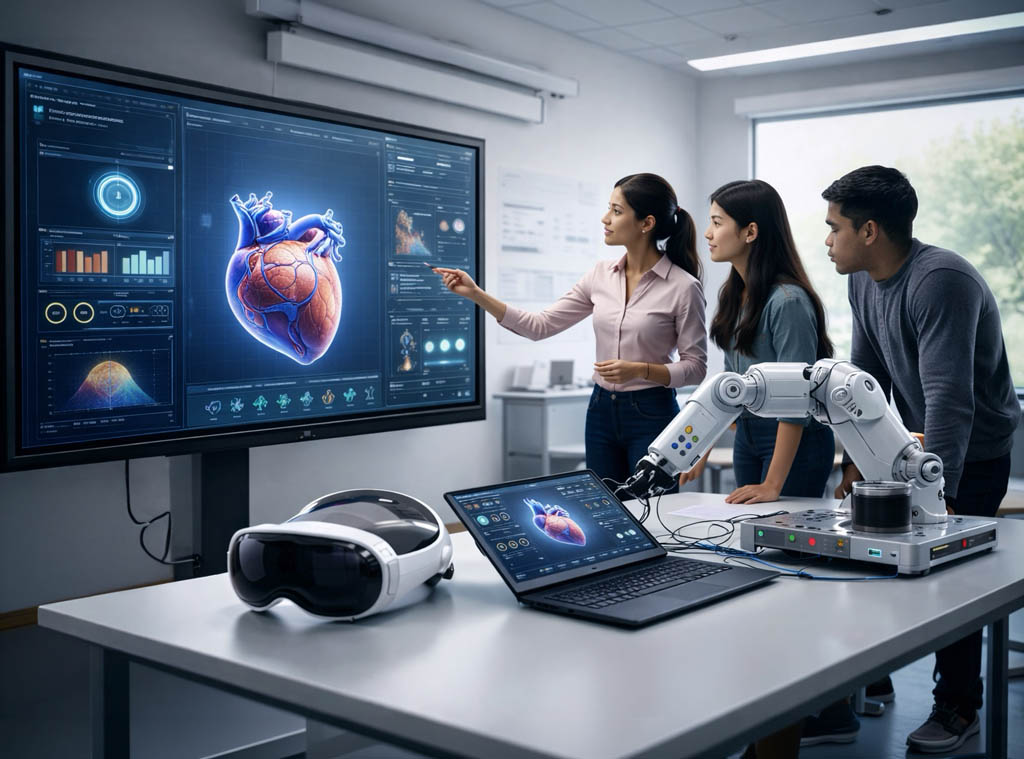
Interactive Learning Environment with AI-Supported Visualization and Robotics in the Classroom
Visualization: © Ulrich Buckenlei | Visoric GmbH | Editorial concept image illustrating the potential integration of AI, spatial simulation, and physical AI in an educational context | The depiction serves analytical classification purposes and does not claim comprehensive implementation
Public discussions about education are often dominated by buzzwords such as digitalization, tablet classes, or digital boards. Yet while industry and business have long been working with simulations, autonomous systems, and AI-supported process control, the structural setup of many classrooms has remained largely unchanged.
At the same time, current studies show that key competency requirements are shifting. According to the World Economic Forum, analytical thinking, technological literacy, and systemic understanding are among the most critical skills for the coming years.[3] OECD reports also emphasize that education must increasingly focus on problem solving, digital sovereignty, and interdisciplinary thinking.[7]
The real question, therefore, is not whether technology is used in the classroom. It is: Is the learning logic itself changing?
When content is no longer conveyed exclusively through text and static images, but experienced as interactive models, simulations, or physical systems, the bottleneck of teaching shifts. The constraint is no longer primarily access to information, but the ability to understand systems, operate interfaces, and interpret relationships.
What is described in companies as digital transformation could, in the educational context, represent a structural shift in learning architecture. The whiteboard becomes a control hub. AI structures learning pathways. Virtual environments visualize complex processes. Robotics makes abstract logic physically tangible.
Costs do not disappear. They change their structure. Instead of investing primarily in infrastructure, the focus shifts to instructional design, data quality, interaction concepts, and media design. Competitive advantage no longer arises from devices alone, but from the ability to meaningfully orchestrate learning environments.
This raises a central question: What could teaching look like if these technologies were conceived not as add-ons, but as integral components of a new learning architecture?
From Whiteboard to Control Hub – How Teaching Logic Could Shift
Today, teaching rarely fails due to a lack of content, but rather due to the challenge of making complex relationships understandable and tangible. While information is available at any time, the question remains how systems, processes, and interactions can be conveyed in a way that generates genuine understanding.
New technologies could address precisely this point. Not because they replace teachers, but because they move the moment of understanding forward. What was previously explained abstractly could become experienceable as an interactive model, simulation, or physical application. The real gain would not lie in spectacular technology, but in the quality of insights per lesson unit.
- Previous bottleneck – information delivery determines the pace of learning
- New bottleneck – model quality and instructional structure determine depth of understanding
- New routine – learning content is conceived across media, from simulation to XR to physical application

Interface shift in the classroom – the board as orchestration surface between simulation, XR, and real robotics
Motif: Editorial concept image | Visualization: © Ulrich Buckenlei | Visoric GmbH | Depiction of a possible AI-supported learning architecture | The illustration serves analytical classification
The image does not show a single technology, but a structure. At the center stands the interactive interface as a control hub. Simulations visualize complex processes, AI structures content, and robotics translates theory into visible action.
What matters is the connection between these layers. It is not the device that changes teaching, but the way content is orchestrated. The whiteboard becomes the interface between digital model and real-world application.
As soon as such interfaces become available, the focus shifts from equipment toward integration, quality, and instructional design. [1]
The next chapter analyzes the conditions under which this potential shift could become viable in everyday school practice.
From Device Procurement to System Architecture – Why Integration Becomes More Important Than Equipment
Many digitalization projects in schools begin with an obvious question: Which devices do we need? Tablets, interactive boards, headsets, robotics kits. Procurement takes center stage. Yet this is often where a fundamental misconception lies. Devices alone do not change learning logic. They merely supplement it. [3]
The decisive question is therefore not: Which hardware is modern? But: How do all elements interconnect as a system? [10]
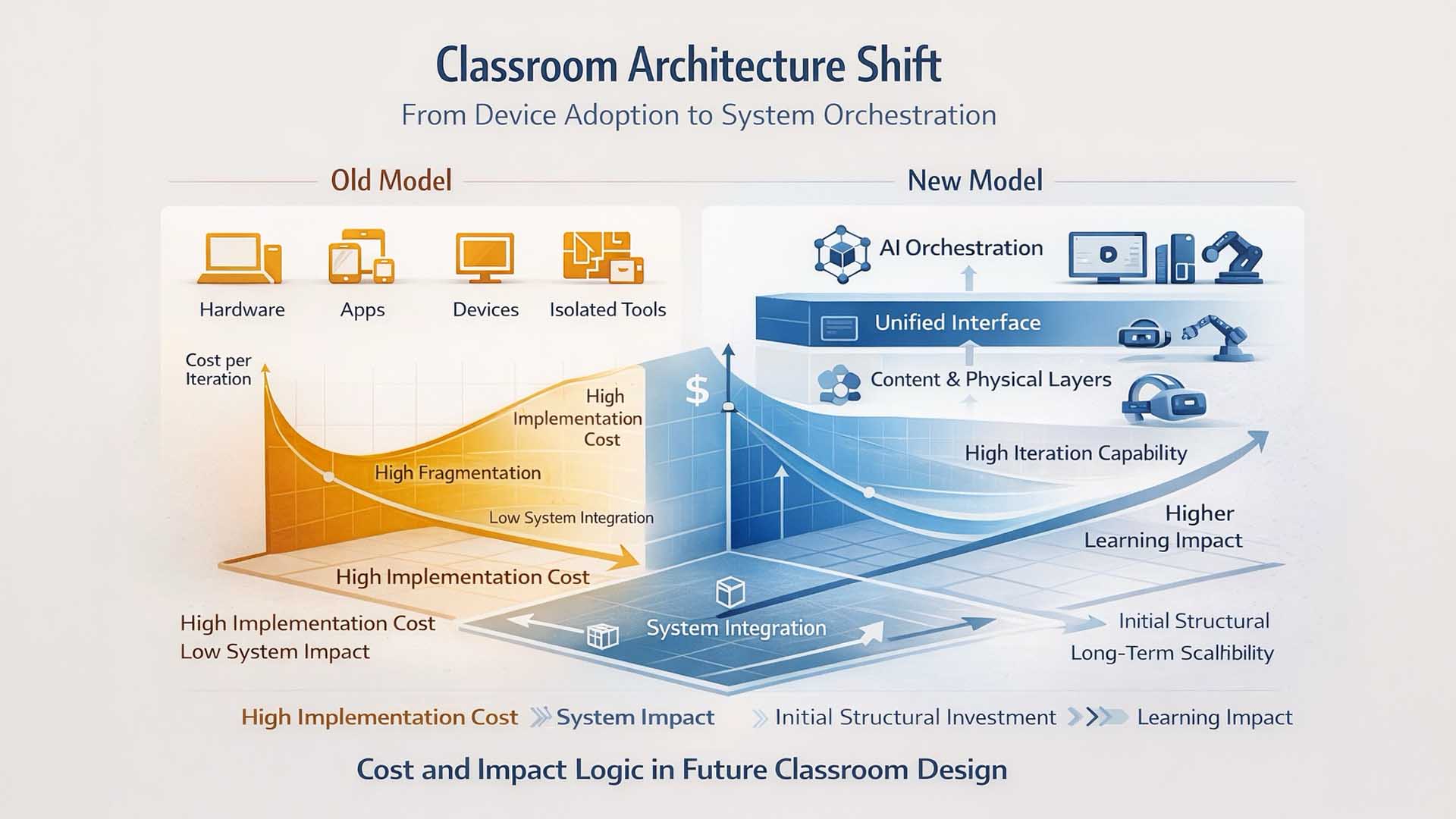
Classroom Architecture Shift – Comparison between device-centered digitalization and orchestrated learning architecture
Graphic: Editorial analysis | Visualization: © Ulrich Buckenlei | Visoric GmbH | The illustration shows the structural shift from isolated device integration toward an AI-supported, integrated learning architecture. The depiction serves analytical classification.
The left side of the graphic shows a familiar pattern. Individual devices, apps, and tools are introduced, often sequentially and independently. Each solution serves a purpose, but remains isolated. This leads to high fragmentation, complex training requirements, and rising implementation costs. [3]
In this model, the cost curve initially decreases but rises again with increasing usage. Maintenance, coordination, and integration generate additional effort. Learning impact often falls short of expectations because no coherent system emerges.
The right side of the graphic presents a different approach. Here, the focus is not on the individual device, but on architecture. [10]
At the center lies an orchestrating layer, such as an intelligent interactive interface that connects different media formats. Above it, an AI layer structures content, adapts learning paths, and synchronizes different media. Below are simulations, immersive XR environments, or physical robotics. [1][4]
- The interface becomes the control hub
- AI supports structuring and personalization
- Content is conceived modularly
- Robotics translates theory into practical experience
In this model, a different logic emerges. Content can be adapted, expanded, and reused. The system becomes iteratively developable and scalable. [12]
The graphic therefore shows not only a technical difference, but a strategic shift. From isolated tools to an integrated learning environment. [10]
The next chapter examines which organizational and instructional prerequisites must be fulfilled so that such an architecture becomes not only technically possible, but sustainably effective.
Organizational and Instructional Prerequisites – What Schools Truly Need
Technology alone does not change teaching. Even the best architecture of AI, immersive interfaces, and robotics remains ineffective if it is not embedded in viable structures. Sustainable transformation therefore begins not with technology, but with organization, competence, and clear strategic alignment. [3][10]
The central question is: Under what conditions can an integrated learning architecture become effective in the long term?
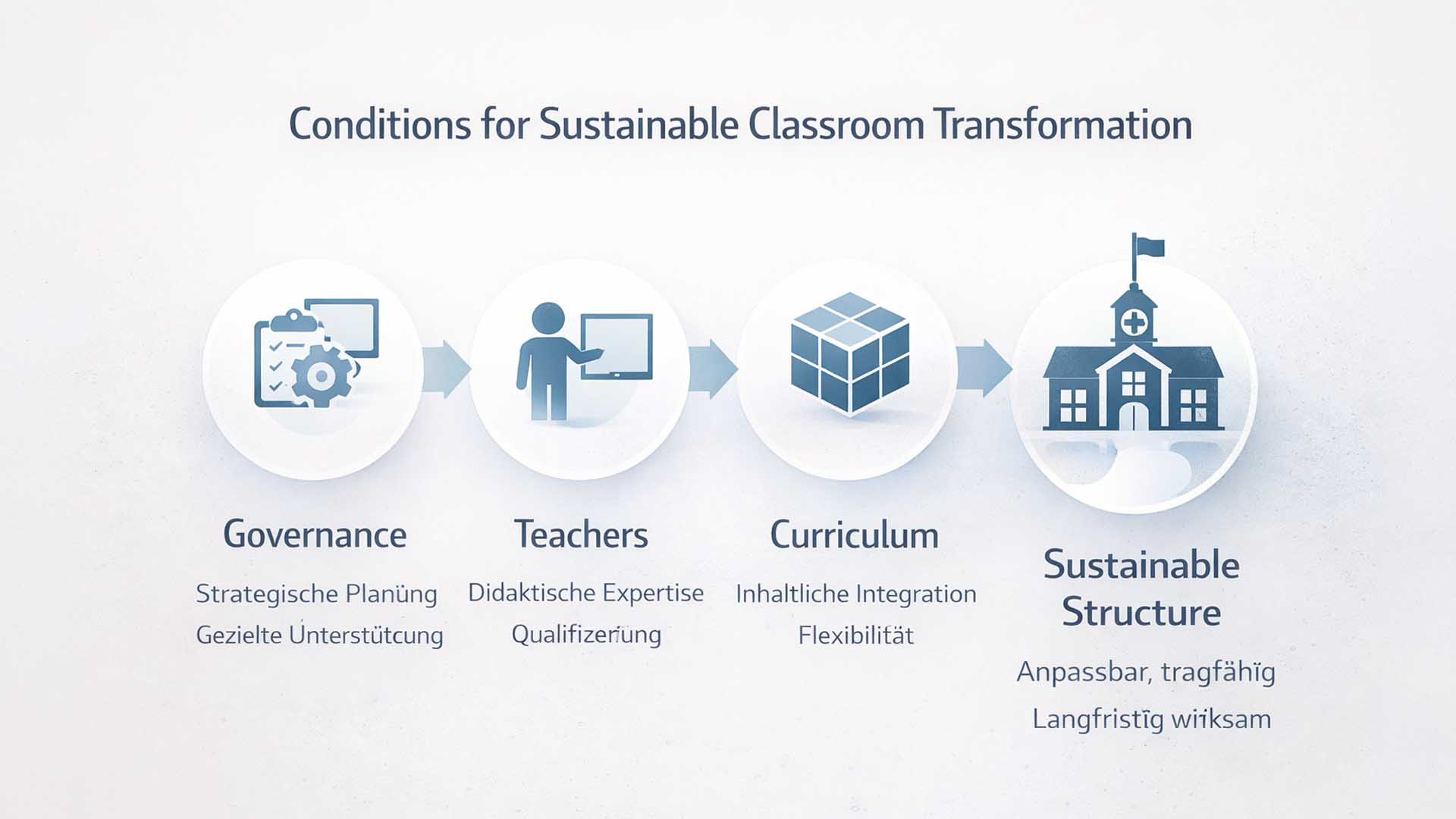
Prerequisites for sustainable classroom transformation – From governance to teaching competence to resilient structure
Graphic: Editorial analysis | Visualization: © Ulrich Buckenlei | Visoric GmbH | The illustration shows four structural layers that are decisive for the sustainable integration of AI, virtual worlds, and robotics in education.
The graphic deliberately reduces complexity to four core areas.
1. Governance
Transformation requires strategic planning. Without clear goal definition, budgeting, responsibilities, and timelines, pilot projects emerge, but no sustainable systems. Studies on educational digitalization show that missing governance structures are among the most frequent reasons for failed implementations. [3]
2. Teachers
Technology does not replace pedagogy. Teachers remain the central factor. Their role shifts, however, from pure knowledge transmitter to learning architect and system facilitator. Targeted qualification, continuous professional development, and instructional support are essential. [5][12]
3. Curriculum
Digital tools unfold impact only when integrated into existing curricula. Content must be conceived modularly, linked interdisciplinarily, and remain flexibly adaptable. AI can support this, but it does not replace curricular clarity. [1][2]
4. Sustainable Structure
Technical infrastructure must be scalable, maintainable, and financially sustainable in the long term. A system that works only in pilot mode generates frustration. Sustainability therefore means organizational resilience as much as technical stability. [10]
The aha moment of the graphic lies in its simplicity. It shows that classroom transformation is not a technology project, but a structural project. AI, XR, and robotics are tools. What matters is the system in which they are embedded.
For schools, educational providers, or public institutions, this means: Successful transformation does not arise from isolated decisions, but from architectural thinking. Those who merely procure devices modernize the surface. Those who develop structures transform impact.
The next chapter therefore examines how such a learning architecture can be practically built, from initial analysis through pilot phases to scalable implementation.
From Analysis to Scaling – How Learning Architectures Are Systematically Built
The introduction of an integrated learning architecture is not a single project. It is a structured development process. Anyone who wants to anchor AI, immersive interfaces, and robotics sustainably in teaching needs more than enthusiasm and budget. It requires a clearly defined sequence of phases that build upon one another and reinforce each other. [3][10]
The following graphic shows such an implementation pathway, reduced to five central phases. Each phase fulfills a specific function in the maturity process of a school or educational institution.
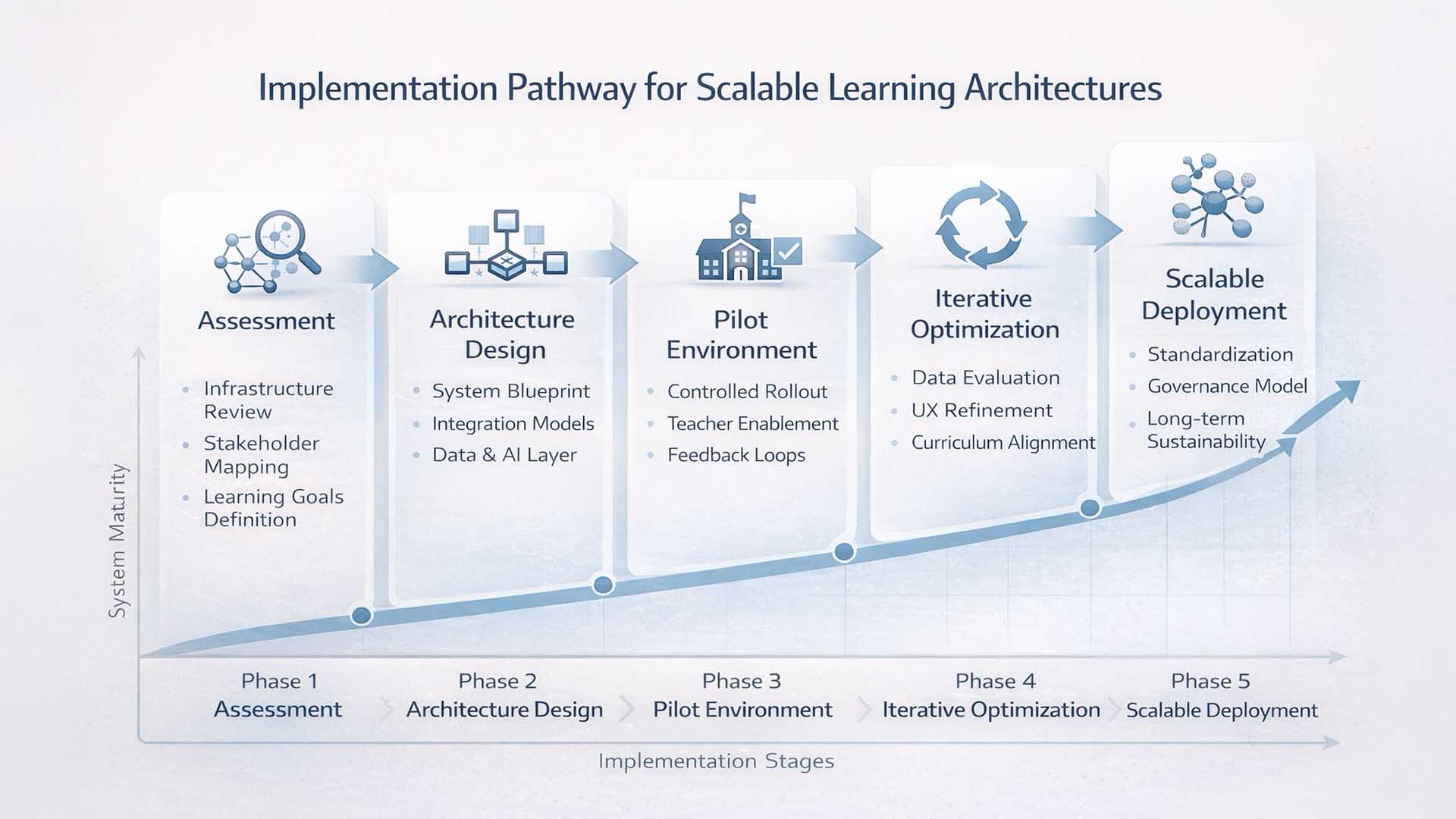
Implementation pathway for scalable learning architectures – From analysis through piloting to sustainable structure
Graphic: Editorial analysis | Visualization: © Ulrich Buckenlei | Visoric GmbH | The illustration shows five sequential implementation phases and increasing system maturity along the time axis.
The lower curve of the graphic illustrates the core idea: With each phase, system maturity increases. Transformation is not a leap, but a continuous maturation process.
Phase 1 – Assessment
The starting point is not a technology decision, but an analysis.
Existing infrastructure, pedagogical objectives, organizational conditions, and relevant stakeholders are systematically assessed. Which systems already exist? Where are bottlenecks? Which competencies are available? [3]
Equally important is the definition of learning goals. Should problem solving skills be strengthened? Interdisciplinary work? Technical literacy? Without clearly defined goals, any architecture remains vague.
Assessment creates orientation. It prevents blind actionism.
Phase 2 – Architecture Design
Only after analysis does system architecture follow.
In this phase, a technical and instructional blueprint is created. What role does AI play? Where is robotics integrated? Which data flows are required? How do interfaces, content, and physical systems interconnect? [10]
Here it becomes clear whether a school introduces individual tools or develops a coherent system.
Architecture design means thinking through interactions. Integration is consciously planned, not randomly produced.
Phase 3 – Pilot Environment
No transformation without a testing field.
In the pilot environment, selected classes, subject areas, or modules are introduced in a controlled manner. Teachers receive targeted support. Processes are observed. Feedback is systematically collected. [5]
Piloting serves two functions.
It reduces risk.
And it creates experiential knowledge.
Only here does theory prove itself in real school practice.
Phase 4 – Iterative Optimization
Transformation does not end with first deployment.
In this phase, data is evaluated, user experiences are analyzed, and instructional adjustments are made. AI systems are fine-tuned. Content is improved. Processes are simplified. [12]
Iteration is not a sign of uncertainty. It is a sign of professional development.
The graphic makes clear: Optimization is a distinct, clearly defined step, not a side effect.
Phase 5 – Scalable Deployment
Only now does actual scaling begin.
Standards are defined. Governance models are established. Responsibilities are assigned. Professional development structures are institutionalized. [10]
Scaling does not mean copying a project. It means establishing a structure that remains viable in the long term.
The rising curve in the graphic symbolizes exactly this maturity level. With each phase, the system becomes more stable, integrated, and effective.
The central difference therefore lies not in the technology, but in the approach. Schools that implement in a structured way develop long term competence. Schools that pilot in isolation create isolated solutions.
And this leads to the next, perhaps most decisive question:
How does the role of the teacher actually change within such an architecture?
The next chapter therefore examines how the professional profile shifts from knowledge transmitter to learning architect, and why this shift is the real key to transformation.
From Knowledge Transmitter to Learning Architect – Why the Role of the Teacher Becomes Decisive
Technology can structure content.
It can personalize, simulate, visualize.
But it cannot lead.
The real transformation in the classroom therefore begins not with AI, robotics, or immersive interfaces. It begins with the role of the teacher.
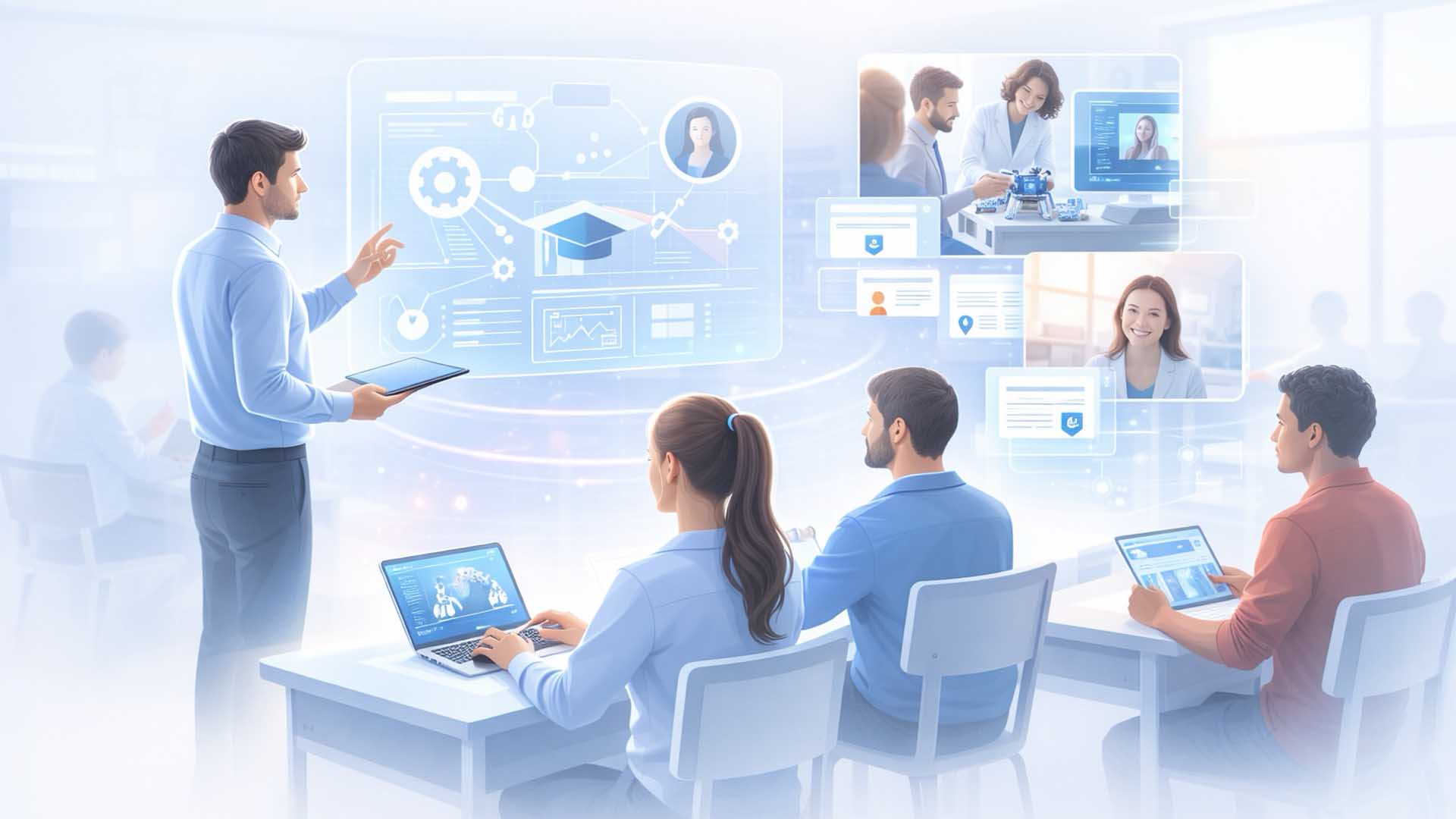
The teacher as learning architect – Technology becomes a tool, the human remains the designer and reference point
Visualization: © Ulrich Buckenlei | Visoric GmbH | Editorial concept image illustrating the shift of the teacher’s role from information delivery to active design of complex learning environments.
The image does not show traditional frontal instruction.
The teacher no longer stands isolated in front of a board. They are positioned at the center of a dynamic learning environment. Digital interfaces, an AI module, a robotics system, and interactive content visually surround them.
What matters is that technology does not dominate.
It aligns itself.
The teacher steers, connects, explains, and structures. Digital systems expand the scope of action, but do not replace it.
Students work actively at their tables. They interact with models, program robotics, analyze data, and discuss content. Learning becomes visible. Not as consumption, but as action.
This depiction illustrates a fundamental shift.
Previously, teaching was often organized linearly:
Teacher → Content → Class.
In an integrated learning architecture, a different pattern emerges:
Teacher at the center → orchestrated learning environment → active learners.
The role changes on several levels.
First, the teacher becomes a curator. They decide which content, tools, and models are meaningfully combined.
Second, they become a moderator. They guide learning processes, ask questions, and create context.
Third, they become an architect. They consciously and strategically design learning spaces. [5][12]
This shift is not a loss of relevance. On the contrary.
The more complex learning environments become, the more important human orientation becomes. AI can analyze data. It can make suggestions. But meaning, judgment, and pedagogical fine-tuning remain human competencies.
This is where the key to transformation lies.
If schools introduce technology without further developing the role of teachers, overload emerges. If teachers are understood as designers of an extended learning environment, empowerment emerges.
The image therefore appears deliberately colorful and dynamic. It does not show a technical system. It shows an attitude.
This leads to the next central question:
How can this new role be concretely supported, qualified, and structurally anchored so that it does not depend on individual motivation, but is systematically fostered?
The next chapter therefore focuses on qualification, professional development, and structural support, and on how transformation can be sustainably anchored in practice.
Qualification as the Foundation – How Transformation Is Anchored in the Long Term
Digital learning architectures do not arise from technology alone. They arise from people who understand, design, and continuously develop them. This is where it is decided whether a vision becomes sustainable practice or remains at the level of a pilot project.
The following visualization shows that professional enablement does not take place on a single level, but must be conceived systematically across multiple layers.
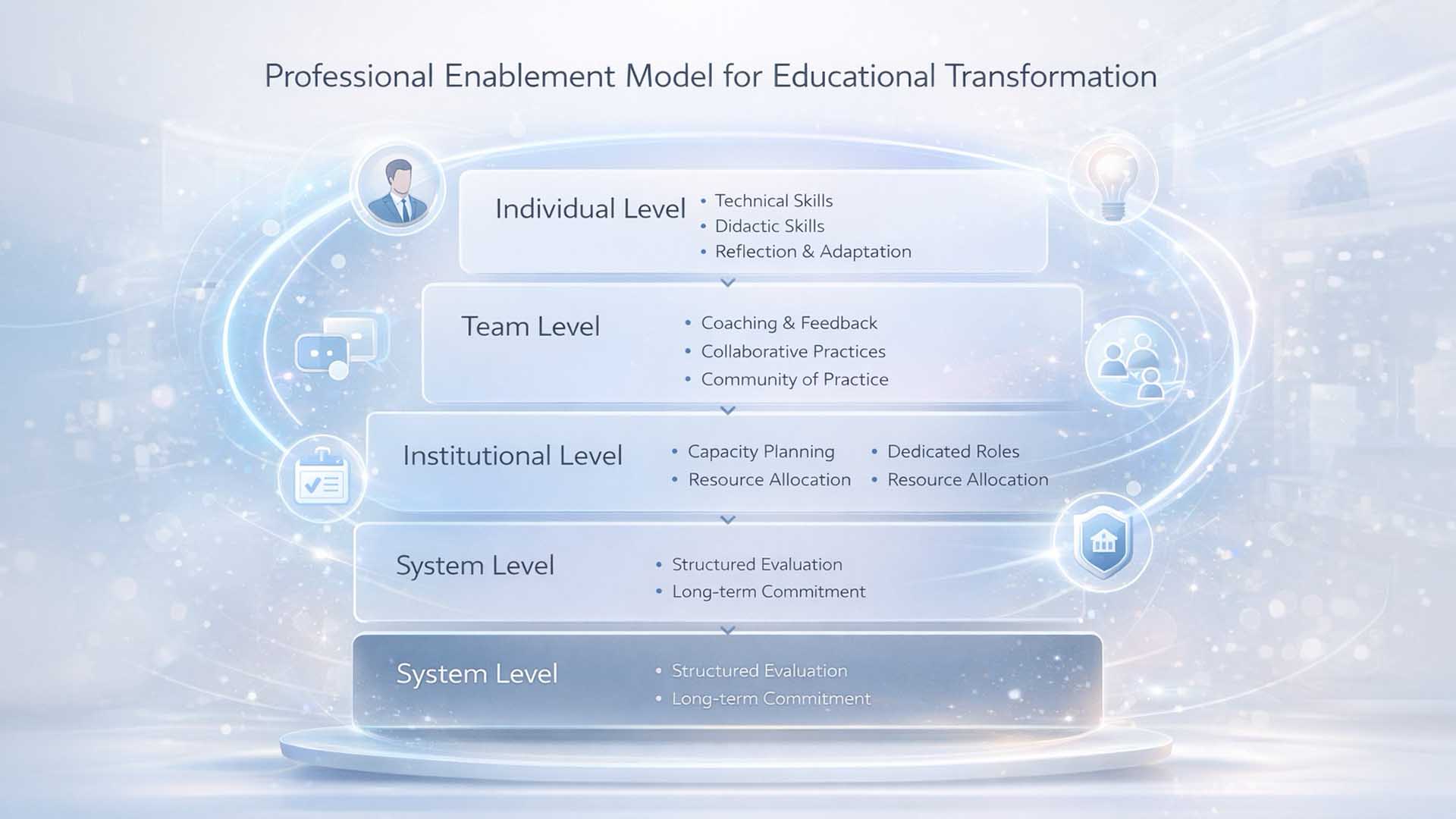
Professional Enablement Model for Educational Transformation
Concept graphic: Multi-layer enablement model for the sustainable anchoring of digital learning architectures | Visualization: Editorial model | © Visoric GmbH
The graphic structures transformation into four sequential layers. Each layer is necessary. None can function in isolation.
1. Individual Level – Competence Begins with the Individual
At the individual level, the focus lies on foundational capabilities that enable confident and reflective use of new technologies.
- Technical skills – confident use of digital tools
- Instructional skills – meaningful integration into learning processes
- Reflection and adaptation – continuous adjustment to new situations
Transformation does not mean that every teacher becomes a programmer. What matters is the ability to use technologies consciously and critically reflect on their impact. Without this personal confidence, uncertainty arises and uncertainty blocks innovation.
2. Team Level – Learning as a Collective Process
Individual committed persons are not enough. Sustainable change emerges only when teams collaborate and learn from one another.
- Coaching and structured feedback
- Collaborative practice formats within the faculty
- Community of practice as a permanent exchange structure
Only when experiences are shared, teaching scenarios are jointly reflected upon, and learning architectures are collaboratively developed further does innovation become normal. Otherwise, new methods remain isolated experiments.
3. Institutional Level – Structure Creates Stability
Even committed teams reach limits if institutional frameworks are missing. Sustainable transformation requires structural backing.
- Capacity planning – time and resources for development
- Dedicated roles – clearly defined responsibilities
- Resource allocation – financial and organizational security
Transformation must not depend on the engagement of individual persons. It must be institutionally anchored. Only then does stability emerge.
4. System Level – Sustainability Through Governance
The highest level considers the education system as a whole. Here it is decided whether change is strategically secured.
- Structured evaluation and continuous data analysis
- Long term strategic commitment
Digital transformation is not a project with an end date. It is a development process. And this process requires clear governance structures.
Overall Conclusion – Why This Model Matters
The visualization makes clear that transformation is not defined by devices or platforms. It arises from the coordinated interplay of individual competence, collective collaboration, institutional structure, and systemic anchoring.
Technology can enable processes.
Architecture can reorganize learning spaces.
But enablement determines whether change has lasting impact.
Only when all four layers interact does a learning architecture emerge that can continue to evolve, independent of individual tools or trends.
In the concluding video, this argument is condensed once more. It demonstrates how AI, virtual worlds, and robotics should not be viewed in isolation, but as part of a new learning architecture that connects technology, structure, and competence.
The video summarizes the core ideas and poses the central question:
If these technologies are already shaping economy and society, how consciously are we designing their role within the education system?
Video Analysis – How AI, Virtual Worlds, and Robotics Merge into a New Learning Architecture
The following video does not present a distant vision of the future, but a possible learning environment that is already technically feasible today. Interactive interfaces, AI-supported orchestration, and real systems interconnect to form an integrated learning architecture.
What becomes visible is not merely a digital classroom. It is an interplay of three layers: an interactive interface, an intelligent control layer, and real physical systems. Content is not only displayed, but dynamically organized. Learning processes are not only accompanied, but analyzed and adaptively structured.[2]
At the center stands the idea of orchestration. Here, AI does not function as a substitute for teachers, but as a supporting coordination instance. It connects virtual simulations, data analyses, and physical robotics systems into a coherent learning environment. Theory does not remain abstract, but becomes tangible through real interaction.[6]
The strategic significance lies less in individual devices than in the architecture behind them. When virtual models, adaptive feedback systems, and real hardware are synchronized, a new quality of learning environment emerges. It enables faster iteration, personalized learning pathways, and immediate feedback loops between digital models and physical application.[8]
At the same time, the video shows that technology alone is not enough. Only in combination with qualified teachers, structural anchoring, and institutional support does technical possibility become sustainable educational innovation, precisely the four layers described in the previous chapter.
Integrated Learning Architecture – AI orchestration between interactive interface, learning metaverse, and real robotics
Demonstration environment: Interactive learning architecture with AI-supported coordination |
Analytical classification: Ulrich Buckenlei |
Credits: Video narrated and edited by tonzo (Instagram)
This example stands as a representative illustration of a possible further development of teaching. It neither replaces teachers nor existing structures. It extends them with a new dimension of linking simulation, analysis, and real-world application.
If AI, virtual worlds, and robotics are already shaping economy and society, the question is no longer whether education should respond, but how consciously and structurally this integration is designed.
In the concluding chapter, this perspective is brought together and placed in a broader strategic context, with a view toward schools, educational providers, and organizations that aim to actively shape transformation.
Sources and References
- UNESCO, “AI and Education: Guidance for Policy-Makers”, 2024.
International guidelines for the responsible integration of artificial intelligence into education systems, focusing on governance, transparency, and ethical frameworks. [1] - OECD, “Digital Education Outlook 2024”, 2024.
Analysis of global developments in digital education, competency requirements, and structural transformation of learning environments. [2] - World Economic Forum, “Future of Jobs Report 2025”, 2025.
Report on future skill requirements, including analytical thinking, technological literacy, and systemic problem solving. [3] - European Commission, “Digital Education Action Plan 2021–2027 – Update 2025”, 2025.
Strategic framework for the digitalization of European education systems, focusing on AI, XR, and innovative learning architectures. [4] - Stanford University – Human-Centered AI Institute, “AI Index Report 2026”, 2026.
Current data analysis on the diffusion and performance development of AI systems in economy, society, and education. [5] - McKinsey & Company, “The State of AI in 2025”, 2025.
Study on AI implementation in organizations, including the education sector and public institutions. [6] - OECD, “PISA Global Competence Framework – Update”, 2024.
Framework for assessing systemic, digital, and intercultural competencies in educational contexts. [7] - World Bank, “Education Technology and Learning Recovery”, 2024.
Study on the role of digital tools in sustainable educational development. [8] - MIT Media Lab, “AI as Learning Companion Research Series”, 2025.
Research on AI-supported assistance systems as adaptive learning companions in the classroom. [9] - Apple Inc., “Apple Vision Pro in Education – Spatial Learning Environments”, 2025.
Presentation of immersive learning environments using spatial computing and mixed reality in education. [10] - Meta, “Immersive Learning and Classroom XR Study”, 2024.
Study on the impact of immersive XR technologies on learning motivation and knowledge retention. [11] - IEEE Robotics & Automation Society, “Educational Robotics Review 2025”, 2025.
Overview of robotics-based learning concepts and their impact on problem solving and systems competence. [12] - World Robotics Report, International Federation of Robotics, 2025.
Current market data on the diffusion of robotics systems and their use in education and training environments. [13] - Harvard Graduate School of Education, “Teaching in the Age of AI”, 2024.
Analysis of instructional adaptation strategies for AI-supported learning environments. [14] - W3C, “WebXR Device API – Snapshot 2025”, 2025.
Technical specification for integrating virtual and augmented reality devices into web-based applications. [15] - W3C, “WebGPU – Candidate Recommendation Snapshot”, 2026.
Modern GPU and compute interface for high-performance 3D and simulation rendering directly in the browser. [16] - ISO, “ISO 23247-1: Digital Twin Framework for Manufacturing”, 2021.
International standard for structuring digital twins, transferable to education-related model architectures. [17] - Plattform Industrie 4.0, “Digital Twin – Interoperability and Standardization”, 2024.
Position paper on standardization of networked systems and interoperable architectures. [18] - EdTech Europe, “Learning Metaverse Report 2025”, 2025.
Analysis of the integration of immersive, metaverse-based learning environments in schools and universities. [19] - Brookings Institution, “AI, Automation and the Future of Learning”, 2024.
Policy and education analysis on the long term impact of AI and automation on learning structures. [20]
Shaping Transformation Means Taking Responsibility
The integration of AI, virtual worlds, and robotics into educational processes is not a question of individual tools. It is a structural decision. As soon as learning architectures are digitally extended, role models, organizational logics, and instructional concepts change.
The decisive question is therefore not whether technology is available. What matters is how it is meaningfully embedded. Which learning objectives should be supported. Which competencies are central. Which organizational prerequisites must be created. And how sustainable added value can emerge for learners, teachers, and institutions.
Anyone who wants to rethink teaching needs more than devices or platforms. It requires a clean end-to-end perspective. From analyzing suitable use cases, designing a viable learning architecture, evaluating technological options, defining organizational roles, to structured piloting and evaluation.
At precisely this interface, we work as an interdisciplinary expert team in Munich. We support schools, educational providers, public institutions, and companies in strategically classifying new technologies. We develop viable concepts for digital learning architectures, assess feasibility and impact, and support implementation not as isolated showcases, but as resilient structures.

Interdisciplinary concept work – Analysis, architecture, and strategic support for digital learning transformation
Source: VISORIC GmbH | Munich
- Strategic analysis → Evaluation of potentials and realistic use cases
- Architecture development → Design of integrated learning and technology models
- Piloting → Structured testing under real conditions
- Evaluation → Measurement of impact, acceptance, and scalability
- Organizational development → Roles, processes, and governance structures
- Long term support → Sustainable anchoring in practice and system
If you would like to assess how teaching, training, or corporate learning processes can be systematically developed further, it is worth taking a joint look at your starting situation.
Not as a sales presentation, but as an analytical discussion about where digital extension is pedagogically meaningful, organizationally viable, and sustainable in the long term.
Transformation does not begin with technology.
It begins with a clear architecture and the willingness to consciously design it.
Contact Us:
Email: info@xrstager.com
Phone: +49 89 21552678
Contact Persons:
Ulrich Buckenlei (Creative Director)
Mobil +49 152 53532871
Mail: ulrich.buckenlei@xrstager.com
Nataliya Daniltseva (Projekt Manager)
Mobil + 49 176 72805705
Mail: nataliya.daniltseva@xrstager.com
Address:
VISORIC GmbH
Bayerstraße 13
D-80335 Munich