
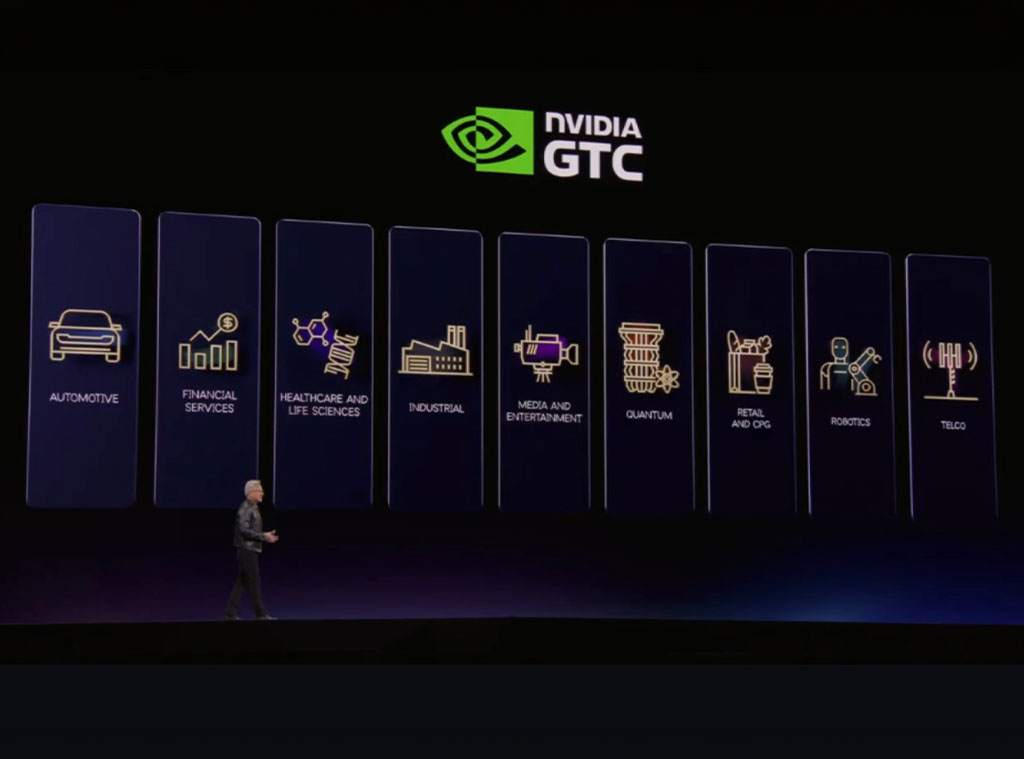
NVIDIA GTC 2026. From AI as Software to AI as Infrastructure
Visual: Keynote by NVIDIA CEO Jensen Huang at GTC 2026 | Source: NVIDIA Keynote Video | Analytical classification: Ulrich Buckenlei | XR Stager Newsroom Online Magazine
The NVIDIA AI conference GTC 2026, which took place from March 16 to 19 in San José, has ended, but the significance of the keynote extends far beyond the event itself. What became visible this year was not a classic technological leap, but a fundamental shift in the role of artificial intelligence. Systems are evolving from reactive tools into operational infrastructures. AI is moving closer to real processes, machines, and production systems. Simulation, data, and models are increasingly merging into a continuous execution layer.
This is precisely where the core message of this year’s GTC lies. The time when artificial intelligence was primarily understood as an analytical tool is coming to an end. Data centers, digital twins, and AI models are developing into systems that not only evaluate data, but also assess situations, prepare decisions, and act autonomously within defined contexts.
For industries such as manufacturing, logistics, energy, healthcare, and digital services, this creates a new technological foundation. Competitiveness is no longer determined by the mere availability of data, but by the ability to turn it into actionable intelligence in real time. This shift marks the transition from software to infrastructure and signals a new phase of industrial systems.
From Software to Intelligent Infrastructure
For many years, artificial intelligence was understood as an extension of existing software. Systems analyzed data, supported decisions, and provided forecasts. This logic still applies today, but reaches its limits where processes must not only be understood, but continuously and economically controlled at scale.
Especially in industrial contexts, it is no longer enough for AI to simply work. What matters is how efficiently it operates, how much computing power it requires, and what the cost per decision or inference is. This is where the role of AI fundamentally changes. It is no longer seen merely as a function, but as infrastructure whose economic efficiency becomes a central factor.
This shift is particularly evident in the current NVIDIA GTC keynote. The focus is no longer solely on increasing performance, but on the relationship between performance and cost. Systems are designed to generate more intelligence per unit of energy and per dollar invested. This creates a new scaling logic defined not only technically, but above all economically.
This development is especially visible in three key changes:
- AI is not only becoming more powerful, but also more cost-efficient per inference
- Data centers are evolving into production facilities for intelligence
- Competition is driven by the ratio of performance to cost, not just absolute performance
This shifts the focus from individual models to entire system architectures. Success is no longer determined by isolated AI models, but by the ability to efficiently generate, scale, and integrate intelligence into real-world processes. Infrastructure itself becomes the carrier of intelligence.
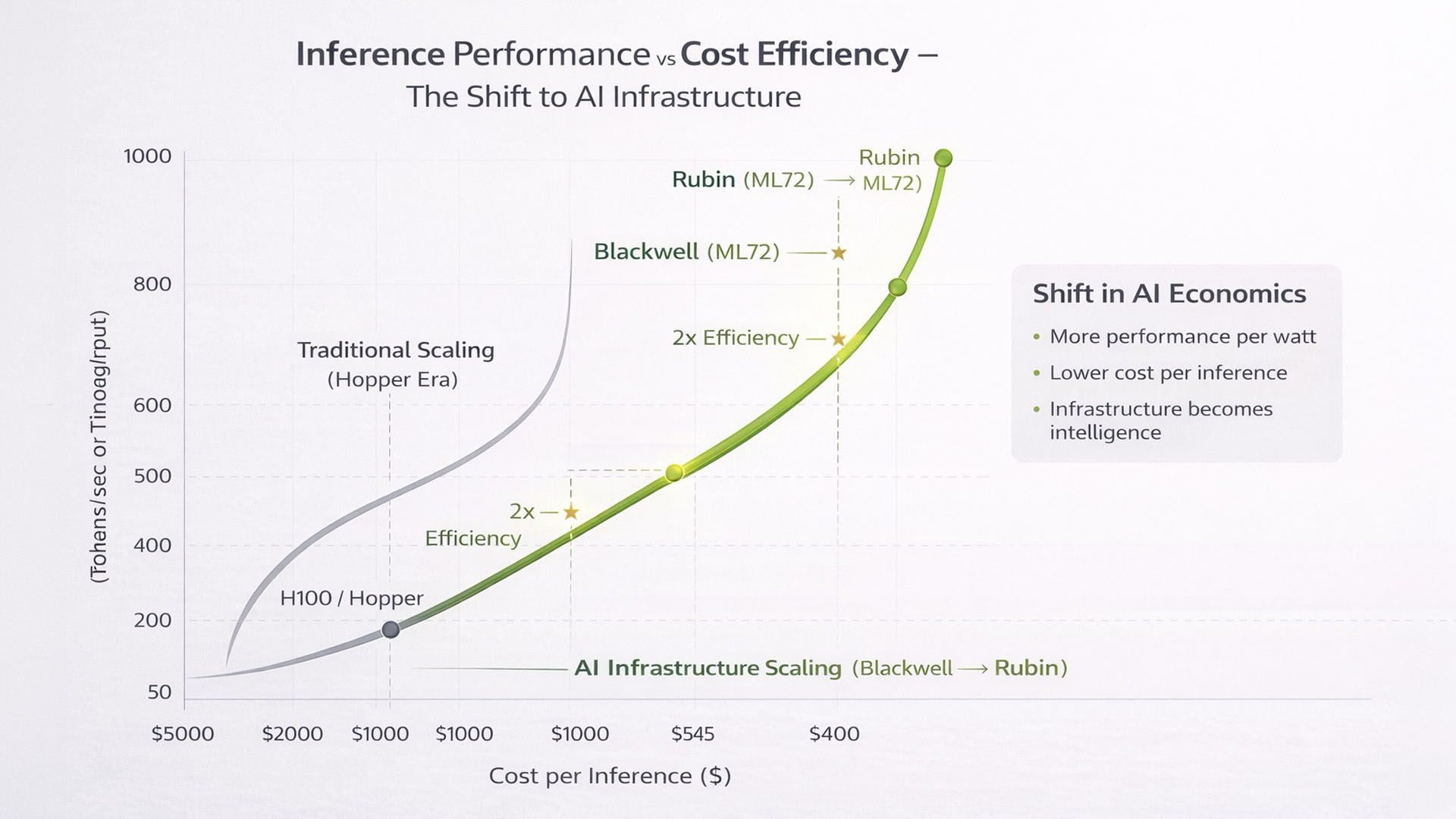
Inference Performance vs Cost Efficiency, illustrating how AI scaling logic is shifting toward infrastructure
Graphic: Based on NVIDIA GTC 2026 Keynote | Analytical classification: Ulrich Buckenlei | XR Stager Newsroom Online Magazine
The graphic shows a central shift in the development of AI systems. While in the so called Hopper era, performance gains were mainly achieved through classical scaling, a new relationship is now coming into focus. Performance no longer grows in isolation, but in direct relation to decreasing costs per inference.
The development from Blackwell to Rubin demonstrates that efficiency is partly doubling while costs are decreasing at the same time. This creates a new economic dynamic. Higher performance at lower cost enables AI to be integrated across entire systems rather than used selectively.
This is the key point. Infrastructure is no longer just a technical foundation, but an active part of value creation. It generates intelligence in real time and makes it economically usable. This marks the beginning of a new phase in which AI is no longer a tool, but a fundamental industrial infrastructure.
From Data Centers to AI Factories
At the center of current developments is no longer the individual AI model, but the structure in which it operates. Data centers are fundamentally changing their role. They are no longer just places for processing data, but are evolving into production systems for intelligence.
This distinction is crucial. While traditional IT infrastructure was designed to store and process data, a new system logic is emerging. Data is continuously fed into systems, models compute states in real time, and directly usable decisions are generated. The output is no longer information, but action.
This logic is described in the NVIDIA GTC keynote as the next stage of evolution. The concept of the AI Factory refers to an infrastructure in which intelligence is not only used, but systematically produced. Computing power becomes comparable to industrial production capacity. The more efficiently these systems operate, the more intelligence can be generated.
Three structural characteristics are particularly important:
- Data centers become scalable production systems for decisions
- Models, simulation, and data merge into a continuous execution layer
- The output shifts from data to automated processes and system control
This development changes not only technology, but also value creation. Companies no longer produce only physical goods or digital services. They increasingly produce intelligence as an independent production factor that optimizes processes, controls systems, and prepares decisions.
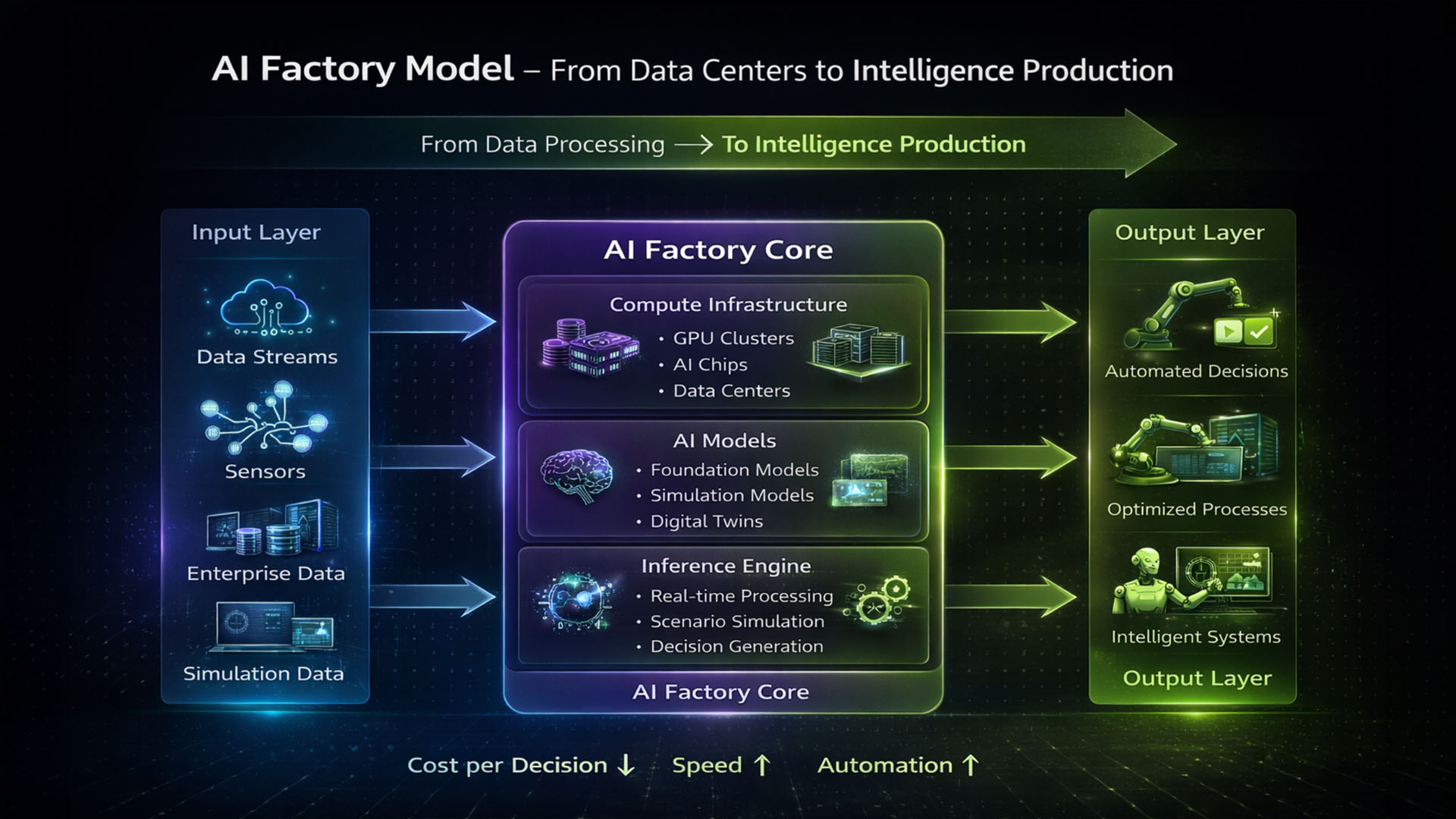
AI Factory Model, showing how data centers become production systems for intelligence
Graphic: Editorial analysis based on NVIDIA GTC 2026 | Visualization: © Ulrich Buckenlei | XR Stager Newsroom Online Magazine
The graphic presents this transformation as a clear flow. On the left are the input streams. Data from sensors, enterprise systems, and simulations form the foundation. In the center, the AI Factory emerges, where computing infrastructure, models, and inference systems operate as an integrated unit.
The key element is the inference engine. It connects data and models into a continuous process where states are calculated, scenarios are simulated, and decisions are generated. This process is not occasional, but ongoing. Intelligence becomes a continuous production process.
On the right, the outcome becomes visible. Automated decisions, optimized processes, and intelligent systems are not the result of isolated calculations, but of a stable infrastructure. This is where the role of AI fundamentally shifts from a tool to the foundation of industrial systems.
This creates a new understanding of technology. Progress is no longer driven by individual applications, but by the ability to continuously, efficiently, and scalably produce intelligence.
Reality Becomes Simulation
The true strength of modern AI systems no longer lies solely in analyzing data, but in their ability to represent real systems as dynamic processes. Machines, factories, and infrastructures are not just observed, but continuously mirrored, simulated, and evolved digitally.
This marks a fundamental shift. Systems no longer simply react to events, but begin to anticipate future states. Data from the physical world flows into digital models, is translated into scenarios, and forms the basis for decisions that influence physical processes.
For industrial applications, this relationship is critical. Many processes are complex, time sensitive, and not directly visible. Traditional control systems react to defined inputs. The new approach goes further. Systems understand their environment, simulate possible developments, and continuously optimize their behavior.
An intelligent loop makes this dynamic visible. Physical systems, data capture, simulation, and AI decision making are no longer separate. They merge into a continuous structure where learning, testing, and acting happen simultaneously.
This logic creates several key advantages:
- Real systems are continuously analyzed and improved through digital twins
- Simulation allows scenarios to be tested without risk before implementation
- AI continuously generates optimized decisions and control signals
This connection between physical reality and digital simulation fundamentally changes the role of technology. It is no longer just about operating systems, but about actively understanding, anticipating, and continuously optimizing them.
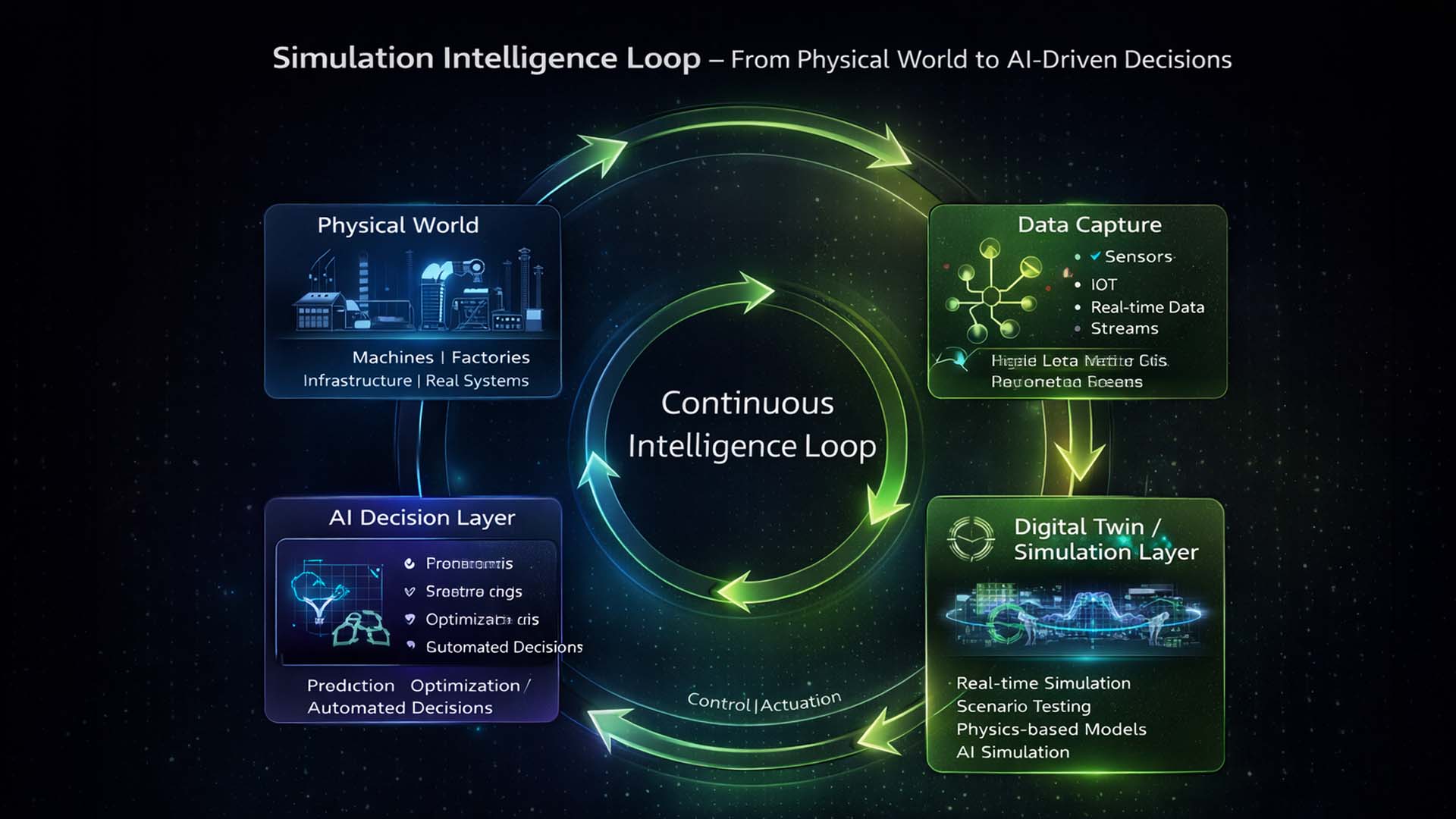
Simulation Intelligence Loop, showing how real systems are continuously optimized through digital twins and AI
Graphic: Editorial analysis based on NVIDIA GTC 2026 | Visualization: © Ulrich Buckenlei | XR Stager Newsroom Online Magazine
The graphic illustrates this development as a closed feedback loop. It begins with the physical world of machines, factories, and infrastructures. Sensors and data streams capture states in real time and transfer them into the digital layer.
There, the digital twin is created. In this simulation layer, real states are not only represented, but actively computed. Scenarios can be tested, processes analyzed, and future developments modeled.
On this basis, the AI decision layer operates. It uses simulated data to generate predictions, optimize processes, and derive automated decisions. These decisions feed back into the physical world and close the loop.
At its core, this structure represents a new industrial reality. Systems are no longer just controlled, but continuously understood and improved. This is where the transition from digital representation to operational intelligence takes place.
When Intelligence Enters the Physical World
Perhaps the most important message of NVIDIA GTC 2026 is no longer about training models or processing data. It is about the moment when artificial intelligence begins to actively act in the real world. This transition is becoming increasingly visible. Intelligence no longer remains in data centers, but becomes part of machines, systems, and operational processes.
The graphic clearly illustrates this shift. On the left are classical AI systems consisting of models, simulations, and decision logic. In the center, a new control layer emerges, where decisions are processed in real time and translated into concrete actions. Only at this stage does computed intelligence become actionable technology.
For industrial applications, this step is critical. Real value is created only when decisions directly influence physical processes. Production lines adapt dynamically, robots respond to changing conditions, and autonomous systems make decisions without delay.
This development can be summarized in three key changes:
- Intelligence moves from analysis to direct real time action
- Machines and systems become increasingly autonomous and adaptive
- Human AI collaboration becomes the new standard
This combination fundamentally transforms industrial value creation. Decisions are no longer just prepared, but executed directly. This leads to new speeds, new efficiency potentials, and entirely new forms of automation.
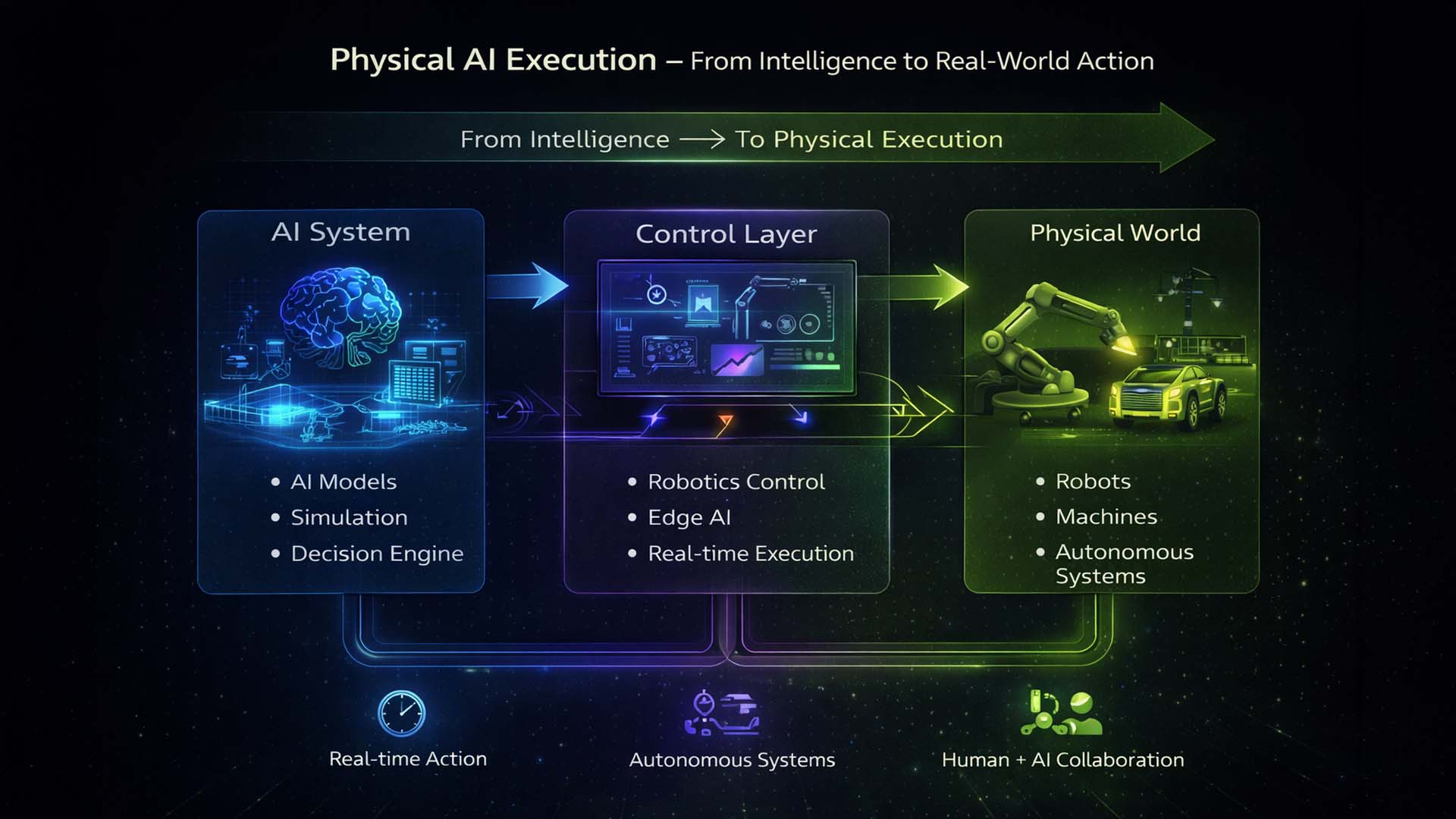
Physical AI Execution shows how artificial intelligence transitions from computation to real world action in machines and systems
Graphic: Editorial analysis based on NVIDIA GTC 2026 | Visualization: © Ulrich Buckenlei | XR Stager Newsroom Online Magazine
At its core, this development represents nothing less than the next evolutionary step of industry. Systems no longer just think, they act. The role of technology fundamentally changes. Software becomes infrastructure. And infrastructure becomes an active part of the real world.
AI Becomes Strategic Infrastructure
With NVIDIA GTC 2026, a shift in perspective becomes visible that goes far beyond technology. Artificial intelligence is evolving from a tool for individual applications into a foundational infrastructure that transforms entire business models. This transformation is clearly illustrated in the current visualization. Intelligence is no longer isolated, but embedded in real value chains.
Companies now face a new starting point. Decisions are no longer created exclusively in traditional systems or through manual analysis. They are generated in real time, evaluated, and increasingly executed automatically. This shifts the focus from pure digitization to the active, intelligent control of processes.
The image shows this transition clearly. On the left, new forms of analysis and prediction emerge from data and models. In the center, an operational control layer prepares and accelerates decisions. On the right, the actual impact unfolds. Machines, systems, and entire infrastructures react dynamically and generate measurable economic value.
Three key developments arise for companies:
- Decision processes become significantly faster and data driven
- Operational costs decrease through automation and optimization
- New business models emerge based on intelligent systems
This combination makes the current transformation so relevant. The question is no longer whether AI is used, but how deeply it is integrated into existing processes. Companies that start early benefit from scale effects and clear competitive advantages.
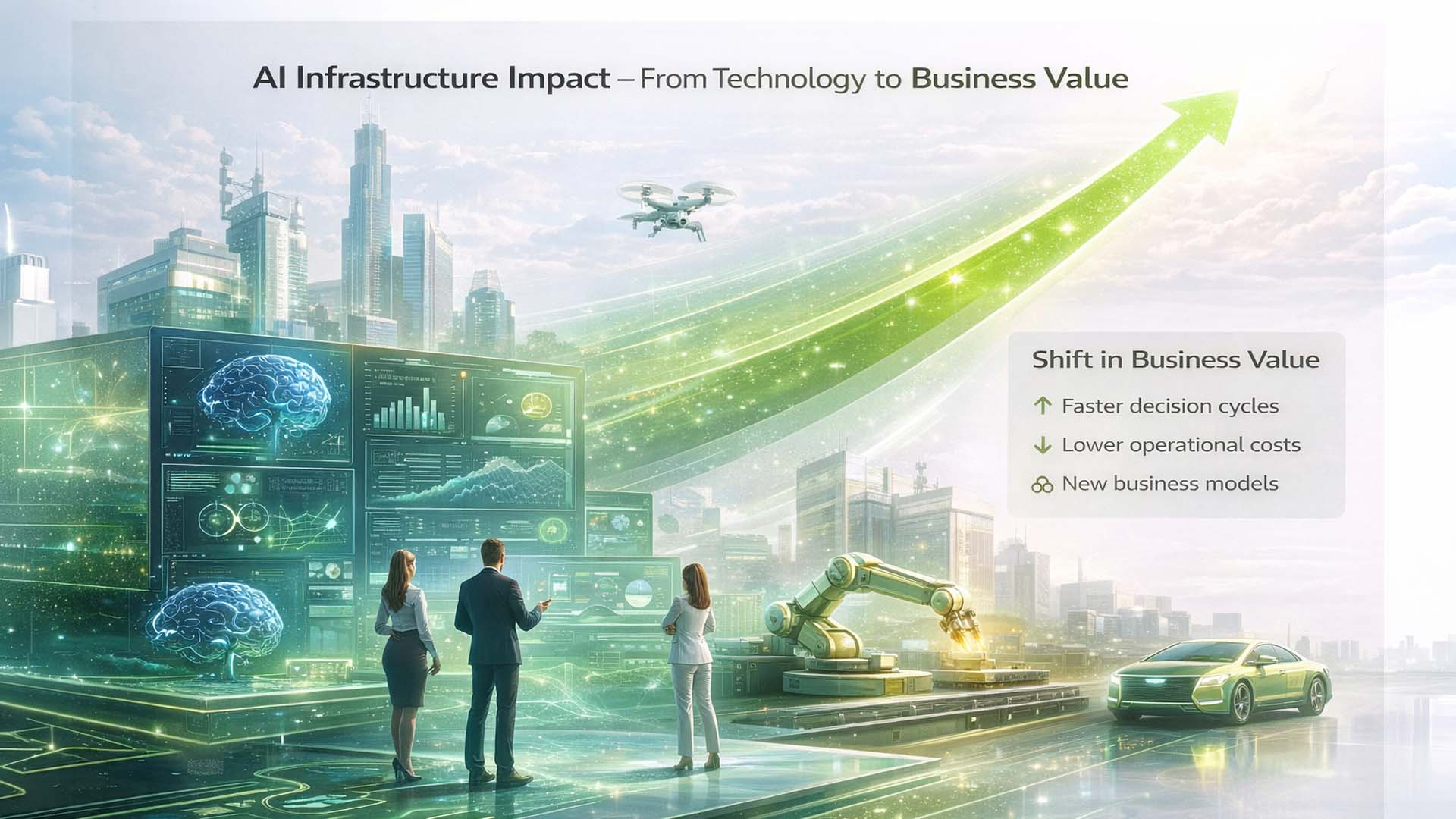
The transformation of AI into infrastructure creates new forms of efficiency, speed, and economic value
Graphic: Editorial analysis based on NVIDIA GTC 2026 | Visualization: © Ulrich Buckenlei | XR Stager Newsroom Online Magazine
At its core, this development marks the beginning of a new industrial phase. Technology is no longer just applied, but actively shapes processes, decisions, and outcomes. Those who understand and leverage this shift will not only work more efficiently, but also unlock new potentials that were previously unreachable.
Implement AI Infrastructure Now
NVIDIA GTC 2026 clearly shows the direction in which industry, software, and computing infrastructure are evolving. Artificial intelligence is no longer understood as an additional feature. It is becoming an operational foundation on which decisions, simulations, automation, and physical systems are increasingly built.
For companies, the question is no longer whether AI is relevant. What matters is how this development can be translated into concrete projects. Where meaningful entry points exist. Which data and models are already available. Which processes are suitable for digital twins, real time simulation, or AI driven control. And how a viable business case can be developed from this.
This is where practical work begins. Many companies are not looking for generic AI promises, but for concrete services that combine strategic relevance with technical feasibility. These primarily include:
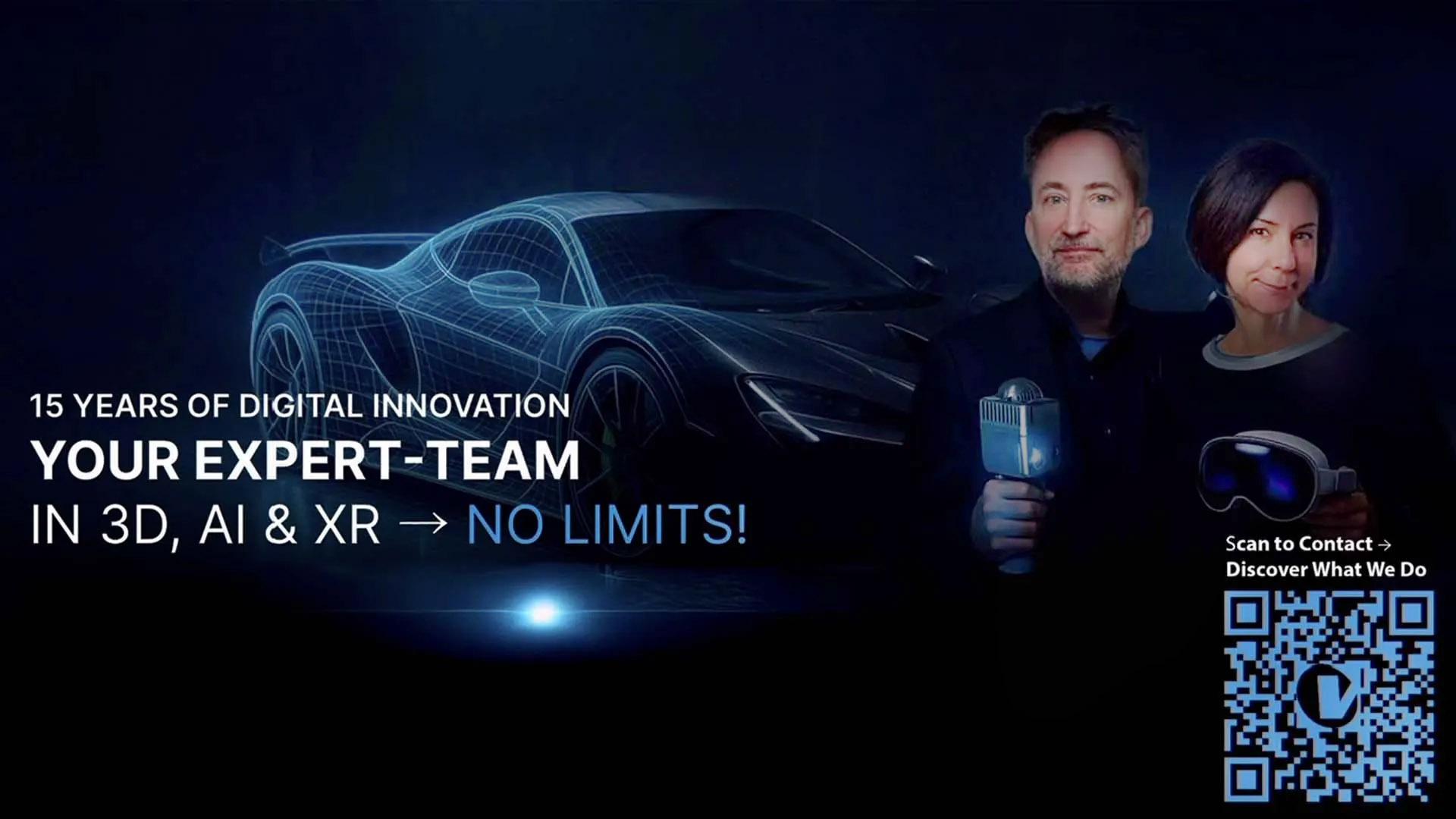
The VISORIC expert team from Munich develops practical AI, digital twin, and simulation solutions for industrial companies
Source: VISORIC GmbH | Munich
- AI Infrastructure Consulting → From use case to scalable AI strategy
- Digital Twins → Making real systems usable as intelligent simulated models
- Real Time Simulation → Testing, optimizing, and validating decisions in real time
- CAD to Experience Pipelines → Transforming technical data into 3D, XR, and simulation systems
- Physical AI & Robotics → Integrating intelligence directly into machines and processes
- XR & Spatial Interfaces → Making complex systems understandable, experiential, and controllable
- Proof of Concept → Rapidly validating what works technologically and economically
- Showcases & Demonstrators → Making innovation visible and convincing decision makers
VISORIC operates exactly at the point where technology becomes real implementation. We combine strategy, simulation, and experience into concrete projects that deliver measurable value.
If you want to understand where AI creates real impact in your company and how to turn it into an executable project, talk to the VISORIC expert team in Munich.
No standard pitch, but a clear view of your data, your processes, and the next meaningful steps.
Contact Us:
Email: info@xrstager.com
Phone: +49 89 21552678
Contact Persons:
Ulrich Buckenlei (Creative Director)
Mobil +49 152 53532871
Mail: ulrich.buckenlei@xrstager.com
Nataliya Daniltseva (Projekt Manager)
Mobil + 49 176 72805705
Mail: nataliya.daniltseva@xrstager.com
Address:
VISORIC GmbH
Bayerstraße 13
D-80335 Munich