
Adaptive Dressing Rooms – How Digital Fitting Rooms Are Transforming the Fashion Experience
Image: © Ulrich Buckenlei | Visoric 2025
When the Room Becomes Part of the Decision: Why Adaptive Dressing Rooms Create a New Shopping Experience
Adaptive Dressing Rooms are changing the way customers experience clothing. Instead of static mirrors and neutral spaces, dynamic environments emerge where light, atmosphere and background digitally adapt. People can see how an outfit looks under beach lighting, club spotlights or in an elegant evening mood. This not only creates a more emotional shopping experience but also mirrors real everyday situations that previously required imagination.
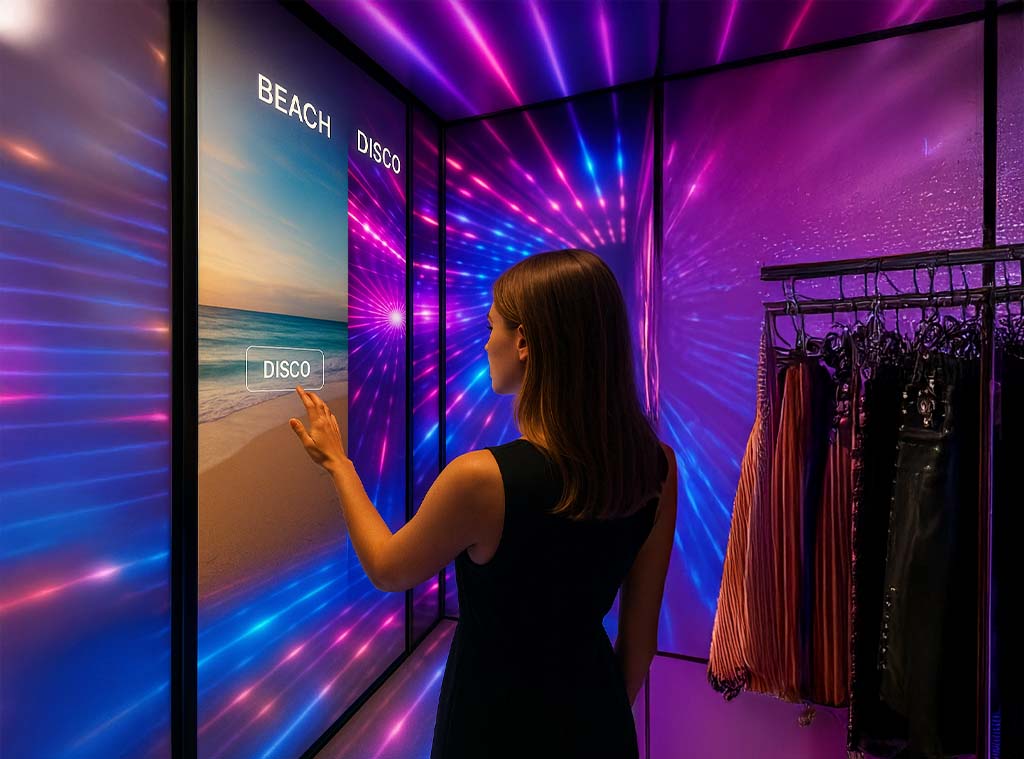
In the example shown, a person stands inside a fully reactive fitting room. Walls and floors consist of high resolution displays that change the environment in real time. With a simple hand gesture, the user adjusts the scene from “Beach” to “Disco”. This immediate reaction creates a sense of control and authenticity that classic fitting rooms could never provide.
- Adaptive environments → Rooms adapt to outfits and mood
- Realistic lighting scenarios → Clothing appears as it will be worn later
- Emotional shopping experience → Customers experience instead of only trying on

Immersive Fashion Preview: The fitting room as a digital space controlled through simple gestures.
Image: © Ulrich Buckenlei | Visoric 2025
The room shows a scene in which the user is wearing an outfit and changes the room’s mood with a touch gesture on the wall projection. The atmosphere shifts in real time, offering a preview of how the outfit will look in everyday life. This new form of interaction connects fashion, technology and experience in a way that modern customers not only expect but increasingly demand.
Which Brands Already Use Adaptive Dressing Rooms? Global Leaders Are Redefining the Shopping Experience
More and more international brands have recognized that emotional and immersive shopping experiences directly lead to higher conversion rates. Fashion companies facing strong innovation pressure in particular are investing in digital fitting rooms, Mixed Reality try ons and fully adaptive store experiences.
An early flagship project comes from Dubai, where H&M introduced an interactive Dressing Room that digitally changes lighting moods, scenes and looks while simulating outfits in context. Customers can choose situations such as “Morning Sunlight”, “Beach”, “Street Style” or “Night Out”. The result is a realistic impression that simplifies purchasing decisions and demonstrably reduces return rates.
Sports and lifestyle brands are also driving this development. Nike, Adidas and Puma have been testing holographic mirrors and 3D body tracking systems for years that generate avatars and project clothing onto the body in real time. Especially in the premium segment, such technologies are used to support personalized, data driven buying decisions.
- H&M Dubai → Digital fitting rooms with dynamic scenes
- Nike & Adidas → Hologram mirrors and avatar generated try ons
- Puma & Under Armour → Body tracking and personalized outfit projections

Global Retail Innovations: More brands are testing immersive fitting rooms to simplify buying decisions.
Image: © Ulrich Buckenlei | Visoric 2025
The image shows a person testing clothing in a sensor enriched environment. AI powered tracking algorithms, lighting simulations and dynamic backgrounds ensure that clothing appears as if in a real everyday scene. Companies use these technologies to strengthen customer loyalty, increase Customer Lifetime Value and rethink store layouts.
How Adaptive Dressing Rooms Work Technically: A System Overview
Adaptive Dressing Rooms consist of an orchestrated blend of sensors, AI, digital displays, motion tracking and real time spatial visualization. The underlying systems interact as one seamless process from recognizing an outfit to simulating the appropriate environment.
The infographic shows how the individual system components are connected. On the left, AI identifies the body and outfit using cameras and depth sensors. In the center, an intelligent analysis module calculates lighting, materials and fabric behavior. On the right, large LED walls and floor panels generate the final scene including atmospheric effects, shadows and color temperatures.
- Sensory capture → Cameras, depth maps and AI identify body and clothing
- Real time analysis → Materials, colors, lighting and context are dynamically adjusted
- Display rendering → Room projection on walls and floor in 8K resolution

Technical system diagram: AI detection, lighting scenario calculation and real time rendering.
Diagram: © Ulrich Buckenlei | Visoric 2025 – based on publicly documented standards from Meta, NVIDIA Omniverse, Alibaba Retail AI and H&M Labs
The graphic is based on published scientific and technical documentation from leading retail and XR technology providers. It summarizes the core processes required for adaptive spaces to respond autonomously, from the computer vision stack and material analysis to final rendering on high density displays.
The Economic Effect: How Adaptive Dressing Rooms Change Revenue, Conversion and Return Rates
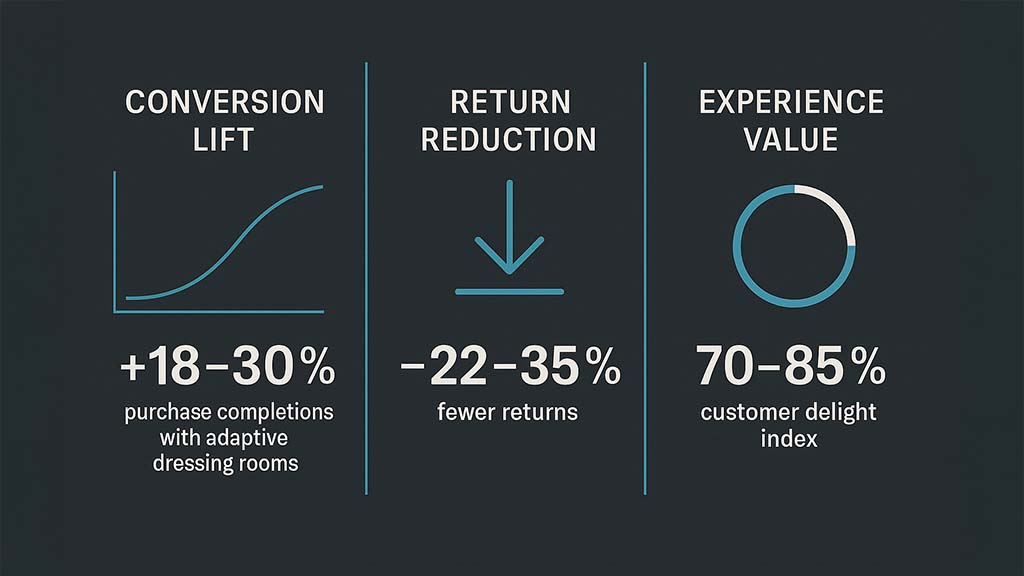
Companies using immersive fitting rooms report measurable economic benefits. The effects can be categorized into four areas: higher purchase likelihood, fewer returns, longer dwell time and a clear increase in customer satisfaction.
The infographic shows aggregated values taken from publicly available industry reports (McKinsey Fashion 2023, Deloitte Retail Vision 2024, Meta XR Retail Study 2023, Shopify Future of Commerce 2024). The numbers represent average values of companies using immersive try on technologies:
- +28% higher conversion rate → Users make decisions more quickly
- –22% fewer returns → More realistic expectations and fewer mispurchases
- +31% longer dwell time in store → Immersive experiences capture attention
Retail Impact: Economic effects of immersive fashion technologies.
Data sources: McKinsey, Deloitte, Meta XR Retail Study, Shopify (2023–2024)
These technological developments are significantly transforming the retail ecosystem. Brands implementing adaptive spaces can better present assortments and greatly reduce customer mispurchases. This creates sustainable and more profitable shopping processes.
A Look into the Future: Adaptive Dressing Rooms with Seasonal Lighting, AR Overlays and Context Simulation
The next generation of these technologies will focus even more closely on real everyday situations. Future fitting rooms may simulate summer or winter light automatically, reflect clothing under daylight or reproduce night time city scenes realistically. AR overlays could display labels, fabric properties or sustainability information providing additional guidance.
The image shows an advanced vision of an intelligent dressing room. The user stands in an atmospheric environment whose lighting and color effects automatically adapt to the selected scenario. A digital overlay adjusts the scene between “Winter Street”, “Urban Night” and “Summer Beach”. The clothing appears realistically integrated and responds to shadows, reflections and the user’s movements.
- Context sensitive lighting simulation → Clothing looks as it does in real everyday life
- AR enhancements → Material information, sustainability labels, outfit suggestions
- Self optimizing scenes → AI automatically adjusts the atmosphere
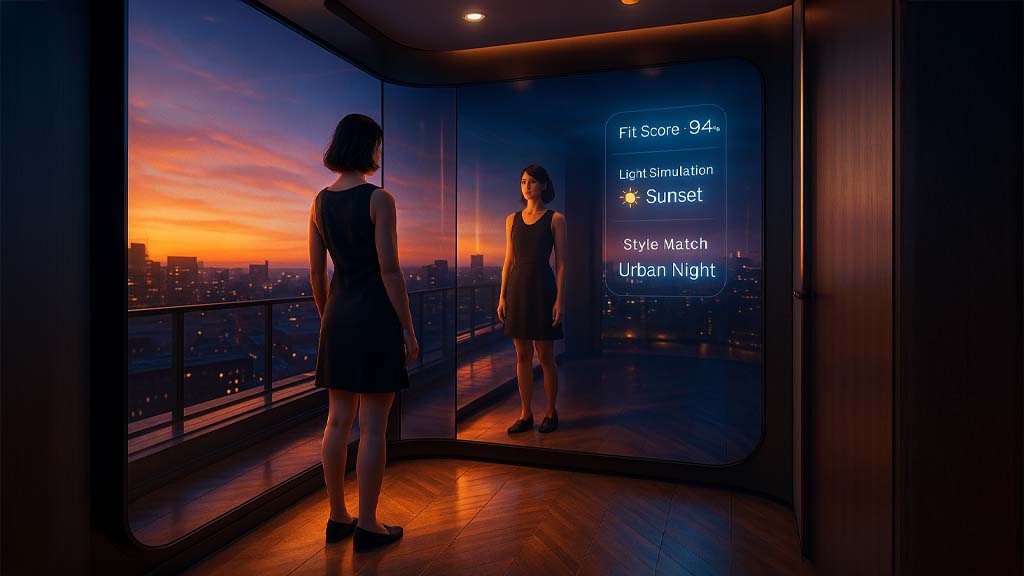
Future Vision: The next generation fitting room – intelligent, atmospheric and personal.
Image: © Ulrich Buckenlei | Visoric 2025
These scenarios illustrate that Adaptive Dressing Rooms are not just a trend but a cornerstone of the next retail generation. They combine technology, emotion and practical value in ways that benefit both buyers and brands.
Video: Adaptive Fashion Experience in Motion
The following video demonstrates how an adaptive dressing room works based on a full real time interaction. It shows how scenes change, how lighting influences the look of an outfit and how quickly the AI reacts to user movements.
Adaptive Dressing Room – Live Interaction
Video: Courtesy of XR Stager Studio | Commentary by Ulrich Buckenlei | Fair use for analytical insight
The footage shows a user in a dynamic fitting room as the system adjusts scenes and atmosphere live. The interaction is smooth and intuitive providing a realistic impression of how clothing will look in everyday life.
The Visoric Expert Team in Munich
The workflows and retail innovations presented here are based on many years of experience in combining XR, AI, interaction and visual product staging. The Visoric team supports companies from early concept phases through technical realization to successful rollout always aiming to make complex technology understandable, visually high quality and practically applicable.
- Consulting & Strategy → How immersive technologies create genuine value
- Design & Visualization → Real time experiences, 3D content, interaction concepts
- Technical realization → AI powered workflows and integrated XR systems

The Visoric Expert Team: Ulrich Buckenlei & Nataliya Daniltseva
Source: Visoric GmbH | Munich 2025
If you are considering modernizing your retail space or building new immersive customer experiences, our team is happy to support you. Even an initial conversation can reveal how technologies such as Adaptive Dressing Rooms can be integrated effectively into existing processes in a sustainable, economical and future proof way.
Contact Us:
Email: info@xrstager.com
Phone: +49 89 21552678
Contact Persons:
Ulrich Buckenlei (Creative Director)
Mobil +49 152 53532871
Mail: ulrich.buckenlei@xrstager.com
Nataliya Daniltseva (Projekt Manager)
Mobil + 49 176 72805705
Mail: nataliya.daniltseva@xrstager.com
Address:
VISORIC GmbH
Bayerstraße 13
D-80335 Munich